


AI Agent Rollouts Will Reach Supervised Recurring Operations Before Full Automation: Notes as of June 17, 2026
The clearest AI trend for operators as of June 17, 2026 is not full autonomy. It is the move toward supervised recurring operations. Companies are learning that the first scalable value from AI agents often comes from having them prepare work repeatedly, under human review, with visible evidence trails.
That pattern shows up clearly in the latest product direction from OpenAI and Anthropic. OpenAI introduced Codex on May 16, 2025 as a cloud software engineering agent that can work on many tasks in parallel, run in isolated environments, and return verifiable evidence such as terminal logs and test outputs. Anthropic followed on May 22, 2025 with Claude 4 and the general availability of Claude Code, highlighting background tasks through GitHub Actions, IDE integrations, and stronger support for agent workflows. Claude Code’s live documentation now goes further and explicitly describes scheduled routines, background agents, and multi-agent execution.
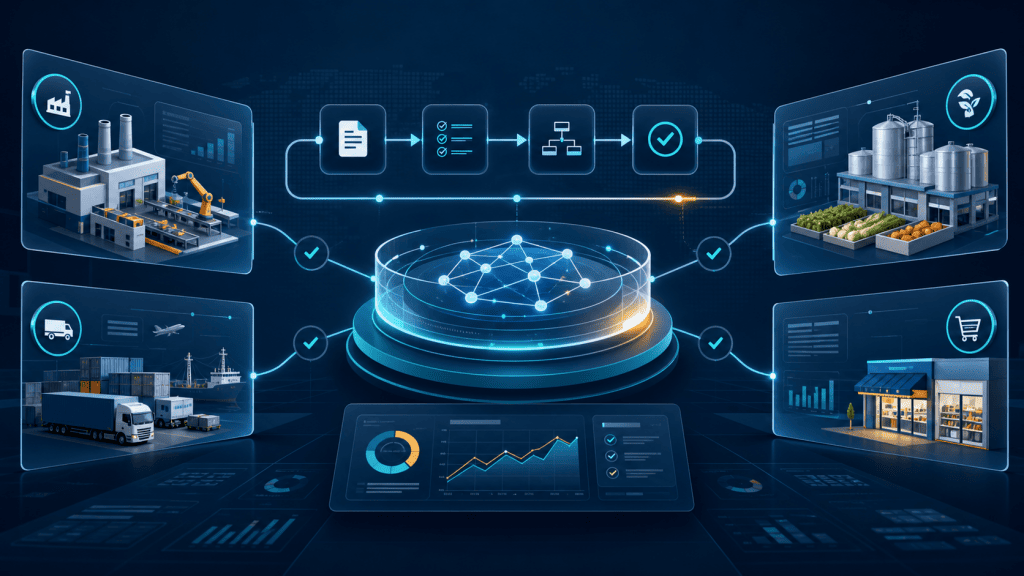
This matters well beyond software teams. In manufacturing, logistics, food, and retail, the practical question is no longer whether AI can produce a smart answer on demand. The question is which recurring work AI should prepare every day or every week before a human makes the final call.
The Main Decision Is No Longer Model Selection Alone
Until recently, enterprise AI programs were often built around summarization, translation, internal Q&A, document drafting, and faster search. Those use cases still matter. But the direction of travel has changed. AI is now being connected to tools, asked to follow several steps, and expected to return structured outputs on a repeating cadence.
Stanford HAI’s 2025 AI Index reports that 78% of organizations said they used AI in 2024, up from 55% the year before. Adoption is no longer the difficult part. The harder part is operating design: choosing work that is reversible, measurable, and reviewable.
That is why the key business question is shifting away from “Which model sounds smartest?” and toward “Which recurring workflow should we delegate first, under what approvals, and with what evidence?”
Codex and Claude Code Point to the Same Operating Pattern
The operational signal from Codex is strong. Tasks run in isolated environments, can proceed in parallel, and return logs and test results that let people verify what happened. Users can hand off work, continue other tasks, and come back later to inspect the outcome.
Claude Code points in the same direction. Anthropic’s Claude 4 launch emphasizes general availability, background tasks through GitHub Actions, and IDE integrations. The current Claude Code documentation expands that into a fuller operating model: scheduled routines, agent teams, background agents, and workflows that span CLI, web, and desktop surfaces.
The common pattern is clear. Enterprise AI is moving from interactive chat assistance toward asynchronous operational preparation. That shift is especially important in industries where people remain accountable for quality, safety, and service outcomes.
In Manufacturing, Cross-Reading Existing Records Is a Strong First Win
Manufacturing AI discussions often jump immediately to computer vision, predictive maintenance, or production optimization. Those are real opportunities, but they are not always the easiest first deployments.
One of the most practical early uses is to let an AI agent review existing records every morning. Maintenance logs, defect reports, inspection notes, shift handovers, and customer complaints often describe the same underlying issue from different angles. An agent can cross-read them and surface repeated symptoms, likely missing checks, unusual concentration around a line or machine, and cases that deserve escalation.
That does not replace expert judgment. It makes expert judgment better prepared and more consistent.
In Logistics, Exception Review Often Matters More Than Elegant Planning
Logistics already runs on structured data, so it is easy to imagine AI delivering value through optimization alone. In practice, operational value often comes from handling broken plans faster.
Delays, failed loading, traffic, labor shortages, customer changes, and site constraints create constant exceptions. A recurring AI agent can review those signals every hour or every morning and recommend what to address first, who to contact first, and which workaround is most realistic based on prior cases.
That framing is more grounded than promising fully autonomous logistics. For many operators, recurring exception preparation is the faster route to measurable value.
In Food Operations, Quiet Quality Workflows Are a Better Starting Point
Food businesses need more than efficiency. Hygiene, traceability, shelf life, waste, and recall readiness are central operating requirements. That makes flashy front-end AI experiments less important than reliable back-end review.
Raw material lots, temperature logs, sanitation checks, production records, shipment history, and complaint files are often scattered across systems. A daily AI agent can flag missing records, inconsistent entries, repeated weak points, and follow-ups that should happen before the next audit or incident.
This is why food-sector AI is likely to scale first as a quiet quality layer rather than a visible automation story.
In Retail, Morning Hypothesis Generation Is a Practical Agent Role
Retail teams already use AI for forecasting, replenishment, pricing, and review analysis. Still, POS data rarely explains the full reason behind performance shifts.
Weather, promotion timing, stockouts, shelf placement, local events, competitor moves, and social signals all affect outcomes. An AI agent that reviews those signals each morning can return structured hypotheses about unusual demand, weak campaign response, likely missed sales, or stores that need immediate follow-up.
That role does not replace store managers or merchants. It gives them a faster first layer of analysis before the day becomes reactive.
Rollout Order Matters More Than Vision Statements
AI agent capabilities are improving quickly, but that is not a reason to start with the largest automation target. The better sequence is small recurring work first.
Choose a task that is easy to reverse, has reasonably consistent inputs, and can be reviewed by the current owner. Define approval gates before launch. Measure business outcomes such as faster investigation time, fewer missing records, earlier exception detection, or shorter response cycles instead of vanity metrics.
Many companies will learn more from one daily recurring agent than from several disconnected pilots.
Conclusion
The business trend in mid-2026 is not that AI agents will instantly replace operations teams. It is that they are becoming a supervised operating layer for recurring work. Codex and Claude Code are strong visible signals of that shift.
For manufacturing, logistics, food, and retail leaders, the right question is not whether AI can do everything. It is where AI can gather context, extract exceptions, prepare hypotheses, and return traceable outputs on a reliable schedule while humans keep the final decision right. Companies that design that layer clearly are more likely to turn generative AI into operating leverage rather than another pilot.
FAQ
How is an AI agent different from standard generative AI?
Standard generative AI mostly answers prompts. An AI agent can gather context, use tools, follow multiple steps, and support or execute part of a recurring workflow.
Why is supervised recurring AI work important now?
Because model quality alone does not create measurable business value. Repeating workflows with review points make speed, consistency, accountability, and ROI easier to track.
What is a practical first use case in manufacturing?
Daily cross-reading of maintenance notes, defect records, inspection results, and quality logs is a strong first use case because the data already exists and the business value is easy to explain.
Where does AI help most in logistics?
For many teams, exception review and response prioritization deliver value sooner than trying to automate all planning.
How do companies avoid getting stuck in AI pilots?
Start with a small recurring task, define approval gates, and measure business KPIs instead of demo quality or prompt volume.
References
- OpenAI, “Introducing Codex,” May 16, 2025
- Anthropic, “Introducing Claude 4,” May 22, 2025
- Anthropic, “Overview – Claude Code Docs”
- Stanford HAI, “The 2025 AI Index Report”
Related Articles
- AI Agents Are Moving Into Exception-Handling Workflows: Practical Notes for Operations Teams as of June 19, 2026
- AI Agents Need a Supervised Control Tower First: Practical Notes as of June 21, 2026
- Start AI Agents with a Verification Layer: Practical Notes as of June 22, 2026
- What Companies Should Do in the Age of AI Agents: Practical AI Use in Manufacturing, Logistics, Food, and Retail


