


What It Takes to Put AI Agents Into Business Operations: Notes as of June 14, 2026
As of June 14, 2026, the clearest shift in generative AI is not just better conversation. It is the move from answer generation to work execution. OpenAI positioned Codex as a cloud software engineering agent that can run multiple tasks in parallel, while Anthropic introduced Claude Code as a terminal-based agentic coding workflow that can search code, edit files, and run tests.
That matters well beyond software teams. McKinsey’s 2025 global survey suggests that only about one-third of organizations have scaled AI across the company, while high performers are much more likely to redesign workflows and scale agents across functions. The practical lesson is simple: companies do not create value by merely picking a famous AI tool. They create value by deciding where AI should prepare, recommend, and execute work inside real operating processes.
The Market Is Moving From Chat Usage to Delegated Work
The first wave of generative AI inside companies was mostly about drafting emails, summarizing meetings, translating documents, and answering internal questions. Those use cases still matter, but they are no longer the full story.
Codex and Claude Code point to a second wave. In that wave, AI is not only asked for ideas. It is assigned bounded work. The system gathers context, takes multiple steps, produces an output, and returns evidence about what it did. In business terms, this means AI is starting to function less like a search box and more like an assistant that owns a slice of the workflow.
This shift is important because most operations teams do not need a magical fully autonomous system. They need a reliable way to let AI assemble first drafts, surface exceptions, connect data, and reduce the time humans spend preparing decisions.
In Manufacturing, the First Win Is Knowledge Capture
Manufacturing discussions about AI often focus on visual inspection, predictive maintenance, demand forecasting, and production planning. Those are important. McKinsey also reports that manufacturing is one of the functions where companies most commonly cite cost benefits from AI.
But there is another high-value layer: turning tacit field knowledge into reusable operational knowledge. Experienced operators notice things that do not always appear in manuals, such as a sound pattern before a machine fault, a setup variation that increases defects, or a line condition that tends to create downstream delays.
An AI agent can read daily logs, maintenance notes, inspection reports, alarm histories, and customer complaints together. It can then highlight recurring conditions, missing checks, and likely causes before a human starts the investigation. That is a better early use case than trying to “replace craftsmanship.” The realistic goal is to preserve and distribute judgment.
In Logistics, Exception Handling Matters More Than Perfect Optimization
Logistics is an obvious AI candidate because routes, allocation, warehouse planning, and demand signals already generate structured data. However, operations value rarely comes from the plan alone. It comes from how well the team responds when the plan breaks.
Weather disruptions, traffic, delivery-site constraints, driver shortages, late loading, and sudden order changes create daily exceptions. A useful AI agent can summarize which customers need to be informed first, which routes create the smallest downstream impact, and which similar cases were resolved successfully in the past.
This is a better framing than “let the AI run logistics.” In most real operations, the value comes from using AI to prepare decisions quickly, while humans retain accountability for trade-offs and final approval.
In Food Operations, Quality and Trust Are the Real Use Cases
In food businesses, AI is not just an efficiency story. Quality, safety, traceability, shelf-life control, and waste reduction directly affect both profit and trust.
An AI agent can connect raw-material lots, production records, temperature logs, hygiene checks, shipping data, and complaint records. When something goes wrong, it can shorten the time needed to find the likely cause or identify related lots. It can also flag missing records, unusual values, or repeated operational weak points before they become audit problems.
This is why food-sector AI adoption often starts in record-intensive operational routines rather than flashy automation. Quiet process reliability is a meaningful competitive advantage.
In Retail, AI Should Generate Operational Hypotheses
Retail teams already use AI for demand forecasting, inventory, pricing, promotions, and review analysis. But POS data tells only part of the story. It shows what sold, not always why it sold.
Sales outcomes are shaped by weather, shelf position, promotion timing, store execution, stockouts, local events, competitor moves, and social signals. An AI agent can combine those signals and return structured hypotheses such as which stores show repeated missed demand, which categories are moving abnormally, or which promotion patterns are producing weak conversion.
That is a practical role for AI in retail: not replacing store managers, but giving them a faster and more structured first layer of analysis.
Codex and Claude Code Point to a Broader Design Pattern
The most useful thing to learn from Codex and Claude Code is not that software engineering is special. It is that enterprise AI is becoming asynchronous, multi-step, and evidence-based.
OpenAI describes Codex as working in isolated environments, running tasks independently, and returning verifiable evidence such as terminal logs and test outputs. Anthropic describes Claude Code as an active collaborator that can search code, edit files, write and run tests, and keep the user in the loop.
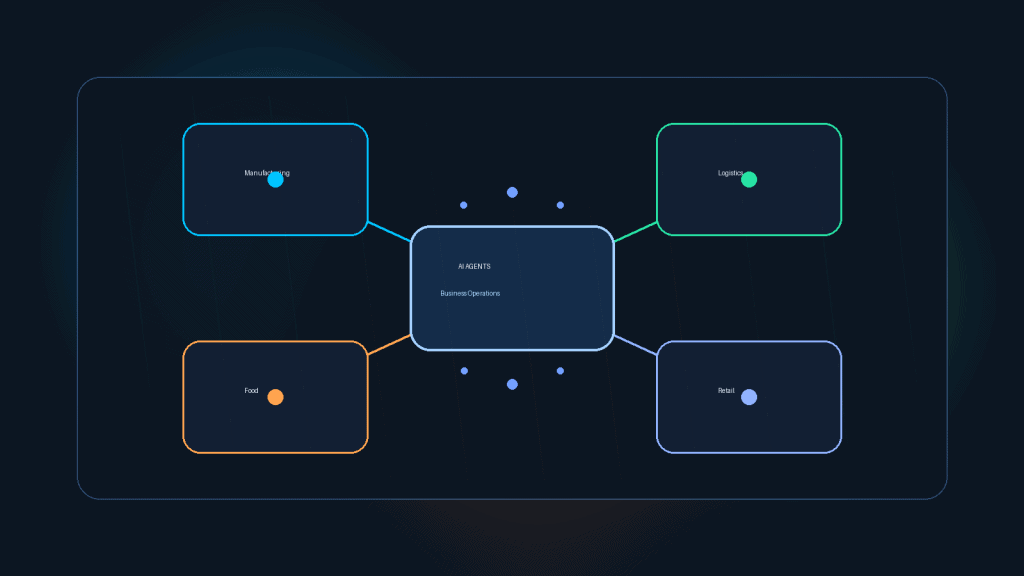
That same pattern can be translated into business operations. In manufacturing, the evidence may be quality logs and equipment history. In logistics, it may be shipment status and customer commitments. In food operations, it may be lot traceability and hygiene checks. In retail, it may be sales anomalies and replenishment timing. The principle is the same: AI should not only answer. It should work and show its reasoning trail.
The Adoption Sequence Should Be Workflow Redesign, Governance, and Small Delegation
McKinsey’s survey shows that the organizations seeing the strongest AI impact are more likely to redesign workflows, define when human validation is required, and embed AI into business processes instead of keeping it at the pilot stage.
That makes the operational rollout path fairly clear. Start with tasks that already have rules, data, and evidence. Define approval points before launch, not after an incident. Track business metrics such as cycle time, missed-record reduction, delay-response speed, and stockout prevention instead of vanity metrics such as prompt counts.
AI agents should be treated as governed operating components, not as a trend experiment.
Conclusion
The most relevant AI trend for business teams in mid-2026 is not simply stronger models. It is the rise of manageable work delegation. Codex and Claude Code are early visible examples, but the same logic applies to manufacturing, logistics, food, and retail.
The question is not whether AI can do everything. The better question is where AI can gather context, prepare recommendations, surface exceptions, and return traceable outputs before a human makes the final call. Companies that design around that question are more likely to turn generative AI into operating leverage.
FAQ
What is an AI agent in business operations?
An AI agent is a system that can gather context, reason across multiple steps, produce a structured output, and support or execute part of a workflow.
Why are Codex and Claude Code relevant outside software?
They show how AI can be assigned bounded work, return evidence, and collaborate asynchronously with humans, which is useful in many operational domains.
What is the best starting point for manufacturing AI?
Cross-reading daily logs, maintenance notes, inspection records, and quality issues is a strong starting point because the data already exists and the value is practical.
Where does AI help most in logistics?
Exception handling is one of the highest-value use cases because disruptions happen daily and response speed matters.
What should retail and food companies watch closely?
They should design for traceability, human approval, and evidence quality, not just model accuracy.
References
- OpenAI, “Introducing Codex,” May 16, 2025
- Anthropic, “Claude 3.7 Sonnet and Claude Code,” February 24, 2025
- McKinsey, “The State of AI: Global Survey 2025”
- Stanford HAI, “AI Index Report 2025”
Related Articles
- AI Adoption Now Needs an Operating Model, Not Another Pilot: Notes as of June 15, 2026
- AI Agents Are Moving from Chat to Scheduled Work: Notes as of June 16, 2026
- AI Agent Rollouts Will Reach Supervised Recurring Operations Before Full Automation: Notes as of June 17, 2026
- AI Agents Are Moving Into Exception-Handling Workflows: Practical Notes for Operations Teams as of June 19, 2026


