



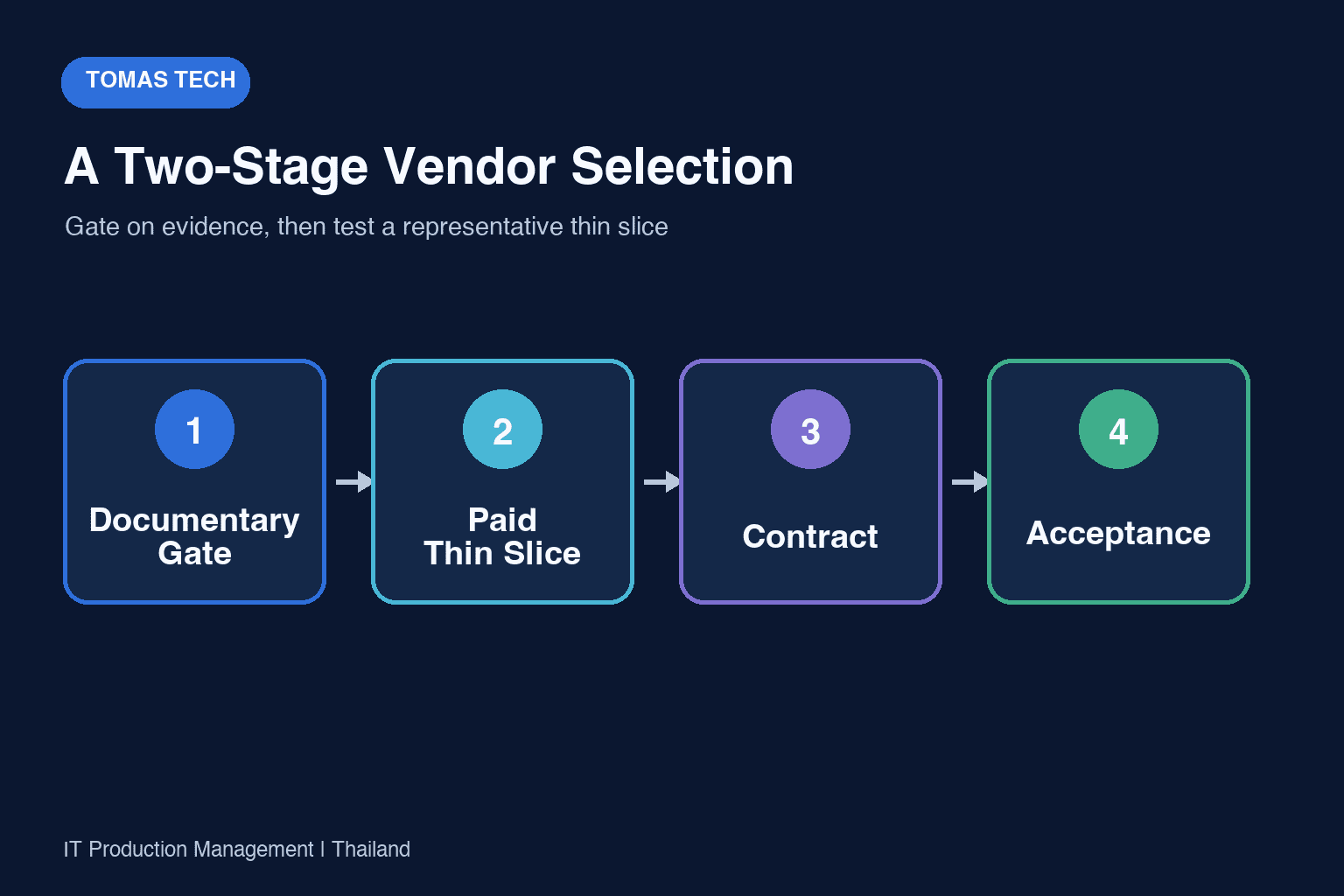
When manufacturers evaluate a Thailand system development company, an attractive presentation, a low hourly rate, or convenient Japanese-language sales support can create confidence too early. The harder questions appear near go-live: Can the system handle shop-floor exceptions? Will it reconnect safely after an ERP or network outage? Can another team build and operate it? This guide presents a two-stage process. Apply a documentary gate first, then use a paid thin slice to test one real workflow from requirement through acceptance and operations.
Search intent and Thailand market context
Investment activity does not prove delivery quality
Thailand’s Board of Investment reported that H1 2026 investment applications reached THB 1.47 trillion across 1,299 projects, up 37% year on year. Digital-sector applications represented around THB 1.12 trillion. These figures provide useful market context, but they are applications, not approvals or realized investment, and not all digital investment is demand for custom software development.
Current BOI application materials include activities covering the development or modification of software, digital platforms, or digital content. BOI eligibility, a certification, a large headcount, or a well-known client logo can be an input to screening. None of them proves that the assigned team can deliver your particular integration, acceptance criteria, or recovery process.
Separate product procurement from bespoke development
For a package or SaaS product, examine standard-function fit, configuration limits, license terms, upgrade policy, integrations, and data portability. For bespoke development, also evaluate requirements management, design decisions, source code, build instructions, test assets, intellectual-property boundaries, and the ability to transition support.
Hybrid projects require both sets of controls. If a production-management package is configured and only Thailand-specific labels, approvals, or machine interfaces are custom-built, identify separate responsibilities for the implementation partner, software licensor, cloud provider, and subcontractors. Our production-management system comparison guide offers additional product-selection criteria.
Define success as one observable sentence
Statements such as “digitize the factory” or “remove paper” do not let vendors estimate the same outcome. Write one sentence naming the user, trigger, completed result, and measurable condition. For example: “A warehouse operator scans an inbound label, matches it to an open ERP purchase order, routes a mismatch to a hold queue, and enables a supervisor to resolve it within the same shift.”
This sentence can be expanded into happy-path, exception, integration, authorization, performance, recovery, and operational-handover tests. If it cannot yet be written, the project needs discovery before an RFP. The same principle is explored in our small-start implementation guide for Thailand.
Common mistakes when choosing Bangkok software development partners
Treating the lowest hourly rate as the lowest total cost
An hourly rate is only one input. Before scope and acceptance are aligned, it does not predict total cost. Repeated explanations, rework, customer-run testing, failed migration, and production support can outweigh an apparent rate advantage. This article does not publish a market price range because the cited primary sources do not establish one.
Ask every bidder to separate assumptions, exclusions, customer work, re-estimation triggers, and change-control rates. Break the commercial response into discovery, design, build, migration, training, go-live assistance, warranty, and support. Compare the same deliverables rather than a single lump sum.
Assuming language support equals engineering capability
Japanese-language coordination can be valuable for a regional headquarters, but sales fluency does not demonstrate the skills of the project manager, analyst, developers, and testers who will do the work. Request the named proposed team, role allocations, availability, replacements, and the method for turning multilingual conversations into controlled decisions.
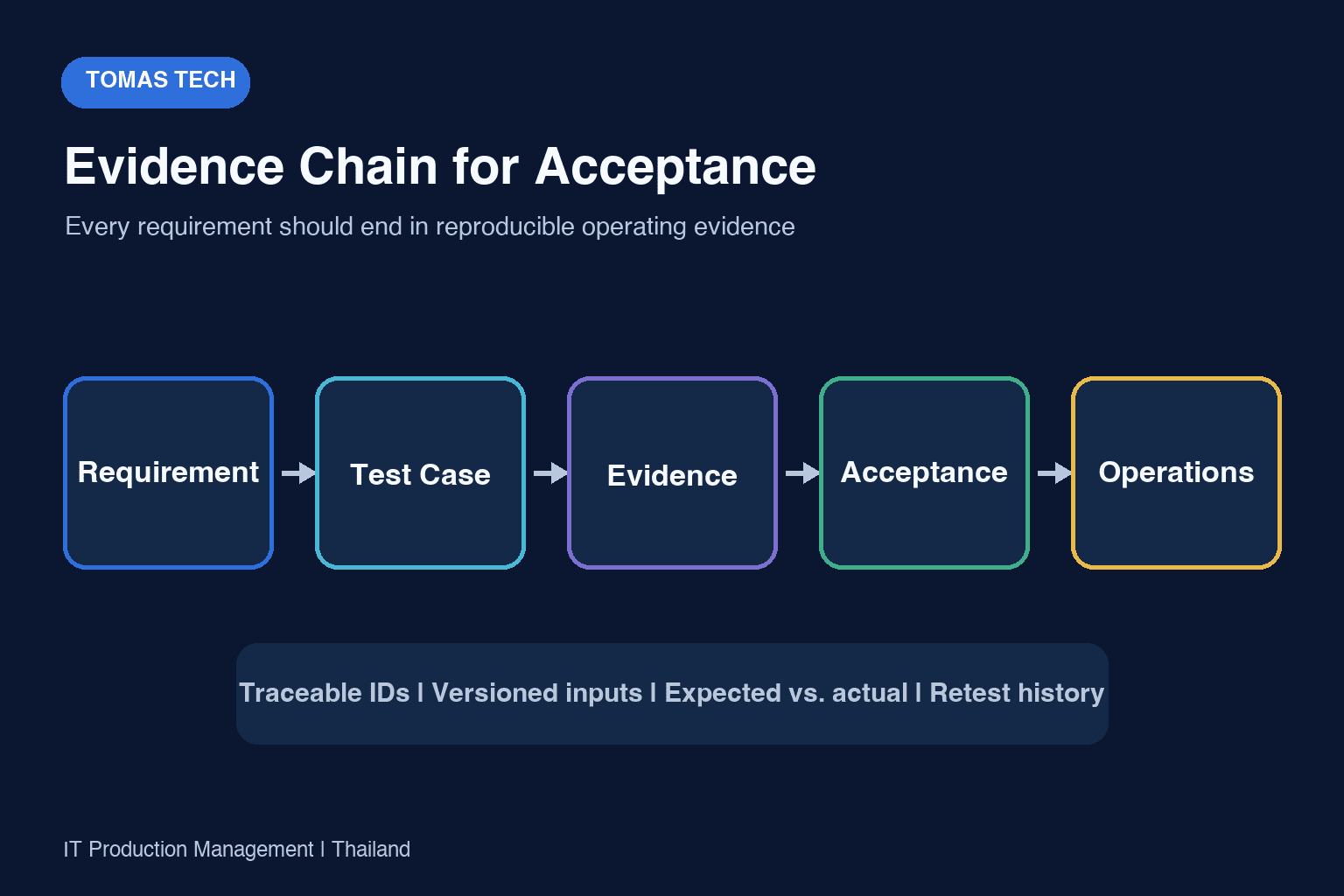
The critical asset is not merely a bilingual meeting. It is a shared register of decisions, open issues, changes, requirements, and acceptance conditions. Ask to trace a requirement ID into a test and its evidence.
Reviewing only a polished happy-path demo
A vendor may demonstrate entry and search with clean sample data, while factory risk emerges when a barcode fails, an ERP call times out, quantity exceeds tolerance, a message is sent twice, the network drops, or an approver is unavailable. Deliberately trigger at least one failure during evaluation. Observe the user message, retry behavior, data integrity, audit history, and recovery steps.
Mistaking badges and scale for project assurance
Certifications and references are useful evidence inputs, not guarantees. Ask what can actually be reused from a similar engagement, what differs, and how defects or changes were handled. Even where customer names are confidential, a vendor should often be able to show anonymized requirement matrices, test results, incident reports, and operating instructions.
Build a requirements gate before issuing the RFP
Create one requirements traceability matrix
A requirements traceability matrix links a business need to acceptance, tests, evidence, and ownership. It does not need to describe the entire future platform. Ten to twenty requirements for the proposed thin slice are enough to make vendor responses comparable.
| Requirement | Business need | Acceptance condition | Test | Evidence | Owner |
|---|---|---|---|---|---|
| R-01 | Match receipt to open PO | Show valid receipt candidate within 5 seconds | T-01 | Screen capture and timestamps | Vendor |
| R-02 | Stop excess quantity | Reject over-tolerance entry and show reason | T-02 | Inputs, outputs, audit log | Vendor |
| R-03 | Continue through ERP outage | Queue locally and resend once without duplication | T-03 | Failure and recovery logs | Joint |
| R-04 | Restrict exception approval | Reject operator role at UI and API | T-04 | Role-based results | Vendor |
| R-05 | Preserve traceability | Search user, device, time, before and after values | T-05 | Audit report | Vendor |
With this matrix, “supported” is not a sufficient answer. The bidder must explain which test will run, how it will run, and what evidence it will hand over.
Split requirements into Must, Scored, and Future
Making every request mandatory inflates price and can encourage fragile customization. Use Must for go-live conditions, Scored for comparative value, and Future for later possibilities. A failed Must item disqualifies a proposal. Scored items feed the 100-point model. Future items stay outside the current estimate while their architectural implications are reviewed.
Avoid words such as “fast” and “secure” as acceptance requirements. Specify or plan to measure concurrent users, volumes, response measurement points, operating windows, recovery assumptions, and log retention. If a value is unknown, label it for validation and assign an owner and date.
Attach real factory constraints
Provide network topology, device operating systems, scanner or PLC types, ERP API or file specifications, shifts, offline procedures, Thai-language master data, time zones, and data-location constraints. Sensitive details can be staged under an NDA after initial screening. A vendor cannot design credible recovery or integration behavior from a generic feature list.
Ask a software development company in Thailand for evidence
| Evaluation target | Requested evidence | What to inspect |
|---|---|---|
| Team | Names, roles, allocation, backups | Whether proposal and delivery teams match |
| Requirements | Anonymized traceability and change log | Whether requirements lead to tests |
| Quality | Test plan, results, defect sample | Whether failures and retests remain visible |
| Integration | API, retry, deduplication example | Whether failure is designed for |
| Security | Threat, review, vulnerability response | Whether evidence goes beyond a badge |
| Release | Pipeline or procedure, rollback | Whether another person can reproduce it |
| Operations | SLA, severity, escalation example | Whether hours and time zones are explicit |
| Handover | Repository, dependencies, configuration | Whether transition is feasible |
Thai Digital Government Development Agency procurement examples refer to source code, test-result documentation, UAT readiness, functional, performance and security tests, production readiness, installation reports, and training. A separate DGA TOR, signed in 2025 and covering fiscal years 2026–2028, asks for test scripts with steps, conditions, and evidence before production deployment. These are public procurement examples, not mandatory rules for private companies, but they demonstrate how deliverables can be made testable.
Compare vendors with a 100-point evidence model
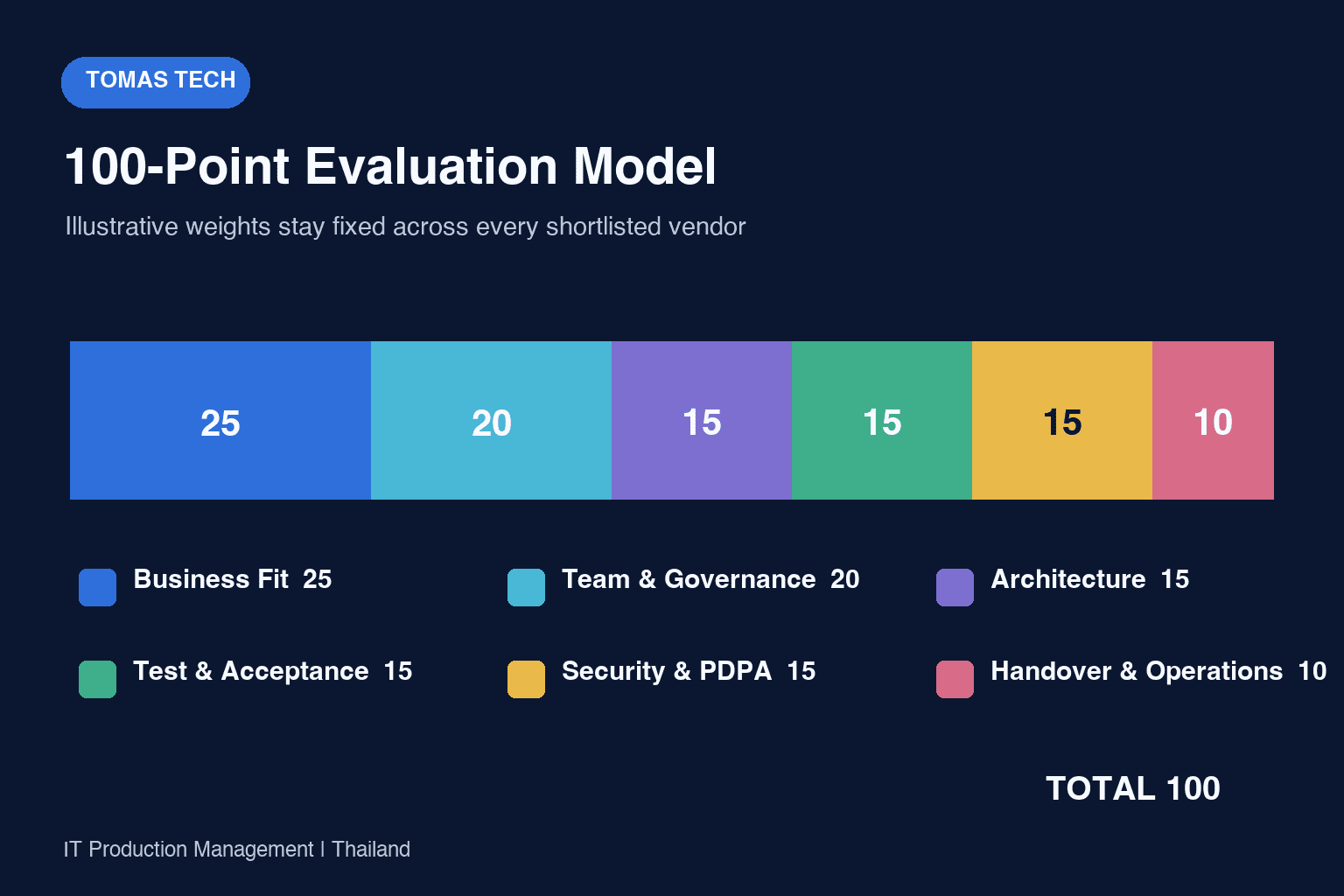
The following is an illustrative TOMAS TECH procurement model. Adapt the detailed questions to your risk profile, but keep the same weights for every bidder. Apply disqualification gates first, then score the survivors.
| Evaluation dimension | Weight | Evidence focus |
|---|---|---|
| Business-process fit | 25 | Exceptions, value, traceability, standardization |
| Delivery team and governance | 20 | Named team, decisions, change, language bridge |
| Architecture and integration | 15 | ERP, equipment, idempotency, responsibility |
| Test and acceptance evidence | 15 | Executable tests, artifacts, defects, UAT |
| Security and PDPA | 15 | Secure development, access, logs, processor controls |
| Handover and operations | 10 | Source, configuration, recovery, SLA, exit |
| Total | 100 | Use the same scenario and evidence set |
Anchor scores to evidence maturity
Calculate each result as rating (0–5) ÷ 5 × dimension weight. A practical scale is: 0 for no answer, 1 for a policy statement, 2 for a template, 3 for anonymized historical evidence, 4 for an engagement-specific execution plan, and 5 for proof demonstrated in the thin slice. A score of 4 in the 25-point business-fit dimension therefore contributes 20 points.
Set tie-breakers before proposals arrive. A stoppage-sensitive factory may prioritize testing and recovery. A personal-data-heavy workflow may prioritize security and PDPA. A company planning internal ownership may prioritize handover. Do not add an undefined “sales impression” score after seeing results.
Use clear documentary disqualification gates
Potential gates include refusing repository or configuration handover for bespoke work, refusing subcontractor disclosure, declining an appropriate data-processing agreement, withholding the delivery team, or excluding acceptance conditions from the contract. SaaS normally does not provide source code, so use data exports, APIs, continuity, and exit assistance instead. Product and bespoke procurement must not be judged by an identical source-handover rule.
Assemble a comparable RFP package
A useful RFP is a comparison mechanism, not merely a long description. Include:
- Business objective and success measures.
- In-scope and out-of-scope processes.
- Current workflow and the thin-slice scenario.
- Requirements traceability matrix.
- System, data, and equipment integration map.
- Non-functional requirements and measurement plan.
- Deliverables, acceptance, migration, training, warranty.
- Security, PDPA, and subcontractor questionnaire.
- Cost breakdown and change-control rules.
- The 100-point scorecard and disqualification gates.
For every function, ask the bidder to classify it as standard, configuration, custom development, third-party product, or unsupported. For customization, request upgrade impact and future support ownership as well as effort. Share clarifications equally with every bidder.
Before approaching vendors, the manufacturing system development outsourcing guide can help define what should remain internal.
Convert proposals into evidence with a paid thin slice
Run one workflow from end to end
A vendor-controlled free demo shows what the vendor prefers. A paid thin slice uses a representative customer workflow and near-real sample data. It runs through interface, API, roles, logs, exceptions, recovery, test evidence, deployment, and handover. Its purpose is not to obtain a cheap piece of the final product. Its purpose is to purchase clarity before a larger commitment.
An illustrative sequence could allocate 2 weeks to requirements and data mapping, 2 weeks to proposal clarification, and 2 to 4 weeks to a paid thin slice before contracting on acceptance evidence. This is an example, not a market average or delivery promise. Equipment access, data readiness, and decision-maker availability can change it.
Require reusable thin-slice artifacts
Receive more than a running screen: the updated traceability matrix, design decisions, source, build and deployment instructions, test scripts, execution evidence, known constraints, and an estimated backlog. Agree before starting what may be reused if no main contract follows.
Observe the team as well as the software. A capable team exposes ambiguity, identifies assumptions that require shop-floor confirmation, and explains the impact of alternatives. Disciplined scope judgment is more valuable than an unconditional “yes” to every request.
Design executable acceptance tests before contracting
Acceptance cannot be reproduced if it only means that users tried the system and found no issue. Define initial state, test data, action, expected result, evidence, owner, pass status, and retest rule.
| Test area | Illustrative scenario | Measurable acceptance condition |
|---|---|---|
| Happy path | Receive against a valid PO | Complete registration and response within the agreed measurement |
| Exception and recovery | Pause the ERP | Show a hold state and resend without duplication after recovery |
| Integration | Send the same message twice | Create one business transaction and preserve audit evidence |
| Role and authorization | Operator attempts approval | Reject at both UI and API and record the attempt |
| Performance | Process agreed concurrent load | Meet threshold at agreed points and volumes |
| Backup and restore | Restore a backup | Complete integrity verification in another environment |
| Operational handover | Customer deploys a build | Reproduce deployment using handed-over instructions |
Do not invent performance targets before measuring the environment. If a 5-second condition is selected, define whether measurement starts at device input, API receipt, ERP response, or user display. Include logs that separate network, ERP, and application latency.
Contract for IP, source, configuration, and exit
For bespoke development, verify these items in the contract or its schedules:
- Continuous access to a customer-controlled or jointly controlled repository.
- Build, test, and deployment instructions reproducible in a clean environment.
- Dependency inventory covering open-source, commercial libraries, and external APIs.
- Environment configuration and change history.
- Secure transfer of secrets through an appropriate vault, not plain-text delivery.
- Machine-readable export of all business data and audit logs.
- Backup, restore, disaster switching, and test responsibility.
- Defect-warranty term, scope, exclusions, and reproduction requirements.
- Severity, response and restoration targets, operating hours, and contacts.
- Subcontractor roles, location, access, and change notification.
- Boundaries among background IP, project deliverables, reusable components, and third-party licenses.
- Data return, knowledge transfer, parallel support, and deletion evidence at exit.
Repository access alone is not a handover if the customer cannot build the software. Request a clean build in a customer-controlled environment during the thin slice or before final acceptance. For SaaS, focus instead on data portability, configuration exports, API constraints, service-ending notice, migration support, and, where appropriate, continuity or escrow arrangements.
Make security and Thailand PDPA procurement requirements
Turn frameworks into verifiable questions
NIST Secure Software Development Framework v1.1 organizes outcome-based practices around preparing the organization, protecting software, producing well-secured software, and responding to vulnerabilities. Use it to ask where code review is recorded, who evaluates vulnerable dependencies, and who can access production secrets. It is not a vendor badge.
CISA’s Secure by Demand Guide encourages security questions before buying, contractual requirements during procurement, and supplier outcome assessment afterward. OWASP ASVS 5.0, released in May 2025, can supply verifiable requirements for modern web applications and services. Using ASVS does not itself amount to certification or proof of security.
Map processor obligations and data flows
Section 40 of the unofficial English translation published by Thailand’s Ministry of Digital Economy and Society (MDES) describes processor duties that include acting on controller instructions, applying appropriate security measures, notifying the controller of a breach, keeping required processing records, and operating under an agreement governing processor activities. These are practical contract checkpoints, not legal advice.
Ask each bidder to map which personal data is held in which country and environment, for what purpose, by whom, and until when. Development copies, logs, backups, and support consoles may also contain personal data. Include subprocessors and cloud providers in role definitions, breach contacts, return obligations, deletion, and evidence. Obtain legal advice for the final interpretation.
Evaluate factory integration, deployment, and recovery
Design ERP and equipment interfaces for failure
Document sender, receiver, data owner, frequency, authentication, timeout, retries, idempotency key, hold queue, monitoring, and manual recovery for each interface. Review timeout, duplicate delivery, out-of-order messages, master-data mismatch, and network partitions explicitly.
Where a business system writes toward a PLC or machine, separate application responsibility from control-safety responsibility. Create a RACI for the developer, equipment supplier, factory IT, and cloud provider. State who owns the interface and who validates physical behavior.
Rehearse cutover and rollback
The migration plan should cover extraction, transformation, reconciliation, delta synchronization, downtime, Go or No-Go ownership, and rollback conditions. Rehearse with anonymized or authorized data. Rollback must address transactions created in the new system, data already sent to connected systems, and work temporarily captured on paper.
Test the operating response, not just a monitoring dashboard. Identify who receives each alert, when it escalates, which evidence is captured, and who is authorized to resume production.
Compare support through service rules and operating evidence
“24-hour support” is incomplete without service language, channels, first-response versus restoration targets, severity rules, holidays, time zone, on-site conditions, third-party escalation, and reporting. A quick ticket number is not the same as technical action.
During the first 30 to 90 days, separate usage questions, defects, training needs, and enhancements. Jointly maintain known issues, workarounds, release history, configuration inventory, and restore-test results. Periodic transition drills can reduce dependency on one vendor.
Make the selection process reproducible inside the company
Connect shop-floor observation to management decisions
Executives, plant managers, supervisors, operators, quality, finance, and IT see different parts of a manufacturing-system problem. Management may focus on investment value and continuity, operators on exceptions and usability, and IT on integration and maintainability. Simply adding every request to a feature list makes the scope grow without clarifying value. Translate each request into the operating risk it reduces, the decision it accelerates, and the evidence that will prove completion.
During workplace observation, examine not only the documented standard procedure but also handwritten notes, spreadsheet re-entry, shared terminals, corrections after closing, night-shift approvals, and temporary handling during a network outage. Do not assume every workaround should be digitized. Separate controls required for law, quality, or customer commitments from tasks created by limitations of the old system. Ask each candidate to classify findings as standard capability, configuration, bespoke development, or process change.
For the management case, select one or two measures tied directly to the purpose, such as schedule adherence, work-in-process delay, trace-search time, re-entry, or shipment errors. Do not ask a vendor to promise an improvement rate where the baseline has not been measured. Agree first on the measurement definition, data source, exclusions, and frequency, then verify that the thin slice can collect the required evidence.
Prevent disputed memories with a decision log
Meeting minutes record a conversation. A decision log controls implementation. Record a decision ID, the decision, rationale, alternatives considered, affected requirements and tests, decision owner, date, and conditions for review. A decision to hold inbound receipts locally during an ERP outage, for example, must connect to capacity, lost-device handling, recovery order, duplicate prevention, and monitoring.
Manage unresolved questions in the same controlled register. Record not just owner and due date but also the temporary assumption and the effect of continuing without a decision. If a vendor implements an unstated assumption, it can return later as cost and schedule under a change request. The same visibility also shows delays in customer decisions, making governance fair to both sides.
In design reviews, sample high-risk requirements and trace them through interface or data-model decisions, code changes, test evidence, and production configuration. This targeted trace gives a more useful view than a presentation-only percentage-complete figure.
Structure customer reference checks
Asking a reference customer whether it was satisfied tends to produce a general answer. Align questions to the scorecard: Did the proposed team remain assigned? When were major assumptions disclosed? How were failed acceptance tests corrected? Who acted during a serious production incident? Could another person work from the handover material? Respect confidentiality and focus on the reproducibility of methods and deliverables.
Break similarity into concrete dimensions. A single plant differs from multiple sites; cloud differs from on-premises deployment; a read-only interface differs from equipment control; and high-mix production differs from continuous production. Instead of accepting one line that says manufacturing experience, document what is genuinely similar, what differs, who closes the gap, and how the difference will be tested.
Keep the final approval paper short
The approval paper should summarize gate results, the 100-point score, thin-slice acceptance, major residual risks, contractual mitigations, and customer-side assumptions. Even a high-scoring candidate may depend on one key person or face an untested machine connection, poor source data, or a third-party license. Show those risks separately from the score.
State the reason for the recommendation and the conditions that would stop it. Examples include not contracting unless the repository is transferred to customer control by an agreed date, or not starting the main build until a failed recovery test is repeated successfully. Explicit conditions prevent important controls from disappearing during commercial negotiation.
What to verify in the first 30 days after contracting
Convert proposal commitments into the execution plan
Move the proposal into the project plan, responsibility matrix, deliverable register, and quality plan. Confirm that named personnel are participating at the proposed allocation and that any replacement is approved against an agreed equivalence. A commitment left only in a sales document may not reach the delivery team.
Requirements, issues, risks, decisions, changes, tests, and releases may live in separate tools, but common IDs should connect them. Define the system of record, update owner, approval state, and access permissions instead of treating email attachments as the master. The customer must also name decision owners, shop-floor reviewers, acceptance owners, and infrastructure contacts.
Establish the development environment and evidence capture early
Confirm the location and access model for the source repository, issue tracker, delivery pipeline, dependency inventory, secret store, logs, and test evidence. If everything moves into the customer environment immediately before go-live, permission, network, license, and build differences will appear late. Give the customer visibility from the first small change and reproduce at least a release candidate through the intended process.
Evidence should not consist only of screenshots. Combine test input, execution time, version, environment, expected and observed results, and references to logs. Preserve failed evidence after a correction and link the fixing commit to the retest result. This turns a verbal quality report into an auditable history.
Perform one recovery early
A configured backup is not proof of a successful restore. During the thin slice or an early iteration, use authorized data to restore into another environment, start the application, and reconcile key records. Compare elapsed time with the recovery objective agreed by the company, not with an unsupported market benchmark.
Recover an integration as well. Make queued data visible, select what should be retried, prevent duplicates, and reconcile processing results. If repair requires manual SQL, define the executor, approval, backup, and audit record in the operating procedure and register an improvement item.
FAQ about selecting a Thailand system development company
What counts as a Thailand system development company?
It may be a Thai developer, a local office of an international firm, or an IT vendor implementing systems in Thailand. Evaluate the assigned team, local factory coverage, languages, data handling, contract structure, and support hours rather than address alone.
How should system development cost in Thailand be compared?
Compare the same requirements, deliverables, customer work, acceptance, and warranty. Include licenses, cloud, integration, migration, training, go-live support, maintenance, changes, and exit transition. This guide does not state an unsupported market average.
Is a Japanese IT vendor in Thailand automatically a better fit?
It may simplify coordination with a Japanese headquarters, but corporate origin is not delivery evidence. Apply the same scorecard to the named team, local coordination, traceability, tests, and support.
How many Bangkok software development companies should receive the RFP?
There is no universal number. Retain enough competition for comparison while limiting the evaluation workload. Because the thin slice is paid, use the documentary gate to narrow the field first.
How is a thin slice different from a proof of concept?
A proof of concept may test only technical feasibility. The thin slice described here takes one business workflow through requirements, interface, integration, exception, security, test evidence, deployment, and handover. It evaluates both the solution and the assigned team.
Must bespoke source code always be handed over?
For custom work, emphasize contractual rights, continuing repository access, and reproducible builds. SaaS usually does not transfer source, so evaluate exports, APIs, configuration, exit assistance, and continuity instead.
Can PDPA compliance be delegated entirely to the developer?
No. The customer still determines purpose, data, access, retention, and role instructions. Require the developer to evidence security, records, breach notification, subprocessors, return, and deletion, and consult qualified counsel for legal conclusions.
Conclusion: select executable evidence, not a company profile
Start Thailand vendor selection with one observable workflow, not a presentation or hourly rate. Compare traceable requirements, the named team, executable tests, security and PDPA controls, source and configuration handover, deployment and recovery rehearsals, and support rules. A documentary gate removes non-viable bids. A common 100-point model compares the rest. A paid thin slice then verifies the proposal before the main commitment.
If you are still designing the RFP, the scorecard, or thin-slice acceptance conditions, you can consult TOMAS TECH before selecting a product or development partner. We can help translate Thailand factory workflows, ERP and equipment constraints, and operating responsibilities into evidence-based requirements.
Primary sources
- Thailand BOI: H1 2026 investment applications
- Thailand BOI: application forms for digital technology activities
- Thailand MDES: Personal Data Protection Act B.E. 2562
- DGA: sample development procurement requirements
- DGA: TOR signed in 2025 for fiscal years 2026–2028
- NIST SP 800-218: Secure Software Development Framework v1.1
- CISA: Secure by Demand Guide
- OWASP Application Security Verification Standard 5.0


