



A small-start system implementation is not a cheap, feature-thin deployment. It fixes one management KPI and one operational boundary, while defining from day one how identifiers, APIs, data accountability and acceptance evidence will support future expansion. This guide turns that principle into a practical 90-day PoC, RFP, FAT/SAT, rollback, TCO and decision-gate plan for factories in Thailand and ASEAN.
Small-start system implementation: make the investment decision small, not the design weak
“Build only a few screens,” “put the current spreadsheet online,” and “let one department try it” can look fast. They often fail later because item, routing, machine and inventory definitions conflict when the scope expands. The element to reduce is the business boundary that management is funding now—not system quality, data integrity or exit readiness.
Fix three things together:
- One management KPI, such as plan-change-to-shop-floor time, on-time operation completion, WIP dwell time or actual-result closing time.
- One operational boundary capable of changing that KPI, such as release of an approved production plan through completion reporting.
- A connection contract for everything outside that boundary: item and operation IDs, plan version, production events, API behavior, data owners and error rules.
With those decisions, a one-line pilot can preserve a path to ERP, MES, warehouse, quality and equipment systems. Without them, even twenty delivered functions do not create an auditable business result.
Why a factory DX roadmap in Thailand benefits from a bounded start
Thailand’s Board of Investment reported that investment applications in the first half of 2026 increased 37% year on year to THB1.47 trillion across 1,299 projects. It also reported 132 Smart and Sustainable Industry applications worth THB17.2 billion. These figures are applications, not approvals, completed investments or realized benefits. They nevertheless show continued consideration of digital and automation investment. Thailand BOI, first half of 2026
The World Bank’s Thailand Digital Data Infrastructure Roadmap describes growth in cloud, AI and data infrastructure alongside gaps in skills, governance, interoperability and institutional coordination. It also notes that many MSMEs use digital platforms in daily operations while advanced analytics and automation remain limited. World Bank roadmap
The practical problem is therefore not merely whether to invest. A factory must translate investment into operating responsibility, shared data meaning and evidence-based decisions. A small start is a way to control that organizational difficulty, not just a way to fit a smaller budget.
Small does not mean removing the hard parts
A screen-led PoC may deliver input, list and CSV functions and declare success when a demo runs. Yet the hard production-management questions remain:
- Do item, operation, machine, worker and lot IDs mean the same thing across systems?
- Can the team trace plan versions, changes and approvals?
- Can it represent partial completion, hold, rework and cancellation?
- Can it recover from a network or device failure without duplicate reporting?
- Are manual corrections authorized, explained and logged?
- Can the customer export data, configuration and a dictionary at contract exit?
These controls are necessary even with ten users. A small-start scope can reduce sites, lines, product families, simultaneous process changes and live integrations. It should not remove identity, authorization, audit, recovery, security, ownership or acceptance testing.
NIST’s Digital Thread for Manufacturing work addresses standards, semantic representations, conformance and traceability across heterogeneous design, manufacturing and inspection systems. It does not recommend a particular production-management product. It does support the principle that even a bounded implementation needs explicit data meaning and testable connections. NIST Digital Thread for Manufacturing
Choose one management KPI
Select a KPI tied to loss or decision speed rather than a system-use metric such as login rate. It must be observable during the PoC and movable by actions inside the boundary.
| KPI candidate | Example definition | Behavior changed in scope | Qualification |
|---|---|---|---|
| Plan propagation time | Approval to operator receipt | Versioned release and acknowledgement | Separate approval waiting time |
| On-time completion | Operations completed by committed time | Prioritization and stagnation alerts | Separate quality holds |
| WIP dwell time | Previous completion to next start | Event capture and transfer request | Define planned stops |
| Actual closing time | Operation completion to accepted actual | Point-of-work capture and exception flow | Track later correction rate |
| Re-entry labor | Time copying the same fact | Single entry and interface | Do not shift work to operators |
Define numerator, denominator, clock source, exclusions, owner and baseline period. “Reduce lead time” is not an acceptance criterion. For plan propagation, for example, start at the production-control owner’s approval timestamp and end at operator acknowledgement, excluding cancelled plans and approved shutdown days.
Set the improvement target after validating the baseline. Instead of asking a supplier to guarantee “30% improvement” before inspecting the data, use Days 0–15 to confirm measurement quality and Gate 1 to approve a credible target range.
Fix one operational boundary
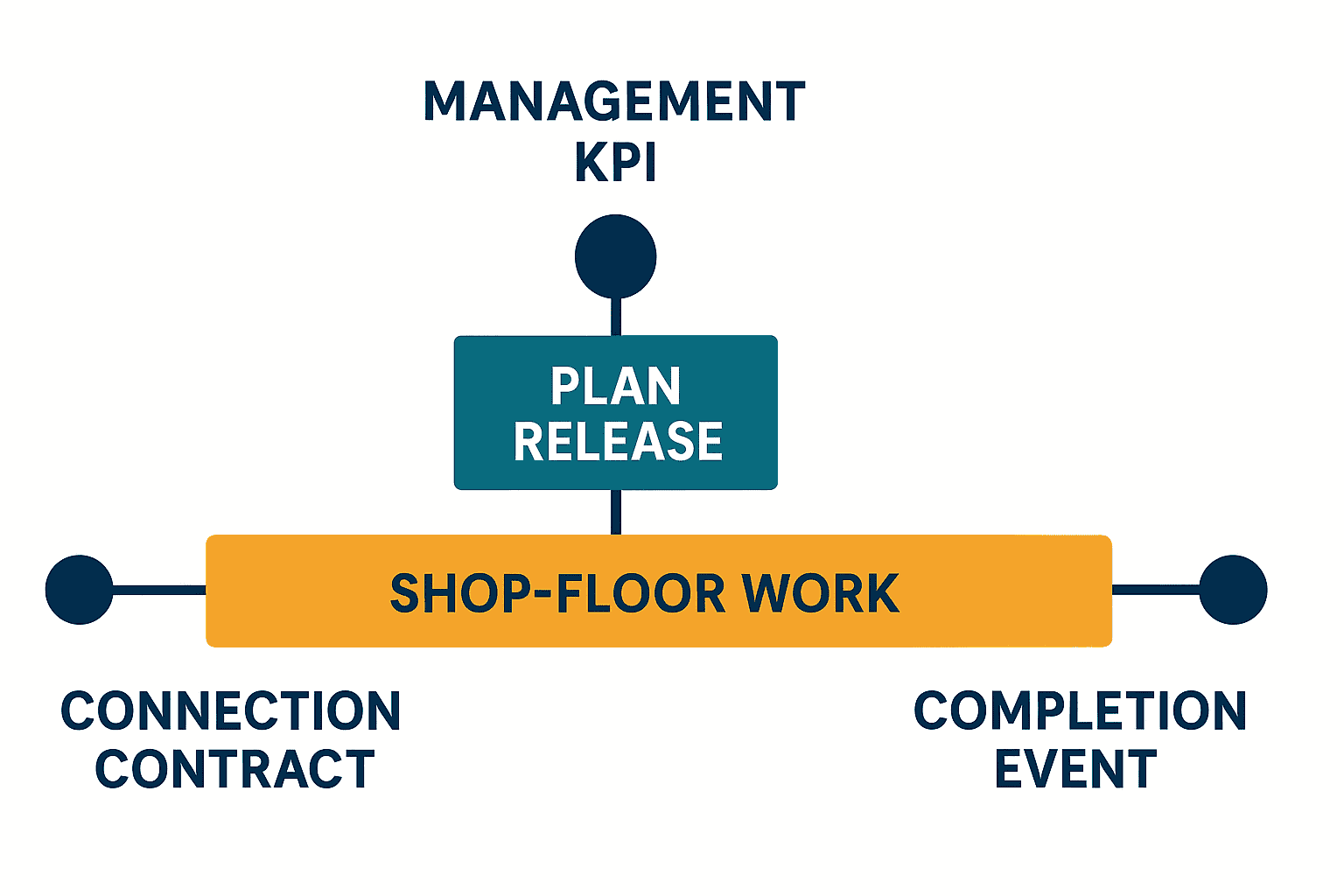
Define the boundary with start event, end event, objects, exceptions and external touchpoints—not by department or screen list. For “approved production plan to operation completion,” a usable definition is:
- Start: an approved plan version is released.
- Population: one line, three operations, representative products and two shifts.
- End: quantity, good, reject, hold, start and finish are recorded.
- In scope: distribution, acknowledgement, start, stop reason, completion and supervisor approval.
- Out of scope: demand forecast, purchasing, detailed costing, final quality disposition and machine control.
- External interfaces: receive plan and item data from ERP; return completion events.
“Out of scope” does not mean never. It separates current accountability and acceptance. The PoC can use controlled CSV or a mock API, but it should preserve production IDs and future responsibilities.
Define the expansion contract before development
A connection contract is broader than an endpoint specification. It covers meaning, ownership, quality, error behavior, versioning, security and retirement.
| Contract element | Minimum decision |
|---|---|
| Identifiers | Issuer of item_id, routing_id, operation_id, work_order_id and lot_id |
| Versions | Plan/BOM/routing version, effective time and cancellation rule |
| Events | Meaning of released, started, paused, completed, held and reworked |
| Quantities | Units, conversion, good/reject/hold and rounding |
| Time | Time zone, event time, receive time and clock-drift handling |
| Quality | Required, optional, unknown, estimated and manually corrected |
| Ownership | Who changes definitions, masters and exception approvals |
| Errors | Retry, idempotency, quarantine, manual recovery and notification |
| Retention | Retention period, audit, backup and approved deletion |
Require idempotency so a retried request does not create a second actual, correlation IDs, structured error codes and version compatibility. A CSV interface needs the same rigor: filename, encoding, delimiter, header, acknowledgement, duplicate rule, partial failure and reprocessing.
Avoid assigning all data ownership to “IT.” Production engineering may own operation meaning, production control the committed plan, manufacturing the actual event, IT access control, and an operations team service health. Include master mismatch, delayed data, correction, outage, cybersecurity incident and supplier exit in the RACI.
Acceptance evidence must state who runs which test, with which data and what record proves it. Build an evidence pack containing input, API request and response, audit log, database or export result, and repeatable steps—not screenshots alone.
A practical 90-day PoC for factory process improvement
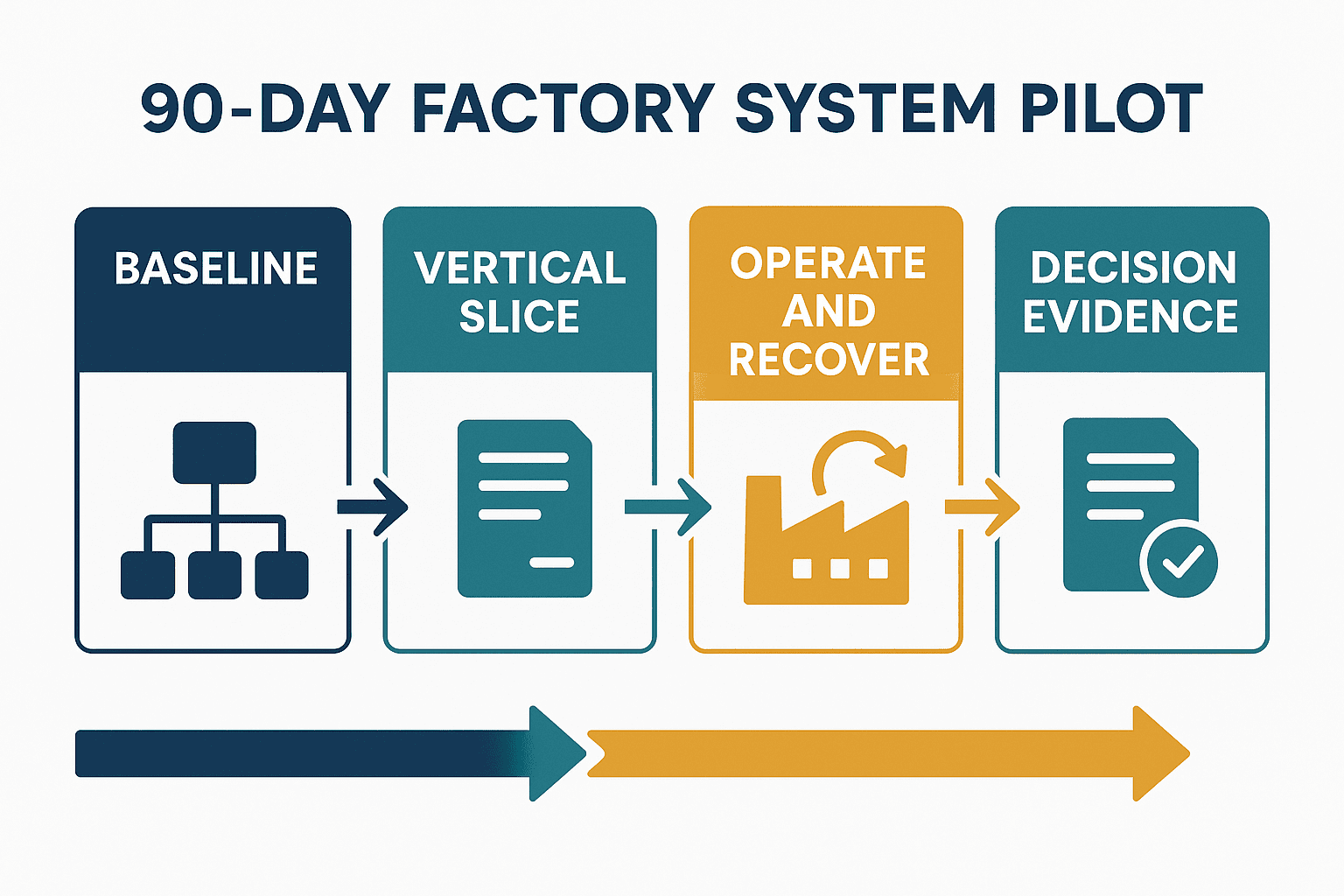
Ninety days is a planning model, not a universal performance guarantee. Adjust it for process cycles, peaks, shifts and maintenance windows. The goal is evidence across technology, operation and economics for one KPI and one boundary.
Days 0–15: baseline, boundary and stop criteria
- Validate the KPI formula, baseline period and data quality.
- Map normal and exception flows, including paper, spreadsheet and verbal work.
- Approve start, end, population, exclusions and accountable owners.
- Define data classification, accounts, devices, network and backup.
- Approve PoC stop conditions and the rollback owner.
Stop conditions can include a wrong instruction affecting safety or quality, mixed plan versions, duplicated actuals, unrecoverable data loss and authorization failure. A production-management PoC must not directly change machine safety control.
Days 16–30: implement one thin vertical slice
Pass one item and work order through receipt, operator acknowledgement, start, completion, exception and actual return. Favor end-to-end traceability over a large number of screens.
Automate contract tests now: missing required field, unknown item, repeated event, stale plan version, network loss, device clock drift and unauthorized action. A happy-path demonstration is not enough to open the next gate.
Days 31–60: operate exceptions on every shift
- Handle changeover, partial completion, hold, rework and cancellation.
- Observe entry time, waiting, questions and proxy entry.
- Confirm the supervisor’s correction authority and approval flow.
- Reconcile daily counts, duplicates, missing data, latency and unresolved errors.
- Measure KPI movement and side effects such as workload or quality deterioration.
Days 61–75: test failure, recovery and rollback
In a test environment or approved maintenance window, exercise network loss, device replacement, API outage and backup restoration. Record recovery time, potential data loss, manual fallback and duplicate behavior after resynchronization.
Days 76–90: assemble TCO and gate evidence
Combine baseline and outcome, unresolved exceptions, operating effort, cost, security, interface contracts and exit data. Review maximum delay, failure cases, manual correction rate and differences between shifts—not just averages.
Write an RFP around evidence, not a feature checklist
A production workflow improvement RFP cannot compare suppliers through boxes labelled planning, actual, inventory and reporting. Include:
- Management KPI and baseline method.
- Boundary, population, exclusions and assumptions.
- AS-IS/TO-BE event flows and exceptions.
- Master and transaction data contracts.
- Integration, performance, availability, offline and retry behavior.
- Authorization, audit, backup and vulnerability handling.
- Migration, training, operation, support and language.
- FAT, SAT and pilot scenarios.
- Rollback, data return and contract-exit assistance.
- Initial cost and three- or five-year TCO.
Ask suppliers to mark each response as standard, configured, custom, third-party, customer responsibility or unsupported. “Future support” requires an owner, planned version, extra cost and workaround. Run demos with representative customer data and exceptions.
When shortlisting products, use the same scoring model for operational boundary, integration, operation and exit as well as features. See our production management system comparison for Thailand and build-versus-outsource guide for manufacturing systems.
Separate FAT, SAT and business acceptance
FAT validates contracted behavior and exceptions in a supplier or test environment. SAT validates the real factory network, devices, users, printers, shifts and data. Business acceptance confirms that responsible operations can sustain the KPI and standard work.
| Test | Representative scenario | Required evidence |
|---|---|---|
| FAT | Wrong version, duplicate, unknown ID, unauthorized action | Logs, API response, audit trail |
| SAT | Wireless loss, device swap, printing, shift handoff, backup | Recovery timing, reconciliation, procedure |
| Business | Normal, hold, rework and cancellation in operation | KPI, labor, exceptions, approvals |
Classify defects by business impact. Critical defects affecting safety, quality, integrity or access should be zero before go-live. High defects require an approved workaround and closure date. Medium and Low enter a governed backlog.
Design rollback as five coordinated reversals
- Process: decision and procedure to return to paper, spreadsheet or legacy system.
- Data: authoritative source, delta, dual entry, resynchronization and correction.
- Technology: configuration, API, devices, accounts and network reversal.
- People: declaration authority and communications to shop floor and management.
- Evidence: cause, period, affected orders/lots and recovery verification.
Define the point of no return. Once the new system begins closing actuals, simply switching back can create two sources of truth. The recovery plan may need an input freeze, delta quarantine, owner selection of the authoritative record and controlled synchronization.
Contract exit is part of rollback. Require machine-readable master, history, attachments, audit logs, configuration, workflow, code tables and API definitions with a data dictionary. Data visible only through a supplier UI is not an exit package.
TCO: do not decide from subscription price
The following is an illustrative assumption model, not a market price, quotation or benefit guarantee.
| Cost | Year 1 | Year 2 | Year 3 | 3-year total |
|---|---|---|---|---|
| Discovery, implementation, migration | THB1,200,000 | 120,000 | 120,000 | 1,440,000 |
| License/cloud | 360,000 | 420,000 | 480,000 | 1,260,000 |
| Integration and monitoring | 300,000 | 300,000 | 300,000 | 900,000 |
| Internal operation and training | 420,000 | 300,000 | 300,000 | 1,020,000 |
| Devices, spares, connectivity | 240,000 | 60,000 | 60,000 | 360,000 |
| Risk reserve | 180,000 | 120,000 | 120,000 | 420,000 |
| Total | THB2,700,000 | 1,320,000 | 1,380,000 | THB5,400,000 |
The arithmetic is THB2,700,000 + THB1,320,000 + THB1,380,000 = THB5,400,000. User growth, data volume, API usage, exchange rate, tax and after-hours support are excluded.
For an illustrative benefit model, suppose re-entry and reconciliation consume 240 hours per month at THB350 per hour and the system removes 60%. Annual avoided labor value is 240 × 350 × 12 × 60% = THB604,800. If evidence also supports THB1,200,000 per year in avoided delay cost, annual benefit is THB1,804,800. 5,400,000 ÷ 1,804,800 ≈ 2.99 years of benefit is a reference ratio of three-year TCO to annual benefit, not a payback date. Because costs occur in different years, calculate the actual recovery point from monthly or annual cumulative cash flow.
Validate avoided loss from actual incidents, cause and contribution margin or incremental cost. Do not count total revenue or double-count the same outcome as both labor and loss avoidance. Keep benefits not testable during the PoC as unvalidated hypotheses.
Decision gates: continue, correct, scale or stop
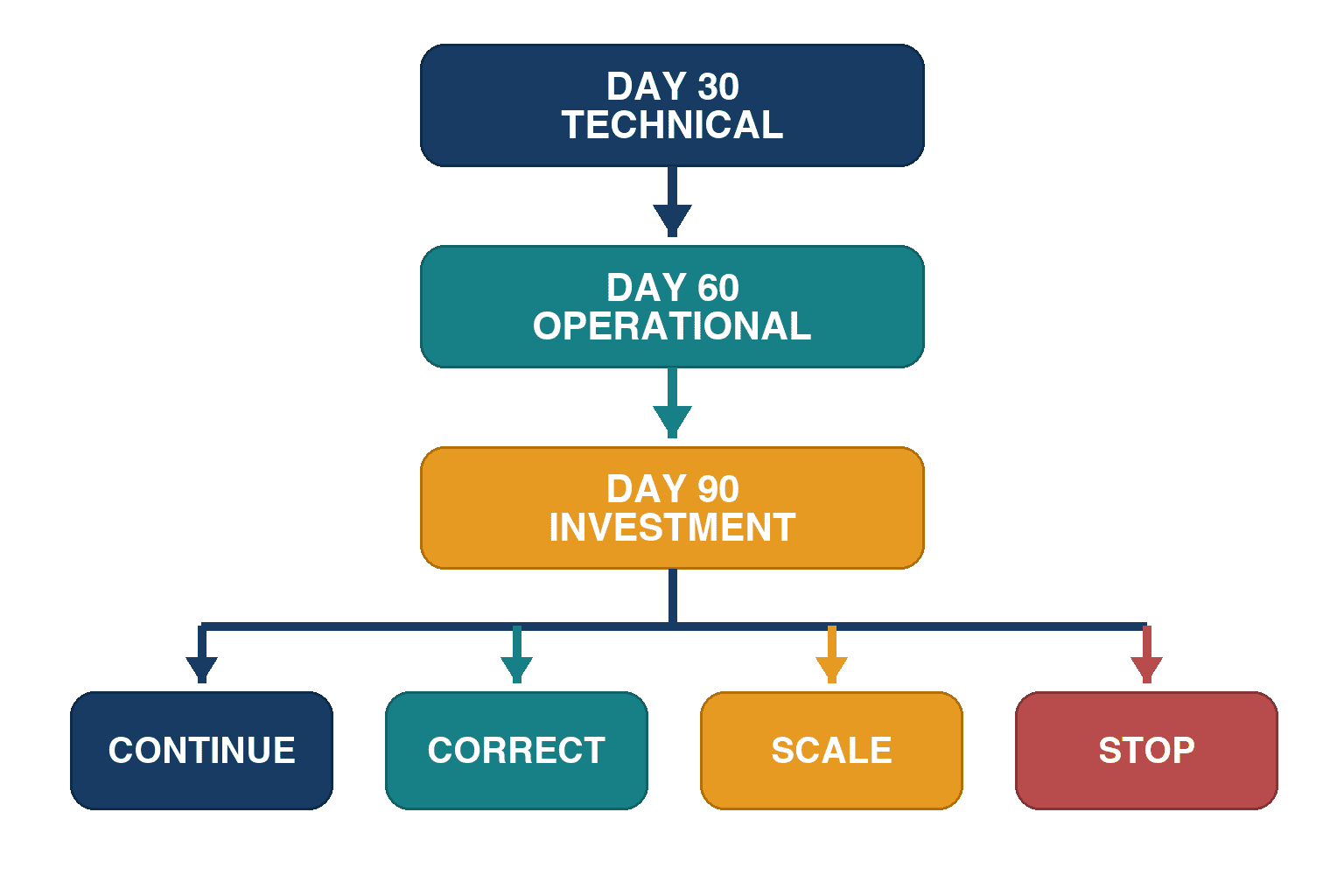
Gate 0 — start
Start when KPI, boundary, owners, data access, stop conditions and budget ceiling are approved. If not, continue business design rather than coding.
Gate 1 — Day 30 technical viability
One instruction is traceable end to end; ID, version, time and exceptions follow contract; no critical security issue remains. Do not widen the scope when this fails.
Gate 2 — Day 60 operational viability
Every shift can operate, correct, hold, rework and reconcile without relying on unpaid heroics. Workload shifted to operators is not a pass.
Gate 3 — Day 90 investment decision
- CONTINUE: stabilize the same boundary.
- CORRECT: modify contract, process or product and retest.
- SCALE: expand to an adjacent line using the same contract and evidence.
- STOP/ROLL BACK: benefit, fit, security, operation or TCO does not pass.
Stopping can be a good outcome. Discovering within 90 days that TCO is too high, data is unavailable, workload remains or the architecture locks future connections prevents a much larger loss.
Read manufacturing DX cases without copying their percentages
A NIST MEP case on Magellan Aerospace describes a site of about 100 employees facing manual legacy processes, rework, scrap, training and limited equipment visibility. The implementation included CAD/CAM management, work instructions, NC program distribution and monitoring of more than 40 devices. The case reports a 1.4% shop-rate reduction based on USD51,473 scrap and rework cost reduction, 2.1% efficiency improvement associated with USD135,900, and USD26,270 lower training cost. Those are case-specific results, not a promised rate for another factory. NIST MEP digital factory case
Borrow the mapping among problem, boundary, intervention and measurement—not the percentages. Check whether the same cost exists, the baseline is measurable and other initiatives can be separated.
A NIST MEP article on manufacturing AI similarly recommends piloting on one line and expanding incrementally, with leadership priority, consistent data collection and a quantifiable pain point. The logic applies beyond AI. NIST MEP manufacturing lessons
Common failure patterns
A line-specific identifier scheme
It is fast initially but creates mappings later. Keep enterprise IDs separate from local display names and declare the issuer.
No audit because “it is only a PoC”
A result that cannot show who corrected an actual is not KPI evidence. Preserve authentication, authorization and create/correct/approve events.
Input rate as the only success metric
One hundred percent entry can coexist with more duplicate work. Measure business KPI, side effects and unresolved exceptions.
Verbal additions to scope
One addition is proportionally large in a small project. Record its KPI, cost, schedule, test and rollback effects and approve it at a gate.
Treating a supplier standard as the customer’s data contract
A standard API may not match customer IDs, versions, errors or exit requirements. Run contract tests with representative data.
The implementation evidence pack required before scaling
Once the first line works, pressure grows to add the next line quickly. Scaling from memory causes configuration, names and exception behavior to drift. Before Gate 3 selects SCALE, version and approve the following artifacts.
| Artifact | Required content | Reuse check |
|---|---|---|
| KPI definition | Formula, population, exclusions, clock, baseline and owner | Does it mean the same thing on the next line? |
| Boundary map | Start, end, population, exceptions and touchpoints | Does the added boundary change the KPI? |
| Data dictionary | IDs, types, units, required fields, versions and codes | Does it avoid new local identifiers? |
| Interface contract | API/CSV, idempotency, retry, errors and performance | Are counterpart version and owner unchanged? |
| Test assets | FAT/SAT scenarios, inputs, expected results and logs | Were new exceptions added? |
| Operating procedure | Monitoring, inquiry, correction, outage and recovery | Can every shift perform it? |
| Security record | Accounts, roles, configuration, updates and incident contact | Are site-network differences reflected? |
| Exit package | Export, configuration, audit and restoration proof | Can the current version still export it? |
Each artifact needs its target system version, approver, change reason and effective date. Treat disagreement between diagram and implementation as a defect. Use anonymized or synthetic representative test data rather than copying personal or customer-confidential data without authorization.
Reuse the shared contract and govern only differences. An item ID issuer and completed-event meaning can remain common, while terminal placement, operator language and added stop-reason codes remain site differences. A request to change the common layer must assess backward compatibility and migration for existing lines.
Schedule 30-, 60- and 90-day production reviews for unresolved errors, manual corrections, questions, access changes, backup restoration and KPI side effects. SCALE is not a larger device count; it is repeatability with the same contract and evidence.
FAQ about small-start system implementation
What is a small-start system implementation?
It limits the investment decision to one management KPI and one operational boundary while defining identifiers, interfaces, ownership, acceptance and exit for expansion. It is not a low-quality edition or screen demo.
Where should a factory DX roadmap begin?
Choose a boundary with measurable loss or decision time, several cycles within 90 days, a clear owner and observable exceptions. For a large dependency such as enterprise master consolidation, design the contract first and make the implementation slice smaller.
How long should a factory process-improvement PoC run?
Ninety days here is a model. Adjust for cycle, season, shifts and maintenance. Include baseline, normal and exception flows, recovery, business acceptance and an investment gate.
What belongs in an RFP for production workflow improvement?
KPI, boundary, AS-IS/TO-BE events, exceptions, data contract, accountability, nonfunctional requirements, FAT/SAT, migration, rollback, exit package and TCO detail.
Can we keep the existing spreadsheet in a small start?
It can support baseline collection or temporary exchange. Define columns, IDs, versions, required fields, errors and ownership; otherwise it becomes migration debt.
Should a PoC stop if a numeric target is missed?
Not automatically. Separate baseline error, data quality, process design, product constraint and poor boundary selection. Approve a bounded correction and retest; roll back when a foundational condition cannot be met.
Summary: start small and design expansion deliberately
A small-start system implementation makes the investment unit small. Fix one management KPI and one operational boundary while defining identity, version, event, data ownership, interface, audit, recovery, exit and acceptance evidence from day one. Separate Day 30 technical, Day 60 operational and Day 90 investment gates, then choose CONTINUE, CORRECT, SCALE or STOP from the same evidence pack.
TOMAS TECH supports manufacturers in Thailand and ASEAN with current-state mapping, KPI and boundary design, RFPs, data contracts, 90-day PoCs, FAT/SAT and TCO decisions. Even before selecting a product or development model, you can contact us to structure the first boundary and its acceptance evidence.


