


Choosing an MES production management system in Thailand is no longer a “nice-to-have improvement project we will get to eventually.” It has become a design question about how to keep a plant running when you can no longer assume you will be able to hire the people you need. Labour shortages and wage increases are arriving at the same time, and shop-floor management built on paper forms and Excel sheets is hitting its limit on both cost and quality. This guide walks through how the layers fit together — MES, ERP, planning and SCADA/IoT — the requirements that are specific to Thailand, how to read a quotation, how to use BOI and depa incentives, and the five failure patterns that show up again and again. It is written for plant managers, operations directors and regional IT leads who have to make the selection decision, not just approve it.
Why Thai Plants Are Rethinking Production Management Now
“We cannot hire” has become a structural problem
Thailand’s working-age population is already in decline as of 2026. This is not a cyclical hiring squeeze that will ease when the economy turns; the pool itself is shrinking. Labour shortages have become permanent, and a large share of manufacturing sites continue to rely on migrant workers from Myanmar and Cambodia (sources: Allied Thai, JETRO).
What makes this awkward is the cost-push dynamic it creates. When labour supply contracts, wages rise even when growth is modest. In other words, your labour cost can climb in a year when you are not increasing output at all. From a plant’s point of view, that is the most painful shape a margin squeeze can take: flat revenue, rising payroll.
Wages are moving steadily upward
Minimum wage revisions continue. The January 2025 revision raised the national average by roughly 2.9%, and from 1 July 2025 the rate was revised again to THB 400 across all of Bangkok and for sectors such as hotels and entertainment venues (source: Career Link Asia). The minimum wage does not directly set pay for every operator on your line, but it exerts upward pressure across the whole wage table.
On top of that, the monthly base salary of a Thai manufacturing worker sits at around USD 437, and the gap versus Vietnam has widened to roughly USD 135 — about 45% (source: Allied Thai). That is a heavy fact for any plant in Thailand. Purely labour-intensive processes are structurally easy to move to neighbouring countries if you look only at unit cost. For a Thai site to stay relevant, it has to compete on something other than “many hands, cheap output”: quality assurance capability, short lead times, flexibility across a wide product mix, and defensible traceability. Every one of those depends on the accuracy and speed of information. That is why the production management question keeps coming back.
The real cost of “we are still managing with paper and Excel”
In many Japanese-owned and other foreign-owned plants in Thailand, daily reports are still handwritten, aggregation happens in Excel, and progress checks mean walking the floor and looking. It appears to work. In practice it generates costs that never appear on a line item:
- Re-keying effort: the operator writes it, an admin types it in, a supervisor aggregates it. The same data is touched two or three times.
- Information lag: actuals are not available until the next day, so actions that could have been taken the same day are not taken. Defects are noticed late.
- Key-person dependency: when the person who built the aggregation workbook resigns, nobody can maintain it. Macros become a black box.
- Numbers that do not tie out: production, inventory, shipping and accounting figures disagree slightly, and someone reconciles them manually at month end.
- Improvement stalls: without clean data you cannot objectively argue which line and which process is the bottleneck, so improvement priorities get set by whoever speaks loudest.
Individually these look minor. Stacked together, they create a plant that only works if you keep adding people. Once you accept that hiring is constrained, that structure is your largest single risk.
Digital transformation investment across Thailand is growing
For context, Thailand’s digital transformation market was estimated at around USD 10 billion in 2025 and is projected to grow at a CAGR of roughly 8.75% through 2031 (source: Iconic Thai). It is realistic to assume the plants you compete with are moving in the same direction. In practical terms, the smart factory conversation in Thailand is no longer about whether to invest, but about where to start and at what scale.
MES vs ERP vs Planning vs SCADA/IoT: Who Does What
This is the most important section of this guide. Most selection failures are not caused by picking a weaker product. They are caused by putting work in the wrong layer: trying to run shop-floor management inside ERP and watching it collapse, demanding costing from an MES until it bloats, or calling raw SCADA data “visibility” when it never connects to production actuals.
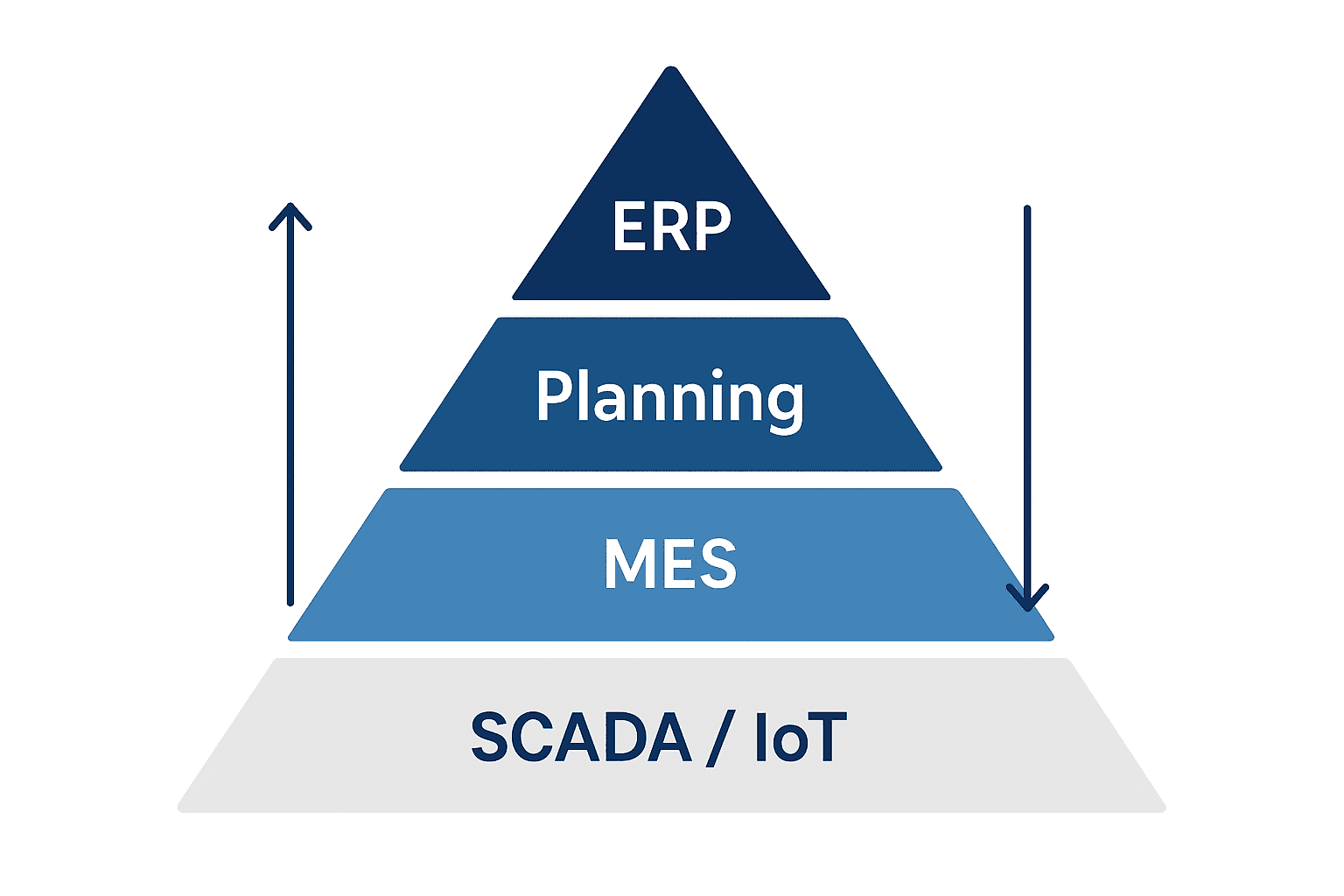
The four layers on one page
| Layer | Common name | Primary role | Time horizon | Main users | Typical inputs/outputs |
|---|---|---|---|---|---|
| Business/corporate | ERP | Single source for orders, purchasing, inventory, costing, accounting, HR | Daily to monthly | Executives, finance, purchasing, sales | Sales orders, purchase orders, inventory valuation, cost and journal entries |
| Planning | Production planning system / scheduler | Production planning, requirements explosion, load levelling, progress control | Weekly to daily | Production control, plant manager | Production plans, work orders, delivery commitments, progress status |
| Execution | MES (manufacturing execution system) | Releasing orders to the floor, collecting actuals, linking operator/machine/material, quality records, traceability | Real time to hourly | Line leaders, production, QA | Manufacturing orders, good/defective counts, run times, lot history |
| Equipment/control | SCADA / IoT / PLC | Monitoring and controlling equipment, collecting machine signals and sensor values | Seconds to minutes | Maintenance, equipment engineers | Run/stop signals, current, temperature, pressure, alarms |
The phrase “production management system” is used very loosely — it can mean an ERP production module, an MES-style actuals collection tool, or a process control spreadsheet somebody built. When you talk to a vendor, simply confirming which layer we are talking about at the start of every conversation eliminates most misunderstandings.
ERP vs MES: the world of plan versus the world of execution
The one-line distinction: ERP manages what should happen (the plan); a manufacturing execution system manages what actually happened (the execution).
ERP takes the order and says “build this product, this quantity, by this date.” On the floor, changeovers run long, material does not arrive, machines stop, and defects force rework. Absorbing that gap second by second and minute by minute is the MES job.
| Dimension | ERP | MES |
|---|---|---|
| Core philosophy | Consistency of plan and accounts | Recording and controlling execution |
| Data granularity | Item and order level | Operation, lot, machine, operator level |
| Update frequency | Often daily batch | Real time / per transaction |
| Strengths | Costing, inventory valuation, purchasing, accounting integration | Progress visibility, defect analysis, traceability |
| Weaknesses | Keeping up with real-time shop-floor variation | Financial accounting, consolidation, tax |
| Implementation weight | Company-wide impact, heavy | Can be phased in line by line |
“We implemented ERP and the floor did not get any easier” is one of the most common complaints we hear. Usually the cause is that execution-layer work was pushed into ERP screens. ERP input forms are designed around accounting integrity, which makes them far too heavy for an operator who has to touch a screen every few dozen seconds.
Production planning systems versus MES
Strictly speaking, a planning system sits on the plan side (deciding what, when and how much to make) and MES on the execution side (recording and controlling how the decided work was actually performed).
In practice, packages overlap. Planning packages often include simple actuals entry; MES products often embed a lightweight scheduler. So do not select by product category label. Lay out your own process flow in sequence, and map which step is handled by whom on which screen, in a feature matrix. Comparing catalogue checkmarks alone hides the traps: “available as a paid option,” or “designed around home-country business practice and unusable in Thailand as shipped.”
Where SCADA and IoT fit
SCADA and IoT gateways are the layer that goes and fetches equipment signals: run/stop, cycle time, current, temperature, alarms, at second-level resolution. The critical point is that equipment data on its own does not give you factory visibility.
You will know the machine was running or stopped. You will not know which product, which lot, which operator, or against which work instruction — that context lives in the MES. Conversely, an MES that relies purely on manual entry will never capture true utilisation or micro-stoppages. Equipment data (SCADA/IoT) only becomes improvement-grade data once it is joined to manufacturing context (MES). When you scope equipment monitoring, work backwards from the question “at what unit of analysis do I ultimately want to slice this data?”
A realistic entry point
For foreign-owned plants in Thailand, the sequence that works most often is:
- Start with MES-style actuals collection and progress visibility. The pain is greatest here and the effect is visible fastest.
- Add automatic collection from equipment (IoT/SCADA) to reduce manual entry.
- Build the ERP interface in parallel, connecting actuals to inventory to cost.
- Then move to analytics and AI (predictive maintenance, visual inspection, planning optimisation).
Starting with an ERP replacement, by contrast, turns the effort into a company-wide programme where the floor feels no benefit for a year or more. If ERP is already running, leave it alone and lighten the shop floor first through MES; payback tends to arrive considerably sooner.
The Features That Actually Matter in a Thai Plant
Feature lists are enormous, but the functions that plants in Thailand consistently say they were glad to have are fairly consistent. Here they are in priority order.
1. Actuals collection (the foundation)
When, on which line, which product, how many units produced, how many defective. Capturing that without manual re-keying is the base of everything else. Input methods are combined: tablets, barcode/QR scanning, automatic pickup of machine signals, operator ID cards.
The key discipline is do not get greedy about granularity. Demanding second-level entry at every process from day one increases operator burden and almost always turns the data into a box-ticking exercise. Start at a granularity the floor can genuinely sustain — per lot, per process, per time block — and tighten it once accuracy is stable.
2. Progress visibility (andon and dashboards)
Get the floor and management looking at the same picture of plan versus actual. Three viewpoints make operations work well: a large line-side monitor (andon), an office dashboard, and a mobile view for managers.
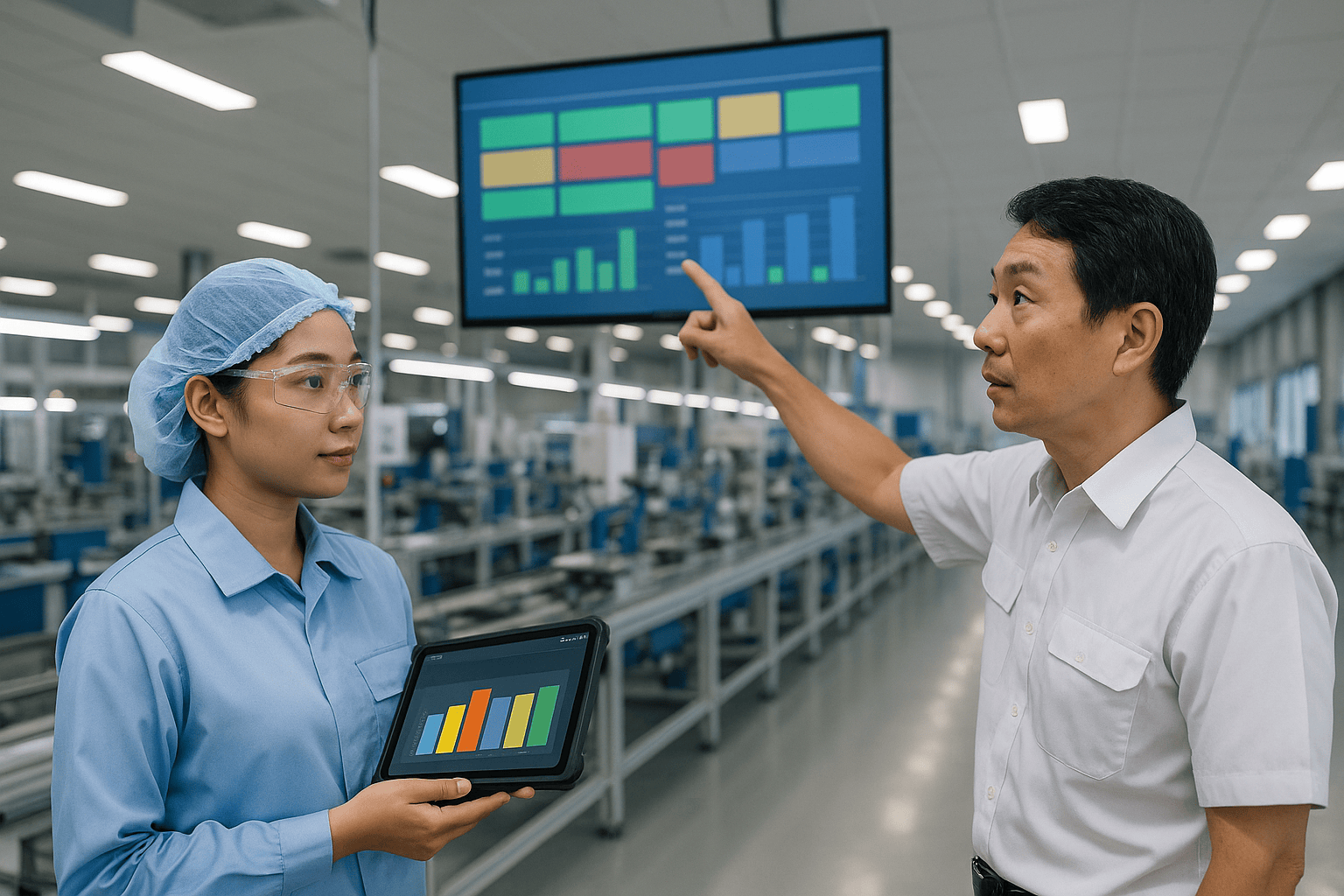
Whether visibility produces results depends on one thing: whether you designed what happens when something goes red. A board that flashes and triggers no action stops being looked at within a few months. Define thresholds, notification recipients and the escalation path as a set.
3. Traceability
Which material lot went into which product, when, on which machine, handled by whom. In automotive components, electronics, food and medical devices this is mandatory for customer audits and regulatory compliance. In food in particular the requirements are highly specific — the design of what to record and how long to retain it is the core of the work, as covered in Food Factory Traceability Systems: FSMA 204 and Thai Regulations in Practice 2026.
The value of traceability is measured by how tightly you can bound the impact when something goes wrong. Whether a recall can be narrowed to specific lots or expands to “everything produced that month” changes the financial damage by an order of magnitude.
4. Equipment performance management (OEE)
OEE — availability, performance and quality combined — is a useful common language for investment decisions. But in daily practice, being able to classify stoppage reasons properly matters more than chasing the OEE number itself. Data where micro-stoppages are all logged as “other” produces no improvement ideas. Design your stop-reason codes together with the floor, at a practical granularity of roughly 10 to 20 codes.
5. Quality management
Recording inspection results, checking against limit samples, classifying defects and linking them to causes, logging corrective actions. Simply digitising paper inspection records already cuts aggregation effort and the risk of lost records. Going further, you can start correlating defect patterns against machine conditions, operators and material lots to narrow down root causes.
6. Inventory and material movement
“We cannot see WIP” is close to universal. Once inter-process inventory becomes visible, you affect both lead time and working capital. If you plan to extend into warehousing and transport, the wider material-flow design discussed in Logistics DX in Southeast Asia: 2026 Outlook is a useful reference for scoping beyond the factory gate.
7. Reports and documents
Reports to headquarters, documents submitted to customers, material for internal meetings. If this is not automated, Excel rework survives regardless of what you implemented. We strongly recommend that you inventory, before implementation, exactly which reports go to whom, at what frequency, in what format. Projects that skip this step tend to generate additional development after go-live.
Requirements Specific to Thailand
Plenty of packages with a strong track record in their home market fail in Thailand. The operating assumptions here are different.
Thai-language UI and multilingual support
Most line operators are Thai, with a meaningful share of workers from Myanmar and Cambodia. Managers may be Japanese or another nationality, headquarters reporting may be in Japanese, and customer communication is often in English. So the same system has to be switchable across English, Thai and Japanese as a hard requirement.
Points to verify:
- Can display language be set per user, or is it fixed system-wide to a single language?
- Beyond screen labels, can master data (product names, process names, defect codes, stop reasons) be held in multiple languages?
- Are error messages, printed reports and notification emails also in scope for translation?
- Do Thai fonts render correctly, without garbled characters or layouts breaking from longer strings?
- Can the system handle the Buddhist era (พ.ศ.) and Thai date and number formats?
The most commonly overlooked item is multilingual master data. Screens are translated but the defect code descriptions are still in the head-office language and the floor cannot read them. This happens more often than you would expect.
Design for operator turnover
You have to design assuming a certain level of turnover on Thai production floors. A system that only a trained veteran can operate stops the day that person leaves.
- Target three steps or fewer for any input sequence
- Prefer scan, tap and select over typing
- Make it intuitive through icons and colour
- Aim for a new hire being productive after a 30-minute briefing
- Provide operating manuals in Thai, with photos and video
Also, do not treat training as a one-off. Quarterly refreshers, and developing line leaders as internal trainers, make adoption stick. Under BOI rules, training expenditure can qualify for a 200% deduction (see below), so building the education plan into the investment case has a fiscal benefit as well as an operational one.
Local support structure
In Thailand this can matter more than features. If the line is down and your only path is to wait until business hours in another time zone, the floor will not tolerate it.
Items to confirm:
- Are engineers physically based in Thailand, or is the local entity sales-only?
- For first-line incident response, which languages are supported — Thai, English, Japanese?
- Is on-site attendance possible, and if so what is the expected arrival time and cost?
- What is inside the maintenance contract and what is explicitly outside it (additional development, master data changes)?
- What is the handover process when the vendor’s assigned engineer changes?
- How likely is it that the engineer who implemented the system is still with the vendor in a few years?
None of this is visible in the price on a quotation. Always get the SLA — response time, recovery target — and support hours in writing.
Network, power and environmental conditions
Thai industrial estates generally have stable infrastructure, but the design still needs care.
- Power outages and voltage dips: UPS for servers and network gear, a defined shutdown procedure, automatic recovery after power returns. Is in-progress production data protected?
- Offline tolerance: can floor terminals buffer data locally during a network outage and sync when it recovers? Without this, the line stops the moment connectivity drops.
- Lightning surge protection: rainy-season strikes are a real risk, especially where IoT sensors involve outdoor cabling.
- Dust, heat and humidity: check the ingress protection (IP) rating and operating temperature range of floor terminals. Consumer tablets fail early in non-air-conditioned plant areas.
- Cloud or on-premise: decide based on connectivity quality, internal data retention policy and head-office security requirements. A hybrid — local processing on the floor, aggregation in the cloud — is often the practical answer.
Regulatory and local business practice fit
There are Thailand-specific operational requirements to check. If you are a BOI-promoted company, you may need to report quantities in connection with duty-exempt imported raw materials (raw material balance management). Whether the system can support that reporting is a significant differentiator for BOI companies. Accounting and tax handling must also follow Thai rules, so confirm what the ERP side covers.
Cost Structure and How to Read a Quotation
What MES implementation costs in Thailand is one of the most-searched questions in this space, and the honest answer is that the figure varies so much with scope that a single benchmark price would be misleading. Instead of quoting a number, this section covers the cost lines you must see itemised and the conditions you have to hold constant when comparing. Getting these two things right does more for comparison accuracy than anything else.
Breaking down the cost lines
| Type | Cost line | What to check |
|---|---|---|
| Initial | Software licence | Perpetual or subscription. Billing unit (users / devices / lines / sites). Unit price for future expansion |
| Initial | Implementation and configuration | How much is covered by standard functionality. Day rate and estimated effort for customisation |
| Initial | Interface development | Number and method of connections to ERP, equipment and legacy systems. Cost per interface |
| Initial | Servers and infrastructure | On-premise servers, network equipment, cloud fees. Redundancy or not |
| Initial | Shop-floor hardware | Tablets, barcode readers, large monitors, IoT gateways, sensors, PLC connection devices |
| Initial | Local installation work | LAN cabling, electrical work, wireless AP installation, panel work, mounting. Local contractor pass-through costs are frequently overlooked |
| Initial | Data migration | Cleaning up item, process and BOM masters. This effort lands on your team too |
| Initial | Training | For administrators and for operators. Cost of producing multilingual materials |
| Recurring | Maintenance and support | Annual. What percentage of licence cost. Support hours and SLA |
| Recurring | Cloud fees | Do they scale up as data volume grows? |
| Recurring | Version upgrades | Included in maintenance or charged separately. Cost of re-fitting customisations |
| Recurring | Additional development | Day rate for post-go-live enhancements and an assumed annual allowance |
How to compare quotations properly
Issue the same written requirements (RFP) with the same assumptions to every vendor. This single step has more impact than any other. Lining up quotations built on different assumptions usually just tells you which vendor scoped the least. At minimum, state the following in the request:
- Number of lines, processes, concurrent devices and expected users
- The data items you want to collect and at what granularity
- Integration requirements with existing systems (ERP name, equipment makers, communication protocols)
- A list of required reports, with samples
- Languages required (English / Thai / Japanese) and which user groups need which
- Target go-live date and milestones
- Required support level (hours of coverage, on-site or not, target recovery time)
Compare on five-year total cost of ownership
Comparing initial cost alone will not reveal a proposal with a high maintenance percentage, or one that assumes heavy customisation and therefore generates rising annual charges. Compare initial cost + five years of maintenance and cloud fees + expected additional development as a single total. Then add the hidden costs:
- Your own team’s effort (project members, master data cleanup, test witnessing)
- Training hours and the productivity dip during ramp-up
- Double-entry effort during parallel running
- Additional network and electrical work discovered mid-project
How to think about the benefit side
When you estimate benefits, avoid starting from an assumed percentage reduction. Realistic improvement targets include reduced re-keying effort for daily reports and aggregation, loss reduction from catching abnormalities earlier, utilisation gains from making changeovers and downtime visible, inventory optimisation, and lower audit preparation effort. The range is wide depending on the plant, so the healthy approach is to measure your current baseline first — how many hours go into re-keying, how many minutes of downtime per month — and model improvement from there. An investment case that assumes “X% improvement” without a measured baseline cannot be evaluated after go-live either.
Using BOI and depa Incentives
Thailand has incentive schemes that can be applied to production management and smart factory investment. The requirements are detailed and subject to amendment, so always confirm current conditions with your tax advisor or accounting firm and with the BOI and depa offices directly. What follows summarises what has been published as of 2026.
200% deduction for digital spending (Royal Decree No. 802)
On 6 February 2026, the Royal Gazette (ราชกิจจานุเบกษา) published พระราชกฤษฎีกา ฉบับที่ 802 พ.ศ. 2569 (Royal Decree No. 802). In outline:
- Eligible taxpayers: SMEs
- Eligible spending: costs of purchasing, commissioning or using software, hardware, smart devices and digital services that are registered with depa
- Benefit: the expenditure can be deducted at twice its value (200%)
- Cap: THB 300,000
- Excluded: computers themselves are not eligible
- Eligible spending period: 24 June 2025 to 31 December 2027
Three practical notes.
First, depa registration is a precondition. You need to check whether the software or service you intend to implement is listed in the depa digital catalog *before* you sign. Discovering afterwards that the product was not registered cannot be fixed retroactively. Put “Are you registered with depa?” into your vendor question list at the selection stage.
Second, the THB 300,000 cap sets expectations. This is not a scheme that covers a large MES programme end to end. Treat it as “use it where it applies” — most useful for a small deployment, a pilot phase, or incremental licence and service purchases.
Third, do not confuse this with the earlier scheme. The depa website still carries material about the 2017–2019 measure (THB 100,000 cap, aimed at SMEs with registered capital up to THB 5 million or revenue up to THB 30 million, and requiring providers to be at least 51% Thai-owned and hold certifications such as ISO/IEC 29110). The new measure is Royal Decree No. 802 and its conditions differ. When you read information online, always establish which scheme it describes. Final eligibility should be confirmed with your tax advisor and depa.
BOI (Board of Investment) incentives
BOI is the scheme that scales to larger investments. According to the guide published as of February 2026, the main points are (source: Pertama Partners):
- Corporate income tax exemption: up to 8 years as a baseline. Up to 15 years in the EEC (Eastern Economic Corridor).
- Technology upgrading (Activity 10.1): an additional 3 years of exemption.
- Import duty exemption: for machinery and equipment used in promoted activities, including servers, GPUs, computer vision cameras, IoT sensors, industrial robots and edge computing devices.
- 200% deduction on training expenditure.
- Additional years for training investment: training investment of 1% / 2% / 3% or more of total payroll adds 1 / 2 / 3 years to the tax exemption period.
- Qualifying Industry 4.0 areas: smart factory and automation, AI visual inspection, predictive maintenance, AI production planning.
For a plant evaluating production management and equipment monitoring investment, two items deserve particular attention: IoT sensors and edge computing devices can fall within the import duty exemption, and training expenditure feeds directly into the incentive. Every system implementation involves training, so building the education plan into the investment case from the start makes it much harder to miss the BOI Industry 4.0 incentives you qualify for.
A practical sequence for using the schemes
- Draft the outline of your investment plan first (scope, rough budget, timing). Look for schemes that fit the plan rather than distorting the plan to fit a scheme.
- Check whether it can qualify for BOI: existing promotion status, whether a new application is needed, activity classification.
- Ask the vendor whether the product is depa-registered (to determine whether Royal Decree No. 802 is usable).
- Confirm deduction requirements and documentation with your tax advisor: what must appear on receipts and contracts, timing conditions for the expenditure.
- Put the application timeline into the project schedule. Some procedures cannot be completed after you have already placed the order.
Schemes change. This article reflects information published at the time of writing; confirm applicability with a qualified professional.
Implementation Steps in Brief
This guide is focused on selection, comparison, cost and incentives, so here is the implementation arc in condensed form, with the checkpoints that matter most.
- Assess the current state. Map process flows, current recording methods and reports; inventory the problems. Measure baselines (labour hours, downtime, defect rate). Anything you have not measured, you cannot later claim to have improved.
- Set the objective and KPIs. Define numerically what “success” means. Projects that skip this are highly likely to drift.
- Define requirements. Prioritise features as must-have / preferred / future. State multilingual, integration and reporting requirements explicitly, because these are the items vendors price very differently.
- Select the vendor. Compare multiple firms against an identical RFP. Insist that demonstrations use your own data and your own product names, not the vendor’s sample dataset.
- Run a pilot. One line, one process. Validate results over roughly three to six months.
- Evaluate and adjust. Reflect operator feedback; tune input granularity and screen layouts before you scale anything.
- Roll out horizontally. Other lines, other processes, other sites — standardising what you learned in the pilot first.
- Sustain and improve. Operating rules, a training cycle, and a defined channel for improvement requests.
The two steps that most often get compressed are the first and the last. Baseline measurement feels like overhead when everyone wants to start configuring; skipping it removes your ability to prove value. Post-go-live ownership feels like something to sort out later; leaving it undefined is how a system quietly drifts away from reality.
Five Common Failure Patterns and How to Avoid Them
These are the patterns that recur when system implementations in Thai plants go wrong.
Failure 1: The objective becomes “implement a system”
Projects that started because headquarters instructed it, or because “other companies are doing it,” lose their anchor during requirements definition. With no way to resolve trade-offs by asking “does this serve the objective?”, scope grows without limit and budget and schedule inflate with it.
How to avoid it: before you start, narrow to no more than three problems you want to solve, and attach a measurable KPI to each — for example, “reduce daily report aggregation effort by X hours per month,” or “classify X% of equipment stoppage reasons.” Baseline measurement is mandatory.
Failure 2: Deciding without involving the floor
The admin department and IT define the specification, then hand it to operators just before go-live. From the floor’s perspective, something unusable was imposed on them. Entries get skipped, data reliability collapses, and a system whose data nobody trusts is a system nobody opens.
How to avoid it: bring line leaders into the project as formal members from the requirements stage, and make sure Thai line leaders in particular are included. Show screen mock-ups early and have them tested inside the real work sequence. Adding a step where the floor reviews “how this actually reads in Thai” removes a lot of post-go-live rework.
Failure 3: Digitising the current process as-is
Turning a paper form into an identical screen preserves the inefficiency of the paper era. Worse, exceptions that people used to just skip on paper become mandatory fields in the system, so the work can actually increase.
How to avoid it: review the process itself before you automate it. Asking “who looks at this field, and for what purpose?” for each item typically eliminates a surprising number of them. At the same time, bending your business entirely to standard functionality is also risky. The workable split is: keep the specific practices that are a genuine source of competitive strength, and align everything else to the standard.
Failure 4: Trying to roll out everywhere at once
Switching several lines simultaneously makes it impossible to isolate the cause when something breaks, and the floor gets confused. Rolling back becomes hard. The project stretches out, and the risk grows that a key member transfers and momentum disappears.
How to avoid it: follow the small-start design below and begin with one line. Standardise what you learn in the pilot, and the cost and duration of line two onwards drop sharply.
Failure 5: No operating model defined for after go-live
If you treat go-live as the finish line, nobody has decided who registers master data, what the procedure is when a new product is added, or who handles first-line troubleshooting. The system drifts away from reality one small gap at a time, and six months later the masters are stale and unusable.
How to avoid it: document the operating model before go-live. At minimum, define (1) the owner and procedure for master data management, (2) daily, weekly and monthly operational tasks with named owners, (3) the escalation flow for incidents and the vendor contact point, and (4) how improvement requests are received and prioritised. Beyond that, designate an internal system owner and formally allocate part of their working time to it. An arrangement where someone does it “with whatever time is left over” stops the moment things get busy.
A note: build a mechanism to catch failure early
What all five share is that the damage grows because the problem is noticed late. Hold a review monthly during the pilot and quarterly after go-live, covering both KPI attainment and actual usage — are people logging in, are entries being skipped? If a feature is not being used, decide explicitly whether to remove it or rebuild it.
Designing the Small Start
The most repeatable way to succeed in Thailand is to narrow the scope and produce a result quickly. Here is how to design that concretely.

Choosing the pilot line
Not every line is a good candidate. Your odds improve considerably if the line meets these conditions:
- A clear problem: progress is invisible, defects are high, overtime is heavy — the improvement theme is obvious
- Measurable effect: a baseline exists, so improvement can be shown numerically
- A cooperative leader: a line leader who is open to a new way of working is the single largest success factor
- Not excessively complex: a manageable number of processes and few unusual machines
- Not the one line you cannot stop: if something goes wrong, business impact stays contained
Conversely, choosing “the line with the most problems and the heaviest workload” often means the team spends the pilot firefighting and never validates anything.
What to do in the first three months
| Period | Main tasks | Definition of done |
|---|---|---|
| Month 1 | Baseline measurement, KPI definition, scope confirmation, start master data cleanup | Baselines captured as numbers |
| Month 2 | Environment build, screen configuration, terminal installation, floor training | Operators can run the process after a briefing |
| Month 3 | Parallel running, data accuracy verification, operational tuning | Entry rate is stable and data matches reality |
The single most important item in this window is making the data match reality. If you scale while the system’s numbers and the floor’s felt experience disagree, you propagate that discrepancy to every line. Always build in a period of daily physical-versus-data reconciliation.
An example of a minimum configuration
As a concrete answer to “what do we put in first,” here is how a low-investment configuration can be scoped.
- Input: one or two shared tablets on the floor plus a barcode reader. The operator scans an ID card and selects product and quantity.
- Equipment connection: only one or two key machines to start, collecting the run/stop signal through an IoT gateway. Even on older machines, it is often possible to capture running status without modifying the equipment — for example by reading the state of the stack light (patlite) with a sensor, or measuring current.
- Display: a single line-side monitor showing plan versus actual and machine status. Managers see the same information from PC or phone.
- Reports: automate only two — the daily and the weekly report. Everything else stays as-is for now.
- Integration: leave automatic ERP integration out of the initial scope and operate with manual CSV import.
A configuration like this keeps investment and duration contained while letting the organisation experience what changes once data actually accumulates. Deciding the expansion scope after that experience wastes far less effort than designing the whole architecture on paper.
Deciding when to move to rollout
Whether to progress from pilot to rollout should be a criteria-based decision, not a feeling. A reasonable bar is all four of: (1) the defined KPIs are approaching target, (2) entry rate and data accuracy are stable, (3) nobody on the floor is asking to go back to paper, and (4) the operating rules are documented with named owners. If any of these is missing, closing that gap before rolling out will get you there faster overall.
A phased investment plan
Small starts also make sense from an incentive standpoint. A modest initial deployment may fall within the THB 300,000 cap of the Royal Decree No. 802 200% deduction, whereas a full rollout involving capital equipment is where BOI incentives come into consideration. Different schemes apply at different phases, so structuring the investment in stages makes the incentive design easier as well. (Always confirm eligibility with a professional.)
Connecting to AI and IoT, and What Comes Next
The real value of a production management system is not only that daily management gets easier — it is that data accumulates. Accumulated data is the raw material for your next move.
Data quality comes first
When plants start evaluating AI, the wall they usually hit is “we have data, but we cannot use it.” The usual causes:
- Inconsistent granularity (lot level for one period, daily for another)
- Stop reasons concentrated in “other”
- Masters never updated, so discontinued items and old process names are mixed in
- Equipment data and production actuals can only be joined by timestamp, never by lot
In other words, the prerequisite for AI is unglamorous data design. During the MES phase, align your keys — timestamp, lot, machine, operator — on the assumption that you will analyse this data later. That decision determines how much freedom you have afterwards.
Likely application areas
Areas currently being evaluated on manufacturing floors include:
- Predictive maintenance: detecting failure precursors from vibration, current and temperature trends
- AI visual inspection: image-based defect judgement, complementing human inspection
- Production planning optimisation: supporting plan generation with changeover counts and due-date constraints considered
- Demand forecasting: building planning assumptions from historical actuals and order trends
- Anomaly detection: automatically flagging patterns that deviate from normal and notifying the right person
All of these fall within the qualifying Industry 4.0 areas under BOI (smart factory and automation, AI visual inspection, predictive maintenance, AI production planning), so there is room to evaluate incentives as part of the investment plan.
AI agents as a new option
What has grown in 2026 is discussion not of one-off AI features but of “AI agents” that operate autonomously inside a business process — reading shop-floor data, generating reports, notifying stakeholders when something is abnormal, and proposing the next action. None of that functions without underlying actuals data. Current developments are covered in AI Agents in Manufacturing 2026: Where Autonomous AI Actually Stands.
Connecting beyond the factory walls
Production management data does not have to stay inside the plant. Connecting it to back-office work — ordering, invoicing, import/export documentation — is another area with substantial room to cut effort. For document processing automation, see AI-OCR for Back-Office Automation: Thailand and ASEAN Factories 2026.
What one implementation case says about continuous improvement
As an example from Thailand, Piolax (Thailand) implemented the base MES and traceability system in 2019 and has continued to improve and extend it since, adding functions such as human-error prevention while incorporating feedback from shop-floor staff. Making production progress visible is reported to have supported labour saving and workload reduction across manufacturing processes (source: SMRI).
The lesson to take from this is that implementation was not the goal; the system kept being grown after go-live by acting on floor feedback. Systems are not built once and left. Whether you have a mechanism to receive improvement requests, prioritise them and act on them is what creates the difference several years out. When you select a vendor, look for the ability to accompany you through post-go-live improvement, not just deliver and leave.
Vendor Selection Checklist
Finally, a set of items to use during comparison. Ask every vendor the same questions and the differences become obvious.
Functionality and technology
- How much of your process flow is covered by standard functionality (with customisation points identified explicitly)?
- Track record integrating with your existing ERP and equipment (at the level of specific maker and protocol names)
- Scope of multilingual support (screens, masters, reports, notifications)
- Behaviour when offline, and data synchronisation after recovery
- Future extensibility (adding lines, adding sites, growing data volume)
- Whether data can be exported and in what format (avoiding vendor lock-in)
Team and support
- Number of engineers based in Thailand, and support availability in Japanese, Thai and English
- Response time and recovery target for incidents (documented as an SLA?)
- On-site support availability, cost and expected arrival time
- Scope of the maintenance contract (what is and is not included, stated explicitly)
- The project organisation chart, with each member’s role and allocation
Track record and credibility
- Implementation track record with foreign-owned manufacturers in Thailand (industry, scale, years in operation)
- Whether a reference customer visit or enquiry is possible
- Examples where additional development and improvement continued after go-live
Cost
- An itemised breakdown following the cost lines above
- A five-year TCO estimate
- Day rate for additional development and the expected annual amount
- Unit price when adding licences
- Whether the product is depa-registered (determining whether Royal Decree No. 802 is usable)
Contract
- Acceptance criteria and the definition of successful go-live
- Warranty period and scope for defect remediation
- Intellectual property ownership (source code for customised portions)
- How data is returned at contract termination
Put these in a single table with each vendor’s answers side by side and the non-price differences become visible. The cheapest proposal turning out to be the most expensive is not unusual in system implementation. In Thailand specifically, differences in local support capability translate directly into post-go-live cost.
Frequently Asked Questions
What is the difference between a production management system and a manufacturing execution system?
Broadly, a production management (planning) system owns “the plan” and an MES owns “execution.” The planning system focuses on deciding and managing what to make, when and how much. The MES records and controls what actually happened on the floor against that plan — who, on which machine, which lot, how many units produced, how many defective. Because packages overlap in coverage, do not compare by product category label. Walk through your own processes and confirm, step by step, which screen handles it and who uses it.
How much does MES implementation cost in Thailand?
There is no single benchmark, because cost varies substantially with the number of lines, the granularity of data collected, the number of integrations with existing systems, and how many reports are required. What matters is making the quotations comparable. Ask every vendor to itemise licence, implementation and configuration, interface development, servers and infrastructure, shop-floor hardware, local installation work, data migration, training, maintenance, cloud fees and additional development — then compare on five-year total cost of ownership rather than initial cost. Issuing the same RFP to every vendor removes the apparent cheapness that comes purely from a narrower scope.
Where should a smart factory programme in Thailand start?
Start where the pain is greatest and the effect is easiest to measure. For most plants that means digitising daily reports and actuals aggregation, then making progress visible, because re-keying effort is a clearly defined target and the improvement can be shown in numbers. Starting instead with a company-wide programme such as a full ERP replacement means the floor waits a long time to feel any benefit, and momentum is hard to sustain. Produce a small result on one line, earn internal support, then expand.
Can a small plant implement production management software?
Yes. A viable minimum configuration is a few shared tablets and a barcode reader, one line-side monitor, and run/stop signal collection from one or two key machines. Using a cloud-based service can also keep initial server investment down. The important discipline is not trying to assemble every feature at the outset, but scoping tightly enough to solve one problem completely. A small deployment may also fall within the Royal Decree No. 802 200% deduction for digital spending (THB 300,000 cap, depa-registered products only) — but confirm eligibility with your tax advisor and depa.
Can equipment monitoring and IoT work on older machines?
In many cases, yes. Even without modifying the machine itself, running status can often be captured with external methods: reading the stack light state with an optical sensor, measuring current with a retrofitted clamp sensor, or picking up the production counter signal. Start by capturing simple “running / stopped” status on key machines and extend into more detailed data collection as needed. Feasibility and accuracy depend on the machine’s construction and installation environment, so a site survey is required before committing. Note that IoT sensors and edge computing devices are listed among the machinery and equipment eligible for import duty exemption under BOI promoted activities.
Is Thai-language support mandatory?
For any screen an operator touches, treat it as effectively mandatory. Screens available only in English or Japanese increase input errors, raise training cost and ultimately reduce data reliability. What to verify: whether master data such as product names, process names, defect codes and stop reasons can also be held in multiple languages, whether reports and notification emails are in scope, and whether Thai text breaks the layout. Splitting the requirement by user group — analytics screens for managers can stay in English, for instance — helps you avoid over-specifying.
Can BOI and depa incentives be used together?
The eligible expenditure and conditions differ per scheme, so whether they can be combined depends on the specifics of your case. Royal Decree No. 802 is an SME deduction measure for depa-registered digital products and services, while BOI centres on corporate income tax exemption and import duty exemption for investment projects. Whether multiple benefits can be stacked against the same expenditure requires checking the conditions, so raise it with your tax advisor or accounting firm and with the BOI and depa offices while the investment plan is still being formed.
How long does implementation take?
It depends on scope, but a pilot covering a single line, from current-state assessment through stable parallel running, is typically measured in a few months. Including full rollout, the timeline extends according to the number of sites and process complexity. The largest lever on schedule is your own internal preparation — baseline measurement, master data cleanup and the reports inventory. A vendor cannot do this for you, and delays here become schedule slippage directly.
Summary
The environment around plants in Thailand — structural labour shortage plus rising wages — is pushing manufacturers toward competing on the accuracy and speed of information. A production management system is the foundation for that, and a few principles decide whether the selection succeeds.
- Do not mix up the layers: ERP for planning and accounting, MES for recording and controlling execution, SCADA/IoT for machine signals. Keep the roles separate.
- Prioritise features rather than collecting them: build on actuals collection and visibility, then extend into traceability, equipment performance, quality and inventory.
- Put Thailand-specific requirements into the requirements document: multilingual (including masters), local support structure and SLA, offline tolerance, power outage and lightning protection.
- Compare cost by itemised lines and five-year TCO: issue an identical RFP and include hidden costs in the estimate.
- Build incentives into the plan from the start: Royal Decree No. 802 (SMEs, depa-registered products, 200% deduction, THB 300,000 cap, computers excluded, spending from 24 June 2025 to 31 December 2027) and BOI (up to 8 years, up to 15 in the EEC, 3 additional years for technology upgrading, 200% deduction on training). Always verify current details with your tax advisor, BOI and depa.
- Pre-empt the failure patterns: vague objectives, absent shop floor, digitising the current process untouched, big-bang rollout, no operating model.
- Start small and produce a result quickly: one line, three months, minimum configuration — then decide rollout against defined criteria.
For the direction AI is taking on the shop floor, see AI Agents in Manufacturing 2026; for extending visibility beyond the plant, see Logistics DX in Southeast Asia 2026.
A system is not finished when it goes live; it is grown by reflecting what the floor tells you. Taking a small, certain first step and getting to a state where data accumulates is the precondition for every move that follows.
TOMAS TECH CO., LTD. is a factory IT integrator headquartered in Bangkok. Centred on the PEGASUS production management and energy management systems, we deliver shop-floor productivity solutions to Japanese and other international manufacturers operating in Thailand and across ASEAN. We provide local support in Japanese, Thai and English, and we are happy to help at the selection stage — questions such as “which layer should we tackle first?” or “how much of our process can standard functionality actually cover?” A working session to structure your requirements is a perfectly good place to start, so please get in touch.
References
- Dharmniti | 200% deduction for digital spending (Royal Decree No. 802)
- depa | Thailand Digital Catalog / Tax 200%
- Pertama Partners | Thailand BOI Manufacturing Incentives Guide
- Allied Thai | Thailand’s economy, labour and wage environment in 2026
- JETRO | Report on Thailand’s labour market and workforce shortage
- Career Link Asia | Thailand minimum wage guide 2025
- Iconic Thai | Thailand Manufacturing Industry (DX market size)
- SMRI | Piolax (Thailand) MES and traceability system case study
- TOMAS TECH | AI Agents in Manufacturing 2026: Where Autonomous AI Actually Stands
- TOMAS TECH | Food Factory Traceability Systems: FSMA 204 and Thai Regulations in Practice 2026
- TOMAS TECH | AI-OCR for Back-Office Automation: Thailand and ASEAN Factories 2026
- TOMAS TECH | Logistics DX in Southeast Asia: 2026 Outlook