


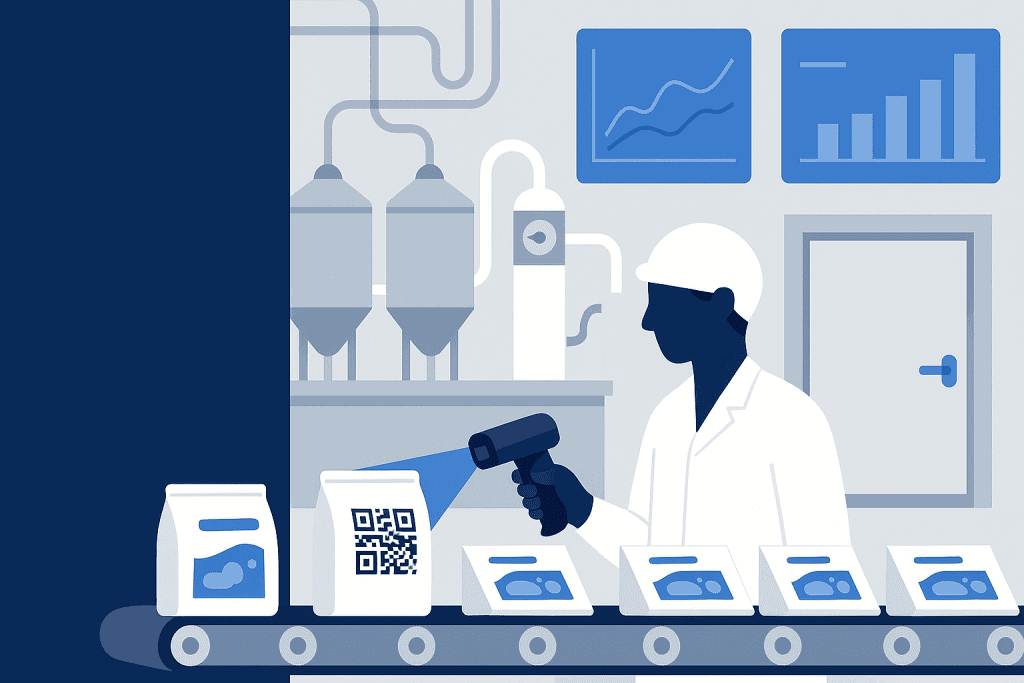
In 2026, a food factory traceability system has quietly stopped being a “good idea for later” and turned into something your customers expect you to be able to explain on demand. Walking the floors of Japanese-owned and multinational food plants across Thailand, we hear the same two admissions again and again.
> “We keep our lot records in Excel. But if a recall started tomorrow morning and somebody asked how many hours it would take us to identify every customer who received the affected product, honestly, nobody in this building could answer.” — QA manager, seasoning plant near Bangkok
> “Cold room temperatures are written on paper three times a day. Operators are supposed to note any excursion. The problem is that we cannot prove, after the fact, that the days with nothing written down were genuinely normal.” — Production control manager, frozen food plant, Eastern Seaboard
Neither plant lacks a system; both are staffed by people who record diligently. The problem is that the records do not survive in a form that is machine-readable, time-aligned and connected. The moment you try to run a mock recall, the Excel lot ledger, the handheld shipping data and the paper cold room log turn out to be three separate islands, and a human being has to reconcile them before anyone can answer a simple question. That is the honest starting point for a large share of food plants in Southeast Asia.
This article does three things. First, it sorts out the three external pressures now converging on food manufacturers: the revised US FSMA 204 timeline, GS1 Sunrise 2027, and Thailand’s Ministry of Public Health Ministerial Regulation No. 420. Second, it shows how to design the system itself using Key Data Elements (KDEs) and Critical Tracking Events (CTEs), and how far cold chain IoT monitoring can realistically be automated. Third, it lays out a 0–18 month implementation roadmap that has survived contact with actual factory floors in Thailand.
Why food factory traceability systems are under scrutiny in 2026
Traceability spent a long time being discussed as food safety idealism. The reason it has become an operational priority in 2026 is that deadlines are arriving almost simultaneously from three directions: regulation, standards bodies and commercial buyers.
FSMA 204 compliance moved to July 20, 2028 — and why that is not a reason to wait
The Food Traceability Final Rule, which implements Section 204(d) of the US Food Safety Modernization Act, originally carried a compliance date of January 20, 2026. In March 2025 the FDA announced a 30-month extension, and in August 2025 the proposed extension was published in the Federal Register, with public comment accepted until September 8, 2025 (sources: Federal Register, FDA).
In November 2025, the US Congress passed the Continuing Appropriations Act of 2026, which directed the FDA not to enforce the rule before July 20, 2028. The FDA has been operating in line with that direction, and the working compliance date for industry is now understood to be July 20, 2028. Part of the stated rationale for the delay was to allow smaller retail operators to comply without carrying disproportionate financial and logistical burdens.
At this point in most meeting rooms, someone says: “So we have until 2028.” We think that reading is risky, for three reasons.
First, FSMA 204 does not ask you to file a document. It asks you to run a process. What the rule requires is that KDEs (Key Data Elements) are captured at CTEs (Critical Tracking Events) as part of normal daily operations. That is not something you can outsource three months before a deadline. Lot numbering conventions, scanning at goods receipt, recording parent-child relationships at packing — these change how operators actually work, and making such changes stick is measured in years rather than weeks.
Second, the grace period was designed as a preparation period. Alongside the announcement of the extension, the FDA has been making new industry-facing resources available (source: Food Safety Magazine). The natural reading is that the extra time exists so that the industry can build properly, not so that it can defer.
Third, and in practice the most important: buyer requirements arrive before regulatory deadlines do. Suppliers shipping into US retail and foodservice chains are not audited on the FDA’s enforcement calendar; they are audited on their customers’ calendar. In our experience at TOMAS TECH, the question “how does your lot tracking work?” starts appearing in RFPs and annual audit checklists one to two years ahead of any regulatory date. For a plant in Thailand selling into a US or European buyer, that clock is already running.
What the extension bought the industry is not permission to do nothing, but the far more valuable option of designing the system calmly rather than under deadline pressure.
GS1 Sunrise 2027 and the GS1 2D barcode food manufacturers will be printing
The second deadline is Sunrise 2027, the GS1 initiative to move from 1D barcodes (the familiar UPC/EAN symbols) to 2D codes such as QR Code and Data Matrix. Under the initiative, retailers are working toward being able to scan both 1D and 2D symbols at point of sale by the end of 2027 (source: GS1 US).
Why does a barcode standard matter in a traceability discussion? Because the information capacity is not remotely comparable. A UPC/EAN barcode carries 12 characters — in practice, the GTIN and nothing else. A GS1-compliant 2D barcode can hold up to roughly 7,000 numeric digits, and when the correct GS1 data structure is used it can carry batch number, lot number, expiry date and serial number inside a single symbol (sources: GS1 US, Videojet).
Three options are identified for point-of-sale 2D symbols: GS1 DataMatrix, QR Code with GS1 Digital Link, and Data Matrix with GS1 Digital Link. Because UPC/EAN and 2D symbols will coexist during the transition, the pragmatic answer for most manufacturers is to print both.
From a plant perspective, however, the real value sits upstream of the checkout — inside the factory and in logistics. The same 2D code can be used to:
- scan at goods receipt and capture lot number and expiry date without any manual keying, and
- scan at the picking face to verify, in the moment, that the operator has selected the correct batch.
Removing manual keying is not simply a speed argument. Given that transcription error is the single largest source of noise in any traceability dataset, automating input is a data quality measure first and a productivity measure second.
Thai FDA, Ministerial Regulation No. 420 and the five GMP domains behind any HACCP system in Thailand
If you manufacture in Thailand, the Ministry of Public Health and the Thai FDA set the baseline. The central instrument is Ministerial Regulation No. 420 B.E. 2563 (2020), “Food Production Processes, Processing Equipment/Utensils and Storage Practices,” which was published on February 9, 2021 (source: Thai FDA).
The GMP it establishes is reported to cover the following five domains.
| Domain | Principal scope |
|---|---|
| 1. Location and buildings | Plant location, building structure, cleaning, maintenance |
| 2. Equipment and machinery | Production equipment, processing utensils, tools |
| 3. Process control | Control of the manufacturing process itself |
| 4. Sanitation | Cleaning, sanitising, drainage, waste management |
| 5. Personal hygiene | Employee hygiene management and training |
The operationally significant point is that the GMP recognised in Thailand may be Thai statutory GMP, Codex GMP, HACCP, ISO 22000, or a standard deemed equivalent to these. For a plant already running HACCP or ISO 22000, that means there is no requirement to build a parallel management system from scratch. Certain categories — food hawkers, fresh produce sorting facilities and salt production, among others — fall outside this GMP and are covered by separate regulation.
Equally important for our purposes: traceability is positioned as an inseparable part of the HACCP approach, useful for monitoring and identifying hazards across the supply chain. In other words, building a HACCP system in Thailand and building a traceability system are not two separate projects competing for the same budget. Your CCP monitoring records are already, in substance, a source of CTE data — they are simply sitting in a format nobody can query. For operators planning to export, conformity with international standards such as GHPs and HACCP is reported to be effectively mandatory.
Buyer pressure on food traceability in Thailand: even the import paperwork has changed
Alongside regulation, commercial pressure is rising. According to JETRO and Japan’s Ministry of Agriculture, Forestry and Fisheries, exports of agricultural, forestry, fishery and food products from Japan to Thailand reached JPY 73.5 billion in 2025, up 17.1% year on year, and the documentation required for imports into Thailand has been revised with traceability in mind (sources: JETRO, MAFF).
When import documentation requirements change, plants that source raw materials from Japan have to capture more information at goods receipt. And here the story loops back to the Excel ledger from the opening. More document fields means more transcription; more transcription means more errors. Adding fields without breaking that structural link simply converts regulatory change into unpaid overtime for your receiving clerks.
If your plant also runs its own warehousing and outbound distribution, the same data discipline question extends past the factory gate — we covered the warehouse side of this in detail in Southeast Asia Logistics DX 2026: Logistics AI, WMS and Warehouse Automation.
What a traceability system actually contains: thinking in KDEs and CTEs
When a plant tells us they want to implement traceability, our first question is never about a product name or a vendor shortlist. It is: “At which events will you capture data, and which data will you capture?” Those two axes are precisely what FSMA 204 calls CTEs and KDEs, and they determine everything downstream.
CTEs: where data gets captured
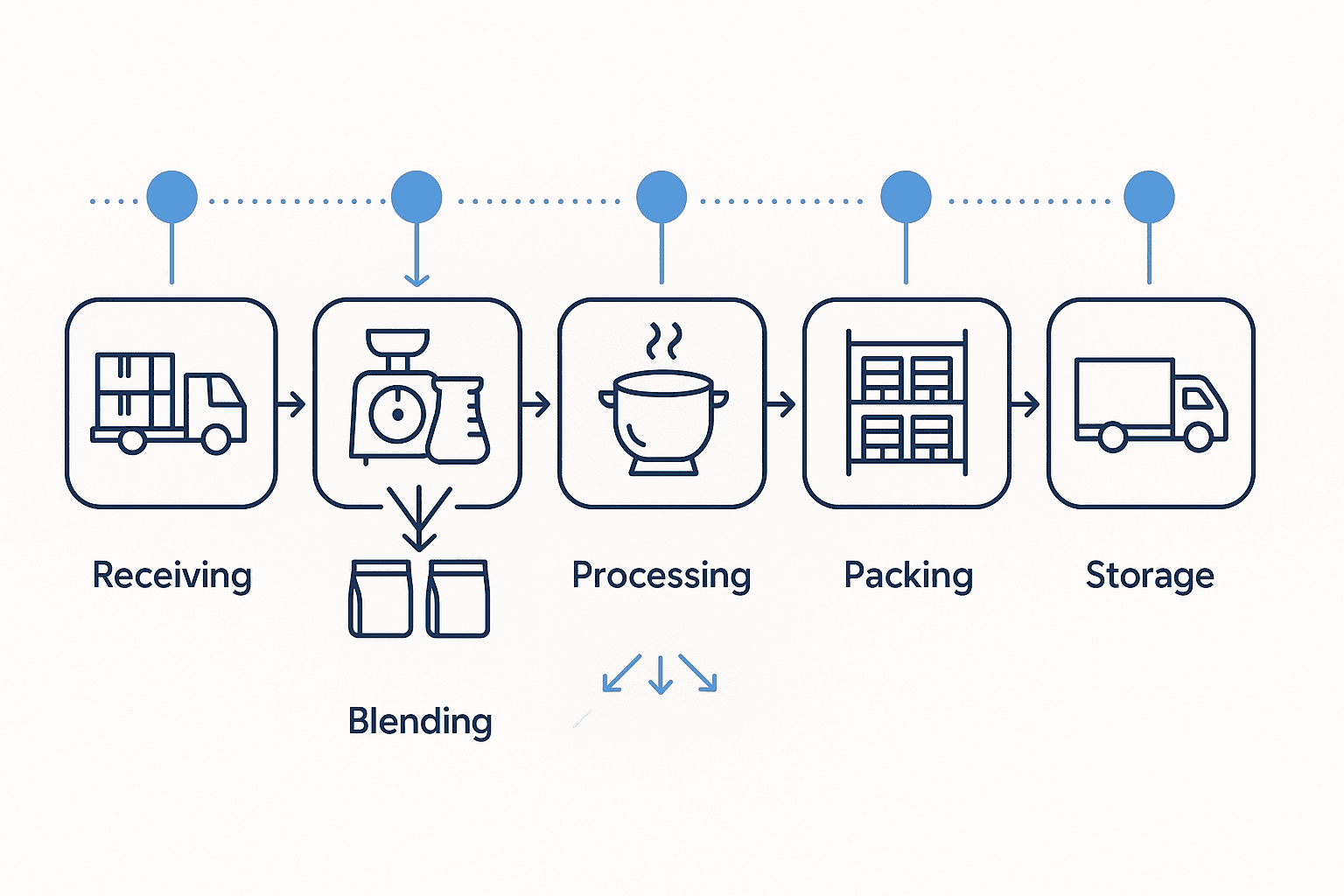
A Critical Tracking Event is a point in the flow of material where, if you fail to record, the chain becomes unrecoverable later. Mapped onto a typical food plant, it looks like this.
| CTE | What happens | Significance for tracing |
|---|---|---|
| Receiving | Raw material enters the plant | Junction between supplier lot and internal lot |
| Storage | Placement in warehouse or chiller | Start of storage condition (temperature) record |
| Weighing / blending | Several lots merge into one batch | Convergence point (many-to-one) |
| Thermal processing | Material physically becomes something else | Frequently coincides with a CCP |
| Filling / packing | One batch splits into many units | Divergence point (one-to-many) |
| Shipping | Product leaves the plant | Junction with the customer |
The hardest parts to design are the convergence and divergence points. Three lots of ingredient A and one lot of ingredient B go into a single tank, and 5,000 packed units come out the other end. If ingredient A lot 2 is later found to be defective, can you say which of those 5,000 units are affected? A system that cannot answer that question is not a traceability system, however impressive the dashboard looks.
The second commonly overlooked case is rework. When product rejected for a packaging fault is reintroduced into the next day’s batch, the lot genealogy branches. If your SOPs permit rework — and almost all of them do — your system needs a CTE for it. The moment anyone says “we’ll handle the exceptions in Excel,” the chain is cut at that point, and every trace crossing it becomes a manual investigation.
KDEs: what gets captured
KDEs are the data items recorded at each CTE. A workable minimum set is:
- What: item code (GTIN or equivalent), item name
- How much: quantity and unit of measure
- Which lot: lot / batch number, expiry or best-before date
- When: timestamp — the actual event time, not the shift date
- Where: site, line and equipment identifiers
- Who: operator ID (which also links accountability to training records)
- From / to: supplier and customer identifiers
What causes trouble in practice is rarely the number of fields. It is identifier consistency. The same raw material is “Material code A-1023” in the purchasing system, “the A powder” on the whiteboard by the mixing line, and something else again in the Excel ledger. A human being reconciles those three effortlessly. Software cannot. In our experience at TOMAS TECH, something like 80% of the real work in KDE design is master data cleansing and agreeing a single numbering convention.
Choosing granularity for lot tracking in food manufacturing
“How fine should a lot be?” is a perennial argument. Finer lots narrow the recall scope but increase the recording burden on the floor. We suggest deciding on three criteria.
- How much are you willing to lose in a recall? One lot per day means a recall reaches an entire day’s production. Half-day lots, or lots delimited by CIP cleaning cycles, narrow that scope considerably.
- What is the physical mixing unit? If material blends in a tank or silo, defining a finer lot on paper below that unit is fiction.
- What can be captured automatically? If a human has to handwrite it, granularity will stay coarse forever. If equipment or a scanner captures it, finer lots cost almost nothing extra in labour.
The third criterion is the decisive one. How fine you can go is determined by how much of the recording you can automate. Read in reverse, this means investment in IoT and scanning delivers not just labour savings but a genuine risk reduction in the form of a smaller recall footprint.
From “one step back, one step forward” to a full internal chain
The regulatory floor for traceability is the familiar “one step back, one step forward” — knowing who supplied you and who you sold to. On paper, most plants already clear this bar.
The differentiator is internal traceability. When the span between the received lot and the shipped lot is a black box labelled “the factory,” any external enquiry forces you to define the recall scope as *every shipment in the relevant period*. When the internal genealogy is connected, that scope shrinks by an order of magnitude, sometimes two.
The target we set with clients is straightforward: from a given received lot, a staff member should be able to produce the list of affected customers without leaving their desk. If you want a numeric goal, plants commonly adopt an internal KPI of four hours initially, tightening toward one hour as the system matures. These are operational targets we recommend, not figures mandated by any regulation.
Cold chain IoT monitoring for food factories
If traceability answers “which lot went where,” the cold chain answers “was that lot kept in the right condition on the way.” In food manufacturing the two questions are inseparable.
Thailand’s cold chain market and the 2026 investment picture
According to Ken Research, Thailand’s cold chain market is expected to exceed THB 20 billion in 2026, driven by growing demand for frozen food products and the growth of the food delivery business (sources: PR Newswire / Ken Research).
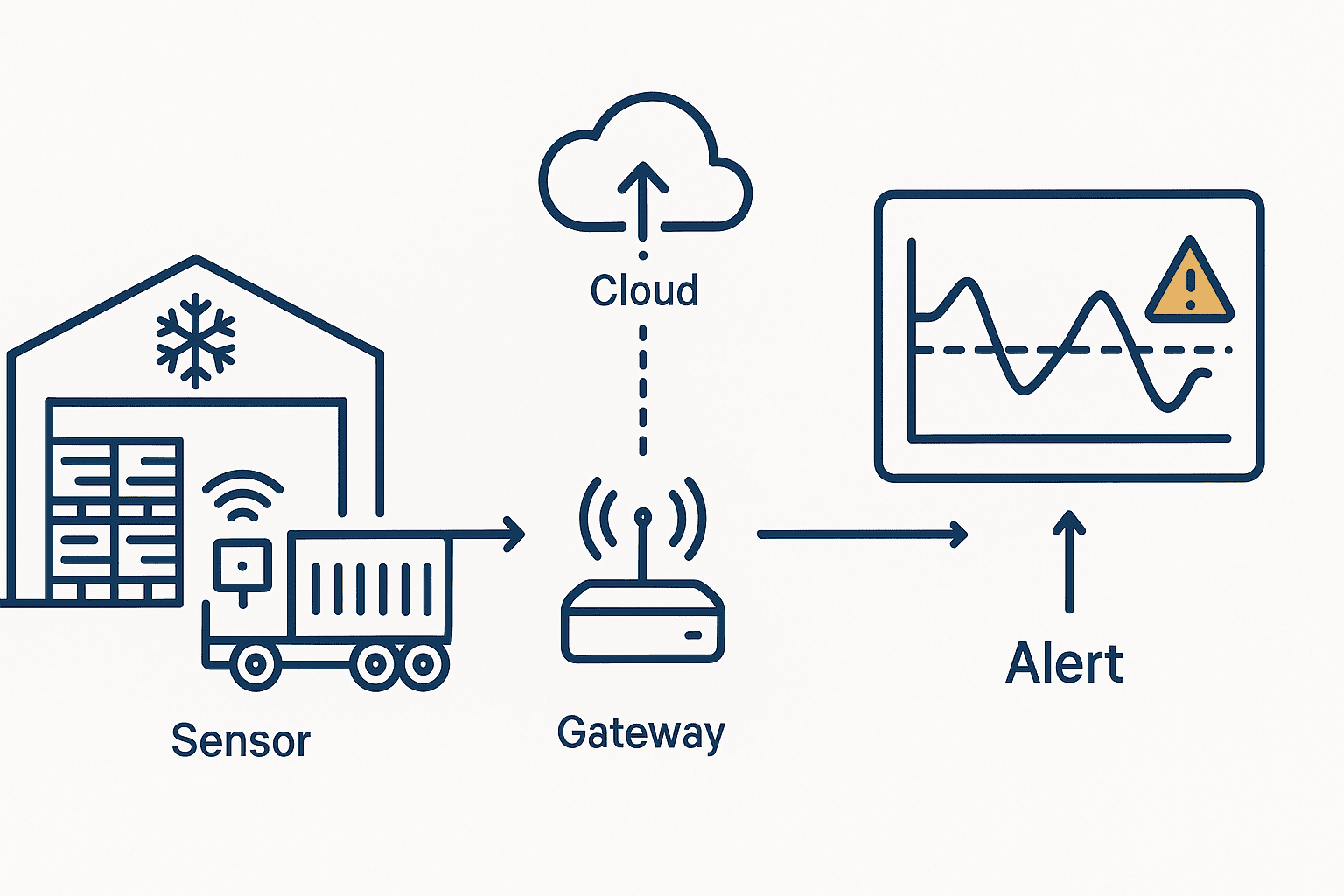
On the technology side, IoT-enabled temperature monitoring is reported to allow cargo to be monitored around the clock and makes temperature recording considerably easier than manual methods. In 2026, industry players are reported to be prioritising investment in IoT monitoring for real-time temperature control alongside more advanced picking intelligence. Advances in IoT, AI and cloud technology are reported to have made cold chain monitoring systems more efficient, lower cost and more accessible (source: MarketsandMarkets).
That last point matches what we see. A few years ago the per-point cost of a temperature sensor meant you instrumented only the most critical locations. Today, wireless sensors retrofitted to existing refrigeration equipment plus a gateway will cover a far wider area for the same budget.
What the Chanthaburi–Rayong–Trat reefer pilot teaches factory teams
One of the more useful Thai data points comes from a 2026 study published in ScienceDirect. It examines deep-sea reefer transport from the eastern coastal “three-province cluster” — Chanthaburi, Rayong and Trat, which accounts for the majority of Thailand’s durian and mangosteen production — to wholesale markets in China.
The study identifies where excursions actually occur: the chain is reported to be particularly vulnerable to temporary temperature excursions at port handover, at customs inspection points, and at inland distribution hubs. Put plainly, excursions cluster not during transit but at transfers and stops.
The instrumentation is equally concrete. Each reefer was fitted with a DS18B20 temperature sensor and a humidity sensor, logging at 15-minute intervals, with smart contracts on a blockchain performing automated data validation and anomaly detection on a 15-minute cycle (source: ScienceDirect).
We draw two lessons for plant teams. The first is that a 15-minute logging interval is a defensible practical benchmark. It is a fundamentally different class of evidence from three manual readings a day. The second is that if you must choose where to monitor, start at handover and stop boundaries. Before the budget exists to instrument everything, the boundaries where custody changes hands are the rational first target.
How far in-plant temperature monitoring can realistically be automated
“IoT temperature monitoring” covers four quite different targets, with very different implementation difficulty and cost. It helps to separate them explicitly rather than discussing them as one line item.
| Target | Difficulty | Main considerations |
|---|---|---|
| Chilled / frozen warehouses | Low | Wireless retrofit is straightforward. Start here |
| Thermal processing and sterilisation equipment | Medium | Requires signal capture from existing instruments. Directly tied to CCPs |
| Transport (reefers) | Medium to high | Connectivity gaps, requires carrier cooperation |
| Work in progress inside the process | High | Defining measurement points is genuinely hard. Defer |
The sequence that holds up best on return on investment is continuous monitoring of chilled and frozen storage → CCP data capture from thermal equipment → transport. Warehouse monitoring produces an easily demonstrated labour saving by retiring paper logs, and it contributes directly to food loss reduction through excursion alerts that reach someone while the product can still be saved.
Alert design deserves more care than it usually gets. Set the thresholds too tightly and an alert fires every time a door opens; within a few weeks nobody looks at them. What we recommend is triggering on sustained deviation over a defined period rather than instantaneous readings, and — more importantly — deciding who receives each alert and what they are required to do before you switch notifications on. Define the operating procedure first, then the technology. That principle does not change here.
Temperature data only becomes evidence when it is joined to a lot
The most important point comes last. You can accumulate a year of temperature logs and still have nothing usable: if you cannot say which lot the data corresponds to, the log is not traceability evidence.
Given a record showing “chiller 2 exceeded its limit between 14:00 and 15:30 on 15 July,” the next question is immediate: which lots were physically in chiller 2 during that window? Answering it requires stock movement records — the location history of inventory — to be joinable with temperature logs on a common time axis.
This is exactly where standalone temperature monitoring deployments break down. Temperature lives in one system, inventory in another, and every excursion triggers a human reconciliation exercise. The problem from the opening of this article reappears, only now with better graphs. Before asking how many sensors to install, decide how that data will be joined to inventory and lot records.
Thailand’s regulatory environment, BOI and the Future Food strategy
So far this has been a technology and operations discussion. For the investment case, the Thai policy context is worth understanding as well — including where it does *not* support the argument you might want to make.
The five GMP domains and equivalence with HACCP and ISO 22000
As noted, the GMP established by Ministerial Regulation No. 420 B.E. 2563 (2020), published on February 9, 2021, covers location and buildings, equipment and machinery, process control, sanitation and personal hygiene. And Thai statutory GMP, Codex GMP, HACCP, ISO 22000 or an equivalent standard are all reported to be acceptable.
That equivalence has a direct bearing on how you scope a system investment. A plant already operating ISO 22000 or FSSC 22000 has documented most of the required records. What is actually needed is moving those records from paper and spreadsheets into a machine-readable form — not rebuilding the management system.
Framed that way, a traceability project for most plants is a project to make what you already do searchable. That framing matters more than it sounds, because it substantially lowers internal resistance. “We are adding new rules” provokes pushback from every department. “The rules stay the same; the way we record them changes” does not.
Reading BOI’s Q1 2026 investment figures honestly
The Thailand Board of Investment numbers are worth a look. BOI investment applications in Q1 2026 are reported to have exceeded THB 1 trillion across 624 projects, 2.4 times the same quarter a year earlier, of which FDI accounted for more than THB 965 billion. Leading sources of investment are reported to include Singapore, the United Kingdom and Japan, with projected job creation of over 42,000 (source: thailand.go.th).
It would not be honest, however, to present that headline as a food industry story. The same source reports that data centre investment alone accounts for roughly 86% of the total value. The overwhelming majority of the money is digital infrastructure; food processing is a small share of it.
That said, the priority sectors are reported to include electronics, clean energy, agriculture and food processing, and high-value logistics services. So the fair reading is not “BOI subsidises food traceability investment.” It is the more modest “agriculture and food processing remains one of BOI’s priority sectors.”
BOI does provide tax and non-tax incentives to the food industry, but whether a specific automation or digitalisation investment qualifies depends on project-specific conditions. Whenever a client wants to build a BOI assumption into a capital request to regional or global head office, we recommend confirming eligibility with BOI or a qualified adviser in advance.
Future Food and the USD 16 billion target for 2030
The second policy thread is Thailand’s “Future Food” strategy. As part of a ten-year plan, Thailand is reported to be targeting a future food industry worth USD 16 billion by 2030, with a goal of generating more than USD 15 billion in the sector by 2027. Future food is reported to include plant-based proteins, insect-derived ingredients and personalised nutrition, with the government providing R&D-focused support and aiming to position the country as a regional leader (sources: Viettonkin Consulting, Food Manufacturing).
These new categories share a useful characteristic: the provenance story *is* the product value. Whether the product is a plant-based protein or an insect-derived ingredient, both consumers and distributors ask where it came from and how it was made. This is the segment where traceability stops being a compliance cost and becomes a marketing asset. Using a GS1 Digital Link encoded in a 2D barcode, a shopper scanning a pack can be taken directly to an ingredient provenance page, which is already technically achievable today.
What we at TOMAS TECH have seen inside food plants
The following reflects what we have observed implementing systems for Japanese-affiliated manufacturing and logistics sites in Thailand and neighbouring countries. It is our own view rather than a general principle, and should be read as such.
PEGASUS production management and lot tracking
Our work centres on PEGASUS, our in-house production management system, which covers order intake, production instruction, shop floor data collection, inventory and shipping. In food plant deployments, the discussion always converges on how to represent the merge and split points described earlier in the master data design.
In discrete manufacturing, where components are assembled, the bill of materials forms a reasonably clean tree. Food is different. Recipes drift daily with yield and raw material moisture, and substitutions to alternative ingredients happen. Build the model on the theoretical BOM alone and the gap between theory and actual consumption accumulates until traces no longer reconcile.
What we recommend is a design that holds the theoretical formulation and the actual issued quantities separately, and links the actually issued lots to the production order. It is unglamorous data modelling, and it is the single largest determinant of whether recall simulation results can be trusted.
AI-OCR: connecting receiving paperwork to lot data
Traceability starts at receiving, and most of the information handled at receiving still arrives as paper and PDF: invoices, packing lists, certificates of analysis (COA), import permit documentation. In Thailand these routinely arrive in a mix of Japanese, English and Thai.
We build AI-OCR automation for customs and order documents, and the highest-value application in a food plant is extracting lot number, production date and expiry date from COAs and delivery notes and posting them automatically to the goods receipt record. Fields a human used to read and retype are captured by machine, which reduces transcription error and shortens receiving time in the same stroke.
AI-OCR is not magic, however. Accuracy degrades with suppliers whose formats change every shipment and with forms containing handwriting. Our standard approach is a hybrid one: attach a confidence score to each extracted value and route only those below the threshold to a human for verification. The goal is not full automation; it is shrinking the set of documents a person must look at.
Decide this before you install a single sensor
IoT equipment data collection is also within our scope, and the first question we ask is never “how many sensors do you want?” It is “who will look at this data, and what decision will they make with it?”
Temperature data that nobody acts on when it deviates is simply a larger pile of records. Conversely, once the rule is defined — “if the deviation persists for 15 minutes, notify the QA group chat and place the affected lot on hold” — the required number of sensors and the necessary system integrations follow almost automatically from that sentence.
IoT creates value only when a business process exists first. We learned that the expensive way, more than once.
Without structured data, neither AI nor automation will work
Requests for AI-based anomaly detection and AI agents that generate reports automatically have increased sharply. We are supportive of the direction. But almost without exception, projects collide with the same wall: data structure.
Temperature is on paper. Lots are in Excel. Shipping records sit in a separate system. COAs sit in a PDF folder on a shared drive. Ask an AI to “determine the recall scope” against that estate and the answer will not be reliable — the limitation is not model capability, it is input.
We regard building the traceability foundation as the groundwork for any serious AI initiative. Holding KDEs and CTEs in machine-readable form is, definitionally, holding your operational data in a form an AI can read. We explore that argument further in AI Agents in Manufacturing 2026: A Practical Guide for Thai Plants, which is worth reading alongside this piece if AI adoption is on your roadmap.
More broadly, as regulation tightens and buyer requirements rise in Thailand’s food sector, we see visibility over quality, temperature, lot and yield as the decisive area for reducing both food loss and risk.
A 0–18 month roadmap for implementing a food factory traceability system
Finally, a practical sequence on a timeline. The durations are indicative and will shift with plant size, SKU count and the state of existing systems.
Phase 0: Inventory the current state (months 0–1)
The first task is not system selection. It is an inventory of what records exist, where, and in what form. Compile the following into one table.
- Name of the record (e.g. chiller temperature log)
- Medium (paper / Excel / existing system / equipment’s internal log)
- Who records it, and how often
- Where it is stored, and for how long
- Whose requirement it exists to satisfy (law / certification / customer / internal)
That last column earns its place. Every inventory we have run has uncovered records that nobody requires and that continue purely from habit. Stopping them is the first tangible benefit the shop floor receives from the project. Removing one burden before introducing a new system materially changes how the project is received.
Phase 1: Define the trace unit (months 1–3)
Next, decide what constitutes one lot for each product family. This is a management decision, not a technical one. Work through the three criteria above — acceptable recall loss, physical mixing unit, and what can be captured automatically — and drive to a definition that QA, production, logistics and sales all sign up to.
At the same time, fix the numbering convention. Will the lot number embed the date and the production line, or will it be a meaningless sequential number? We usually recommend a compromise: the minimum human-readable information (typically a date) plus a sequence. Encode too much meaning and you lose the ability to change the rule later without invalidating history.
Phase 2: Data diagnosis (months 2–4)
Assess the quality of existing data. Three things matter most.
- Identifier consistency: does the same item and the same supplier carry the same code across systems?
- Missing values: what proportion of records have blank lot numbers or expiry dates?
- Timestamp precision: does the record capture the shift date, or the actual event time?
A poor result here is not a failure. It is the information you need to size the remediation work. In our experience, the projects that skip this diagnosis are precisely the ones that overrun budget in later phases.
Phase 3: Proof of concept (months 4–8)
Do not go plant-wide immediately. Run a PoC scoped to one line and one product family. The evaluation criterion is not “did the software run.” It is these three:
- Does a recall simulation complete within the target time? (for example, four hours)
- Has floor-level task time increased? (if it has, the design is wrong, not the operators)
- Do the exceptions work? (rework, emergency shipments, manual fallback)
The third is the most important. Every system handles the happy path. Systems are differentiated entirely by exception handling, and a PoC that skips it guarantees off-system workarounds in production.
Phase 4: Guardrail design (months 6–10)
Before go-live, write down the rules for deviations.
- When a temperature excursion occurs, is the affected lot placed on hold automatically?
- Whose approval is required to release a hold?
- If a lot number cannot be read, does work stop, or does it proceed on a provisional entry?
- If provisional entry is used, by when and by whom must it be confirmed?
How much authority to give the system to *stop* work needs careful debate. Too strict and the line halts, at which point the floor invents a workaround that defeats the control. Too loose and gaps appear in the record. We generally favour a staged approach: warnings only at first, switching to hard blocks once the process is embedded.
Phase 5: Go-live (months 9–14)
Promote the validated scope into production. The critical decision at this stage is to fix the duration of parallel running with the old records in advance. “We’ll keep the paper going until the new system is stable,” with no end date, becomes permanent double entry within a quarter. Cap it at two to three months and agree the exit criteria before you start.
Phase 6: Roll-out (months 12–18)
Extend to the remaining lines. Only at this stage does return on investment become visible in the numbers. The key question during roll-out is whether the design produced in the PoC can be replicated as-is. Accumulate per-line customisations and maintenance cost grows faster than linearly.
How to think about cost and ROI
Actual figures vary so widely with plant size and scope that quoting a market rate would be misleading. Instead, here are the cost lines to insist on when comparing quotations.
| Cost line | Contents | Commonly overlooked |
|---|---|---|
| Software | Licences / subscriptions | Unit price as user count grows |
| Hardware | Handhelds, label printers, sensors, gateways | Need for waterproof, dustproof, low-temperature rated devices |
| Network | Wireless coverage inside chillers and outdoors | Metal and low temperature degrade RF propagation |
| Data preparation | Master data cleansing, legacy data migration | The single largest source of cost variance |
| Training and adoption | Floor training, multilingual materials | Thai, Japanese and English running in parallel |
| Maintenance | Annual support, sensor battery replacement | Battery replacement labour is larger than expected |
When presenting ROI — particularly to a regional or global head office that is comparing your request against projects in other countries — put risk reduction next to labour saving, not instead of it. Labour saving (time spent recording, transcribing and reconciling) is easy to quantify but rarely large in absolute terms. The heavier items are narrower recall scope, reduced disposal loss, lower audit effort, and the continuation of the customer relationship itself. A traceability capability that is a condition of supply is not a productivity project; it is market access, and it should be argued as such.
Frequently Asked Questions
Where should a food factory traceability system implementation start?
Before selecting a system, start with defining the trace unit (lot or batch) and standardising the numbering convention. Deploy a tool while that remains ambiguous and you will rebuild it later regardless of which product you chose. After that, begin where automation delivers the most benefit and reduces rather than increases floor workload — specifically scan-based capture at goods receipt and automatic temperature logging in chilled and frozen storage. Those two produce early wins. Detailed tracking of work in progress inside the process is genuinely difficult and can safely wait.
FSMA 204 compliance moved to 2028 — is there still a reason to act now?
The working enforcement date is reported to be July 20, 2028, but in our view that is not a reason to defer. The KDE and CTE records FSMA 204 requires involve changing daily operating procedures, and embedding those changes takes years rather than months. More immediately, buyer audits and RFP questionnaires arrive well before the regulatory date. The FDA is reported to have released new industry resources alongside the extension announcement, which supports reading the grace period as preparation time. Note also that GS1 Sunrise 2027 — retailers aiming to scan both 1D and 2D symbols at POS by the end of 2027 — arrives first, so the labelling and barcode workstream is on an earlier schedule than the FSMA date implies.
What does it cost to digitise a HACCP system in Thailand?
Costs vary too much with plant size, SKU count and existing systems for a single benchmark to be meaningful. When comparing proposals, compare total cost including not only software licences but hardware such as handhelds and sensors, wireless coverage work inside chillers and outdoors, data preparation including master data cleansing, multilingual floor training, and annual maintenance. Data preparation is typically the largest source of variance, and any proposal that excludes it tends to generate change orders later. One mitigating factor: because Thai statutory GMP, Codex GMP, HACCP, ISO 22000 and equivalent standards are all reported to be accepted under Ministerial Regulation No. 420, a plant already running HACCP or ISO 22000 can scope the project as “replacing the recording method” rather than rebuilding the management system, which can meaningfully reduce cost.
How far can cold chain IoT monitoring be automated in a food plant?
Continuous monitoring of chilled and frozen storage is comparatively easy to automate with retrofit wireless sensors and a gateway. Thermal processing and sterilisation equipment is moderately difficult because it requires signal capture from existing instruments; transport (reefers) is medium to high difficulty due to connectivity gaps and the need for carrier cooperation; and work in progress inside the process is hard because defining measurement points is genuinely ambiguous. On logging frequency, the reefer pilot in Thailand’s eastern three-province cluster (Chanthaburi, Rayong, Trat) offers a useful reference point, using DS18B20 temperature sensors and humidity sensors logging at 15-minute intervals. The decisive factor, however, is not sensor count but whether the temperature data can be joined to inventory location history and lot records. Deploy monitoring without designing that join and every excursion still ends in a manual reconciliation.
Can a smaller plant justify the investment in lot tracking for food manufacturing?
The smaller the operation, the harder it is to justify on labour savings alone. We recommend quantifying the risk reduction explicitly and presenting it alongside: narrower recall scope (finer lot granularity means less product destroyed when a recall happens), reduced disposal loss through early detection of temperature excursions, lower effort responding to audits and customer enquiries, and the value of retaining the customer relationship at all. Starting with a single-line PoC and expanding only after the effect is confirmed also keeps initial capital exposure low. In addition, agriculture and food processing is reported to be one of BOI’s priority investment sectors in Thailand, and BOI provides tax and non-tax incentives to the food industry. Because eligibility for automation and digitalisation investment depends on project-specific conditions, we recommend confirming applicability with BOI or a specialist adviser before building it into your business case.
Conclusion
Here is the 2026 picture for food factory traceability, expressed in the numbers that matter.
- FSMA 204: the original compliance date was January 20, 2026, but the FDA announced a 30-month extension in March 2025. In November 2025 the US Congress passed the Continuing Appropriations Act of 2026, directing that the rule not be enforced before July 20, 2028 (sources: Federal Register, FDA). We read that window as build time, not idle time.
- GS1 Sunrise 2027: retailers are working toward scanning both 1D and 2D symbols at POS by the end of 2027. A 2D barcode can hold up to roughly 7,000 numeric digits, carrying batch, lot, expiry and serial data (source: GS1 US).
- Thai FDA: Ministerial Regulation No. 420 B.E. 2563 (2020) was published on February 9, 2021. Its GMP covers five domains, and Thai GMP, Codex GMP, HACCP and ISO 22000 or equivalents are reported to be accepted (source: Thai FDA).
- Cold chain: Thailand’s market is expected to exceed THB 20 billion in 2026 (source: Ken Research). The eastern three-province reefer pilot used DS18B20 sensors logging at 15-minute intervals (source: ScienceDirect).
- Investment climate: BOI applications in Q1 2026 are reported at over THB 1 trillion across 624 projects, 2.4x year on year, with FDI above THB 965 billion — but data centres account for roughly 86%, so food processing is a small share (source: thailand.go.th). The Future Food strategy targets USD 16 billion by 2030 (sources: Viettonkin Consulting, Food Manufacturing).
- Japan to Thailand: 2025 exports of agricultural, forestry, fishery and food products reached JPY 73.5 billion, up 17.1% year on year, and import documentation has been revised with traceability in mind (sources: JETRO, MAFF).
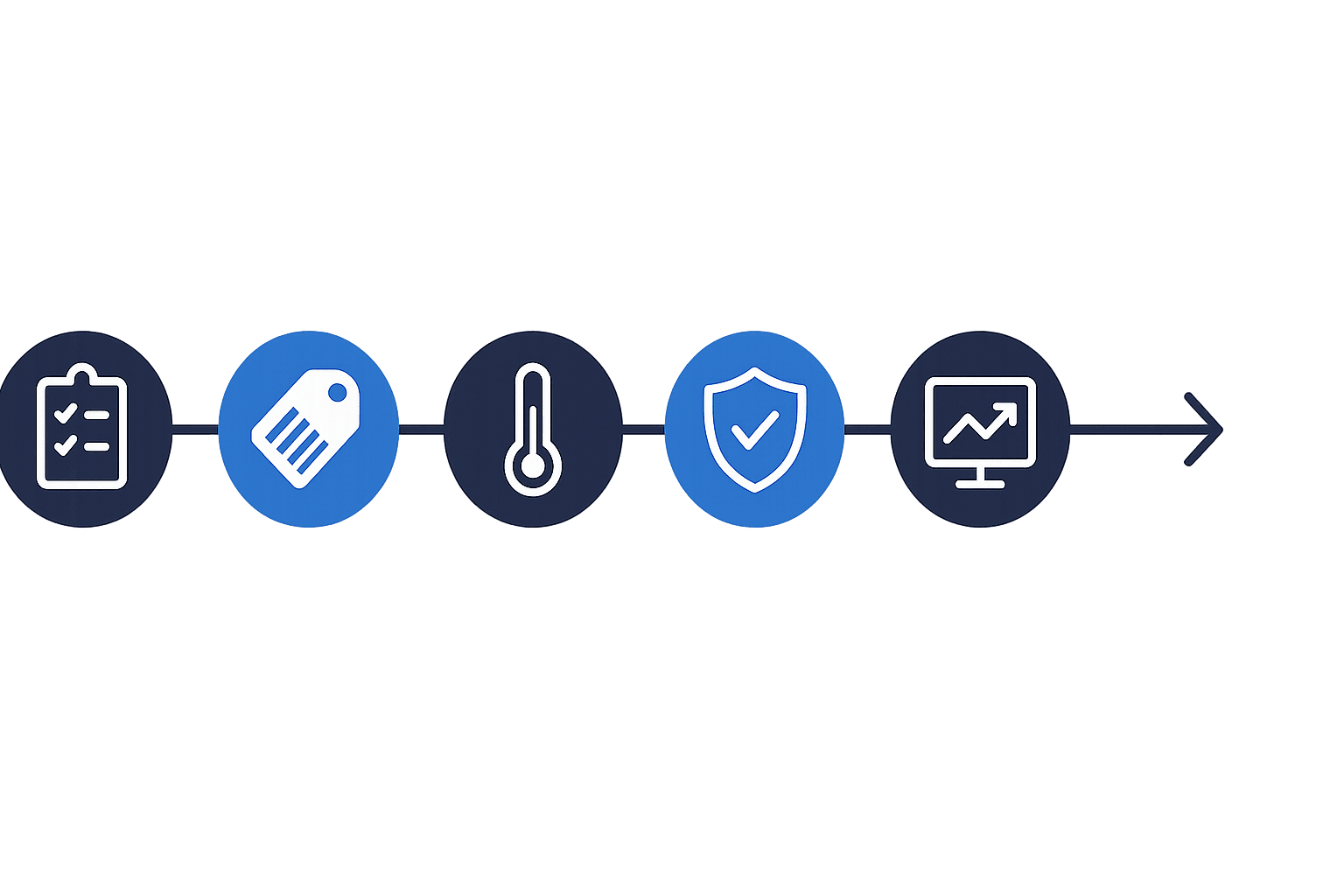
The practical conclusion is simple. A traceability system is a data design problem, not a software purchase. Which events (CTEs), which data (KDEs), at which granularity. Start comparing vendors before those three are settled and you will rebuild the system.
The goal for the period from 2026 to 2028 is not certification, and it is not a dashboard. It is being able to answer the question from the opening of this article — *if a recall started tomorrow, how many hours would it take to define the scope?* — with confidence, and with evidence.
TOMAS TECH CO., LTD. is based in Bangkok and implements systems for Japanese-affiliated manufacturing and logistics sites in Thailand and neighbouring countries. Around our in-house PEGASUS production management system, we deliver IoT equipment data collection, AI-OCR automation for customs and order documentation, and energy management as an integrated capability. We are equally happy to be engaged early — “we want to start by inventorying our current records” or “we want to pressure-test how to scope a PoC” are perfectly good places to begin. Please get in touch.
References
- Federal Register (FSMA 204 compliance date extension): https://www.federalregister.gov/documents/2025/08/07/2025-14967/requirements-for-additional-traceability-records-for-certain-foods-compliance-date-extension
- Food Safety Magazine (new FDA FSMA 204 resources after the extension): https://www.food-safety.com/articles/10591-after-extending-compliance-date-fda-offers-new-fsma-204-resources-for-industry
- U.S. FDA (Food Traceability Final Rule): https://www.fda.gov/food/food-safety-modernization-act-fsma/fsma-final-rule-requirements-additional-traceability-records-certain-foods
- inecta (FSMA 204 compliance guide): https://www.inecta.com/blog/fsma-204-compliance-guide
- GS1 US (Sunrise 2027): https://www.gs1us.org/industries-and-insights/by-topic/sunrise-2027
- Videojet (GS1 Sunrise 2027 explainer): https://www.videojet.com/us/homepage/resources/learn/gs1-sunrise-2027.html
- Thai FDA (Good Manufacturing Practice / GMP): https://en.fda.moph.go.th/entrepreneurs-food/good-manufacturing-practice-gmp-01
- Artixio (Thailand FDA regulations for food manufactured or imported in Thailand): https://www.artixio.com/post/thailand-fda-regulations-of-food-manufactured-or-imported-in-thailand
- Pro Industrial Solutions (6 things to know about establishing a GMP food factory in Thailand): https://en.proindsolutions.com/17470879/6-things-to-know-about-establishing-a-gmp-food-factory-in-thailand
- thailand.go.th (BOI investment applications, Q1 2026): https://thailand.go.th/issue-focus-detail/thailands-boi-investment-applications-surge-past-1-trillion-baht-in-q1-2026-led-by-digital-and-ai-boom
- Viettonkin Consulting (Thailand food processing industry): https://viettonkinconsulting.com/accounting-and-finance/thailand-food-processing-industry/
- Food Manufacturing (A Taste of Thailand): https://www.foodmanufacturing.com/home/article/13245452/a-taste-of-thailand
- PR Newswire / Ken Research (Thailand cold chain market): https://www.prnewswire.com/news-releases/thailand-cold-chain-market-is-expected-to-generate-more-than-thb-20-bn-in-2026f-due-to-growing-demand-for-frozen-food-products-growth-in-food-delivery-business-ken-research-301718973.html
- MarketsandMarkets (cold chain monitoring market): https://www.marketsandmarkets.com/Market-Reports/cold-chain-monitoring-market-161738480.html
- ScienceDirect (IoT and blockchain pilot for Thai fruit exports, 2026): https://www.sciencedirect.com/science/article/pii/S2772502226006323
- JETRO (Thailand agriculture, forestry, fishery and food export platform materials): https://www.jetro.go.jp/ext_images/agriportal/platform/th/pf_th.pdf
- Ministry of Agriculture, Forestry and Fisheries of Japan (export information for Thailand): https://www.maff.go.jp/j/shokusan/export/Tai.html
- TOMAS TECH (Southeast Asia Logistics DX 2026): https://tomastc.com/en/blog/logistics-dx-southeast-asia-2026-en/
- TOMAS TECH (AI Agents in Manufacturing 2026): https://tomastc.com/en/blog/ai-agent-manufacturing-2026-en/


