


Introduction: Three Things to Decide Before Using Generative AI for PLC Programming
More and more factories are asking whether generative AI can be used for PLC programming. The ladder left behind by a predecessor is hard to read. The comments are still in Japanese, so Thai maintenance staff cannot read them. Even a small modification means waiting for an outside system integrator’s quote and schedule. Against this background, major PLC and factory automation vendors announced generative AI features one after another between 2024 and 2026. Some are already on sale, and some are still under development.
In this article, we take the view that what you decide first is not the name of a tool, but the following three things.
- (1) The scope of tasks given to AI (which to start with among new development, modification, reading and commenting existing code, review, test creation and documentation)
- (2) The verification steps for AI output (compilation, static checks, simulation or virtual commissioning, FAT and SAT on the real equipment, and human review and approval)
- (3) Where source code and equipment information are sent (cloud or local, whether it is used for training, and whether it conflicts with non-disclosure agreements with customers)
Every major vendor that addresses human involvement describes its features on the premise that a person checks the output before it is used. Research has also reported that valid programs are hard to obtain without built-in verification tools. In the official abstracts and clauses of the standards we checked, we found no provision that decides whether AI-written code is permitted or not. On the other hand, whether the author is a person or AI, it is required that errors in control logic do not create hazards, and verification and version control of modifications are required. That is why our editorial view is to write the task scope, verification and data destination into internal rules and RFPs, and confirm them at FAT and SAT.
This article is not a recommendation or ranking of specific products. Product features are presented as each company’s own description. The cost model in the second half uses hypothetical figures prepared for this article. The basics of PLCs and ladder logic are covered in “What Is a PLC? Basic Mechanism and How to Choose“, so this article focuses on situations where generative AI is used.
Why Is Generative AI for PLC Programming Getting Attention Now?
The reason it is getting attention is that products from major vendors have appeared one after another over the last one to two years. Here are the main developments, within what we could confirm as of October 15, 2026.
Siemens states that it announced the “Eigen Engineering Agent” at Hannover Messe on April 20, 2026, and began selling it the same day. According to the company, the launch followed pilots with more than 100 companies in 19 countries. The name moved from “Industrial Copilot” through “Engineering Copilot TIA” (Preview and beta), and the current product name is Eigen Engineering Agent. As a figure based on pilot results, the company states that engineering efficiency improved by up to 50%. This is the company’s own claim and cannot be compared with figures from other companies measured under different conditions.
Rockwell Automation announced an expanded collaboration with Microsoft on November 19, 2024, and stated in that announcement that it had added a generative AI Copilot to its design software FactoryTalk Design Studio. The current product page also introduces AI Plan & Build Agents and emulation in the cloud.
CODESYS Group states that it offers the “CODESYS Development System MCP Server”, which allows AI systems to operate the development environment, as a standalone product. Beckhoff announced that it had developed the TwinCAT Chat of 2023 into TwinCAT CoAgent in April 2025. However, the status on the TE1700 product page is “product announcement”, and we could not find any statement indicating general availability.
Among Japanese manufacturers, Mitsubishi Electric has presented a ladder generation AI, and OMRON has presented “OMRON Automation Teams (tentative name)”, at a trade show (IIFES 2025) and in interviews. Both are under-development content explained at the trade show and in interviews, and as of October 15, 2026, we could not confirm any launch announcement. For KEYENCE, we could not confirm an official announcement of generative AI features.
Here is some brief background on the Thai side. According to the Thailand Board of Investment (BOI), investment promotion applications in 2025 totaled THB 1,876.6 billion (3,370 projects), up 67% year on year. This is an application-based figure, not an approved amount or actual investment. FDI applications from Japan were THB 119.1 billion across 311 projects. In addition, according to a law firm’s commentary, BOI Announcement 4/2569 (published in the Royal Gazette on March 31, 2026) promotes investment in automation and robotics for automotive manufacturing (categories 3.6 and 3.8). Whether automotive parts, electronic components or food factories are covered as they are cannot be confirmed from this source. On the talent side, Kasikorn Research estimates that Thailand will need about 1.1 million highly skilled workers in 2025 to 2029. Meanwhile, the share of STEM graduates fell from 23.2% in 2020 to 22.3% in 2025. In this article, we see the background as demand to speed up, even a little, the understanding and modification of existing programs while people who understand control systems are limited.
What Generative AI Can Do for PLC Programs: Six Types of Tasks
Based on each company’s description, we divide the PLC programming tasks that generative AI touches into six types. Which task to start with is the starting point for Rule (1), discussed later.
The first is new development. Siemens lists generation of SCL and LAD on the Eigen Engineering Agent product page. CODESYS states that POUs and PLC code can be generated via the MCP Server.
The second is modification. Siemens lists revising existing code, and Mitsubishi Electric has shown a demo in which, given an existing ladder, its comments and modification instructions, the AI outputs the modified ladder, an explanatory text and a flowchart (this is under-development content).
The third is reading and commenting existing code. Rockwell states that, for code written by someone else, users can select a rung, routine, program or the whole project and have Copilot break down and explain its content. Siemens also lists explaining and commenting legacy logic as a feature. CODESYS also lists explaining existing code.
The fourth is review and error correction. Siemens lists fixing compilation and syntax errors and checking against style guides, and CODESYS lists detecting and fixing coding errors. Copia Automation lists suggestions for quality improvement on its Copia AI product page.
The fifth is test creation. Siemens lists generating test logic. Schneider Electric writes on its official blog that Copilot generates, explains and tests PLC code using the company’s validated libraries and multiple layers of guardrails.
The sixth is documentation and translation. Copia Automation lists automatic generation of PLC code documentation such as routines, comments and overviews. Siemens lists automatic project documentation and translation of PLC and HMI texts. For factories that want to translate comments for Thai maintenance staff, this is likely a use of high interest.
Note that Schneider Electric states on its official blog that development time can be cut by up to 30 to 50%. This too is the company’s own description and cannot be compared with figures from other companies under different conditions.
Ladder (LD) and Structured Text (ST) Differ in Difficulty
It has been reported that how easily generative AI handles a PLC program differs by language. First, let us check the definitions of the languages. For the fourth edition of IEC 61131-3, published on May 22, 2025, the official IEC abstract states that it specifies the syntax and semantics of a set of languages consisting of the textual language ST and the graphical languages LD and FBD. SFC is defined as an element for structuring the internal organization of programs and function blocks. The addition of UTF-8 strings is listed as a main change in the fourth edition.
In research, several papers report results for generating the textual language ST. A 2023 paper (an exploratory study by ABB researchers) tried 100 prompts in 10 categories with GPT-4 and reported that syntactically correct ST was generated in many cases. A separate 2024 paper cited the scarcity of ST in publicly available training data and the complexity of its syntax as challenges, and reported that training using compiler feedback raised the compilation success rate.
Ladder, on the other hand, is considered difficult. Under the conditions of a 2024 paper, SFC for simple requirements could be generated correctly when multiple examples were given, but automatic generation of LD was reported to remain challenging even for very simple cases. A Mitsubishi Electric developer also said in an interview, in effect, that current LLMs can hardly generate ladder programs without prompt engineering or the internal logic of GX Works3. In the under-development configuration the company explained in a March 2026 interview, a GPT model is used for ladder and a Claude model for ST. However, the developer also said this is an under-development configuration that may change depending on the form of the service. It is not a product specification.
The papers introduced here date from 2023 to 2025, and the models used are not the latest models available today. Even so, in this article we consider them material for the idea that, in ladder-centered factories, “reading” is an easier entry point than “generating”.
Limits Shown by Research and the Idea of Building In Verification
What research repeatedly shows is that results improve when LLMs are combined with verification mechanisms rather than used on their own.
LLM4PLC (a 2024 paper) writes that LLMs at the time, such as GPT-4, could not generate valid programs for industrial control systems. It therefore proposed an iterative mechanism using external verification tools (a syntax checker, a compiler and the SMV verifier) and user feedback. Under the conditions of the 2024 paper (a FischerTechnik manufacturing testbed, using GPT-3.5, GPT-4, Code Llama and others), it reports that the generation success rate rose from 47% to 72%, and the expert code quality rating rose from 2.25 to 7.75 out of 10. The 72% figure is with verification tools and feedback built in, not the performance of a standalone LLM. The remaining roughly 30% failed.
Agents4PLC (a 2024 paper) is a mechanism that divides generation, compilation, formal verification and debugging among multiple LLM agents to form a closed loop. It uses nuXmv and PLCverif for formal verification. The paper itself writes that LLM-generated code carries significant uncertainty and may fail to compile or fail to meet requirements. It also lists as a challenge that defining formal specifications is itself difficult for users.
Spec2Control (a 2025 paper by ABB researchers) generates graphical control logic for process control systems (DCS) from natural-language requirements, and under the conditions of the 2025 paper, it reports that 98.6% of control strategy connections were generated correctly. This is a result for DCS, and it is not a figure that applies as is to ladder for discrete PLCs in factories.
Germany’s Fraunhofer IKS states that, in a three-year research project that began in January 2025, it is building a benchmark to measure the reliability of AI-generated control code. Generated ST code is evaluated in three stages: static analysis, unit tests that AI creates from the specification, and simulation with a soft PLC and a digital twin of the machine. The institute also points out that benchmarks for ST are lacking because much industrial code is the intellectual property of companies.
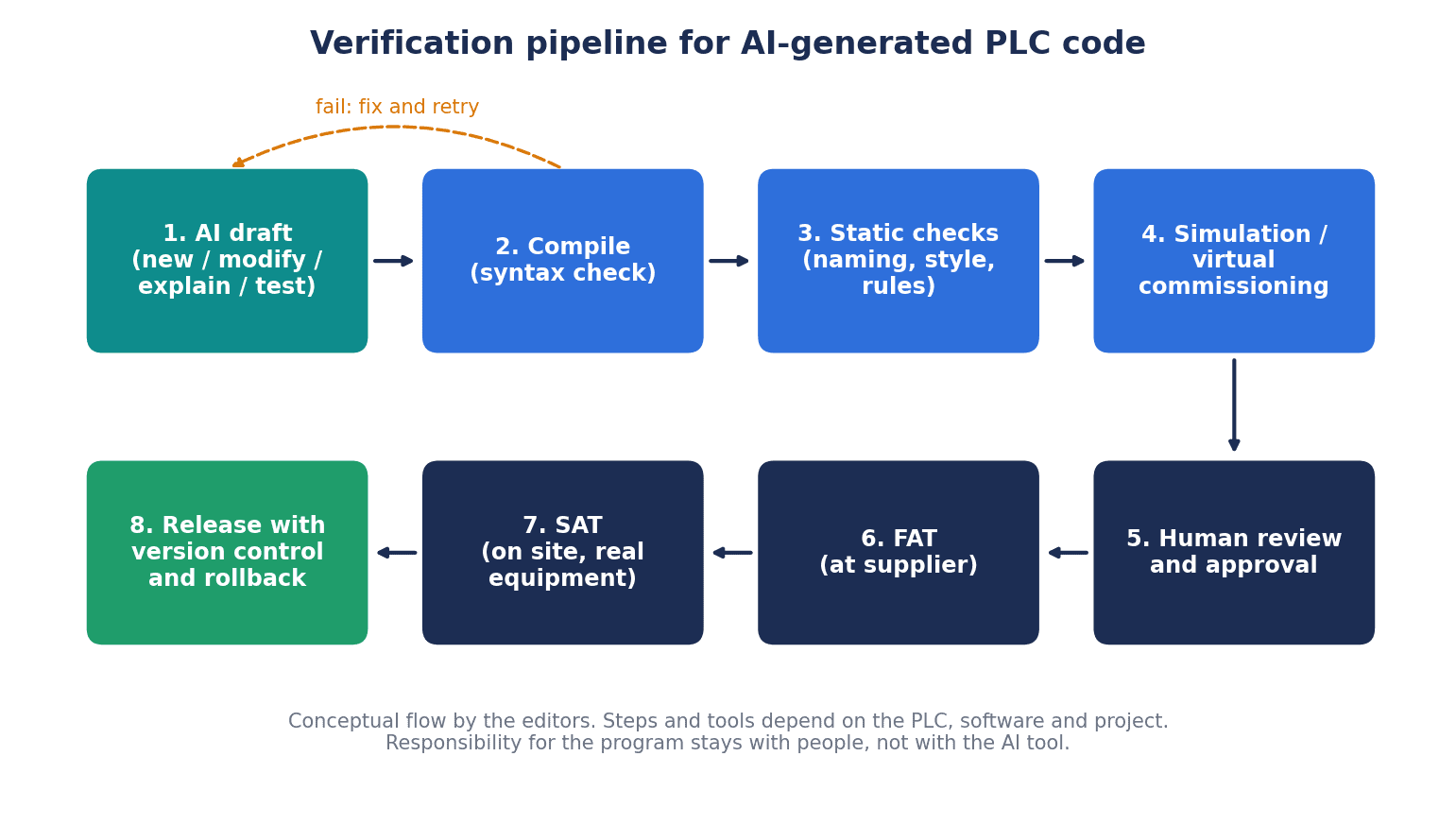
Translated into factory practice, this becomes a flow of checking the output in order for “does it compile”, “does it follow the agreed rules”, “does it behave as intended in tests”, “does it run together with the equipment in simulation” and “can a person read and explain it”, and finally moving on to FAT and SAT on the real equipment. In this article, we call this flow the verification pipeline.
Availability of Major Vendors and the Features Each Company Describes
The table below summarizes the status of the major vendors. Vendors are listed in alphabetical order, and the order does not indicate superiority or recommendation. Availability is within what we could confirm as of October 15, 2026. Fields we could not confirm are marked “Not confirmed in official materials”.
| Vendor | Product, feature name | Availability | Main features described by the company | Statements on data handling |
|---|---|---|---|---|
| Beckhoff | TwinCAT 3 CoAgent for Engineering (TE1700). Predecessor is TwinCAT Chat | Product page shows “product announcement”. No statement indicating general availability found | Suggestions of PLC code based on natural language and project context, suggestions for I/O configuration, direct access to the Beckhoff Information System | TwinCAT Chat in 2023 was described as connecting to each LLM’s host cloud. For TE1700, not confirmed in official materials |
| CODESYS | CODESYS Development System MCP Server | Offered as a standalone product (CODESYS V3.5 SP22 or later, bundled with the Professional Developer Edition) | Generation of POUs and PLC code through remote operation from AI systems, detection and correction of coding errors, explanation of existing code | Described as able to communicate with both cloud AI and local LLMs. Local LLMs via OpenVINO are at the research stage |
| Copia Automation | Copia AI | Not confirmed in official materials | Automatic documentation, summaries of code blocks, suggestions for quality improvement, code generation for routine tasks. Described as multi-vendor | Not confirmed in official materials |
| Mitsubishi Electric | Ladder generation AI (name not yet decided) | Under development. At the stage of being explained at a trade show and in interviews | Output of ladder, flowcharts and explanatory text from specifications. Output of modification proposals for existing ladder (all demos) | Not confirmed in official materials |
| OMRON | OMRON Automation Teams (tentative name) | Under development. Described in an interview as planned for launch during fiscal 2026. Official release not confirmed | Search and explanation of past ladder assets, automatic generation of ST programs, engineering support | Described in an interview as a design that does not train the LLM and does not leave information on cloud servers (a planned service) |
| Rockwell Automation | Copilot in FactoryTalk Design Studio, AI Plan & Build Agents | Available (Copilot announced in November 2024). 90-day free trial | Code generation, code explanation, troubleshooting, device configuration, creating implementation plans from requirements | States ISO 27001 and SOC 2 certification and GDPR compliance. Whether data is used for training and the processing region are not confirmed in official materials |
| Schneider Electric | PLC Code Generation Copilot (EcoStruxure Automation Expert Platform) | Described in a May 2025 announcement as offered within the platform. Scope of general availability (regions, editions) not confirmed | Generation, explanation and testing of PLC code using validated libraries and guardrails | Not confirmed in official materials |
| Siemens | Eigen Engineering Agent (formerly Engineering Copilot TIA) | On sale since April 20, 2026. Requires a valid license for TIA Portal V19, V20 or V21 | Generation and revision of SCL and LAD, test logic generation, error correction, style guide checks, documentation, explanation of legacy logic, text translation | States that input and output prompts are stored only locally and that PLC code and project files are not used for training. EU customer data is processed within the EU. Processing region for customers in Thailand not confirmed in official materials |
There are three points to keep in mind when reading the table.
The first is that availability differs greatly. Products on sale, announcements only and features under development are mixed together. If you plan on the assumption of features still under development, the timing may slip.
The second is not to apply one company’s data handling to others. “Not used for training” and “stored locally” are statements in the official documentation of Siemens Eigen. Also, “not stored in the cloud” does not mean the same as “not processed in the cloud”. Siemens states that its predecessor Preview version used a configuration with microservices and LLMs in the cloud.
The third is that the descriptions of every company that addresses human involvement presuppose human checking. Schneider Electric writes on its official blog of “an AI-assisted workflow that keeps humans in control, not autonomous AI coding”. Rockwell states that engineers review and modify recommendations before applying them. The terms of use of the Siemens Preview version explicitly stated that generated content is not intended for production use. For the product version Eigen as well, the company states that it repeats self-verification until the result is ready for review, so the output is premised on going to human review. A Mitsubishi Electric developer said, in effect, that writing generative AI answers to equipment without checking them is not an intended use. OMRON said in an interview that “because AI hallucinates, it is technically impossible to output something that is 100% accurate”.
Rule (1): Decide the Scope of Tasks Given to AI
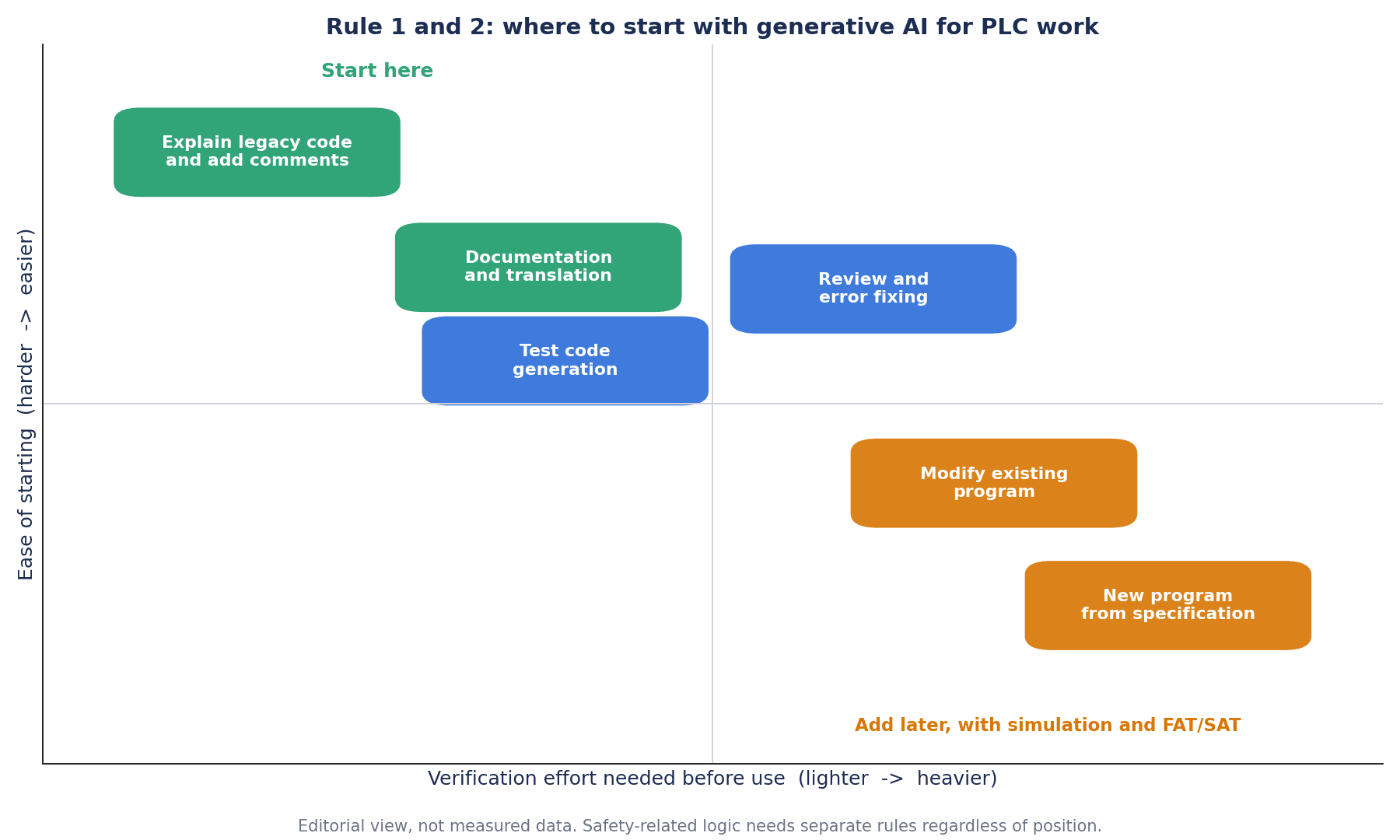
The first rule is which tasks to give to AI. Organizing the six types by ease of starting and weight of verification gives the following. This is this article’s way of thinking based on each company’s description and on research, not a numerical evaluation.
| Task type | Ease of starting | Main risks | Weight of verification |
|---|---|---|---|
| Reading and commenting | Easy to start | Errors in explanations mislead maintenance staff | Light (a person reads it against the original) |
| Documentation and translation | Easy to start | Mistranslation of technical terms and signal names | Light to moderate |
| Review and error correction | Moderate | Missed findings, side effects of proposed fixes | Moderate |
| Test creation | Moderate | The tests themselves misread the specification | Moderate |
| Modification | With caution | Unintentionally changing existing behavior | Heavy (diff check, simulation, check on real equipment) |
| New development | With caution | Misunderstanding the specification, missing abnormal cases | Heavy |
In this article, we consider “reading and commenting existing programs” an easy first step. There are three reasons.
First, the output does not change the behavior of the equipment. Even if an explanation or comment is wrong, it does not affect how the program runs. A person can check it against the original.
Second, demand is large. Mitsubishi Electric states that after IIFES 2025 it also began developing an “explanation generation” feature for ladder and ST. The reason given is that it is more readily accepted than generation, whose reliability is hard to guarantee. In an interview, OMRON said that reuse of past assets occurs in more than 80% of cases according to its own research, and introduced a feature in which AI searches past ladder assets and explains them (both are each company’s own research and description, not industry statistics). Rockwell and Siemens also list features for explaining and interpreting existing code in products already on sale.
Finally, the effect is easy to measure. The time taken to understand one program can be compared before and after introduction.
Another option is to keep safety-related circuits outside the scope of tasks given to AI for the time being. The handling of safety-related programs is discussed in detail in a later section.
The checking procedure when taking over a predecessor’s program is organized in “Taking Over Mitsubishi PLC Programs“. Even if generative AI speeds up reading, the basics of a handover, such as securing backups and confirming that the real equipment and the source match, do not change.
Rule (2): Decide the Verification Steps for AI Output
The second rule is how to check the output. Based on research and vendor descriptions, we recommend writing down the following six stages as an internal procedure.
Stage 1 is compilation. Check that the code passes in the development environment without syntax errors. Siemens and CODESYS list fixing compilation errors and coding errors as features.
Stage 2 is static checking. Check whether the code follows your own style, such as naming rules, how comments are written, and the range of instructions and devices allowed. Siemens lists style guide checks as a feature. If your own rules are not documented, writing them comes first.
Stage 3 is testing. Create test cases from the specification and check that inputs and outputs are as intended. If AI is used to create the tests, a person checks the tests themselves.
Stage 4 is simulation and virtual commissioning. Run the code together with a soft PLC and a model of the equipment to check timing and interlocks. Rockwell states that FactoryTalk Design Studio v2.06 integrates cloud emulation through “FactoryTalk Logix Echo as a Service”, making it possible to create and verify control logic without waiting for hardware. OMRON described in an interview a concept, as Phase 1, of virtualizing the PLC to verify AI output (this is under-development content). For how to proceed with virtual commissioning, see “Robot Simulation and Virtual Commissioning“.
Stage 5 is human review and approval. Decide by name who reviews and who approves. In the review, check whether “I can explain this logic in my own words”. A clear criterion would be not to adopt any part that cannot be explained, even if it works.
Stage 6 is version control. Keep a record of which version was changed, when, by whom and for what reason. Marking the parts generated by AI makes them easier to trace if a problem arises later.
After these six stages, move on to FAT and SAT on the real equipment. How many stages are needed depends on the task type. The idea is that for reading and commenting, the human check in Stage 5 is central, while modification and new development need all stages.
Rule (3): Decide Where Source Code and Equipment Information Are Sent
The third rule is where to send PLC source code and equipment information. Here the design differs from tool to tool, so it cannot be judged by general principles.
As a view from public bodies, there is “Principles for the Secure Integration of Artificial Intelligence in Operational Technology”, joint guidance issued on December 3, 2025 by nine agencies including the U.S. CISA. This guidance is aimed at critical infrastructure operators, and its main subject is AI in operation. It is not a document that regulates coding assistance for PLCs. However, it is useful as a way of thinking about handling OT data. The guidance calls for not sharing sensitive data with AI models hosted under external control, and for understanding how AI vendors access and use OT data. It names “engineering configuration data” as data to protect with priority, and its examples include network diagrams, asset inventories, operating sequence documents, safety-related information, logic diagrams and circuit diagrams. It further recommends checking with vendors their data use policies, including use for training, whether the AI can run on premises or without a constant connection, and the conditions under which AI features can be disabled.
Vendor descriptions vary. For Eigen, Siemens states that input and output prompts are stored only locally and that PLC code and project files are not used for training. However, while there is a statement that EU customer data is processed within the EU, we could not confirm the processing region for customers in Thailand. CODESYS states that the MCP Server can communicate with both cloud AI and local LLMs. For its planned service, OMRON said the design does not train the LLM and does not leave information on cloud servers. For Rockwell, Schneider Electric, Mitsubishi Electric and Copia Automation, we could not find official statements that specify whether data is used for training.
Let us also clarify the relationship with Thailand’s Personal Data Protection Act (PDPA). The PDPA is a law that protects information that can identify a living individual. PLC source code and equipment information are generally considered not to be personal data. In this article, we consider whether to send them to cloud AI to be mainly a matter of trade secrets, non-disclosure agreements with customers and intellectual property. However, care is needed because the PDPA may apply when comments contain operators’ names, or when logic or logs that handle operator IDs are sent.
In practice, check the following before sending. Whether drawings or specifications entrusted by customers are included. Whether a non-disclosure agreement restricts disclosure to third parties. Whether personal information such as operators’ names is in the comments. Up to which class of information your internal information classification allows sending to external AI. The overall picture of how to handle information given to generative AI is explained in “Preventing Data Leaks with Generative AI“. As an option when you do not want information to leave the company, for running models in-house see “Implementing a Local LLM“.
Safety-Related Programs and the Standards
The relationship between safety standards and AI-written code is easily misunderstood. In the official abstracts and clauses of the standards we checked, we found no provision that decides whether code written with generative AI is permitted or not. What can be said is only that, whether the author is a person or AI, software verification, a rationale for the choice of tools and measures against errors in control logic are required.
According to the official abstract of IEC 61508-3 (software requirements), the standard includes requirements for software used to develop safety-related systems and for support tools such as development and design tools, language translators and test tools. IEC 61508 classifies offline support tools as T1 to T3. T3 covers tools that generate outputs that contribute directly or indirectly to executable code, and evidence of conformance to specification is required. We could not find any material from standards, public bodies or certification bodies that shows which of these classes generative AI falls into. On that basis, as this article’s inference, we think that if AI output becomes executable code as it is, a rationale for tool selection and verification may be required, in the same way as for a compiler. This is an inference and is not asserted as a requirement of the standard.
ISO/IEC TR 5469:2024 is a technical report that also covers the use of AI systems in the design and development of safety-related functions. It is not a requirements standard that demands conformity. ISO 13849-1:2023 and IEC 62061:2021 set requirements for the design of safety-related control systems of machinery, but their official abstracts do not mention generative AI.
When building machines for Europe, the EU Machinery Regulation (EU) 2023/1230 is also relevant. The European Commission states clearly that the regulation applies on a mandatory basis from January 20, 2027. Annex III 1.2.1(c) requires that errors in the logic of the control system do not lead to hazardous situations. What is listed among the categories that require third-party conformity assessment is safety components and systems with self-evolving behavior using machine learning. Recital (55) states that this third-party assessment provision does not apply to software that cannot learn or evolve and is merely programmed to perform specific automated functions. A PLC program that is fixed after being written with generative AI does not itself learn or evolve, so under this wording it can be read as not falling under self-evolving behavior. However, this is this article’s interpretation, not the view of the authorities. Also, the requirement to prevent logic errors applies regardless of whether AI was used to write the code.
This time, we could not confirm any official position from certification bodies such as TÜV on the use of AI-generated code in safety-related software. How to proceed with safety PLC validation is explained in “Validating Safety PLCs“. As this article’s way of thinking, we consider a clear line to be keeping safety-related circuits outside the scope of tasks given to AI for the time being, and, when they are handled, putting them through the same verification and approval procedure as ordinary safety-related software.
OT Security and Version Control
With generative AI, source changes become faster and more numerous. Accordingly, recording and protecting changes becomes more important.
Annex III 1.1.9 of the EU Machinery Regulation requires identifying software and data critical to conformity, protecting them against malicious or accidental alteration, and collecting evidence of modifications to software. 1.2.1(f) requires that logs tracking the version of safety software uploaded after placing on the market and data on interventions be enabled for five years. Even for equipment not bound for Europe, the idea of keeping the version and reason for each modification is a useful guide for version control in factories that use AI.
IEC 62443-4-1 is a standard that sets process requirements for securely developing products for industrial control systems. However, its official abstract states that it applies to product developers and maintainers, not to integrators or users. In this article, we consider it appropriate to use it not as a standard directly applying to factories or system integrators, but as material for thinking about what to ask of vendors that provide tools with AI features.
What we want to decide in practice is the following. Keep source backups before and after a modification. Periodically check that the program on the real equipment matches the source on the server. Understand with what privileges AI tools connect to the development environment and the PLC. When using a mechanism such as MCP that lets external AI operate the development environment, narrow the range of what it can operate. Security when using AI agents in factories is organized in “Industrial AI Agent Security“.
Cautions When Using It for Migration in PLC Upgrades and Replacements
Generative AI has also begun to be used to move old programs to a new environment when upgrading PLCs or changing manufacturers.
CODESYS introduces SyntaxShift from KS Solutions AG as an external solution. It uses AI to convert between Siemens IL or SCL and CODESYS ST, and the company’s page describes it as “coming soon to the CODESYS Store”. Siemens lists, as features of Eigen, explaining and commenting legacy logic and migrating from VBScript to JavaScript in WinCC Unified.
When using it for migration, it is important to treat the conversion result the same way as a newly written program. Use a diff to check that I/O assignments, timer and counter settings, and behavior in abnormal conditions match before and after conversion. Then run it through the verification steps of Rule (2) and move on to checks on the real equipment. Another possible order is to first have AI read and comment the old program, document the specification, and then migrate.
The decision on whether and when to upgrade is explained in “Deciding on PLC Upgrade and Replacement“.
Agreements When Contractors and System Integrators Use Generative AI
Even if you do not use generative AI in-house, your contracted system integrator may use it. As the client, we recommend agreeing on the following points.
The first is disclosure of the tools used and where data is sent. Have them tell you in advance which tools they use, where they send source code and specifications, and whether the settings allow use for training. If you have entrusted them with customer drawings or similar materials, also check the relationship with non-disclosure agreements.
The second is a record of generated parts. Have them make the parts generated or modified by AI identifiable through comments or change records.
The third is where review responsibility lies. Writing into the contract that the contractor is responsible for the content of the delivered program, regardless of whether AI was used, reduces misunderstandings.
The fourth is source delivery. Have them deliver, with comments, the same source as the version written to the real equipment.
The fifth is the language of comments. You can also request comments in Thai or English so that Thai maintenance staff can read them. Even when generative AI translation features are used, a person checks the translation of signal names and technical terms.
How to choose contractors and the general process of placing orders are explained in “Outsourcing PLC Program Development“.
Requirements to Write in the RFP and Acceptance Criteria for FAT and SAT
Whether you introduce a tool or allow a contractor to use generative AI, writing the requirements into the RFP makes comparison and acceptance easier. For how to create internal usage rules, see also “Internal Usage Rules for Generative AI“.
| Item | What to write in the RFP | How to confirm |
|---|---|---|
| Scope of target tasks | Which of the six types it will be used for. Whether safety-related circuits are in scope | Statements in the proposal |
| Target PLCs and software versions | Manufacturer, model, development software version | Operating environment documents |
| Data destination and use for training | Processing region, cloud or local, whether data is used for training | Official documents and contract clauses |
| Log retention | Where and for how long prompts and outputs are stored | Settings screens and documents |
| Identification of generated parts | How the parts generated by AI are recorded | Sample deliverables |
| Verification steps | How far to go among compilation, static checks, tests and simulation | Procedure documents and records |
| Reviewers and approvers | Who reviews and who approves | Organization chart |
| Handling of safety-related items | Whether to keep them out of scope, and additional steps if they are handled | Proposal and procedure documents |
| Version control | Versioning, backups, checking consistency with real equipment | Operating procedures |
| Training | Content and frequency of training for users | Training plan |
At FAT (factory acceptance test), prepare several representative modification instructions and check the following. Whether the code compiles. Whether the prepared tests pass. Whether it behaves as intended in simulation. Whether the person in charge can read and explain the logic.
At SAT (site acceptance test), check operation on the real equipment, check abnormal cases, and check the procedure for reverting to the original version if a problem occurs.
For numerical pass criteria (for example, the share of outputs that pass verification, or the time spent on human rework), write the values agreed within your company. This article does not recommend specific values. How to decide when to end a trial (PoC) and move to full deployment is explained in “Exit Criteria for AI PoCs“.
Cost and Benefit Model Calculation (Hypothetical Figures)
From here, we calculate using hypothetical figures prepared for this article. These are not figures from an actual factory.
The assumed case is a Japanese automotive parts factory in Thailand. It has three control engineers in production engineering, and PLCs from multiple manufacturers are mixed. Small modifications are outsourced to a system integrator.
There are two annual cost items as the baseline. A and B are counted as separate tasks, and the same cost is not counted twice.
- A: In-house time spent reading existing programs and creating documentation is 600 hours per year; at 500 THB per hour, that is 300,000 THB/year.
- B: Outsourcing costs for small modifications are 20 jobs per year at 40,000 THB each, or 800,000 THB/year.
- The total is 1,100,000 THB/year.
The measures are introducing a generative AI tool, a verification environment, internal rules and training, and organizing the source code and version control.
- The initial cost is 520,000 THB. The breakdown is 220,000 THB for the verification environment (soft PLC or simulation, and test procedures), 150,000 THB for creating internal rules and training, and 150,000 THB for organizing the source code and version control.
- The annual operating cost is 90,000 THB/year. The breakdown is 60,000 THB for tool fees (hypothetical) and 30,000 THB for the labor of additional review of AI output.
| Item | Base case | Sensitivity (smaller effect) |
|---|---|---|
| Reduction rate for A | 40% | 20% |
| Effect on A | 300,000 × 40% = 120,000 THB | 300,000 × 20% = 60,000 THB |
| Number of B jobs done in-house | 5 per year | 2 per year |
| Outsourcing cost reduced | 5 × 40,000 = 200,000 THB | 2 × 40,000 = 80,000 THB |
| Added in-house labor | 5 × 40 hours × 500 = 100,000 THB | 2 × 40 hours × 500 = 40,000 THB |
| Effect on B (net) | 100,000 THB | 40,000 THB |
| Total effect | 220,000 THB/year | 100,000 THB/year |
| Annual operating cost | 90,000 THB/year | 90,000 THB/year |
| Annual net effect | 130,000 THB/year | 10,000 THB/year |
| Initial cost | 520,000 THB | 520,000 THB |
| Payback period | 520,000 ÷ 130,000 = 4.0 years | 520,000 ÷ 10,000 = 52.0 years |
In the base case, cutting the time for A by 40% yields an effect of 120,000 THB/year. If 5 of the B jobs per year can be done in-house, outsourcing costs fall by 200,000 THB, while in-house labor of 5 jobs × 40 hours × 500 THB = 100,000 THB is incurred, for a net 100,000 THB/year. The total effect is 220,000 THB/year; after subtracting the operating cost of 90,000 THB/year, the net effect is 130,000 THB/year, and the payback on the initial cost of 520,000 THB is 4.0 years.
In the smaller-effect case (20% for A, 2 jobs per year for B), A is 60,000 THB, and B is 40,000 THB after subtracting 40,000 THB of in-house labor from the 80,000 THB outsourcing reduction, so the total effect is 100,000 THB/year. The net effect stays at 10,000 THB/year, and the payback is 52.0 years, meaning the investment is effectively not recovered.
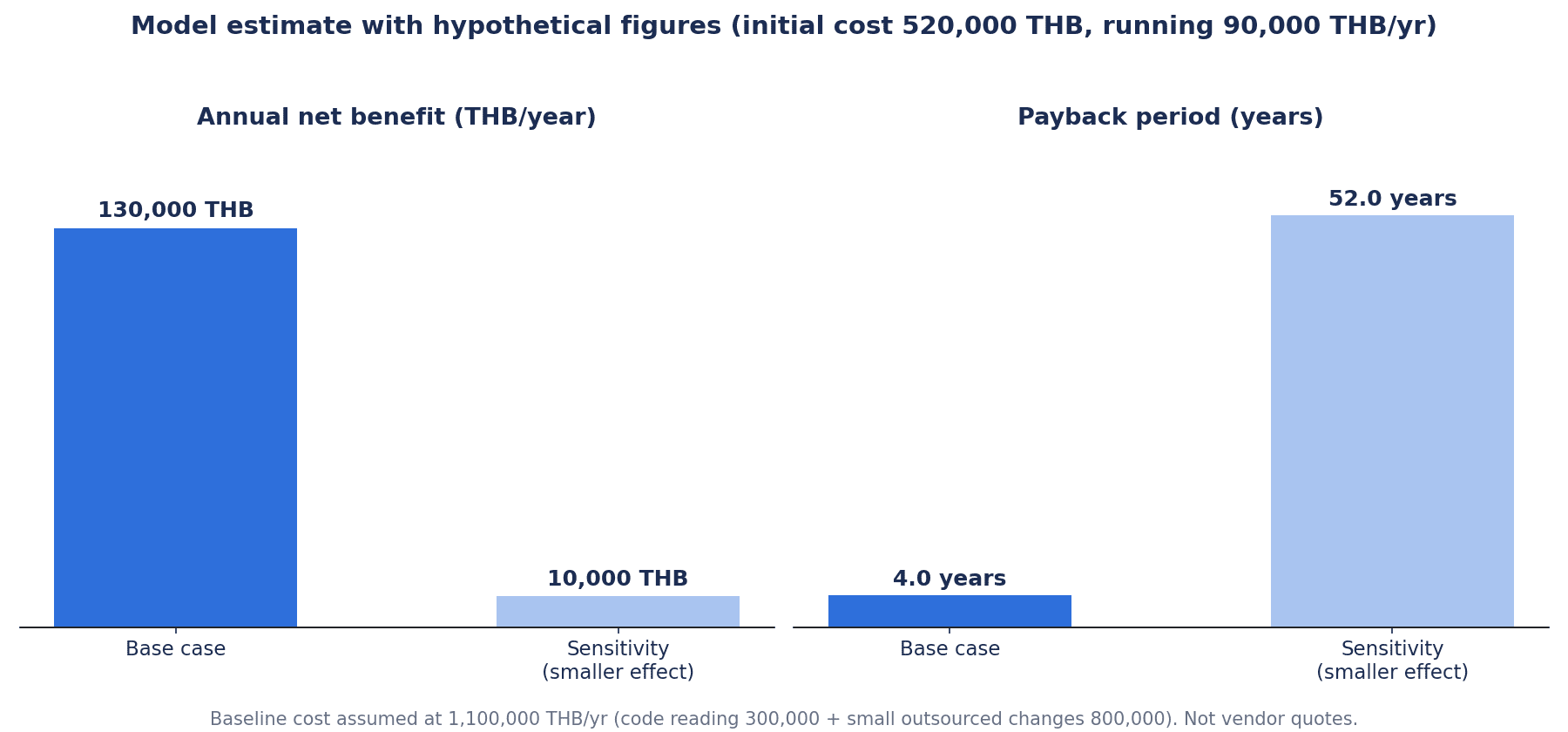
Here are some notes on how to read this calculation. The effect rates and job counts are assumptions. The costs of verification and review are incurred regardless of how much the tool is used, so if the effect is small, the investment is not recovered. That is why, in this article, we consider it realistic to narrow the target tasks at first and measure the effect starting from tasks such as reading and commenting, where verification is light and volume is high. Safety-related modifications and losses from mistakes (equipment stoppages or quality incidents) are not included in this calculation. Before introduction, we recommend counting the number of modifications, outsourcing costs and time spent reading existing programs over the past 12 months. Until you try representative modification instructions in a PoC and measure the share that passes verification and the time for human rework, it is safer not to count the effect.
We also note the publicly available cost information. For Siemens Eigen Engineering Agent, the sales page on Siemens Digital Exchange (S-DEX) showed an annual subscription of USD 2,100 (after a one-month free trial). This is the price displayed for the U.S. billing region (as of October 15, 2026, possibly excluding tax), and we have not checked the price or sales terms in Thailand. The same page states that up to three users can be assigned to one seat, with one user able to use it at a time. Rockwell’s FactoryTalk Design Studio has a 90-day free trial, but we could not confirm a public price. The CODESYS MCP Server is described as offered bundled with the Professional Developer Edition, but we could not confirm a public price. For Beckhoff, Copia Automation, Schneider Electric, Mitsubishi Electric and OMRON, we could not confirm public prices either.
Frequently Asked Questions
Can generative AI create PLC programs?
There are situations where it can, but think of it as something to use as a draft or modification proposal on the premise of human checking. Every company that addresses human involvement describes its features on the premise that a person reviews the output before it is used. Research has reported that success rates rose in setups with built-in verification tools, but even under the conditions of the 2024 paper, roughly 30% failed.
Which is easier to generate, ladder or ST?
In research, several papers report results for generating ST. On the other hand, under the conditions of a 2024 paper, automatic generation of ladder (LD) was considered to remain challenging even for very simple examples. Mitsubishi Electric also said, in effect, that general-purpose LLMs without special techniques can hardly generate ladder. However, the papers date from 2023 to 2025, and the models are not the latest.
Can generated programs be used as they are?
We do not recommend it. In this article, we recommend using them only after passing compilation, static checks, tests, simulation, and human review and approval, and confirming them at FAT and SAT on the real equipment. The terms of use of the Siemens Preview version explicitly stated that generated content is not intended for production use.
Do safety standards prohibit AI-generated code?
In the official abstracts and clauses of the safety standards we checked, we found no provision that prohibits or permits code written with generative AI. However, whether the author is a person or AI, software verification, a rationale for tool selection and measures against errors in control logic are required. This article presents the option of keeping safety-related circuits outside the scope of tasks given to AI for the time being.
Is it safe to send PLC source code to cloud AI?
Data handling differs from tool to tool, so it cannot be judged by general principles. Check the processing region, whether data is used for training and where logs are stored in official documents and contracts. PLC source code is generally not personal data, but it may become a matter of non-disclosure agreements with customers or trade secrets. Care is also needed because Thailand’s PDPA may apply when comments contain operators’ names.
Can it also be used to read existing ladder?
Yes. In this article, we consider reading and commenting an easy first step. This is because the output does not change the behavior of the equipment, and a person can check it against the original. Rockwell and Siemens list features for explaining existing code in products already on sale, and Mitsubishi Electric and OMRON have also introduced explanation features as under-development content.
How much do generative AI tools for PLC programming cost?
The only public price we could confirm was for Siemens Eigen Engineering Agent. The price displayed for the U.S. billing region (as of October 15, 2026, possibly excluding tax) is USD 2,100 per year, and we have not checked the price in Thailand. We could not confirm public prices from other companies. Besides the tool fee, there are also costs for a verification environment, training, organizing the source code and labor for additional review.
Summary
- What you decide first when introducing generative AI for PLC programming is not the name of a tool, but three things: (1) the scope of tasks given to AI, (2) the verification steps for AI output, and (3) where source code and equipment information are sent.
- The availability of major vendors is a mix of products on sale, announcements only and features under development. Every company that addresses human involvement describes its features on the premise of human checking.
- Research reports that results improve when verification tools are built in. Ladder is considered harder to generate than ST.
- In this article, we consider reading and commenting existing programs an easy first step.
- For verification, write the six stages (compilation, static checks, tests, simulation, human review and approval, and version control) into your procedure, and confirm at FAT and SAT on the real equipment.
- Data handling differs by company. Check the processing region, use for training and log retention in official documents and contracts.
- In the official abstracts and clauses of the safety standards we checked, we found no provision deciding whether AI-generated code is permitted. Measures against logic errors and verification of modifications are required regardless of the author.
- In the hypothetical calculation, the investment is not recovered if the effect is small. Before introduction, count modifications and reading time, and count the effect only after measuring it in a PoC.
At TOMAS TECH, we are happy to help even from the early stages, such as deciding which tasks to try generative AI on, organizing verification steps and where source code is sent, and drawing up agreements with contractors. If your factory in Thailand has PLCs from multiple manufacturers, we can also work with you starting from organizing the current situation. Please feel free to contact us.
References
- Siemens bringt „Eigen Engineering Agent” auf den Markt (2026-04-20) / Siemens AG
- Eigen Engineering Agent (product page) / Siemens
- Data security, Eigen Engineering Agent (Doc v1.5.1) / Siemens
- Eigen Engineering Agent (S-DEX sales page) / Siemens
- Engineering Copilot TIA Standard (Preview) / Siemens
- Rockwell Automation and Microsoft Deliver on a Shared Vision (2024-11-19) / Rockwell Automation
- FactoryTalk Design Studio (product page) / Rockwell Automation
- TwinCAT Chat: Using innovative chatbot technology in TwinCAT engineering / Beckhoff
- TE1700 TwinCAT 3 CoAgent for Engineering / Beckhoff
- Engineering at scale: How AI is transforming PLC coding (2025-11-14) / Schneider Electric Blog
- CODESYS AI-supported Engineering / CODESYS Group
- Why Mitsubishi Electric Took On Ladder Generation AI (1/2) / MONOist (Japanese)
- Why Mitsubishi Electric Took On Ladder Generation AI (2/2) / MONOist (Japanese)
- “Will You Still Be Able to Read That Ladder Program in 10 Years?” OMRON’s Vision for AI Use (1/2) / MONOist (Japanese)
- “Will You Still Be Able to Read That Ladder Program in 10 Years?” OMRON’s Vision for AI Use (2/2) / MONOist (Japanese)
- OMRON Boosts Efficiency with a “Team of Generative AI”, Including Search of Ladder Program Assets / MONOist (Japanese)
- Copia AI / Copia Automation
- LLM4PLC: Harnessing LLMs for Verifiable Programming of PLCs / arXiv
- Agents4PLC: Automating Closed-loop PLC Code Generation and Verification / arXiv
- ChatGPT for PLC/DCS Control Logic Generation / arXiv
- Exploring LLM Support for Generating IEC 61131-3 Graphic Language Programs / arXiv
- Training LLMs for Generating IEC 61131-3 Structured Text with Online Feedback / arXiv
- Spec2Control: Automating PLC/DCS Control-Logic Engineering / arXiv
- Industrial Automation, Setting the Standard for AI-Generated Control Code / Fraunhofer IKS
- IEC 61131-3:2025 Programmable controllers, Part 3 Programming languages / IEC Webstore
- IEC 61508-3:2010 Functional safety, Part 3 Software requirements / IEC Webstore
- ISO 13849-1:2023 Safety-related parts of control systems / ISO
- IEC 62061:2021 Safety of machinery / IEC Webstore
- ISO/IEC TR 5469:2024 Artificial intelligence, Functional safety and AI systems / ISO
- IEC 61508, Why tool qualification / UL (document hosted by the 61508 Association)
- Regulation (EU) 2023/1230 on machinery / Publications Office of the EU
- Machinery / European Commission
- IEC 62443-4-1:2018 Secure product development lifecycle requirements / IEC Webstore
- Principles for the Secure Integration of AI in Operational Technology / CISA et al.
- Thailand’s Investment Applications Reach New Highs in 2025 / BOI
- Thailand Unveils New Incentives for Automotive and HEV/PHEV Manufacturing / Tilleke & Gibbins
- AI boom leaves Thai graduates facing a tougher job hunt / The Star
- What to Expect When the PDPA B.E. 2562 Is Fully Enforced in June 2022 / Gala & Associates


