



Implementing AI heat seal inspection starts with a quality question, not a camera catalogue: which faults can be observed in an image, which package functions require a separate test, and where does a suspect pouch physically go? Entrapped product, wrinkles and insufficient seal width may leave visible evidence. A seal that looks perfect, however, is not proof of leak tightness or adequate strength. This guide is for teams specifying inspection of the sealed area on packaging lines in Thailand. For selection of the bagging machine as a whole, see our VFFS bagging automation guide. Here we focus on the inspection and acceptance of the seal after it is made.
1. Separate visible heat seal defects from package performance
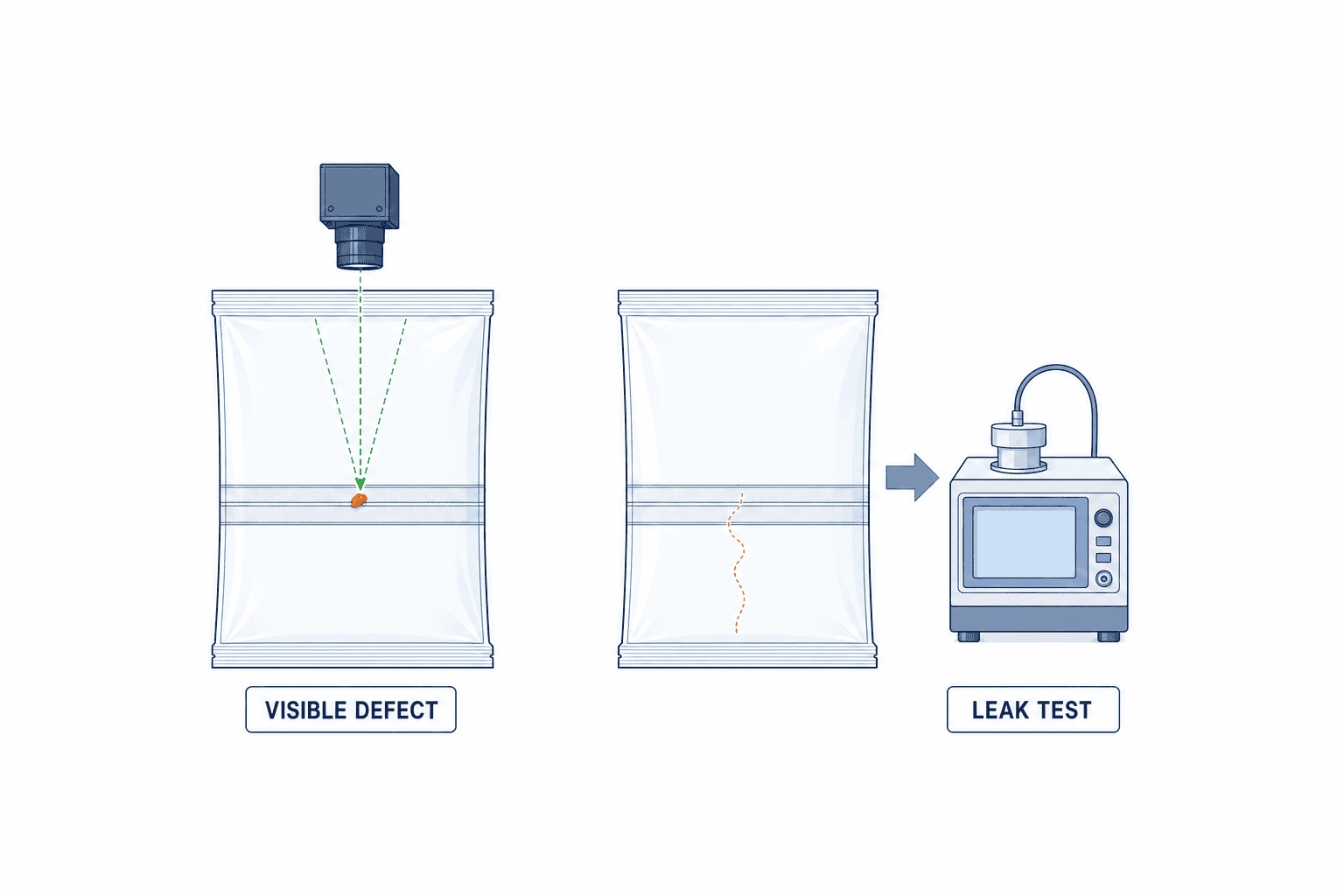
Appearance, tightness and opening force are different requirements. Product powder trapped across the seal may show as an interruption in the seal band. A tiny channel may remain even where the film looks bonded. Conversely, a reflection or printed pattern may resemble a defect without affecting function. An AI vision result is evidence about an image, not a certificate that the package is hermetic.
Write the inspection plan in four columns: characteristics observed on every package; characteristics checked by a suitable leak or strength test; process parameters such as sealing temperature, pressure and dwell time; and the person authorised to release or hold a lot. The choice of functional test depends on the product, film and customer requirements. Do not assume that a standard cited for one packaging application automatically governs another. ISO 11607-1 addresses packaging for terminally sterilised medical devices. ASTM F1929 is a dye penetration test for leaks in porous medical packaging. Those are different from a routine food pouch specification. ASTM F1886/F1886M identifies a method for visual inspection of primary packaging; its seal-channel inspection section applies where at least one side is transparent and the seal can be seen clearly, while surface inspection has a different scope. ASTM F88/F88M concerns seal strength of flexible barrier materials. Citing their numbers does not, by itself, define your pass criteria. Quality assurance must check scope and edition against the actual package and contract.
2. Build a defect register before training an AI model
For each seal location, record the film and product, appearance, likely process cause, shipping severity, inspection method and disposition. “Bad seal” is too broad for either sample collection or equipment selection. The following is an example of structure; any dimensional pass limit must come from the plant’s approved product specification.
| Condition | Image evidence to investigate | Evidence beyond the image | Typical action |
|---|---|---|---|
| Trapped powder, liquid or product | Colour, shape, height or a break across the band | Appropriate leak or strength test when required | Isolate pouch; investigate filling and drop timing |
| Wrinkle, fold or overlapping film | Linear shading, curved band, local overlap | Functional test for the relevant limit condition | Compare with approved boundary sample |
| Narrow or displaced seal | Inner/outer edge position, continuous width and side-to-side variation | Measurement-system check and functional test | Check machine and inspection recipes |
| Overheating or damaged film | Discolouration, texture or suspected pinhole | Material, strength or leakage assessment | Check temperature, dwell time and heater condition |
| Visually acceptable but functionally weak | May have no reliable image signature | Application-appropriate test | Hold and investigate the lot |
“Visible” never means “visible under any camera setup.” A pale particle under clear film, a wrinkle on metallised laminate or a fold on the reverse side may need a different light or another camera. Record minimum defect size, location, pouch orientation, colour and allowable appearance variation with actual good, bad and boundary samples. Establish limits by relating real defects to product function, rather than copying a vendor demonstration value.
The register must also describe good variation: print changes, film stretch, warm-up appearance, and moisture after cleaning. Otherwise the system may reject many sound pouches. QA sets the good/bad/review boundary; production and maintenance verify it can be reproduced on the line. An ambiguous label remains ambiguous after model training.
3. Design the image around trapped product and seal geometry
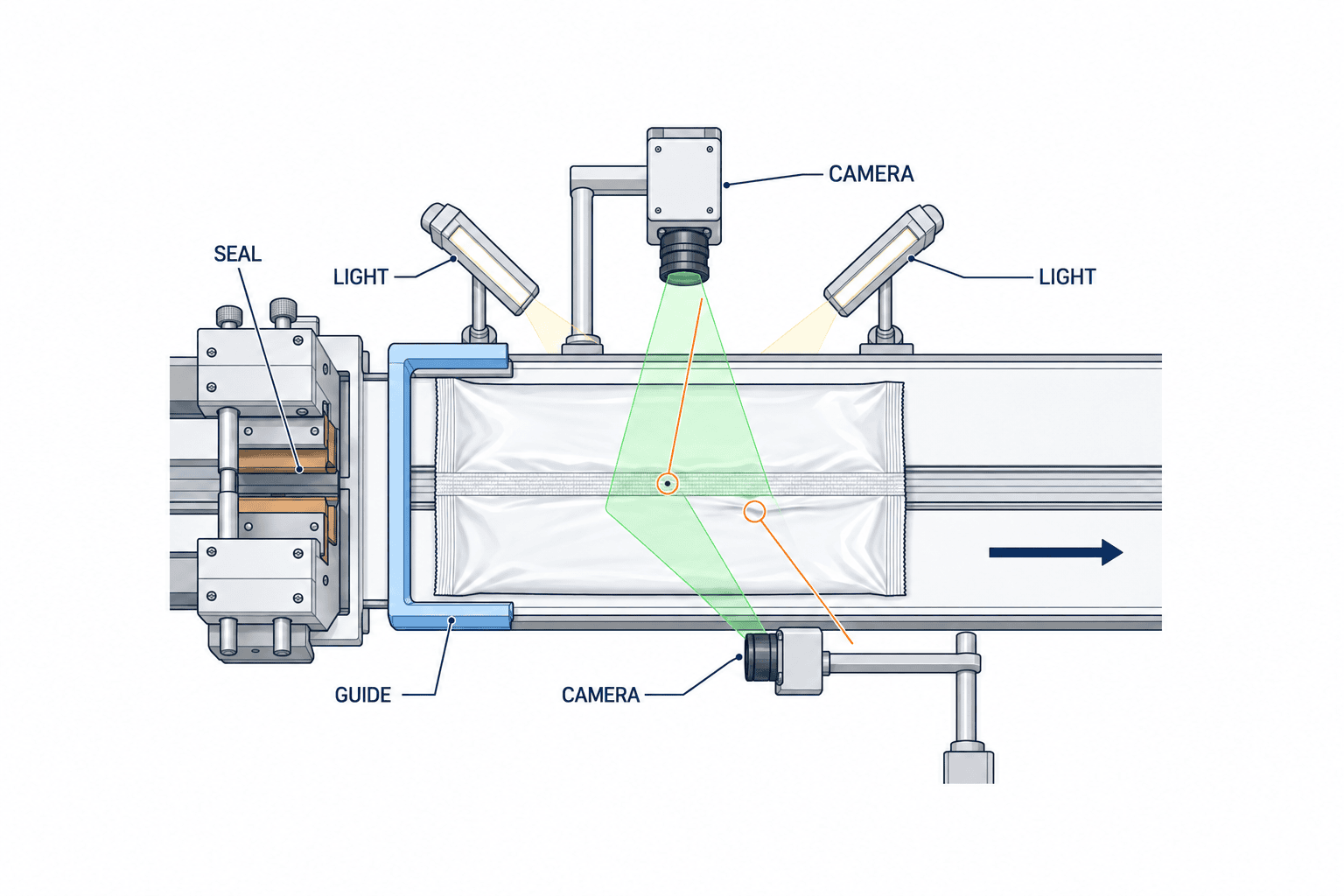
First decide which side of the seal band must be inspected, from what angle and at what point in the process. One top camera may be enough for some packs; another format may require a reverse-side or side view. Stabilising a swinging pouch with a guide can be more effective than making the model more complicated.
Transmitted light can highlight some interruptions in transparent film but is unsuitable for opaque structures. Oblique reflection may reveal creases and steps but also amplify glare from printing. Diffuse light often suppresses specular reflection while making a very small height change harder to see. Compare the most serious defect with the most confusing acceptable sample under each candidate arrangement. Choose for separability, not simply a bright picture.
If print overwhelms colour-based 2D inspection, height sensing may be an option. KEYENCE publishes a heat seal disruption example using a 3D laser snapshot sensor to inspect height distribution for foreign material in a seal. That is an application example, not a universal requirement. Compare it with optimised 2D lighting on the actual material, speed, mounting distance and budget. The same vendor also lists heat seal width defects among healthcare-related vision applications; that example does not set food-packaging acceptance limits.
Specify the lens and image scale from the smallest relevant feature across the whole seal band, rather than megapixels alone. Include pouch width range, wander, working distance, depth of field, exposure, vibration, speed and washdown environment. If the seal edge leaves the field of view, the model cannot assess it. Treat missing or unusable images as process exceptions, never as automatic passes.
4. Compare rule-based vision, AI and 3D against the same samples
Where seal width and position have measurable boundaries, start by testing rule-based vision. It can give a direct dimensional explanation and may need less training data. For irregular product inclusions, creases overlapping print, or large variation among sound pouches, compare classification, detection and segmentation models. If the key evidence is height rather than colour, include 3D. A mixed system may be appropriate.
Give every candidate the same physical samples, acceptance register and opportunity to optimise lighting. Check whether training examples are skewed by SKU, film, machine, shift or defect type. Reserve independent batches, dates and post-changeover samples for acceptance. Replaying the same contiguous lot that trained the model is weak evidence for new-lot performance.
Overall accuracy alone is a poor purchasing measure on a line dominated by good packs. Report escapes by defect class, false rejects among known good packs, review rate, lost images, decision latency and wrong-pouch rejection separately. Our guide to false rejects in AI visual inspection explains the general threshold trade-off. For heat seals, the trade-off must be made defect by defect: a cosmetic fold and an interruption with possible leakage do not necessarily have the same consequence.
5. Link each vision decision to the physical pouch
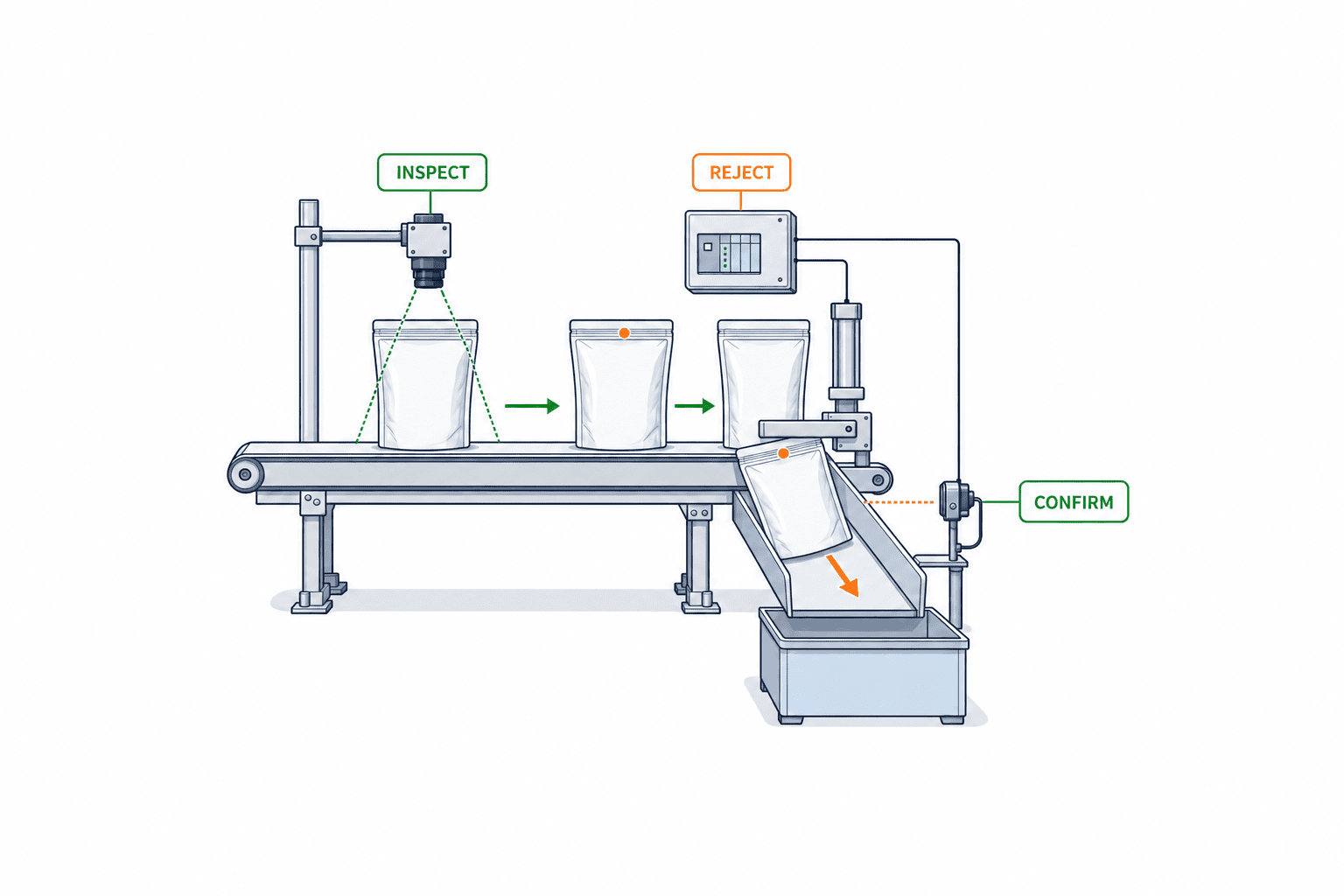
Detecting a defect in a saved image is insufficient if the line ejects a different pouch. Validate distance from camera to reject station, variable conveyor speed, pouch pitch, sensor and PLC latency, and the response of the air jet or pusher. After a VFFS cut, the pouch may change orientation; another SKU may have a different length. Use a suitable trigger, counter, encoder or product ID rather than relying on clock time alone.
Verify that a reject confirmation sensor sees the pouch enter the isolated route. Define the response to a full bin, low air pressure, reject failure, missing image, communication loss and wrong recipe: stop, or divert all affected packs to a controlled hold area. Engineering, safety and QA should approve the final machine behaviour and product disposition.
Link each decision to time, SKU, lot, sealer recipe, camera and light recipe, model version, defect class, reject command, reject confirmation and human reinspection result. Set image retention and access rights, and frame the camera so it does not capture unrelated people or areas. Those records let the team distinguish a model error from a mapping or actuator error.
6. Control changeovers and false rejects
A change of film artwork, pouch dimension or content can move the seal band and change its appearance. Keep SKU ID, film, inspection region, illumination, permitted width, model or threshold, reject delay and disposition in one controlled recipe. Before release after a changeover, match sealer and inspection recipes and run known good, bad and review samples.
When false rejects increase, investigate a dirty light, shifted camera, film wander, changed seal conditions and the ground truth of the samples before relaxing a threshold. A threshold change may also raise escapes. Compare old and new versions on the same independent challenge set, defect class by defect class. Record approval, affected lots and rollback procedure. Trend counts and denominators by SKU, shift and lot: inspected packs, each defect, review cases, false rejects, actual escapes, missing frames and reject failures. Reinspection findings need to flow back into those logs.
7. Keep vision and leak/strength testing in complementary roles
Inline vision checks visible characteristics quickly on every pouch and can provide an early sign of process drift. Functional testing checks a different property. QA determines its method and frequency, and how far to hold product if a result fails. A higher visual pass rate alone does not prove that existing leak or strength tests can be reduced. Any such change requires application-specific validation and approval.
If vision finds a narrow seal, isolate that pouch and compare the period’s functional results and sealer parameter history. If a functional test fails without a visible anomaly, investigate whether the fault is inherently invisible, the image angle missed it, or the image and tested pouch were mismatched. Use lot, SKU and time to connect both streams.
Keep the scope of cited standards explicit. ASTM F88/F88M concerns seal strength of flexible barrier materials. ASTM F1929 is a dye penetration method for porous medical packaging. ISO 11607-1 concerns packaging systems for terminally sterilised medical devices. None is a blanket requirement for every pouch. QA should verify the applicable edition, product, material, market and customer contract.
8. Twelve RFP items for packaging inspection equipment
Give suppliers an acceptance target before asking them to recommend a camera. “AI enabled,” “high accuracy” and “100% inspection” do not tell you how to accept the installed system.
- Scope: formats, SKUs, seal positions, dimensions, film and line-speed range.
- Defect register: definitions, boundary samples, severity and disposition for each class.
- Observation: minimum relevant feature, surfaces, movement, lighting and cleaning conditions.
- Method: reason for 2D, 3D, rules or AI, supported by original images.
- Changeovers: recipe selection, mismatch prevention, standard samples and permissions.
- Performance: escapes and denominator by class, false rejects and denominator, review and missing-image rates.
- Timing: capture, inference and rejection at maximum and variable speeds.
- Isolation: actuator, confirmation and behaviour on full bin, low air or lost communications.
- Evidence: image, lot, SKU, time, model version, command, confirmation and reinspection records.
- Tests: FAT/SAT sample composition, witnesses, method, retest and pass criteria.
- Maintenance: cleaning, calibration, lighting replacement, model updates, rollback and local support.
- Cost: machine modifications, fixtures, PLC integration, commissioning, training and recurring fees.
Avoid one advertised “minimum detectable size” for every defect and film. Ask for a test matrix by defect and package type, including conditions that cannot be detected. Separate supplier training samples from the holdout set used for acceptance.
9. Accept image judgement and physical ejection separately in FAT/SAT
At FAT, test defect detection, false rejects, recipes, lost-image response, records and reject commands using good, bad and boundary samples. Include seal ends, inclusions overlapping artwork, clear and opaque formats, and post-changeover samples. QA fixes ground truth before the trial. If a threshold is tuned during FAT, use a separate holdout sample to judge the final configuration.
At SAT, include actual speed, vibration, ambient-light changes, cleaning, film changes and shift startup. Count image decisions separately from correct physical isolation of the intended pouch. Mark trial defect packs and keep them away from saleable production. Simulate lost communication and rejection failure to confirm how many potentially affected packs are held.
Report sample counts, denominators, misses, false rejects, review cases and wrong-pouch rejects by class and format. Zero misses among 20 challenge defects is not the same strength of evidence as zero among hundreds of independent examples. Approve thresholds beforehand from product risk and customer requirements, not from the illustrative numbers in an article.
For heat seals, the challenge set should distinguish powder touching the inner edge from powder crossing the entire seal band; droplets on the surface from droplets trapped between layers; folds parallel to the seal from folds across it; and width loss at the centre from width loss at an end. Pair suspected overheating with normal print-density variation. Deliberately made defects should resemble faults that actually occur in the process. A few large, easy-to-see inclusions do not establish sensitivity to fine powder. Identify and count every trial pouch and recover it after SAT so it cannot re-enter saleable production.
Create a separate review disposition when the image is blurred, the seal is partly hidden, an unfamiliar film appears or a score sits near the limit. Define a controlled hold location, reinspection method and authority to return the pouch. Measure the review queue at peak production, not only its percentage. A human looking at the same image cannot resolve a leak that has no visible signature; when needed, examine the physical pouch and record whether the decision came from appearance alone or functional testing. That distinction matters when the reinspection result becomes a training label.
Repeat capture and ejection checks at startup, slowdown, stop, restart, pouch-length change and film-roll change. Heat remaining in the sealing jaws, ambient light, powder on the camera window and cleaning water can alter images. Run long enough to see warm-up and bin capacity effects. Record condition, expected and actual result, original image, pouch ID, observer and reason for retest. If a supplier changes a setting, record its version and rerun affected conditions. Accept the final production configuration, including light, recipe and reject hardware, rather than assuming unchanged AI weights mean unchanged line performance. QA, production, maintenance, IT/OT and procurement should each sign off on their own acceptance evidence.
10. Make every business-case number an explicit assumption
The following is a hypothetical calculation, not a TOMAS TECH installation result or an equipment guarantee. Suppose a line inspects 100,000 pouches per day and the current visible seal-defect rate is assumed to be 0.20%: 200 suspect pouches. Assume a 0.10% false-reject rate among 99,800 good pouches: about 100 good pouches reach reinspection. If the miss rate for those defects were assumed at 1%, around two defective pouches per day would pass. That arithmetic does not establish that such a miss rate is acceptable.
If 198 detected defects and about 100 false rejects are reviewed, the maximum review queue in this simplified scenario is about 298 pouches/day. In practice, some defects are discarded or sent for functional testing, so set review time and recovery rate by class. Include peak arrivals and bin capacity. Cutting false rejects is not a saving if it increases critical escapes.
Compare total cost: machine, lighting, installation, film-artwork revalidation, lost good product, reviewers, downtime and possible market loss. Where a cost is unknown, use low, middle and high scenarios. Do not book an avoided quality event as guaranteed profit.
11. A practical six-week planning sequence
In week 1, QA and production select one SKU, approve the defect register and identify functional tests. In week 2, study seal visibility, film and line motion, then shortlist 2D/3D views. In week 3, collect good, bad and boundary samples from distinct lots and fix ground truth. In week 4, give candidate suppliers the same RFP and samples. In week 5, finalise FAT criteria and an independent holdout set. In week 6, assign owners for installation, isolation, SAT, training and changes.
This is a planning example, not a promise that implementation finishes in six weeks. Rare defects, artwork revisions, customer approval and additional tests may extend the schedule. A short proof of concept should expose what is and is not observable and define a defensible acceptance test; a few attractive demonstration images are not production evidence.
Frequently asked questions
Can AI visual inspection find every heat seal defect?
No. Even visible entrapment, wrinkles or width loss depend on film, light, view and defect position. A visually sound seal can still fail a functional requirement. Combine vision with appropriate testing and process control.
Should trapped-product detection use a 2D camera or a 3D sensor?
Capture actual boundary samples at the required line speed. If optimised 2D lighting separates defects reliably, it may suffice. If print masks colour but height is distinct, compare 3D. Evaluate misses, false rejects, maintenance and total cost on the same samples.
What should be specified before buying packaging inspection equipment?
Specify defect classes and limits, films and formats, speed, imaging location, reject route, review capacity and FAT/SAT samples before selecting a camera model.
Can leak or seal-strength tests be reduced after installing vision AI?
Not merely because vision is installed. These methods observe different properties. QA must validate any frequency change against the product, customer contract and process risks.
What belongs in FAT/SAT acceptance for a Thai plant?
Agree class-specific misses and false rejects, missing frames, changeovers, reject confirmation, communication-loss disposition and traceable records. Keep FAT image scoring and SAT pouch-level ejection as separate results, each with sample counts.
Summary
AI heat seal inspection is a way to catch observable seal defects across production and see process drift sooner. Begin with a defect register and boundary samples, prove visibility with actual film, then accept both the image decision and the correct physical isolation. State clearly what appearance cannot prove about leakage or strength, and retain suitable functional testing and process records. One defect definition should connect the RFP, FAT, SAT and routine operation.
If your Thailand packaging line is still defining seal defect categories or comparing inspection equipment, you can contact TOMAS TECH. We can help organise sample, imaging and acceptance questions before a machine specification is final.
References
- ASTM F1886/F1886M-25, visual inspection of primary packaging.
- ASTM F88/F88M-23, seal strength of flexible barrier materials.
- ASTM F1929-23, dye penetration for porous medical packaging.
- ISO 11607-1:2019, packaging for terminally sterilised medical devices.
- OMRON, Ensure the Integrity of Packaging.
- KEYENCE, healthcare-related machine vision examples.
- KEYENCE, heat seal disruption inspection.
- KEYENCE, food and beverage packaging vision systems.


