


When selecting bagging automation, the bagger’s catalog speed is only one input. Short supply from the feeder, product caught in the seal, a wrong date code, or an unconfirmed reject can all reduce the number of saleable bags. This guide is for Thai food and consumer goods factories procuring a vertical form fill seal (VFFS) line. It covers product and film trials, output calculations, the request for proposal (RFP), factory acceptance testing (FAT), and site acceptance testing (SAT). It concerns primary packs; automated case packing and stretch wrapper selection are separate downstream decisions.
Select bagging automation by the flow of good bags
A VFFS machine forms roll film around a tube, makes longitudinal and transverse seals, dispenses product, and cuts the bag. The factory needs output that survives the entire chain: product feed, dosing or weighing, film transport, sealing, date and lot coding, inspection, and physical rejection. If one station cannot keep pace, the weigher waits, the filling window shifts, or bags accumulate on the conveyor. Empty-machine speed therefore does not describe line capacity.
Ishida’s bagmaker range distinguishes intermittent and rotary configurations and several bag formats, and places bagmakers alongside multihead weighers and inspection equipment. This is a useful reminder to define the product and package first and then compare complete line configurations. It does not imply that one machine is suitable for every product.
The procurement brief should start with flow behavior, fragility, dust, oil, bag width and length, film structure, required shelf-life seal, coding content, and inspection method. Compare catalog claims with continuous runs using each relevant product and material. At a minimum, the realistic limit is constrained by both the rate of reliable product supply and the rate at which the jaws can create acceptable seals.
Define what the new line replaces
Replacing manual filling also removes human interventions that used to catch a bent bag mouth, product on the seal, contamination, or a misprinted code. If the existing weigher stays, document its ready, discharge, pause, and emergency-stop signals, as well as product drop height. If the coder stays, confirm its trigger and film-registration relationship. The narrower the equipment scope, the more important a written interface and responsibility matrix become.
For a new line, show the boundary from weighing through the good-bag handoff. Good and rejected bags need separate physical paths. Specify whether there is a reject confirmation sensor and what happens if the reject bin fills or air pressure falls. Check bag orientation and spacing before downstream code readers. These details rarely appear in a bagger speed table, yet they determine actual quality assurance.
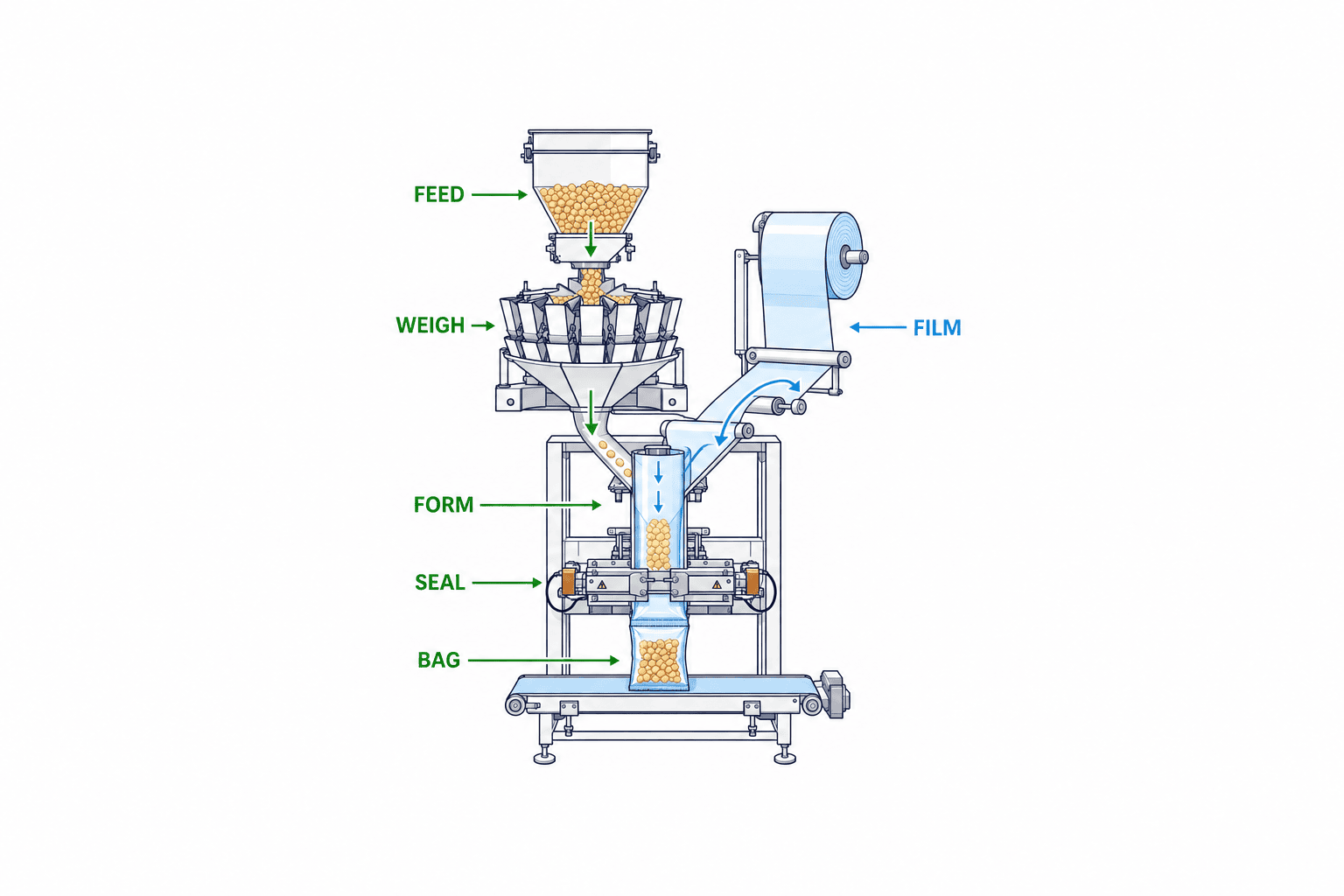
Fix product, film, and bag specifications before selecting a VFFS model
Do not describe a product only by its average properties
Even within one snack family, light fragments, oily fines, and irregular large pieces behave differently. They change hopper surfaces, feeder settings, chute angles, drop distance, and adhesion to film or jaws. Include the least free-flowing SKU, the most fragile SKU, and the SKU most likely to contaminate the seal in the RFP. Trials should use representative production lots and reflect the site’s temperature and humidity, rather than a convenient small sample alone.
For powders, bridging and airborne dust can disturb both dosing and seal cleanliness. For large pieces, watch for blockage and impact damage. Frozen products add condensation, frost, and cleaning constraints. Liquid or viscous products raise nozzle-drip and bag-mouth contamination issues. Record weight distribution, breakage, and seal contamination by SKU; a trial report that says only “no blockage” is not sufficient.
Test bag format and film compatibility independently
Pillow, gusseted, stand-up, and zipper packs require different forming parts and seal motions. Syntegon’s SVE family includes designs from pillow bags to Doy-Zip packs. Its stated up to 100 bags/min applies to a particular Doy-Zip series; it is an OEM claim, not a guaranteed rate for your product and film. The page’s up to 380 mm bag width also applies to specified models. Check model, options, and pack dimensions before putting such numbers in a comparison table.
State the film layer structure, total thickness and tolerance, roll width and outside diameter, core diameter, friction behavior, print registration mark, and sealant-side orientation. If a recyclable mono-material film may replace the current laminate, trial it separately: the old temperature, dwell time, and pressure settings may not transfer. Include storage and lot variation where those can affect performance in the Thai plant.
Design the coding zone with the bag drawing. A date or lot code can be legible on the artwork yet become unreadable when placed over a cross-seal or back seam. Changing artwork can change registration. The RFP should specify correct code content, character integrity, and allowable position, and should demand verification with the actual printed film.
Evaluate planned material and format changes
If future bags differ in width, length, fill weight, or film, list the forming shoulders, tubes, jaws, and guides needed for each SKU. Syntegon’s SVX family emphasizes material and format flexibility. In a purchase decision, that claim must still be translated into model-specific limits, change parts, settings, and changeover work. A quoted “multi-format” capability is less useful than a parts list and a measured, repeatable conversion procedure.
Treat feeding, weighing, and filling as one capacity constraint
The bagger cannot reach a useful rate without a stable product supply. Check bulk-feed capacity, buffer volume, vibratory feeder control range, hopper-level sensing, and cleanability. A combination weigher loses effective combinations if supply fluctuates, causing giveaway or waits. Screw or volumetric filling may suit other products. Select the dosing method from product trials, rather than from the label on the machine.
The drop from weigher to open bag affects breakage and timing. Put chute angle, contact surfaces, inspection access, and disassembly space on the layout drawing, not just overall machine height. With different machine vendors, define “weigh complete,” “bag ready,” “discharge permitted,” pause, fault, and restart signals in an I/O list. A quotation saying only “communication available” does not establish synchronized operation.
Measure each SKU. A nominally adequate bag count may conceal excessive product giveaway when fills cluster above target. Conversely, a setting too close to the minimum can increase checkweigher rejects. Record set weight, actual-weight distribution, checkweigher decisions, and good-bag count in the same time window. This exposes the difference between component speed and the line’s saleable output.
Specify seal contamination and leak behavior
A heater setpoint alone does not define seal quality
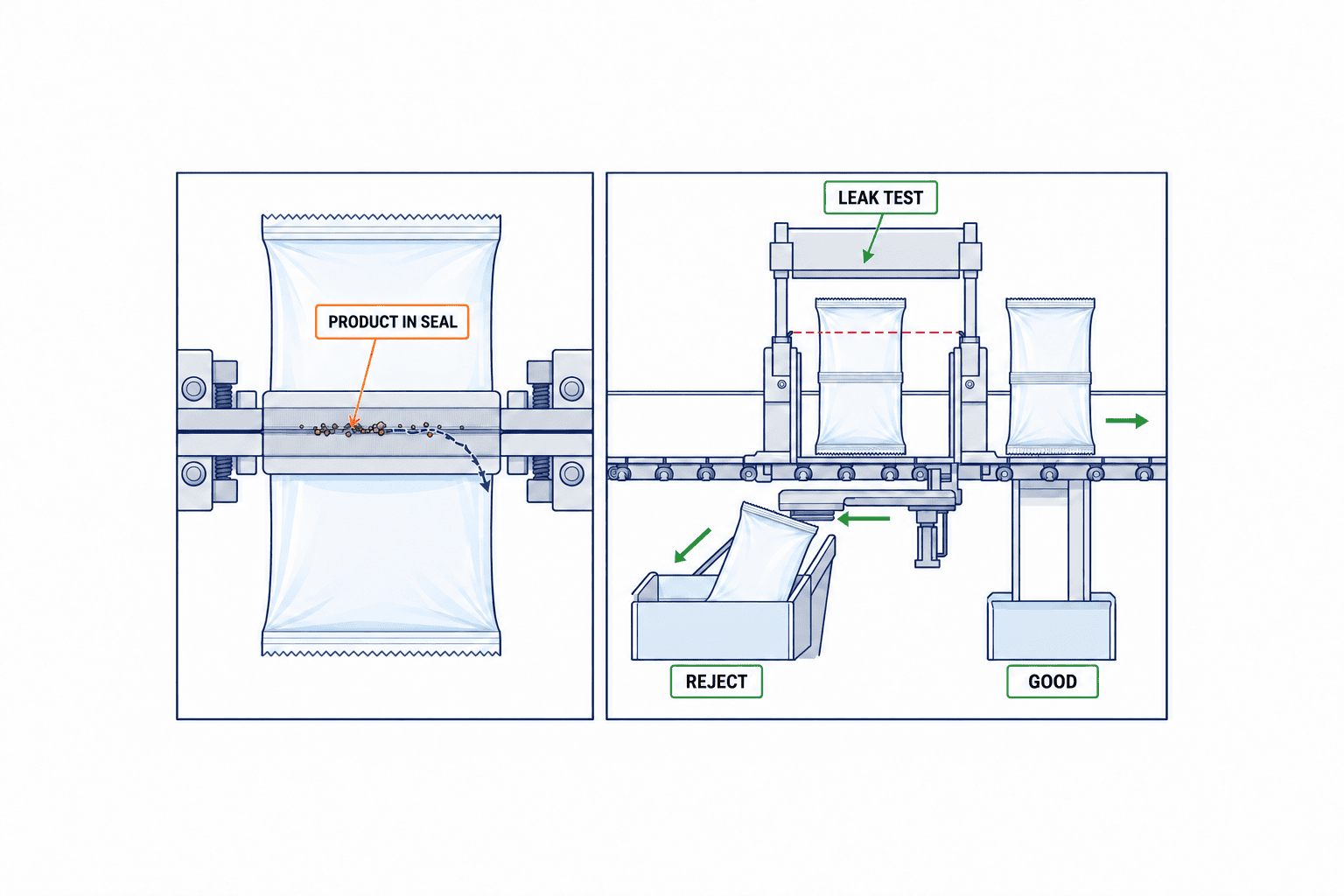
Transverse seal integrity depends on temperature, pressure, contact time, film tension, and product contamination. Powder or fragments left at the mouth can defeat a seemingly correct temperature. Ishida’s ASTRO-B describes an optional sealing movement that combines a brushing action with conventional stripping to help keep product out of the seal. This is an example to trial with your most difficult SKU, not a promise of zero trapped product.
At FAT, establish a seal-process window for each film. Testing only one nominal setting cannot reveal tolerance to film-lot or machine variation. At the upper and lower settings, inspect appearance, seal width, strength, and leaks; repeat sampling during product-filled continuous running. Prepare intentional product-in-seal defects and agree how they should be detected and rejected. Avoid claiming “100% detection” without a defined defect type, size, location, and validated inspection method.
Pair the leak test with confirmed rejection
Ishida’s TSC-AS applies controlled pressure to each pack, detects excessive inspection-head movement, and rejects defective packs. Its stated defect examples include air leakage from product in the seal and poor heat sealing. The web page also mentions detection of a 3 mm diameter hole; that is a claim for this product under its conditions, not a universal assurance for every bag geometry or fill volume. Agree test bags and record location, defect type, and result.
An NG signal is not proof that the bag reached quarantine. Verify the reject actuator, confirmation sensor, full-bin signal, low-air response, broken-sensor response, and restart after power loss. Challenge close bag spacing to expose a possible wrong-bag reject. Record detection decisions, confirmed rejects, and manual quarantine separately.
Do not confuse inspection functions. A leak tester does not validate all code content. A checkweigher does not directly measure seal integrity. A code reader does not establish weight. Build a defect-mode table with columns for defect, source, detector, confirmation method, reject point, record, and FAT sample. Include underweight, overfill, missing or wrong code, product-in-seal, pinhole, metallic contaminant, and empty bag. Any residual undetected modes remain visible to quality assurance.
Sequence coding, weight, metal, and seal inspections deliberately
Coding on the film and coding on the formed bag create different tracking distances from the fault to the reject point. Define the trigger, SKU recipe, authorized code changes, and first-piece check. For a vision reader, determine whether it merely detects print presence or verifies the correct date and lot. Test real artwork for false reads and misses.
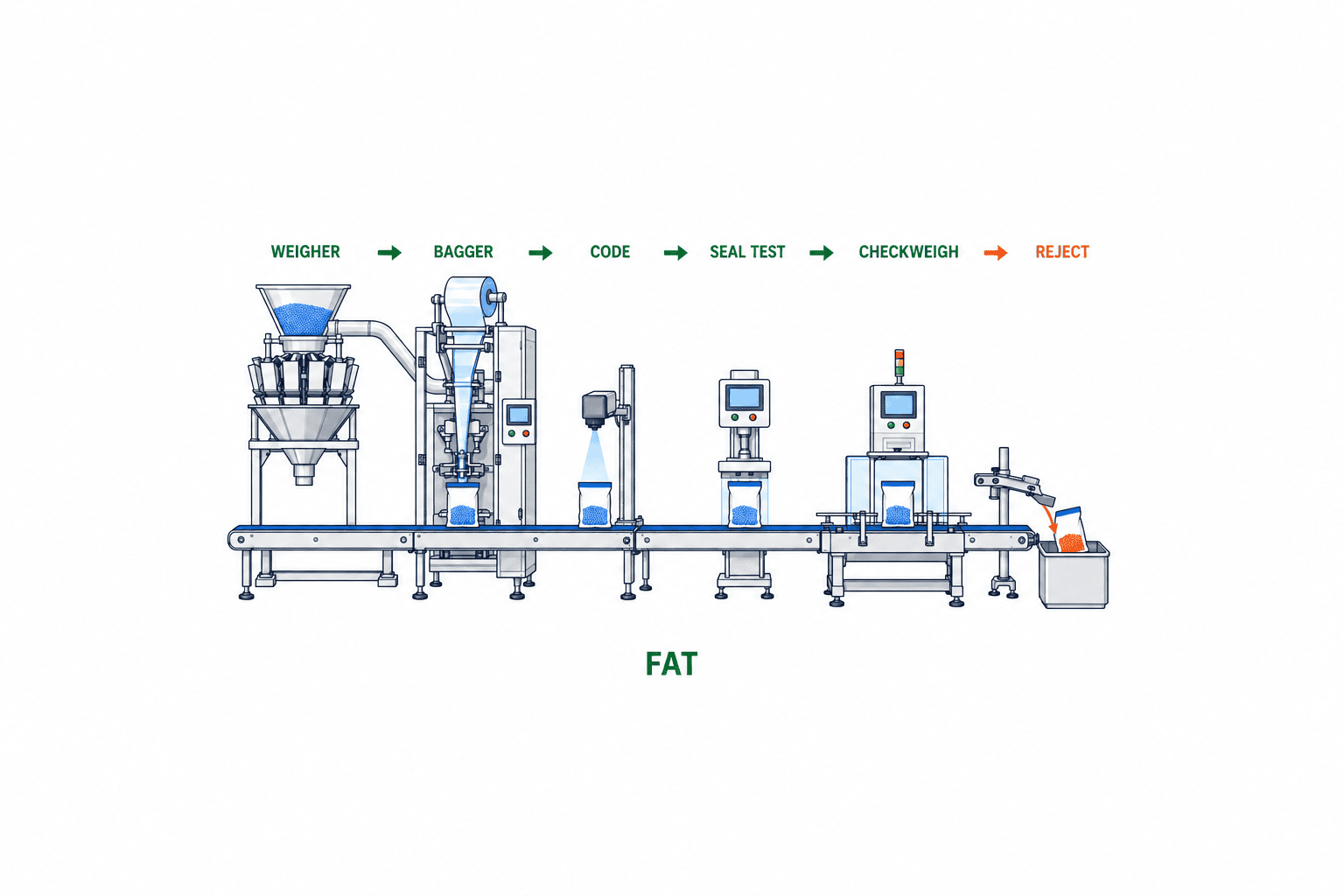
Checkweigher performance depends on vibration, bag attitude, and spacing. Agree what to do when the upstream filler and downstream checkweigher disagree. If metal detection is included, choose test pieces, sensitivity, and rejection location for the product and package. Place the leak tester, checkweigher, and any metal detector according to the defects and conveying condition. At changeover, verify that bagger, coder, and all inspection recipes match the SKU.
The defect-mode table makes bids comparable. It also prevents a collection of devices from being mistaken for a functioning quality system. Every fault requires a defined detection test, a confirmed route to the reject bin, traceable count, and a named person to reconcile quarantined product.
Calculate good output and total cost with explicit assumptions
The following figures are illustrative assumptions, not OEM guarantees, measured Thai-market averages, or a real quotation. Suppose the target is 40,000 saleable bags per shift. Assume an eight-hour shift contains seven hours of planned production, that illustrative availability is 85%, and that 98% of produced bags pass inspection. The required running speed is 40,000 ÷ (7 × 60 × 0.85 × 0.98) ≈ 114.3 bags/min. Replace 85% and 98% with SKU-specific measurements before procurement.
In that example, a candidate labeled 120 bags/min still misses the target if it reaches only 100 bags/min with the chosen film. A 160 bags/min bagger cannot lift a line whose feed reliably delivers just 110 bags/min above 110. Keep separate columns for catalog maximum, continuous FAT result on the target SKU, and good-bag SAT result. Record test duration, stops included, weight setpoint, film lot, and the definition of a counted good bag.
Compare total project cost: feed and weighing, bagging, printing, inspection, rejection, conveyors, controls integration, installation, training, spares, format parts, material trials, and ramp-up. If additional investment of THB 12 million and annual net benefit of THB 3 million are assumed for illustration, simple payback is four years (12 ÷ 3). This is not a price or business case for a particular factory. Net benefit should include realistic product giveaway, scrap, rework, labor expense actually removed, maintenance, and energy changes.
Do not book all redeployed labor as a cash saving. Distinguish an expense that actually disappears from capacity transferred to another task. Likewise, estimate avoided customer claims from the site’s own claim history rather than from a supplier’s promotional example. Finance, manufacturing, and quality should sign off on the inputs before ranking a more expensive but potentially more capable line.
Put changeover and cleaning into the line specification
In a multi-SKU plant, productive hours can matter more than peak speed. A changeover may involve the forming shoulder, filling tube, jaws, film roll, code recipe, inspection settings, and checkweigher setting. The line is not producing approved goods until the next SKU’s first-piece inspection is complete. Define changeover time in the RFP as the interval from the last approved bag of the prior run to the first approved bag of the next run.
The TSC-AS page describes automatic changeover as an option; confirm it is in the quoted configuration and trial it on your SKUs. Syntegon also highlights fast format changes for SVE machines, but the number of parts and tools depends on model and format. Do not transfer a catalog changeover time to an unrelated line.
Define disassembly order, tools, permitted water or chemicals, drying time, and checks after reassembly for each product-contact area. Powder and frozen food lines call for different cleaning approaches. A bagger designed for wet cleaning does not imply that its adjacent coder or sensors tolerate the same method. Check access, drains, and maintenance clearance on the actual plant layout.
Treat recipes as operational controls. Speed, seal temperature, weighing target, code content, and inspection thresholds should be reconciled for each SKU. Limit unauthorized edits and retain change history. Ishida describes user permissions and operation logs for ASTRO-B, but confirm the function in the actual model and purchased configuration.
Write a Thai-factory RFP that produces comparable bids
An RFP should request evidence, not merely a “yes, possible.” Attach the SKU and film matrix, bag dimensions, weight range, minimum and peak required good output, and cleaning classes. Add a boundary drawing, power and air conditions, network, floor loading, ceiling height, and equipment access route. Define each defect mode, detection and reject responsibility, records, and FAT/SAT method.
For every SKU, request a guaranteed performance figure with its conditions. Clarify whether a maximum was proven with the named product, film, and bag size. Specify duration of continuous tests and whether first-piece approval, stops, format changes, and cleaning count. Acceptance criteria for breakage, weight distribution, seal failures, print readability, and reject success need both a limit and a sample method.
Discuss guarding, emergency stop, isolation for maintenance, and risks at access points. PMMI’s standards page says ANSI/PMMI B155.1-2023 covers machinery performing primary, secondary, and tertiary packaging and related conveying machinery. Its listing is not a statement of Thai legal compliance. Ask the supplier to identify applicable local obligations, the plant’s own safety rules, and responsibility for the assessment.
Request maintenance instructions and lead times for jaws, knives, belts, sensors, print heads, and inspection checks. Evaluate Thai service coverage, language, response route, and remote-support terms. A low equipment price is not directly comparable with a quotation that includes format tooling, first-year support, and commissioning.
Use FAT to examine the actual bagging line
At the vendor site, FAT should use the completed equipment and near-production samples. Include the least free-flowing product, worst seal-contamination product, and smallest and largest packs, not only the most convenient SKU. Supply the correct production-film structure. If substitute film is unavoidable, mark those results as conditional. Record machine settings and material lot before testing.
For capacity, count good bags after weighing, filling, coding, inspection, and rejection—not empty bags from the bagger. Log stops, short interruptions, product starvation, roll changes, and false rejects with time stamps. Run a changeover between two buyer-selected SKUs and time last approved bag to next approved first bag; note personnel required and repeat with another operator if practical.
Challenge underweight, incorrect code, product-in-seal, and deliberate leaks one defect at a time. Follow the decision through to physical isolation. Test a full reject bin, failed confirmation sensor, and inadequate air pressure. Quality assurance should approve test samples and method. A failed FAT item needs an owner, corrective action, deadline, repeat-test method, and a decision on whether it may be carried to SAT. Keep settings and test evidence for later diagnosis.
Confirm the Thai site’s conditions at SAT
SAT follows installation and integration with the plant’s products, film, operators, utilities, and surrounding equipment. If an FAT rate falls at the site, investigate supply, electricity, compressed-air quality, floor vibration, temperature, humidity, and bag attitude. Retain the FAT baseline and explain the difference. Manufacturing, maintenance, quality, and IT/OT should review the same data.
Test start, stop, emergency-stop recovery, recipe retention after power interruption, low air pressure, upstream starvation, downstream congestion, and reject-bin-full behavior. Use a bag identifier or timing log so bags cannot be confused between inspection stations. Confirm HMI language, alarm wording, procedures, and training that local operators can use; determine whether Thai manuals and training are included in the contract.
Define SAT sign-off with SKU-specific good output, quality results, changeover and cleaning time, fault recovery, completed training, and delivery of drawings, software backups, and spares. Schedule an early production review. Assign residual micro-stops and film-lot issues to owners with closure tests rather than calling the line “accepted” simply because it ran once.
Rank candidates with evidence
Compare candidates by good output on the target SKU, pack range, film compatibility, seal-defect controls, inspection and reject completion, observed changeover, cleaning, footprint, service, spares, warranty, and total cost. Mandatory requirements should be pass/fail. Only then apply agreed weights to quality, output, operation, support, and cost. Record drawings, physical trials, FAT data, parts lists, and service proposals as evidence.
Agree whether future format flexibility or rapid launch of today’s SKU matters more before scoring. For future case packing, define the good-bag handoff attitude and rate: thickness and air-fill variation can cause misfeeds. Ishida describes TSC-AS air-fill data passed to a downstream case packer, but confirm equipment and controls compatibility. Evaluate stretch-wrapping conditions separately once the pallet load is defined.
Use commissioning data for continuing improvement
Line performance is not fixed after SAT. Product and film lots, jaw wear, and changeover practice alter the good-bag rate and stop frequency. For the first weeks, compare scheduled output, feed count, good bags, NG decisions, and stop time by SKU. A machine can remain “running” while operators slow it to protect seal quality, so uptime alone can hide a capacity loss. Align counter definitions across weigher, bagger, and inspectors and compare the same production order and time interval.
Do not combine all rejects into one number. Track product-in-seal, underweight, coding fault, leak, and false reject separately, with SKU, film lot, and settings. Before reducing inspection sensitivity after an NG increase, determine whether defects actually rose or bag spacing and attitude changed. Quality assurance should own pass criteria and retest rules for rejects; engineering should separate material, machine, and operator causes.
Define useful data fields during the RFP: time, SKU, recipe, machine state, stop reason, inspection result, and confirmed rejection, along with format and source device. Agree retention, clock synchronization, backup, and remote-service access. Start with a small reliable record if integration would delay launch, then automate collection as the line stabilizes. Keep the FAT/SAT definition of a “good bag” consistent during routine operation.
Conclusion: three decisions to make before the RFP
First, define the SKU, film, bag, and worst operating conditions. Second, define the complete boundary from weighing to sealing, coding, inspection, and physically confirmed rejection, along with good-bag capacity. Third, put agreed samples, test duration, pass criteria, and treatment of failures into FAT and SAT. OEM speed claims help screen candidates; continuous tests on the plant’s own materials should decide the purchase.
If you are scoping a VFFS line, connections to existing machines, or acceptance criteria for a Thai site, contact TOMAS TECH. We can help organize the equipment boundary while the project is still at the concept or RFP stage.
Frequently asked questions
Can bagging automation cost be compared from the bagger price alone?
No. Compare feed and weighing, coding, inspection, rejection, conveyors, controls, installation, training, format tooling, and spares. The THB 12 million and four-year example above is illustrative, not a quotation.
Can a VFFS catalog speed be used directly in the production plan?
No. Flow behavior, bag dimensions, film, weighing supply, seal quality, and rejects all change good-bag output. Verify it in a continuous FAT run and a site SAT run for the selected SKUs.
Can the bagger alone eliminate product in the seal?
Jaw motion can help, but feed rate, drop timing, dust, oil, and bag-mouth geometry also matter. Trial the product and couple the preventive measures with leak inspection and confirmed rejection.
What is the difference between FAT and SAT?
FAT tests the finished equipment at the vendor site with agreed samples. SAT tests the installed line at the Thai factory with its actual utilities, operators, and adjacent machines. Use common acceptance definitions and record site-specific differences.
Can we select a machine using only today’s film if a future change is planned?
If that change is part of the investment case, trial the candidate film. A different layer structure and sealing surface can change the process window, format tooling, and code position. State current and future requirements separately.
Sources
- Ishida, Bagmakers, accessed 8 October 2026.
- Ishida, Vertical Bagmaker ASTRO-B, accessed 8 October 2026.
- Ishida, TSC-AS, accessed 8 October 2026.
- Syntegon, SVE Series, accessed 8 October 2026.
- Syntegon, SVX Series, accessed 8 October 2026.
- PMMI, Standards and Regulations, accessed 8 October 2026.


