


When a pallet has physically moved but the warehouse record still points to its old bin, a manufacturer loses more than search time. Lot traceability, reservations, shipping, and material supply can all be affected. A warehouse location movement system should therefore define what constitutes one movement, who may move which inventory, and when the move becomes final before handheld devices are deployed. This guide focuses on internal bin-to-bin transfers at a Thai manufacturing site and turns the workflow into requirements for an RFP, factory acceptance testing (FAT), and site acceptance testing (SAT).
Define the scope of an internal location movement
Here, a location movement means physically transferring stock from bin A to bin B within the same warehouse and updating both its current location and transaction history. It is distinct from receiving a purchase order, shipping a sales order, transferring stock between warehouses, or adjusting a stocktake variance. Common examples include moving a pallet from receiving to inspection staging, consolidating half-empty storage bins, and changing outbound staging after a dock assignment changes. Microsoft documents similar scenarios for its warehouse product; those examples illustrate possible requirements, not capabilities that every WMS provides. Microsoft: moving inventory with associated work
Location movement overlaps with replenishment, but the triggering decision is different. Our guide to pick-face replenishment starts with demand and a rule for restoring stock to a picking location. This article deals with the execution and evidence of all kinds of internal transfers, including ad hoc relocations and moves following quality inspection. A replenishment task can use the movement controls described here, but a movement does not necessarily replenish anything.
Identify stock at the granularity the factory actually uses
A record containing only item, quantity, source, and destination fails when two lots or pallets of the same item share a bin. Depending on the material, consider warehouse, bin, item, lot, serial number, inventory status, handling unit or license plate (LP), unit of measure, and quantity. Do not force every worker to enter every field. Make lot mandatory for lot-controlled materials, serial number mandatory for serialized assets, and LP mandatory when the operation moves pallets. Also distinguish a physical relocation from a quality-status change or quantity adjustment. Otherwise a later audit cannot explain what happened.
For example, if lots L1 and L2 of item A are stored together, an entry saying “move ten A” cannot establish which lot changed location. Split the transaction by lot and reconcile the remaining balances. For a mixed pallet, decide whether a full LP or a subset moves and whether the subset needs a new LP. Microsoft’s movement menu describes configuration choices for moving full LPs and for creating an LP when part of a quantity moves. These are useful questions to ask a supplier, not reasons to skip verification by default. Microsoft: manual movement menu
Separate three reasons for a movement task
First, an ad hoc movement starts on the shop floor: a damaged rack must be cleared, an aisle must be opened, or a pallet must be moved to a safe place. A worker or supervisor may propose the move, but unrestricted choice of destination risks capacity violations, incompatible materials, and broken FIFO rules. Define approved zones, reason codes, roles, and approvals. Microsoft describes a manual movement flow in which the worker chooses what to move and where; the availability of such a flow in another product must be verified. Microsoft: manual movement menu
Second, a directed move is triggered by a rule or event. After quality release, approved stock may need to go to normal storage; hazardous material may need a designated zone. A system can suggest a bin based on capacity, temperature, compatibility, or distance, then ask the worker to scan the actual destination. Microsoft’s “Movement by template” lets work templates and location directives determine the destination instead of leaving the choice entirely to the worker. In an RFP, ask how the candidate solution calculates alternatives, handles a full bin, and records an approved override. Microsoft: movement by template
Third, a move may affect an existing work order or reservation. If a pallet allocated to a shipment moves to a different staging lane, a simple location change can leave the pick work pointing to the old lane. Microsoft’s documentation describes permissions and restrictions for moving reserved inventory and avoids splitting an existing work line in some cases. Its documented reserved-stock movement is ad hoc, rather than movement by template. The exact behavior is product and version specific; demonstrate it with the proposed software. Microsoft: moving inventory with associated work
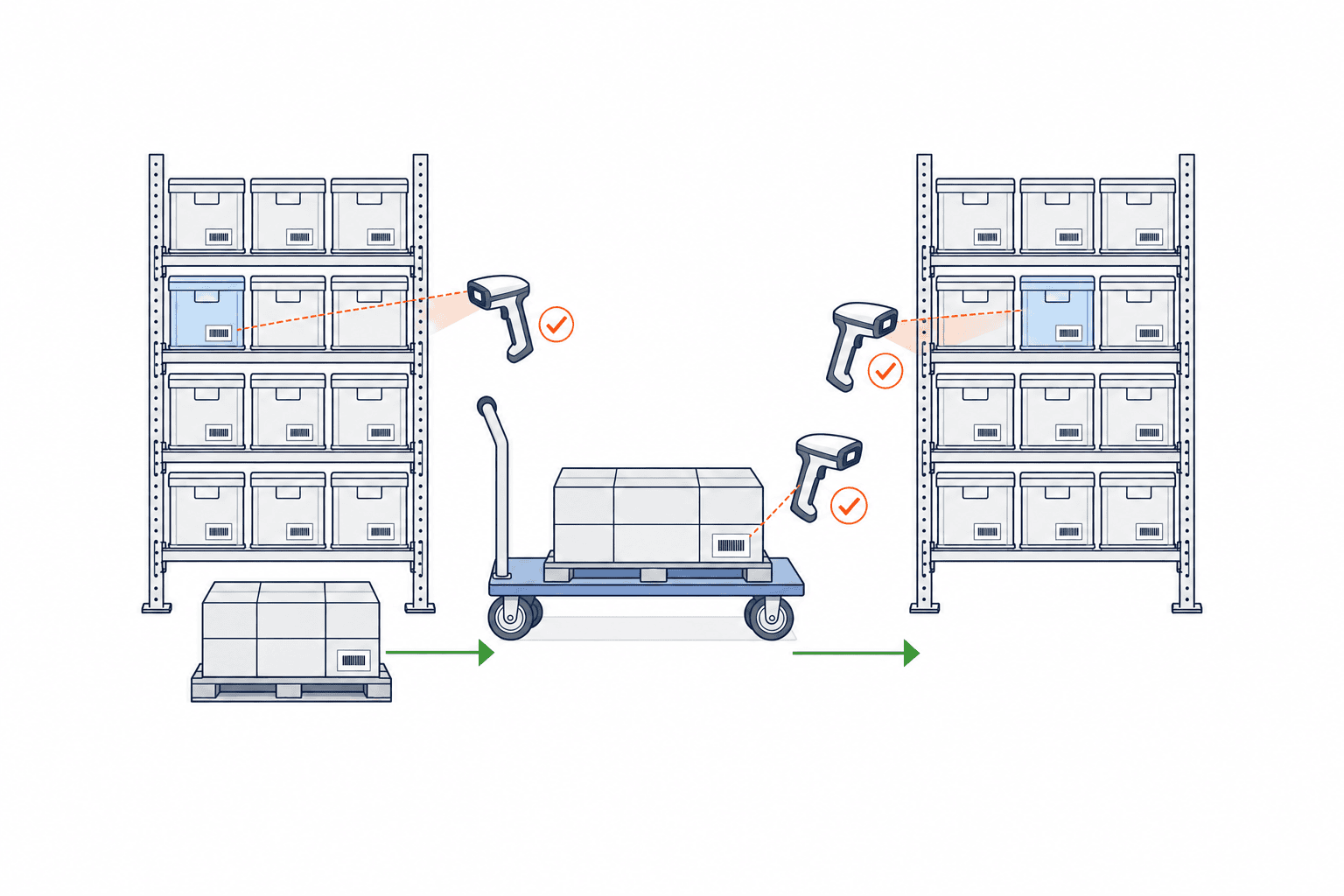
Close the transaction with source and destination scans
A practical handheld flow starts with a task ID or reason, then checks the source bin, LP or container, item, lot or serial, quantity, and destination bin. The optimal screen order depends on whether the rack or pallet label is visible first and whether the operator’s hands are occupied. The invariant is that the source actually picked and destination actually used are evidenced against physical labels. Selecting a destination from a list is not the same as arriving there: scan the destination at putaway. If offline operation is allowed, retain separate timestamps for the physical action and server posting.
A successful barcode read can still identify the wrong kind of object. A numeric string might represent an item, LP, internal bin, or GS1 key. Pair readable short location names with unique machine codes and validate the expected data type at each step. GS1 explains that a GLN used on a physical storage location uses Application Identifier (414), whereas AI (410) means “Deliver to.” Choosing internal codes or GLNs depends on the integration and labeling scheme; a GLN alone does not create reliable bin control. GS1: identifying a physical location with a GLN
When external logistics labels are used, define the relationship between an SSCC on a logistics unit and an internal LP. The GS1 Logistic Label Guideline describes labeling of logistics units. An internal LP does not necessarily need to become an SSCC, but confusing their numbers breaks the trail between an internal move and shipping information. Include inbound label reading and the LP cross-reference in the RFP.
Do not assume “barcode confirmation” covers every flow
Confirmation settings may depend on work type and how a value was entered. Microsoft’s documentation lists conditions for batch, serial, LP, and location confirmation. It also notes that the ordinary location-confirmation step is skipped when the location is entered manually during a manual movement. Therefore write a test case that names the screen, user, attribute, scan, and expected rejection rather than asking only whether the product “supports confirmation.” Microsoft: batch, LP and location confirmation
Resolve reservations, quality holds, and prohibited bins first
An empty-looking bin can still be unsuitable because of weight, size, temperature, hazardous-goods separation, ownership, customer stock, or FIFO requirements. At posting, check that source stock exists, the destination accepts the item’s status, and another task has not consumed the same stock. Give precise meanings to on-hand, reserved, in-transit, and available quantities. If a paper-based process is replaced without defining reservations, a relocation can make shipping staff search for already allocated material.
Quality status is a separate dimension from physical location. A move from inspection staging to approved storage may accompany a release decision, but the event that changes status should remain distinguishable from the event that changes location. A move alone should not silently approve a lot. Moving questionable material into quarantine may be urgent; returning it to available stock may need a quality officer’s approval. Separate permissions for creating, executing, approving exceptions, reversing, and adjusting stock. Define whether unapproved stock may move and whether it contributes to available inventory.
Concurrency matters as much as scanning. Two workers may handle the same LP for different tasks. If one starts a move and another completes shipping work, the first device must not post from a stale balance. Recheck a stock version or quantity at commit and require a physical recheck on conflict. This is a design requirement, not a claim about a standard feature of a particular vendor. Offline devices increase the conflict window, so include synchronization and conflict handling in FAT.
Make “in transit” visible
If a move takes several minutes, subtracting from A and immediately adding to B makes the pallet appear at B before it arrives. Posting only at completion makes it appear at A during transport. Choose based on task duration and downstream use. A task state model can distinguish open, picked, in transit, put away, reversed, and exception, with a clear answer to whether stock is at A, on a trolley, or at B. Even if a short move is posted in one step, supervisors must find transactions interrupted by a dead battery or lost connection.
Define an owner and recovery deadline for tasks that remain in transit across shifts. If outbound work begins, should the stock be blocked? Who may force-complete a task, and what reason and approval are logged? A colored dashboard alone is insufficient; provide exception lists, alerts, audit history, and daily reconciliation. The issue connects to our discussion of physical WIP inventory control, while bin movement requires location to be resolved per transaction.
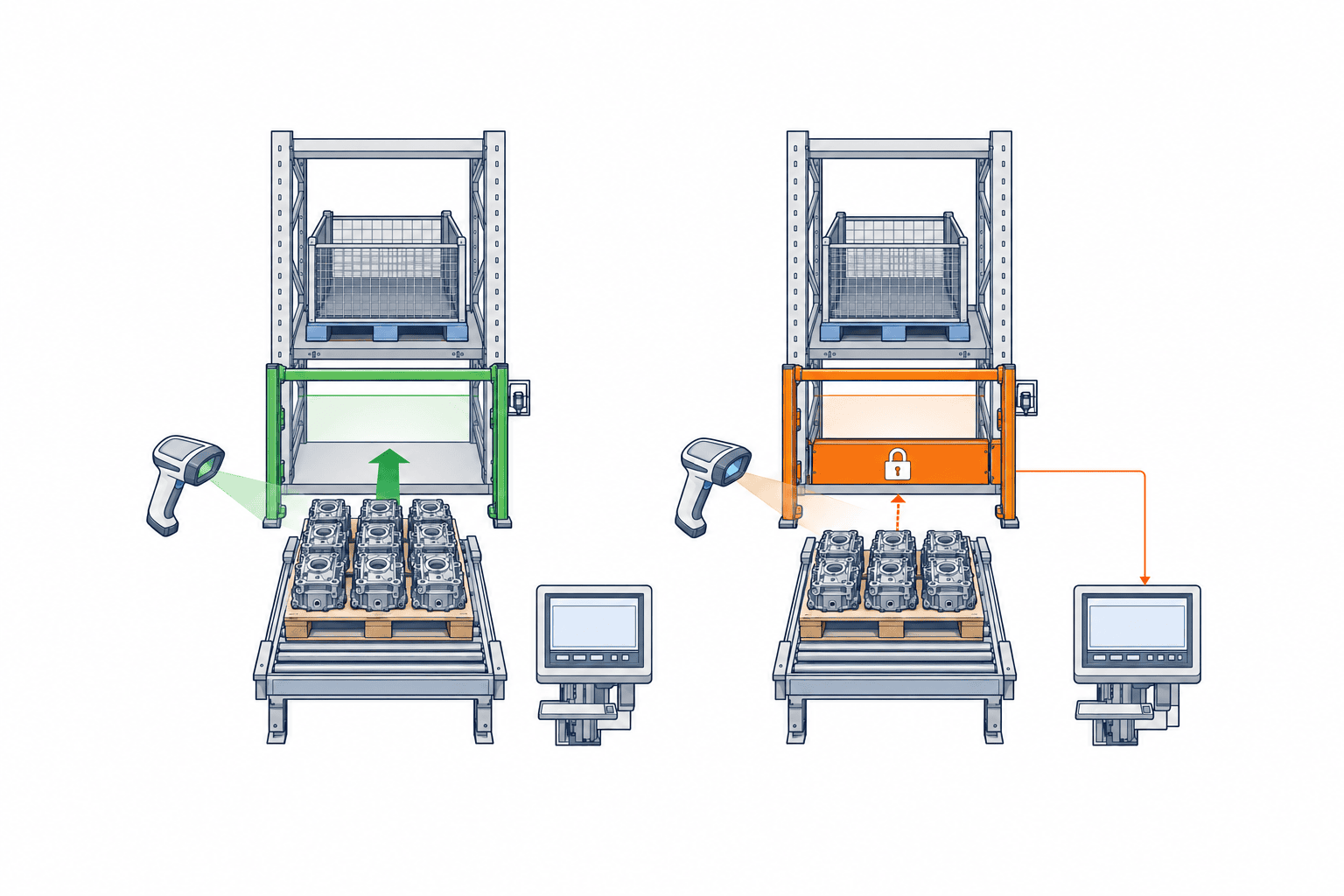
Reverse completed moves without erasing history
A worker may scan the wrong source, put a pallet in the wrong bin, or enter too much quantity. Discarding an unstarted transaction, canceling an in-progress task, reversing a completed move, and making an inventory adjustment are different actions. Editing or deleting a completed movement destroys the ability to reconstruct where material was at a given time. A reversal should reference the original transaction and record actor, reason, approver, and time. If the stock has subsequently been reserved or consumed, block a simple reversal and require a physical check and replan.
Duplicate scans and retries need their own control. Give each device operation a unique ID so a network retry cannot post the same move twice. A date is not an idempotency key. Decide whether a correction from ten to twelve units replaces the original entry or adds a two-unit movement, and where approval applies. Never move stock only in the database while the pallet remains physically elsewhere. For a physical return, scan the return destination as evidence.
Route exceptions to a visible stop state
Unreadable bin labels, full destinations, detached LP labels, illegible lots, and a changed inspection result cannot be made safe with an unrestricted manual entry field. Stop the standard task and show a controlled alternative. Reprint a bin label only after checking the location master. Distinguish reprinting an existing LP from creating a new one. A quality disposition change needs its own authorization. Record a structured reason and optional free text, then measure whether master data, labeling, radio coverage, or layout is causing repeated stops.
Set ERP, WMS, and MES boundaries by the system of record
ERP often owns purchasing, sales, valuation, and corporate stock; WMS commonly manages bins, LPs, handheld tasks, and scan history; MES commonly manages production orders, consumption, and WIP. These descriptions do not determine the actual owner in a specific plant. Some sites use an ERP warehouse module; others use a standalone WMS as the bin-level source of truth. Create a table naming the owner of item, lot, warehouse, bin, LP, quality status, reservations, and cost before integration design begins.
A move between bins in one warehouse may remain inside WMS if ownership and cost do not change, with an event or summary sent to ERP. If ERP itself holds bin balances, it also needs an update. Moving between warehouses, changing a financial stock category, or issuing material to production can have accounting or manufacturing meaning. Do not hide these operations behind the same “move bin” button. Specify event triggers, acknowledgement, retry, ordering, failure queue, and reversal treatment in each interface contract.
For automated transport, decide whether an equipment arrival signal is enough to post the location change or whether a worker must confirm putaway. A scanner, RFID read, and PLC signal observe different things; reading a code does not prove a pallet was placed in the intended bin. Preserve device and server timestamps and an unambiguous event sequence across sites.
Write an RFP around demonstrable cases
A feature matrix with check marks is weaker than a demonstration using your exceptions. State the number of warehouses, bins, SKUs, lot- and serial-controlled items, moves per day, devices, radio dead zones, label types, and peak hours. Use your own measurements and make vendors price the same scope. Include future areas and clarify who pays for rule changes.
Ask whether the product: (1) separates ad hoc and directed moves by role; (2) physically scans both bins; (3) distinguishes multiple lots and LPs in one bin; (4) handles full and partial LP moves; (5) controls moves of reserved or shipment-assigned stock; (6) controls moves of quality-held stock and prevents incompatible-bin or overcapacity moves, while handling unit conversion; (7) handles offline retry without duplicates; (8) links a reversal to its original transaction; (9) exposes integration failures and retries; (10) supports the required Thai, English, and Japanese screens and labels; and (11) exports an audit trail with role-based access to viewing and export. Require each answer to say standard, configured, custom-built, operational workaround, or unavailable. Demonstrate confirmation specifically on the manual movement screen; vendor wording alone is not enough. Microsoft: confirmation conditions
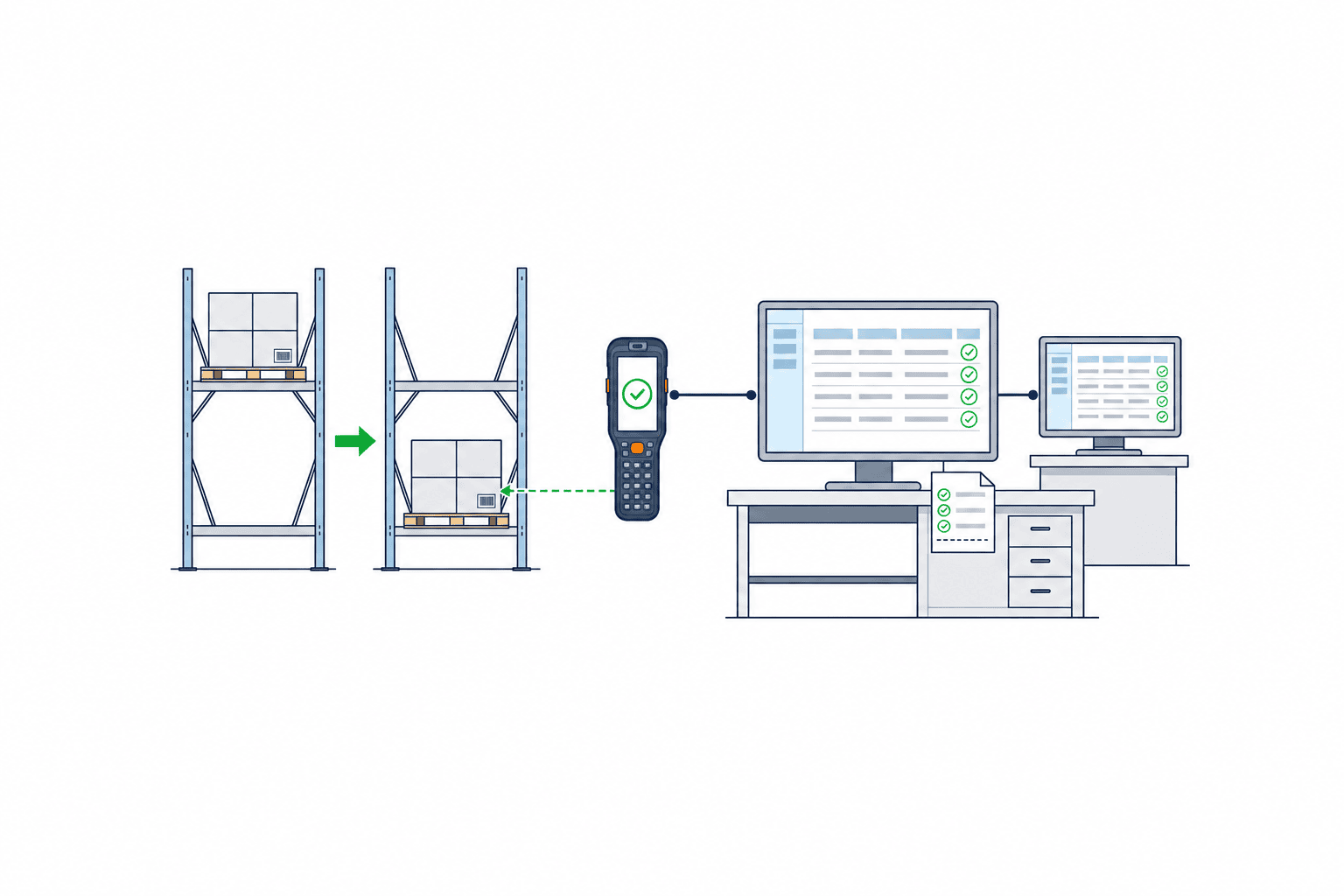
FAT and SAT must prove that wrong moves are stopped
In FAT, configure representative master data and test the handheld, WMS, and interface together. Normal cases include a single-lot bin move, a full mixed LP move, a partial LP split, a move to quality hold, a suggested destination, and an ERP event. For each case, record source and destination balances, reserved and available quantities, and transaction IDs before and after. A green “success” banner is not the acceptance criterion.
Negative cases should include a wrong source, wrong lot, excess quantity, prohibited or full destination, an LP already allocated to another task, repeat submission with the same operation ID, offline retry, battery failure, ERP receive failure, cancellation, and reversal. Test the supplier’s actual rule for reserved inventory. Microsoft’s documented example restricts moving only 30 units of a 100-unit existing work line because doing so would split that line; some staging cases permit only the entire LP. These are example product constraints to investigate, not universal WMS rules. Microsoft: reserved-stock movement limitations
In SAT, repeat the same cases with real racks, labels, devices, wireless coverage, and operator routes. Check whether a label can be read from a forklift, whether neighboring bins are confused, whether a drop in connectivity causes duplicate postings, whether gloves make the screen difficult to use, and whether Thai instructions are understood. Count stock in the pilot area before cutover and reconcile the migrated balance. Otherwise even a correct new movement history starts from an unreliable opening position.
Acceptance should cover critical defects, training, exception contacts, label readiness, and monitoring of interface failures. During the first week, review moves, unfinished tasks, reversals, location mismatches, scan exceptions, and integration retries daily. Set targets after measuring a plant-specific baseline; a generic promise of a percentage improvement is less useful than a count of errors the project is designed to remove.
Start with one controlled area
Choose an area with frequent moves and manageable labels and master data. Observe where current paper forms or verbal instructions lose the location trail. Map items, lots, LPs, reasons, bins, and permissions. Pilot source and destination scanning with an immutable completion history, then expand to quality states and integration only when the system of record remains sound. A limited pilot is a way to validate the whole transaction, not a reason to ignore controls needed for production.
Record operator feedback on the number and order of scans. A repeated scan that can be safely inferred from the master may be removed; the final destination confirmation should remain. Train supervisors, warehouse staff, quality, IT, and ERP owners on the same exception scenarios. Manuals should answer what to do when stock is missing, a different lot appears, or the assigned bin is full, not just which button to press.
After go-live, use movement history to improve the operation. Repeated ad hoc moves from the same rack may indicate layout or replenishment problems. A long quality-hold backlog may show a decision bottleneck. Frequent reversals may point to confusing bin labels or screens. The goal is not to blame workers; it is to make physical stock, work orders, and reservations agree on where each unit is.
Five decisions to settle with real operators
1. The bin contains a different lot
A screen showing 20 units of item A in bin A is insufficient if that balance consists of ten units each of lots L1 and L2. After L1 is scanned, show only its movable balance; never borrow from L2 to permit the transaction. If the scanned lot differs from the task, stop and distinguish misplaced stock from an outdated instruction. For a mixed LP, record whether the whole pallet or one case moved, the remaining contents of the original LP, and the receiving container ID. Two containers must not end up claiming the same LP number. Design identifiers for the downstream traceability required, without unnecessarily serializing every item.
2. The suggested destination cannot be used
The system proposes bin B, but a pallet already occupies it. A worker finding empty bin C should not simply overwrite the destination. Reassess capacity, material compatibility, ownership, quality status, and temperature. Permit C with a reason if it meets the rules; otherwise escalate. Record the discrepancy between B’s physical and system states for investigation. If stock is physically placed at C but the device reports a communication failure, first query the pending operation ID. Retrieve the result if the server accepted it; if not, verify the pallet and retry with the same controlled operation. Test this by disconnecting the device during an RFP demonstration.
3. A reserved pallet must move
When an allocated pallet moves because an aisle is closed, the shipping team’s reference must follow. Test role, quantity unit, work-order notification, and new pick location in one scenario. Some products cannot split an existing 100-unit work line to move only 30 units. Microsoft’s documented restriction is an example to investigate. If the candidate system disallows the operation, define the formal alternative: release and recreate work, or move the full pallet. Also align the meaning of “reserved” across ERP and WMS: order-level allocation, WMS work creation, and physical set-aside are distinct stages. Name the approval boundary for each.
4. Quality-held stock must move
Moving a quality-held pallet closer to the inspection room is a physical action, not a release decision. Keep its status on hold after the move and prevent consumption or shipping. A quality officer can approve release later and, if needed, initiate another move. If one user action performs both changes, retain separate audit events for location and disposition. If a lot becomes nonconforming while a movement is in progress, stop the handheld task and require a confirmed physical handover to quarantine. A notification without a stock check can leave a physically available pallet marked as quarantined in the database.
5. An unfinished move crosses shifts
A verbal “finish this later” loses the pallet. An unfinished-task list should show last scanned source, LP, quantity, intended destination, owner, last action time, and whether a physical recheck is required. The incoming shift accepts the task against the pallet. Decide whether to close the old task or transfer ownership, including how to handle a late synchronization from the previous worker’s device. A time limit can alert a supervisor, but it should never automatically claim the pallet has arrived at B without observation. Reconcile queued device operations by their IDs after a network outage.
Evidence and ownership for the investment decision
Measure the effect of wrong locations through search time, extra picking, shipment delays, possible line interruptions, stocktake investigation, and lot inquiries. Do not add every figure into a claimed benefit: not every incident is caused by location moves. For a baseline period, log reasons, source bins, and exceptions, separating routine and ad hoc work. Then explain which problems need software, layout changes, or training.
Warehouse operations should own physical confirmation and work standards; quality should own disposition approval; IT should maintain devices, wireless coverage, and interfaces; ERP owners should reconcile valuation. Assign control of location master changes. Before a new bin becomes active, who checks the physical label? Before a bin is retired, who proves it has no stock or unfinished work? These routine controls keep the system aligned months after go-live. Give suppliers anonymized but realistic master records, label photos, movement forms, reservation steps, and quality rules. Compare whether the same exception is handled through configuration or custom code, who maintains that code, and how the site recovers during an outage.
Do not judge a pilot on average task time alone. Measure time from task start to physical placement, time to ledger posting, and time to resolve an exception separately. A short move by one worker and a forklift move requiring two people should not be averaged together if the goal is to improve the screen. By move type, compare scans, unfinished tasks, wrong-bin incidents, and reversals. Additional input can be worthwhile if it reduces searching and rework; conversely, accurate records with long waits at the rack point to wireless coverage, screen flow, or approval delays that still need fixing.
Put data responsibility into the operating agreement. If the site falls back to paper during an outage, specify who enters the transactions after restoration, by when, how duplicate entry is prevented, and which balance is authoritative. When replacing a handheld, check whether unsent transactions remain on it. Log before-and-after versions and approvers for bin-master changes, and avoid altering locations referenced by open tasks. “Support included” does not answer who can resolve a night-shift stock discrepancy. Define service hours, incident priority, and ownership of the fallback procedure.
If proposed prices differ sharply, compare assumptions before license rates. A cheaper bid may exclude lot-level LP splits, offline retries, reversals, or ERP interface monitoring, leaving manual work after launch. A more expensive bid may price everything as custom code when configuration could suffice. Include expansion of bins and users, label renewal, incident support, and regression testing after version updates, not just initial construction. A comparison by the same business scenarios, showing cost and gaps side by side, makes the actual trade-offs visible.
Frequently asked questions
Can we implement bin control before a full WMS?
Sometimes, but first decide where bin-level stock is authoritative. Receiving must create stock at a known bin, and shipping or production must consume it from a known bin. A pilot can cover one warehouse and item family from receipt through movement to consumption; a movement-only ledger that does not reconcile to those events will drift.
Will barcodes eliminate wrong movements?
No. Misapplied labels, similar bin codes, incorrect master data, putting stock elsewhere after a scan, and duplicate retries remain possible. Combine source and destination verification, clear stop states, label maintenance, and physical reconciliation. GS1 identifiers support consistent identification, but do not replace validation and operating discipline. GS1: physical-location GLN guidance
What should be counted for an implementation estimate?
Count warehouses, bins, SKUs, devices, users, label replacement, wireless coverage, ERP/MES interfaces, lot and LP complexity, exception handling, data migration, training, and support. Compare bids on the same scope. Measure today’s moves and the time lost finding misplaced material rather than comparing software subscription fees alone.
Should ERP or WMS finalize a bin movement?
The system of record for bin balances should finalize it. That may be an ERP warehouse module or a standalone WMS that then reports the result to ERP. MES receives the detail it needs for material issue and production. Independent manual registration of the same move in both systems invites duplicate posting and reconciliation work.
Conclusion
A useful warehouse location movement system defines the transaction unit, lot and LP identification, rights over reserved stock, in-transit state, reversal, and system of record before the handheld screen is designed. Put exceptions in the RFP, and make FAT and SAT prove that wrong actions are rejected and history can be reconstructed. Accurate bin inventory results from matching physical confirmation with clear system boundaries.
If your Thai manufacturing site is planning bin-to-bin control or an ERP/WMS connection, contact TOMAS TECH while you are still mapping current forms and exceptions. We can begin with requirements for a limited pilot area.


