


At month-end, a production order may show 100 units at operation 2 while the team finds 20 beside operation 1, 75 at operation 2, and five in quality hold. A total of 100 does not resolve the discrepancy. The groups differ in availability, responsibility, and cost status. A work-in-process (WIP) physical inventory system should establish what physically existed at a defined cutoff, link each count to a work order, lot, location, and process state, and retain evidence of the investigation and approval. This article focuses on period-end physical WIP counts in Thai factories, rather than the wider design of day-to-day WIP management, lot split and merge, interoperation transport, or material returns. It complements general stocktaking efficiency and inventory adjustment approval. All quantities below are illustrative, not industry benchmarks or legal thresholds.
Define the physical scope separately from accounting WIP
A physical count confirms the quantity and state of objects at a site or subcontractor. Accounting WIP is a monetary balance derived from material issues, labor, overhead, output, and the company’s costing policy. The two are related but not interchangeable. Material issued to a work order may still look like raw stock beside a line; a unit declared complete on the floor may still await inspection and finished-goods receipt. Microsoft’s production-posting documentation distinguishes consumption, time, reporting as finished, and order closure. This is a product example, not a universal accounting rule.
Define whether the count covers material issued but not started, queues between operations, pieces inside machines, quality hold, rework, scrap awaiting decision, and stock at subcontractors. Document why owned goods elsewhere, customer-owned goods, approved scrap, or already received finished goods are included or excluded. Ownership, physical custody, operation state, and valuation class are separate attributes. A single “WIP” flag cannot describe them all. Also define count units and conversion rules. Ten bars before cutting, forty pieces after cutting, and ten assembled units cannot simply be added as sixty identical units. Keep the revision of any conversion rule and distinguish measurement tolerance from actual loss. Finance and audit teams must confirm the applicable accounting and Thai filing policy.
Fix one cutoff and retain in-transit pieces
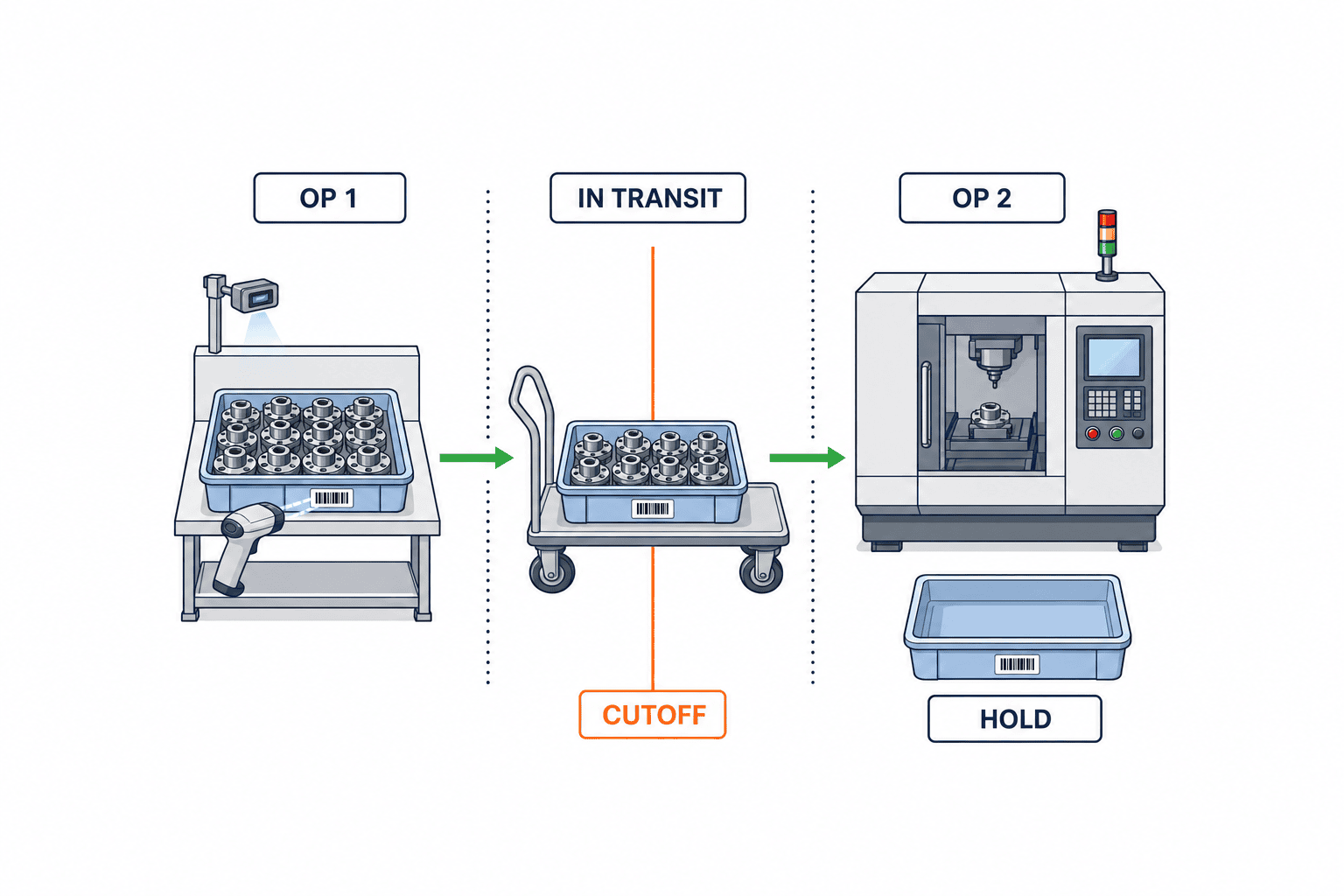
Choose the balance time first. With an 18:00 month-end cutoff, an operation completed at 17:59 belongs to a different period from a receipt recorded at 18:01. Counting may run into the next morning, but the cutoff does not move. Store both event time and entry time, with reasons and approval for backdated entries. Offline devices should retain an event ID and device time. Convert local Thailand time and UTC consistently at the date boundary.
A plant may stop movement during a zone count or keep producing and reconstruct the position from movements around the cutoff. In either case, record who froze each zone, when it was released, and whether physical movement and system posting were both restricted. Microsoft’s tag-counting guidance distinguishes item locking during counts from tag counts that are not locked. Use that distinction to define plant policy, not to assume a software setting is a physical barrier.
Do not make a transport container disappear because it has left one operation but has not reached the next. Give it a transfer ID, container ID, departure time, expected destination, arrival confirmation, and owner. Reconcile the one authoritative movement event across MES, WMS, and paper records. For outsourced work, record the subcontractor’s count date, confirmation, and movements between that date and the plant’s cutoff. A confirmation made on a different date is not automatically a period-end balance.
Choose a count key that the floor can actually identify
A useful key combines item and revision, lot or serial, work order, operation, location, container, ownership, quality state, and cutoff. Not every object needs every field. Yet if the same item occupies two operations or states, the underlying records must distinguish them before totals are rolled up. The GS1 Global Traceability Standard explains identification at item class, lot, and individual-instance levels according to purpose. It does not require every factory part to have a serial number.
Separate the reusable container ID from the lot currently inside it. Preserve the pairing at count time, label print time, and relabel history. A terminal can show an item image, drawing revision, common shop-floor name, and pack quantity to help identification. If scanning fails, allow controlled manual entry with a reason and independent check. Use states that workers can judge from the object: not started, processing, operation complete, quality hold, rework, or awaiting scrap decision. A percentage-complete field by itself cannot classify physical pieces. For pieces inside equipment, agree on a safe count or documented estimate before opening a machine; follow site machine-safety procedures.
Count each container of a split lot and preserve the link to the original lot. This article’s concern is who counted each container at cutoff, not the general history of splitting and merging. For weight-derived quantities, capture tare, scale condition, time, and rounding rule. Set conversion and tolerance rules before seeing a variance.
Treat first count, recount, and zero confirmation as distinct evidence
Issue tasks by location. The worker checks the label, quantity, and state of every physical container. Deciding whether to hide the expected quantity is a control choice: a blind count reduces the temptation to match the system, while complex identification may require additional reference information. Predefine recount triggers using quantity, value, quality status, or customer risk. Local management must approve the thresholds for the products concerned.
Capture exceptions such as one container counted in two zones, two tags on one box, or an operation finishing during the count. Require a zero confirmation for an empty expected location; otherwise “empty” and “forgotten” look identical. Each planned zone needs an explicit status such as completed, not started, inaccessible, in transit, or out of scope. Period close should display unresolved zones.
Microsoft’s inventory-journal documentation describes counting journals that record physical quantities and reconcile differences. A generic inventory screen may lack work order, operation, quality state, or processing unit. In an RFP, ask the vendor to demonstrate those fields with real WIP examples and show what remains in MES and what posts to ERP. A warehouse location alone is not a substitute for the state of production.
Investigate three different kinds of variance
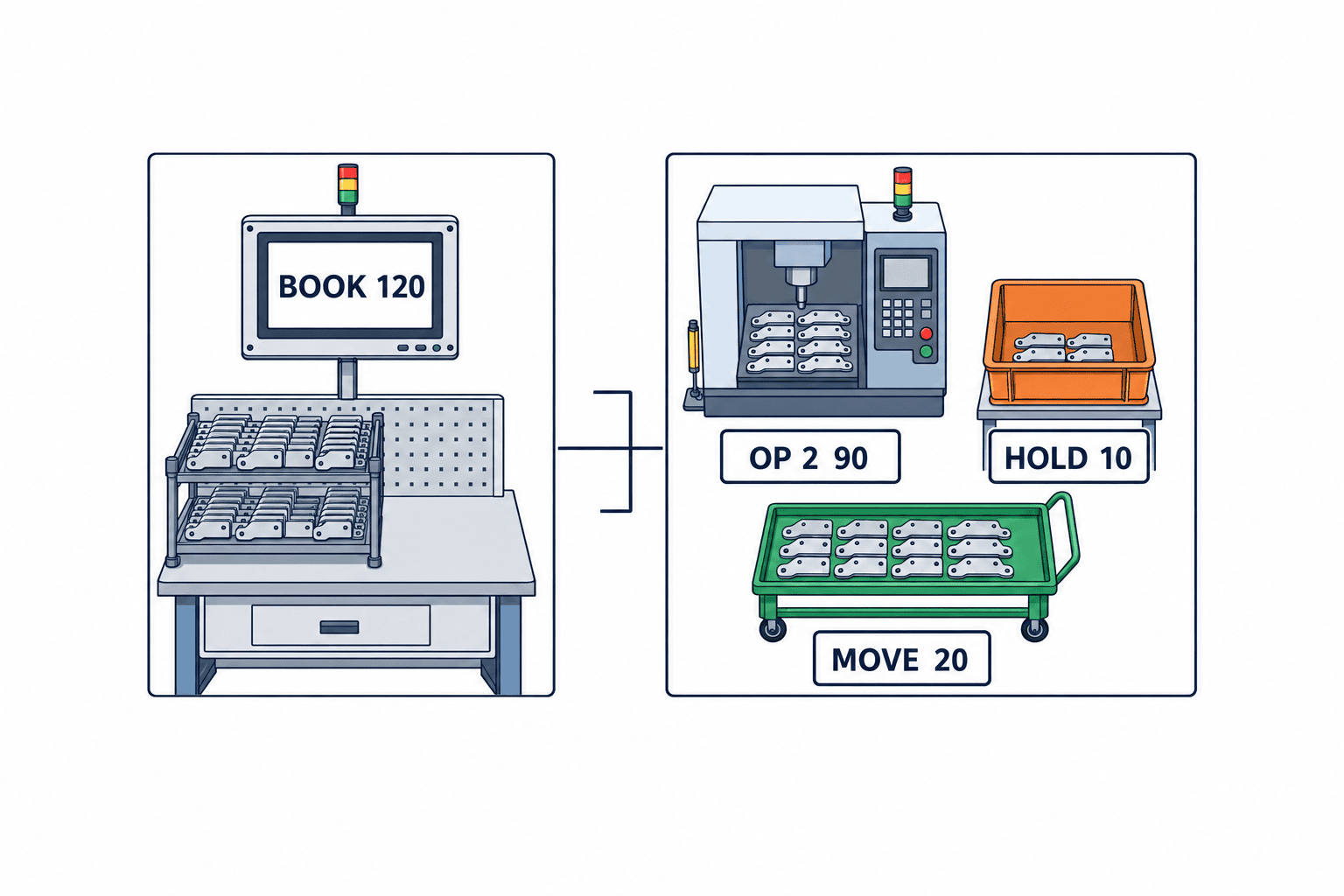
Separate physical quantity variance, identity or location variance, and timing variance. The first means fewer or more physical units for the same key. The second means totals agree but the lot, work order, operation, or quality state differs. The third means an event happened before cutoff but was entered afterward. Collapsing all three into a single adjustment conceals the reason and invites recurrence.
For example, a work order shows 120 at operation 2; counters find 90 available there, ten on quality hold, and twenty in a transfer container from operation 1. The total is 120, yet only 90 are available for the next action. Posting a 30-unit net adjustment would be wrong. If only 118 are found against a book balance of 120, investigate missed containers, duplicate documents, lagged output, rejected pieces, and machine contents before declaring a two-unit physical loss. These are sample numbers, not acceptable-variance limits.
Link the snapshot, count sheet, photos where permitted, transfer events, production output, inspection result, and recount to each case. Record the proposed cause, test, temporary control, final cause, and prevention. Keep permissions to alter counts, conclude an investigation, and approve an accounting posting separate. The detailed workflow for the posting decision is covered in inventory adjustment approval. Here, the priority is to explain the physical object before adjustment. Even a zero total variance may conceal a wrong lot assignment. Track correct identity, zone coverage, quality holds, and open count tasks as well as quantity variance.
Reconcile ERP, MES, and WMS at the same granularity
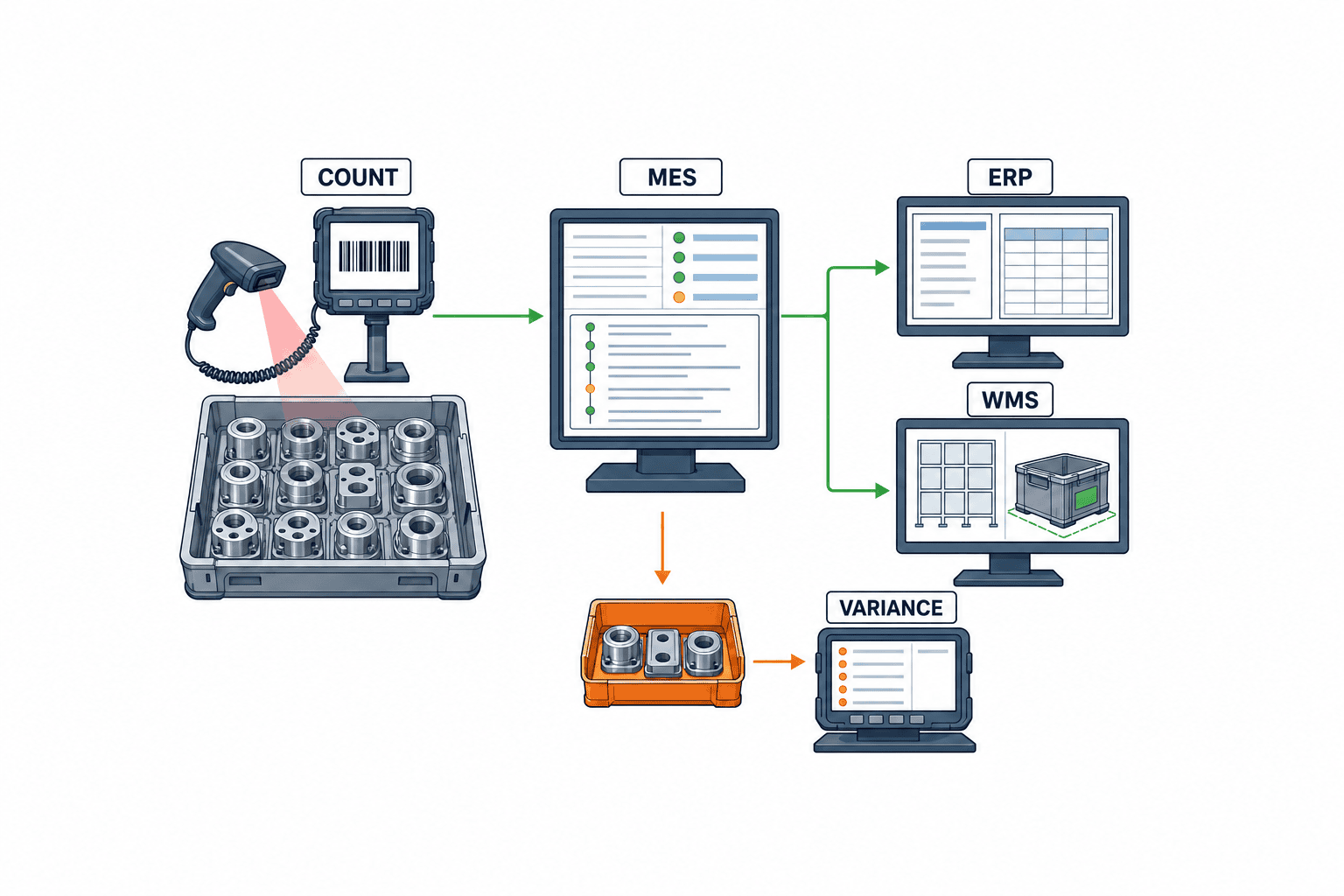
ERP commonly holds work orders, material issues, output, costs, and accounting periods; MES commonly holds operation events and floor state; WMS commonly holds warehouse locations and container moves. Actual authority varies by installation. Assign one editable system of record per attribute after examining existing data. A possible allocation is ERP for order number and approved accounting balance, MES for operation and shop-floor position, and WMS for finished-goods warehouse locations.
Compare the MES cutoff snapshot, ERP issues and output, and WMS moves by item, lot, order, operation, location, and state, not only by grand total. Microsoft’s item-tracing documentation shows item, batch, storage dimension, period, and production order as trace criteria; another system may need its own key map. Version the mappings for old item codes and alternate units so a mapping error is not mistaken for missing stock.
An interface message needs event ID, occurrence and entry times, sender, receiver, and processing state. Resending it must not double-post the transaction. A record present in MES but absent from ERP is a transmission problem; physical stock missing from both may be a shop-floor registration problem. At close, list unsent, failed, and manually corrected messages. Apply approved accounting treatment to late events without silently overwriting the original timestamp.
Preserve a period-end snapshot and audit trail
Freeze the cutoff rule, population, master-data revision, count, valuation class, open variance, and approver in a snapshot. Changes the next day should append a correction event, not overwrite what was known at close. Evidence photos need a link to the lot, location, and time; a photo on its own proves little. Use another evidence method where photography is restricted. An approval record should identify the exact snapshot, unresolved exceptions, role, and time. Keep a consistent display and storage timezone across Thailand and head-office reviewers.
Reports should drill down by operation, quality state, order, and unresolved case. Exports need their generation time, snapshot ID, filter, and data version. Quantity and value should reconcile through the same order and cutoff, even if shop-floor counters cannot see confidential costs. A spreadsheet without its version can become impossible to audit after corrections.
Fit the workflow to Thai language, shifts, and real devices
Translate operational states with examples of actual pieces, not only dictionary equivalents. Agree Thai, English, and Japanese terms for “operation complete,” “quality hold,” and “rework.” Pair concise labels with color but do not rely on color alone. If a shift changes at cutoff, assign each zone and open task to a role and deadline. Test scanning with gloves, dust, oil, curved labels, and the plant’s lighting.
Where connectivity is unreliable, test offline duplicate counts, synchronization order, and what happens if a device with unsent records is lost. For subcontracted WIP, agree on count time, unit, format, and the bridge of shipments between the subcontractor count and plant cutoff. Ownership and valuation depend on contract and accounting policy, not on physical address alone.
Write RFP acceptance scenarios, then test them in FAT and SAT
An RFP saying only “barcode support” and “stocktaking function” will not expose WIP gaps. State the sites, lines, items, orders, containers, cutoff, shifts, languages, and current ERP/MES/WMS. Give vendors anonymized real discrepancies. Include one lot split across two operations, one quality hold, one container in transit, and equal grand totals. Ask the vendor to demonstrate how each state is counted, investigated, and fixed in the snapshot.
Require cutoff control, full zone coverage, count and recount separation, variance classification, open-case visibility, source-event drilldown, audit logs, permissions, and safe interface retry. Specify performance with actual volumes and a measurable response time rather than the word “fast.” Compare quotations including master-data cleanup, labels, devices, integrations, training, night-shift support, maintenance, and export options. A low license fee can conceal recurring monthly spreadsheet work.
At FAT, use representative and exception data in a controlled vendor environment. Test unreadable tags, duplicate scans, offline entries, transfers across 18:00, next-day backdating, equal total but wrong operation, and an attempted close with unresolved high-risk cases. Record expected results, logs, defects, owners, and retest evidence. At SAT, repeat the critical cases on the Thai site’s devices, network, labels, shifts, actual pieces, and live integrations. Confirm that a next-day edit does not replace the prior snapshot and that the night shift hands open tasks to the day shift. Rehearse numbered paper forms and recovery entry for an outage. Agree risk definitions before setting any zero-open-case acceptance rule.
Roll out by zone and measure the whole close
Start by tracing recent discrepancies backward to the labels, states, and event fields that were missing. Clean one representative line’s item, order, location, and state data. Pilot counts, investigations, recounts, approval, and snapshots in that zone before adding interfaces and exceptional areas. Expand to night shifts, quality hold, transfers, and subcontractors after the basic record chain works.
Measure the time from first count to approved snapshot, not only minutes spent scanning. Also review uncounted zones, unidentified containers, events without reliable times, recount rate, late corrections, and repeat causes. These are diagnostic measures rather than targets to manipulate. Period-end accuracy is earned through everyday registration at operation completion and handoff.
What a count-sheet line must preserve
Consider an illustrative line: cutoff at 18:00 on the last day of the month; plant A, line 2, before operation 20; container C-017; part P-42 revision B; lot L-08; work order MO-531; operation complete and awaiting inspection; 24 pieces physically counted at 08:14 the next morning by worker A. The 08:14 count time is not itself the 18:00 balance. If pieces moved or were inspected overnight, link the event IDs and add or subtract those events to reconstruct the cutoff position. Preserve the calculation and the original observation rather than silently replacing the count with a corrected number.
Keep a line for an apparently empty location. “Expected container missing,” “container present but empty,” and “location outside scope” are different findings. Record who physically checked the shelf or machine and when. An unsafe machine interior is “unconfirmed, alternative method pending,” not zero. Later, link a safe count to that open line instead of deleting it. The closer can then see the number of unresolved areas.
The method of counting matters as much as the result. Twenty-four individually counted pieces and twenty-four inferred from weight have different evidence. Capture method (individual count, standard pack × boxes, weight conversion, equipment counter, or estimate), instrument ID, tare, conversion factor, rounding rule, and any second checker. Successful barcode scanning proves only that a label was read; it does not prove the label was on the correct workpiece. Record whether the drawing revision and physical form were checked, and whether a sealed container was counted using standard pack quantity.
Prepare migration and exception ownership before the first close
Do not copy the current ERP WIP balance into a new application as an unquestioned opening count. Identify work orders without locations, retired item codes, old lots in different units, and operation-complete pieces not yet received as finished goods. Classify each as physical and recorded, book-only, physical but unidentified, or a timing difference. Decide which records to correct before migration and which to keep as explicit first-close cases. Erasing history to make opening balances agree makes later investigation harder.
During the first parallel close, compare old reports and the new snapshot by order, operation, and quality state, not only by total. List lines found on one side only and determine whether item mapping, scope, posting time, or unit conversion caused them. Assign physical verification to production, hold status to quality, interfaces and masters to IT, and period and valuation to finance, adapting roles to the organization. Unowned cases will sit unresolved at close regardless of system speed. Give each case a due time and substitute approver for nights and holidays.
Decide production cutover from evidence of full zone coverage, missing-key counts, unsent events, unmatched records, permissions, backup restoration, and recovery entry from numbered paper forms. If serious differences remain, apply an approved temporary close procedure with cause and resolution date. Then improve label placement, operation-completion registration, or transfer receipt at the point that produced the error. A successful first close is one in which differences can be explained and corrections replayed, not one that happens to show equal totals.
Frequently asked questions
Can ERP alone manage WIP physical inventory?
Yes, if it can hold the required operation, location, container, quality state, count evidence, and cutoff snapshot at the necessary granularity. Otherwise MES or a shop-floor application can capture physical events and send approved results to ERP. Decide through a test with real plant data.
Can the line keep running during the count?
Sometimes, provided moves and completions around cutoff are reliably logged, zones have controlled freeze and release, and safe machine procedures take priority. The test is whether the position at cutoff can be reconstructed.
Is a matching grand total enough?
No. Ninety available, ten on hold, and twenty in transit do not mean 120 are available at operation 2. Investigate location, identity, state, and time as well as quantity.
Will barcodes eliminate variance?
They help identify and enter objects, but cannot alone prevent a wrong label, unrecorded move, incorrect process state, or duplicate count. Design recount, coverage, event reconciliation, and approvals together.
Must the same application calculate WIP value?
No. Physical quantity and state may be managed separately from costing, but the order and cutoff must connect the records so finance can explain differences under the company’s policy.
Conclusion
A reliable WIP close preserves not only how many units were counted but when, where, in which operation and state, by whom, and with what unresolved variance. Build the RFP around actual exceptions; verify record logic in FAT and the real pieces, terminals, shifts, and closing procedure in SAT. That gives production and finance an explainable period-end position rather than a number forced to agree.
If your Thai factory is still defining WIP count units or the boundary between ERP, MES, and WMS, TOMAS TECH can help assess the floor and shape the requirements. Contact us with the target line and current counting method.


