


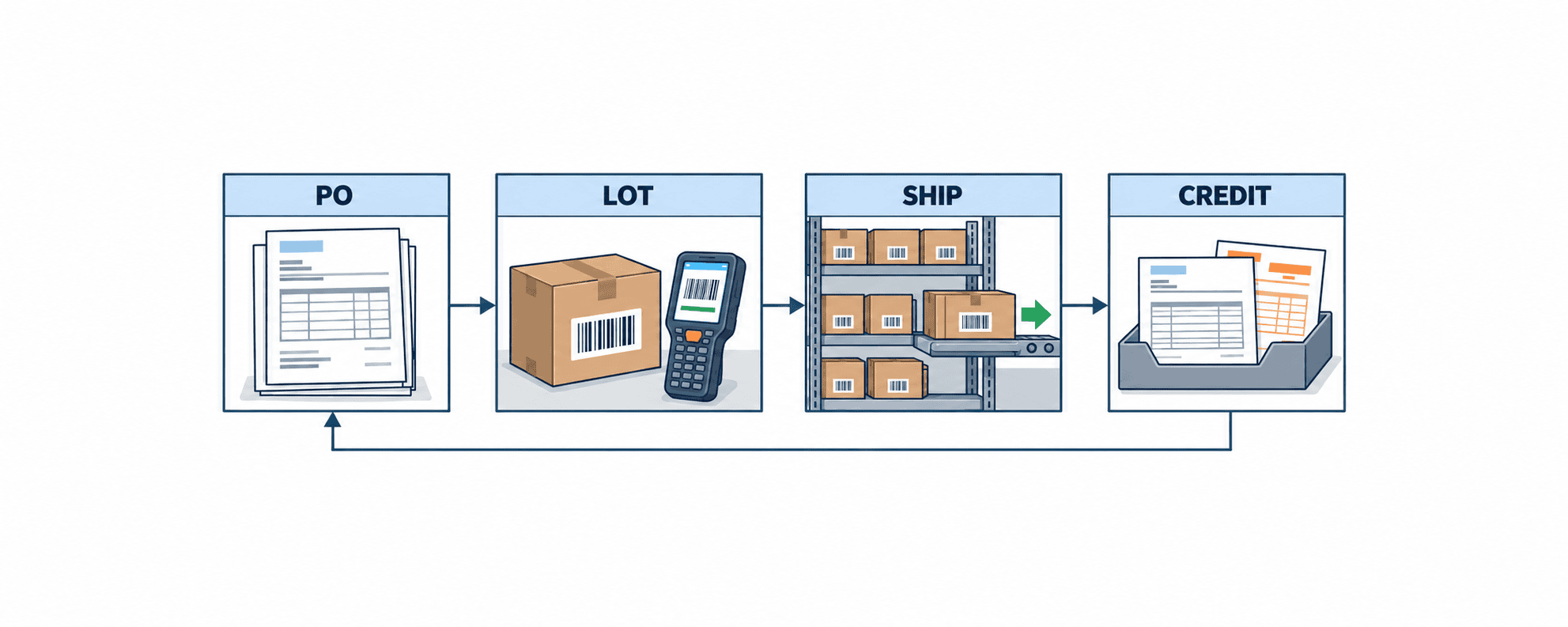
Thai manufacturers sometimes have to send received materials back to a supplier. Defects, wrong specifications, delivery errors and surplus stock may have different causes, but shipping the goods is only one part of the work. A manufacturing supplier return management system should connect the original purchase order (PO), receipt and lot with quality hold, authorization, return shipment, replacement or supplier credit, and inventory and accounts payable (AP) reconciliation. This guide sets out the process, ERP interfaces, RFP questions, and FAT/SAT tests for a factory in Thailand.
What does return to vendor (RTV) cover?
Return to vendor (RTV) is the purchasing-side process in which a factory physically sends purchased and received material back to its supplier. It is different from a customer returning a finished product to the factory: the direction of the goods, the documents, and the financial counterparty differ. See our separate guide to customer RMA management. The core RTV question is: which physical units from which supplier, PO line and receipt are being returned, in what quantity, and why?
If the issue is an incorrect received quantity or item, first decide whether the receiving discrepancy process calls for a receipt correction, missing-delivery follow-up or PO amendment. Recording an inspection result and deciding pass/fail belongs to inbound receiving inspection. RTV begins when the decision is to send actual material back, and then crosses warehouse, purchasing and finance. Recording a mere receipt correction as a physical return may reduce inventory twice. Conversely, removing a rejected item with a receipt correction alone can leave goods on the shelf with no matching system balance.
Microsoft’s official Dynamics 365 procedure illustrates a return PO created by copying the original supplier invoice line, with a negative return quantity. It can be marked against the original inventory transaction, but Microsoft notes exceptions when stock is consumed or an item does not use marking. Treat this as functionality to test in your configuration, not a promise that every return is automatically traceable. Microsoft’s return PO procedure provides a useful reference.
Reconcile three ledgers at the same time
Observe physical inventory, the purchasing commitment, and AP/tax documents separately. For example, when a factory receives 100 units and rejects eight, moving the eight to a hold location does not mean they have left the factory. The physical outbound event occurs at shipping confirmation. Whether the supplier provides eight replacement units or a credit for eight changes both the open quantity and the financial settlement.
| View | When the return is opened | When goods are shipped | Closing condition |
|---|---|---|---|
| Goods and stock | Identify lot and quantity; prevent use | Match shipping record to inventory movement | Held, shipped and replacement quantities reconcile |
| Purchasing | Link original PO, receipt and approval | Keep return document and supplier authorization reference | Replacement PO or credit disposition is complete |
| AP and cost | Determine invoiced or uninvoiced state | Do not equate shipment with a refund | Match supplier document, AP balance and relevant tax treatment |
One generic “return status” cannot express “shipped, credit outstanding” or “replacement received, but no evidence of return shipment.” Keep operational and financial progress as separate fields; close the case only when their conditions reconcile.
Seven stages of a supplier return process
1. Identify the original PO, receipt and lot
An item number alone is insufficient. A factory may buy the same item from several suppliers, or the same supplier under different prices, specifications and lots. At the first scan, show original PO and line, receipt, lot or serial number, quantity and unit, warehouse and bin, supplier, inspection result and invoice-match state. If an item has no lot control or the receipt history predates system migration, require an exception reason, approver and supporting evidence. Oracle’s receiving documentation treats transaction history, lot and serial capture, and receipt returns as distinct activities. Use Oracle Using Receiving 26A to challenge the requirements.
2. Apply quality hold before the material is used
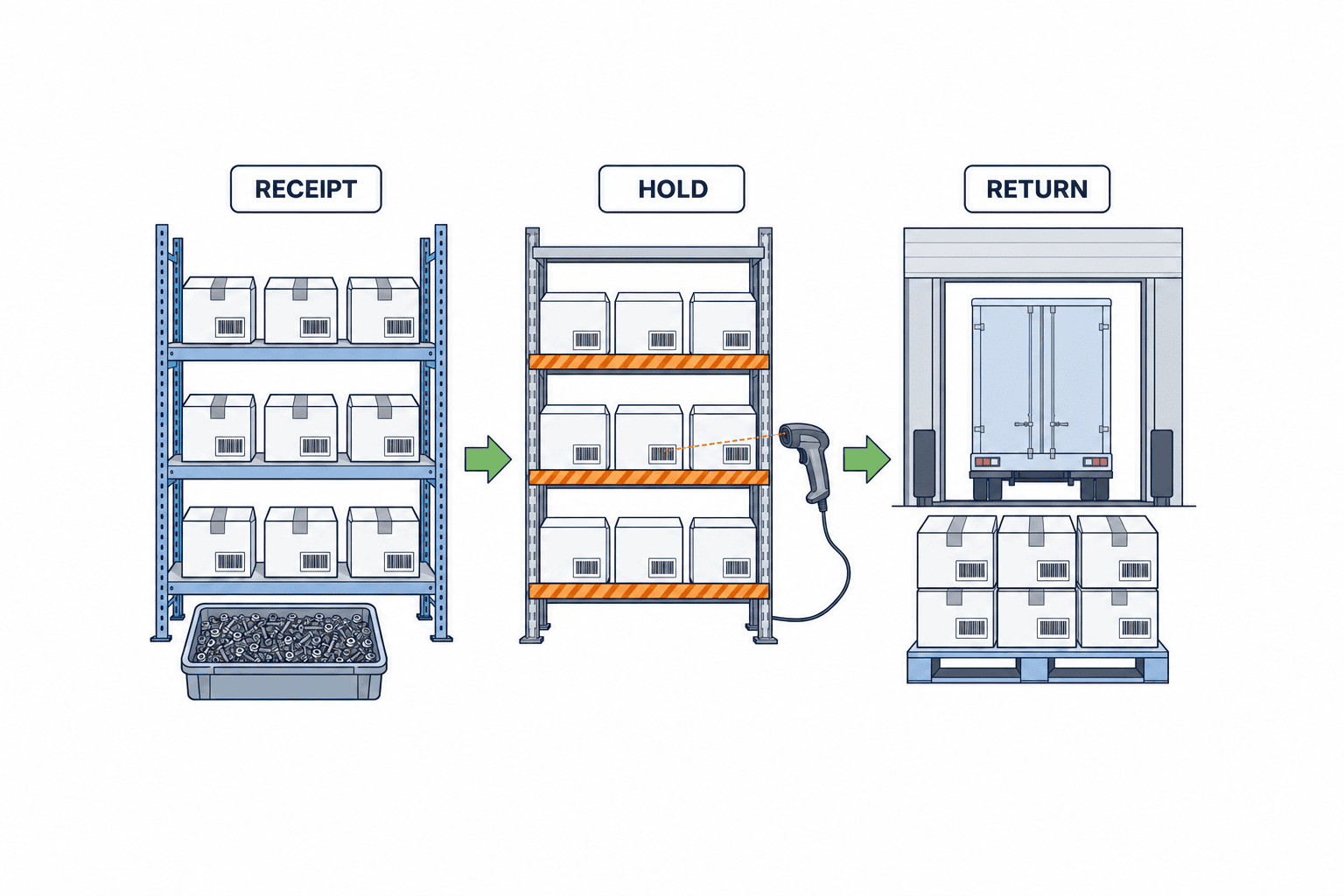
A rejected lot can disappear into production while purchasing negotiates with the supplier. Remove only the affected quantity from available-to-use stock: move it to a segregated location or block allocation with an inventory status. Link the physical hold tag, MES issue permission and ERP reservation rule by one case ID. Decide whether to hold the whole lot or just the failed quantity according to the item and traceability requirements. A hold is not a final RTV decision. It prevents accidental use while reinspection, acceptance with concession, scrap and return are considered.
3. Authorize the return and disposition
Quality verifies the nonconformance and evidence; purchasing checks commercial terms and secures the supplier’s authorization. Planning may assess replacement lead time. Store the reason code, quantity, shipping cost responsibility, return destination, supplier reference and provisional replacement-or-credit outcome. An approval screen should show the lot, quantity and evidence. Microsoft’s PO documentation includes a field for the supplier’s return authorization number on returned orders; naming and mandatory behavior depend on the product and setup. A practical RFP question is whether that number can be recorded and searched. See Microsoft’s PO documentation.
4. Create the return PO and shipping instruction
Link the warehouse shipping instruction to the ERP return PO. The return line should retain the original PO and receipt, lot, quantity, unit, reason, warehouse, supplier reference and planned shipping date. Some ERPs represent a return as a negative PO quantity. The warehouse document should still make the operator’s task unambiguous—for example, “return eight units”—even if an integration uses a negative number. Allow partial returns, and block a quantity exceeding received minus previously returned or otherwise unavailable stock.
5. Verify and confirm the physical shipment
Before dispatch, check item, lot, quantity, packages, labels and destination by scan or a second person. Attach carrier, tracking number, dispatch time, waybill, packing list and photos to the case. Oracle describes a two-step pattern: create a return-to-supplier transaction in Receiving, then confirm the shipment and documents in Shipping. Document printing depends on configuration and transaction conditions. Test precisely whether return entry itself changes inventory, and what shipment confirmation triggers in your implementation. Align the timing of the physical handover and stock update as closely as possible.
6. Settle by replacement or supplier credit
For replacement, link the RTV case to a replacement PO or expected receipt. Record the new lot, inspection and receipt date; never overwrite the rejected lot’s history. For a refund or allowance, match the supplier’s credit memo against the original invoice, returned quantity and unit price. SAP describes a document chain of returns PO, outbound return delivery and goods issue, followed by a supplier credit memo—or a replacement PO and receipt. See SAP’s supplier-return document flow. Without a clear branch, a company may both receive replacements and record a full credit for the same units. Make mixed settlements explicit and subject exceptions to approval.
7. Reconcile inventory and AP before closing
“Shipped” is not the end state. Close when return quantity, warehouse issue, supplier receipt acknowledgment, replacement receipt or credit, AP clearing and applicable tax documentation align. Age credit-pending cases by days and value, and give purchasing an actionable follow-up. If the supplier agrees to replace half and credit half, keep separate quantities and amounts. SAP explains that a supplier credit memo can reference a PO or goods receipt and adjust purchasing history. See SAP Credit Memo. Actual postings depend on company policy and ERP setup.
Four stock states that must not be confused
At minimum, distinguish awaiting inspection, quality hold, awaiting return shipment and shipped. These need not all be separate ERP stock categories; decide whether the ERP, WMS or QMS owns each physical balance, and synchronize the others by case ID. Held material must be unavailable for production. Ownership, valuation and accounting during hold depend on contract terms and system design.
| State | Physical location | Production issue | Next decision |
|---|---|---|---|
| Awaiting inspection | Receiving area | Normally blocked | Record inspection result |
| Quality hold | Segregated rack | Blocked | Reinspect, accept, return or scrap |
| Awaiting return shipment | Dispatch staging | Blocked | Verify lot, quantity and destination |
| Shipped to supplier | Outside factory | Blocked | Supplier acknowledgment, replacement or credit |
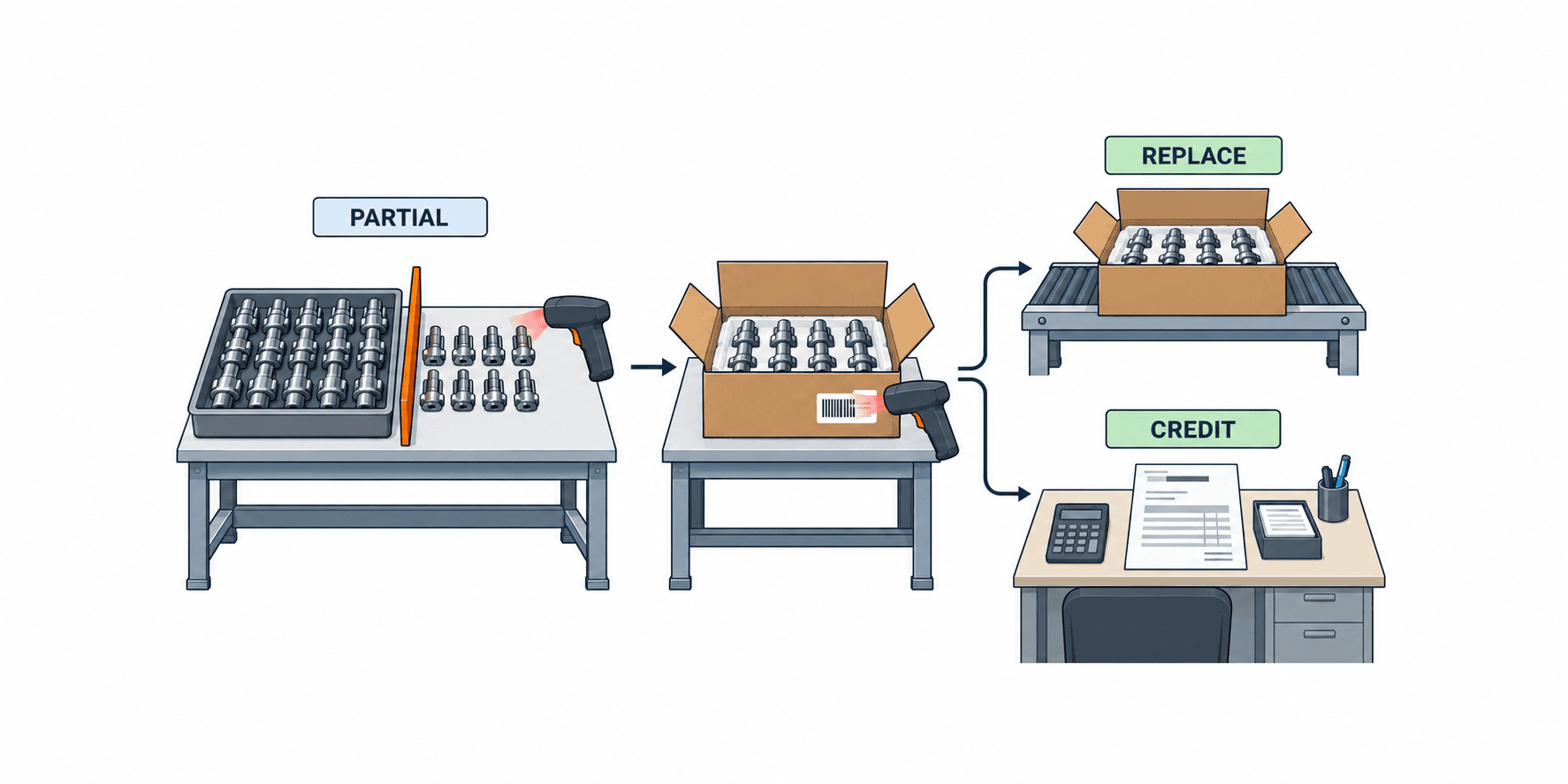
If 100 units arrive, eight are held and 92 good units can be used, retain the 100-unit receipt history. Available stock is 92 and held stock is eight. After shipment, total factory stock is 92; the replacement eight create a new receipt. The case screen should explain this arithmetic. Microsoft’s marking example also has exceptions for consumed or unmarked stock; do not promise universal automatic original-lot matching. Specify an approved exception route for missing links.
Return PO and ERP integration: the data model
Core identifiers include RTV case ID, supplier, original PO and line, receipt transaction, item, lot/serial, quantity, unit, reason, hold status, approval, return-shipment transaction, supplier authorization, settlement method, and links to the credit memo or replacement PO. Attach photos and inspection reports, or link a controlled document store. One invoice may cover several receipts, so do not assume a one-to-one relationship between a return and invoice line; preserve quantity and value allocation.
Assign a source of truth to every field. QMS may own quality decisions, WMS scanning and shipping, and ERP POs and AP. An ERP that already controls quality hold may own that state instead. The key is to prevent two systems from independently changing the same quantity. Design for duplicate return numbers, retries after failed connections, partial shipments, cancellation and invoices arriving before the return is resolved. Use idempotency keys and a way to query the result of an integration request.
Unit conversion is another frequent source of error. A PO may be in boxes, warehouse stock in pieces, and supplier invoice in sets. Preserve the conversion version and rounding rule. If one box is 20 pieces and eight pieces are returned, purchasing must determine whether the supplier accepts a 0.4-box credit or whether contract units need adjustment. Automatic unit conversion does not automatically validate the commercial value.
Thailand VAT and credit notes require conditional treatment
A physical return and a tax credit note are different events. Section 86/10 of Thailand’s Revenue Code describes credit notes issued by a VAT-registered seller to the buyer when a qualifying event reduces the taxable value. It specifies details including the original tax-invoice number, old and corrected values, difference and adjusted VAT. See the Thai Revenue Department’s text. Whether a particular return qualifies, and its timing and form, depend on the facts. Do not specify that the purchasing system automatically issues a tax credit note the moment the buyer confirms shipment.
Finance and tax specialists should review whether the supplier is VAT-registered, which original invoice is affected, the reason for return, whether settlement is a discount or replacement, and whether imports or exports are involved. On receipt of a supplier credit note, match its original invoice reference, lines, value difference and tax to the RTV case. Confirm legal timing against current rules and advice. The system’s job is to track required documents and flag missing or mismatched ones. Cross-border returns also need separate logistics and customs design.
RFP questions for supplier return management software
“Can it create a return document?” is not an adequate demo question. Ask vendors to show the screen, document, API, posting example and permission setting for each case.
| Area | Question for vendor | Evidence of fit |
|---|---|---|
| Traceability | Can an RTV line navigate to original PO, receipt, lot, inspection and invoice? | Real linked records and history screen |
| Quantity control | How are an eight-unit partial return from 100 and a later two-unit return controlled? | Excess-return block and remaining quantity |
| Quality hold | Can held units be prevented from production issue? | Allocation test across WMS/MES |
| Approvals | Can quality, purchasing and finance approvals, including delegation, be configured? | Role-specific audit log |
| Shipment | Can supplier authorization, packaging, waybill and tracking be stored? | Return document and dispatch history |
| Settlement | Can eight replacements, full credit, or a four/four split be tracked? | Document flow for each case |
| AP | What changes for invoiced, uninvoiced or partly invoiced receipts? | Entries and unresolved balance |
| Exceptions | What happens with unknown lot, consumed stock, canceled shipment or repeated API call? | Error handling and audit log |
Provide vendors with actual master data, units, hold locations, languages, ERP version and responsibility by site. Ask them to separate standard functions, customization, manual workarounds and ongoing cost. SAP Business Network lists quality noncompliance, damage, overstock and delivery error among return reasons. The reason code should drive approval and cost responsibility rather than be free text alone. See SAP’s supplier return and credit guide.
FAT and SAT scenarios to run
Factory acceptance testing (FAT) checks configuration, interfaces and calculations. Site acceptance testing (SAT) adds the real scanners, warehouse, access rights, network and documents. Quantities below are test examples, not observed results.
| Test | Input and action | Expected outcome |
|---|---|---|
| Normal partial return | PO and receipt 100; hold and return eight from lot L1 | Available 92, shipment eight, links to PO/receipt/lot |
| Second return | Return two more from that receipt | Cumulative ten, remaining 90, separate transaction history |
| Excess return | Enter more than the eligible balance | Reject and show the balance used |
| Replacement | Ship eight, receive eight in new lot L2 | Distinct old/new lots, no unresolved quantity |
| Credit | Ship eight, match supplier credit to original invoice | Flag value/tax variance and unresolved AP |
| Issue during hold | Attempt to reserve/issue held eight via MES | Reject and audit exception action |
| Retry | Shipping interface times out and resends same request | No duplicate shipment or stock reduction |
| Cancel | Cancel after picking but before carrier collection | Show conditions for physical and available-stock recovery |
Correct screen totals are not enough if the AP balance or lot-level goods differ. Keep opening balance, operation log, closing balance and interface messages for each test. At SAT, test adjacent good and return shelves, wrong-lot scans, network recovery, Thai labels and documents, and delegated approvals. The acceptance standard is whether physical goods, quantities, documents and AP can all be explained by the same case.
Choose the disposition before deciding to ship a return
A failed inspection does not always mean a physical supplier return. Track missing quantities as outstanding deliveries and correct erroneous receipt entries with an audit trail. Even if the material is present, the choices can include reinspection, use under concession, local scrap, and return to supplier. The system should not let a case move to “shipped” before quality decides on the disposition, and should retain the reason and owner. A concession or scrap should go through its appropriate inventory and cost process without creating a fictitious return PO.
| Observed event | Check first | Main options | Open an RTV only when |
|---|---|---|---|
| PO 100, physical goods 92 | Was receipt entered as 100 or 92? Are eight still due? | Correct receipt or track shortage | Goods are later physically returned |
| 100 received, eight defective | Failed lot and scope; supplier agreement | Hold, then return, concession or scrap | Approved to ship the eight to supplier |
| Wrong item physically present | Wrong delivery or revised order? Opened or used? | Hold and replace or return | Wrong goods are physically sent back |
| Surplus but good goods | Buyback terms, return window, cost allocation | Compare storage, transfer, sale and return | Supplier accepts the return |
This is a process-design example; contracts and item types change its application. If a supplier instructs the factory to scrap locally and send photos, no return shipment should be fabricated, but quality evidence, scrap approval and financial adjustment remain necessary. If damage occurred in transit, check the shipping terms and point of handover before treating it as supplier quality failure. Code dispositions so quality, purchasing and accounting use the same meaning.
Design exception handling before manual reconciliation becomes routine
Early deployments expose cases whose original transaction cannot be selected uniquely. If the same item and lot were received twice and some units have already been consumed, a matching lot alone cannot determine eligible return quantity. Check the physical units still present, reservations, prior returns and invoiced quantity. If nobody knows which receipt an on-hand box came from, do not guess an ERP link. Record candidate receipts, evidence and the decision maker as an exception. Treat missing traceability as a quality finding and improve labels at receiving to prevent recurrence.
Timing gaps are another source of errors. A supplier may change the destination after a shipping instruction is issued; collection may slip a day; or a carton may be recounted after packing. Record return authorization, picking, handover to the carrier and supplier receipt as distinct events. This makes it clear when changes and cancellation remain possible. Canceling before handover is different from trying to stop a shipment already with the carrier. Preserve revised and voided waybills and shipped quantities by lot in the audit log.
Invoices and credits also arrive at different times. AP behaves differently if the goods are returned before the original invoice arrives versus after it was paid. Show “awaiting shipment,” “awaiting supplier acknowledgment,” “awaiting credit,” and “matching variance” separately, assigning each unresolved reason to its owner. A replacement may arrive before the rejected units are collected; record both events so the new receipt cannot be mistaken for proof of the old shipment. At month-end, finance should be able to retrieve shipped-but-uncredited cases with supporting documents.
If there are multiple plants or currencies, establish which legal entity owns the original PO and which entity returns the goods. A shipment created by another entity’s warehouse can misstate entity-level stock and AP. Company accounting policy should decide whether exchange differences, freight and repacking are included in return value or booked separately. Ask in the RFP how one case displays entity, site, currency and cost responsibility; test with a real example from your operations.
Define ownership and work rules before designing screens
A system cannot clear backlogs if nobody owns supplier contact, shipment stops or overdue credits. Quality owns the nonconformance decision and evidence; purchasing confirms return terms and settlement with the supplier; warehouse records hold, picking and shipment; finance matches credit and AP; planning assesses the shortage and required replacement date. Access rights should follow those responsibilities so an operator cannot approve their own quality decision. Define the scope and expiry of delegated approvals so leave and night shifts do not halt the process.
Write work instructions at the level of “print a physical hold tag with case number,” “scan transfer to the hold rack,” “issue the return label after approval,” and “confirm shipment when the carrier collects.” Prepopulate known PO and lot data instead of simply adding required fields. Decide which items need photos, their view and naming convention. If terminals are scarce, define how long paper labeling and later entry may be used and how accidental issue is prevented during the gap. Test offline entry for duplicate transactions on recovery.
Do not give the shipping operator sole authority to close the case. Put closure with an owner who can see outstanding replacement or credit. Show returned quantity, shipped quantity, replacement received, credited quantity, quantity difference and value difference together. If a variance remains, require a reason and approval before closure. Regular joint review by purchasing, quality and finance of “shipped but uncredited,” “long-held,” and “unknown original lot” lists distinguishes cases whose data entry ended from cases actually resolved.
Catch duplicate compensation with a value-based test
Use money as well as quantities in FAT. This is hypothetical: at THB 100 per unit, 100 units are received and eight returned, giving a pre-tax return value of THB 800. If the supplier replaces four and credits four, the value represented by replacement is THB 400 and the credit portion is THB 400. Posting a full THB 800 credit and receiving four replacement units would exceed the agreement. Compare the sum of quantities and values by disposition with the case total and warn on excess. Freight and tax require separate review under the contract and applicable rules; do not add them automatically to this simple example.
Test changed unit prices, discounts, unit conversions and rounding. If the PO and invoice prices differ, purchasing and finance should agree which price is the credit matching basis, and record the variance reason. A matching quantity is not a reason to close a case whose value still differs. For cross-currency transactions, display which exchange rates applied on PO, shipment and credit dates. Explain exchange differences separately from item-price errors. If the replacement price changes, use the supplier agreement to determine whether it is a free replacement or an additional charge; do not close on physical receipt alone.
Check data migration and cutover carefully
Not every old return needs migration at full detail, but cases open across the go-live date need both physical and financial review. List at least those on quality hold, awaiting shipment, shipped awaiting supplier acknowledgment, awaiting replacement, and awaiting credit. Give each an owner and next due date. If original PO or receipt exists only in the old system, keep its old number, a searchable reference and a copy of the source document. Do not invent a new receipt to hide a missing link; that may duplicate quantity or cost.
Before cutover, count the hold and return-staging racks and record physical quantity, lot, old case number and whether shipment has occurred. Reconcile this count to old-system stock, open AP and supplier credits outstanding. Assign an owner and resolution date to discrepancies instead of marking ambiguous cases migrated. State the precise time at which the new system becomes the record of authority for receiving and shipping. Where movements cannot stop, list transactions crossing the cutover time and review them one by one; avoid double entry.
Initial data quality can be measured by the share of open cases linked to original PO and receipt, the share with verified lot, the share with supplier authorization, and the share of credits linked to original invoices. If these rates are low, improve receiving labels and document retention before accelerating automation. At the first month-end after go-live, separate carried-over cases from new ones so finance can verify the value of shipped-but-uncredited returns. Judge the rollout by how quickly it exposes unresolved goods and liabilities, not only by screen speed.
Start small and measure useful KPIs
Begin with an item family that has recurring returns, lot control and electronic PO/receipt history. Sample actual cases to find missing source data, hold-location behavior, supplier authorization numbers and credit collection times. Agree on states, owners and closure criteria, compare candidates through the RFP, remove key exceptions in FAT, and run SAT at one warehouse and supplier group before broader rollout.
Count more than RTV cases. Track time from detection to hold, issues of held stock, days from shipment to supplier acknowledgment, days to credit reconciliation, unresolved AP value, original-lot trace rate and duplicate postings. Establish a baseline before making a reduction claim. Break aging down by reason, supplier and settlement type so a simple average does not conceal old unresolved cases.
FAQ: supplier returns and ERP integration
Is an RTV the same as correcting a receiving discrepancy?
No. A receipt correction addresses a quantity not received or an entry error. Physically sending already received material back requires hold, shipment, purchasing and AP steps. When uncertain, match receipt history to the actual goods first to avoid reducing stock twice.
Can an RTV always identify the original lot automatically?
No. Items without lot capture, consumed stock, migrated history and mixed material may defeat automatic matching. Define the traceable scope, require evidence and approval for exceptions, and test with real records in FAT.
Does creating a return PO automatically reconcile inventory and AP?
Usually not. Shipment, supplier acknowledgment, replacement receipt or credit, and matching to the original invoice are separate events. Test exactly which quantity and amount each configured action changes.
Can replacement and credit share one RTV case?
They should. A supplier may replace some units and credit the rest. Store each settlement’s quantity and value separately, verify they total the returned amount and approve unusual combinations to prevent double compensation.
Does the buyer’s return entry automatically issue a Thai VAT credit note?
Do not assume so. Section 86/10 concerns issue by a VAT-registered seller when its conditions apply. The buyer matches the supplier’s document to the original invoice and checks the treatment with finance or tax advisers. Track requirement, receipt and discrepancies in the system.
Where should the RFP, FAT and SAT begin?
Take one recent case and assemble its original PO, receipt, lot, inspection, shipment and credit evidence. Turn missing links into RFP questions and reuse the case as FAT/SAT test data. Include partial returns, replacements, cancellation and integration retries as well as a normal case.
Conclusion
Supplier return control is a connected process: identify the original purchase and goods, block their use, ship them, secure replacement or supplier credit, and reconcile stock and AP. Prioritize a case-level link to the original PO, receipt and lot; hold and approval; shipping evidence; settlement branches; and AP matching. Ask about exceptions in the RFP and prove that goods, quantities, documents and AP reconcile in FAT and SAT.
If you are reviewing supplier returns at a Thai factory, we can help map the current links among purchasing, receiving, inventory and accounting even at the evaluation stage. Contact TOMAS TECH.
References
- Microsoft Learn: Create a purchase return order
- Microsoft Learn: Create purchase orders
- Oracle Fusion Cloud SCM: Using Receiving 26A
- SAP Help: Document Flow in Supplier Returns
- SAP Help: Credit Memo
- SAP Business Network: Order Collaboration Returns for Suppliers
- Thailand Revenue Department: Revenue Code, Sections 85–86
*This guide supports system planning. Standard product behavior varies by release and setup; tax treatment requires review against transaction facts and current rules.*


