


When a manufacturer plans a receiving discrepancy control system, the first decision is not which handheld scanner to buy. It is whether the purchase order (PO), advance shipping notice (ASN), and physically counted goods can be compared using the same item, unit of measure and shipment identity. A factory can detect a shortage, over-delivery or wrong item yet leave the goods on hold while the ERP inventory and supplier invoice move on with different quantities. This guide explains how to design one controlled process from discrepancy capture through tolerance, approval, inventory posting and invoice matching.
Define the purpose of receiving quantity discrepancy management
The goal is not to make the receipt quantity look equal to the ordered quantity. It is to preserve the difference between the physical goods and the commercial agreement, along with who decided what and on what evidence. If the PO says 100 units, the ASN says 100 and the dock counts 98, there is a shortage of two. Typing 100 into the receipt screen may close the PO line, but it overstates stock and creates a later problem for picking, stock count and invoice validation.
Conversely, a PO and ASN of 100 against 103 physical units creates an over-delivery of three. Posting all 103 straight to usable stock can obscure whether the business accepted ownership and payment for the extra units. Detection and authorized receipt are different events. Item substitution needs its own treatment: if 90 units of A and 10 of B arrive against a PO for 100 of A, record A’s shortage and B’s unordered arrival separately. Do not cancel one against the other merely because the total is 100.
Microsoft’s product receipt documentation distinguishes warehouse registration, possible quality processing, and formal receipt against a PO. It also explains that receipt quantities can be changed for under- and over-delivery and that a product receipt identifier, often linked to a packing slip, supports audit and accounting. These are product-specific features, but the separation of physical observation and formal receipt is a useful design principle. Microsoft product receipt documentation
Keep the quantity fields separate
At minimum, store ordered PO quantity, announced ASN quantity and physically counted quantity separately. Add approved receipt quantity, quality-accepted quantity and invoiced quantity to follow the process downstream. An ASN is a supplier’s announcement, not proof of delivery. A delivery note’s carton count is not automatically the number of pieces inside the cartons. State the handling unit, stock unit, unpacking rule and inspection scope when the count is made.
A discrepancy can be expressed as physical count minus comparison quantity, but every report must identify the comparison. With PO 100, ASN 90 and physical count 90, the ASN-to-actual difference is zero while the PO-to-actual shortage is ten. Both statements are true. Display both in separate columns so a shipment that arrived exactly as announced does not accidentally erase an open PO balance.
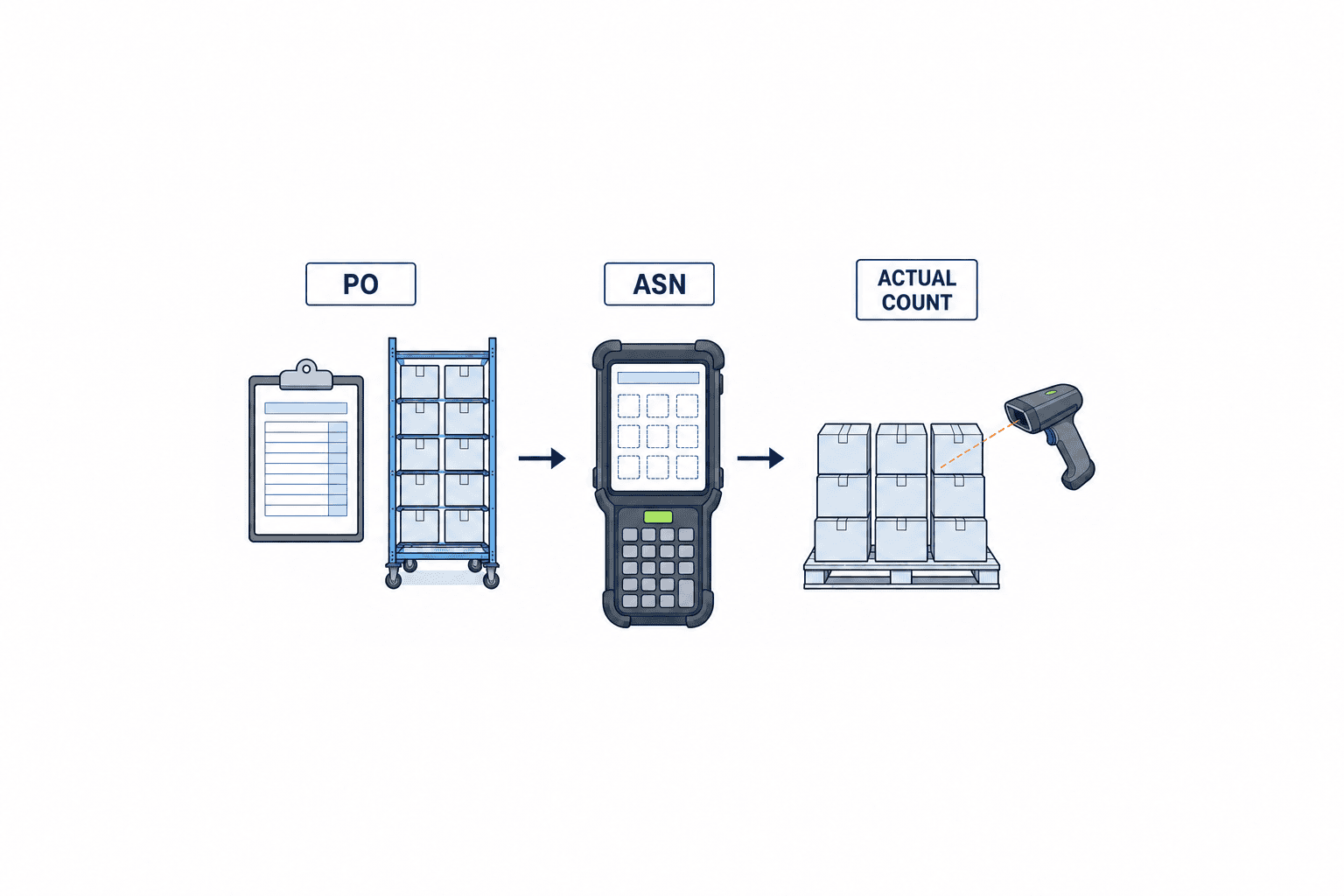
Data model for matching PO, ASN and physical goods
A PO number alone is not a sufficient key: one order may have many lines, partial deliveries and several vehicles. A practical matching key combines PO number and line, current item, destination, ASN or shipment, handling-unit identifier and unique receiving event ID. Preserve batch or serial references where required. The receiving event ID must survive retries so importing the same ASN or resending an ERP message never doubles the stock.
Where GS1 logistic labels are used, an SSCC can identify a pallet or other logistic unit at the receiving entrance. It does not by itself prove that the contents or quantity match the PO. Keep the label-to-ASN relationship and actual count as distinct records. Define what happens when a label cannot be read, a pallet is mixed, a carton is partly opened or a label must be replaced. Faster scanning is only valuable if the exception can still be recorded accurately.
Record fields and ownership
| Field | Example | Primary owner |
|---|---|---|
| PO number, line and revision | Effective quantity after a PO revision | Purchasing |
| ASN, vehicle and expected delivery | Planned quantity by shipment | Supplier and logistics |
| Physical item, count and unit | Cartons and pieces stored separately | Receiving operator |
| Discrepancy and reason | Short, over, wrong item, damage, unconfirmed | Receiving operator |
| Evidence | Packing slip, label, photo, recount | Receiving operator |
| Decision | Tolerated, hold, return, amend PO, await balance | Purchasing, quality, warehouse |
| Inventory disposition | Staging, inspection, available, quarantine, return | Warehouse and quality |
| Invoice disposition | Billed quantity, hold reason, adjustment | Finance and purchasing |
If a supplier part number differs from the internal item number, maintain an effective-dated cross-reference. Record the unit conversion version as well. One carton ordered as 12 pieces but found to contain 10 pieces is not a simple comparison of 1 against 10. The conversion used, and any approval to change it, must remain visible. A recount should create a new record with operator, time and reason instead of silently overwriting the first count.
Use a consistent comparison sequence: validate the effective PO line, compare ASN to plan, identify the physical item, count and recount, classify the discrepancy, resolve the exception, and then post formal receipt. A wrong item must not proceed to a quantity tolerance calculation. If the unit cannot be converted reliably, hold the event rather than guessing.
Model over- and under-delivery as states
“Receipt” can mean unloading, scanning, counting, putting goods into inspection, accepting them against the PO, moving them to a good-stock bin or posting ERP inventory. These events rarely occur at the same instant. Define states such as arrived, counting, discrepancy hold, quality hold, approved, formally received and returned or reversed. Show both the current state and the responsible next role on the work screen.
For a shortage, the normal candidate is to receive the quantity actually accepted and keep the remaining PO balance open. The later balance may be delivered, cancelled or settled through a supplier credit according to the contract. Do not automatically erase the balance. For an over-delivery, decide by item and supplier whether a within-tolerance quantity can be accepted automatically or needs explicit approval. Goods with uncertain ownership should remain in quarantine or custodial stock, outside usable inventory.
Microsoft’s Landed cost documentation illustrates rules using order-value and PO-line percentage tolerances, followed by movements or additional orders for over- and under-deliveries. That feature concerns a particular goods-in-transit process. Its 10% example is not a general industry tolerance. Configure tolerances around contract, item risk, accounting policy and the behavior of the selected WMS and ERP. Microsoft over/under transaction documentation
Never treat a wrong item as a tolerable quantity variance
If a PO requests 100 of item A and the shipment has 95 of A plus five of B, create two exceptions: shortage of A and unordered receipt of B. Accepting B as a substitute requires a check of the purchase agreement, drawing revision, process suitability, quality requirements, price and invoice item description. Decide whether approval applies only to this receiving event or changes the permanent item substitution master. A one-time operational workaround must not silently change the master data.
Damage and failed inspection are quality events, distinct from a pure quantity variance. A shipment can match the PO count and still contain units that cannot be released to production. Store physical arrival quantity separately from usable accepted quantity. Link the discrepancy system to the quality hold record, even if the inspection workflow is implemented in another system. Specify which quantity closes the PO for each item and contract.

Specify tolerance, approval authority and inventory posting point
A tolerance policy needs more than a percentage. Is the denominator the entire PO line or this shipment’s planned quantity? Is there also an absolute-unit limit? Does a high-value component follow the same rule as a commodity consumable? Are over- and under-delivery treated symmetrically? Did the supplier warn of a revised shipment? A one-unit variance can be a high percentage on a small order. Even when a variance is within policy, preserve it as a recorded, tolerated discrepancy.
Oracle’s item purchasing attributes describe warning or rejection for over-receipt and a configurable tolerance. They separately describe direct, inspection and standard receipt routing and whether substitutes can be received. The 5% mentioned in the product documentation is an illustrative setting, not a universal factory recommendation. The practical lesson is to keep quantity tolerance, inspection routing and substitution permission as separate rules. Oracle item purchasing attributes
Assign authority by impact and discrepancy type. Warehouse staff confirm physical count and isolation. Purchasing decides a PO amendment, extra order or supplier settlement. Quality approves the use of substitute or damaged goods. Finance decides how an invoice hold is released. Configure automated decisions for well-defined low-risk cases and explicit approval for the rest. Include delegates, deadlines and escalation, while limiting who may edit ordered or posted quantities.
Mark the exact inventory confirmation point
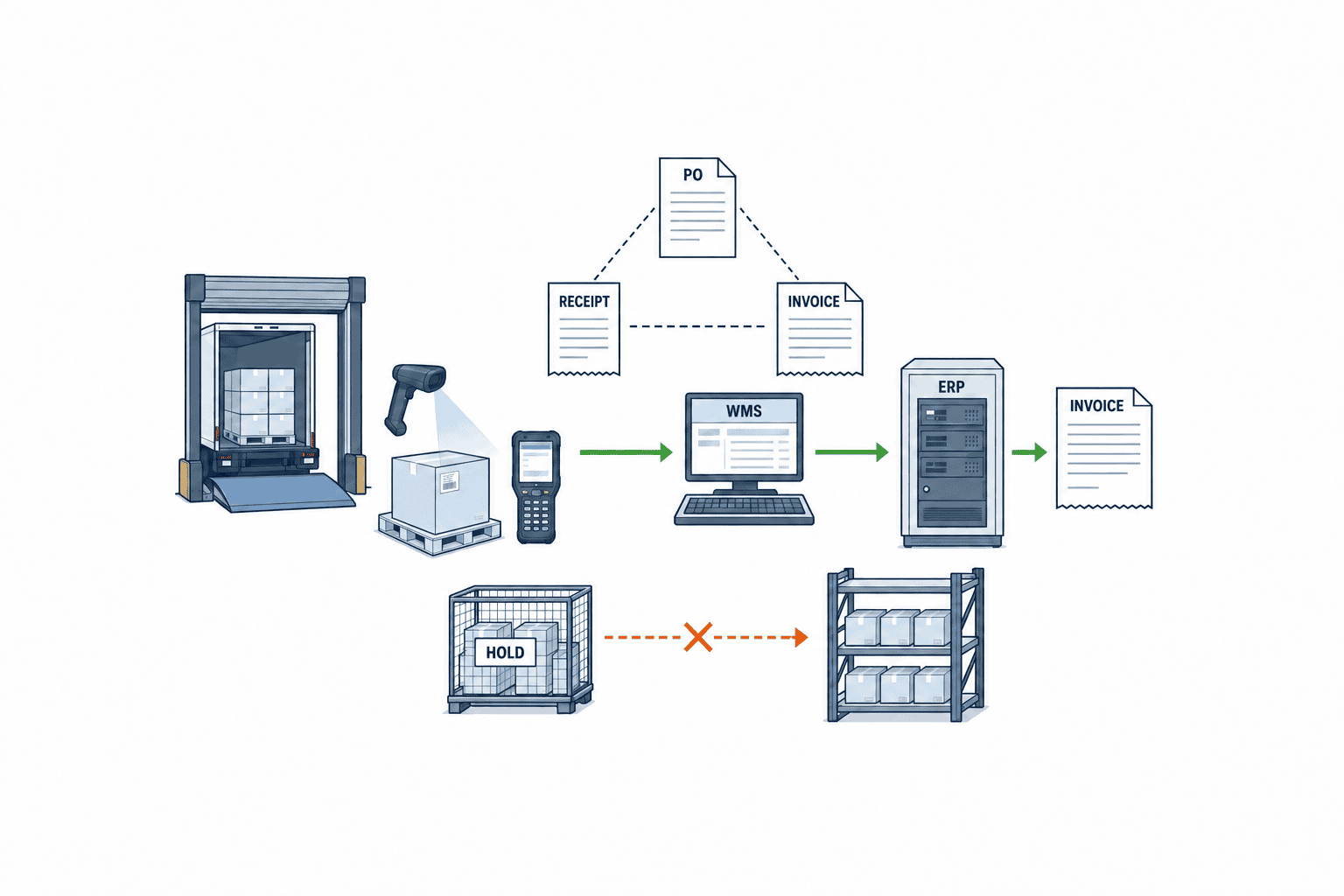
Some operations increase ERP stock immediately after a scan; others wait for quantity and quality approval. Either arrangement can be supported, but physical arrival, formally received stock and available good stock must remain distinguishable. A hold on paper is ineffective if the goods have already been moved to a pickable location. The handheld and warehouse location should show quarantine or hold status.
Draw a clear posting line in the process map: before approval, only arrival and staging are recorded; after approval, a formal ERP receipt is posted; after quality release, stock becomes available. If the existing ERP posts financial inventory at receipt, investigate a quarantine warehouse or blocked stock status. Attach the same receiving event ID to WMS and ERP messages for safe retries. Correct a posted event with a referenced reversal rather than deleting the history.
Design WMS and ERP integration around failure cases
Define what happens if the WMS sends a receipt event but the ERP does not receive it, or if the ERP posts it but its acknowledgment is lost. Who sees the failure, which screen can retry, and how does the ERP recognize a duplicate? Also decide which item and unit-conversion revision applies when a master record changes while a shipment remains on hold. A happy-path interface diagram is not enough for the dock team.
An integration event should contain the event ID, PO line, ASN, actual item, quantity, unit, discrepancy reason, approval reference, timestamp, source status and message version. The ERP reply should return its receipt document ID and confirmed quantity. Until it arrives, the terminal should show “ERP pending.” Batch interfaces need an accounting date separate from the actual receiving timestamp, particularly around midnight. These audit needs apply whether the interface uses APIs or files.
Open PO balance management covers how much remains undelivered across orders. This article focuses on how an individual arrival becomes an approved receipt. The adjacent receiving inspection system guide covers inspection design. The discrepancy event must link to both workflows without confusing count, inspection outcome and open PO balance.
Three-way matching: ordered, received and invoiced quantities
Three-way matching ordinarily checks the PO, formal receipt record and supplier invoice. A quantity variance found on arrival and a billed-quantity variance discovered after invoice arrival are separate events. If 100 were ordered, 98 formally received and 100 invoiced, there is a shortage of two plus an invoice that bills for two more than the accepted receipt. The business may hold the invoice, pay an agreed partial amount or await a later delivery, depending on its terms. Define that rule before automating payment.
Oracle explains that invoice tolerances can be set for quantity or amount, with an invoice hold when validation finds a variance beyond the configured limit. A tolerance against ordered quantity is different from one against received quantity. The interpretation of a blank or zero setting is product-specific and must be checked in configuration. Oracle invoice tolerances
For an accepted over-delivery, the invoice should not automatically be approved just because the goods were counted. Link any extra PO or contract amendment to the receiving event. For a return, track return shipment and credit note. Separate item, quantity, unit price and tax variance: an approval of three extra pieces is not an approval of a price change. Evidence captured at the dock should let finance resolve the invoice without repeating the physical investigation.
Discovery and RFP: specify cases with numbers
Before selecting a product, sample recent receipts and record detection time, exception resolution time, invoice holds, recounts and manual corrections. A plant reporting zero discrepancies may simply copy the packing slip quantity without counting. Observe where a quantity is physically measured and where it is merely transcribed. Include split shipments, mixed pallets, weekend and night deliveries, third-party warehouses, returns, substitutes, free-issue goods and deliveries across PO revisions.
Write expected inputs and outputs into the RFP. With PO A100, ASN A100 and physical A98, the system should record a shortage of two, offer receipt of 98 and preserve an open balance of two. With PO A100 and physical A100+B3, A matches and B is isolated as unordered. With A103 outside the configured rule, three extra units should not become available in ERP before approval. Numbers, states and owner roles make vendor demonstrations comparable.
Include item cross-reference, unit conversion, receipt without ASN, unreadable labels, recount evidence, photo attachment, offline recovery, delegated approval, audit log, partial receipt, reversal and invoice-event linkage. In a Thai factory, specify which operational screens must be in Thai and which management reports need Japanese or English. Define the business meanings of “arrived,” “held” and “received” before translating those labels.
Compare implementation quotes, responsibilities and cutover
Compare proposals on exception scope, not scanner count alone
Two bids with the same number of licenses may cover very different processes. One may import ASN messages automatically while the other assumes manual CSV uploads. One may stop at WMS staging while formal ERP receipt remains a manual entry. Normalize the comparison around sites, monthly receipt lines, suppliers, ASN formats, label types, ERP interface, approvers, hold locations and invoice integration. Include master-data cleanup, training, label changes, supplier communication and post-launch exception analysis. For a business case, measure time spent investigating and approving one real discrepancy, rather than assuming an unverified percentage saving.
Assign the decision to a named role
With a shortage of two, receiving recounts, purchasing agrees on a later delivery, warehouse posts only the accepted quantity and finance matches the later invoice. With an overage, warehouse isolates the extra goods while purchasing decides to buy or return them. Quality can approve technical substitution, but purchasing still owns the commercial terms. An approval matrix should list discrepancy type, financial impact, item risk, approver, deputy, deadline and escalation. Preserve before and after quantities, evidence, operator and time. A count correction must be a different action from a business decision to accept goods.
Migrate open receiving work explicitly
At cutover there will be open POs, ASNs without arrival, counted shipments not yet posted in ERP, quality holds and invoices received before goods. Reconcile and label each state before migration, keeping the old record ID and current owner. Never resend a receipt that the old ERP has already posted. If paper and the new system run briefly in parallel, choose one source of truth and one receiving event ID per arrival. During the first week reconcile daily the physical count, holds, ERP receipt documents and invoices waiting for matching.
FAT and SAT scenarios
Use FAT in the supplier’s test environment and SAT with the plant’s scanners, labels, network, WMS/ERP and actual roles. Test not only that the screen responds but also what stops when an exception remains unresolved and who receives the alert.
| Scenario | Expected result |
|---|---|
| PO100, ASN100, actual98 | Shortage two; accepted candidate 98 and open balance two |
| PO100, ASN103, actual103 | ASN matches actual, but PO overage three requires policy decision |
| PO A100, actual A90+B10 | Separate A shortage and unordered B; no offset |
| First count 99, recount 100 | Both counts, operator and final decision retained |
| Actual100, quality rejects five | Arrival 100 distinct from available 95 |
| Same event sent twice | Only one ERP receipt document |
| ERP reply lost | Re-query or retry converges on the same document ID |
| Invoice100, formal receipt98 | Separate invoice variance with a link to receipt evidence |
At SAT, also check scanning distance, glove use, mixed pallet handling, offline recovery and the absence of a night-shift approver. Record whether each failure requires a rule change, software fix, training or master-data correction. Go-live does not require every discrepancy to disappear. It requires the system to reveal discrepancies, prevent wrong stock or payment movements during a hold, and converge on the approved quantities afterward.
KPIs and phased deployment
Start with one plant, a defined item family and a few suppliers where the counting or reconciliation burden is meaningful. Do not judge a pilot only by the number of detected variances: it can rise initially when previously hidden differences become visible. Track time to resolve a hold, the percentage of receipts traceable from PO through physical count, duplicate ERP postings and invoice-hold handling time. Compare periods with the same scope.
A practical sequence is to define the source of each quantity, preserve discrepancies, establish approval and inventory posting, integrate WMS/ERP, and then connect invoice matching. Before asking suppliers for ASN data, stabilize your own PO item, unit and delivery schedule. Otherwise a mismatch may be caused by master data rather than the physical shipment. Work with suppliers on labels, packaging, ASN timing and units instead of using the system only to assign blame.
Common failures include automatically turning every scan into a formal receipt, using one percentage tolerance for all items, lacking a WMS-to-ERP event map for safe retries, and treating an invoice mismatch as the same event as a receiving mismatch. Counter these with a state transition table, approval matrix, exception cases and unique event IDs during RFP and testing. Even when adopting standard package behavior, do not lose the separation of actual goods and accepted receipt, the approval evidence or duplicate-posting protection.
Conclusion: retain the discrepancy until it is resolved
A manufacturing receiving discrepancy system is more than a three-column comparison screen. It must preserve over-delivery, shortage and wrong-item events; apply item-appropriate rules and authority; identify the formal receipt and available-stock points; and connect the same event to WMS, ERP and invoice matching. Begin by tracing one shipment from arrival to its final resolution.
If your PO, ASN, physical count, ERP receipt and supplier invoice disagree, you can contact TOMAS TECH while still evaluating the approach. We can help map the recording unit, approval flow and FAT/SAT cases around your existing systems and dock process.
FAQ
Should receiving quantity discrepancies be measured against the PO or the ASN?
Measure both separately. ASN-to-actual measures the accuracy of the shipping notice; PO-to-actual measures fulfillment of the order. A shipment can match the ASN and still leave an open PO balance.
What percentage of over- or under-delivery can be accepted automatically?
There is no universal figure. Determine it by item value and risk, contract, unit, supplier and accounting policy. Percentage values in Microsoft and Oracle documentation illustrate product settings, not an industry standard. Keep even tolerated variances in the audit record.
How is an invoice matched when ordered and received quantities differ?
Match PO, formal receipt and invoice as distinct documents. Keep the arrival variance and the billed variance as separate linked events. Whether to hold, partly pay or request credit depends on agreed terms and company policy.
Can a wrong item be accepted when the total quantity matches?
Matching total quantity is insufficient. Record the shortage of the ordered item and the unordered item separately. Purchasing and quality must review substitution, specification, price and invoice description before release to usable stock.
What should FAT and SAT test first?
Test shortage, overage, wrong item, recount, quality hold, lost ERP response, duplicate sending and invoice variance. Confirm that held goods cannot become available or payable without the required decision.


