



When a customer emails a “revised specification” PDF, who checks what changed before your team quotes or starts production? Deploying AI to compare manufacturing specifications should do more than highlight different words. The useful outcome is a controlled decision: which requirement changed, which product and order it applies to, what it means for cost, lead time and inspection, and who approved the interpretation. This guide covers customer and supplier PDF revisions, requirement extraction, differences in tables and figures, human signoff, and how to test the workflow from RFP through FAT and SAT.
Why finding a difference is only the beginning
A change to a material grade can affect purchasing and cost. A note about inspection frequency can alter work and delivery records. A packaging drawing can change a fixture or shipping container. The same edited page therefore has different implications for sales, design, quality, production engineering and procurement. A word-level “diff” cannot make these decisions for them.
Real specifications also arrive as selectable PDFs, scans, tables in appendices, tiny callouts in drawings and multilingual editions. Reflowed paragraphs can create a flood of false differences; merged table cells or a drawing note can be missed. A customer may resend content under the same revision label or clarify applicability in an email. File names alone do not identify the contractual source of truth.
This workflow addresses the step before formal engineering change execution. ECR, ECO, ECN and BOM distribution are downstream change-control tasks. Searching a drawing archive for similar drawings is a different task. Here the question is narrower and earlier: how does the newly received customer or supplier specification PDF differ from the last accepted version, and may the new requirements pass to quotation or production? Keep document comparison, applicability and signoff as a separate gate even if they connect to those later systems.
Build a requirement decision register, not just a redline
Each result should carry a document ID, issuer, receipt date, old and new revision identifiers, affected customer, product and factory, a stable requirement ID, source location, before-and-after text, difference type, potential impacts, owner, decision, rationale, approver and approval time. Store the original file hash and a link back to its page, table cell or drawing region. A page number alone may move when the PDF is reformatted.
Useful difference classes include addition, deletion, value or unit change, tolerance change, applicability change, drawing-note change, table row or column movement, formatting only and unresolved. AI may propose a class but should not make it final. A shift from 10 ± 0.1 mm to 10 ± 0.05 mm is short in text yet may affect machining and measurement. A heading font change is visually large yet normally does not change a requirement. Risk does not follow the number of changed characters.
The register must distinguish whether the passage is a binding requirement, which contract and lots it applies to, whether current capability meets it, whether it changes the quote and whether the customer must clarify it. “AI marked it important” is not an auditable rationale. The model proposes review candidates; an authorized person accepts requirements and decides their effective scope.
Choose the right versions and scope before choosing a model
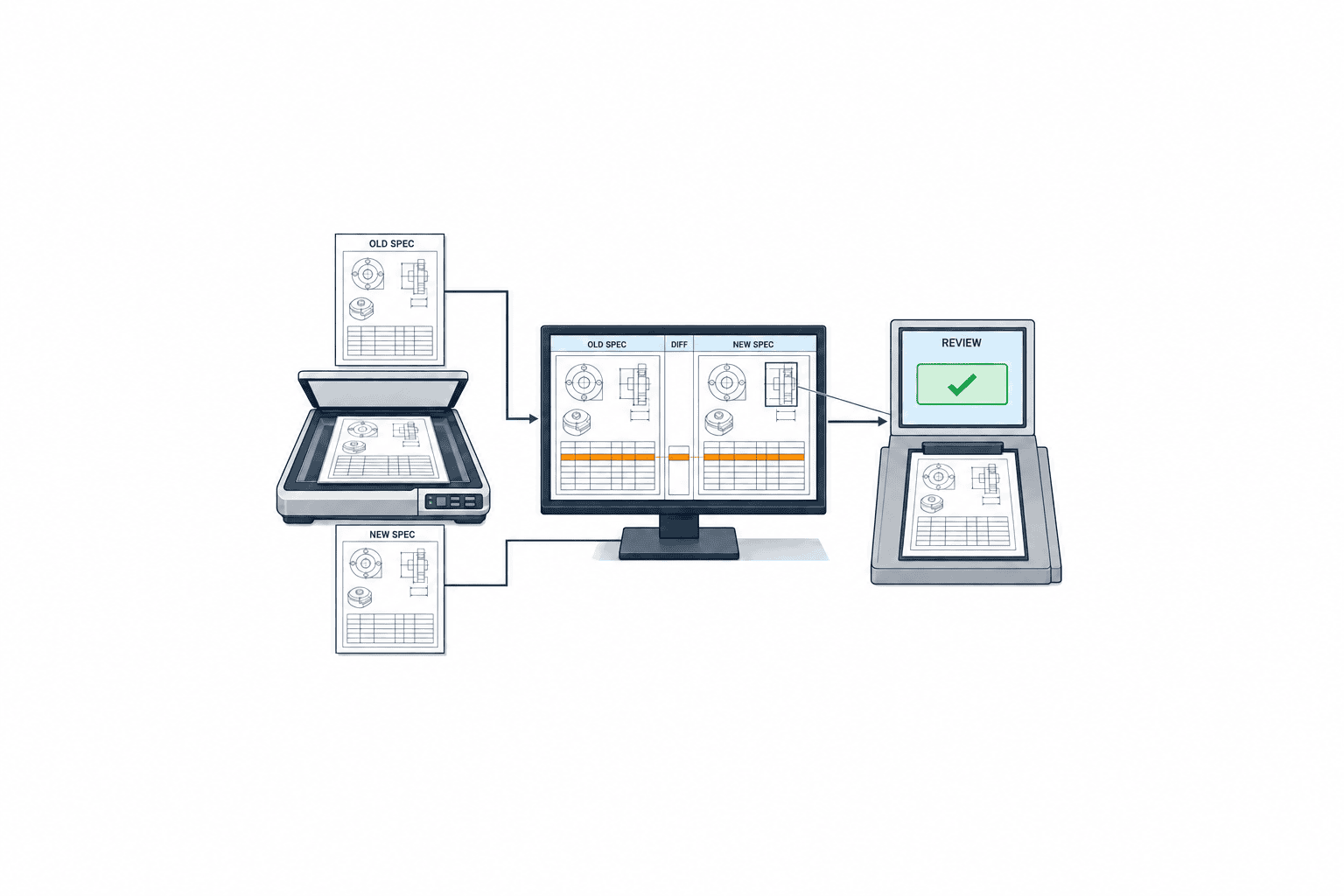
The older comparison copy is not always the last file received. It may be the version approved for a quote, the production baseline or a version restricted to one customer contract. Record document number, revision, issue and receipt dates, issuer, affected part numbers, plant, contract or purchase order, language and relationships to appendices. Define whether a customer requirement or a supplier proposal is authoritative when both exist.
A cryptographic hash helps detect two files with the same revision label but different bytes. It does not prove a requirement changed: a PDF regenerated with different metadata may also hash differently. Compare the actual content and preserve the source of the version selection. Never silently choose the newer filename when the email says to disregard that attachment.
Applicability may begin at a new quote, new purchase order, particular lot, customer approval or after stock depletion. AI can identify candidate effective dates or lots, while people verify them against contracts, inventory and processes. If the document does not state an effective date, leave it unresolved rather than inventing one. Otherwise sales and the shop floor can act on different revisions.
Extract requirements from PDF: OCR is one stage
For born-digital PDFs, try embedded text extraction first; scans require OCR. Recognizing characters is distinct from understanding their relationship to table headings, footnotes, figures and sections. Google Cloud’s Document AI Layout Parser documentation describes extraction of PDF headings, tables and figures. Microsoft’s Document Intelligence documents pages, tables, figures and sections; Amazon Textract documents table cells and merged cells. These official capabilities support document structure extraction, not a guarantee that any specific manufacturing requirement will be interpreted correctly.
Keep the pipeline separable: retain the original, segment page regions, extract text/table/figure structure, identify requirement candidates, align old and new versions, display differences with sources, then obtain human approval. Save intermediate results so an error can be traced to OCR, table alignment or requirement interpretation. A single final AI summary is hard to troubleshoot and retest.
Search for obligations in natural-language clauses and in table headers, drawing dimensions and exceptions in remarks. Yet do not promote explanatory text or reference values into contractual requirements. Display the original passage alongside any AI paraphrase. If a scan is unreadable or confidence is low, request a better copy or route it to manual reading; a fluent reconstruction is not evidence.
Test tables, drawings and units separately
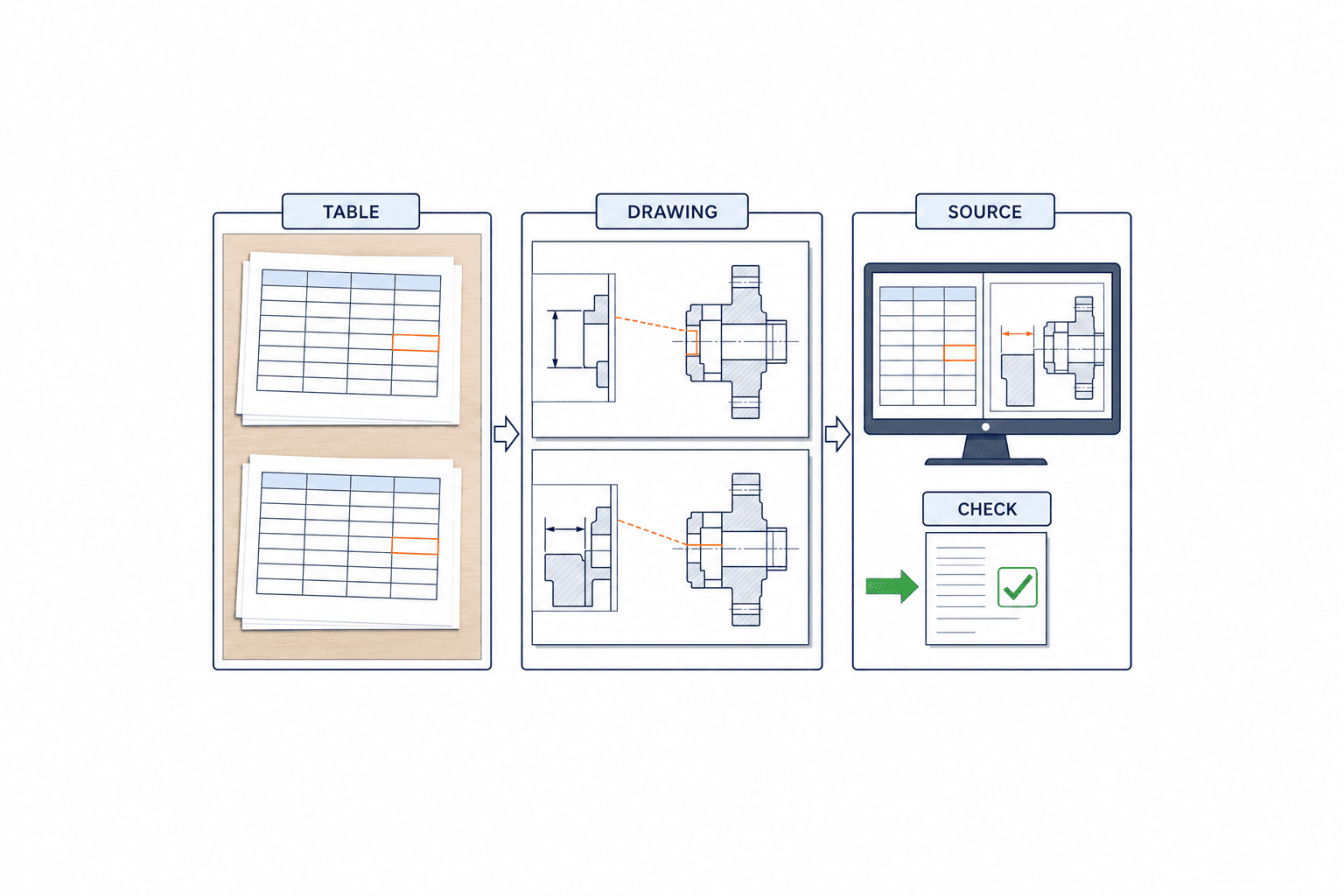
A table value means little without its row and column headings, footnote, merged-cell context, unit and applicability. The value “0.2” can remain unchanged while the heading changes from “maximum” to “nominal.” Test page-spanning and rotated tables using your own documents. Google’s documentation notes that tables spanning multiple PDF pages may be split. This is one reason to run a representative proof of concept rather than select a vendor by feature list.
For drawings, review what a leader line points to, note references, dimensions, tolerances, revision marks and the relation between views. A shifted PDF layout can trigger a noisy pixel difference; a tiny dimensional edit can still be consequential. Treat automated drawing interpretation as a candidate locator. Show the changed region and suspected note, then have engineering and quality inspect the original.
Normalize units for comparison while retaining the original expression. Millimetres and inches, MPa and N/mm², or Celsius and Fahrenheit may require conversion rules and rounding decisions. Check whether a value is a maximum, minimum, target or reference. Decimal separators, thousands separators and mixed Thai and English text can also confuse parsing. Show original numbers side by side so an attractive AI summary cannot hide a numerical error.
Define the human approval gate
Classify possible impact on product conformity, safety, customer-specific obligations, process capability, inspection, cost, lead time, packaging and logistics. Route high-impact changes to responsible functions. Sample-check lower-risk differences, and also audit some documents that AI says have “no change”: missed differences would otherwise remain invisible.
Sales checks the quote and customer response; design checks technical meaning; quality checks inspection and evidence; production engineering checks process capability; procurement checks supplier commitments. Name the person who makes the final applicability decision for each case. An unresolved requirement must not flow silently into a quote or work order. Link customer clarification, rejection and reapproval to the same stable requirement ID. Electronic-signature form and retention depend on the applicable contract, internal policy and law.
NIST’s AI Risk Management Framework is a voluntary resource for integrating AI risk management into organizational practice. It is not, by itself, certification or legal compliance. It can help frame roles, measurement, monitoring and correction. In this use case, distinguish “AI detected a possible change” from “a person accepted this requirement,” and record why a reviewer overruled a suggestion. An unsupported generative summary is not signoff evidence.
Separate pre-quote and pre-production decisions
Before quotation, ask whether a revised requirement changes price, lead time, tooling, test equipment, outsourced operations or validation cost. “Technically possible” does not mean “price and schedule committed.” Put unresolved assumptions in the quotation or question list and link them to the revision used. Sales should not accept “no impact” from a model that lacks site-specific capability data.
Before production, verify that the approved revision reached work instructions, inspection criteria, procurement specifications, machine settings and shipping documents. A change after quotation may require the quote to be revisited. If both the customer and supplier specifications changed, compare supplier commitments against customer requirements as a separate check. A supplier’s “equivalent” material description does not establish that customer-specified grade, test method and certificate format are met.
The shop floor needs a short controlled release notice: effective revision, affected parts and lots, changed work or inspection condition, approver and contact. Keep holds separate from approved items. Grant production release only after the owner has dispositioned unresolved requirements.
Keep an evidence path from each decision to the source
Months later a customer may ask why an inspection was added or which revision applied to a lot. A useful system follows a requirement ID from the source PDF through the AI candidate, human decision, approval and downstream documents. Link customer and supplier PDFs, quote, work instruction and inspection result where relevant.
Retain the original and hash, comparison pair, extractor and model version, execution time, detected difference, source coordinates, reviewer decision, approval, destination and verification. Freeze historical runs when the model changes. Correct an erroneous decision through a dated amendment and reapproval instead of erasing the old record. Decide document storage, access, retention and whether an external service may use data for training before procurement.
ISO’s official site states that ISO 9001:2026 has been published and replaces the 2015 edition. Its public overview emphasizes customer needs, consistency, risk and improvement. That overview does not certify a particular AI comparison product. Align document control, requirement review and change approval with your own quality management system, customer arrangements and audit approach. Software helps create evidence; it does not transfer accountability away from the organization.
Start a PoC with a ground-truth set and failure conditions
Limit the first proof of concept to one customer or product family and historical revision pairs with accepted decisions. Include real hard cases: scans, appendices, tables, figures, mixed languages, same-label reissues and unclear effective scope. Clean PDFs alone cannot test the exceptions most likely to delay a quotation.
For each pair, prepare source versions, stable requirement IDs, changed locations, impact, owner, applicability and the human decision with rationale. Mark legitimately ambiguous items “clarification needed.” If AI fabricates a resolution, count it as a failure even when its prose sounds confident. Values, units, tolerances, negation, exceptions and drawing notes should be mandatory test cases.
Measure missed critical requirements, nuisance alerts, correctness of source links, table-cell alignment, human drawing-review load and approval delay, as well as processing time. Set targets after measuring your baseline. A generic percentage saving obscures differences in input quality and review scope. Compare the same document set under the same scoring rules before and after the trial.
Specify RFP requirements and verify them in FAT and SAT
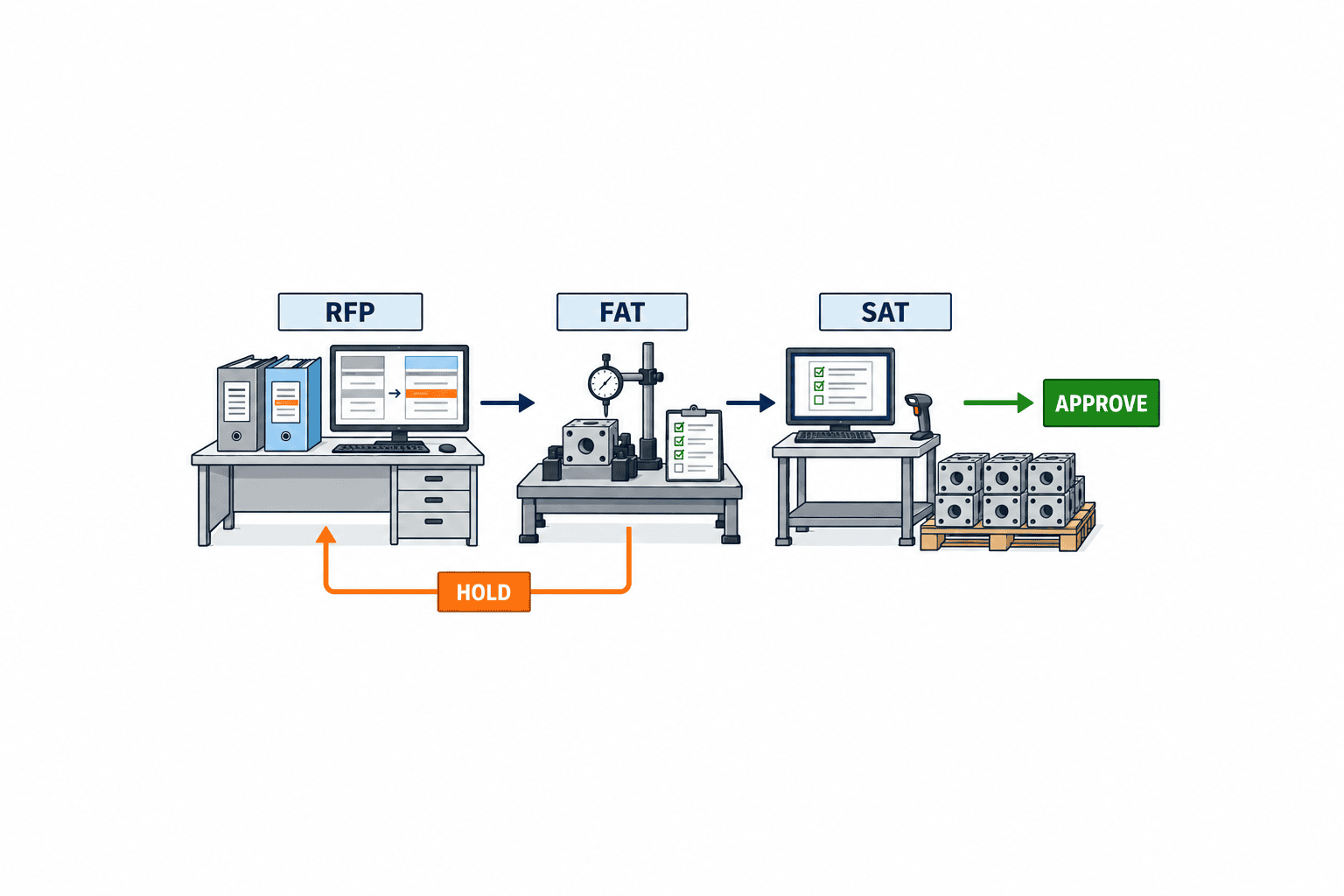
An RFP saying only “AI compares specifications” is too vague for comparable proposals. State PDF types, volume and languages; scan quality; baseline selection; treatment of tables, drawings and appendices; register fields; approval roles; integration; confidentiality; reprocessing; and outage procedures. Ask vendors to show both supported cases and cases that must go to a person. Include model-change revalidation and operating cost in the scope.
In FAT, use agreed sample PDFs and ground truth to test extraction, differences, source display, permissions and history. A feature appearing in a demo is not a pass. Include deliberate challenges: a tolerance in a merged cell, a deleted drawing note, a same-label reissue with different content, an added effective lot and an unreadable scan. Define expected outcomes in advance: detect correctly, place on hold for a human, or block acceptance.
In SAT, test the real receiving channel, local permissions, network, storage and handoff to quotation and production. At a Thai factory, translations can assist multilingual review, but the source-language original should remain authoritative and visible beside the translation. Check that local quality, sales and production engineers can disposition one case together and that holds survive the handoff. Record acceptance criteria and open defects; do not allow an unresolved critical item to auto-pass in production.
Evaluate value through avoided rework, not only document volume
Cost includes document analysis, AI use, baseline management, access design, integration, ground-truth preparation, training, monitoring and retesting after model changes. It depends on pages, scans, table and drawing complexity, languages, and deployment architecture. Request pricing against your sample set rather than assume a universal per-page cost.
Benefits may include earlier customer questions, catching post-quote changes, preventing production against the wrong revision, reducing repeated inspection and making approval delays visible. Not every benefit needs an invented currency value. Record baseline receipts, revisions, review time, rework, requotes, wrong-revision releases and customer findings, then compare. A low document count does not remove the risk of one serious missed requirement.
A sensible sequence is: register authoritative documents, propose text and table differences, introduce the approval register, then connect to quotation, production and inspection. Do not promise fully autonomous drawing interpretation or multilingual translation on day one. Set explicit handoff-to-human rules first. Downstream engineering change management covers ECR/ECO/ECN and BOM execution; supplier material certificate verification addresses received certificate and lot evidence. Keep this specification-revision acceptance gate distinct from those tasks.
Example register entries and exception handling
Consider a fictional packaging specification. Rev.B says 20 pieces per carton; Rev.C says 16, and a label location in a figure moves. Record the old and new source, table coordinates, figure region, part number and missing or stated reason. AI can mark a quantity change, but a person must decide whether it is a packing unit or shipping unit. Sales checks packaging cost and transport; logistics checks carton and pallet; production engineering checks packing work; quality checks label and count inspection. If the customer has already ordered against Rev.B, the effective lot cannot be inferred from the two PDFs. Put it on hold and ask the customer.
In another fictional case, a supplier material specification changes only a test temperature. Quality checks the standard, test method, customer-required property and incoming inspection. “Equivalent” in a supplier explanation is not a substitute for contract and customer approval. This decision may connect to later certificate checks, but acceptance of the specification revision is its own gate.
A model may split one clause into several candidates or merge multiple paragraphs. Give requirements stable internal IDs alongside document clause numbers, retain mappings across revisions and keep deleted requirements in the history. This allows a team to explain why a requirement absent from today’s version still applied to an earlier lot.
Define manual handling for encrypted or damaged PDFs, low-resolution scans, handwritten notes, complex columns and tiny image text. Define whether to request a better original, compare manually or hold the case. An older issue date, duplicate revision label or “ignore previous attachment” email should block automatic baseline selection. PDF metadata and filename alone do not prove contractual validity.
Address service outages, model upgrades and API changes in the RFP. Decide how unprocessed documents queue, how to reprocess them and how to prevent duplicate approvals. Check data residency, retention, training use, access logs and deletion against the contract. Vendor capabilities and limits can change by version; record and retest the specific configuration you use.
Share one source of truth across departments
Sales may want quote impact, quality wants inspection changes and production engineering wants process changes. Their views can differ while the underlying requirement ID, source location, before-and-after text and applicability decision stay shared. Avoid separate AI summaries that quietly point to different versions. Notifications should identify the owner, due date, required action and next gate, not merely say “important change.”
When approval is slow, investigate whether ownership, customer clarification, missing appendices or capability testing is the cause before speeding up the model. Statuses such as extracted, in review, awaiting customer, approved and on hold help everyone see unresolved conditions. Re-enter comparison and approval when another revision arrives.
Review translations against the contractual source language
Multilingual factories may translate an English customer specification into Thai or Vietnamese work instructions. Comparing only translations cannot tell whether the customer requirement changed or merely the wording of the translation. Make the contractually authoritative source language the comparison baseline, and show its exact passage and revision beside the translated review view. A mistranslated “shall” versus “should,” permission versus obligation, or negation can reverse a process or inspection decision. If uncertainty remains, a responsible person reads the original and asks the customer when necessary.
After approval, shop-floor notices should include the source requirement ID, effective revision, translated operational instruction and approver. If someone corrects a translation, record that as a translation correction in its own history rather than a customer-specification revision. This prevents an improvement to an internal explanation from being mistaken for a change in the customer’s requirement.
Monitor performance after go-live
Each month sample accepted documents and compare AI candidates with the final human requirements. Customer template changes or a replacement scanner can alter extraction even without a model upgrade. For a miss, record whether input quality, baseline selection, OCR, alignment, classification or approval failed. A prompt change alone may not fix a broken document-control process. If alerts are too noisy, check whether critical changes are being buried before raising thresholds.
Conclusion
Treat two-PDF selection, difference detection, evidence and human acceptance as one controlled workflow. Handle tables, drawings, appendices, units and applicability; retain a route back to the source. Separate pre-quote from pre-production reviews and hold unreadable or ambiguous content. Specify exceptions in the RFP and use your difficult real examples in FAT and SAT. People remain accountable for accepting a requirement and releasing a revision.
If customer or supplier specification PDFs are increasing your pre-quote workload or complicating revision handoff, contact TOMAS TECH while you are still mapping documents and approval steps. We can start by identifying the differences that must reliably reach a human reviewer.
Frequently asked questions
Does AI-OCR alone automate specification revision review?
No. OCR extracts text and layout. Aligning versions, interpreting requirements, deciding applicability and assessing quote or process impact are separate tasks. Begin with candidate extraction and source display; retain human acceptance.
Can AI detect changes in tables and drawings?
Document services can extract table cells and figure regions, but performance on your PDFs must be tested. Include merged cells, page-spanning tables, small notes and poor scans in ground truth, with a hold route for uncertain results.
Should pre-quote and pre-production reviews use the same gate?
They can share comparison infrastructure, but their decisions differ. Pre-quote review checks price, schedule, feasibility and assumptions; pre-production review checks effective lot and propagation to work, inspection and purchasing. Define separate owners and pass conditions.
What belongs in the RFP at minimum?
Define PDF types, baseline selection, languages, tables and figures, a source-linked requirement register, permissions, history, hold behavior and FAT/SAT acceptance criteria. Anonymized real revision pairs improve vendor comparisons.
Who is responsible if the AI suggestion is wrong?
Responsibility depends on contracts and internal rules, so name the business owner of requirement acceptance and applicability in advance. Preserve the AI candidate, source and human correction/approval separately so errors can be investigated and corrected.
Official primary sources
- Google Cloud, Process documents with Gemini layout parser — PDF structure and limitations.
- Microsoft Learn, Document layout analysis — tables, figures and sections.
- Amazon Textract, Tables — cells, merged cells and headers.
- NIST, AI Risk Management Framework — voluntary risk-management framework.
- ISO, ISO 9001:2026 — official overview of the 2026 quality-management standard.


