



When a manufacturer introduces AI verification of supplier material certificates, the first question is not how quickly it can read a PDF. The critical question is whether the purchase order, approved material specification, supplier document and physical heat or lot identifier all refer to the same material. A certificate may arrive with the wrong order number; its test values may be within limits while its heat cannot be linked to the pallet; an English name may not map safely to the material grade in a Thai system. The purpose of the project is to expose such exceptions at receipt and let an authorized person decide from the evidence. This guide covers supplier documents from intake through extraction, matching, exception review and stock release. It does not cover generating the inspection certificate that a manufacturer sends to its customer at shipment.
The operating boundary: AI proposes matches; people release material
AI can classify document formats; extract grade, specification and revision, test items, values and units, heat or batch identifiers and issuer; and flag possible mismatches with orders, controlled specifications and package labels. AI should not independently decide that material is fit for use. Procurement checks commercial and order terms, quality checks test evidence, the warehouse checks physical labels and quantities, and engineering reviews substitute material or application changes. The quality system must name the person with final release authority.
The NIST AI Risk Management Framework emphasizes defined human oversight, roles, intended uses and documented limits. It is guidance for designing this workflow, not a material receiving mandate. Excellent extraction accuracy alone cannot establish that the certificate and physical goods belong together.
| Stage | AI support | Human decision | Evidence |
|---|---|---|---|
| Document receipt | Classify, extract and detect likely duplicates | Confirm supplier and source document | Original file, sender and receipt time |
| Order check | Propose part, grade, specification and quantity comparisons | Resolve contractual and substitute terms | Order revision and comparison |
| Physical check | Propose heat/lot and package-label linkage | Verify goods and quantity | Scan, photo and inspector |
| Test results | Extract values, units and limit comparisons | Validate applicable method and acceptance | Source location and reason |
| Release | Show unresolved exceptions | Quarantine, request evidence, reject or release | Authority, time and lot scope |
Define what “material certificate” means for each purchase
The terms mill sheet, MTC, material certificate, certificate of analysis and certificate of conformance are often used loosely. Their contents, issuer and evidential meaning differ. For steel and steel products, ISO 10474:2013 defines types of inspection documents supplied to a purchaser according to the order. Its scope is steel and steel products. It must not be treated as a universal requirement for polymers, electronics, chemicals or aluminium. Check the applicable material standard, customer specification and purchase order separately.
ISO 404:2013 describes general technical delivery conditions for the steel products within its scope and explains that agreed order conditions or relevant product standards take precedence where they differ. A certificate bearing a standard number therefore does not automatically prove acceptance. The order revision, extra requirements, manufacturing route and test conditions still matter.
An ASME review-team quality-system checklist for Section IV cast-iron and cast-aluminium boilers asks who determines the need for material test reports or certificates, who performs receiving inspection, and how nonconforming incoming materials are handled. This is an example from that specific boiler review context, not a general BPV checklist or a universal rule for every plant. It illustrates why the RFP should assign responsibility and define exception handling.
Split the workflow from document arrival to permission to use
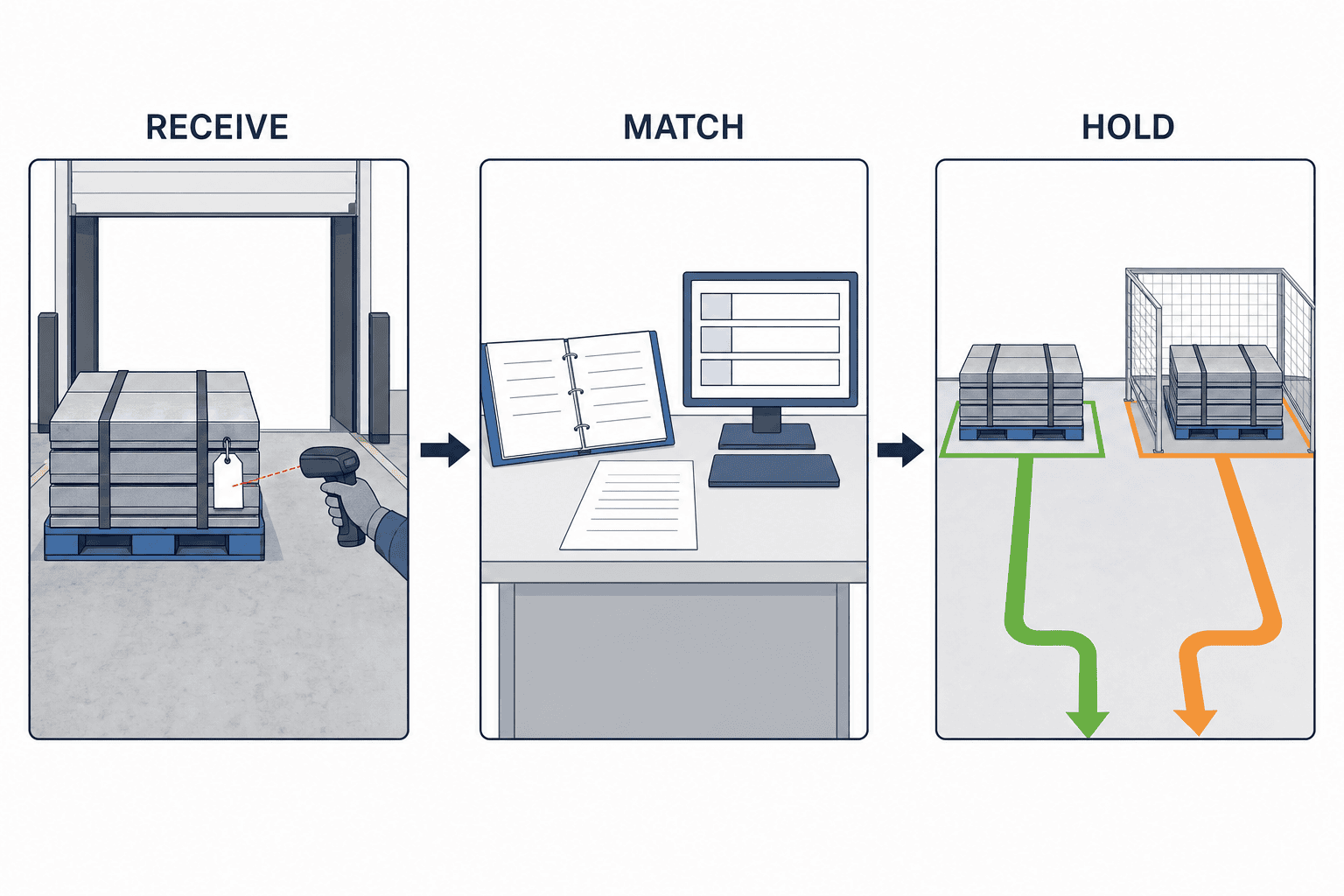
An emailed PDF in a shared folder does not make a material usable. Separate the flow into document receipt, comparison with order and specification, physical identification, review of test results, resolution of gaps, authorized release, and synchronization to warehouse and production systems. Each step needs a distinct state. Open exceptions should block downstream use where the quality plan requires it.
At receipt, capture document type, issuer, date, PO and line, part, heat or lot, page count and revision. A folder of PDFs alone cannot distinguish a corrected certificate from the old attachment. Use file hashes and communication history to identify possible duplicates; have a responsible person designate the valid version. Where signatures or supplier portal records are required, include those checks. OCR cannot establish authenticity.
Match to the exact purchase-order line. One order can have the same part on several lines. One delivery can contain several heats; one heat can arrive in multiple deliveries. Model certificate, heat, receiving lot and package as related entities rather than assuming a one-to-one relationship. Otherwise inventory records and downstream traceability will be misleading.
Master data and identifiers matter more than the model
Define links among PO number and line, approved supplier, part and revision, material specification and revision, heat or batch, receiving lot, package, physical label and storage location. Similar material names do not prove identical grades. A multilingual synonym dictionary should have approved mappings and an owner.
Heat numbers are central for many steel purchases, but another material may use a batch, production lot or date code. Define required identifiers by material class. Preserve leading zeros and separators; treat O/0 and I/1 as ambiguity, not a silent correction. Display uncertain OCR characters alongside the exact area of the scanned label and document.
| Identifier | Compared with | Typical exception | Owner action |
|---|---|---|---|
| PO and line | Certificate, receipt | Previous order or wrong line | Procurement review |
| Part and specification revision | Certificate, approved specification | Superseded grade | Engineering and quality review |
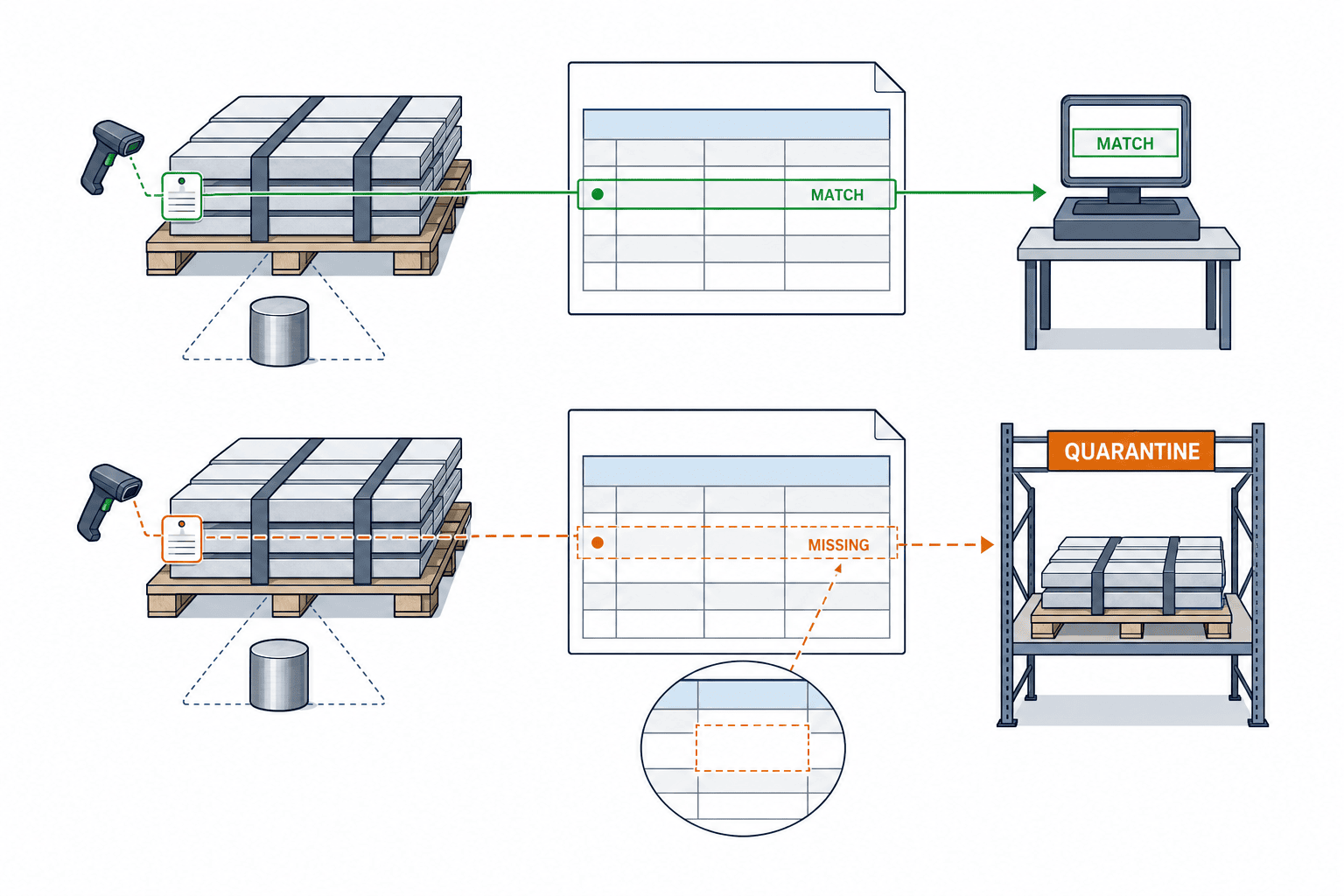
| Heat or lot | Certificate, physical package | Document says A, pallet says B | Quarantine and ask supplier |
| Required test | Order, certificate | Missing result | Quality seeks additional evidence |
| Value and unit | Approved limit | Unit or decimal ambiguity | Check original and method |
| Quantity and package | Delivery note, goods | One package has another lot | Split by package |
For the wider receiving-state workflow, see incoming inspection management at Thai factories. The focus here is the supplier certificate and its link to the actual material.
Design a safe response when AI cannot read the document
Supplier formats vary: scanned pages, merged table cells, handwritten heat numbers, multilingual headers, attached test conditions and image signatures. OCR and AI can assist extraction, but must not guess missing data. Every extracted field should lead back to a page, table cell or image region.
A blank value, a measured zero and “not detected” are different. A missing test value is an exception. “ND” may require a detection limit and method. Show the original value, unit, conversion rule and displayed precision when comparing limits; near-boundary results should go to a reviewer. OCR confidence is not a probability that a material is acceptable: text can be read accurately from the wrong table row. RFP evaluation should test how reliably unreadable and ambiguous fields are routed to the exception queue, in addition to average extraction accuracy.
Compare four sources, not two PDFs
The order states what was bought; the controlled specification contains technical acceptance criteria; the supplier certificate states reported results; the goods carry labels and actual quantities. A match among documents is weak if the physical package cannot be identified.
Start with deterministic comparison of PO line, part, specification revision, heat or lot, quantity, required tests, numbers and units. AI extracts variable-layout content and suggests possible synonyms. It should not approve the equivalence of two standards, a substitute grade or a changed test method on similarity alone. Use a controlled, approved equivalence table where one exists.
Classify exceptions before deciding disposition. A transcription error may need a corrected supplier document; an omitted test may need more evidence; an unreadable label may require quarantine and identification; a true specification mismatch may require return or formal engineering concession. Conditional release is appropriate only where authority, permitted use, deadline and tracking were defined in advance. An AI recommendation must never write a “usable” stock status on its own.
Put the exception queue at the centre of operations
An advertised 95% automatic-match rate says little about the remaining 5%. Each exception should show severity, delivery, supplier, PO line, heat/lot, unresolved item, source location, package image, next owner and due time. Procurement, quality and warehouse should work on one case ID rather than parallel email threads.
Prioritize a broken physical identifier, absent mandatory test, wrong specification revision or borderline result ahead of minor formatting differences. Implement the rule “unresolved critical exception blocks release” deterministically. Test that warehouse stock status and MES permission to consume reflect the same decision.
Use exception categories for improvement. If one supplier moves the heat number around the page, agree a submission template. If the PO uses an old specification, repair the purchasing master. Separate AI extraction error, supplier omission, internal master-data defect and label defect. This keeps the project from becoming an endless model-tuning exercise.
Keep meaning consistent across languages
A Thai factory may have Japanese purchase specifications, English supplier certificates and Thai warehouse screens. Never translate part or heat identifiers. Show both original and normalized values where units or decimal separators change. Assign stable status codes for received, under review, quarantined, released, conditionally released and returned, with carefully reviewed language labels.
Do not translate “document approved” as “stock received” if that would imply the goods can be used. Document validation and physical material release are different states. When Japanese headquarters makes a technical decision and the Thai site controls goods, specify each party’s authority. Show the local operator a short reason and next action in their language, while preserving a link to the original source.
Carry the lot link into manufacturing records
Release is not the end of traceability. Link certificate ID, heat or batch, receiving lot, location, issue transaction, manufacturing order and finished lot. Then a later supplier notice can identify affected work and stock. NIST’s supply-chain data work discusses trust and traceability, including signed data exchange. Choose an appropriate method for the existing ERP/MES and suppliers; a particular technology is not automatically required.
Allow one certificate to cover several heats and one lot to receive a corrected or additional certificate. Include return, re-receipt, splitting and subcontract movement. A scanned PDF is insufficient if it cannot be tied to identified goods. The work-in-process lot split and merge guide addresses the later production stage; certificate-to-lot linkage must already be established at receipt.
ERP purchasing and stock, MES consumption, and QMS nonconformance records are likely integration points. They need not all be replaced. Start with identifiers and state codes for one material class, then expand without losing the history of which lot was allowed for which order.
Authenticity, correction and tampering
Correctly extracted text does not establish that the certificate is genuine. Check supplier identity, transmission route, issuer, replacement history and, where needed, signatures or supplier portal records. A QR code by itself proves nothing about the destination it opens. Store both the original and extracted fields, with who corrected what and when. Never rewrite the supplier original as an OCR correction.
When a revised certificate arrives, preserve the earlier document and record its relation to the new one, the reason for replacement and the affected heat. An unclear issuer or suspected alteration needs stricter release authority than a simple typo. These controls are part of supplier-document governance, not a feature that image recognition can supply alone.
Specify the RFP beyond “AI reads mill sheets”
Give bidders material classes, suppliers, certificate types and volumes, languages, scan quality, PO/specification/stock systems, label method, approval roles and audit needs. Provide anonymized real certificates only after checking confidentiality and use rights, including difficult cases.
| RFP question | Answer to require |
|---|---|
| Input and extraction | PDF, image, multiple pages, tables, handwriting and unreadable-area display |
| Matching | PO line, specification revision, heat/lot, physical label, tests and units |
| Exceptions | Severity, owner, deadlines, quarantine, correction and release workflow |
| Authority | Who corrects data, grants concessions, returns or releases goods |
| Integration | ERP, MES, QMS, warehouse devices, status sync and duplicate-message handling |
| Audit | Original, extracted values, corrections, reasons, approvals and photos |
| Security | Storage, external AI transfer, model-training use and access control |
| Cost | Documents, pages, supplier formats, users, integration and maintenance |
The total cost also includes master-data cleanup, supplier template work, label standardization, integration and quality review. Compare how a product handles unreadable data and new supplier layouts, rather than accepting a single accuracy percentage.
Agree FAT and SAT before building
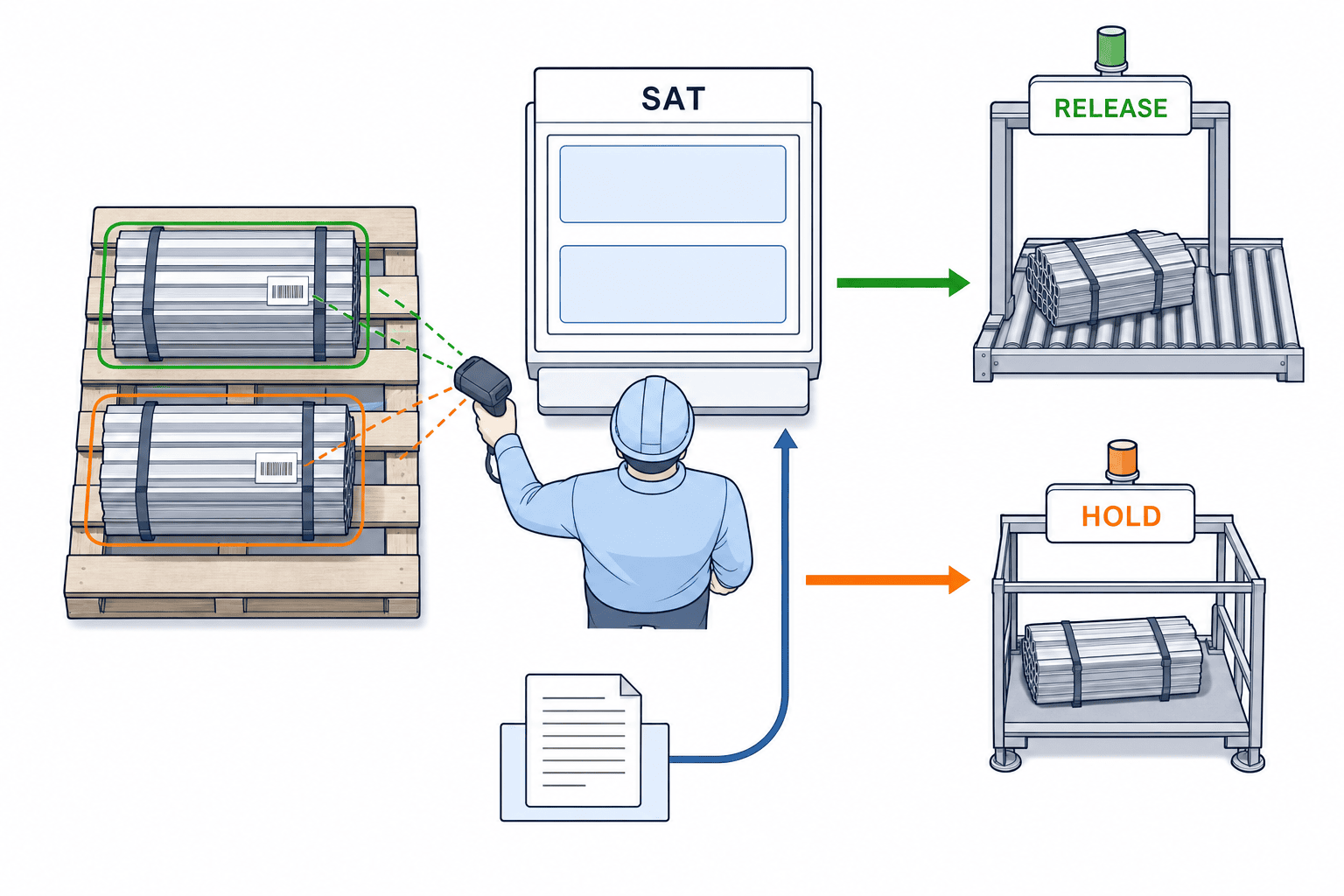
Use FAT to test extraction and business rules in a controlled environment; use SAT to test actual receiving, package labels and ERP/MES behavior on site. Define those names and contractual meaning for the project. Quality should create ground truth before the tests. Measure average field extraction separately from the rate at which critical mismatches are wrongly released.
FAT cases should include the same part on another PO, one-character heat differences, leading zeros, decimals and units, borderline limits, multi-page results, several heats on one certificate, a missing test, obsolete specification revision, resent duplicates, unreadable scans and corrected certificates. The system should show uncertainty and source location. Limit values must come from a controlled specification revision, not a model’s general knowledge.
SAT should scan actual package labels, register receipt lots, work through quarantine and release with site staff, and check night-shift use. Test disagreement between ERP and MES states, offline operation, unauthorized release, replacement documents, returns and re-receipts, lot splits, and retrospective tracing after issue to production. Failure should leave the material unavailable for use.
Measure more than typing time
A shorter data-entry time is not a success if material enters production without reliable certificate linkage. Baseline processing time per receipt, exception handling time, unreadable-field rate, value corrections, wrong-lot links, quarantine-to-release time and time to identify affected finished lots. Split measurements by material class and supplier format; a pilot made only of easy PDFs is not representative of critical receiving work.
Include AI charges, master-data preparation, supplier coordination, ERP/MES integration, quality review and support in the cost case. Potential benefits include reduced receiving delay and faster investigation, but do not import unverified defect-reduction percentages from vendor material. Separate metrics observable in the pilot from those that require post-rollout history.
Cost the failures as well as the license. An unverified heat that reaches production may require investigation of WIP, finished goods and customer deliveries. Holding every uncertain package for too long can also interrupt production. A pilot should therefore measure both false releases and unnecessary holds, then set rules according to material risk. Assign corrective action to the right source: improve extraction for OCR error, supplier terms for a missing test, label practice for an unlinked pallet, and purchasing master control for an obsolete specification. All four can appear as “AI could not match,” but they need different remedies.
Start with one material class
Choose a material with recurring certificates, clear required tests and a heat or lot visibly marked on the goods. Observe actual receiving decisions before configuring AI. Build ground truth from both normal and mismatch cases. Pilot the full path to an authorized release, not extraction alone.
Next add supplier layouts and poor scans, connect PO lines and receipt lots to QMS exceptions and MES consumption, and only then add another material class. Do not copy steel heat-number and ISO 10474 rules to polymer or electronics purchases. Agree required identifiers and evidence for each class. Work with suppliers on required fields and electronic submission so fewer exceptions arise in the first place.
Worked example: two heats on one certificate
Suppose one steel PO line covers a total quantity, a supplier PDF lists separate results for heats H-A and H-B, and two pallets arrive. An AI extraction of total quantity and matching part number is insufficient. Warehouse staff scan each pallet and record the heat and quantity. Quality checks each set of results against the specification revision effective for that order. Combining the pallets into one “accepted lot” would make a later defect in H-B hard to isolate.
If H-A has complete results but a value for H-B is unreadable, partial release depends on physical separation, contract terms and company authority. AI must not arbitrarily allocate half the quantity to an accepted state. Quarantine H-B, request a readable replacement or additional evidence, retain the superseded PDF, and preserve the link between any issued H-A stock and its approval history. A similarly named but different specification revision must also be held until an authorized technical judgement establishes equivalence.
Warehouse screens should emphasize order line, label, quantity, location and status. Quality screens need original image, extracted values, controlled limits, missing fields and exceptions. Procurement screens need supplier questions, replies and replacement documents. A state flow such as registered → awaiting document → review → exception → release/quarantine/return prevents a warehouse click from bypassing quality approval. At production issue, recheck the current lot state: a supplier notice, withdrawal of a corrected certificate, or internal nonconformance may have withdrawn an earlier release. If the connection to ERP or the warehouse device drops, keep the safe blocked state; after reconnection, reconcile state-change histories before allowing issue. Closing an exception manually must require a named authorized role and a recorded reason, even when the supporting supplier document looks correct.
FAQ
Can AI certificate matching replace incoming inspection?
No. It assists document extraction and comparison. Physical identification, quantity and required visual, dimensional or additional testing still follow the receiving plan. A certificate with good values cannot release unidentified goods.
Does a mill sheet automatically make steel acceptable?
No. Check the PO, applicable standard and revision, required document type and tests, and the link between heat and goods. ISO 10474 classifies steel inspection documents; it does not decide that a specific shipment meets your contract.
Can high OCR confidence remove human review?
OCR confidence is about text recognition, not authenticity, correct table-row assignment or fit for use. Reviews of simple, low-risk fields may be streamlined under defined rules. Route missing, ambiguous and consequential cases to authorized staff.
Can this work if certificates are English and the warehouse uses Thai?
Yes, if numeric values, units and identifiers remain stable, status meanings are reviewed in both languages, and staff can reach the original evidence. A multilingual material-name dictionary does not by itself prove equivalent grades.
Should every supplier and material be included from day one?
Start with one class and genuine exception cases. Identifier and test requirements differ across steel, polymers and electronics. Expand after FAT/SAT evidence shows that release and traceability work safely.
Summary
Supplier certificate AI verification is more than transferring PDF text into a table. Link the PO line, controlled specification, supplier report and actual heat or lot in one receiving case. Send uncertainty and mismatches to an exception queue; let authorized people release goods. Make source evidence, physical identifiers, fail-safe status, ERP/MES synchronization and downstream lot tracing part of the RFP and acceptance tests.
A Thai plant can begin with one material class and a sample of its real purchase orders, certificates and package labels. If you are defining the scope of a pilot or the FAT/SAT criteria, contact TOMAS TECH to review the current receiving path together.
Sources
- ISO 10474:2013, Steel and steel products — Inspection documents — types of documents for steel products, not a universal material rule.
- ISO 404:2013, Steel and steel products — General technical delivery requirements — general delivery conditions and precedence of order terms in its scope.
- ASME Quality System Review Checklist — Section IV cast-iron/cast-aluminium boiler review-team example of responsibilities at receipt.
- NIST AI RMF Core — human oversight, roles and system limits.
- NIST, Trustworthiness and Traceability of Supply Chain Data — research on trustworthy supply-chain data.
- ISO/TC 176, Guidance on documented information for ISO 9001:2015 — reference on controlled documented information.


