


When evaluating a manufacturing routing system, a screen that lists operations is only the beginning. The consequential question is which approved sequence applies to a given item, plant, configuration, quantity and production date. An otherwise correct master record can still cause the wrong process to reach the shop floor if alternative routes, effective dates, approval and the point at which a route is fixed to a work order are undefined. This guide focuses on routing master design for factories in Thailand and ASEAN: operation sequence, alternatives, revisions, the boundary with BOM, ERP and MES, change approval, RFP requirements and FAT/SAT evidence.
The central decision: a route is a conditional production definition
A route normally specifies operations, their order or dependencies, work centers, required resources, standard times and inspection or reporting points. The system must also select exactly one approved version for the relevant conditions and record which version was used by the order. Microsoft’s official route documentation covers route networks, operation properties, route versions, approval and selection by site, quantity or date. Oracle’s work definition combines operations, materials and resources in a template for work orders and supports effective versions. These are useful reference models for questions to ask suppliers, not a claim that every product behaves in the same way.
Before comparing products, define four rules: how a route is selected without ambiguity; who approves a change and when it becomes effective; whether the order retains its selected route version; and how a switch to an alternative is justified and audited. These rules drive screens, data migration, interfaces and acceptance tests.
Routing versus BOM: process and material have different jobs
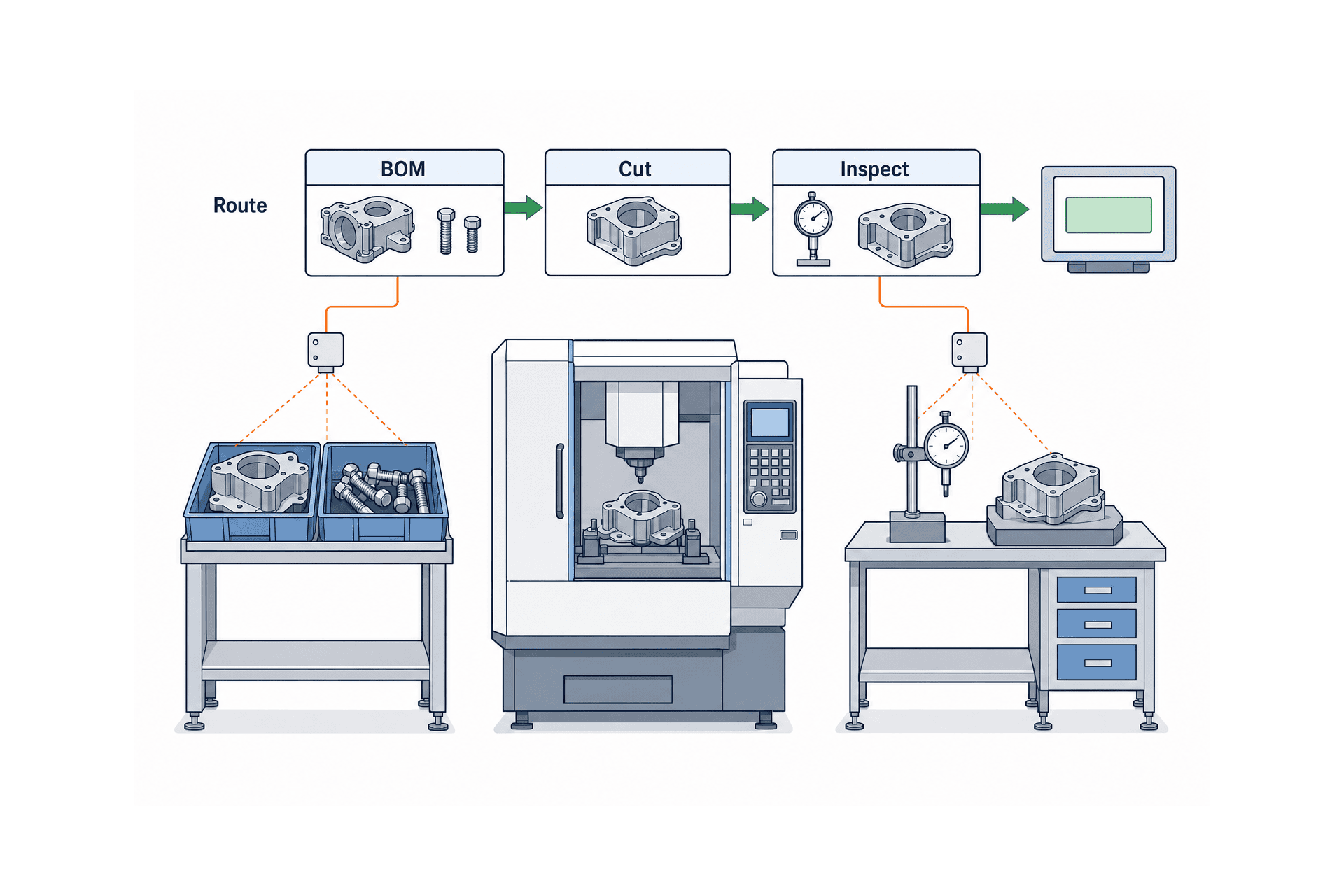
A bill of materials answers what is consumed and in what quantity. A route answers how production proceeds and where it takes place. They meet when materials are issued at a particular operation and when process time and consumption contribute to cost. A correct BOM total is insufficient if a component is assigned to the wrong operation or if the work order and shop-floor terminal use different versions. Microsoft describes BOM and route together as a basis for estimated product cost; Oracle presents an item structure and route together in a work definition.
Do not write only “BOM integration” in an RFP. State the item, revision, plant and effective-date keys; whether material is assigned to an operation; what happens to that assignment when a route changes; and whether an issued work order is re-expanded. Test a route-only change with the same BOM separately from a BOM-only change. They require different reviewers and different expected outcomes.
| Record | Question | Typical fields | Change impact |
|---|---|---|---|
| BOM | What is used? | Components, quantities, units, revision, dates | Purchasing, issues and cost |
| Route | How is it made? | Operation IDs, precedence, work centers, time, revision | Planning, instructions and inspection |
| Work order | What is made now? | Order ID, quantity, dates, selected revisions | Treatment of existing orders |
| Execution record | What actually happened? | Start/end, resource, quantity, checks, deviations | Traceability and correction |
Start with stable operation identifiers
Two operations called “Assembly” may have different times or controls. A translated name is a poor integration key. Keep route ID, version ID, operation ID and work-center ID separate from display names in Thai, Japanese and English. A local shorthand can be another attribute, but it should not be the authoritative identifier. Numbering operations 10, 20 and 30 leaves room to insert steps, yet numbers alone cannot represent all parallel paths and joins. Microsoft distinguishes simple sequential routes from route networks with multiple starts and parallel operations. If your factory has parallel assembly, external processing or a return from subcontracting, ask whether the product stores explicit predecessor and successor relationships.
Standard routes, alternatives and one-off deviations
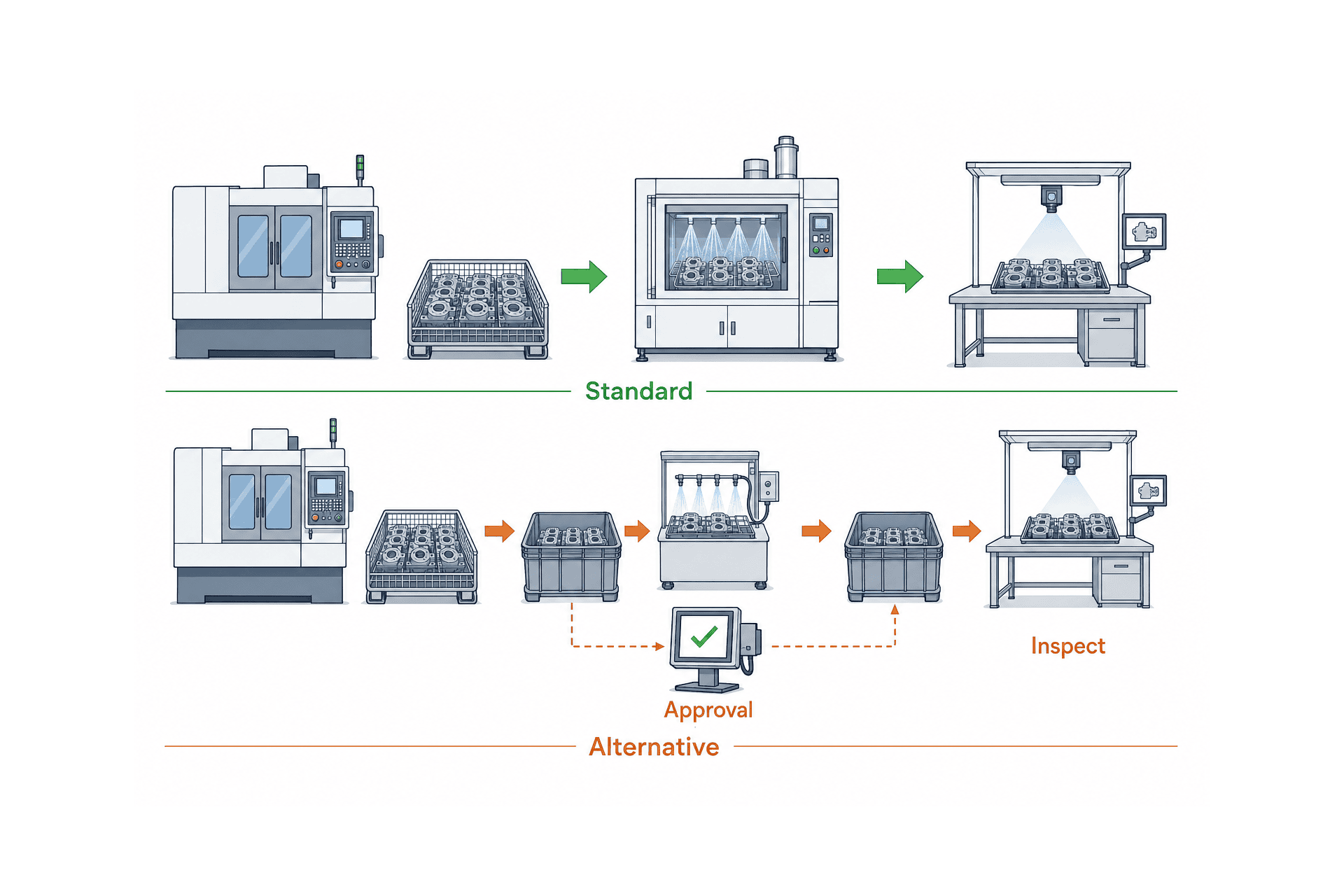
An alternative route is another approved way to manufacture under defined conditions, such as a site, volume, configuration or equipment constraint. Do not overwrite the standard route every time the plant switches methods. Give the alternative its own identity, selection condition, priority, quality checks and effective date. Microsoft documents multiple routes for one product and route-version selection by site, quantity and date. Oracle distinguishes primary and alternate work definitions.
A one-off rework or emergency deviation belongs to the individual order until the organization approves it as a reusable route. Record its reason, approver, affected work order or lot, and the state of the product. This keeps temporary improvisations from silently entering the automatic selection pool. For example, a normal route may be machining → cleaning → inspection, while an approved alternative during an equipment outage is machining → external cleaning → receiving inspection. The alternative also changes handover, transport, supplier and inspection responsibilities. Customer and regulatory permission to change a process must be checked for each product.
Effective dates and revisions protect existing orders
Choose whether a process change creates a new version rather than leaving this to an operator’s habit. A version should carry an effective start, optional end, reason, approver and affected items, plants and BOM revisions. Oracle explains that a work-definition version defines an effective period and describes when changes to effective operations require a new version. Microsoft describes separate approval and activation of route versions and conflict prevention for overlapping active conditions. Specify the behavior you need in the procurement documents, because suppliers implement these concepts differently.
Three decisions need explicit owners. Which date drives selection: order creation or manufacturing start? Does activating a new version change an already issued order or preserve its selected version? Can a running order gain or lose an operation, or does that require a controlled order change? Keep the selected version ID and selection date on the work order so the decision can be reconstructed.
Consider a new inspection operation effective on 20 October. An order issued on 18 October but started on 21 October could validly follow different company policies: freeze at issue, re-evaluate at start, or change only after approval. The software cannot invent the business rule. Define the plant timezone and cutover time too; headquarters in Japan and a factory in Thailand may otherwise disagree about the date boundary.
Make route selection deterministic
Product, configuration, site, quantity and dates can match several candidates. Decide whether an exact product match outranks a product-family route, how priority is represented, and whether ambiguous matches stop the order. Likewise, if no approved route matches, hold the order rather than silently choosing an unrelated fallback. A selection matrix with candidates as rows and conditions as columns exposes overlaps and gaps. Test quantity boundaries, the first and last effective day, prototypes versus volume production, and alternative priority. During migration, turn tacit choices from spreadsheets into conditions a system can evaluate. Use actual past work orders to compare the selected route with what the factory did.
Separate editing, approval and activation
If every master-data editor can activate a route, an unreviewed sequence may reach production. Define proposal, engineering review, quality review, planning or cost impact review, and activation. Approval depth may vary: removing an inspection point is different from correcting a standard time. Capture old and new values, reason, proposer, approver, timestamps, effective date and affected work orders. An audit trail that says only “record saved” cannot explain a changed operation. Microsoft documents separate route and route-version approval and optional electronic signatures.
Test rejection, withdrawal and correction of an already approved version. Decide whether a correction produces another version or changes a draft. Keep IDs common across languages so teams in Thailand and Japan review the same record even when descriptions differ.
Decide the ERP, MES and production-management boundary
ISA-95 provides a vocabulary for information exchange between business planning and logistics at Level 4 and manufacturing operations management at Level 3. It does not dictate a specific software deployment. In one factory ERP may own the item, BOM and order; a production-management system may own planning and routing; MES may deliver operation instructions and capture actuals. Another factory may allocate these responsibilities differently. Record the system of record for each object instead of assuming a product name implies ownership.
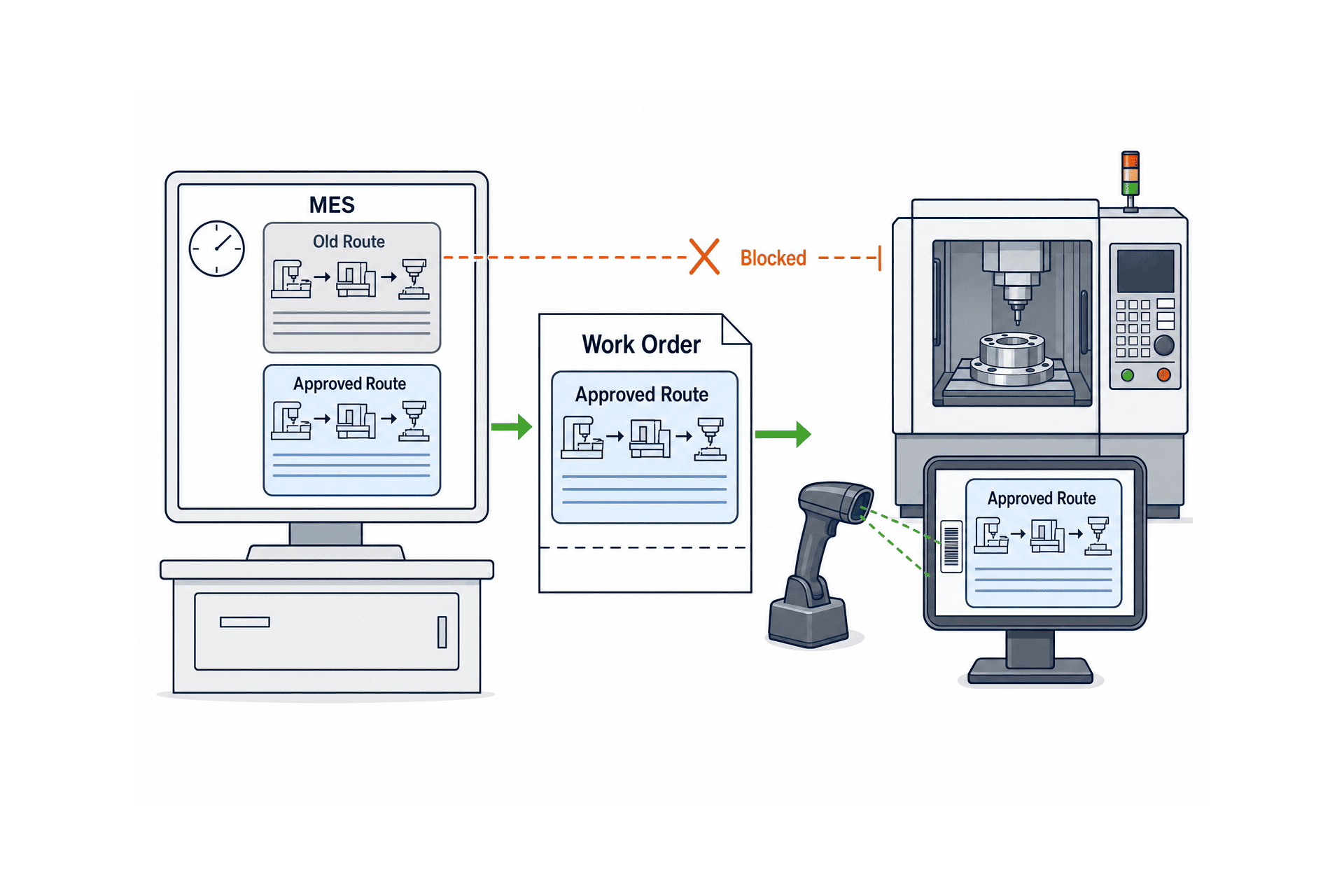
Choose one authoritative source for approved route versions. When distributing them, include version ID, conditions, operation sequence, resource requirements, material issue points and inspection points. Define acknowledgement, retry, rejection of stale versions and offline behavior. If MES collects results against V2 while ERP prices an order against V1, apparently complete transactions will not reconcile. The ERP–production management integration guide discusses the broader data contract; this article concentrates on the route inside it.
| Object | Possible owner | Check at the receiver |
|---|---|---|
| Item and BOM version | ERP or PLM interface | ID, unit and dates |
| Approved route version | ERP or production management | Version, order and alternatives |
| Order’s selected route | Order issuer | Freeze and change policy |
| Operation actuals | MES or terminal | Order, operation and version IDs |
| Cost and inventory postings | ERP | Duplicate and reversal rules |
Show operators the route approved for this order
An administrative screen may display drafts, future versions and history. The operator terminal should clearly show the authorized route for this work order: order ID, item, quantity, selected version, current and next operation, work center, checks and holds. Scan the item and order at operation start and test whether an unapproved version or impossible operation is rejected. For an offline terminal, define the validity of its cached approved version and the reconciliation process after reconnection.
A block needs a usable explanation and escalation path. If an operator tries to start operation 30 before completing 20, the system should distinguish an illegal sequence, permitted parallel work and a missing transaction. A simple numeric sequence model used for a physically parallel process invites fictitious completions. Compare the digital route with material movement on the floor.
Routing-system RFP checklist
Provide the same sample data and expected results to every supplier. Describe the target products, plants, current BOM and order systems, parallel and joined operations, subcontracting, and quality constraints. Ask each supplier to identify what is standard configuration, customization, development or manual workaround.
- Stable, separate route, version and operation identifiers despite name changes.
- Unique approved-route selection by item, configuration, plant, quantity band and date, with an explicit conflict error.
- Standard and alternative priorities with reason, approver and affected order in history.
- Support for the parallel, join and outside-processing paths actually used in the plant.
- Recording of BOM–route version combinations, material issue points and inspection gates.
- Retention of the selected version on an order and a defined policy for changes after issue.
- Separate roles for proposal, review, approval and activation, with before/after audit values.
- Delivery to ERP and MES, acknowledgement, retries, stale-version rejection and recovery.
- Localized names with the same identifiers for cross-language reconciliation.
- A migration crosswalk, effective-date controls and a plan for incomplete orders at cutover.
Ask for a demonstration of an order crossing an effective-date boundary, an approved alternative switch and a withdrawn version, not just one successful order. Compare full costs including master cleanup, integration, migration, tests, training and maintenance after revisions.
FAT and SAT: acceptance as observed behavior
FAT checks selection, prevention and history against specifications in a test environment. SAT repeats the relevant cases with the actual plant, terminals, network and connected systems. Define inputs, outputs and evidence logs before the test. For example, item A, plant B, a manufacturing start date of 20 October and quantity 500 should select version V2; both the work order and MES terminal should retain the same version ID. These values are illustrative project test data, not industry benchmarks.
| Case | Action | Expected evidence |
|---|---|---|
| Day before effectivity | Create an order | Old version selected; new one hidden from shop floor |
| First effective day | Create an order | Approved new version selected |
| Overlap | Activate two matching versions | Activation blocked with reason |
| No match | Order an unsupported configuration | Order held, no unrelated fallback |
| Alternative | Approver switches with a reason | Order, terminal and audit trail agree |
| Issued order | Activate a newer route | Agreed freeze/re-evaluation policy holds |
| Offline recovery | Revise during a terminal outage | Cached-version and sync decisions logged |
| ERP/MES transfer | Distribute and acknowledge | IDs, sequence and inspection points match |
At the factory, compare current paper instructions with electronic orders. Include volume production, prototype, outsourced work, inspection and rework examples. Check whether wrong-order scans are stopped and whether WIP that began on an older version can finish under the agreed rule. The master owner, planner, quality, shop-floor and IT representatives should sign the cases relevant to them.
Migrate against historical orders, not just master-row counts
Spreadsheets may contain several names for one operation, blank site conditions, no end date for an old version and alternatives nobody uses. Start with a bounded item set and reconcile its master route against past work orders and actual work records. Map each old line to new route, version and operation IDs; quarantine ambiguous lines instead of guessing. A high import percentage is meaningless if the new system selects the wrong process.
In a rehearsal, recreate representative orders and compare route, material issue, inspection and work center with the former process. Test future and expired versions. Decide whether open orders finish in the old system, move to the new one or move in stages. Assign owners for corrections, re-import and old-system read access, and preserve the source extract version and import timestamp.
Measure fewer wrong selections and faster controlled changes
The number of routes entered is not an outcome. Candidate measures include wrong-route selections, time from order issue to correct instruction delivery, time from change proposal to approval and distribution, mismatches between operation actuals and selected version, and the share of alternative uses with a recorded reason. Define denominators, event boundaries, data sources and owners before rollout. Reported mistakes may rise initially because they become visible; review correction closure as well as counts. Set targets from your plant baseline, not from vendor promises.
Show the impact before approving a route change
Once the system is live, the most useful change-control feature is often the ability to see consequences before editing, rather than the speed of the edit screen. Deleting operation 20 may affect products sharing it, approved alternative routes, future versions, unstarted work orders and WIP that has already passed that operation. The screen should separate three decisions: change the master; apply it only to future orders; or propose applying it to issued orders. The approver can then see exactly what the approval authorizes. Test that material issues and inspection records retain valid references after the planned operation disappears.
Reordering operations 20 and 40 may look like a display change but can alter material issue timing, in-process checks, accumulated standard time and WIP handover. A change record should examine sequence, resources, materials, inspection, cost and operator training. Where there is no impact, record that conclusion and its reason rather than leaving a blank field. A change to a route shared across items or plants needs particular care because its reach is wider than one product.
For an equipment failure, decide in advance whether production stops, uses an already approved alternative or follows a controlled temporary deviation. If a deviation without prior route approval is necessary, define the temporary authority, affected orders, expiry, subsequent review and any customer notification condition. The system should show who permitted the exception, why, and when the normal approved process resumed.
Operating across Thailand and ASEAN
Where Japan approves a baseline and Thailand runs production, decide which site may activate plant-specific work centers and alternatives, which changes require headquarters approval, and who can act on a night shift or holiday. A delegated emergency approval needs subsequent review. Keep IDs common even when operator labels are Thai and engineering notes are Japanese. Across plants, distinguish common process steps from local resource assignments or maintain explicitly plant-specific versions. Assign one system of record and an owner for failed distribution. The broader rollout gates are covered in our production management system implementation process.
For changes after a route has been applied to an order, see production-order change control; for the boundary between route sequence and resource capability, see equipment capacity master design.
FAQ: implementing a manufacturing routing system
Is a routing system the same as a process-management system?
Names vary by supplier. Here routing means defining an approved sequence, alternatives and effective versions and applying one to an order. Process management may also cover WIP, progress, capacity and actuals. Define these functions separately in the RFP.
How many alternative routes should we register?
There is no universal number. Register only methods whose usage conditions, resources, quality checks and approvers are defined. Keep an idea in draft until it has been tested and approved. More alternatives require stronger conflict detection.
Can a route change after work-order issue?
Technical behavior varies. Separate unstarted from running orders. Treat an order with material issues, actuals or quality records more strictly. If change is permitted, retain the old and new versions, reason, approver and operation state at change time.
What determines cost?
Besides licenses, scope includes master cleanup, BOM/ERP/MES interfaces, parallel or outsourced paths, version migration, localization, FAT/SAT and support. Give suppliers identical counts of items, routes, versions, plants and exceptions, and separate configuration from development.
Does a small factory need a system?
A small plant with few items and changes may begin with an approved version register and the route version on each order. Multiple plants, frequent alternatives, strict quality evidence or repeated wrong-route risk strengthen the case for automation. Complexity matters more than item count alone.
Summary
Successful routing-system implementation leaves one explainable, approved route version on each work order. Select it by item, plant, configuration, quantity and date; retain the reason and subsequent changes with shop-floor actuals. Keep BOM, route, order and execution responsibilities clear and use shared identifiers across their boundaries. Include overlap, gaps, effective-date edges, alternative changes and issued-order behavior in the RFP and verify them with FAT/SAT evidence. Begin with a bounded item set and reconcile historical orders before broad migration.
TOMAS TECH can help a Thailand factory examine its current route lists, BOMs, orders and actual records, then specify selection rules and acceptance tests before product selection. If you are still organizing requirements, contact us.


