


Search for a production management system for make-to-stock manufacturing and every shortlisted product looks the same on paper. Demand forecasting, inventory management, MRP, production planning. They all have everything. Yet about six months after go-live, the shop floor starts saying the system does not match how the plant actually works. What does not match is rarely a missing function. It is the assumption the package quietly builds in. This article, based on information available as of August 2026, sets out the questions a make-to-stock plant should settle before it ever opens a feature comparison sheet.
What is actually happening when a make-to-stock plant says the system does not fit
The breaking point is different from engineer-to-order
Complaints that a production management system does not fit arrive from every kind of plant. But the place where things break differs sharply by production type.
In engineer-to-order manufacturing, procurement starts before the bill of materials is complete, design changes travel outside the system, and cost only becomes visible after the project closes. The uncertainty of the individual project breaks through the assumptions of the software. We covered that structure in detail in our article on production management systems for engineer-to-order manufacturing.
Make-to-stock plants look very different. The bill of materials is settled. Design changes happen a few times a year. Cost comes out at the item level. And still the system does not fit. The reason is that what breaks in make-to-stock is not project uncertainty. It is the way the plan itself is handled.
The single difference is that production starts from a plan, not an order
If you had to state the difference between make-to-stock and engineer-to-order in one sentence, it is that production is triggered by a plan rather than by an order.
In order-driven manufacturing, quantity and due date are fixed the moment the order arrives. The system receives confirmed information and explodes it. In make-to-stock, the basis for starting production is a number that says roughly this much will sell. That number changes every week. It changes, and every time it changes someone has to decide how much of the existing plan to rebuild.
Many production management packages are thin exactly where this matters, in handling a premise that keeps moving. There is a screen for entering the plan. But how the difference between last week’s plan and this week’s plan is treated, how quantities already released for procurement are treated, and how confirmed orders are netted against the forecast are three questions that a surprising number of products cannot answer.
Why better forecast accuracy does not solve it
When inventory does not reconcile and stockouts keep appearing, the first proposal is usually to improve forecast accuracy. That is the right direction. It is just not sufficient.
According to benchmarks compiled by Xorosoft, the median monthly demand forecast accuracy measured by APQC across 1,068 organizations is 85 percent. The same page cites McKinsey’s finding that AI-driven forecasting can reduce error by 20 to 50 percent in suitable use cases. Suppose that improvement lands in your plant and monthly accuracy rises above 90 percent. Ten percent is still wrong.
The real question is what moves when that 10 percent goes wrong. A mechanism that detects the miss, a procedure for rebuilding the plan, and a decision rule for whether to stop or continue orders already in flight. Without those, higher accuracy does not reduce the workload on the planning desk. The return on investment of forecasting itself is treated separately in our article on the cost effectiveness of AI demand forecasting.
In other words, what you should demand from a production management system is not a forecast that is usually right, but a structure that can be rebuilt quickly when the forecast is wrong. That shift in framing is what separates the products worth shortlisting from the rest.
Restating the make-to-stock and engineer-to-order difference in system requirements

General explanations of production types describe the difference between make-to-stock and engineer-to-order in terms of lead time, inventory and cost. CREX Group’s Japanese-language explainer takes the same line, noting that make-to-stock ships from stock and therefore quotes short lead times and benefits from economies of scale, while carrying the risk of both excess inventory and stockouts when the forecast is wrong. That is accurate, but far too coarse to derive system requirements from.
So let us restate the same difference in the language of the software.
| Question | Make-to-stock | Engineer-to-order |
|---|---|---|
| What triggers production | Demand forecast and inventory targets | A confirmed customer order |
| When quantity becomes fixed | Can still change after production starts | Fixed at the point of order |
| The core the system must hold | Master production schedule and inventory recalculation | Project-level progress and cost accumulation |
| The typical failure mode | Excess stock and stockouts occur at the same time | Late delivery and cost visible only in hindsight |
| Who owns the inventory | Shared between sales and production planning | Effectively nobody |
| Weight of the item master | High SKU count, attribute management pays off | New items are created continuously |
| Source of change | The market and the sales plan | The customer and engineering |
The row that matters most in practice is the one about inventory ownership.
In engineer-to-order manufacturing, inventory barely exists, and where it does exist it is tied to a project. Nobody has to argue about whose inventory it is. Make-to-stock is different. If what you built does not sell, whose fault is that. Was the sales forecast optimistic, or did production overbuild. An organization that cannot answer that question will not reduce inventory no matter which system it installs.
Translated into a selection criterion, the question is whether the product holds the sales plan and the production plan in separate tables and preserves the difference between them. In a product where the same figure is simply overwritten, you cannot later trace whose judgment produced the current number. And when you cannot trace it, the accountability discussion becomes an argument about feelings every single time.
High-mix make-to-stock is a different animal
There is a second distinction that gets missed. Low-mix high-volume make-to-stock and high-mix make-to-stock ask different things of a system.
With a small number of items, a spreadsheet can still hold the whole supply and demand picture. What you want from a package is accurate recording of actuals and automated component procurement through MRP.
High-mix make-to-stock changes the premise. You carry hundreds or thousands of SKUs, a few dozen of them account for most of the shipments, and the rest move a handful of units a month. Apply the same forecasting logic and the same safety stock philosophy to all of them and stock piles up on the items that do not move while the items that do move run out. That is where the symptom peculiar to make-to-stock, excess inventory and stockouts occurring simultaneously, comes from.
For a high-mix plant, therefore, whether the package can segment SKUs and apply different planning rules to each segment becomes a decisive selection criterion.
Five structural checks that come before the feature list
Below are five structural questions to settle before comparing products. All of them are hard to see in a demo, and none of them can be added later.
Are the master production schedule and MRP separated
The first thing to check in a make-to-stock system is whether the master production schedule and MRP exist as separate layers.
The master production schedule decides when, which finished goods, and how many to build. MRP takes that and explodes what to procure and when. Where the two are fused, every touch of the finished goods plan rebuilds the entire component procurement picture. In a make-to-stock operation that reviews the plan weekly, that is fatal.
When they are separated, you can settle the finished goods plan first and run the component explosion only when it is needed. In a demo, ask the vendor to show the exact sequence of operations from changing a plan to seeing it reflected in component procurement. The underlying structure becomes obvious immediately.
Is there logic to net orders against the forecast
The mechanism that bites daily in make-to-stock operations is forecast consumption, the netting of confirmed orders against the forecast.
Suppose you set a forecast of 100 units at the start of the month and 60 units of firm orders arrive mid-month. Do you now read the remaining plan as 40 units, or as 100 forecast units plus 60 order units. The former is forecast consumption. In a product without that logic, forecast and orders are counted twice and overbuilding becomes structural.
What to check is the unit and the period of consumption. Item level or item group level. Weekly or monthly buckets. Whether an order pulled forward can consume the forecast of an earlier bucket. The finer these settings, the closer the resulting plan is to reality.
Can safety stock be parameterized at SKU level
The safety stock formula itself is broadly similar across products. The difference shows up in the granularity at which the parameters of that formula can be held.
A product that only allows one company-wide service level cannot address the high-mix problem described above. The requirement is that the target service level and the review period can differ by SKU, or at least by SKU group. In practice you also want to vary the value by period, for instance carrying more of a particular item ahead of a seasonal peak.
How to decide the level of safety stock itself is a calculation question, and we have set that out, including the layered view and the tail of lead time, in our article on managing optimal inventory levels. Here, as a system requirement, focus only on parameter granularity and whether a history is kept. In a product that does not record the fact that a value was changed, nobody will remember six months later why the level is what it is.
Does the supply and demand review screen hold a planning table
In make-to-stock operations, a supply and demand review meeting is held monthly or weekly. Sales plan, production plan and projected inventory are laid side by side and the group decides what to cut and what to add.
The artefact used in that meeting is a planning table with items down the side, periods across the top, and three rows per item for sales plan, production plan and closing inventory. In most plants it lives in a spreadsheet.
The problem arises when the production management system does not hold that table. Every meeting, actuals are exported from the system, rebuilt in a spreadsheet, and the agreed result is typed back by hand. Once that round trip exists, the numbers inside the system are permanently one generation behind the meeting.
During selection, confirm whether this planning table lives inside the system and whether an adjustment made during the meeting immediately recalculates the projected inventory. As long as it sits in an external spreadsheet, the system remains a recording device and never becomes a planning device.
Is there a mechanism that detects exceptions and tells someone
The last of the five is exception detection.
In make-to-stock, as long as things run to plan, nobody should have to do anything. People should be pulled in only when actual demand deviates from the forecast, when stock falls below its target, or when a procurement order will not arrive in time.
Yet in most plants a planner scans an inventory list every morning looking for items that look risky. With several hundred SKUs, that alone consumes the morning. And things still get missed.
So whether a mechanism that surfaces only the items breaching a threshold is a standard feature has a large effect on the ongoing workload. We have written up how to design this in layers in our article on a five-layer design for stockout prevention. During selection, check the unit at which thresholds can be set and how the notification actually reaches a person.
Requirements specific to high-mix make-to-stock

Plants running high-mix make-to-stock face several additional requirements on top of the five above.
Does SKU segmentation connect to planning rules
Most products include some form of ABC analysis. But in many of them the result of the analysis only appears on a screen and never connects to a planning rule.
What you need is for the way plans are built to change according to the segment. Items with high, stable shipments are replenished periodically from a forecast. Items with low, erratic shipments give up on forecasting altogether and are either built only after an order arrives or held at a deliberately minimal stock level. Whether this split can be expressed as a rule inside the system is the requirement.
The review cycle of the segmentation is worth checking too. A product that can only refresh the classification twice a year cannot keep up with a new product ramping or an item being phased out.
Does the plan know about changeover constraints
In high-mix make-to-stock, changeover is what determines the quality of a plan.
Switching from item A to item B takes 30 minutes, while switching from item A to item C takes only 10. If the planning engine does not know these relationships between items, the plan it produces will always be rearranged on the floor. And the moment it is rearranged, nobody looks at the system plan again.
Few packages handle this constraint in standard functionality. In most cases detailed production scheduling is the job of a separate advanced planning and scheduling engine. This is a genuine fork in the road during selection, and you need to decide up front whether to complete everything inside the production management system or to place a scheduling engine alongside it. We set out the material for that decision in our article on production planning simulation.
Are item master attributes in a form the planning engine can use
The more variants you carry, the more the design of the item master matters.
How do you hold colour variants, capacity variants and destination variants of the same product. Hold them as entirely separate items and the SKU count explodes into a unit that is far too fine to forecast on. Collapse them into one and you can no longer manage physical stock.
The workable answer is a two-layer structure in which items carry attributes, forecasting is done at the level of an attribute grouping, and inventory and procurement are handled at SKU level. Check whether the package supports these two layers and how many levels of attribute it can hold.
None of this works unless the master data itself is accurate. However refined the planning logic, if the item master or the bill of materials contains errors, the numbers that come out are unusable. We have covered that foundation in our article on master data accuracy in MRP.
How far can a system help with production levelling
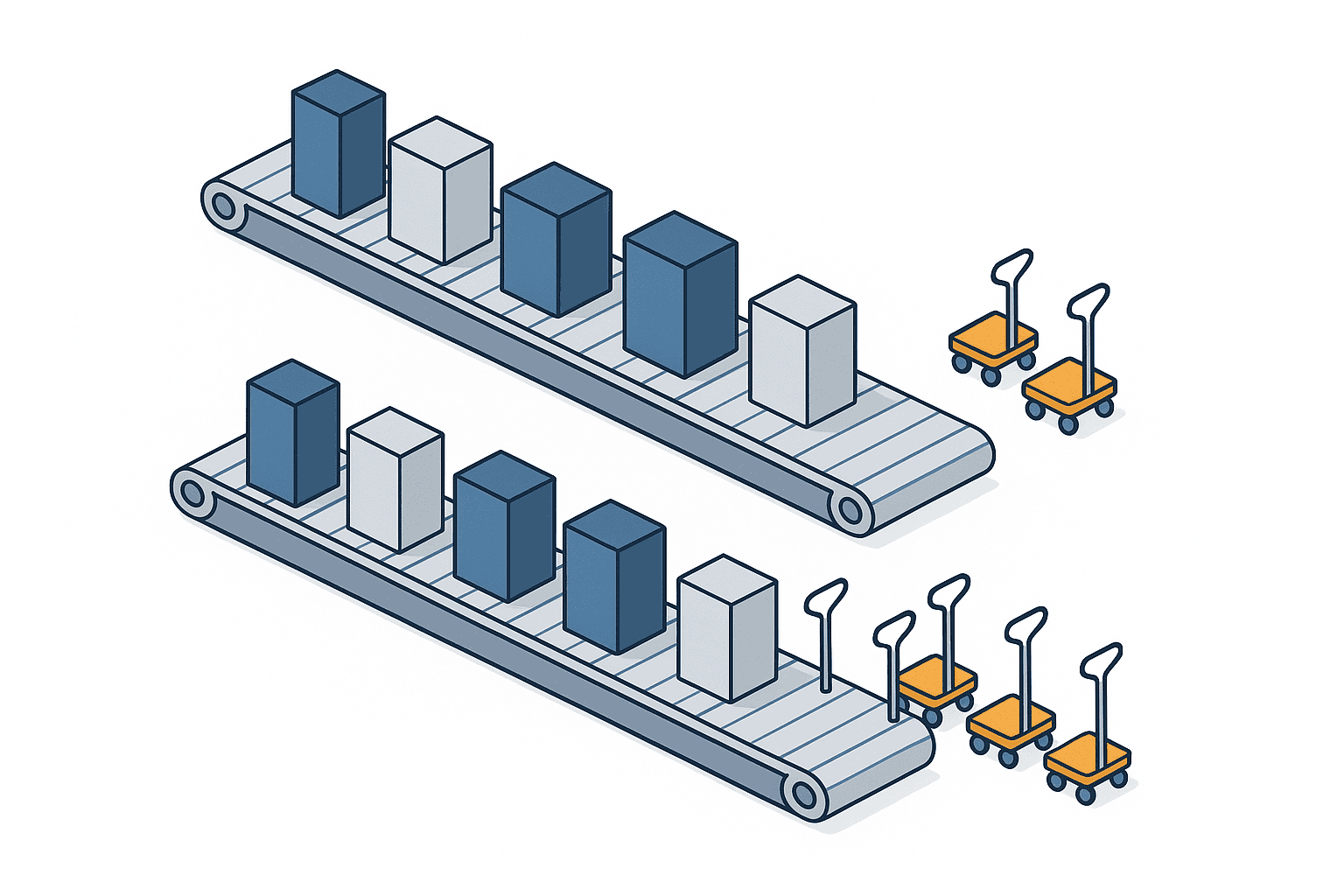
The strength of make-to-stock is that it can absorb demand swings in inventory and hold production steady. That idea is known as levelling, or heijunka.
Advanced Technology Services describes levelling as distributing production volume and product mix evenly across time, and gives the example of building 50 units each of two products every day instead of 500 units of product A on Monday and 500 of product B on Tuesday. Keeping the daily volume and mix constant stabilises how people, equipment and components are consumed.
Levelling and changeover are always in tension
Levelling has a price, and the price is changeover count.
Consider building six units across three product types, two of each. Build them in batches and the type changes twice. Mix them one at a time and the type changes five times. The same six units cost either two changeovers or five. That gap is the practical cost of levelling.
Levelling therefore only advances hand in hand with changeover time reduction. On a line where a changeover takes an hour, fine-grained mixing eats the available run time. Where a changeover takes five minutes, mixing finely costs very little.
What you can reasonably expect from a production management system is that it shows this trade-off in numbers. When lot size changes, how does total changeover time move and how does average inventory move. Put those two side by side and the discussion moves from intuition to arithmetic.
Levelling is a sequencing problem, not a calendar problem
Understanding levelling as building the same quantity every day does not work in practice. What actually pays off is stabilising the sequence in which things are built.
With a stable sequence, component supply, jig preparation and inspection setup all become predictable. With a constant total but a sequence that changes daily, every surrounding process is thrown around daily.
During selection, check whether the planning output is a list of quantities or something that carries a sequence. Where a product can only output quantities, the levelling discussion goes straight back to the discretion of the shop floor.
How to write accuracy requirements into an RFP
Selecting a system for make-to-stock usually means writing a forecast accuracy requirement into the RFP. Leave the definition of the metric vague and there will be an argument later.
Writing MAPE alone does not work
RELEX Solutions notes that while MAPE is easy to compare across products and categories, it produces misleadingly large percentages for slow-moving items where a small absolute error becomes a large percentage swing, and that it cannot be calculated at all when actual demand is zero. The same material argues that WAPE, weighted by volume, is better suited to assessing business impact.
The point that deserves the most attention is the aggregation level. On identical data, calculating the error after aggregating versus calculating per item and then averaging produced results of 3 percent and 33 percent respectively. Write only “MAPE of 15 percent or better” into an RFP and the vendor will choose whichever aggregation flatters them.
Fix four conditions together
The safer way to write an accuracy requirement is as follows.
| What to fix | Example wording | What happens if you leave it open |
|---|---|---|
| The metric | Use WAPE weighted by shipped quantity | Slow movers drag the whole figure down |
| The aggregation level | Calculate per item, then average across the top group | The figure is computed after aggregation and looks better |
| The forecast horizon | Weekly forecasts four weeks ahead | Accuracy is measured on near-term forecasts and stops being useful |
| The scope | The items making up the top 80 percent of shipment value | Dead items distort the evaluation |
Having fixed those four, measure your own current value first. Writing a target without knowing the baseline leaves nobody able to judge whether it is achievable.
Netstock’s framing is also useful here. In its analysis of more than 2,400 small and mid-sized businesses, top performers held forecast accuracy 23 percent higher than average performers, updated forecasts 3.2 times more frequently, and adopted AI-powered forecasting at a rate of 48 percent against 23 percent across all respondents. Organizations holding weekly cross-functional meetings achieved 18 percent higher forecast accuracy. Accuracy is not decided by tools alone. Update frequency and meeting discipline decide it too.
Points specific to Japanese-owned plants in Thailand
The head office demand plan and the local master schedule become two plans
A recurring pattern at Japanese-owned manufacturing sites in Thailand is dual management between the demand plan held by the head office in Japan and the master production schedule held locally.
Head office reviews global demand monthly and allocates production volumes by site. The local site takes that number and builds its own weekly plan. So far so natural. The problem is that no rule exists for how much of the local plan to rebuild when the head office allocation changes mid-month.
As a selection criterion, check whether there is a standard interface for importing an externally supplied plan figure, and whether the imported figure and the locally adjusted figure can be held separately. In a product that only overwrites, you lose the ability to distinguish a head office instruction from a local judgment.
The tail of the shipping lead time is long
For make-to-stock at a Thai site, the destination is rarely domestic only. Shipping by sea to Japan, elsewhere in ASEAN, Europe or North America means lead times measured in weeks, and the tail stretches further with port congestion and vessel delays.
Feed only the average lead time into a safety stock calculation and that tail disappears. What you want from the system is the ability to hold lead time as an actual distribution rather than a fixed value, or at minimum to hold different values by destination.
How to read the 2026 production trend
It is worth checking recent industrial trends when setting planning assumptions.
Thailand’s manufacturing production index rose 0.46 percent year on year in July 2026, returning to growth for the first time in four months. The drivers were electronics such as hard disk drives lifted by AI-related demand, along with pet food and ready-to-eat meals reflecting changing consumer behaviour. Meanwhile the S&P Global Thailand Manufacturing PMI stood at 54.2 in July 2026, up from 53.6 in June and the highest reading since December 2025.
Those two figures together show that the timing of recovery differs sharply by sector. Rather than applying one company-wide growth rate to the plan, look at the movement of the specific segment your product family sits in.
What order to implement in
A make-to-stock production management system fails if every function goes live at once. A practical sequence looks like this.
- Start by getting inventory and shipment actuals recorded accurately, because everything downstream is wrong if this is wrong
- Next raise the accuracy of the item master and the bill of materials, and decide the SKU segmentation
- Then put the master production schedule inside the system and run the supply and demand review meeting on the system’s numbers
- Take on advanced forecasting and detailed scheduling only after the above is stable
- Finally tune the exception thresholds so that the list a person reviews is genuinely short
Skip the sequence and start from forecasting, and the accuracy debate runs ahead while there is still no planning vessel to receive the forecast. Plants that advanced forecasting first and now copy the output into a spreadsheet are not rare.
Frequently asked questions
Should make-to-stock and engineer-to-order use separate production management systems
Where both types coexist inside one plant, the realistic first step is to check whether a single system can vary its treatment by item, rather than running two systems. Splitting them means inventory and cost are managed twice, and every company-level number requires reconciliation. That said, if the engineer-to-order share is high and project-level cost management is core to the business, holding a separate mechanism for that part is a defensible decision. The dividing line is not item count. It is how much project-level plan-versus-actual management is genuinely used by management.
What forecast accuracy percentage should we target
We would not recommend setting a single target at all. As a reference point, APQC’s measurement across 1,068 organizations puts median monthly demand forecast accuracy at 85 percent, but that is a monthly figure at an aggregated level. Measure the same organization per item and per week and the number falls sharply. If you must set a target, first fix the metric, the aggregation level, the horizon and the scope, measure your own current value, and set the target as an improvement from there. Borrowing another company’s number produces improvements that mean nothing.
Will raising safety stock reduce stockouts
It will, but raising it uniformly across all items makes inventory jump. The state that arises most often in make-to-stock is excess inventory and stockouts occurring at the same time, which happens because stock accumulates on slow movers while fast movers run dry. The move to make is therefore not increasing the total but differentiating the target service level by item group. As a system requirement, the deciding factor is whether safety stock parameters can be held at SKU or SKU group level.
Will installing a system deliver production levelling
Not on its own. Levelling increases changeover frequency, so without a reduction in changeover time it simply consumes available run time. What the system can do is put the numbers side by side, showing how total changeover time and average inventory move when lot size changes. Deciding how finely to mix, given those numbers, remains a human judgment. Measuring current changeover times by item pair before implementation makes that discussion far more concrete.
Is it unreasonable to keep running high-mix make-to-stock on spreadsheets
Judge on two variables, SKU count and the number of people involved in the supply and demand review. With a few dozen SKUs and one planner, a spreadsheet works. Once SKUs reach the hundreds and sales, production planning and purchasing all have to agree on the same numbers, the version control cost of the spreadsheet exceeds its benefit. That said, making the removal of spreadsheets the goal is a mistake. Write down which decisions the current spreadsheet actually supports, design how those decisions will be reproduced in the system, and migrate after that.
Should we choose a package or custom development
For make-to-stock, planning logic is fairly common across industries, so this is a domain where packages tend to fit. The fork in the road is the shape of the planning table used in the supply and demand review and the attribute design of the item master. Choose a product whose approach to those two differs greatly from yours and customisation piles up. During selection, ask to see those two screens populated with your own data rather than asking whether a feature exists.
Summary
When a make-to-stock plant says its production management system does not fit, the cause is rarely a missing function. It is the assumption built into the package. Because production is triggered by a plan, what the system needs to provide is not an accurate forecast but a vessel that can be rebuilt quickly when the forecast is wrong.
The requirements for that vessel come down to five. The master production schedule and MRP separated into layers. Logic that nets confirmed orders against the forecast. Safety stock parameters held at SKU level. A supply and demand planning table living inside the system. And a mechanism that surfaces only exceptions to a person. For high-mix make-to-stock, add two more, SKU segmentation connected to planning rules, and a planning engine that knows about changeover constraints.
Treat levelling not as something the system delivers but as something the system quantifies, showing the trade-off against changeover. And when writing accuracy requirements into an RFP, fix the metric, the aggregation level, the horizon and the scope together. Write a number without those four and a difference of interpretation will surface after the contract is signed.
TOMAS TECH is based in Bangkok and supports Japanese-owned manufacturing sites in Thailand with production management system selection and implementation design. For a make-to-stock plant, the line between what to leave to the package and what to design yourself is worth drawing before you start comparing products. We are happy to work through the questions with you even if the investment itself is not yet decided. Please get in touch through our contact page.
References
- The APQC median monthly demand forecast accuracy of 85 percent across 1,068 organizations, and McKinsey’s estimate of 20 to 50 percent error reduction, are cited from Xorosoft, “Forecast Accuracy Statistics – 2026 Benchmarks and Trends”
- The weaknesses of MAPE, the case for WAPE, and the example where aggregation level produces 3 percent versus 33 percent on identical data come from RELEX Solutions, “Measuring forecast accuracy”
- The figures on top performers holding 23 percent higher accuracy, updating 3.2 times more frequently, 48 percent versus 23 percent AI adoption, and 18 percent higher accuracy with weekly cross-functional meetings, drawn from an analysis of more than 2,400 businesses, appear in Netstock, “The New Rules of Demand Forecasting in 2026”
- Thailand’s manufacturing production index rising 0.46 percent year on year in July 2026 and returning to growth for the first time in four months, together with the leading sectors, is reported by Xinhua, “Thailand’s industrial output returns to growth in July”, 27 August 2026
- The Thailand Manufacturing PMI reading of 54.2 in July 2026, up from 53.6 in June, is from Trading Economics, “Thailand Manufacturing PMI”
- The definition of levelling and the example of building 50 units of each product daily come from Advanced Technology Services, “Heijunka and Production Leveling in Manufacturing”
- The general comparison between make-to-stock and order-driven production references CREX Group, “What is make-to-stock”, a Japanese-language explainer


