


Every AGV project at a factory in Thailand or Vietnam reaches the same fork in the road long before anyone compares vehicle models. Which guidance method do you use? A laser guided AGV delivers high positioning accuracy and has a long track record behind it, but it does not deliver the same performance in every building. In a plant crowded with structural columns its reliability drops, and there are sites where humble magnetic tape guidance runs far more consistently.
This article is a selection guide for the three dominant AGV guidance methods, magnetic tape, laser and SLAM, judged not on catalogue specifications but on the physical and operational conditions of your own building. If you need the underlying definitions and the difference between AGV and AMR, we covered those in What Is an AGV. Here we stay focused on one thing only, the decision axes that determine which guidance method fits.

Three guidance methods, one practical classification
Vendor catalogues list many names for guidance technology, but when the question is which one suits your site, three families are enough to compare. The wider taxonomy, including electromagnetic guidance and grid control, is set out in What Is an AGV. The question that separates the three is simple. What does the factory itself have to install so the vehicle can know where it is? That answer drives both the capital cost and the cost of every future change.
Magnetic tape guidance, a route stuck to the floor
Magnetic tape is applied to the floor and a magnetic sensor under the vehicle follows it. The onboard architecture is simple because the vehicle never has to search for its position. As long as it stays on the tape it repeats exactly the same path, which makes its behaviour easy to predict and easy for shop floor operators to understand.
The weakness is equally clear. Every route change means lifting and re-laying tape, and that generates ongoing maintenance cost, a point Phoxter identifies as the characteristic drawback of the method. In practice the material cost is minor. What hurts is the production downtime needed to do the work.
Laser guidance, triangulation from wall mounted reflectors
A laser guided AGV carries a laser head that fires pulsed laser light at reflectors installed in advance on the walls and columns of the plant. By measuring the angles to several reflectors it calculates its own position by triangulation, the same principle a surveyor uses. For how a laser guided AGV is actually brought into service, meaning the design of the course data and the installation of the reflectors that goes with it, Meidensha sets out the procedure.
Because nothing is fixed to the floor, the method is unaffected by floor wear and contamination, and positioning accuracy is high. Routes live as coordinates in software, so minor path adjustments need no civil work at all. The catch is that in an environment full of columns or stacked goods that block the laser, the vehicle cannot see its reflectors reliably and the method becomes difficult to apply. That line of sight question is the single biggest factor in deciding whether laser guidance is right for your plant.
SLAM guidance, building the map while driving
SLAM performs self localisation and mapping at the same time. Instead of installing magnetic tape, reflectors or any other guidance infrastructure, the vehicle reads the shape of its surroundings with onboard sensors and estimates where it is. Depending on the sensor type it is usually classified as LiDAR SLAM, Visual SLAM or Depth SLAM, a breakdown set out by TechnoPro Simulation.
Because no infrastructure has to be installed first, installation work is minimal and the method shows its flexibility in environments where the layout changes often. As we discuss below, however, minimal installation work does not tell the whole story, because cost shifts into the control system and the network.
Set the three methods side by side in terms of what the factory has to provide, and the trade offs become visible.
| Aspect | Magnetic tape | Laser guidance | SLAM |
|---|---|---|---|
| What the plant installs | Tape on the floor | Reflectors on walls and columns | Nothing in principle |
| Positioning accuracy | Stable while on the tape | High | Depends on environmental features |
| Changing a route | Lift and re-lay tape | Edit coordinates in software | Edit the route in software |
| Difficult environments | Worn or contaminated floors | Columns and goods blocking reflectors | Large featureless spaces |
| Diagnosing a stoppage | Easy | Moderate | Hard |
Pay particular attention to the last row. Guidance debates tend to gravitate toward capital cost, but what actually exhausts a shop floor team is not knowing why a vehicle stopped. Anyone can see that a strip of tape has torn. Nobody standing next to a stalled AMR can tell you why SLAM lost its position estimate. Choose a method with your maintenance organisation in mind, not only your budget.
Five site conditions decide the method
Here is the core of the decision. The right guidance method is not the newest one or the cheapest one. It is the one that matches your building and the way you run it. Five conditions carry the weight in practice.
Condition 1, how often the layout changes
This carries the most weight. If your product mix is stable for years and the flow between processes does not move, fixing the route to the floor with magnetic tape is a perfectly rational decision. If instead your order mix rotates and you rearrange cells every six months, re-laying tape at every change will become a real burden. One qualification is worth adding here. Laser guidance absorbs a minor path adjustment by editing coordinates in software alone, but once the equipment and racking themselves move, the sight lines to the reflectors move with them, so the reflectors have to be relocated and re-surveyed. That is why laser guidance rates as moderate rather than strong against frequent layout change.
The number to look at is not how many times you have changed the layout. It is how many times you wanted to change it and could not. Plenty of plants quietly tolerate equipment sitting in the wrong place because something has already been fixed to the floor around it. If you do not surface that suppressed demand for change before you buy, you will pick the wrong method. For how the layout itself and the fleet size are designed, see AGV Layout Design.
Condition 2, obstruction from columns and equipment
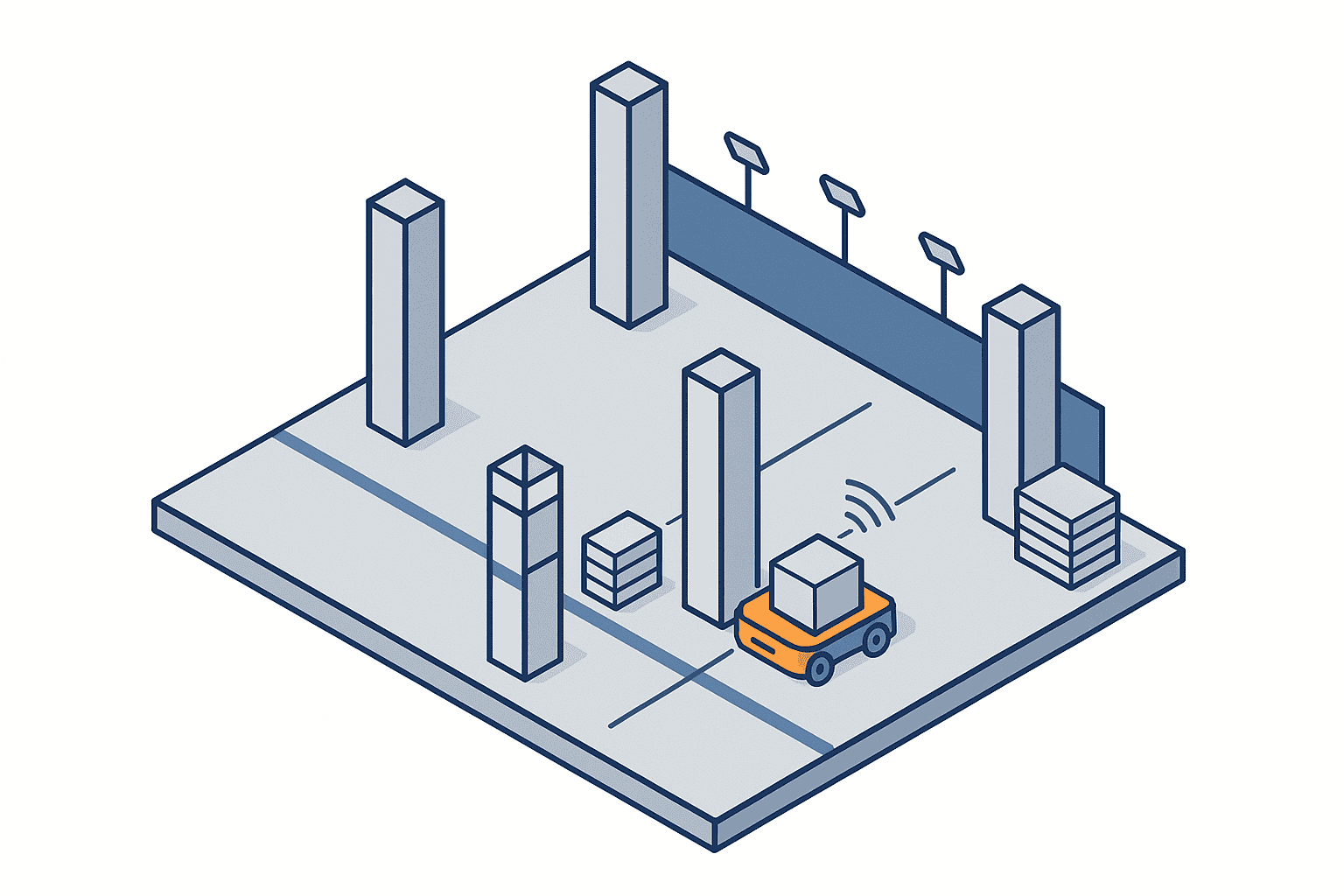
If laser guidance is on your shortlist, verify this first. Laser guidance assumes an unbroken line of sight to the reflectors. From every single point along the driving route, the vehicle must be able to see enough reflectors simultaneously to compute a position.
The dangerous case is the one that works on the drawing and fails on the floor. The aisle margin that was clear at design time fills with staged pallets once production starts. A forklift parks there temporarily. A rack fills with finished goods and hides a reflector that used to be visible. A wide building with few columns gives you design margin. A building that has been extended repeatedly until columns crowd the floor, or one with a low ceiling that limits where reflectors can be mounted, deserves a much harder look at obstruction risk.
If you occupy a ready built warehouse of the kind common in Thai industrial estates, the column spacing and beam positions are already fixed and you may not be free to choose reflector locations. Some leases also restrict permanent fixings to the walls. Raise that question with the landlord or the estate management company early, not after the order is placed.
Condition 3, whether floor work is possible
Magnetic tape makes the floor part of the scope of work. The question to ask is not whether tape can be applied, but whether it can survive. Aisles shared with forklift traffic, food plant floors that are washed down, and machining areas where cutting oil reaches the ground all shorten tape life below the assumption in the quotation.
Plants in Thailand and Vietnam that have grown by extension can carry steps and slopes left over from that history. Before worrying about whether tape will track across them, ask whether the jolt at a step will affect the load being carried. Neither laser guidance nor SLAM removes floor work entirely either, because a flat running surface is a shared prerequisite for all three methods.
Condition 4, required positioning accuracy
How accurate you need to be depends entirely on what happens at the destination. If the vehicle simply parks a cart in a marked area, the difference between methods barely matters. If it has to transfer a load automatically to a conveyor, square up to a machine loading port, or insert a pallet into a narrow rack opening, then repeatability at the stopping point becomes decisive.
Repeatability is one of the reasons laser guidance has kept its place. In real designs, though, a hybrid arrangement is extremely common. The vehicle travels roughly under SLAM or laser guidance, then uses a floor marker or a mechanical guide on the equipment for the final alignment. Do not judge on travel accuracy alone. Decide what handles the final stop at the same time.
Condition 5, when the money is spent
Look at the timing of cost, not only the total. Magnetic tape gives you relatively predictable installation cost up front and then charges you again at every route change. Laser guidance loads reflector design and installation into the initial phase, and route changes after that need no floor work. Autonomous vehicles including SLAM need minimal site work and let you change routes in software, but on top of the vehicle price you must budget for the control system and the network infrastructure, and you need people with specialist knowledge to operate them. Both NTT Docomo Business and SK Solution make the same point about AMR cost structure.
The cost breakdown itself, and the point at which the totals cross over between the methods, is covered in AGV Price and Total Cost, so we do not go into it here.
As a site condition, what matters is not the size of the number but the way budget moves through your organisation. A plant that can get one capital approval this fiscal year and a plant that has to push a small request through every time the layout changes will end up with different realistic options even at the same total cost. Where the second pattern applies, a method that front loads its cost tends to survive in service longer.
Mapping the five conditions, plus maintenance capability as a sixth viewpoint, onto the three methods gives you the skeleton of the decision.
| Site condition | Magnetic tape | Laser guidance | SLAM |
|---|---|---|---|
| Layout changes frequently | Weak | Moderate | Strong |
| Heavy obstruction from columns and staged goods | Largely unaffected | Weak | Moderate |
| Floor work is restricted | Weak | Strong | Strong |
| High stopping accuracy required | Moderate | Strong, usually combined with an assist at the stop | Assumes an assist at the stop |
| When the cost is incurred | Front loaded, then again at every change | Front loaded, light on changes | Light at first, ongoing on the operations side |
| Recovery must be possible by the shop floor alone | Strong | Moderate | Weak |
This matrix is not a ranking table. It is meant to be read after you have decided which one or two of your own conditions are genuinely non negotiable. No method wins every row, so if you compare without settling that question first, the conclusion will simply follow whichever vendor presents most confidently.
Where a laser guided AGV fits, and where it does not
Laser guidance is a mature technology and there is no reason to strike it off the list. Its strengths and weaknesses are simply well defined.
It fits open, unobstructed spaces where fixed routes are repeated over and over. Long shuttles between a finished goods warehouse and a shipping bay, or between moulding and assembly, play to its strengths. Because repeatability at the stopping point is high, it also suits processes that involve automatic handover to fixed equipment.
It does not fit buildings dense with columns, areas where staged goods move daily, or warehouses with tall racking on both sides of the aisle. Once the number of visible reflectors drops below what the position calculation needs, positioning degrades and travel becomes unstable. Simulate reflector count and placement during design, and confirm that the required number stays visible from every point on the route. Because the answer depends on building geometry, do not settle it with a generic rule of thumb.
One more thing gets overlooked in practice. Reflectors become assets that need to be maintained. Left alone, they drift out of alignment through vibration and lose performance through dirt. They get removed during cleaning or extension work and never go back. Put reflector inspection on the maintenance checklist and keep a drawing of their positions on site. Without that discipline, stoppages that take a long time to diagnose start appearing a few years later.
Should you still install magnetic tape guidance today
A newer method arriving does not make an older one wrong. On sites where the following conditions hold, magnetic tape can still be the best value choice available.
- The route is fixed and no change is planned for the next several years
- The load and its packaging format are stable
- The floor is in good condition and forklift traffic can be separated
- You want the shop floor maintenance team to be able to recover on their own
- You want to prove the benefit on one route before expanding
Be more careful if any of the following apply. The layout changes several times a year. Floor wear or oil makes tape life unpredictable. There is a plan to add transport routes later. On those sites, the downtime consumed by re-laying tape accumulates and can erase the initial cost advantage within a few years.
What gets missed when choosing a SLAM AMR
The absence of guidance infrastructure is the headline feature of SLAM, but three things deserve verification before you commit.
First, the cost that sits outside the vehicle. As noted above, an AMR needs minimal site work but assumes a control system and network infrastructure. Run several units at once without a fleet management layer above them and you will create congestion and waiting. Nor can you assume the existing office wireless network will serve the shop floor. Ask for a quotation that covers plant network design as well.
Second, whether the environment itself suits the method. SLAM relies on the shape of its surroundings, so feature poor environments are difficult. A vast empty floor, an aisle of identical racking repeating without variation, or an area where most of the field of view is occupied by goods that move can all destabilise position estimation. Not needing guidance infrastructure is not the same as working anywhere.
Third, whether you have someone to run it. AMR operation requires people with specialist knowledge. Decide before purchase who will rebuild maps, revise routes and coordinate traffic between multiple vehicles. If your Thai or Vietnamese site is designed around calling the Japanese head office for that support, recovery from every incident will be slow.
You do not have to standardise on one method
There is no requirement to pick a single method for the whole plant. In practice, matching the method to each area is often the realistic answer.
A fixed warehouse route can be automated cheaply with magnetic tape while an assembly area whose layout keeps moving is served by SLAM based AMRs. Laser guidance can be reserved for the one section that requires automatic handover to equipment.
If you do mix methods, the design of the layer above them matters. When each method comes from a different manufacturer, the mechanism that issues transport instructions fragments, and you lose the single view of where every load currently is. Make the ability to consolidate transport instructions and performance data at the upper layer an explicit requirement in vendor selection.
Questions to ask when comparing vendor proposals
Even with an identical condition sheet, proposals will be written differently by every supplier. Put the following questions to all of them so you are comparing the methods rather than the sales writing. The specificity of the answers is a direct measure of engineering capability.
- Which of our building conditions justifies the guidance method you are proposing
- For laser guidance, can you provide a reflector layout drawing and the basis for how many stay visible along the route
- For SLAM, do you have running installations in an environment with no more features than ours
- When we change the layout, who does what, over how many days, and what happens to production meanwhile
- When a vehicle stops, how far is our own shop floor expected to recover unaided
- Where are spare parts held, and how soon can an engineer physically reach our site
- If we scale up the fleet, what additional system and network capacity is required
The question about who does the work during a layout change, and the question about how far your own team can recover a stopped vehicle, matter more than any other to life after installation, and they are precisely the ones that proposals leave out. There is a wide gap between a vendor who answers verbally that they will take care of it and one who can give you a procedure and a duration, and that gap shows up in your uptime six months in.
Asking the same questions of vendors who each favour a different method also forces each of them to explain how they compensate for the weakness of their own approach. Treat a proposal that acknowledges a weakness and shows the mitigation as lower risk than one that never mentions the weakness at all.
Safety standards apply regardless of method
Whatever guidance method you choose, ISO 3691-4 applies to the safety design of AGVs and AMRs. First published in 2020, with ISO 3691-4:2023 as the current edition, it covers both AGVs that follow a predetermined route and AMRs that navigate autonomously by perceiving their surroundings. It specifies the required performance level of monitoring functions, operating modes, brake control, emergency stop and speed control, as documented by the Japan Quality Assurance Organization. For how to think about safety measures when an AMR is introduced, Kyodo Robot is a useful companion reference. In Japan the corresponding standard, JIS D 6802, was fully revised in 2022 and corresponds to ISO 3691-4:2020.
The point that matters for method selection is that safety requirements do not relax because a vehicle uses SLAM, nor tighten because it uses tape. Autonomous vehicles are explicitly in scope, so equivalent safety design is expected regardless of the method you pick. If a proposal says nothing about safety functions, or cannot explain how conformity is verified, raise it at that moment rather than at acceptance testing.
Local factors specific to Thailand and Vietnam
Applying Japanese decision criteria unchanged will lead you astray on the ground. Three local factors deserve weight.
The first is labour cost movement. Wage growth at Japanese affiliated companies in Thailand ran at 3.8% in 2023 and 4.58% in 2024, with 4.64% forecast for 2025, and upward pressure on worker wages continues against a background of manufacturing labour shortage, as summarised in this analysis of Thai labour cost trends. Calculate payback on today’s labour cost alone and the result will be more conservative than reality.
The second is investment incentives. The Thailand Board of Investment operates a promotion policy for automation machinery and the robotics industry, and states that 85% of Thai industry has an opportunity to adopt automation machinery or robots for process improvement. The policy is published in the BOI promotion document. Eligibility depends on the specifics of each case, so approach BOI early, in parallel with method selection rather than after it.
The third is service coverage. The method you choose determines which spare parts you can source locally and how deep the pool of qualified engineers is. Magnetic tape is easy to obtain in country, while proprietary reflectors and SLAM sensors can leave you waiting on an import. How many days a failure costs you is decided less by vehicle reliability than by parts supply and the distance to an engineer. During vendor selection, confirm whether engineers are resident in Thailand or elsewhere in ASEAN and where spare parts are stocked.
How to run the selection without getting it wrong
Sequencing the internal work this way keeps the discussion from being hijacked by method preferences.
- Fix the target process and the load first, and define the range of packaging formats and weights
- Write down every layout change you can foresee over the next three years
- Walk the intended driving area and physically measure column positions and staging space
- Decide the positioning accuracy needed at each stopping point, process by process
- Check floor condition and where routes will cross other vehicle traffic
- Consolidate all of the above onto one sheet before inviting proposals from multiple vendors on identical terms
The last line is the important one. Invite proposals without organising your conditions and each supplier will propose around the method they are strongest in, leaving you nothing comparable. Only when everyone receives the same condition sheet can you compare vendor capability rather than method marketing.
Frequently asked questions
Is a laser guided AGV or a SLAM AMR cheaper
Vehicle purchase price alone will not answer this. Laser guidance front loads reflector design and installation, while SLAM minimises site work but adds control system and network infrastructure cost. Which is cheaper is therefore settled by your building, not by a price list. Do you have unbroken sight lines to reflectors, are you planning to move the layout, and do you have people locally who can run the system? Answer those three and you know which shape of quotation you should be comparing.
Can we add AMRs while keeping our existing magnetic tape AGVs
Physically yes, but settle the layer above them first. Where an existing tape route crosses an AMR operating area, you need a rule about which vehicle gives way. And if transport instructions stay split between the tape AGV system and the AMR system, you lose the single view of where each load is. When you ask for a quotation that reuses the existing fleet, write the crossing traffic rule and the ability to consolidate transport instructions into the requirements.
How many reflectors does laser guidance need
The answer varies with building geometry and route, so do not settle it with a generic figure. The test is not the count itself but whether enough reflectors for a position calculation stay simultaneously visible from every point along the route. Simulate it during design and build in margin for temporary obstruction by staged goods and forklifts.
Can the guidance method be changed later
Not easily, because it generally means replacing the vehicles. Moving from magnetic tape to SLAM typically requires new vehicles plus the addition of a fleet management system. That is exactly why writing down your expected layout changes for the next three years is worth doing before you buy. If future expansion is genuinely unclear, either choose the method that is easiest to extend or start small on one route and expand once you have real results.
Summary
AGV guidance comes down to three methods, magnetic tape, laser and SLAM. Arguing about which is superior leads nowhere. The answer follows five conditions, how often the layout changes, how much obstruction columns and staged goods create, whether floor work is possible, what positioning accuracy the stopping points require, and when the money has to be spent.
The laser guided AGV keeps its place on the strength of accuracy and track record, but because it depends on line of sight to reflectors, buildings dense with columns and areas where staging moves demand careful design. Magnetic tape remains rational wherever routes are fixed. SLAM delivers flexibility where layouts move, provided you budget for the cost outside the vehicle and secure the people to run it. There is no obligation to standardise the whole plant on one method, and mixing methods by area is frequently the realistic answer.
In Thailand and Vietnam, continued wage growth and BOI automation incentives both push in favour of investment, while parts supply and the distance to a qualified engineer impose local constraints. Start the selection by walking your own building and writing down the conditions, not by reading catalogues.
TOMAS TECH supports Japanese affiliated factories across Thailand and Vietnam, from guidance method selection through integration with the systems above the vehicles. Even at an early stage, before any decision has been made, we are happy to sit down and organise your building conditions with you. With site photographs and a rough layout drawing we can already give you a view on which methods are realistic candidates, so please get in touch through our contact form.
References
- Types and characteristics of AGV guidance methods – Phoxter
- Laser guided AGV systems – Meidensha
- Fundamentals and types of SLAM technology – TechnoPro Simulation
- What is an AMR – NTT Docomo Business
- Benefits and challenges of AMR adoption – SK Solution
- Trends in robot safety standards – Japan Quality Assurance Organization
- Explaining the ISO 3691-4 safety standard – Kyodo Robot
- Latest trends in Thai labour management and labour cost growth rates – Kuno CPA Office
- Thailand Investment Promotion Policy for Automation and Robotics Industries – BOI


