


When a Thai factory evaluates labor cost reduction through automation, comparing a robot price with the statutory minimum wage is not enough. The target is not simply a smaller headcount. It is less time locked into repetitive work, less overtime and temporary-labor dependency, less capacity lost to vacancies, and less quality variation and rework. This guide connects shop-floor observation to a 90-day proof, an RFP, FAT/SAT, and operational handover. Every number labelled “recommended example” is an illustrative assumption—not a market price, guaranteed result, or TOMAS TECH customer result.
Why Thai factories should connect labor-cost risk and automation now
Thailand’s Ministry of Labour currently lists Wage Committee Notification No. 14, effective 1 July 2025. Its English notice states a THB 400 daily minimum wage for Bangkok, Chonburi, Rayong and Chachoengsao, among other locations; THB 372 for Samut Prakan and Pathum Thani; and THB 357 for Ayutthaya and Prachinburi. This was the current notice shown on the ministry page when checked on 3 September 2026. Each factory must confirm the applicable location, business category and effective rule in the official documents.
The minimum wage is only one component of labor cost. A credible baseline may also include social-security contributions, shift and attendance allowances, overtime, recruitment, training, turnover replacement, transport, uniforms, supervision and indirect administration. Likewise, a robot quotation is only one component of automation cost. Tooling, feeding, controls, guarding, conveyors, vision, networking, data integration, installation, commissioning, training, spares and maintenance belong in the investment case.
The National Statistical Office’s Q2 2026 Labour Force Survey reports 41.51 million employed people, 0.40 million unemployed people and a 1.0% unemployment rate; manufacturing employment increased 2.7% year on year. These national figures do not prove that every Thai factory faces the same labor shortage. Region, occupation, shift and skill matter. A plant should therefore measure its own days-to-fill, absence-related stoppage, overtime, borrowed labor and time spent by skilled employees covering repetitive work.
The objective can be separated into four outcomes:
- Reduce labor hours in feeding, movement, inspection, recording, packing and other repetitive tasks.
- Reduce capacity risk caused by vacancies, absence, turnover or single-person dependency.
- Reduce quality risk from operator variation, missed checks, rework and poor traceability.
- Reduce exposure to heavy, repetitive or hazardous work without weakening safety controls.
Keeping these KPIs separate lets management explain value even when payroll does not immediately fall.
Reduce required work and capacity exposure—not people on a slide
“Turn a three-person process into a one-person process” is not a cash-flow statement. Even if two operators are released from the task, employment arrangements, demand and skill needs may prevent an immediate reduction in payroll. Counting two full salaries as savings creates a gap between the approval case and actual results.
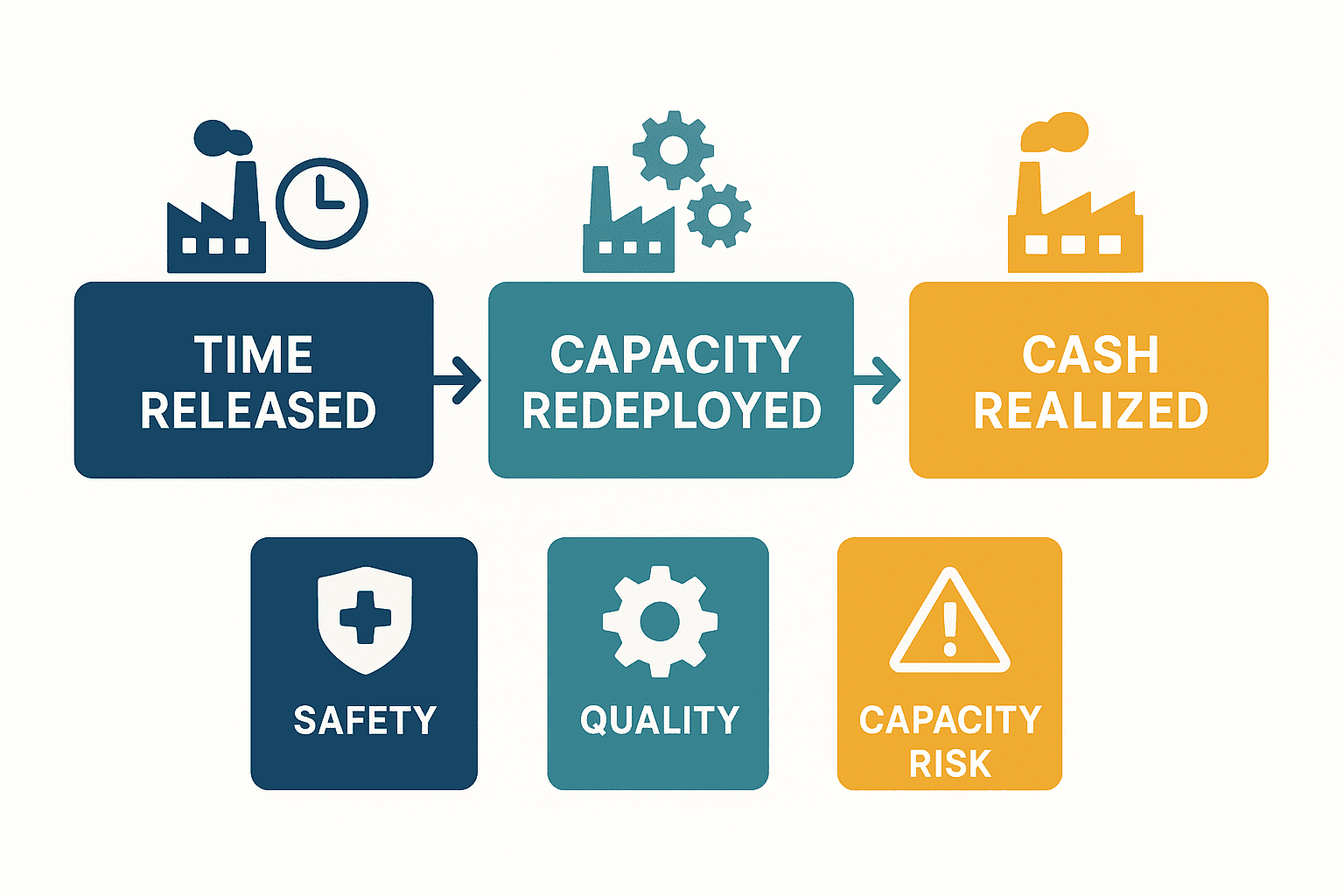
Use three levels of benefit:
- Time released: how many hours no longer go to the repetitive task.
- Capacity redeployed: whether those hours are actually used for inspection, changeover, maintenance or additional saleable output.
- Cash realized: whether overtime, agency labor, outsourcing, hiring, scrap or another payment truly declined.
Time released does not automatically become cash. In a growing plant, however, redeploying existing employees to add output can be more valuable than payroll reduction. On a night shift with persistent vacancies, the main benefit may be preserving production that would otherwise be lost.
Five tests for selecting automation in labor-constrained manufacturing
1. The task repeats and input variation can be controlled
Stable part position, orientation, size and arrival timing improve automation feasibility. If every SKU differs and acceptance criteria remain tribal knowledge, adding a robot can add stoppages. Standardize feeding and exception handling first.
2. Work can be measured in time
Separate touch time, walking, waiting, recording, rework and changeover. Observe normal, peak and high-changeover periods. “The team is busy” is not a baseline.
3. Vacancy impact is material
A low-paid task can still be high priority if one absence stops the line, calls a skilled person from another area or triggers overtime. Value either the actual replacement cost or probability-adjusted lost contribution—never both for the same event.
4. Quality or traceability improves at the same time
Automated checking, fastening, label verification, weighing and serial capture can create both labor-hour and quality-record benefits. A more expensive solution may have a better total return if it reduces rework and audit effort.
5. Safety passes as an independent gate
A short payback cannot compensate for inadequate safeguards. ISO 12100 provides principles for identifying hazards, assessing risk and reducing risk over the machinery lifecycle. IEC 60204-1 covers electrical, electronic and programmable electronic equipment of machines, including protective bonding, overcurrent protection, emergency stops, control circuits and documentation. Qualified specialists must determine applicable standards based on the machine, use, customer requirements and Thai law.
Build a process evidence sheet before asking for a labor-saving machine
Create one evidence sheet per candidate process before requesting quotations.
| Field | What to record | How it supports the decision |
|---|---|---|
| Demand | Good units/day, peak, product mix | Separates required capacity from overdesign |
| Labor | Direct staff, borrowed staff, overtime, agency labor | Identifies avoidable cost |
| Time | Cycle, wait, walking, changeover | Separates tasks to automate from tasks to retain |
| Quality | Defects, rework, escapes, scrap | Tracks quality in units and money |
| Stops | Failure, shortage, vacancy, minor stops | Separates capacity-risk causes |
| Safety | Crush, contact, weight, posture | Feeds the safety specification |
| Data | PLC, sensors, MES, ERP | Defines evidence and traceability |
| Exceptions | Jams, tilted parts, wrong parts, re-entry | Defines recovery and human work |
Measure tasks, not just people. A packing station can be split into carton forming, loading, count verification, sealing, labeling and pallet movement. Full automation may not pay back, while sealing and label verification may support a useful small start.
For sequencing, see our phased factory automation roadmap for Thailand. To compare practical scopes, see these small-manufacturer automation case studies.
Calculate automation cost-effectiveness in seven boxes
- Initial investment: machinery, robot, tooling, controls, safety, conveying, vision, installation and training.
- Internal implementation cost: specifications, reviews, acceptance, downtime and master-data preparation.
- Annual run cost: maintenance, spares, calibration, software, communications and energy.
- Cash savings: actual reductions in overtime, agency labor, outsourcing, hiring, scrap or inspection.
- Avoided future cost: additional hiring, expansion or emergency freight, adjusted for probability.
- Capacity value: contribution from additional good output only where demand and sales are credible.
- Transition risk: startup interruption, temporary yield loss, parallel running and modification reserve.
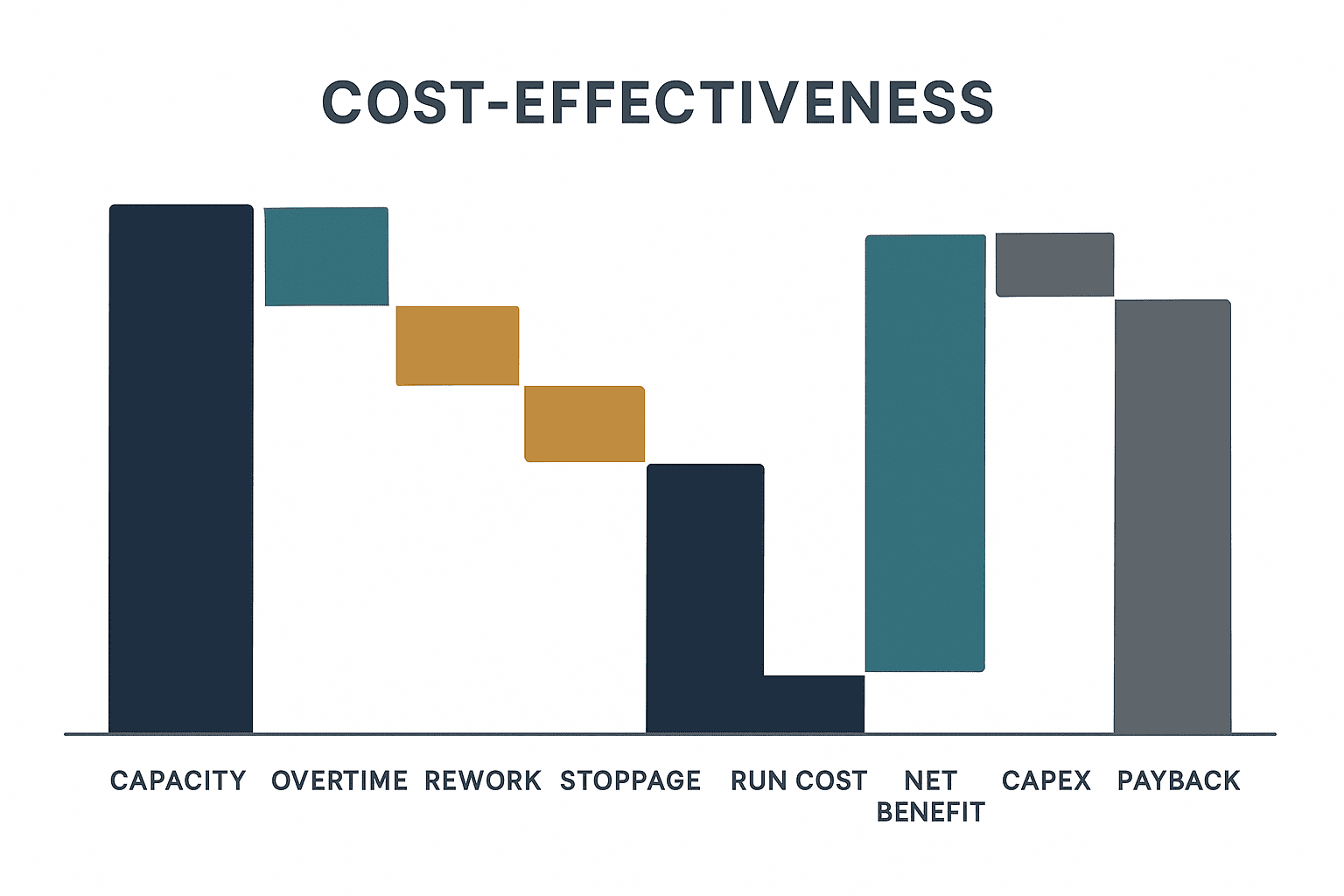
Simple payback months are approximately initial investment divided by annual net benefit, multiplied by 12. Net benefit is realized cash savings plus realizable capacity value minus annual run cost. Avoided future costs should be probability-adjusted or kept out of the base case. Unsold extra output is not revenue.
Use the plant’s loaded labor cost—not minimum wage divided by eight
A useful hourly rate is annual loaded labor cost divided by annual productive hours. Define which wages, allowances, employer costs, bonuses, recruitment, training and transport are included. Define how holidays, leave, meetings and training affect productive hours.
Then apply a realization factor. Overtime removed from payroll can have a high cash-realization rate. Regular hours released without an approved redeployment plan have a low cash-realization rate and should be tracked as capacity instead.
Recommended example: a Thai factory labor-cost and capacity-risk scenario
The following is an illustrative recommended example. All prices, staffing and effects are fictional and are not quotations, market benchmarks, actual results or guarantees.
Assume a two-shift packing and verification process. A semi-automated cell handles feeding, count verification, label matching and sealing. Two FTE-equivalents are redeployed to inspection and changeover rather than dismissed. Overtime and temporary-labor reductions are treated as cash; regular-hour redeployment is capacity value.
| Recommended-example item | Assumption | Annual treatment |
|---|---|---|
| Redeployable capacity | 2 FTE × THB 22,000/month × 12 | THB 528,000 capacity value |
| Overtime and temporary labor | Illustrative historical pattern | THB 180,000 |
| Rework and shipping errors | Illustrative historical pattern | THB 120,000 |
| Vacancy-related stoppage avoided | Probability-adjusted illustration | THB 160,000 |
| Gross annual benefit | Sum above | THB 988,000 |
| Annual run cost | Illustrative maintenance and spares | –THB 198,000 |
| Annual net benefit | Gross less run cost | THB 790,000 |
| Initial investment | Illustrative complete scope | THB 1,800,000 |
| Simple payback | 1,800,000 ÷ 790,000 × 12 | About 27.3 months |
The THB 528,000 is not automatically payroll savings. At day 90, confirm whether the redeployed time increased inspection capacity, avoided hiring or reduced overtime. If not, remove it from the cash base case and recalculate. Test benefit at 80%, 100% and 120%, investment at +10% and +20%, and a one-month startup delay. The plant’s capital policy—not this article—sets the acceptable payback.
Prove a small-start automation project in 90 days
Starting small means narrowing scope while retaining safety, measurement, recoverability and handover. The dates and thresholds below are recommended examples to be approved for each plant.
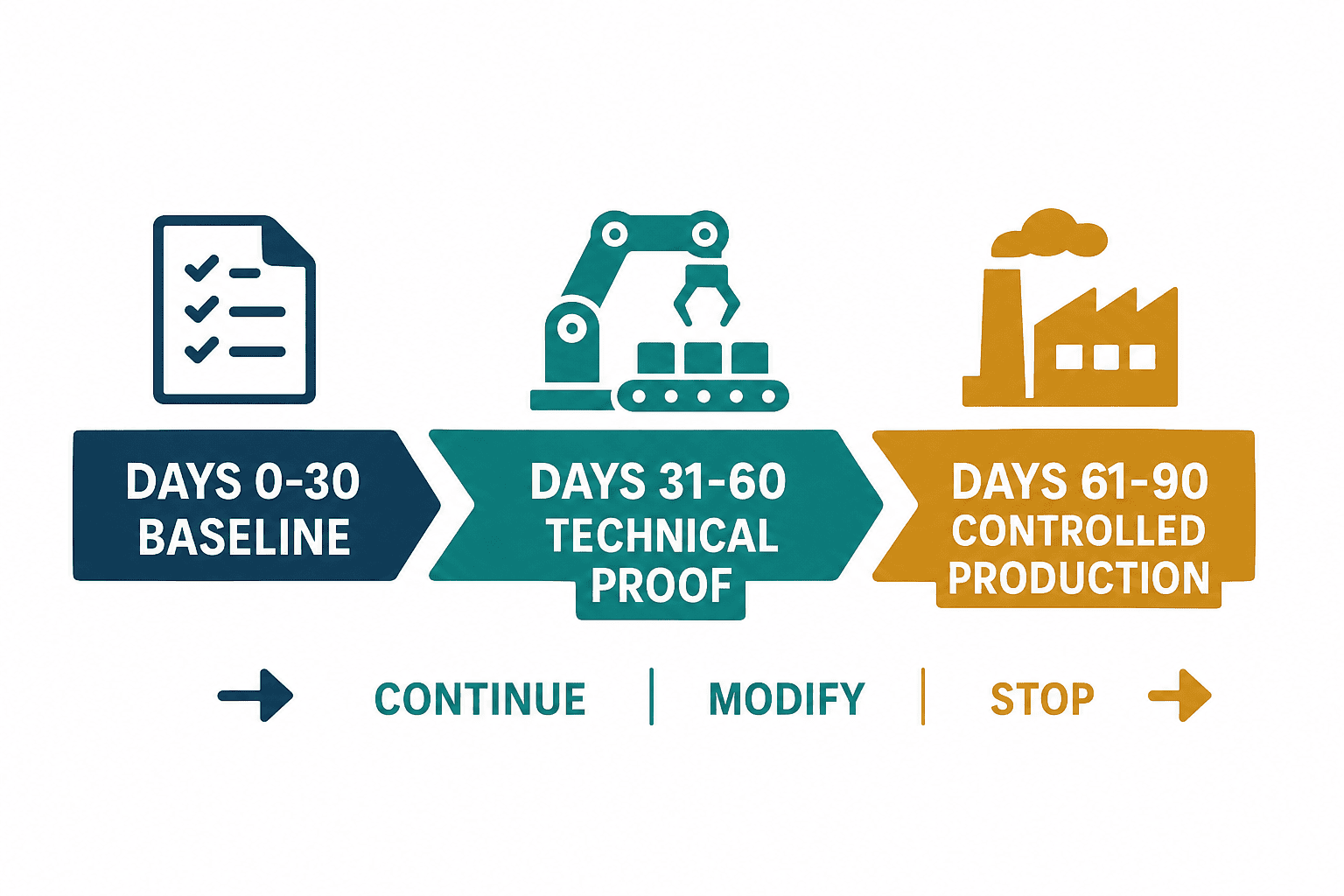
Days 0–30: freeze the baseline and requirements
- Recommended example: observe at least 15 operating days covering normal, peak and changeover conditions.
- Capture cycle, good output, stops, labor time, overtime and rework using stable definitions.
- Record product-change and abnormal scenarios in sequence.
- Define safety requirements, network boundaries and data ownership.
- Approve the evidence required to proceed.
Deliverables are a process evidence sheet, user requirement specification, I/O and data list, risk register and pilot plan. A vendor proposal is not a substitute for owner requirements.
Days 31–60: technical proof offline or in parallel
- Recommended example: include at least 95% of representative product volume.
- Require zero safety-related incidents; safety is not a weighted KPI.
- Measure human interventions, false decisions, jams and mean recovery time.
- Test real PLC, MES and ERP data paths.
- Confirm that operators, maintenance and IT use the same fault definitions.
The 95% figure is illustrative, not a universal acceptance criterion. A high-mix plant may need every high-risk or high-revenue SKU in scope while retaining a manual route for rare parts.
Days 61–90: controlled production and business proof
- Recommended example: begin with one line or one shift.
- Recommended example: demonstrate capacity, quality, safety and recovery for ten consecutive operating days.
- Verify where released hours actually went and which cash payments changed.
- Close FAT/SAT punch items or document controlled exceptions.
- Decide among continue, modify and stop; do not make full rollout automatic.
Review worst shift, hardest SKU and abnormal recovery—not only average cycle time. A fast cell that only the supplier can recover is a new capacity risk.
Twelve items every automation RFP should contain
- Product scope: SKU, dimensions, weight, material, future variants and exclusions.
- Capacity: good-output cycle, operating time, changeover and buffer.
- Input variation: position, orientation, supply, environment and upstream faults.
- Output quality: inspection, verification, records, reject route and NG handling.
- Exceptions: jams, power loss, communication loss, sensor failure and manual recovery.
- Safety: risk assessment, guarding, interlocks, stop functions and validation records.
- Control boundary: PLC, HMI, robot, existing machine and I/O responsibility.
- Data boundary: tags, timestamps, history, MES/ERP, backup and ownership.
- Cybersecurity: accounts, remote access, updates, logs and segmentation.
- FAT/SAT: cases, samples, witness points, evidence and acceptance states.
- Handover: drawings, programs, credential control, BOM, spares, training and languages.
- Commercial terms: price breakdown, change control, milestones, warranty and service SLA.
Specify tasks and conditions, not “remove two people.” Ask each bidder to state exclusions in the same structure. As a recommended example, link payment milestones to design approval, FAT, shipment, SAT, sustained run and final handover. The percentages must reflect the contract; evidence should prevent most payment being triggered simply by equipment arrival.
Connect FAT, SAT and handover to the business case
ISA describes ANSI/ISA-62381-2026 / IEC 62381:2024 as a structured FAT, SAT and SIT methodology for process-industry automation. It highlights readiness, punch lists, completion criteria and checks for documents, hardware, software, HMI and communications. ISA also states that FAT/SAT does not itself cover loop checks, commissioning or MES testing. Passing FAT therefore does not prove business return.
FAT verifies specification in the supplier environment. SAT verifies the installed site with utilities, conveying, existing machines, networks, actual parts and operators. Labor-cost proof still requires controlled-production data.
Acceptance evidence should contain requirement and test IDs, results, time, responsible people, part/tool/software/parameter versions, logs, measurements, punch items, owner, deadline and retest scope. Handover is complete when Thai plant operators and maintenance can demonstrate normal running, changeover, abnormal recovery and backup restore—not when a manual is merely delivered. Provide instructions in a language actual users understand.
Do not bolt on safety, legal review or OT security at the end
Automation may reduce routine exposure while making cleaning, jam clearing and maintenance more hazardous. Risk assessment must cover normal operation, reasonably foreseeable misuse, changeover, maintenance and disposal.
Thailand’s Department of Industrial Works publishes procedures under the Factory Act for factory operation, machinery trial runs and machinery changes. IEAT conditions may apply in industrial estates. Whether a change affects permission, notification or environmental measurement depends on the factory class, location, machinery and license conditions. Confirm with the competent authority and qualified advisers before work. This article is not legal advice.
For connected equipment, define OT security in acceptance. TISI’s new-standards list shows TIS 62382-2568 and TIS 62443 Parts 2(1)-2568 and 2(4)-2568 effective 9 May 2026. Confirm applicability, then specify remote-maintenance approval, account ownership, logs, backup, patching and network separation.
Roles that make automation stick in a Thai plant
- Executive sponsor approves objectives, benefit definitions and redeployment policy.
- Process owner defines standard work, capacity, quality and exceptions.
- Operator representative validates usability and recovery.
- Maintenance owns preventive work, spares, backups and recovery time.
- Quality owns inspection, measurement, records and change reapproval.
- EHS verifies risk assessment and safety validation.
- IT/OT manages networks, accounts, logs and integration.
- Finance audits baseline, cash benefits and capacity benefits.
- Supplier/SI delivers design, tests, documents, training and warranty.
Communicate the painful tasks being removed, decisions retained, redeployment destination, new skills and evidence—not only a headcount target. If operators hide faults because reporting feels punitive, the pilot produces misleadingly good data and an unreliable rollout.
Questions for comparing vendors and system integrators
Price and delivery time are not enough. Require every vendor or SI to answer the following questions in the same format so that assumptions and exclusions can be compared:
- Under which workpiece conditions and stop-time exclusions was the proposed cycle time calculated?
- Which exceptions still require human intervention, and how will their frequency be verified?
- Where is the boundary of responsibility for safety design, and is independent verification available?
- Who assesses the impact of modifications on existing-machine programs and warranties?
- Who owns production data and audit logs, and in which usable format can the plant export them?
- Can the plant authorize, stop and record each remote-maintenance connection?
- Can the same requirement IDs be traced from the URS through FAT and SAT evidence?
- Who closes each punch-list item, by when, and which functions must be retested after a change?
- What are the Thai-language training scope, local maintenance coverage and spare-parts response times?
- Will the vendor participate in the 30-, 60- and 90-day post-startup benefit reviews?
A strong proposal makes prerequisites, exclusions, data paths, abnormal scenarios and verification methods explicit, not just the machine configuration. A low base price can become the highest lifecycle cost when existing-machine changes, safety, integration and documentation are excluded.
Common failures and corrections
Minimum wage × people removed: use loaded cost, realization and actual payments; track redeployment separately.
Robot price comparison: add feeding, tooling, safety, controls, installation, integration, training and spares.
Automating the hardest full process first: decompose tasks and narrow product, station or shift scope.
Accepting on average cycle only: test product mix, worst shift, abnormal recovery, good output and intervention rate.
No defined human work after automation: document replenishment, setup, sampling, recovery, cleaning and maintenance.
No owner for benefit measurement: finance and process ownership must approve identical baseline and post-launch definitions.
FAQ on labor cost reduction and automation
How large must a factory be before labor cost reduction through automation makes sense?
Judge the task, not total headcount. A small process may qualify when overtime is high, a vacancy stops shipping or one skilled person is the only recovery path. Compare no-capex improvement, fixtures, semi-automation and full automation using the same evidence.
Which tasks are good first candidates for manufacturing automation under labor shortage?
Movement, feeding, counting, label verification, sealing, palletizing and repeatable inspection are common candidates when inputs can be controlled. Observe hazards, upstream/downstream behavior, product change and exception frequency before selecting.
What does labor-saving equipment cost?
There is no universal price. Feeding, tooling, safety, existing-machine changes, vision, data integration and installation can outweigh the base machine. Use a common RFP and compare lifecycle cost. Every amount in this article is illustrative.
What payback period makes automation cost-effective?
It depends on capital cost, product life, demand certainty, obsolescence and maintenance capability. Compare downside, base and upside cases. Include capacity value only when demand can convert it into saleable output.
What should never be cut from small-start automation?
Safety, baseline measurement, abnormal recovery, backup, data ownership, acceptance criteria and training. Narrow the product, task, line or shift—not the evidence needed to decide the next step.
Can minimum wage be used in ROI?
It is essential for compliance and scenario updates, but the process hourly rate should normally come from the plant’s loaded annual cost and productive hours. Confirm the current official wage for the site and add actual company costs.
Can automation produce value without job losses?
Yes. It can reduce overtime, agency labor, hiring, vacancy stoppage and rework while moving time to inspection, maintenance, changeover or output. Do not book intended redeployment as cash before results are observed.
Are Thai-language manuals mandatory?
Whether a specific document is legally required in Thai depends on the equipment, contract, applicable regulation and authority, so the project must verify its own obligations. Operationally, however, instructions must be available in a language actual users understand. Cover normal running, changeover, abnormal recovery, lockout, maintenance and escalation with diagrams and hands-on demonstration; do not rely on an untranslated manual alone.
Conclusion: buy an evidence chain, not just equipment
Labor cost reduction through automation in Thailand is not decided by minimum wage versus robot price. Decompose the process, distinguish time released, capacity redeployed and cash realized, and measure safety, quality and vacancy risk independently. Use a 90-day sequence of baseline, technical proof and controlled production to decide continue, modify or stop.
The RFP should define input variation, exceptions, control and data boundaries, FAT/SAT and handover. Completion means the plant can recover the system and measure its benefit with the same definitions—not simply that the robot moves.
TOMAS TECH can support candidate-process screening, work measurement, replacement of the illustrative model with plant data, 90-day pilot design and an executable RFP. If you want to define both what to automate now and what to leave manual, contact TOMAS TECH while the project is still at the evaluation stage.
Sources
- Thailand Ministry of Labour, Minimum Wage: https://www.mol.go.th/อัตราค่าจ้างขั้นต่ำ/
- Thailand Ministry of Labour, Notification No. 14 summary: https://www.mol.go.th/en/news/starting-july-1-ministry-of-labour-revises-minimum-wage-to-align-with-economy-and-improve-workers-quality-of-life
- National Statistical Office, Q2 2026 Labour Force Survey: https://www.nso.go.th/nsoweb/storage/survey_detail/2026/20260727145040_51612.pdf
- NSO, The Labor Force Survey: https://www.nso.go.th/nsoweb/nso/survey_detail/9u?set_lang=en
- ISO 12100:2010: https://www.iso.org/standard/51528.html
- IEC 60204-1:2016: https://webstore.iec.ch/en/publication/26037
- ISA-105 / ANSI/ISA-62381-2026: https://www.isa.org/standards-and-publications/isa-standards/isa-105-standards
- TISI, New Standards: https://www2.tisi.go.th/website/standardlist/new_standards_en
- Department of Industrial Works, Factory Act public guide: https://www.diw.go.th/webdiw/publicguide-factory/
*Research checked 3 September 2026. This is general information, not legal, labor, safety, tax or investment advice. Confirm current laws, standards, wages, permits and applicability with official sources and qualified professionals at project time.*


