


“We cannot hire enough people, so we need a robot now.” “We have a quotation, but we cannot tell whether it will pay back.” For a Thai small or medium-sized manufacturer, the first automation question is not which machine to buy. It is which loss in which process can be reduced, and what level of investment that reduction can justify. This guide presents four SME automation case studies as design patterns: jigs and poka-yoke, inspection, material handling and semi-automation, and a robot cell. It connects the initial problem, a small proof of concept, the RFP, FAT/SAT, and the final investment gate, so that a factory can prepare before asking an automation equipment manufacturer for a proposal.
Important: The four cases below are design examples/model cases assembled from conditions commonly found in Thai SME factories. They are not presented as results achieved by real TOMAS TECH customers. Named NIST MEP cases are clearly identified as external, publicly documented examples. All cost and benefit calculations for the four model cases are estimates, not guaranteed project results.
Why Thai SMEs should start automation small
On July 23, 2026, Thailand BOI’s OSOS reported that investment applications in the first half of 2026 reached 1,299 projects worth approximately THB 1.47 trillion, up 37% year on year. Machinery, automation and robotics accounted for 82 applications worth about THB 13.1 billion. The report also said the Smart and Sustainable Industry initiative received 132 applications worth approximately THB 17.2 billion for machinery upgrades, digital adoption, and the integration of automation and robotics. These figures do not mean every SME should rush into a large project. They show that the surrounding production ecosystem is modernizing and that customer expectations for quality, delivery and production data are likely to continue rising.
Some older BOI program pages describe measures whose application windows ended in 2025. This article does not present those measures as current incentives. If an incentive affects the business case, verify the current BOI announcement, eligible activity, application date, machinery origin and treatment of existing equipment for the specific project. Build a case that works without an incentive first; treat a confirmed benefit as upside.
SME automation must solve three constraints at the same time:
- Variation: product mix, volume, material condition and operator skill change frequently.
- Limited resources: dedicated production engineering, controls and maintenance capacity is scarce.
- Investment exposure: one failed project can stop the next improvement budget.
Therefore, the starting point should not be “buy a robot.” It should be “measure the loss and prove repeatability at small scale.” For the risks behind that approach, see Automation Project Failure Risks in Thailand. When you are ready to compare suppliers, use our Thailand Automation Equipment Vendor Selection Guide.
Turn the problem into numbers before selecting equipment
Statements such as “the job is difficult,” “mistakes happen often,” or “we are short of people” cannot yet become an RFP. Observe a representative period—often about four weeks—and record each process consistently.
| Measure | How to record it | Use in the investment case |
|---|---|---|
| Net work time | Separate work, waiting, walking and rework within the cycle | Distinguish automatable time from remaining human work |
| Defects and escapes | Record model, shift, cause and detection point | Quantify avoided loss for poka-yoke or inspection |
| Downtime | Record time, cause, recovery owner and minutes | Define maintainability and recovery requirements |
| Labor variability | Record support labor, overtime, absence and training | Value staffing stability, not only headcount reduction |
| WIP and movement | Record quantity, dwell time and travel distance | Design handling scope and buffers |
| Changeover | Record frequency, time and tooling | Set acceptance limits for high-mix production |
Rank candidates by repetition, degree of standardization, abnormal-event frequency, quality impact, ergonomic/safety burden, and stability of upstream and downstream processes—not simply by labor cost. A process with heavy human judgment, randomly presented parts and frequent starvation may benefit more from standard work and better fixturing before robotics.
Five conditions to freeze in the first proof of concept
- Product variants and workpiece tolerances
- Accepted cycle time and continuous-run duration
- Method for judging good and bad output
- Recovery method and target recovery time after a fault
- Operator tasks for replenishment, changeover, cleaning and inspection
Moving one sample in a demonstration is not proof of production capability. Include representative parts, seeded defects, material variation, full/empty conditions, contaminated sensors and power-recovery behavior in the test plan.
Turning proof records into an investment decision
The purpose of a proof is not to record a video of the equipment moving once. It is to create repeatable evidence for an investment gate. For every test, use one record format for part number, material lot, operator, start and finish time, equipment and software version, settings, ambient conditions, result, stop reason and recovery time. Do not feed only accepted parts. Deliberately test boundary conditions that occur in production, including misaligned workpieces, missing components, full containers, communication loss, power restart and changeover. Keep failed tests, and link each one to its cause, containment, permanent action and retest result. Those records can then become RFP and FAT/SAT acceptance criteria.
In the management paper, separate measured proof results from annualized estimates. If one week of avoided downtime is annualized, state the operating days, demand, product mix, contribution margin and maintenance cost, then show lower-demand and higher-maintenance cases. Do not convert all released work time directly into payroll savings. Decide whether the value will appear as less overtime, avoided hiring, absence resilience or redeployment to quality work. Naming the proof owner, approver, evidence repository and decision deadline in advance also prevents a project from being approved on one unusually good day or on personal impressions.
Set stop conditions and replication conditions in advance
Starting small does not mean continuing a failed proof without a deadline. Before work begins, define stop conditions for technical feasibility, operational feasibility and economics. Technical feasibility asks whether representative variants meet the required cycle time, critical defects are detected and the process can recover by a standard method. Operational feasibility asks whether production can sustain replenishment, cleaning, changeover and daily checks, and whether maintenance can restore the system from backups. Economic feasibility asks whether the project still meets its payback gate under conservative demand and higher maintenance cost. If one gate fails, cap the additional spend and set a retest deadline; beyond that point, change the solution concept or stop the project.
Replication should not be approved merely because the first unit runs. First experience several changeovers, restart after planned shutdown, recovery from representative faults, maintenance work and traceability of quality data. Before copying the solution, bring the changed drawings, PLC/HMI/robot programs, parameters, bill of materials, spares, training material and risk assessment under controlled master versions. Even an identical machine needs revalidation when the floor, utilities, network, surrounding equipment, operator route or product mix differs.
Writing these gates down avoids both the sunk-cost argument—continuing because money has already been spent—and premature rollout because the first unit had a good week. A stop decision is useful learning that may redirect the plant to a fixture or semi-automatic option. A rollout decision approves not only machine performance but also repeatable standard work, maintenance capability, quality assurance, data control and change management. Put the conditions to proceed, conditions to stop and fallback option beside the next investment amount in the approval paper.

SME automation case study 1: assembly jig and poka-yoke
Problem in this design example/model case
Consider an eastern Thailand metal-parts factory manually assembling six variants of a small product. It sees orientation errors, missing components and inconsistent tightening sequences. Monthly demand fluctuates, so a dedicated high-volume machine may not tolerate product changes. Adding inspectors might catch defects later, but it would not remove rework and delivery delay.
Small proof of concept
The first investment is not a robot. It is a locating fixture, error-proof geometry, part-presence sensors, fastening-complete signals and a simple PLC interlock. Trial one model, one process and one shift for two weeks. Check operator posture, whether cleaning disturbs sensors, and how reworked parts re-enter the sequence.
| Proof KPI | Example acceptance condition | Action if it fails |
|---|---|---|
| In-process defects | At least 50% fewer events per 1,000 units than baseline | Redesign by defect mode |
| Cycle time | Median no worse than current; 95th percentile within target | Remove avoidable waiting added by controls |
| Changeover | Target under 10 minutes and preferably tool-less | Add datum pins, visual coding and recipe verification |
| Recovery | Operator recovers from misload in under 3 minutes | Improve HMI message and standard procedure |
RFP and investment decision
The RFP should not merely say “install sensors.” It should identify the target defects, detection limits, bypass authorization, model verification, history retention, spare parts and required drawings. A labor-only calculation can make this project look small. Its larger value may lie in avoided rework, sorting, expedited freight, customer containment and operator training.
Model estimate: assume THB 450,000 initial investment, THB 360,000 annual avoided loss and THB 60,000 additional annual maintenance. Simple payback is 450,000 ÷ (360,000 − 60,000) × 12 = 18 months. This is an estimate. It assumes the initial cost includes fixture, PLC, installation and training, while the avoided loss is based on the prior 12 months; it is not a reported result.
The lesson is to stabilize the quality mechanism with a small solution before commissioning a larger custom machine. Standardize datum surfaces and I/O so the fixture can later be reused in a semi-automatic system.
SME automation case study 2: make vision inspection a process-improvement tool
Problem in this design example/model case
Consider molded plastic parts inspected for chips, short shots, color variation and print position. Human judgment differs by shift, creating customer escapes. However, buying an “AI camera” before stabilizing lighting, presentation and defect definitions may simply create more false decisions.
Small proof of concept
Quality and production first agree on “defects to detect” and “conditions outside scope.” For three representative models, collect normal good-part variation and defects with known causes. Test camera, lighting, lens, enclosure and part location as one optical system. Store not only the decision but also the image and production conditions.
A single false-reject figure can be misleading; a system that labels everything as good may appear efficient. Use a confusion matrix and manage missed defects separately because they can escape to customers.
| Machine decision | Actually good | Actually defective |
|---|---|---|
| Good | True negative | Missed defect—highest priority |
| Defective | False reject | True positive |
RFP, FAT and SAT
Specify defect definitions by model, minimum defect size, color conditions, cycle time, image-retention period, recipe access rights, light-source life and retraining procedure. During FAT (Factory Acceptance Test), use a customer-approved sample set in randomized order. During SAT (Site Acceptance Test), repeat the evaluation with actual vibration, ambient light, humidity, part temperature and line speed.
Model estimate: assume THB 1.2 million for equipment and integration, THB 480,000 annual value from redeployed inspection work, THB 420,000 expected avoided escape/sorting loss, and THB 120,000 annual maintenance and retraining. Payback is 1,200,000 ÷ (480,000 + 420,000 − 120,000) × 12 = 18.5 months. Expected avoided loss means prior event count multiplied by average response cost; it does not guarantee future savings.
The main objective is not only removing an inspector. When defect images are linked to molding parameters and mold numbers, inspection becomes a quality-data platform that supports process improvement.
SME automation case study 3: material handling and semi-automation
Problem in this design example/model case
Imagine stamped parts moving by cart through washing, drying and inspection. When the handler is absent, WIP grows, upstream equipment stops full and downstream processes starve. The factory wants to select an AGV or AMR, but container dimensions, transfer heights, call rules, priority and aisle intersections are not standardized.
Small proof of concept
Pilot one route with a common cart or pallet, full/empty detection, fixed transfer positions and an electronic call. A person may still perform transport. Once calling and handoff are stable, compare a powered conveyor, lift, AMR or other solution. This is what small-start automation looks like.
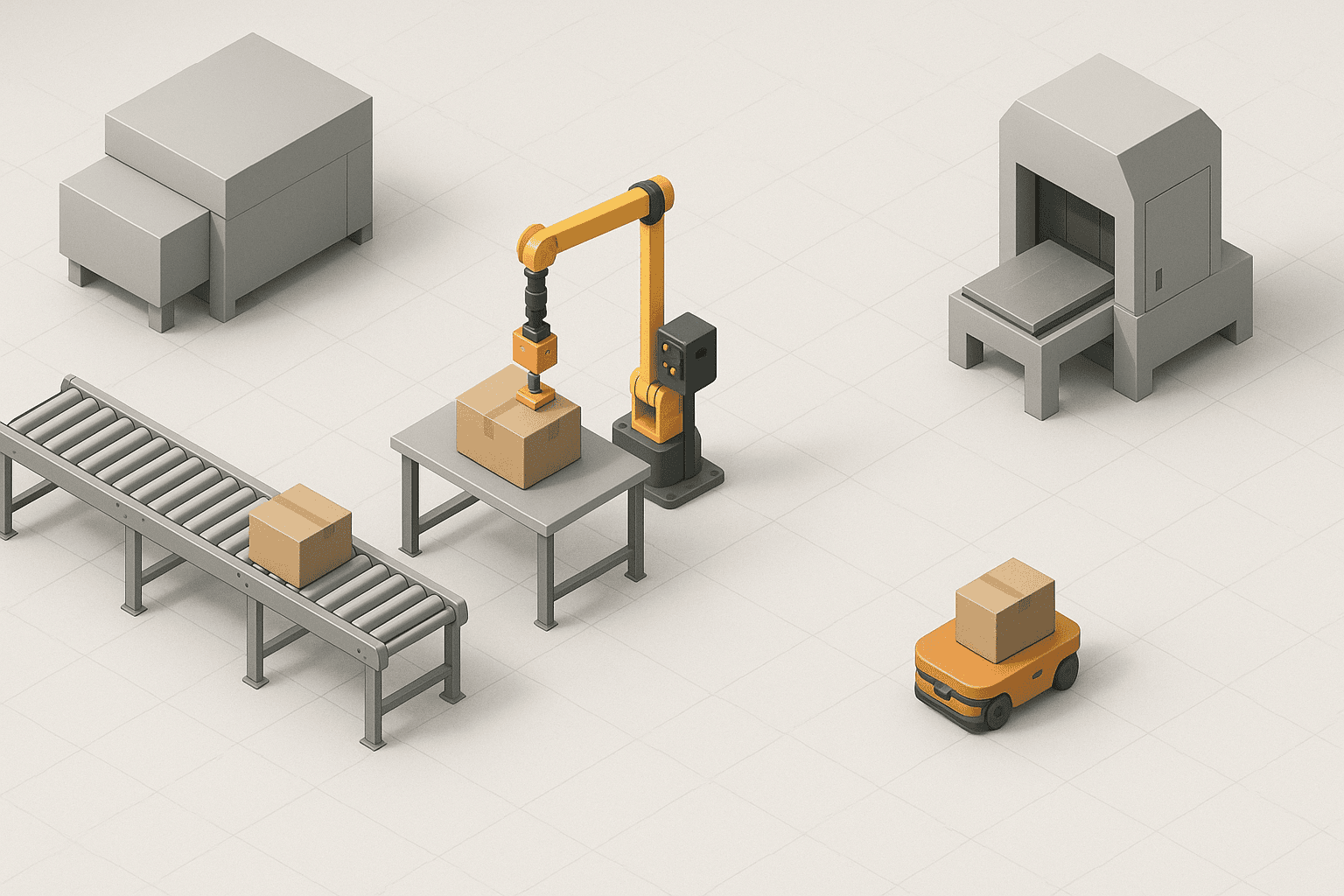
| Option | Suitable conditions | Main considerations |
|---|---|---|
| Gravity/powered conveyor | Fixed route, high frequency, stable mix | Escape route, crossings, jams, layout changes |
| Lift plus semi-auto feed | Height or manual-load burden is the main issue | Pinch/drop risks and positioning |
| AMR | Multiple routes, variable demand, staged expansion | Aisles, traffic rules, charging and network |
| Dedicated transfer machine | High speed and accuracy under fixed conditions | Future products and specialist maintenance |
RFP, FAT and SAT
Define performance not by top speed, but by moves per hour at an agreed utilization, 95th-percentile call-to-pickup time, empty-container behavior, and safe stop/recovery after communication loss. FAT should cover a mock layout and maximum load; SAT should cover actual congestion, floor transitions, intersections and wireless conditions.
Model estimate: assume THB 1.8 million initial cost, THB 720,000 annual value from redeployed handling work, THB 540,000 annual reduction in upstream/downstream downtime, and THB 180,000 maintenance and energy. Payback is 1,800,000 ÷ (720,000 + 540,000 − 180,000) × 12 = 20 months. Downtime benefit is an estimate based on observed downtime minutes multiplied by contribution margin per minute and annualized. Any revenue upside must also pass a demand and material-capacity check.
The outcome is not automatically “remove one person.” It is to reduce absence-driven instability and heavy transport, then redeploy the operator to changeover and quality verification.
SME automation case study 4: evaluate a robot cell as a complete system
Problem in this design example/model case
The fourth model automates CNC loading/unloading or case packing. The task is repetitive and the machine sits idle for long periods outside the staffed shift. Yet a price comparison limited to the robot arm omits the gripper, feed system, fixture, guarding, controls, legacy-machine modification, commissioning, training and spares.
Small proof of concept
Limit the initial scope to one or two parts. Verify gripping tolerance, presentation, post-process chips or oil, gauging, reject handling and replenishment. If a loan robot is unavailable, use 3D simulation, a simple gripper prototype and the existing fixture to retire uncertainty. Acceptance must cover cycle time, continuous operation, changeover, fault recovery and operator competence.
What public external cases show
The cases below are not the Thai model cases in this article. They are external U.S. company cases published by NIST MEP. Country, wages, products, markets and accounting differ, so their figures must not be transferred into a Thai factory’s ROI. Their decision sequences are still useful.
| External case | NIST MEP reported result | Practical lesson for a Thai plant |
|---|---|---|
| AMG Industries (published July 31, 2024) | After a three-month loan trial, bought a UR10E; output rose 38%, from 200 to 276 parts/hour | Test before purchase and update the investment decision with measured data |
| Go Fast Manufacturing (created Jan. 13, 2026) | Used a Profit Risk Assessment and automation roadmap; cutting speed rose from 400 to 4,000 inches/minute | Select from the business constraint and bottleneck, not from a machine catalog |
| A-1 Industries (created Jan. 13, 2026) | Identified target processes and worked with multiple technology firms; reported USD 2 million investment and 3% overall cost reduction | Keep requirements and overall accountability clear across suppliers |
| Cascade Corporation (created Jan. 13, 2026) | Evaluated ten technology opportunities, identified three cobot candidates and reported 10% higher uptime in the saw department | Prioritize a roadmap across the plant |
| Area 419 (created Dec. 5, 2025) | Automated parts handling let a five-axis machine operate for the remaining 16 hours; a similar machine was purchased within eight months | Prove one cell, then replicate |
| New Millennium (created May 23, updated May 30, 2026) | With workforce training, reported 70% lower automation downtime and 40% higher automated-process efficiency | Skills and recovery capability determine sustained performance |
Separate robot safety from integrated-system safety
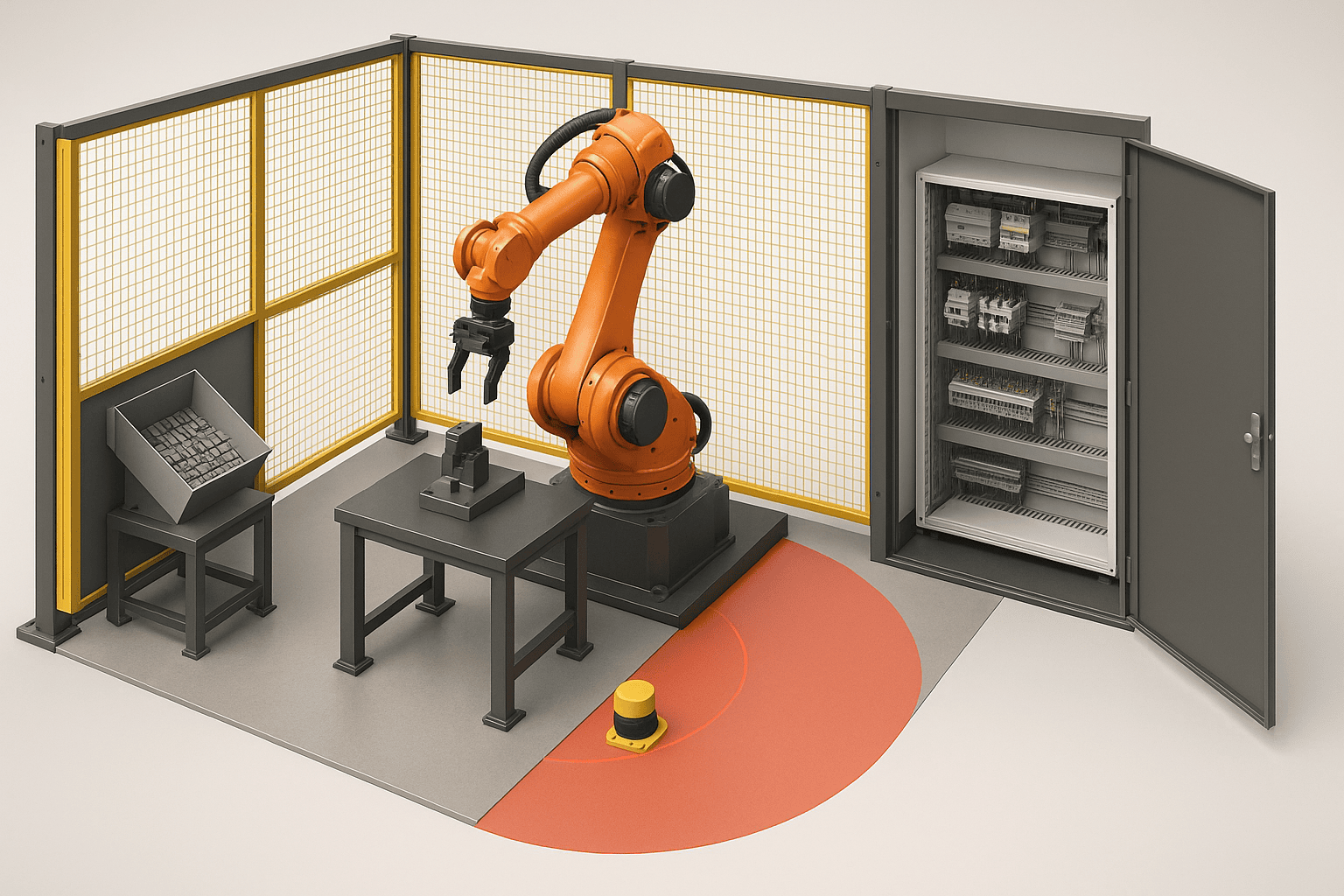
ISO published the third edition of ISO 10218-1:2025 in February 2025. Part 1 covers safety requirements for the industrial robot itself. The ISO page explicitly notes that integration and robot applications are addressed in ISO 10218-2:2025. Buying a robot associated with ISO 10218-1 therefore does not, by itself, establish that the completed cell is safe.
At system level, the risk assessment must cover the workpiece, end effector, fixture, peripheral machinery, process hazards such as machining or welding, guards and scanners, mode changes, teaching, cleaning, jam recovery, maintenance and reasonably foreseeable misuse. Applicable law, customer standards, current standards and validation methods should be determined for the specific project with competent safety personnel and the integrator. This article does not certify or promise standards conformity.
Compare the four paths: where should automation begin?
| Option | Initial objective | Technical uncertainty | Investment level | First evidence required |
|---|---|---|---|---|
| Jig and poka-yoke | Prevent creation or escape of defects | Low–medium | Low | Reduction by defect mode |
| Vision inspection | Standardize decisions and create image data | Medium | Low–medium | Misses, false rejects and cycle time |
| Handling/semi-automation | Reduce waiting, ergonomic load and inter-process variation | Medium | Medium | Stable calls and handoffs |
| Robot cell | Reduce repetitive work and equipment idle time | Medium–high | Medium–high | Continuous operation and recovery |
When uncertain, do not simply select the cheapest option. Select the option that tests the most important assumption at the lowest cost. If inspection performance may be limited by lighting or the defect standard, run an imaging study before ordering an inline system. If transport loss is caused by the call rule, pilot digital calls before buying AMRs.
Compare automation ROI with one consistent formula
When each department uses a different calculation, the loudest proposal may win. Standardize at least these formulas.
Annual net benefit
= value of redeployable work + contribution margin from added capacity + expected avoided defect/rework/downtime/incident loss − added maintenance − consumables − energy − software
Simple payback in months
= total initial investment ÷ annual net benefit × 12
Total initial investment includes equipment, peripherals, integration, legacy modifications, safeguarding, freight/duty, installation, commissioning, training, initial spares and internal project labor. For labor, specify whether value comes from attrition avoidance, overtime reduction, avoiding a future hire, or redeployment. Do not automatically call the full payroll a saving.
Use at least three sensitivity cases
| Case | Capacity/reduction effect | Utilization | Maintenance | Purpose |
|---|---|---|---|---|
| Conservative | 60–70% of proof result | Lower | Higher | Test the downside |
| Base | Proof result adjusted for demand | Normal | Quoted | Main approval case |
| Upside | Some demand growth and replication | Higher | Normal | Understand capacity headroom |
Label every figure as a project assumption. NIST MEP company results are reported results for those companies, not inputs for your model.
Required items in an RFP to an automation equipment manufacturer
A good RFP does more than describe a machine. It defines what must be true for acceptance.
- Current process, products, layout, operating hours and baseline losses
- Product variants, maximum/minimum workpiece, tolerance, material variation and future variants
- Acceptance criteria for rate, quality, changeover, continuous run and recovery
- Supply scope, exclusions and interfaces with existing equipment
- Responsibilities for safety design, risk assessment and validation records
- FAT/SAT tests, sample quantities, measurement methods and retest rules
- Delivery of PLC/HMI source, electrical drawings, BOM and backups
- Thai/English operator and maintenance training with competence check
- Warranty, local response, remote support, spares and obsolescence plan
- Change control, approval of additional cost and milestone payments
Evaluate price together with requirement understanding, omissions, maintainability, safety, documentation, local support and total cost of ownership. Our vendor selection guide explains responsibility boundaries in more detail.
Use FAT and SAT as investment gates
FAT and SAT are not ceremonies. They are gates for payment, ownership and production release.
Verify during FAT
- Approved drawings, installed components and software versions
- Rate and quality using representative models and boundary conditions
- Continuous run, incorrect input, full/empty states and power recovery
- Recorded verification that safety functions behave as designed
- Documentation, backups, spares and training materials
- Open-item list with owner and due date before SAT
Verify during SAT
- Performance with real materials, operators and utilities
- Upstream/downstream interfaces, actual layout and environment
- Operation, changeover, cleaning and recovery across shifts
- Maintenance staff’s ability to restore backups and replace key components
- Agreed continuous-run period, categorized downtime and quality capability
If a criterion is missed, do not close it verbally as “operations will manage.” Record the effect, temporary control, permanent correction, retest and payment hold. This is a practical way to reduce automation project failure risk.
Eight questions for the investment gate
- What loss did the baseline period quantify?
- Which assumption did the small proof test, and what evidence supports it?
- What human work and skill remain after automation?
- Does the project pay back if demand underperforms?
- Can it handle product change, material variation and fault recovery?
- Who owns maintenance, spares and remote support?
- Who accepts the safety risks and residual risks?
- What can be reused in the next machine?
If the only answer is “the vendor will handle it,” the responsibility boundary is incomplete. A system integrator is a critical partner, but the manufacturer still owns product strategy, demand, quality risk, workforce deployment and capital return.
Conclusion: connect small evidence to a disciplined investment decision
For a Thai SME, the fastest path is rarely the largest labor-saving machine. Compare jigs and poka-yoke, vision inspection, material handling and semi-automation, and a robot cell. Quantify the loss, test the largest uncertainty at small scale, turn the evidence into RFP acceptance criteria, verify it through FAT/SAT, and compare total investment and annual net benefit with one formula. External case figures are useful context, but the decision must use your own material, mix, work content, demand and maintenance capability.
You can talk with TOMAS TECH even before the candidate process, proof scope, RFP or FAT/SAT criteria are finalized. We help Thai factories structure the decision without starting from a preferred machine. Contact us with a brief description of your current process and constraint.
FAQ
Where should an SME start with automation?
Collect about four weeks of process data and translate defects, waiting, transport, downtime and ergonomic burden into time and money. Then test the most important assumption with the smallest safe proof. Robot model selection comes later.
How should we define the scope of small-start automation?
One process, one or two variants and one shift are a useful starting boundary, provided the solution can be expanded. Do not treat safety circuits or interfaces as vague temporary items. Include production fault recovery in the proof.
What belongs in an automation ROI calculation?
Include equipment, integration, fixturing, safeguarding, legacy modification, logistics, training and internal labor in initial cost. Add redeployable work, contribution margin and expected avoided loss as benefits, then subtract maintenance, consumables, energy and software.
Will a labor-saving machine reduce headcount?
Not necessarily. Replenishment, changeover, inspection, recovery and maintenance remain. Define a realistic benefit such as attrition avoidance, overtime reduction, avoiding a future hire or redeployment to another process.
How many automation equipment manufacturers should we compare?
The important point is to compare multiple proposals against the same RFP and acceptance conditions. Evaluate requirement understanding, technology, maintainability, safety, local support and total ownership cost—not quotation price alone.
Primary sources
- Thailand BOI / OSOS, “Thailand Secures $43.6bn 1H 2026 Investment Surge…” (July 23, 2026)
https://osos.boi.go.th/EN/news/2430/Thailand-Secures-43-6bn-1H-2026-Investment-Surge-as-Big-Tec/
- NIST MEP, AMG Industries (July 31, 2024)
- NIST MEP, Go Fast Manufacturing (created Jan. 13, 2026)
- NIST MEP, A-1 Industries (created Jan. 13, 2026)
https://www.nist.gov/mep/successstories/2024/automation-leads-increased-efficiencies-and-sales
- NIST MEP, Cascade Corporation (created Jan. 13, 2026)
- NIST MEP, Area 419 (created Dec. 5, 2025)
https://www.nist.gov/mep/successstories/2025/automation-results-increased-investment-and-staffing
- NIST MEP, New Millennium (created May 23, updated May 30, 2026)
- ISO, ISO 10218-1:2025, third edition (published Feb. 2025)


