


When a factory in Thailand starts working on heat illness, the first move is almost always the statutory WBGT measurement. Yet in plants that clear the limits at their once-a-year measurement, some people still collapse while their colleagues on the same line are fine. The average condition of a space and what is happening inside an individual body are two different things. This article separates the environmental measurement that Thai law requires from the individual risk that IoT wearables make visible, treats them as distinct layers, and explains at a design level how to connect the two.
Heat in Thai Factories Has Stopped Being an Occasional Accident
Heat is not a new subject for manufacturing in Thailand. What is new is that the heat is now being counted, has become a matter of interest to the authorities, and is drifting into the territory where an employer’s management responsibility can be questioned.
According to tallies by Thai health authorities, by early May 2024 more than 60 people had already died of heat stroke since the start of that year. Set against 37 deaths for the whole of 2023, that is a clear acceleration. The worst-affected regions were the Northeast with 33 deaths, the Central region with 13 and the North with 10, and most of the victims were agricultural or construction workers. The same authorities recorded 200 deaths in total between 2018 and May 2024.
More recent figures are available for 2025. The Department of Disease Control’s digital disease surveillance system captured 182 heat-related illness cases, and the epidemiology division counted 21 deaths, 18 men and 3 women, aged between 27 and 79. Looking at the age distribution of cases, the 15 to 34 bracket accounted for 78 cases, or 42.8 percent of the total, while people aged 60 and over accounted for only 29 cases, or 15.9 percent. In other words, the intuition that heat illness is an elderly person’s problem does not hold up against Thailand’s national statistics. By occupation, soldiers and general labourers working outdoors made up 53.3 percent of cases, and 28.5 percent of those who died were manual workers. By region, the Northeast recorded 52 percent of heat-related deaths, the highest share, followed by the Central and Western regions at 24 percent.
The 2026 hot season was also severe. In March of that year the Thai government published an outlook warning that between April and May the heat index could exceed 52 degrees Celsius, a level classified as very dangerous, and identified the North, Northeast and Central regions as the highest-risk areas. A heat index of 59.5 degrees Celsius had been recorded the previous year.
All of these are national figures, and it is true that outdoor workers make up a large share of them. But the inside of a plant that runs furnaces, boilers, injection moulding machines, drying ovens and paint booths has heat sources that are independent of the outside air temperature. Radiant heat from equipment does not disappear in the evening when the outdoor temperature falls. When the outdoor statistics are getting worse, there is no reason to assume that indoor high-temperature processes are safe.
Start by Fixing the Scope of the Legal Obligation
Before designing any countermeasure, you need to separate precisely what the law requires from what it does not. Going into product selection with this left vague produces two failures at once. You buy something believing it satisfies the law when it does not, and you also relax because you have satisfied the law while the real risk on the floor goes unmanaged.
Heat inside a workplace in Thailand is governed by a ministerial regulation issued under the Occupational Safety, Health and Environment Act B.E. 2554 (2011), rendered in English as the Ministerial Regulations on the Standard of Management and Operation on Safety, Occupation and Workplace Environment Regarding to Heat, Light and Noise, B.E. 2559 (2016).
The “heat level” regulated by that instrument is defined as the wet bulb globe temperature, or WBGT, of the area in which the worker is working. What matters most is how it is to be measured. The regulation states explicitly that the assessment uses the average over the two hottest hours of normal work. Not an instantaneous reading, and not a daily average, but the average of the hottest two hours.
The limits are split into three bands according to work intensity. Work intensity is classified by metabolic rate, that is, by how much heat the work generates inside the body.
| Work category | Indicative metabolic rate | WBGT limit |
|---|---|---|
| Light work | Up to 200 kcal per hour | Must not exceed 34 degrees Celsius |
| Moderate work | 201 to 350 kcal per hour | Must not exceed 32 degrees Celsius |
| Heavy work | Above 350 kcal per hour | Must not exceed 30 degrees Celsius |
The work classification is likewise determined by what the worker is actually doing during those two hottest hours. If the same person monitors machines in the morning and handles material transport in the afternoon, which of those periods happens to be the hottest can change which limit applies.
The employer’s procedural obligations run as follows. For processes with a heat source, the heat level must be measured at least once a year, the results reported to the Department of Labour Protection and Welfare within 30 business days, and the records kept at the establishment. Medical examinations for workers and reporting of those results to the authorities are also required. Where the standard is not met, engineering controls or personal protective equipment must be provided.
The penalty for breaching the standards set out in the ministerial regulation sits in the parent act. Section 53 of the Occupational Safety, Health and Environment Act B.E. 2554 provides that an employer who violates or fails to comply with a standard prescribed in a ministerial regulation issued under Section 8 is liable to imprisonment of up to one year, a fine of up to 400,000 baht, or both.
This is the point to state the central argument of this article. What the Thai regulation imposes is a duty to measure the working environment of the establishment, keep it within the limits and report it. It is not a duty to fit individual workers with biometric sensors and monitor heart rate or body temperature in real time. Any claim that Thai law requires wearable devices is simply wrong. The converse also holds. Handing a wearable to every worker does not, on its own, discharge the annual WBGT measurement and reporting duty. These are two different layers, with different purposes, different objects of measurement and different lines of accountability to the regulator.
What Fixed-Point Measurement Does Not Capture
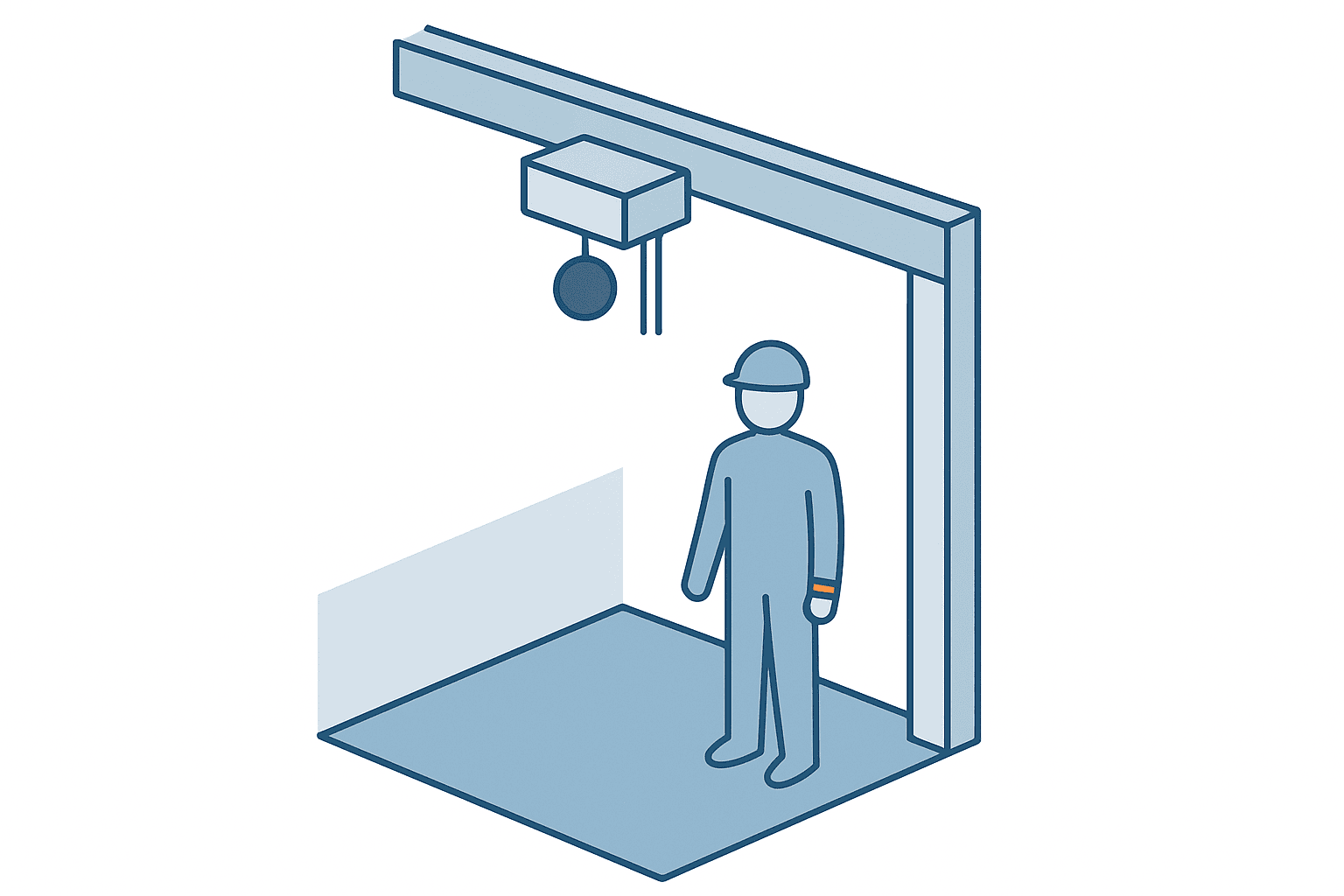
Measuring once a year and averaging the two hottest hours is a reasonable framework for a law. It filters out plainly dangerous working environments without imposing an excessive burden on employers. But there are three kinds of information that this method structurally misses.
The first is spatial variation. WBGT is derived from natural wet bulb temperature, globe temperature and dry bulb temperature. Indoors it weights natural wet bulb at 0.7 and globe temperature at 0.3; outdoors it weights natural wet bulb at 0.7, globe temperature at 0.2 and dry bulb at 0.1. Globe temperature is in the formula in order to capture radiant heat, and that is exactly what bites in a factory. With identical air temperature and humidity, a different radiant load produces a very different level of danger. In a plant with a high roof, poor air movement and large metal structures, heat accumulates, and a mezzanine can read a distinctly higher WBGT than the ground floor. The area in front of a furnace and the material storage area are closer to being separate environments than parts of one building, even under the same roof. If the annual measurement is taken at a single representative point, nothing guarantees that the point chosen is the most dangerous one.
The second is variation over time. The measurement is timed to catch the hottest two hours, but in practice how hot a workplace gets varies day to day with the outdoor temperature, the production schedule, how many furnaces are running, how often doors are opened and whether the air conditioning has failed. Researchers have noted that while the Thai heat standard requires measurement during the hottest part of the day, from 10:00 to 15:00, it does not prescribe how work and rest should be allocated. How many minutes of work and how many minutes of rest should follow an exceedance is left to the employer’s discretion. And even on a day when the limits are not exceeded, actual exposure rises when production is under pressure.
The third, and the most important, is individual variation. Workers placed in the same environment do not carry the same physiological load. A study at an aluminium smelter in Texas in the United States observed 60 potroom workers over four days in July. It used the heat strain criteria of the American Conference of Governmental Industrial Hygienists, namely a core body temperature exceeding 38.0 degrees Celsius (100.4 degrees Fahrenheit) for unacclimatised workers and 38.5 degrees Celsius (101.3 degrees Fahrenheit) for medically fit, heat-acclimatised workers, together with a heart rate exceeding 180 minus the worker’s age sustained over several minutes. The result was unambiguous. Of the 58 participants for whom core temperature data was obtained, 7 of the 8 unacclimatised participants, or 88 percent, exceeded the criteria, compared with 10 of the 50 acclimatised participants, or 20 percent. The study also found that those who exceeded the criteria had a significantly lower body mass index than those who did not.
That is the spread you get in the same plant, in the same hours, at the same WBGT. A new hire, someone returning from extended leave, a person seconded from another department, poor health, a bad night’s sleep, medication, protective clothing — none of these show up on a fixed WBGT instrument. Heat illness is not a function of the environment. It is a function of the environment and the individual together.
We have covered the approach of strengthening safety management with cameras and image sensing in how to advance factory safety management with AI, but what an image can capture stops at behaviour and equipment. The heat accumulating inside a body does not appear in the frame. These are different sensing layers.
Organising the Problem as Three Layers
With that established, it helps to split factory heat illness countermeasures into three layers. When the layers are mixed together, the legal compliance conversation, the shop floor operations conversation and the investment conversation collide at the same table and nothing moves forward.
| Layer | What is measured | Primary purpose | Typical means | Accountable to |
|---|---|---|---|---|
| Compliance layer | The environment of the work area (WBGT) | Meeting and reporting the statutory standard | Annual statutory measurement, permanently installed WBGT monitoring | Department of Labour Protection and Welfare, auditors, head office |
| Individual risk layer | The physiological response of each worker | Pulling someone out before symptoms appear | Wearable biometric sensors, heat strain indices | Line supervisors, occupational physician, the worker |
| Improvement layer | Correlation between environment, people and process conditions | Justifying investment in permanent fixes | Integration of environmental and biometric data, matching against process data | Management, capital investment decision makers |
None of these three layers substitutes for another. You can satisfy the compliance layer and still have people collapse, and you can perfect the individual risk layer without discharging your reporting obligations. The improvement layer only becomes possible once the data from the two layers above it exists.
The Canadian Centre for Occupational Health and Safety takes a similar position, describing physiological monitoring as a way to measure a worker’s physiological response to heat continuously, individually and quantitatively, and as something that can complement an existing heat stress programme. Complement rather than replace is exactly the framing the layer model above depends on.
What Wearable IoT Actually Measures
For the devices that carry the individual risk layer, you need an accurate picture of what is measured and what is inferred. Getting this wrong is what creates the gap between expectation and reality.
Today’s heat stress monitoring wearables for workers are worn on the wrist, upper arm, chest or ear, and directly measure roughly the following. Heart rate and heart rate variability, skin temperature, activity level derived from an accelerometer, and on some models electrodermal activity related to sweating. These are measured values.
Core body temperature, which is what the shop floor really wants to know, cannot be measured directly by non-invasive means. Most products estimate core temperature with a model that takes heart rate, skin temperature, activity and ambient temperature and humidity as inputs, then derive a proprietary heat strain index from that estimate. In other words, the body temperature a wearable displays is in most cases an estimate. This is a point that must always be communicated when introducing the devices. Hide the fact that it is an estimate and the first time a reading looks off, trust collapses and the device stops being worn.
Vendor implementations are appearing. A case published in May 2026 describes a wearable that picks up signs associated with fatigue and dehydration from core body temperature and heart rate variability, pairs over Bluetooth with single-gas and four-gas detectors, and transmits data over a cellular IoT network. The product is designed to warn before the worker reaches a dangerous threshold and to notify both a supervisor’s smartphone and a dashboard. Consolidating gas detection and heat stress into one device fits the reality of a shop floor where nobody wants to wear several separate pieces of protective equipment.
The market is also getting off the ground. One estimate puts the worker heat stress monitoring wearable market at 570 million US dollars in 2025 rising to 640 million US dollars in 2026, growth of 13.1 percent in a single year. The same estimate projects an average annual growth rate of 12.9 percent from 2026 to 2030, reaching 1.04 billion US dollars in 2030. In absolute terms this is still a small market, but the number of options on the supply side is genuinely increasing year on year.
The boundary needs restating here too. The heat strain index a wearable produces is not a statutory WBGT measurement, and it is not a number you can put into an annual report to the authorities. It exists inside the individual risk layer, as input for a supervisor deciding whether to stand this person down right now.
Alert Design Decides Whether the Deployment Succeeds
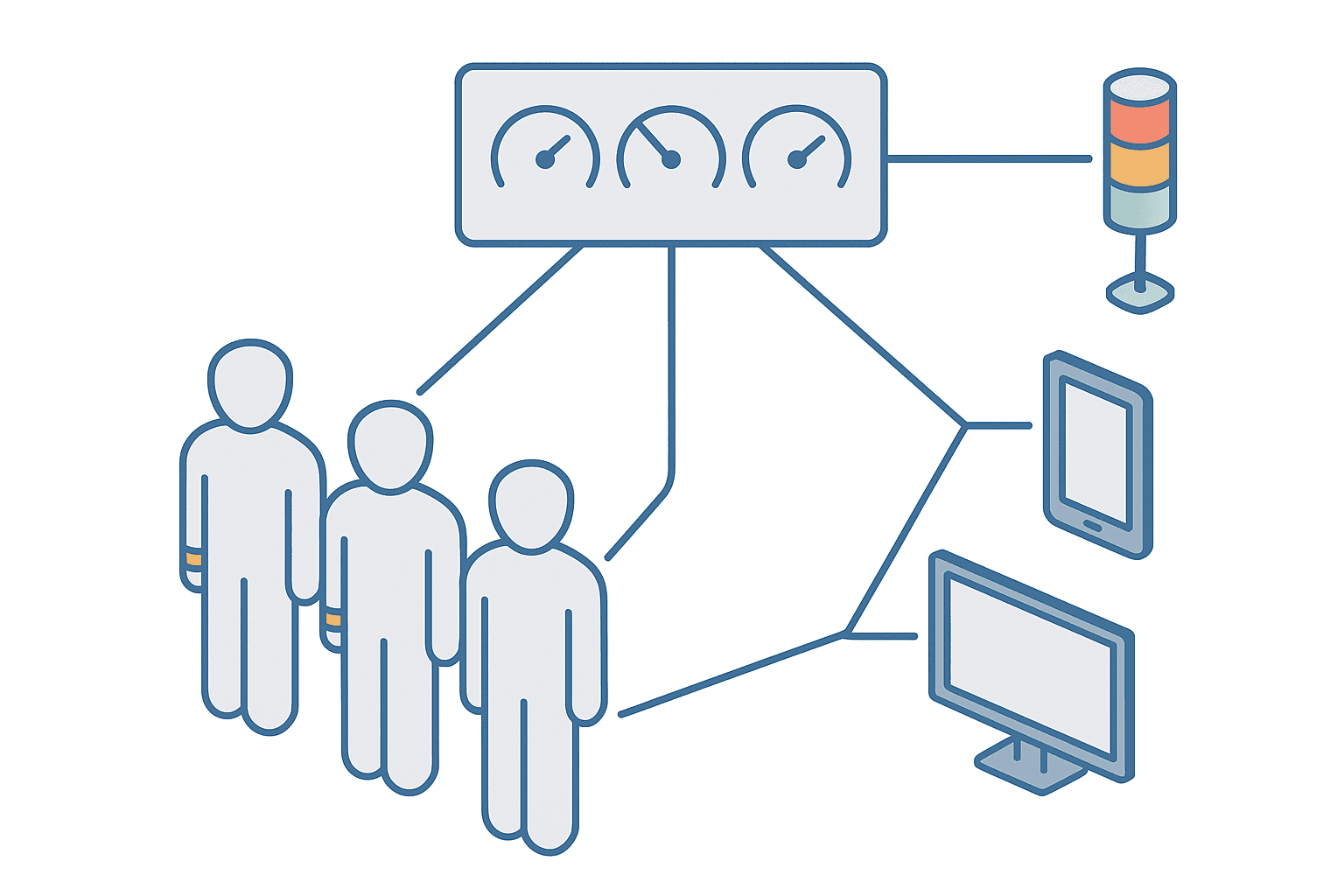
The most common failure when deploying IoT for heat illness is not a bad choice of hardware. It is bad alert design. Set the threshold too low and it fires dozens of times a day until the floor turns notifications off. Set it too high and by the time it fires it is already too late. Both happen in practice.
The starting point of the design is deciding who decides what. An alert only works if it is an instruction rather than a piece of information. Here is an example of a staged escalation.
| Tier | Condition detected | Notified | Expected action |
|---|---|---|---|
| Caution | Heart rate approaching the individual baseline threshold, ambient WBGT approaching the limit | The worker’s own device only | Drink water and change posture briefly |
| Warning | Heart rate above 180 minus age sustained over several minutes | The worker and the immediate team leader | At least 10 minutes of rest in a cool area, rotate the task |
| Severe | Estimated core body temperature above the criterion, or heart rate failing to recover | Team leader, production manager, control room monitor | Remove from the task, check condition, refer to the clinic if needed |
| Equipment factor | WBGT in a specific area persistently above the limit | Maintenance and the safety committee | Inspect the heat source, apply interim ventilation or shielding, raise a permanent fix |
What deserves attention in this table is that only the bottom row points at equipment rather than at a person. If individual alerts are concentrating in one area, that is not a problem with those individuals’ health, it is a problem with the equipment. Unless you design the path that feeds individual risk layer data into the improvement layer from the very beginning, you will spend every day standing someone down and the workplace will never actually improve.
There are practical ways to cut false alarms. Hold thresholds as deviations from an individual baseline rather than as absolute values. Require a condition to persist for a set period. Suspend evaluation during breaks and while a worker is moving between areas. Detect poor sensor fit and raise it as a fit alert rather than a heat alert. These measures alone will substantially reduce notification volume.
As for the notification path, the rule is to put the alert on something the floor already looks at. Adding one more colour to the existing andon light will be seen far more reliably than adding one more app.
Putting It on the Factory OT Platform You Already Have

If heat illness IoT goes in as a closed system on a separate track from the existing production and equipment monitoring platform, the operating burden doubles and the whole thing becomes a formality within a few years. In a plant that already has an OT network and a data platform, the realistic order of integration is as follows.
First, the permanently installed WBGT sensors on the environmental side go onto the same collection path as existing equipment and environmental monitoring. Most plants already collect temperature, humidity and electricity, so in many cases this amounts to adding points. What matters here is how the installation points are chosen. Rather than one representative point, place them so the heat gradient can be read — near heat sources such as furnaces and boilers, on the mezzanine and near the ceiling where radiant load is highest, at loading doors exposed to outside air, and at a reference point for comparison. The annual statutory measurement is carried out separately, by the prescribed method. Understand the permanent sensors as filling the gap between measurements, not as replacing the statutory measurement.
Second, the wearable data. Biometric data is fundamentally different in nature from environmental data, so it is easier to handle if the collection path and the storage location are kept separate and the two are only brought together at the visualisation stage. A design that pipes identifiable raw data into a plant-wide dashboard should be avoided both from the PDPA standpoint discussed below and from a plain operational standpoint.
Third, notifications. Heat alerts are added as one more stream on the notification channels that already exist — the andon, the existing call system, supervisors’ smartphones and the control room monitor. Not creating a new notification mechanism is the condition for the system sticking.
Finally, matching against process data. On the day you were running a given work order, on which line, how many warnings were raised. Once you can answer that, heat management stops being a safety and health topic and becomes a production planning topic. If warnings cluster only on the days you run a particular product, then heat source countermeasures or a change in manning for that process becomes a concrete investment theme.
Biometric Data and Thailand’s PDPA
Heart rate, body temperature and activity level are data that can fall within sensitive personal data under Thailand’s personal data protection law. Hand out devices before settling this and the programme will be stopped later.
Section 26 of the Personal Data Protection Act B.E. 2562 (2019) prohibits, as a general rule, the collection without the data subject’s explicit consent of data on racial or ethnic origin, political opinions, cult, religious or philosophical beliefs, sexual behaviour, criminal records, health data, disability, trade union information, genetic data, biometric data, and any data which may affect the data subject in a similar manner. The key point is that health data and biometric data are named explicitly in that list. Consent must be freely given, specific and informed, and it must be presented in plain language and clearly distinguishable from other matters. You should assume that reading a blanket consent into the work rules is unlikely to hold.
There are, however, exceptions. Section 26 lists as exceptions to explicit consent the prevention of danger to life, body or health where the data subject is incapable of giving consent, cases necessary for compliance with the law in relation to preventive or occupational medicine, assessment of the working capacity of an employee, or medical diagnosis, and cases necessary in relation to protection of employment and social security. That occupational medicine and assessment of working capacity are named explicitly makes these provisions relevant in a heat management context. Even so, a design that leans on the exceptions is fragile the moment the scope of that exception is contested. In practice the safe approach is a two-stage one — establish the legal basis, and separately obtain explicit consent as well. The administrative fine for a controller that breaches the first paragraph of Section 26 is set at up to 5,000,000 baht, which is not a figure to disregard.
Some design checkpoints worth listing. Narrow the items collected to the minimum needed for the safety purpose. Define who can see what level of detail by role, so that a team leader sees only the alert status of their own team while the occupational physician can see an individual’s history. Set a retention period and implement deletion once it has passed. Provide a means of withdrawing consent, and define an alternative arrangement so that a worker who withdraws suffers no disadvantage. If a subcontractor or device vendor moves data out of the country, verify the cross-border transfer requirements. And prepare the documents explaining all of this to workers in Thai.
The relationship between factory IoT data and the PDPA in general is covered in practical PDPA compliance for factory IoT. Biometric data is the category that demands the most cautious handling among the issues set out there.
Indicative Costs and Ownership
What follows is not published market pricing but our own estimate, based on experience supporting deployments in Thailand. The assumption is a site of 100 employees, of whom 30 work in high-temperature processes. The purpose is to show that the nature of the cost differs by layer.
| Layer | Cost item | Indicative cost | Nature of the cost |
|---|---|---|---|
| Compliance layer | Outsourced annual statutory measurement | 5,000 to 15,000 baht per process | Fixed cost, recurs every year |
| Compliance layer | Permanently installed WBGT monitoring unit | 30,000 to 80,000 baht per unit | Capital expenditure, scales with number of points |
| Individual risk layer | Wearable device | 4,000 to 15,000 baht per unit | Capital expenditure, scales with number of wearers |
| Individual risk layer | Cloud and connectivity charges | 150 to 400 baht per person per month | Recurring cost, scales with number of wearers |
| Improvement layer | Integration with the existing OT platform and screen development | 300,000 to 1,200,000 baht | Capital expenditure, one time |
| All layers | Operating design, consent documentation, training | 100,000 to 300,000 baht | Capital expenditure, light to refresh |
What to take from this table is less the amounts than the fact that the nature of the cost differs by layer. The compliance layer’s annual measurement recurs every year whatever else you do. The individual risk layer accumulates recurring cost in proportion to the number of wearers, which is why restricting it to high-risk processes rather than issuing devices to everyone is the decision that matters. The improvement layer costs little to repeat once built, and keeps producing material for investment decisions.
Reading that mapping between layers and cost items also clarifies the order of investment. When budget is tight, the integration work in the improvement layer is the part people assume they can cut, but in reality it is the opposite. Cut the improvement layer and the alerts that fire every day in the individual risk layer never turn into permanent fixes, leaving only the recurring cost. What should be cut is the scope of who wears a device, not the path that turns data into improvement.
On ownership, a workable split is for the safety committee to lead, maintenance to own the environmental sensors, the production department to own alert operations, and HR and general affairs to own consent documentation and training. There is no need for a dedicated full-time role, but decide from the outset who chairs the monthly alert review.
A Phased Sequence for Rolling This Out
There is no need to assemble everything at once. Working through the following sequence gives you something to judge by at each stage.
- In the first stage, review the results of your current statutory measurement and the placement of measurement points, and check whether the areas near heat sources are actually being measured. If there are gaps, start by revising the measurement points.
- In the second stage, install a handful of permanent WBGT sensors in the processes you believe are high risk and record the variation over several weeks to several months. This makes visible the temporal variation and spatial distribution that an annual measurement could never show.
- In the third stage, run a wearable trial limited to that process. A small number of participants is enough, and the purpose is to measure the size of individual variation and the operating burden. Consent documentation and training are put in place at this stage.
- In the fourth stage, tune the alert design against real data and put it on the existing notification channels. This is where you confirm the false alarm rate and how well the floor accepts it.
- In the fifth stage, match environmental data, biometric data and process data against each other and extract investment themes for permanent fixes.
The advantage of this sequence is that you can stop at any point. If the second stage shows that environmental variation is in fact small and individual factors dominate, it is entirely reasonable to conclude that investing in training and a revised work allocation beats adding more sensor points.
Frequently Asked Questions
Does Thai law require factories to make workers wear wearable devices?
No, it does not. What Ministerial Regulation B.E. 2559 requires is that you measure the heat level of the work area, that is the WBGT, keep it below the limit that corresponds to the work intensity, and report the results of a measurement taken at least once a year to the authorities. There is also an obligation to provide medical examinations for workers, but that is periodic examination, not real-time physiological monitoring. Treat the introduction of wearables not as discharging a statutory duty but as a voluntary programme to manage the individual risk layer that statutory duty does not cover.
Is a WBGT monitoring system alone insufficient as a heat illness countermeasure?
From a compliance standpoint, if you measure and report by a method that meets the requirements, it is sufficient. From a prevention standpoint, environmental measurement alone has limits. In the study at the aluminium smelter in the United States, 88 percent of the unacclimatised workers exceeded the core body temperature criteria in the same workplace environment, while only 20 percent of the acclimatised workers did. The fact that the same environment does not produce the same bodily response is the starting point for any countermeasure. Permanently installed WBGT monitoring fills in the temporal variation and spatial distribution that an annual measurement cannot capture, and wearables go one step further to cover individual variation.
Which process should a factory start with when deploying heat management IoT?
Start with processes that have a clear heat source and that people have to approach. Concretely, that means the area around furnaces and boilers, the outfeed of drying ovens and heat treatment lines, die change work on moulding machines, and equipment on mezzanines close to the roof. Conversely, starting in an air-conditioned area with no heat source yields very little information for the money. If you are unsure, cross-reference the processes where the most recent statutory measurement came close to the limit against the processes with a history of reported health complaints.
Can heart rate data collected by a wearable serve as evidence in a workers’ compensation claim for heat illness?
Do not assume it automatically will. Compensation claims are decided through a prescribed procedure, and how data an employer has collected on its own initiative is weighed is a case-by-case judgement. What matters more in practice is that if data is retained, so is the record of a warning that was raised and not acted on. Unless you operate the system so that the response to each alert is recorded alongside it, the data can end up working against the employer. Document the response procedure for when an alert fires, and design the mechanism for recording what was actually done at the same time.
At what headcount does a wearable-based heat programme pay for itself?
It fits reality better to judge by the character of the process than by headcount. On our own estimate, even with around 10 people in scope, if the high-temperature process runs continuously and there is a history of health complaints, the combined device and monthly cost will often come to less than the cost of a single heat illness incident, counting the production stoppage, the arrangement of a replacement worker and the reporting back to head office. Conversely, if you have 50 people in scope but heat exposure is seasonal and limited to a few weeks, permanent environmental sensors plus a revised work allocation will win on cost effectiveness.
Should we stop outsourcing our WBGT measurement to an external provider?
There is no need to stop, and you should not. The annual statutory measurement has to be carried out by the prescribed method and by qualified personnel, and outsourcing it to an external measurement provider is the usual arrangement. Permanent sensors and wearables do not replace that statutory measurement. They fill the gap between measurements, and the gap between the environment and the individual. There is also a useful side effect — comparing the results of the outsourced statutory measurement against what your permanent sensors recorded over the same period lets you verify whether the representative point was well chosen.
Conclusion
Heat illness countermeasures in Thai factories tend to be discussed as one thing, when they in fact serve two different purposes, legal compliance and prevention of illness. What this article has proposed is splitting that into three layers. Ministerial Regulation B.E. 2559 requires environmental measurement and reporting for the work area, evaluated as the average over the hottest two hours against limits of 34 degrees Celsius for light work, 32 degrees Celsius for moderate work and 30 degrees Celsius for heavy work. That is the compliance layer. But bodily responses to the same environment differ greatly between people, and there is observational evidence that heat acclimatisation alone splits the rate of exceeding the core body temperature criteria into 88 percent and 20 percent. Closing that gap is the job of the individual risk layer, carried by wearables. And matching both sets of data against process data to extract investment themes for permanent fixes is the improvement layer.
Regulation does not require wearables. That is precisely why you have to define for yourself what you are deploying them for. Settle three things first — alert design, integration with your existing OT platform, and a consent design that follows Thailand’s PDPA — and you can choose the hardware afterwards. Pick the hardware first and leave those three for later, and within a few months you will be left with a dashboard nobody looks at. There is still time to fix the design and get through a trial deployment before the next hot season arrives.
If you are at the point of wanting to map out where the statutory obligation ends and the gap begins for your own processes, or of working through concretely how to connect environmental sensors and biometric data to an equipment monitoring platform you already run, we would be glad to talk it through from our contact page. We will ask about your current measurement point layout and process conditions, and work out with you which layer it is realistic to start from.
References
- Guide to workplace environment measurement and assessment, Occupational Safety Bureau, Department of Labour Protection and Welfare — definition of heat level, the measurement method based on the average of the two hottest hours, the limits of 34 degrees Celsius for light work, 32 for moderate and 30 for heavy work, and the classification of work by metabolic rate
- Thailand, Management of heat, noise and lighting at Workplace, Enviliance ASIA — the English title of Ministerial Regulation B.E. 2559, the parent Occupational Safety, Health and Environment Act B.E. 2554, the duty to measure at least once a year and report within 30 business days, and the duty to provide and report worker medical examinations
- Occupational Safety, Health and Environment Act B.E. 2554, English translation published by the Thailand Institute of Occupational Safety and Health — employer duties under Section 8 and the Section 53 penalty of up to one year’s imprisonment or a fine of up to 400,000 baht
- Working with heat, light and noise under the law, Factorium — the official Thai title of the ministerial regulation and an explanation of the metabolic rate and WBGT limit for each work category
- Climate Warming and Occupational Heat and Hot Environment Standards in Thailand — that the Thai heat standard sets WBGT limits of 30, 32 and 34 degrees Celsius by work intensity while not prescribing work and rest allocation, and the requirement to measure between 10:00 and 15:00
- Thailand, over 60 deaths from heat stroke this year, Business and Human Rights Resource Centre — dated 11 May 2024. More than 60 heat stroke deaths year to date against 37 for the whole of 2023, 33 in the Northeast, 13 in the Central region and 10 in the North, and 200 deaths cumulatively since 2018
- Heat-related illness statistics, Thairath English — dated 14 March 2026. 182 heat-related illness cases in 2025 and 21 deaths counted by the epidemiology division, 78 cases or 42.8 percent in the 15 to 34 age bracket, 53.3 percent outdoor workers, and 52 percent in the Northeast
- Thailand braces for extreme heat in 2026, The Nation Thailand — dated 18 March 2026. The outlook that the heat index could exceed 52 degrees Celsius and reach the very dangerous level between April and May of that year, the 59.5 degrees Celsius recorded the previous year, and the North, Northeast and Central regions as highest risk
- OSHA Technical Manual Section III Chapter 4, Heat Stress — the indoor and outdoor WBGT formulas and the reflection of radiant heat through globe temperature
- Factors Associated With Heat Strain Among Workers at an Aluminum Smelter in Texas — the heat strain criteria of 100.4 degrees Fahrenheit and 101.3 degrees Fahrenheit core body temperature and a heart rate of 180 minus age, the difference between 7 of 8 unacclimatised and 10 of 50 acclimatised workers, the 60 workers studied and the four days of observation in July
- Hot Environments, Assessment and Control Measures, Canadian Centre for Occupational Health and Safety — the position that physiological monitoring provides continuous, individual and quantitative measurement and can complement an existing heat stress programme
- Worker Heat Stress Monitoring Wearable Market Report, Research and Markets — growth of 13.1 percent from 570 million US dollars in 2025 to 640 million US dollars in 2026, and an average annual rate of 12.9 percent from 2026 to 2030 reaching 1.04 billion US dollars in 2030
- Zackat Labs combines wearable heat stress monitoring and gas alerts, IoT Business News — the configuration that picks up signs of fatigue and dehydration from core body temperature and heart rate variability, Bluetooth pairing with gas detectors, and notification of supervisors before a threshold is reached
- Personal Data Protection Act B.E. 2562, English translation published by the Ministry of Digital Economy and Society — the Section 26 list of sensitive personal data including health data and biometric data, the principle of explicit consent and the exceptions covering occupational medicine, assessment of working capacity and protection of employment, and the Section 84 administrative fine of up to 5,000,000 baht
- Data Protected Thailand, Linklaters — that consent must be freely given, specific and informed, the requirement to present it in plain language clearly distinguishable from other matters, and the ceiling on administrative fines


