


If you run a factory in Thailand, rising labour costs and the difficulty of holding on to skilled operators get heavier every year. Collaborative robots are a serious option, but no amount of time spent reading catalogues will tell you which of your own processes a cobot would actually improve. What does tell you is the hard numbers reported in collaborative robot case studies from companies whose processes resemble yours. This article lines up published cases and their results process by process, covering machine tending, assembly, inspection and food packaging, and then works through how to think about cost and benefit, including the conditions specific to Thailand.
Why Collaborative Robot Case Studies Come Before Catalogues
Most cobot evaluations start with a manufacturer’s specification sheet. Payload, reach, repeatability, whether force sensing is built in. Every one of those is a meaningful specification, and none of them answers the question that actually matters, which is how much money a robot would produce if it were installed on that one process in your plant.
Spec Sheets Cannot Tell You Whether a Cobot Fits Your Line
A spec sheet will confirm that an arm rated for a 10 kg payload can lift your workpiece. It will not tell you how many operators’ worth of work the arm displaces, how much cycle time comes off, or how many months the investment takes to pay back. Those answers live inside the process, not inside the datasheet. Two robots with identical payload ratings produce completely different results depending on whether they are loading a machining centre that runs around the clock or applying labels during a few hours of the day shift.
That is exactly why, at the early stage of an investment decision, it pays to look first at what companies with processes similar to yours actually achieved. Once you can see the order of magnitude of the benefit, the internal discussion moves on from whether to automate at all to which process to automate first.
Read Case Studies by Motion, Not by Industry
The most common mistake when reading a collection of case studies is filtering by industry. Automotive parts makers look only at automotive parts cases, food plants look only at food cases. But what a collaborative robot replaces is not an industry. It is a human motion.
Taking a finished workpiece out of one machine and loading it into the next is essentially the same motion whether the part goes into a car, an electronic component or a medical device. Picking products off a tray and placing them into a carton is the same motion for food, cosmetics and moulded plastic parts alike. When you read case studies, prioritise a match in motion over a match in industry. Pick, place, fasten, apply, transfer. If those match, the results will be comparable even when the industries do not.
Three Assumptions to Fix Before You Read Any Numbers
Every published figure in a collaborative robot case study is the result that one company obtained on one of its processes. Read them the wrong way and internal expectations climb to a level nobody can deliver against later. Settle these three points first.
- The reported figures come from individual cases, and there is no guarantee the same improvement repeats on any other shop floor. The worse the pre-installation baseline, the larger the improvement rate looks
- Collaborative robots and industrial robots are separate categories, distinguished by criteria such as whether safety fencing is required. Some material published as robot deployment case studies does not state the conditions specific to collaborative operation
- The reported figures are rarely the result of the robot alone. Fixture and end effector design, a rethink of the surrounding material flow, and a redesign of the work procedure itself usually come with them
This article uses only figures whose source can be verified, and states explicitly where something could not be verified.
Collaborative Robot Case Studies and Results by Process

This is the core of the article. Published cases are organised by process, and each one is presented in the same order, what the process involves, what result was obtained, and where the figure comes from. Start with the entries whose motions resemble your own.
Machine Tending and Welding — 200% and 600% Productivity Gains with ROI Within 12 Months
Machine tending means loading raw material into machine tools such as machining centres, lathes and presses, and removing the finished workpiece afterwards. The work itself is simple, but while the machine is cutting, a person waits, and the operator’s time is consumed in fragments. It is one of the processes where collaborative robots deliver most readily.
The collaborative robot case study collection published by the International Federation of Robotics (IFR) includes a deployment covering welding and machining processes. In that case, the welding process is reported to have achieved a 200% productivity gain and the machine tending process a 600% productivity gain, with a return on investment (ROI) within 12 months.
Taken on its own, 600% sounds detached from reality. As a general matter, though, there is a structural explanation for why improvement rates run high in machine tending. In a plant where operators stand in front of machines waiting for a cycle to finish, actual machine running time is capped by human working hours. Once a robot handles loading and unloading, the machine keeps running through breaks. If daily running time multiplies several times over, a productivity figure that multiplies several times over is not arithmetically surprising. Note that this explanation describes the general mechanism behind large improvement rates. The pre-installation working conditions in the IFR case above are not something we were able to verify from published information.
The converse is equally important. In a plant where machine utilisation is already high and operators tend several machines without idle time, the same improvement rate will not appear. This is a point you have to settle by measuring your own current state before deciding anything.
Assembly and Screw Fastening — Uniform Cycle Times and Less Quality Variation
Assembly and screw fastening are tasks people can perform perfectly well by hand. The reason robots keep taking them over is that human hands cannot eliminate variation.
In the case story Universal Robots publishes on Sankei Industry, robot deployment on an assembly and component attachment line is reported to have succeeded in automating the work while securing uniform cycle times and safety, delivering quality consistency that does not depend on how experienced the operator is. The part worth noticing here is not a headcount reduction. It is the point about quality no longer depending on operator experience.
In our practical experience, this point carries particular weight in Thai factories. In an environment where staff turnover occurs at a steady rate, torque control and work sequence tend to differ between veterans and newcomers, and that difference surfaces as defects and customer complaints. Hand the screw fastening over to a robot and the tightening sequence and torque become identical every time. Quality that does not move when the people move also pays back in the form of lower training cost.
When you evaluate an assembly or fastening process, the harder problem is usually not selecting the robot but selecting the end effector. Until the design of the part that grips the workpiece is settled, the robot specification cannot be settled either. We cover that thinking in detail in Robot Hand and Gripper Selection for Factory Automation, so read that first if assembly-type processes are on your list.
Gear Manufacturing — One Operator Off a Two-Person Setup and a 30% Productivity Gain
In the case story Universal Robots publishes on Okubo Gear, collaborative robot deployment is reported to have reduced a two-person setup by one operator on the target equipment, while achieving a 30% productivity gain on that same equipment. The company manufactures gears.
The critical thing about reading this case correctly is that the benefit is described as limited to the target equipment. Plant-wide productivity did not rise 30%. The figure applies to the equipment where the robot was installed. When you circulate case study numbers internally, carry that scope limitation with them. Drop the scope and report only that productivity rises 30%, and expectations inflate to the point where the post-installation review looks harsher than the result deserves.
The scale is realistic too. A two-person setup reduced by one operator is what collaborative robot deployment actually looks like. It does not turn a process unmanned overnight; it lets a smaller team run work that previously needed a larger one. It is the accumulation of changes at that scale that adds up to a leaner plant.
Inspection — Fixing the Viewing Conditions Rather Than Replacing the Eye
Inspection comes up constantly as a candidate for collaborative robots, but among published cases there are fewer verifiable quantitative results than for machine tending or packaging. Since this article does not print figures it cannot verify, this section sets out how to think about the process rather than what percentage to expect.
What the robot handles in an inspection process is usually not the judgement itself. It is presenting the workpiece to the camera at a fixed position and a fixed angle. When a person holds a part and inspects it visually, the grip, the angle and the way the light falls change every single time. That instability is where missed defects breed. Give the collaborative robot the job of holding the workpiece and controlling its orientation, fix the imaging conditions, and let image processing make the call, and the decision criteria stabilise.
The consequence is that when you evaluate inspection, the investment is not a robot. It is a combination of robot, image processing and lighting. Judge the project on a quotation for the robot alone and the cost will grow afterwards.
Sorting, Labelling and Packaging — Cases That State the Headcount Change
Downstream processes such as sorting, labelling and packaging are comparatively well represented among published cases that state a specific headcount reduction. A column published by Nikken Total Sourcing describes the following three cases.
Takazono, a manufacturer of medical dispensing and packaging machines, is reported to have cut operators on its product sorting and loading process from 6 to 4 through robot deployment. Takagi Bakery is reported to have cut operators on its labelling process from 5 to 2, while also eliminating label application errors. Nippon Ham Factory, a producer of ham and sausage, is reported to have cut operators on the process feeding its packaging machine from 5 to 3.
These are described as robot deployment cases rather than being specifically identified as collaborative robots. Whether safety fencing could be omitted is not verifiable from the source, so do not read them as evidence that fencing became unnecessary because the robots were collaborative. What is worth taking from all three is that none of the processes went unmanned. The reduction landed at two or three operators and stopped there.
Cases that state a headcount change also have a practical advantage in internal approval processes. A statement that five operators became two carries meaning for the finance department and the plant manager alike, in a way that a percentage productivity gain usually does not.
Painting — Accuracy, Productivity and Quality Gains with a UR10
The IFR collection includes a case in which a UR10 was deployed on a painting process, improving accuracy, productivity and quality (October 2024). Painting is a process where operator health has to be considered, and where coating uniformity depends heavily on individual skill. What characterises this process is that the motivation for automating is not only reducing headcount but improving the working environment.
Be aware that painting processes bring interfaces with explosion-proof specifications and ventilation equipment, so there are more surrounding conditions to confirm than in other processes. It is worth pulling your facilities and safety people into the discussion at an early stage.
Food Baking — A Bakery Running FANUC Collaborative Robots
The same IFR collection includes a case in which the bakery Bakisto adopted FANUC collaborative robots and automated its baking process, freeing staff from repetitive work, improving process reliability and reducing food waste (December 2025).
What stands out here is that waste reduction is listed among the benefits. In other words, there are processes where material loss, not only headcount and quality, contributes to the return on investment. Where yield is part of the investment case, calculating payback from labour cost alone will understate the benefit.
The Process-by-Process Summary Table
Here are the cases above, rearranged so that process and result sit side by side. Start your evaluation from the row closest to your own process.
| Process | Result verified in published cases | Source |
|---|---|---|
| Welding | 200% productivity gain, ROI within 12 months | IFR case collection |
| Machine tending | 600% productivity gain, ROI within 12 months | IFR case collection |
| Gear manufacturing | Two-person setup reduced by one operator, 30% productivity gain on target equipment | Universal Robots, Okubo Gear |
| Assembly and component attachment | Uniform cycle times and consistent quality | Universal Robots, Sankei Industry |
| Sorting and loading | Operators from 6 to 4 | Nikken Total Sourcing |
| Labelling | Operators from 5 to 2, label errors prevented | Nikken Total Sourcing |
| Feeding a packaging machine | Operators from 5 to 3 | Nikken Total Sourcing |
| Painting | Improved accuracy, productivity and quality | IFR case collection |
| Baking | Freedom from repetitive work, better reliability, less food waste | IFR case collection |
Looking down the table, the benefits fall into two distinct shapes. One is the machine tending and welding shape, where extending equipment running time produces a large multiple in productivity. The other is the labelling and packaging shape, where the benefit appears as fewer people. Working out which shape your target process belongs to changes how you should estimate the benefit.
How to Think About Collaborative Robot Cost and Benefit
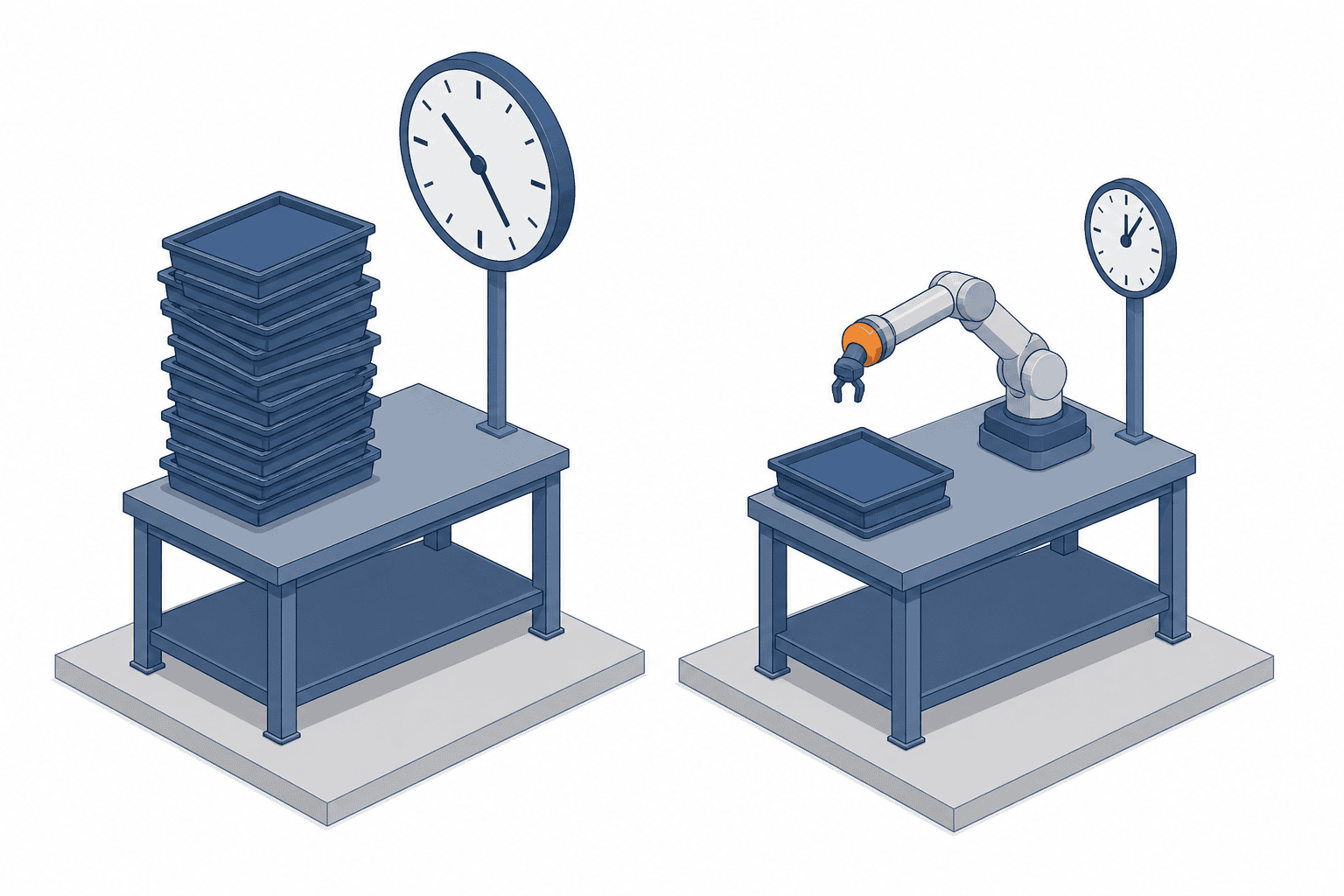
Once you know what the case studies report, the next step is applying them to your own plant. The important thing here is not to multiply your own numbers by somebody else’s improvement rate.
The General ROI Benchmark Is 8 to 18 Months
The ROI, or payback period, for collaborative robot deployment is generally cited as somewhere in the region of 8 to 18 months. Productivity gains are described as ranging from 20% to 200% depending on baseline efficiency and task complexity.
The width of that range is the genuinely useful information. There is a factor of ten between 20% and 200%, and the same investment produces completely different payback periods across that span. What creates the width is the pre-installation state. The more time operators spend waiting in front of machines, the larger the improvement rate. The more efficiently a plant already runs multi-machine tending, the smaller it gets.
So looking at a case study and concluding that your plant will also see 600% gets the order of operations backwards. Measure your own baseline first, meaning how much waiting time exists in the target process and what proportion of working hours the equipment actually runs. The worse those numbers are, the better your return on a collaborative robot will be.
Build the Payback Estimate From Three Numbers
Consider a hypothetical company. Assume a Japanese-affiliated metalworking plant operating in Thailand installs one collaborative robot to tend two machining centres. In that situation, the estimate comes down to three numbers.
- The operator hours that can be removed or redeployed. How many hours of work per day transfer to the robot
- The labour cost attached to those hours. Not base pay alone but the actual figure including social insurance and overtime premiums
- The increase in actual equipment running time. How many more hours the machine runs once nobody has to wait for it, and how many additional units that time produces
The annual benefit is those three converted into money and added together. The payback period is the initial investment divided by the annual benefit. The formula is simple, and in practice the third item is the hard one. An increase in equipment running time only becomes money if the additional output can be sold. In a plant where orders have plateaued, running the machine longer just builds inventory, and inventory is not a benefit.
So before you run the estimate, confirm with your sales side whether demand exists for the additional volume. If it does not, the benefit has to be calculated from labour cost savings alone, and the payback period lengthens accordingly. Estimates that skip this confirmation land on the optimistic side almost without exception.
Costs That Get Missed, and Where the Cost Structure Is Broken Down
The initial investment is not just the price of the robot. End effectors, the mounting frame, surrounding conveyance, safety assessment, teaching, signal interfacing with existing equipment, and the production losses incurred during commissioning all belong in the investment figure. Calculate payback from the robot price alone and actual payback lands a long way further out.
For how to decompose and estimate that cost structure, Collaborative Robot Deployment Cost and Process with Safety Standards sets out the cost breakdown along with the mandatory steps around safety standards. For smaller plants, the approach of estimating robot deployment cost in layers is covered in Industrial Robot Deployment Cost Model with a Five-Layer Breakdown for Smaller Plants. The payback thinking in this article is a case-based approximation, so read those two alongside it when you move towards an actual budget.
Collaborative Robot Pricing Outlook and Market Growth
There are useful forecasts on cobot pricing itself. Measured on a manufacturer shipment value basis, Japan’s domestic collaborative robot market stood at JPY 100,078 million in 2019 (1,000 oku 7,800 man yen in the source’s own unit notation) and is forecast to exceed JPY 223,082 million by 2030 (2,230 oku 8,200 man yen). Cobot unit prices are expected to fall by roughly 30% from 2020 levels by 2030. For context, Universal Robots, cited as the leading collaborative robot manufacturer by global market share, was founded in 2005, which tells you the market itself is comparatively young.
Given that prices are expected to fall, should you wait? We get that question often, and our view is that it rarely justifies waiting. There are two reasons. The first is that what is expected to fall is the robot price, and the robot accounts for a modest share of the total investment. End effectors, surrounding fabrication and engineering costs do not fall the way unit prices do. The second is that the labour cost during the waiting period is money that actually leaves the business. For a project whose payback lands inside the 8-to-18-month range, the cost of waiting is very likely the larger number.
| Item | Benchmark or forecast | Note |
|---|---|---|
| General ROI benchmark | 8 to 18 months | An industry benchmark, not a guaranteed value |
| Productivity gain range | 20% to 200% | Varies with baseline efficiency and task complexity |
| Japan domestic market 2019 | JPY 100,078 million | Manufacturer shipment value basis |
| Japan domestic market 2030 forecast | Above JPY 223,082 million | Manufacturer shipment value basis |
| Unit price outlook | Roughly 30% below 2020 levels by 2030 | A forecast for the robot price, not total investment |
Success Patterns and Pitfalls Visible in the Case Studies
Read across the case studies and you find that successful deployments share a common approach, while the projects that failed to produce results share common reasons.
Success Pattern — Start Small and Replicate Sideways
What the companies with results have in common is that they started with one process and one robot. Rather than drawing up a plant-wide automation concept and investing across the board, they picked one process where the benefit was easy to read, built a track record and in-house know-how there, and then extended to the adjacent process.
This approach has three practical advantages. First, the initial investment is small, so the decision is quick. Second, the first robot trains the people who will handle teaching and maintenance, which shortens commissioning for every robot after it. Third, the gap between assumption and reality gets discovered at a small monetary scale.
Success Pattern — Scope the Job by Motion, Not by Task
Framing the job as automating the inspection process leaves the scope too broad for anyone to write a specification. Break it down to placing the workpiece on the inspection table and tilting it to a defined angle three times, and the required robot and gripper become concrete. The projects in the case studies that were commissioned quickly are the ones that did this decomposition.
Pitfall — Pick the Wrong Process and the Numbers Never Appear
The classic failure is a target process whose work time was short to begin with. Automating a task that occupies a total of 30 minutes a day saves a strictly limited amount of labour cost. Collaborative robots pay off on processes that repeat the same motion for long stretches. Start by measuring how many hours a day the target process actually runs.
The other classic is a process with high variability in the workpiece. When material shape or presentation differs every time, absorbing that on the robot side requires image processing and heavily engineered fixtures, and the investment jumps. In that situation, straightening out the upstream process before installing a robot usually ends up cheaper.
Pitfall — Applying Case Study Numbers Directly to Your Own Plant
To repeat, a published result is what that company achieved on that process. The 600% figure holds because of the specific operating conditions that existed before installation. When you quote a case in internal documents, always carry the source and the qualifier that the benefit applies to the target process.
Pitfall — Confusing Collaborative Robots With Industrial Robots
Collaborative robots and industrial robots are separate categories, distinguished by criteria such as whether safety fencing is required. Some information published as robot deployment case studies does not spell out the details of collaborative-specific safety design. Do not generalise to the conclusion that a collaborative robot can always be installed without fencing. Whether a given installation is acceptable has to be decided on a risk assessment. The practical side of safety standards is covered in the collaborative robot deployment article referenced above.
Collaborative Robots in Thailand and ASEAN
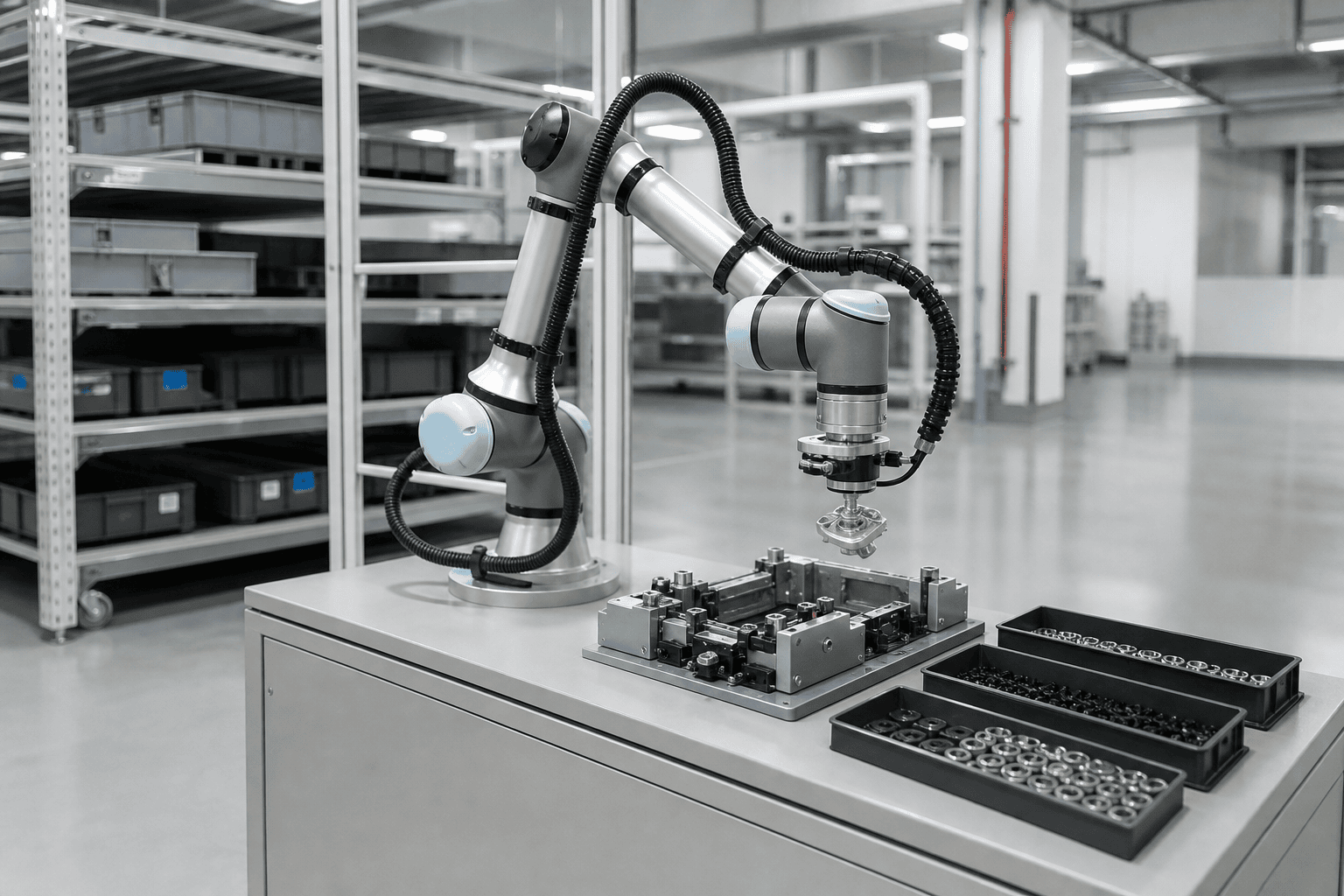
Everything so far has been Japanese and global cases. From here, the discussion moves onto Thai shop floors. For labour-saving measures more broadly, not limited to collaborative robots, Factory Labour Saving with Case Studies and Cost-Benefit Thinking organises cases and returns across different equipment types, which is a useful reference if you want to compare options beyond robots.
The Wide Automation Gap Inside Thailand’s Automotive Industry
An industry association study of Thailand’s automotive sector is reported to give the following picture. Body welding at vehicle manufacturers (OEMs), the body-in-white process, runs at an automation rate above 90%, while Tier 1 suppliers sit at 40% to 60% and Tier 2 to Tier 3 suppliers at only 10% to 25%.
That gap is a map of where the headroom is. OEM welding lines are already automated and there is limited room left. In the Tier 2 to Tier 3 layer, by contrast, a large number of processes remain unautomated. And in that layer, collaborative robots are reported to be spreading for screw fastening, adhesive dispensing and machine tending, specifically products such as those from Universal Robots and the FANUC CRX series.
This is where the cases from the first half of this article come back. The 600% productivity gain with ROI within 12 months came from a machine tending process. The two-person setup reduced by one operator with a 30% productivity gain came from a gear manufacturing operation doing parts machining. The processes where collaborative robot adoption is spreading among Thai Tier 2 to Tier 3 suppliers and the processes where published cases confirm results are the same processes.
What Is Driving Thailand’s Collaborative Robot Market
Thailand’s collaborative robot market is reported to be expanding with automotive, electronics, healthcare and furniture and fixtures as its main industries, with rising labour costs, a shortage of skilled workers and government Industry 4.0 promotion cited as growth drivers.
Of those three drivers, the second is the one that feels most immediate on the shop floor. Advertising a position and getting no experienced applicants, then watching people you trained move on within a few years, is a shared experience across many Japanese-affiliated plants. Seen through that lens, the purpose of the investment shifts from reducing headcount to holding quality and output steady as people change. The consistent quality independent of operator experience reported in the Sankei Industry case speaks directly to that purpose.
BOI’s Industry 4.0 Priority Sectors as a Tailwind
Thailand’s Board of Investment (BOI) is reported to have positioned Industry 4.0 related fields, including smart factories, AI-enabled production and automation, as priority sectors in its manufacturing investment review for 2026. When you plan an automation investment, it is worth checking early whether it could qualify for BOI incentives. Eligibility and conditions are decided case by case, so confirm the details directly with the BOI or an adviser experienced in the application process.
Starting Small Matters Even More in Thailand
Tier 2 and Tier 3 suppliers have less investment capacity than OEMs and Tier 1 companies. That is precisely why the one-process, one-robot approach described earlier is an especially realistic choice on Thai shop floors.
There is a second, Thailand-specific practical reason. Whether you can keep the people who commission and run the robot day to day in-house has a large effect on utilisation after deployment. If local staff learn teaching and basic troubleshooting on the first robot, the scope of outsourcing shrinks from the second one onwards. Commission several robots simultaneously from the start, however, and training never catches up, external dependence gets locked in, and running costs stay where they are.
One caveat. Case studies naming specific companies deploying collaborative robots inside Thailand could not be verified as published information in this research. This article therefore combines the results shown in Japanese and global cases with Thai industrial structure and market data, and presents the conclusion that the same process selection logic applies on Thai shop floors as our own view. Please read the facts and the interpretation as separate things.
A Checklist to Test Whether Your Process Fits
Having read the cases, here are the items to check when deciding whether your own process suits a collaborative robot. They are written at a level of detail you can confirm while walking the plant.
- How many hours a day does the target process run in total. Establish this from actual measurement
- How much of that time do people spend waiting. Check what proportion of working hours the equipment actually runs
- Are the shape, dimensions and presented orientation of the workpiece the same every time. If they vary, can the upstream process be straightened out
- Can the job be decomposed into pick, place, fasten, apply and transfer. A process that resists decomposition will not produce a firm specification
- If output increases, is there demand for the additional volume. Has this been confirmed with the sales side
- Do quality defects on the target process depend on operator experience
- Can you secure people in-house to handle commissioning and daily operation
- Are installation space, power supply and signal interfacing with existing equipment available
- Do you have the capability to carry out a safety risk assessment
- Have you checked whether the investment could qualify for BOI incentives
If you can answer the first three with confidence, the project is well worth taking to an estimate. Request a quotation before you have measured how long the target process actually runs, on the other hand, and you end up debating a price with no basis for comparison.
Frequently Asked Questions
How Should I Think About Collaborative Robot Cost and Benefit
The general benchmark for payback is 8 to 18 months. That is an industry benchmark, though, and your own payback has to be calculated from three numbers — the working hours you can remove, the labour cost attached to those hours, and the increase in actual equipment running time. Productivity gains span a wide range from 20% to 200%, and the worse the pre-installation state, the larger the improvement rate. Rather than applying a case study percentage directly, measure your own baseline first and then estimate.
Will Collaborative Robot Prices Fall Further, and Should I Wait
Cobot unit prices are expected to fall by roughly 30% from 2020 levels by 2030. What falls, though, is the robot price. End effectors, surrounding fabrication and engineering costs do not fall in the same way. For a project whose payback is expected to land within 8 to 18 months, the labour cost incurred while waiting is very likely the larger number, so we do not see it as a good reason to wait.
Are Manufacturing Robot Case Studies Useful for Smaller Plants
Yes. Most of the cases in this article involve changes on a modest scale — a two-person setup reduced by one operator, 6 operators to 4, 5 to 2, 5 to 3. None of them describes a plant going unmanned in one move. They describe headcount coming down one process at a time. That is a granularity smaller plants can realistically consider reproducing.
Can Collaborative Robots Be Installed Without Safety Fencing
Collaborative robots and industrial robots are separate categories, distinguished by criteria such as whether safety fencing is required, but being collaborative does not always mean fencing becomes unnecessary. Whether a given installation is acceptable is decided case by case on a risk assessment covering workpiece shape, operating speed, surrounding layout and how often people approach. The procedures around safety standards are covered in a separate article.
Will Thai Factories See the Same Results as Japanese Ones
Case studies naming specific deploying companies inside Thailand could not be verified as published information in this research. That said, the processes where collaborative robot adoption is reported to be spreading among Thai Tier 2 to Tier 3 suppliers, namely screw fastening, adhesive dispensing and machine tending, are the same processes where published cases confirm results. We believe the process selection logic transfers directly, but the numbers should be re-estimated against your own baseline.
Summary
Here is what to take away from these collaborative robot case studies.
- Read cases by motion rather than industry. If pick, place, fasten, apply and transfer match, the results will be comparable even across different industries
- The IFR case collection reports a 200% productivity gain on a welding process and 600% on machine tending, with ROI within 12 months
- In Universal Robots cases, Okubo Gear reduced a two-person setup by one operator with a 30% productivity gain on the target equipment, and Sankei Industry achieved uniform cycle times and consistent quality
- Sorting, labelling and packaging cases state headcount changes explicitly, going from 6 operators to 4, from 5 to 2, and from 5 to 3
- The general ROI benchmark is 8 to 18 months and productivity gains range from 20% to 200%. The width of that range comes from differences in the pre-installation baseline
- Japan’s domestic market is forecast to grow from JPY 100,078 million in 2019 to above JPY 223,082 million by 2030, with unit prices expected to sit roughly 30% below 2020 levels by 2030
- In Thailand, OEM body welding runs above 90% automation while Tier 1 sits at 40% to 60% and Tier 2 to Tier 3 at 10% to 25%. The headroom is in Tier 2 and Tier 3 processes
- Thailand’s BOI is reported to have positioned Industry 4.0 related fields as priority sectors in its manufacturing investment review for 2026
The first thing to do is not to request a quotation. It is to measure how many hours a day the target process actually runs. Without that number, no case study will tell you whether it applies to your plant.
TOMAS TECH supports Japanese-affiliated manufacturers operating in Thailand with shop floor digitalisation and automation, including the PEGASUS production management system. On collaborative robots, we are happy to start further upstream, with questions such as which of your processes is a candidate and what exactly you should measure if you begin with measurement. Information gathering before any decision is entirely welcome, so please get in touch through our contact page.
References
- International Federation of Robotics – Case Studies Collaborative Robots
- Universal Robots – Okubo Gear Case Story
- Universal Robots – Sankei Industry Case Story
- Nikken Total Sourcing – Collaborative Robot Case Studies and Market Trends
- MANTEC – Robotics on the Line, Simple ROI Calculator and Adoption Roadmap
- Robotomated – Cobot Adoption in Manufacturing 2026
- Seraphim – Robotics in Thailand Automotive Industry
- 6Wresearch – Thailand Collaborative Robot Market
- Pertama Partners – Thailand BOI Manufacturing


