


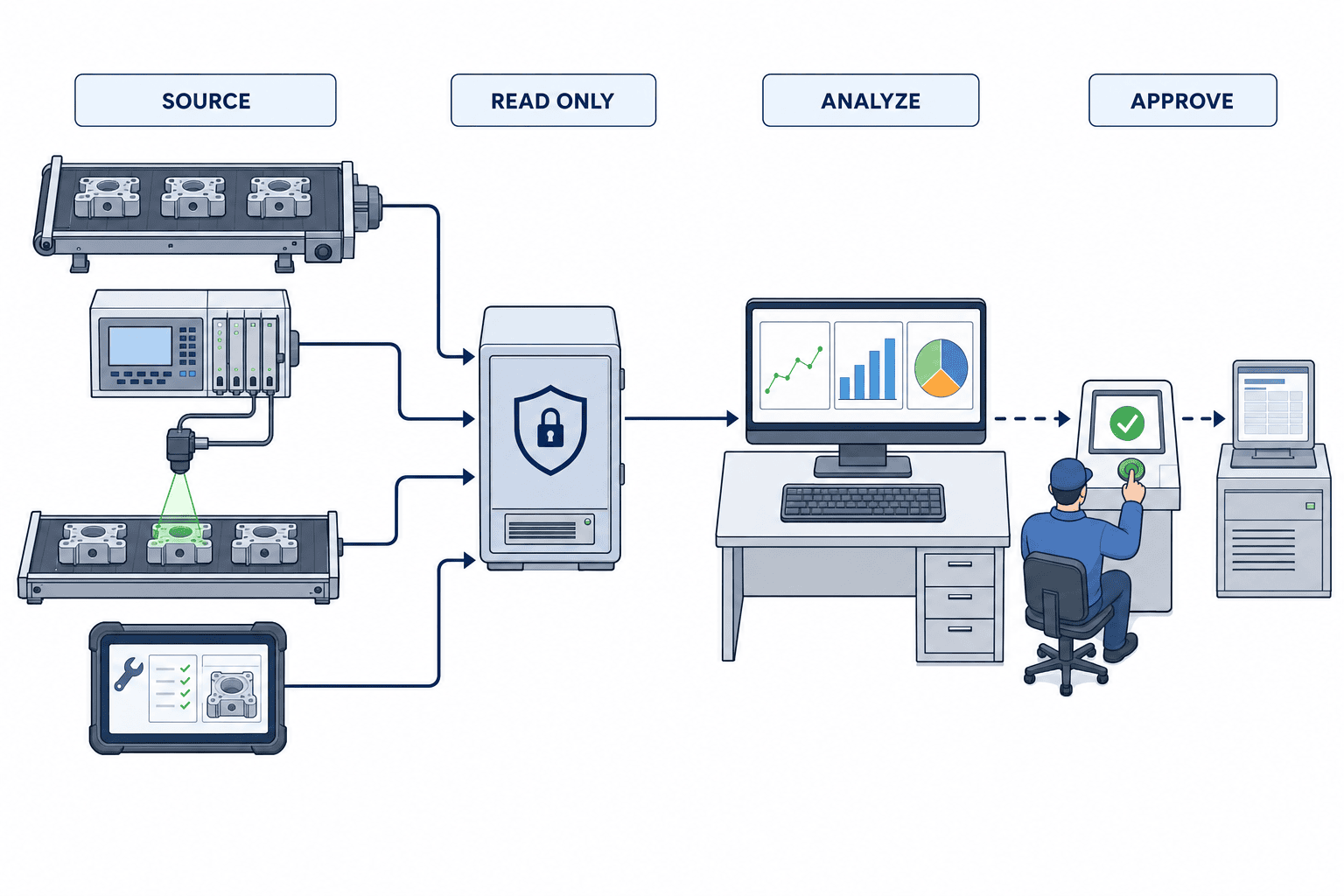
Many manufacturers want to put ChatGPT to work, but their plan becomes vague immediately after the enterprise environment is approved. This guide is not a plan comparison or a broad collection of generative AI examples. It explains how a Thai manufacturing site can implement and formally evaluate a 90-day ChatGPT Work pilot for three specific workflows: (1) daily and weekly operations reviews, (2) consolidated quality, maintenance, and customer-response documents, and (3) KPI analysis and dashboards. The initial scope ends at read-only access, analysis, and deliverable creation. A human remains in the approval path for every write to ERP, MES, or OT systems.
Define an acceptance scope for a 90-day ChatGPT pilot
Manufacturing AI projects often stall because the acceptance unit is unclear, not because the technology is unavailable. Goals such as “improve productivity” or “deploy AI companywide” cannot be passed or failed after 90 days. Start with one plant, three workflows, a limited user group, and read-oriented access.
OpenAI introduced ChatGPT Work in July 2026 as an environment for longer-running work that can include research, analysis, and deliverable creation. Its September 2026 Data agent announcement describes connections that respect existing permissions and administrative controls. Those points support a practical starting pattern: inherit existing access, read and analyze first, and expand only after evidence-based acceptance. They are not a reason to automate every action from day one.
The pilot boundary should be explicit.
| Boundary | Included in 90 days | Excluded from 90 days |
|---|---|---|
| Organization | One plant, three workflows, 5–10 users per workflow | Simultaneous rollout across legal entities |
| Data action | Read, search, aggregate, draft, visualize | Unattended writes to ERP, MES, or OT |
| Deliverable | Review pack, consolidated report, KPI view | Automatic changes to master data |
| Decision | Show evidence, then obtain human approval | AI-only quality decisions or shipment holds |
| Evaluation | Time, quality, repeatability, permissions, auditability | Satisfaction scores alone |
If you are still deciding the contract owner and administrative model, start with our ChatGPT enterprise implementation guide. If the product decision is still open, see how to select a generative AI tool. This article begins at the next question: what exactly should the chosen environment produce, and how will the plant accept it?
Why these three manufacturing workflows
These workflows occur frequently, have definable inputs and outputs, and can create measurable value without writing back to operational systems. OpenAI’s published country-level analysis reports that, at work, people are more than twice as likely to use ChatGPT to complete a task or create something as they are outside work. The useful lesson is not the size of the number. It is that the pilot should measure completed business deliverables rather than chat volume.
| Workflow | Main input | Expected deliverable | Decision retained by people |
|---|---|---|---|
| 1. Operations review | Production actuals, downtime, yield, plan variance | Daily summary, weekly issues, action proposal | Confirm cause, priority, instruction |
| 2. Document consolidation | Defect forms, maintenance history, customer requirements, email | Unified timeline, comparison, response draft | External response, quality disposition, ownership |
| 3. KPI analysis | KPI tables, departmental results, definition book | Trend analysis, dashboard, validation note | KPI change, target, investment decision |
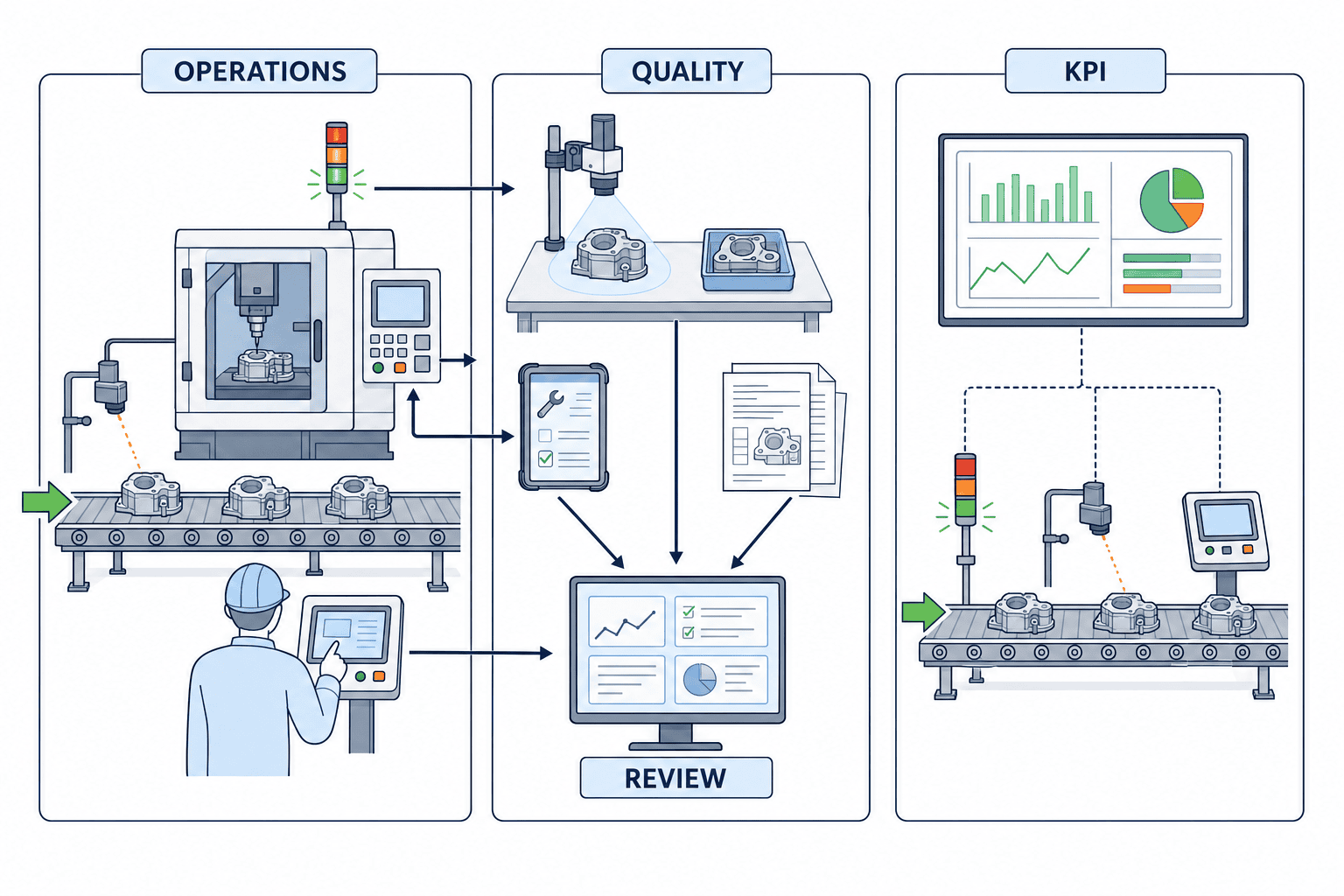
Workflow 1: daily and weekly operations reviews
A typical daily meeting draws from several spreadsheets, an MES export, maintenance records, and handwritten notes. Staff spend time finding the right number, matching field names, and rewriting explanations. ChatGPT Work should not make the operational decision. It should prepare the structured evidence immediately before that decision.
Limit the first input schema to date, line, part number, planned quantity, actual quantity, defect quantity, downtime minutes, reason code, and comment. For the first two weeks, import only approved CSV files or approved shared files. Fix the output at five blocks: variance against plan and previous day, anomaly candidates, source rows, clarification questions, and provisional actions.
The instruction must say: show “unknown” when the downtime reason is missing; calculate yield using the plant-approved formula and return N/A when its denominator is zero; and never turn a threshold breach into a causal claim. These controls reduce the risk that fluent prose is mistaken for a verified explanation.
The weekly pack can reuse daily outputs to show repeated stops, cumulative loss, part-level variation, and overdue actions. However, KPI names differ across plants. Include the approved KPI definition book and require its formula and exclusions. Do not allow generic internet definitions of OEE, downtime, or defect rate to override the site definition.
Acceptance should cover more than agreement with the old report. Measure the percentage of numbers traceable to a source row, the percentage of missing values correctly disclosed, correction count before the meeting, preparation time, and additional questions raised in the meeting. A polished narrative that cannot link back to evidence fails.
Workflow 2: quality, maintenance, and customer-response consolidation
During a quality incident or equipment failure, information is split by function. Quality owns symptoms and inspection results. Maintenance owns alarms and replaced parts. Production owns lots and settings. Sales or customer service owns the customer’s questions. The first value of ChatGPT workflow automation is not an automatic root-cause conclusion. It is a shared timeline and vocabulary.
Use the same case template every time:
- Event: what was observed, where, and when
- Scope: affected lots, equipment, customers, and inventory
- Confirmed facts: original source and author
- Open questions: missing data and accountable owner
- Hypotheses: clearly separated from facts, with a validation method
- Containment: approver, execution time, and release condition
- Customer draft: non-final wording clearly marked for approval
When records span Japanese, English, and Thai, build a glossary first. “Leak,” “รั่ว,” and “漏れ” may translate similarly, but a document may refer to the detection point, observed phenomenon, or presumed cause. The glossary should contain the preferred term, aliases, prohibited ambiguous terms, definition, unit, and source document. Translation acceptance must compare lot numbers, dates, units, and exact component names, not just naturalness.
Every external response needs approval from the quality and commercial owners before sending. ChatGPT may draft, translate, and point out missing topics. It must not state that a root cause is final or recurrence is impossible unless an approved 8D or CAPA supports the statement. Return registration in ERP, corrective-action closure in QMS, and PLC parameter changes remain outside the 90-day scope.
For a broader data-foundation implementation, see our manufacturing data-agent guide. This pilot does not assume a data-platform replacement. It evaluates approved read sources and the quality of the resulting work products.
Workflow 3: KPI analysis and dashboards
OpenAI’s Data plugin help article lists analysis, dashboard creation, and result validation among the intended activities. In a factory, the critical requirement is not an attractive chart. It is a fixed meaning and update condition behind every number.
For each KPI, register its name, business purpose, formula, grain, period, time zone, exclusions, update frequency, data owner, and approver. “Monthly defect rate” can change depending on whether the denominator is production quantity or inspection quantity. Rework, trials, scrap, and inter-plant transfers also need explicit inclusion rules.
Use three dashboard layers:
- Layer 1 for the plant manager: core safety, quality, delivery, and cost KPIs with prior-period comparison
- Layer 2 for functional managers: contribution and anomaly candidates by line, part, and shift
- Layer 3 for analysts: source data, transformations, missing values, refresh history, and validation results
Every view should display the refresh time, covered period, active filters, and a link to the calculation definition. Separate a threshold fact from a diagnostic proposal. “Line B defect rate is 2.1%, above the 1.5% threshold” does not prove equipment wear.
A 90-day roadmap for ChatGPT data analysis
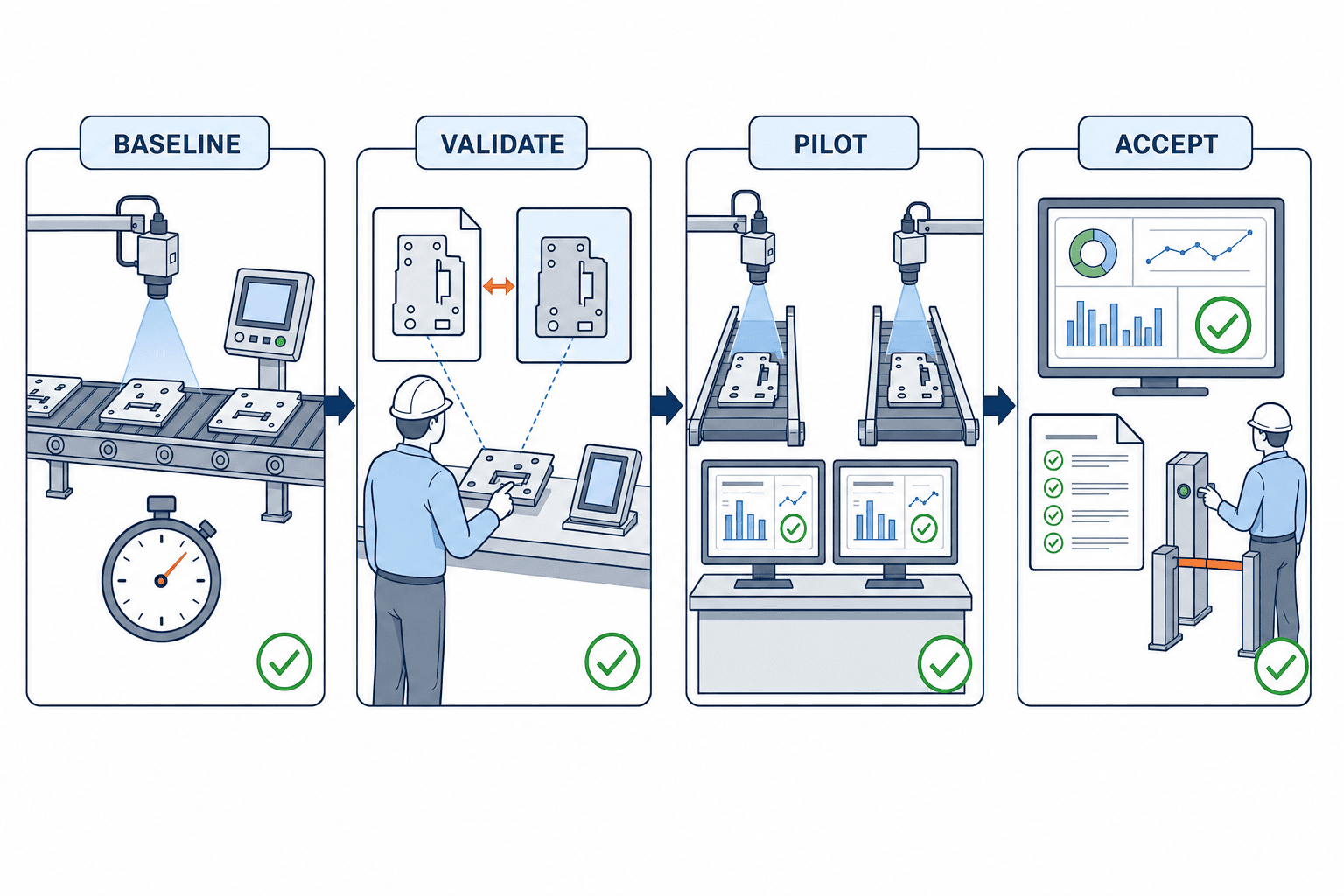
Divide the pilot into four stages. Each stage has an exit condition; do not expand scope when the condition is missed.
Days 0–15: workflow and permission baseline
Measure present preparation time, correction count, data sources, and approval paths. Without a pre-pilot baseline, the improvement denominator becomes a guess. Capture at least 10 working days and separate normal from peak days.
Create a data inventory and classify data as public, internal, confidential, or highly confidential. Legal, information-security, and data owners should review personal data, customer confidential information, export-controlled information, and contractually restricted material before connection. OpenAI’s Business Data Privacy page states that business data is not used to train models by default and describes encryption in transit and at rest as well as administrative capabilities. That does not by itself prove compliance with each company’s laws, contracts, retention rules, or regional requirements. Confirm the actual configuration and contract.
The Day 15 exit condition is a documented user list, workflow list, approved source list, prohibited-data list, approver, and log-review owner.
Days 16–30: gold sets and output templates
Select 10 representative cases from each workflow. Use six normal cases, two incomplete cases, and two exception cases. The accepted answer must include not only the final document but also source evidence, calculation steps, deferred decisions, and approval history.
Manage instructions in five blocks: role, input, output, prohibitions, and validation procedure. Store version, owner, reason for change, and test result. OpenAI’s Operations materials describe use through plugins and Skills. Implementation still has to separate technical connectivity from business approval.
The Day 30 exit condition in the TOMAS TECH assumed model is at least 95% completion of mandatory fields, zero material numeric errors, and a 100% source-link rate across 3 workflows × 10 cases. These are proposed acceptance thresholds, not OpenAI performance guarantees.
Days 31–60: controlled use and parallel production
Limit access to 5–10 people per workflow. For the first 10 working days, create the same deliverable with both the existing and AI-assisted methods. Classify differences as missing input, definition mismatch, calculation error, translation error, insufficient evidence, or missed approval.
Apply least privilege to every Data plugin or business plugin. OpenAI’s published materials describe respect for existing permissions and administrative control. Audit and action-traceability capabilities depend on the subscription plan and connected tool. Test whether each user can see only authorized data, whether permission changes propagate, and whether actions are traceable. Include leavers, transferred staff, and contractors in the test set.
The Day 60 exit condition in the TOMAS TECH assumed model is zero material errors for 10 consecutive working days, a correction rate of 10% or less for standard cases, 100% permission-test pass, and zero external sends without approval.
Days 61–90: live operation, exception tests, and acceptance
Deliberately add exceptions: missing columns, mixed units, time-zone offsets, duplicate part names, stale files, unauthorized data, and contradictory instructions. The environment should stop or ask a question instead of silently inventing a value.
The final acceptance meeting should include the workflow owner, IT, information security, quality, and user representatives. Choose pass, limited extension, or stop. A broad rollout requires metrics, evidence, and safe exception behavior—not only positive user feedback.
TOMAS TECH assumed model: a worked 90-day pilot estimate
The following is a fictional planning model for a medium-sized manufacturing site in Thailand. It is not an outcome reported by OpenAI. Replace users, labor rates, volumes, and approval time with your own operating data.
Assumptions
| Item | Assumption |
|---|---|
| Pilot users | 24 people (3 workflows × 8) |
| Working days | 22 per month |
| Operations packs | 2/day; 60 minutes before, 35 after |
| Consolidated reports | 20/month; 150 minutes before, 95 after |
| KPI refresh and validation | 12/month; 180 minutes before, 110 after |
| Loaded labor rate | THB 600/hour |
| Additional approval and audit | 18 hours/month |
| Initial preparation | 240 hours |
Formula
Each workflow’s monthly time saving is rounded to one decimal place before the displayed values are added.
- Operations reviews: 2 × 22 × (60−35) ÷ 60 = 18.3 hours/month
- Consolidated reports: 20 × (150−95) ÷ 60 = 18.3 hours/month
- KPI work: 12 × (180−110) ÷ 60 = 14.0 hours/month
- Gross saving: 18.3 + 18.3 + 14.0 = 50.6 hours/month
- Net saving: 50.6 − 18 additional approval hours = 32.6 hours/month
- Labor equivalent: 32.6 × THB 600 = THB 19,560/month
Over three months, the operating labor equivalent is THB 58,680. Initial preparation is 240 × THB 600 = THB 144,000. This assumed case therefore does not target cash payback within 90 days. It tests whether repeatable savings and controlled risk support expansion over the following 6–12 months. On labor alone, the indicative break-even is 144,000 ÷ 19,560 = about 7.4 months. Licenses, connector development, training, and external support are excluded.
Run sensitivity analysis as well. If post-adoption task time is 20% worse than assumed, the savings fall. If transaction volume doubles while approver capacity does not, the benefit will not double. Track correction rate, approval waiting time, and material errors alongside “volume × time saved.”
ChatGPT plugins and permission design
More connectors do not automatically make a pilot more useful. Begin with one or two approved sources per workflow. A practical sequence is approved files, read-only database or BI, ticket or document system, and only then core operational systems.
Design control across four axes.
| Axis | Control question | Acceptance evidence |
|---|---|---|
| User | Who has access; what happens after transfer or departure? | Account list, disablement test |
| Data | Which plant, customer, and period can be viewed? | Access matrix, denied-access result, audit log |
| Action | Is the operation read, analyze, export, or write? | Action-specific test result |
| Deliverable | Where is it stored, shared, retained, and deleted? | Storage setting, sharing history, deletion test |
OpenAI’s business-plugins materials describe enforcement of existing source permissions, administrative controls, and a default not to train on business data. Audit logs should be used where the customer’s subscription plan and connector support them. The customer still needs to configure SSO, RBAC, sharing, retention, and ownership of available logs, then review access regularly. If the source system grants excessive access, constraining only the AI layer is insufficient.
Why ERP, MES, and OT writes retain human approval
A read error can often be corrected in review. A write error can propagate into inventory, planning, quality, equipment, or the physical process. During the 90-day pilot, ChatGPT produces a proposed change, difference, rationale, and affected scope. An authorized employee approves and executes it in a separate step.
Advancing toward automated writes requires sustained zero material errors, passed exception tests, rollback, dual approval, audit logging, and accountable-owner agreement. PLC settings, safety interlocks, quality disposition, payment, and shipment hold require separate risk assessment even after those conditions are met.
Acceptance scorecard
Do not reduce acceptance to a single “accuracy” number.
| Area | Weight | Example pass condition |
|---|---|---|
| Business effect | 25 | At least 20% net task-time reduction |
| Deliverable quality | 25 | Mandatory fields ≥95%; zero material numeric errors |
| Repeatability | 15 | Critical numbers and conclusions repeat for the same input |
| Security and access | 20 | 100% access tests passed; zero unauthorized retrievals |
| Operability | 15 | Owner, procedure, and incident contacts documented |
In the TOMAS TECH assumed model, 80 points or more is a pass candidate only when material numeric error, access violation, and unapproved external sending are all zero. A score of 70–79 extends the same scope for 30 days; 69 or below, or any material-condition breach, triggers stop and redesign. Regulated or safety-critical environments should set stricter limits.
Common failure patterns
Distributing access to everyone first
Input formats and expectations diverge before the gold set exists. Start with three workflows and roughly 24 users, with workflow owners, data owners, and approvers assigned.
Treating dashboard appearance as an outcome
A polished chart with the wrong formula is dangerous. Accept the KPI definition, source, missing-data behavior, and refresh time together.
Treating ChatGPT data analysis as a root-cause decision
An association, anomaly candidate, or hypothesis is not a confirmed cause. The accountable person combines shop-floor observation, additional measurement, and process knowledge.
Reviewing multilingual prose but not operational tokens
For factory work, numbers, units, lots, part numbers, and timestamps may matter more than elegant translation. Separate language review from data reconciliation.
Rushing ChatGPT automation into write access
Keep the 90-day scope to read, analyze, and create. Move writing into a separate pilot only where approval, diff review, rollback, and audit are ready.
For a cross-industry view of patterns, see generative AI use cases in manufacturing. The present guide is different: it narrows the problem to a 90-day implementation and acceptance process.
FAQ
How many people should join a ChatGPT Work manufacturing pilot?
The TOMAS TECH assumed model uses one plant, three workflows, and 5–10 people per workflow. The presence of workflow owners, data owners, and approvers is more important than the exact number.
Can ChatGPT data analysis connect directly to MES?
Technical connectivity and business approval are separate. Start with approved files or read-only BI, then validate inherited permissions, audit logs, retention, and exception behavior. Exclude MES writes from the initial pilot.
Can ChatGPT workflow automation make quality decisions?
In the 90-day scope, it organizes evidence, compares against specifications, and drafts a response. The accountable quality owner retains disposition, shipment, and corrective-action approval.
How many ChatGPT plugins should be connected?
Start with one or two sources per workflow. Least privilege, consistent definitions, and auditability matter more than connector count.
Is a pilot worthwhile if it cannot pay back in 90 days?
Yes. The purpose is to quantify effect, quality, exception behavior, and access control with real work. The fictional calculation above indicates about 7.4 months on labor alone, but each plant should substitute its own numbers and use the evidence for a 6–12 month decision.
Conclusion: start small and decide from deliverables and evidence
A Thai manufacturer can move ChatGPT use forward by accepting three workflows in 90 days rather than opening unrestricted use after procurement. Standardize daily and weekly operations reviews, consolidated quality and maintenance responses, and KPI analysis through the point of deliverable creation. Keep a person in the approval path for ERP, MES, and OT writes. Judge success through time saved, correction rate, material error count, source traceability, permission tests, and exception behavior—not message volume.
Even if your data locations and approval paths are not yet fully documented, you can begin with workflow scoping and an acceptance scorecard. Contact TOMAS TECH to discuss a pilot boundary that works with your current ERP and MES rather than assuming a replacement.
References
- OpenAI: Put data to work (Data agent, September 10, 2026)
- OpenAI Help: ChatGPT Data plugin
- OpenAI: ChatGPT for your most ambitious work (July 9, 2026)
- OpenAI: Solutions for Operations
- OpenAI: Business plugins
- OpenAI: Business data privacy, security, and compliance
- OpenAI: Samsung Electronics deployment (June 21, 2026)
- OpenAI: Unlocking new ways of working (September 16, 2026)
- OpenAI: How the world is putting ChatGPT to work (August 6, 2026)
*The 90-day stages, staffing, time, cost, and thresholds in this article are a TOMAS TECH assumed model. Adapt them to applicable contracts, laws, information-security policy, quality systems, and safety requirements.*