


For a long time, air cylinder selection was a task that ended with “order the same part number when the old one breaks”. In recent years, however, a new option has worked its way into the decision on the shop floor: replacing the same motion with an electric actuator. This article first organizes the basic selection criteria for pneumatic equipment, then separates the conditions under which electrification is worth considering from the conditions under which you should simply stay pneumatic.
Air Cylinder and Pneumatic Equipment Selection Criteria | Five Axes to Fix First
Selecting pneumatic equipment is an area where your hand stops the moment you open the catalog, purely because of the number of options. Take SMC standard linear actuators as an example. Looking only at the representative series, bore sizes run from 3/4 inch (20mm) up to 300mm, strokes from 1 inch up to 2400mm, and the number of mounting styles offered ranges from 4 to 11 depending on the product series. Turned around, that breadth means you cannot choose anything until you decide which axis you will narrow down on first.
In practice, the useful order of narrowing comes down to the following five axes.
Selection Criterion 1 | Bore Size and Required Thrust
The force an air cylinder can produce is the product of the piston pressure-receiving area and the supply pressure. So the order is: derive the required thrust from the mass, friction, inclination and acceleration of the object you want to move, divide it by the actual supply pressure available in the plant to obtain the required pressure-receiving area, and select the bore size from there.
The point where practitioners most often stumble is how they treat “the actual supply pressure available in the plant”. The pressure assumed at design time and the pressure that actually reaches the machine can differ. Long piping runs, restrictions somewhere in the line, or a heavy air consumer hanging off the same header all pull the end-of-line pressure down. If you pick a bore size that only just satisfies the design value, you end up with a low-reproducibility fault where thrust falls short and the workpiece stalls only during busy periods.
To absorb this uncertainty, pneumatic selection conventionally does not use theoretical thrust directly. Instead it builds in margin through the concept of a load ratio: you decide in advance what proportion of the theoretical thrust you will actually allow yourself to use, allowing for friction and pressure fluctuation, and then choose a bore size that satisfies that proportion. Transfer motions involving acceleration need a thicker margin than static clamping.
One more basic point that is easy to forget is that the pressure-receiving area differs between the rod side and the head side. On a double-acting cylinder, the force available in the extend direction and the retract direction is not the same. A jig that catches on the way back, even though the push stroke works fine, is sometimes caused by exactly this asymmetry.
Selection Criterion 2 | Stroke and Speed
Stroke is decided as “the travel you need plus a margin”, but too much margin creates a different problem. The longer the stroke, the more air is consumed to perform the same motion. The difference per cycle is tiny, but once it accumulates over several thousand cycles a day and several million cycles a year, it feeds straight into the compressed air cost discussed below.
Speed is largely determined not by the cylinder itself but by the speed controllers, the piping diameter and the effective cross-sectional area of the solenoid valves. The maximum speed in the catalog is a value under ideal conditions; actual speed is set by the pneumatic circuit as a whole. If you misread this as “choosing the cylinder also fixes the speed”, you end up unable to hit the target cycle time at commissioning.
The faster the motion, the greater the impact energy at the end of stroke. Cushions and shock absorbers have to be selected from both speed and moving mass, and it is safer to treat that as a separate step from selecting the cylinder itself.
Selection Criterion 3 | Mounting Style
The mounting style simultaneously affects the freedom of the mechanical design and the ease of maintenance. Basic, flange, clevis and trunnion styles are among the options, and the number of styles available differs by series. In the SMC example above, 4 to 11 mounting styles are configured depending on the series.
The way to approach the choice is to first confirm whether the cylinder axis and the direction of load motion are aligned. If they are, a basic or flange style is enough; if the cylinder itself swings as part of the mechanism, a clevis or trunnion style is required. Get this wrong and side load is applied to the rod, the bush and rod seal wear unevenly, and air leakage starts earlier than expected.
The maintainability angle also belongs here. With some mounting styles, you have to remove surrounding jigs in order to replace the cylinder. A design that takes two hours to change and one that takes twenty minutes produce completely different equipment availability at the same failure rate.
Selection Criterion 4 | Double-Acting or Single-Acting
A double-acting cylinder is driven pneumatically in both the extend and retract directions, while a single-acting cylinder returns in one direction by spring force or gravity. Single-acting consumes less air and keeps the piping and solenoid valve simple, but the return force depends on the spring, so the force cannot be controlled.
The criterion is straightforward: does the return stroke need “controlled force” or “holding partway”? If it does, use double-acting; if the part simply has to go back to its home position, single-acting is enough. For applications such as clamps and chucks, where you want the behavior on loss of power or air supply to fail safe, a single-acting design that keeps clamping by spring force becomes a positive choice rather than a compromise.
Selection Criterion 5 | Operating Environment
Environmental conditions are the axis that bites hardest in factories in Thailand and the rest of ASEAN. Most of the ground on which pneumatics still holds an advantage over electric actuators comes down to exactly this item.
- High temperature and humidity, and condensation. Moisture in the compressed air becomes condensate and collects inside cylinders and air lines
- Dust. Dust clinging to the rod surface damages the seals
- Water and washdown. In processes such as food plants that use high-pressure washing, the ingress protection rating becomes the first condition of selection
- Vibration and shock. Around presses, mounting hardware works loose early
- Explosion-proof requirements. In areas such as paint booths, electrical equipment is difficult to place at all
Selection of the FRL unit (filter, regulator, lubricator) is another item that has to be considered together with these environmental conditions. In hot and humid environments in particular, a weak condensate-handling design shortens the life of even the best cylinder you could have chosen. Upstream design decisions such as the capacity of the air dryer and aftercooler, the position of drain traps, and the slope of the piping carry the same weight as cylinder selection itself. Note that non-lube specifications are now mainstream, so configurations that omit the lubricator have become common.
In practice, fixing these five axes in the following order minimizes rework.
| Order | Item to fix | Main inputs | Easy to overlook |
|---|---|---|---|
| 1 | Required thrust and bore size | Moving mass, friction, inclination, acceleration | Actual supply pressure at the end of the line, area difference between rod side and head side |
| 2 | Stroke | Required travel, mechanical clearance | Excessive stroke increases air consumption |
| 3 | Speed and cushioning | Cycle time, moving mass | Speed is set by the whole circuit; cushioning is selected separately |
| 4 | Mounting style | Direction of mechanical motion, maintenance space | Uneven seal wear from side load, replacement labor |
| 5 | Environmental conditions | Temperature, humidity, dust, washdown, explosion protection | Upstream design including FRL and condensate handling |
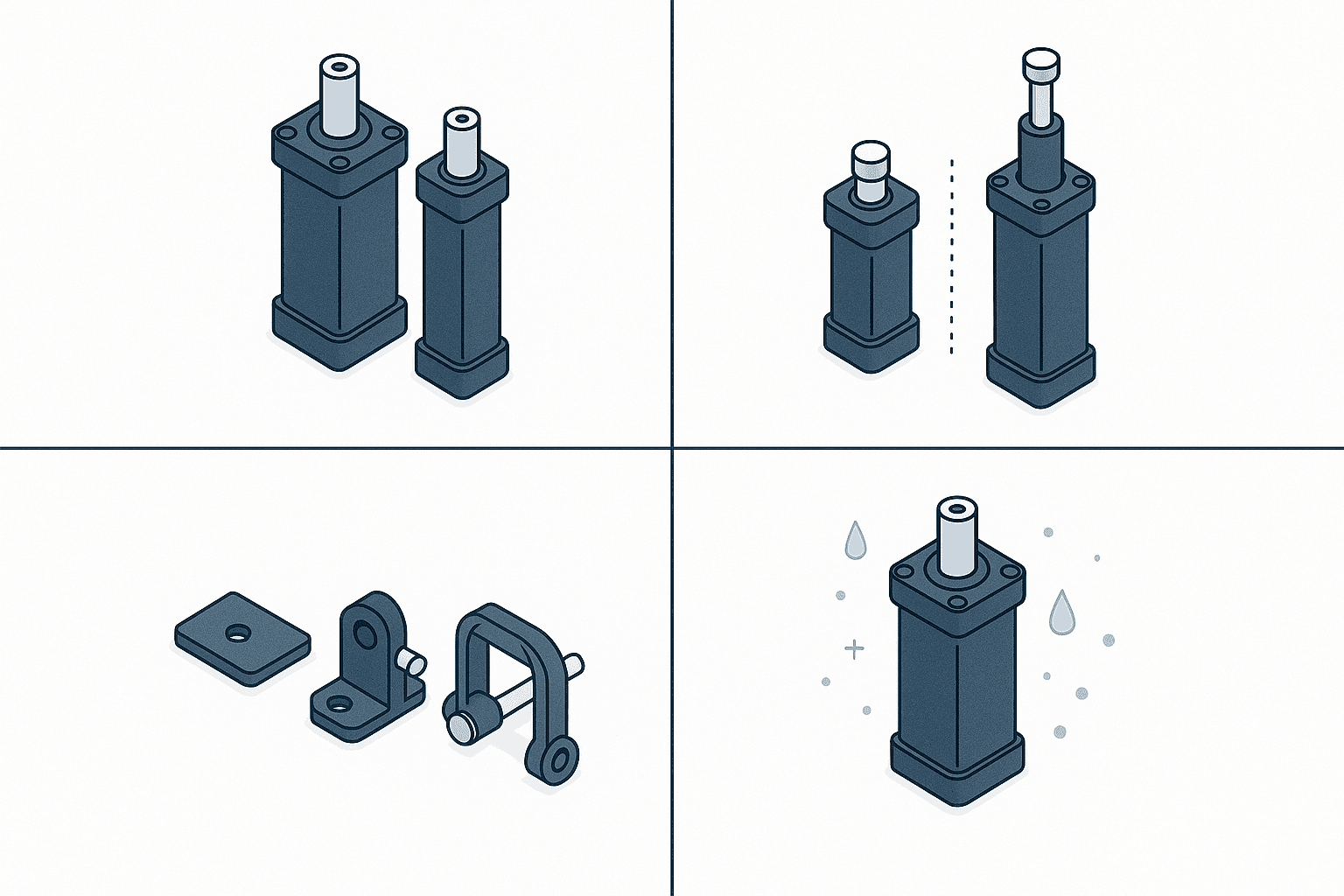
The Hidden Cost of Compressed Air | Leaks and Energy Efficiency
If you select pneumatic equipment purely on “the price and performance of the device itself”, one issue always falls out of the discussion: compressed air is an expensive utility in its own right.
Air Leaks Can Reach 20-30%
A compressed air fact sheet compiled by the Office of Industrial Technologies at the U.S. Department of Energy (DOE) states that in plants with inadequate maintenance, as much as 20-30% of compressed air can be lost to leaks. The same document also states that in a properly managed system, leaks can be held to less than 10%.
What these figures show is that air leakage is not a question of whether it happens, but of how far you have managed to suppress it. Leak-prone points such as fittings, couplers, hoses, drain traps and cylinder rod seals will inevitably degrade for as long as the equipment keeps running.
One caveat: this document was published in 1998, and its worked example assumes a US electricity price of USD 0.05 per kWh. Conditions differ from Thai electricity tariffs, so you cannot take the monetary figure itself and use it as your own loss. What you can use is the ratio, “20-30% versus less than 10%”. Only when you multiply the electrical energy going into your own compressed air by the actual unit price of electricity in Thailand does the number become meaningful.
For the practical steps of finding and fixing air leaks, our article on compressed air leak countermeasures for compressors covers how to use an ultrasonic leak detector and how to set priorities. Understanding the state of the supply side in parallel with pneumatic equipment selection sharpens the accuracy of your decisions.
The Energy Efficiency Itself Is Low
Even if you could drive leaks to zero, compressed air retains an inherent inefficiency. According to comparison material published by Tolomatic, a manufacturer that makes both pneumatic equipment and electric actuators, the energy efficiency of pneumatic systems is roughly in the 10-30% range. Within that, the material cites 10-15% from a 2004 U.S. Department of Energy document and 23-30% from a 2000 survey by the British Fluid Power Association. The same Tolomatic material puts the efficiency of electric systems at approximately 80%. It should be read with the understanding that this material was produced to demonstrate the advantages of electric actuators.
The reason for the gap is the number of stages involved. Electricity compresses air, the heat of compression is thrown away, the air travels through piping, it is regulated down along the way, it finally does work at the cylinder, and the exhaust is vented to atmosphere. Losses accumulate at every stage. An electric actuator converts electricity directly into motor rotation and then into linear motion through a ball screw or similar, so the shorter path gives it higher efficiency.
However, it is a mistake to read that efficiency gap as “electrification cuts your electricity bill by 80%”. An efficiency comparison compares the input energy needed to produce the same amount of work. In real equipment, utilization rate, operating hours, standby consumption and, above all, the operating pattern of the compressor itself dominate. Where an existing compressor serves multiple machines, it is entirely normal for compressor running time to barely change after a single cylinder is electrified.
The Pneumatic Side Has Energy-Saving Options Too
Electrification is not the only route to energy savings. Pneumatic equipment makers offer energy-saving product lines. Festo, for example, offers lightweight cylinders and energy-saving modules that automatically reduce the supply pressure or shut off the air supply when the machine is idle.
In a reader survey conducted by the trade publication Power & Motion, 78% of respondents answered that sustainability is influencing the design and use of hydraulic and pneumatic technology. Note, though, that this figure is the proportion of respondents in that publication’s reader survey, not an industry-wide average.
In practice, before entering any electrification study, you should check the room for improvement on the pneumatic side, such as the following.
- Optimizing supply pressure. Are you running at a higher pressure than you need?
- Shutting off during standby. Do you keep feeding air while the machine is stopped?
- Reviewing pipe diameter and length. Are there routes with large pressure drops?
- Continuous leak detection. Is periodic leak diagnosis built into a routine?
- Condensate handling. Are drain traps blowing air through?
Because these can be carried out on existing equipment as it stands, the standard approach is to tackle them before any investment that involves replacing equipment, such as electrification.
Is Switching to Electric Actuators Really Worth It | Pneumatic vs Electric
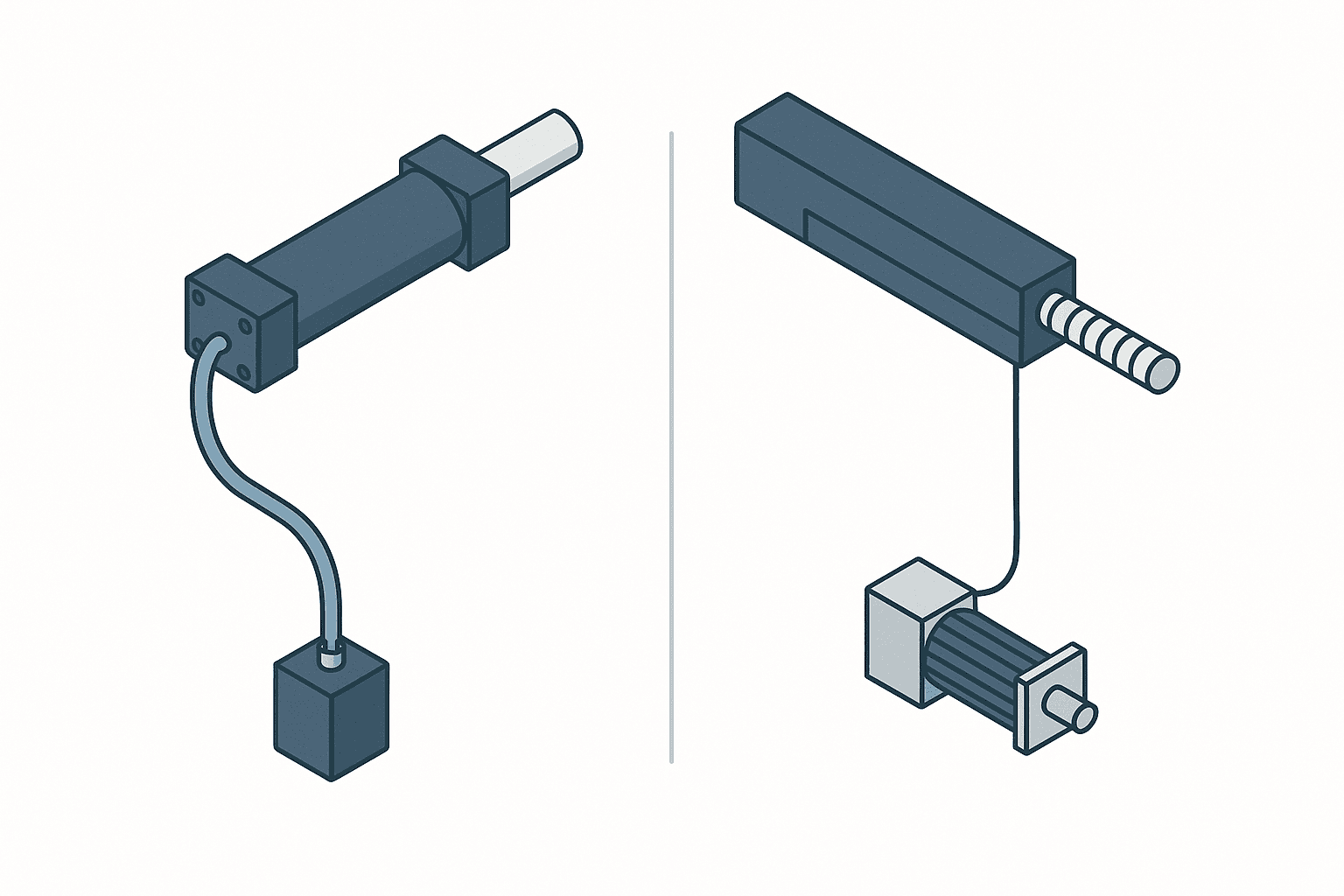
This is the core question. The table below compares pneumatics and electric actuators item by item. Where a quantitative source exists, the figure is given; where none exists, the assessment is qualitative.
| Comparison item | Pneumatic (air cylinder) | Electric actuator | Notes |
|---|---|---|---|
| Initial cost | ◎ Low | △ High | Electric requires a drive and controls |
| Running cost | △ High | ◎ Low | Consumable costs plus the efficiency gap (Tolomatic) |
| Maintainability | ○ Easy parts replacement | △ Specialist knowledge required | Pneumatic parts are easy to source locally, but replacement frequency rises in harsh environments |
| Positioning accuracy | △ End positions basically | ◎ Any position | Pneumatics can stop midstroke, but accuracy is hard to achieve |
| Speed and force control | △ Circuit dependent | ◎ Programmable | Electric allows conditions to be changed per process |
| Response speed | ◎ Fast | ○ Depends on application | Pneumatics often wins for simple reciprocating motion |
| Environmental tolerance | ◎ Strong against dust and water | △ Depends on IP rating | Pneumatics is realistic in explosion-proof areas, though harsh environments also shorten pneumatic life |
| Behavior on power loss | ○ Depends on valve configuration | △ Needs a brake to hold | A single-acting design holds by spring force even when air is cut |
| Heat generation | ◎ Low | △ Occurs at the drive | Affects thermal design inside the panel |
| Data acquisition | △ Separate sensors needed | ◎ Position and current available | Good fit with predictive maintenance |
The rows most often misread in this table are initial cost and running cost. The two are in a trade-off, and which one wins is determined by operating hours and years of service. What you should compare, therefore, is not unit price but total cost over the expected service life.
The Tolomatic Worked Example, and How to Read It
As a concrete worked example, Tolomatic’s material presents a case of a noodle cutting machine in the food and beverage industry. Assuming a typical US electricity price of USD 0.08 per kWh, the total cost over three years came to USD 4,111.20 for pneumatic and USD 1,524.30 for electric, with a payback period of less than 13 months.
Reading that USD 4,111.20 as “three years of electricity” leads to a badly wrong decision. Looking at the breakdown in the same material, the bulk of that figure is the cost of periodically replacing cylinders; the electricity itself is only a small fraction. Moreover, in this case the cylinder replacement frequency was extremely high. The original source does not explain why, but since the application requirements are stated as stainless steel and IP69K equivalent, it suggests an environment involving washdown. The source itself notes that this is an extreme case, and explicitly states that the calculation assumes a more conservative replacement interval than the one actually observed.
So when you apply this figure to your own site, keep the following four points in mind.
- This is a calculation based on US prices. Because electricity is only a small share of the total, what will actually drive the result in Thailand is the unit price of cylinders, the price of electric actuators, and local labor cost
- It is a comparison under the conditions of one specific process, a noodle cutting machine, and cannot be generalized to every process
- The main driver of the difference is not electricity but the cost of cylinder replacement parts. On top of that, the source calculation does not include the labor for those replacements
- The source does not explain why the replacement frequency was so high. Note that it is a calculation presented with the caveat that this is an extreme case
In other words, what this case teaches is not “electrification pays back in 13 months”, but “in a process that runs at high frequency in an environment that shortens cylinder life, the payback on electrification can land inside a realistic time frame”. To decide for your own site, you have to line up the actual operating record of the target process against the actual cylinder replacement record. The inputs to use are summarized in Decision Criterion 5 below. At the very least, lining up electricity costs alone will not reproduce the conclusion of this case.
Electrification Comes with a Control Method Decision
Introducing an electric actuator also means choosing a motor and its control method. If positioning is required, servo; if simple speed adjustment is enough, an inverter. The configuration changes with the accuracy and control freedom demanded. Our article comparing servo control and inverter control covers how to make that distinction, including cost structure and applicable range. Firming up the control-side requirements at the same time as you study a switch away from pneumatics avoids specification changes later in the project.
The Supply Side Is Moving Toward Electric As Well
What the suppliers are doing is also useful input. At its second quarter 2026 earnings call, the major Taiwanese pneumatic equipment maker AirTAC had its CFO refer to a plan to enter the electric actuator field. The target timing for market launch is stated as 2028 to 2029. The important point here is that this is still a future plan and no product has been released. It cannot be counted as a candidate supplier at this time.
What you should read into it is the structural shift in the industry: a maker whose core business has been pneumatic equipment is preparing to add electric actuators to its product line. Rather than an either-or choice between pneumatic and electric, a purchasing pattern where you source from makers who handle both and use each where it fits the process may well become common.
Which Should You Choose | Sorting It Out with Five Decision Criteria
Staring at a comparison table does not produce a conclusion. You have to apply decision criteria process by process. The five criteria below work in practice.
| Decision criterion | Where pneumatic fits | Where electric fits |
|---|---|---|
| Process accuracy requirement | Reciprocating between end positions is enough | Stopping at any position, fine position adjustment needed |
| Environmental conditions | Dust, water, washdown, explosion-proof areas | Air-conditioned, clean areas |
| Fit with existing equipment | Air piping is already in place | Control panels and networks are already built out |
| Maintenance capability | You want local staff to complete parts replacement themselves | Staff who can handle controls, or a maintenance contract |
| Payback period | Low operating frequency and long cylinder life | High frequency, with replacement parts and maintenance labor piling up |
Apply these five in order from the top; the more items that fall on the pneumatic side, the stronger the case for keeping things as they are. Even for a process that fell on the pneumatic side at Decision Criterion 1, go all the way through to Decision Criterion 5 if consumable replacement costs are piling up. The noodle cutting machine described above is precisely a case where reciprocating between end positions was enough, yet electrification still stacked up because of the scale of replacement costs. The environmental conditions in Decision Criterion 2 raise the bar for electrification by one notch, but as explained below, they are not on their own an absolute reason to rule electric out.
Decision Criterion 1 | Start from the Process Accuracy Requirement
The first thing to look at is whether the process genuinely requires stopping at an arbitrary position. Motions such as pushing out a workpiece, clamping it, or extending and retracting a stopper are complete as reciprocation between end positions. In that case, all electrification buys you is reduced electricity and consumable costs, while the greatest advantage of electric, control freedom, goes unused.
Conversely, if you need to vary the stroke by product variant, press against a workpiece and control the force partway through, or log measured position values, pneumatics forces you to build out circuits and mechanisms, and electric achieves the same thing far more directly.
Decision Criterion 2 | Environmental Conditions Raise the Bar
Conditions such as heavy dust, frequent washdown, or an explosion-proof area raise the bar for electrification by one notch. Electric actuators with high IP ratings do exist, but they cost more and add a new weak point in the form of waterproofing for cables and connectors. Whether that goes as far as ruling electric out on its own should be decided together with the cylinder replacement record for that process, in the paragraph below and in Decision Criterion 5.
In Thai factories, humidity swings widely between the dry and rainy seasons, and condensation occurs in plant buildings without air conditioning. The risk of adding control panels and cabling under these conditions should be rated higher than for equivalent equipment in Japan.
There is, however, a flip side to this criterion. A harsh environment is unfavorable for an electric actuator, but it also shortens the life of a pneumatic cylinder. Recall the Tolomatic case described above. As the application requirements of stainless steel and IP69K equivalent indicate, that was a cutting process at a food plant in an environment involving washdown, and the main reason pneumatics lost out was the high frequency of cylinder replacement. So even when you rule out electric on the grounds of environmental conditions, always confirm how many cylinders that process consumes per year. If the count is high, the answer may not be electrification at all, but a change to cylinders with a higher protection specification, or a design change that isolates the rod from the environment. Note also that the source does not state the protection rating of the cylinders that were actually installed, so from this case alone you cannot tell how far raising the specification would have reduced the replacement frequency.
Decision Criterion 3 | Fit with Existing Equipment
In a plant where air piping is already installed and the compressor has capacity to spare, the marginal cost of adding one more cylinder is very low. Electrify that line, on the other hand, and you incur associated work for panel space, power capacity and network cabling.
The key point of judgment is the fact that electrifying just that one unit does not change the supply side. If the air piping and the compressor both remain in place, all you eliminate is the air consumption of that one unit. If you want to maximize the effect of electrification, you have to design the replacement at the level of a line, or of a group of processes.
Decision Criterion 4 | Maintenance Capability Decides a Lot of It
This criterion carries particular weight at sites in Thailand and ASEAN. Air cylinders have simple failure modes, the cause can be narrowed down from the symptom (does not move, moves slowly, no force, leaking air), and recovery is a matter of replacing parts. The range that local maintenance staff can handle on their own is wide.
With an electric actuator, when something fails you have to isolate whether the cause lies in the mechanics, the motor, the drive, the wiring or the parameter settings. Whether someone at the site can perform that isolation, or whether there is a maintenance contract with fast response, effectively determines whether you can adopt it at all.
Put differently, the electrification decision is not a comparison of equipment but a comparison of your own maintenance capability. Adopt it without facing that squarely and all you gain is one more machine that nobody can touch when it stops.
Decision Criterion 5 | Narrow It Down Last with Payback Period
For processes that were not ruled out at Decision Criterion 2, run the payback calculation last. The inputs you need are the annual cycle count of the target process, the actual cylinder replacement frequency and replacement parts cost, the labor and downtime per replacement, the air consumption per cycle, the electrical energy per cubic meter of compressed air, the unit price of electricity in Thailand, and the equipment and installation cost of electrification.
Among these, replacement parts cost and downtime are the ones most often overlooked. In the case described above, that much of a difference appeared even without putting a monetary value on replacement labor. Turned around, once you count labor and downtime as well, the gap widens further. It is not unusual for the main contributor to savings to be consumables and maintenance labor rather than electricity, so start by pulling out of the past few years of maintenance records how many cylinders that process actually consumed.
The Tolomatic case above came out at less than 13 months because cylinder replacement frequency was extremely high and replacement parts costs had piled up. Run the same calculation on a process where cylinders last for years and operating frequency is low, and the payback period stretches to several years or more than ten, not infrequently exceeding the remaining life of the equipment. If the payback period exceeds the equipment’s remaining life, the rational move is to keep that process pneumatic and revisit the question when the equipment is renewed.
Ordering Practices When Specifying FA Equipment in Thailand and Southeast Asia
Once the selection criteria are settled, procurement is next. Write your purchase specification with the same assumptions you would use in Japan and, in Thailand, there is a high probability of rework.
Understand the Market Environment
As background, automation investment in this region is in an expansion phase. A private research firm forecasts that the Thailand industrial automation market will grow from approximately USD 1.99 billion in 2024 to USD 3.53 billion in 2032, at a compound annual growth rate of 9.44%.
For the Southeast Asian industrial and service robot market as a whole, another forecast puts growth from USD 1.2 billion in 2025 to USD 1.83 billion in 2031, with a compound annual growth rate of 7.32% from 2026 to 2031. For Thailand, EEC incentive policies and BOI support are cited as the drivers of demand, and the BOI is reported to be supporting 15 billion baht worth of robotics projects with a target of 10,000 new system installations annually.
All of these are forecasts, not results. From a procurement standpoint, though, two implications are usable. First, the number of suppliers handling FA equipment in this region, and the depth of local stock, is on a rising trend. Second, because BOI support schemes are designed on the premise of advancing automation, it is worth checking during the planning stage of a capital investment whether incentives apply.
What You Must Ask For in the RFP
When you put FA equipment involving pneumatics or electric actuators out to vendors, there are items you have to write into the specification for quotation comparison to work at all.
- Cycle time and annual operating hours of the target process. This is the basis for equipment selection
- Supply air conditions. Supply pressure, dew point, purity class, spare compressor capacity
- Environmental conditions. Temperature, humidity, dust, presence of washdown, explosion-proof requirements, required IP rating
- List of consumables and maintenance parts. Item, recommended replacement interval, unit price, availability of local stock
- Parts procurement lead time. Local Thai stock or import, and if imported, the number of days including customs clearance
- Control method and network. Connection specification with the existing PLC and upper-level systems
- Documentation. Circuit diagrams, parameter lists, and the language of the operating manual
- Warranty scope and response times. Time to first response on failure, and the structure behind it
Order “one set of air cylinders” without writing these down and each vendor quotes on different assumptions, so price comparison never works. The consumables list and procurement lead time in particular are invisible in an initial cost comparison but bite after the equipment is running.
Design FAT and SAT as Separate Steps
Trying to get by with only one of FAT (Factory Acceptance Test) or SAT (Site Acceptance Test) always causes trouble. FAT is performed at the vendor’s factory, where supply air and power are under ideal conditions. SAT is performed under the real conditions of your own plant, which is where problems such as end-of-line pressure drop and interference with existing equipment surface for the first time.
In practice, the following split works: verify function and performance at FAT, and verify reproducibility in the real environment at SAT. And agree in writing, before the FAT, on which items will be verified at SAT. Without that agreement, when a problem appears at SAT you end up deadlocked against a vendor insisting the equipment is “per specification”.
A point specific to pneumatic equipment: measure the actual supply pressure at the end of the line during SAT. The difference between the design value and the measured value becomes baseline data you will certainly refer to in any later fault investigation.
How to Split Local Procurement and Imports
When you think about procurement at a Thai site, local purchase and import from Japan should not be compared on price alone. There are three axes of judgment.
- Allowable downtime. For equipment on a line that cannot be stopped, choose consumable part numbers that are held in local stock
- Who does the maintenance. If local staff perform the replacement, lean toward part numbers that can be bought locally
- Standardization. Narrowing the part numbers used across the site lowers stockout risk without increasing inventory value
Importing the identical Japanese part number makes design easy, but it means stopping the equipment while a single part takes weeks to arrive. Conversely, replacing everything with locally procured items puts you outside the Japanese head office standard specification and makes your design assets unusable. The realistic landing point is a two-tier structure: keep standard part numbers for critical safety parts and parts that affect accuracy, and shift consumables and general-purpose parts toward locally procurable part numbers.
Frequently Asked Questions
What is an air cylinder?
It is a device that uses the force of compressed air to move a piston and extract linear motion. In factories it is widely used for motions such as pushing out workpieces, clamping, extending and retracting stoppers, and switching chutes. Its characteristics are a simple construction, recovery by parts replacement when it fails, and strong resistance to dust and water.
What are the basics of how to choose an air cylinder?
The basic order is: determine the bore size from the required thrust, the stroke from the required travel, the mounting style from the direction of mechanical motion, double-acting or single-acting from the requirements of the return stroke, and finally fix the protection specification from the operating environment. With product families as broad as SMC standard linear actuators, where even the representative series alone span bore sizes from 20mm to 300mm, strokes from 1 inch to 2400mm, and 4 to 11 mounting styles, selection does not progress unless you narrow down in this order.
Should we replace pneumatics with electric actuators?
It depends on the process. If a process needs stopping at arbitrary positions or force control, runs at high frequency, and has staff who can maintain it, the conditions are in place for electrification to pay off. Conversely, for processes where reciprocating between end positions is enough and cylinder replacement frequency is low, for explosion-proof areas, and for processes with low operating frequency, staying pneumatic is more rational. The factor most likely to decide it is the actual record of how many cylinders that process consumes per year. The higher the count, the shorter the payback on electrification, but even then, decide only after comparing against the option of switching to cylinders with a higher protection specification. On energy efficiency alone electric wins, but the efficiency gap does not translate directly into a reduction in your electricity bill.
How much can we reduce compressed air costs?
The room for reduction varies enormously with your starting point. U.S. Department of Energy material states that in plants with inadequate maintenance, 20-30% of compressed air is lost to leaks, while a properly managed system holds it to less than 10%. If your situation is closer to the former, leak countermeasures deliver a better return on investment than replacing equipment. Note that the monetary example in the same document assumes US electricity prices, so savings in Thailand have to be recalculated from your own energy consumption and the local unit price.
Can we consider AirTAC electric actuators now?
Not at this point. AirTAC referred to a plan to enter the electric actuator field at its second quarter 2026 earnings call, but the target timing for market launch is stated as 2028 to 2029, and the product has not been released. It is not a candidate for a current procurement, but expecting that electric products will also be supplied by pneumatic equipment makers over the medium term makes it easier to set a standardization policy.
Summary
Air cylinder selection is the work of fixing five axes in order: thrust, stroke, mounting style, drive type and environmental conditions. That fundamental does not change just because electrification is on the table.
On top of that, what you need to keep in mind is that compressed air is a utility with costs that are hard to see. Air leakage varies from less than 10% to 20-30% depending on how well it is managed, and the energy efficiency of the system as a whole sits at a low level compared with electric. But how much that gap is worth in savings at your own site cannot be known until you put in your operating frequency and the local unit price of electricity.
Electrification is one option, not an objective. Apply the five filters of accuracy requirement, environmental conditions, fit with existing equipment, maintenance capability and payback period in order, and the processes that should be replaced separate naturally from the processes that should stay pneumatic. In most factories, having both mixed together is the normal, healthy picture.
And at sites in Thailand and ASEAN, whether parts can be obtained and whether they can be repaired locally matter more than equipment performance. Writing the consumables list and procurement lead times into the purchase specification, and agreeing in advance on how verification items are split between FAT and SAT, affect equipment availability just as much as the equipment selection itself.
Questions such as which of your processes suit electrification, and how large your current compressed air cost really is, cannot be answered without looking at the actual equipment and operating data. TOMAS TECH has worked on both production equipment and factory systems for Japanese manufacturers on the ground in Thailand. Even if you have not decided on an implementation, and simply want to take stock of the current situation or organize how to approach the study, please feel free to reach out through our contact page.
References
- Electric Actuators vs Pneumatic Cylinders – Tolomatic
- Standard Linear Actuators – SMC Corporation of America
- Compressed Air System Leaks Fact Sheet – U.S. Department of Energy, Office of Industrial Technologies
- Thailand Industrial Automation Market – Data Bridge Market Research
- Southeast Asia Industrial and Service Robot Market – Global Information
- AirTAC Earnings Call Transcript Q2 2026 – Investing.com
- The Rising Influence of Sustainability on Hydraulics and Pneumatics – Power & Motion


