


The first thing that happens when a factory adopts generative AI is not cost reduction. It is that the content of the work people have been doing starts to change. Transcribing inspection records, translating between Japanese, Thai and English, keying in purchase and sales data, assembling the monthly reporting pack. Plenty of sites hand out the tools without ever deciding what happens to the staff who spent years becoming good at exactly those routine tasks. AI reskilling is not a matter of sending people on a course. It is a workforce strategy that runs all the way from breaking work down into tasks, through redesigning the jobs themselves, to redeploying the people who hold them. This article sets out where Japanese manufacturers operating in Thailand and the wider ASEAN region should start, based on the most recent published research.
Why AI Reskilling Has Become a Board-Level Issue
The gap between what leadership expects and what employees are offered
In “Four Futures for Jobs in the New Economy: AI and Talent in 2030”, published by the World Economic Forum (WEF) in January 2026, 54% of surveyed executives said they expect AI to displace existing jobs, while 24% expect it to create new ones. More than twice as many leaders anticipate displacement as anticipate creation.
A second finding in the same survey deserves closer attention. Close to 45% of respondents expect AI adoption to improve profit margins, but only 12% expect it to lead to higher wages. In other words, the assumption that productivity gains flow back to employees is absent from the leadership’s own outlook. Call for reskilling from that starting point and it is entirely rational for the shop floor to read it as “make your own job more efficient, and put your own position at risk”.
Treating AI reskilling as a management issue means closing that gap by design, and doing it before the training conversation starts. Decide what job a person moves into and how they will be rewarded, then discuss what they need to learn. Reverse the order and attendance rates go up while behaviour stays exactly the same.
2030 is not a single road
The same WEF report does not offer one forecast for employment in 2030. It sets out four scenarios instead: “Supercharged Progress”, “Age of Displacement”, “Co-Pilot Economy” and “Stalled Progress”. What separates them is the combination of two axes, one being how far AI technology advances and the other being whether people with the skills to use AI well become widely available. “Co-Pilot Economy” and “Stalled Progress”, for instance, share the same technology assumption, namely gradual rather than dramatic advance. The only difference between them sits on the talent side. In the former, AI-capable skills are widely distributed. In the latter, they remain confined to a few.
What matters operationally is that one of the two axes is not technology at all. Technological progress happens outside your company. Whether you invest in your people is your own decision. Put two sites in the same technological environment and the one that invested will arrive at a different 2030 from the one that did not. Headcount structure and tenure distribution at a Thai site are not the same as at the Japanese head office. Rather than importing the head office debate wholesale, each site needs to decide which scenario it intends to reach.
The phase where buying tools was enough is already over
SDE Partners Inc. published a survey of Japanese corporate users on 8 June 2026, conducted between 18 and 23 March 2026 among 1,014 generative AI users employed at companies with 300 or more staff. Corporate adoption was almost evenly split between Microsoft Copilot at 45.3% and ChatGPT at 45.0%. At the same time, a combined 83.0% of users felt that functionality and accuracy had not reached a practical working standard.
That survey covers Japan, but the point it makes travels. Installing an off-the-shelf AI tool does not complete the work. Someone still has to verify the output, adapt it to how the business actually runs, and handle the exceptions by hand. That human adaptation is exactly what reskilling targets. Many sites spend their time debating tool selection and defer the design of the roles and structures around the people who will use them, yet it is the latter that decides the outcome. For the typical fault lines that leave a tool unused after go-live, see AI Adoption Enablement 2026 – Three Gaps That Kill Usage After Training.
Task Redesign – Telling AI Work Apart From Human-Only Work
Break the work into tasks, not job titles
The most common failure in AI reskilling planning is arguing about which job titles will disappear. The inspector role does not vanish. Of the dozen or several dozen tasks an inspector performs, some get automated, some remain, and some come into existence for the first time. That is what actually happens.
Research Material Series No. 299, “The Impact of Generative AI Use in the Workplace on Employees”, published by the Japan Institute for Labour Policy and Training (JILPT) on 18 March 2026, draws on case studies at Company J in information and communications and Company K in manufacturing. It groups the observed task changes into five patterns.
- Complementary task shift. AI takes over work people were doing, and the mix within a person’s remit changes (observed at both Company J and Company K)
- Task scope expansion. People can now reach analysis and proposal work they previously had no time for (observed at Company J)
- Task reorganisation. The sequence of existing work and the split of responsibilities change (observed at Company K)
- Creation of new tasks. Verifying AI output and setting standards for how instructions are written become jobs in their own right (observed at both Company J and Company K)
- Wider partial automation. Only part of a process is automated while a person continues to own the whole (observed at Company J)
Not one of the five describes an occupation disappearing. Of these, three were observed at manufacturer Company K: complementary task shift, task reorganisation, and the creation of new tasks. What happens in practice is a rewriting of the outline of a job, which is why reskilling has to be organised around tasks if it is going to fit the reality.
A four-quadrant sort
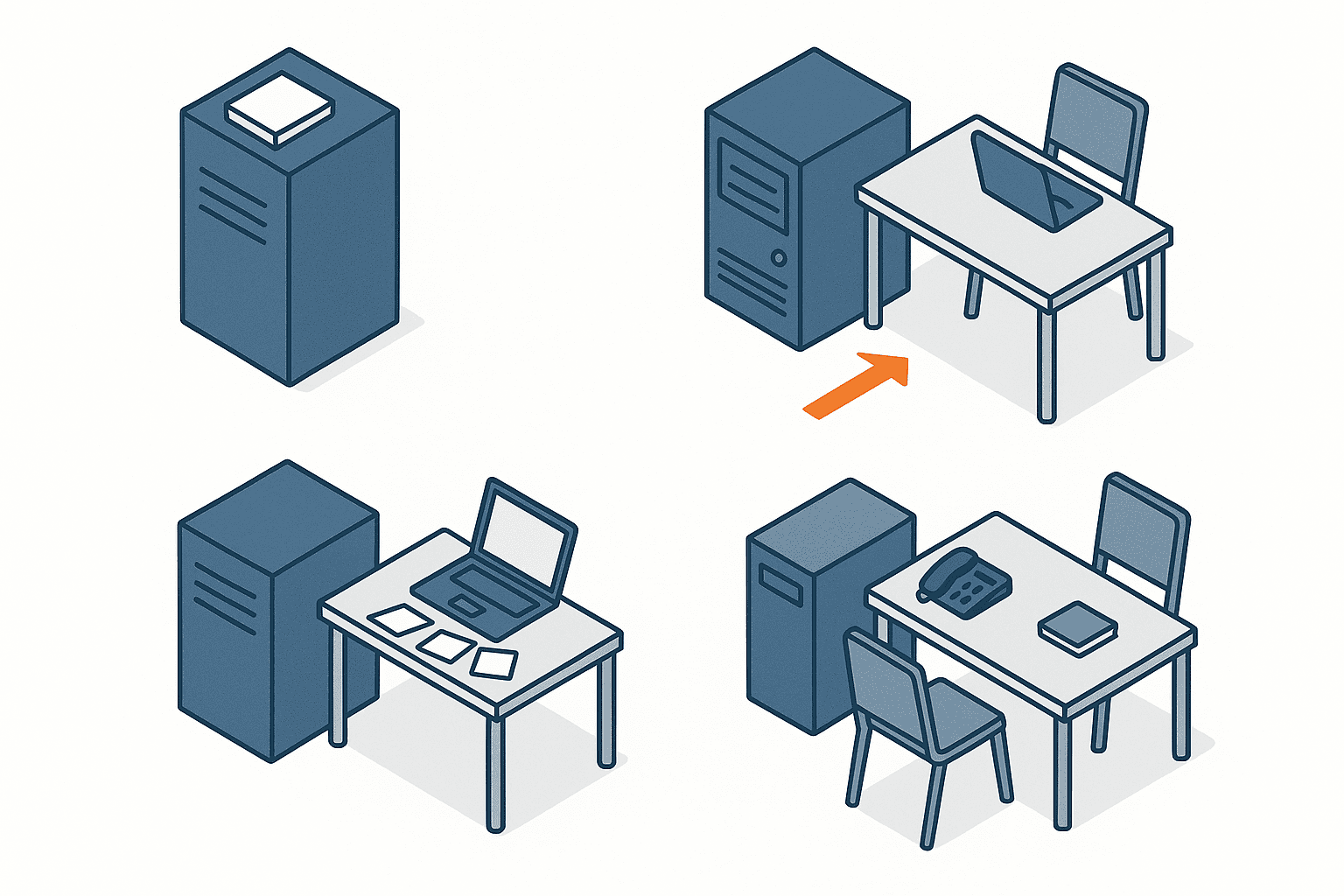
Once you have inventoried the tasks, how do you sort them? The two axes that work best in practice are how repeatable the judgement is, and how large the impact is when the judgement is wrong.
| Category | Repeatability of judgement | Impact of an error | How to involve AI | Examples |
|---|---|---|---|---|
| Replacement candidates | High | Low | Automate most of it, verify by sampling | Transcribing standard forms, first-pass translation of internal documents |
| Assistance candidates | High | High | AI drafts, a person approves every case | First-pass inspection judgement, rough translation of contracts |
| Augmentation candidates | Low | Low | Use it to widen the range of human ideas | Generating improvement options, drafting document structures |
| Human-owned work | Low | High | Limit AI to gathering reference material | Explaining a defect to a customer, staffing decisions |
The important thing about this sort is not to look at the people behind the replacement candidates as surplus. The more fluent someone is in a task, the better placed they are to judge whether AI output in the assistance quadrant is sound. Someone who has transcribed inspection records for ten years knows in their gut which numbers are plausible and which are not.
Human-only work concentrates in verification and in dealing with people
Coursera’s “Job Skills Report 2026”, published on 21 January 2026, draws on data from roughly 6 million enterprise learners and reports that enrolment in generative AI skills grew 234% year on year. Just as notable is the sharp rise in critical thinking enrolment across fields, including 168% growth in the data domain. The report reads this as evidence of a shift toward humans acting as the experts who verify what AI produces.
Learning how to operate an AI tool and being able to doubt what it produces are two different skills. The first can be picked up quickly. The second needs the backing of domain knowledge. This is the territory where long-serving staff have the advantage.
Interpersonal skills point in the same direction. In a Fortune interview on 7 February 2026, Anthropic co-founder Daniela Amodei said she wants to hire people strong in communication, EQ and interpersonal skills, and argued that while AI is strong in STEM areas, humanities-grounded judgement will only become more important. Translated into a factory setting, explaining a defect to a customer, building consensus on the floor and negotiating with suppliers stay in human hands. AI can produce a draft, but the final accountability does not move.
What Changes on the Factory Floor – Inspection, Translation, Data Entry and Admin
At a Thai site, the staff in routine roles are concentrated in visual inspection, interpreting and translation, data entry, and accounting and general administration. Here is what changes, function by function.
Visual inspection moves from judging parts to owning the criteria
Image-based visual inspection was being automated well before generative AI. What changed is the height of the barrier to entry. Generative AI can now handle the surrounding work such as organising training data, documenting judgement criteria and describing exception cases, which puts small-lot items that were previously ruled out on scale grounds within reach.
As a result, an inspector’s job moves from deciding whether a part is good or defective to maintaining the criteria that decide it. In concrete terms, that means adjudicating the cases where AI hesitates, watching for drift when the season or a material changes, and adding criteria when a new product launches. The number of judgements goes down while the difficulty of the work goes up. That is not a demotion, and it needs to be handled as an explicit upgrade in job grade.
Translation moves from rendering words to guaranteeing meaning
This is where the impact at Thai sites is largest. First-pass translation between Japanese, Thai and English is approaching practical quality. In day-to-day exchanges between Japanese expatriates and local staff, machine translation is almost certainly already in the loop more often than not.
Meanwhile, a clear residue remains that machine translation cannot handle. How do you convey what a Japanese engineer means by “I think it is probably fine” in a quality defect report? During a customer audit, how do you handle a question that should not be answered? In a disciplinary conversation, how do you ask for correction while letting the other person keep face? These are exercises in contextual judgement, not language conversion.
Sites with translation staff have room to redefine that role from interpreter to designer of Japanese-Thai communication. Maintaining the glossary, checking translation quality, writing the rules that mark out situations where machine translation is dangerous. These are tasks whose value rises as AI spreads.
Data entry does not disappear, it moves upstream
Entering purchase orders, production results and inventory is exactly the kind of work that AI-OCR combined with generative AI can cut back sharply. Just do not misread what is left behind once it has been cut.
What remains is not the keying but the work of protecting data integrity. Keeping up when a customer changes its form layout, handling cases where a scanned result does not reconcile with the existing master, chasing down why figures disagree between systems. This kind of work resists automation, and it cannot be done without knowing how the site really operates. The knowledge a data entry clerk carries, of the sort that says “this customer always quotes in cases”, becomes the foundation of the next role directly.
Administrative and indirect functions can widen their scope
Of the five JILPT patterns above, “task scope expansion” was observed in the case of Company J in information and communications, but indirect functions in manufacturing have the same room. Time freed from preparing documents and first drafts of meeting minutes can go into the analysis and improvement proposals nobody previously had capacity for. That expansion does not happen on its own, though. Unless a manager designs what the freed-up time is for, all that happens is that there is less work.
The same study also points to some skills losing value, alongside the creation of new skills and the deepening of existing ones. Facing that squarely is where reskilling begins. Acknowledge that some skills will be worth less, then work out how to connect the other assets a person holds, such as domain knowledge, internal relationships and shop-floor instinct, to their next role. That connecting work is management’s job.
| Function | What AI takes on | What stays with people | Roles it can be redesigned into |
|---|---|---|---|
| Visual inspection | First-pass judgement, automatic record generation | Adjudicating borderline cases, maintaining criteria | Inspection criteria management, quality data analysis |
| Translation and interpreting | First-pass translation, standard document rendering | Conveying nuance, judgement in negotiations | Terminology governance, multilingual training design |
| Data entry | Form reading, transcription, reconciliation prep | Exception handling, master maintenance, root cause tracing | Master data management, business process improvement |
| General administration | Drafting documents, first-pass minutes | Judging whether content is sound, aligning stakeholders | Business analysis, DX leadership for indirect functions |
Treat this table as a frame to be filled in site by site rather than a finished answer. Even within “data entry”, what remains depends on how each site’s systems are put together.
Beyond Training – Job Redesign and Career Redeployment
Why training alone does not change behaviour
Most sites have already run AI training. The reason it does not stick is that training deals with what people are able to do, while the job defines what they are supposed to do. Hand someone a new skill while the job description, the evaluation criteria and the daily work instructions all stay the same, and there is no legitimate basis for using that skill during working hours.
So what determines whether reskilling works is not the quality of the training but the design of the job the person returns to. Miss that and the more you spend, the more firmly people remember a course that was of no use. The relationship between audience design and cost-effectiveness in training is covered in DX Talent Development 2026. The subject of this article sits one step earlier, in how you rewrite the job itself.
Rewrite the job description first
The practical sequence looks like this.
- Inventory the target tasks and sort them using the four quadrants above
- Remove the tasks classified as replacement and assistance candidates from the current job description
- Define what goes into the freed-up hours, specified at the level of concrete deliverables
- List the skills the new job requires, and only then design the training
- Revise evaluation criteria and compensation to match the new job
The order matters. Run the training first and the mismatch between what was learned and what the job requires surfaces afterwards, forcing a redo.
Rockwell Automation, in an analysis of how AI-driven, human-centred manufacturing will reshape Southeast Asia, reports that 42% of manufacturers in the APAC region are using digital tools for job redesign. The same analysis points to hybrid roles emerging, such as operators evolving into reliability engineers, and to the uptake of augmented work instructions with AI-based guidance built into the task, alongside digital training modules aimed at frontline staff. It also notes that hybrid architectures combining cloud and edge are becoming the norm in markets including Vietnam, Thailand, Malaysia and Indonesia. Neither job redesign nor digital infrastructure is a conversation reserved for advanced economies.
Three patterns of redeployment
Redeployment is not only promotion. Three patterns get used in practice.
- Vertical moves. Staying in the same domain while moving from executor to manager or designer. An inspector becoming an inspection criteria owner is the classic case
- Lateral moves. Moving into an adjacent domain, such as a data entry clerk shifting into production performance analysis
- Moves into a connector role. Sitting between the shop floor and IT, or between Japanese managers and local staff. Multilingual staff show their strength here
Of the three, the connector role is where Thai sites are shortest of people. Someone who understands both the language of systems and the language of the floor, and who can work in Japanese and Thai, is extremely expensive to hire externally. It is a role with a strong case for growing internally. On how to capture what veterans hold as tacit knowledge, Skill Transfer AI 2026 — Capture Tacit Knowledge in Three Tiers sets out the approach tier by tier.
Who to Start With – Setting AI Reskilling Priorities
Do not start with everyone at once
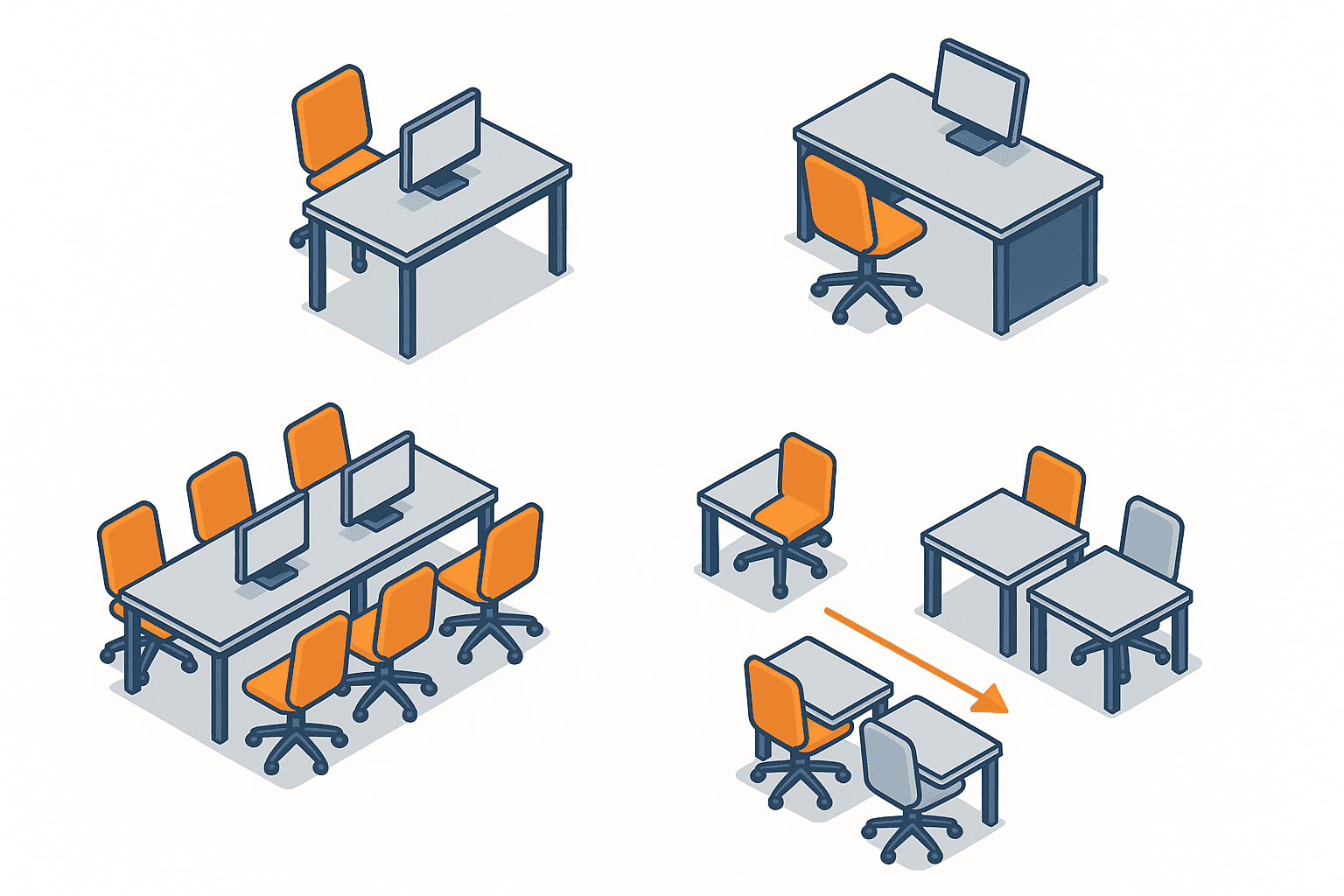
Budget and management bandwidth are both finite, so the population has to be narrowed. Three axes decide the order.
- Urgency of impact. The higher the share of a person’s tasks that fall into the replacement and assistance quadrants, the sooner you should start
- Feasibility of transition. Whether the person’s domain knowledge transfers to the next role, and whether they want to learn
- Effect on the site. How much the surrounding work changes when this person moves
The third is the one most sites overlook. When one person delivers a result in a new role, the people around them conclude that this applies to them too. Whether you choose your first candidate with that ripple in mind changes how easy the second round is. Start instead with the most resistant group, stumble, and that single case becomes the site’s remembered failure, which makes everything afterwards harder.
Sequencing the rollout
| Stage | Target group | What to do | Intended outcome |
|---|---|---|---|
| Stage 1 | Mid-career staff with a high share of routine work and deep domain knowledge | Job redesign with one-to-one support | A concrete success case that can be shown internally |
| Stage 2 | The line managers directly above the Stage 1 group | How to design and evaluate their reports’ jobs | Alignment between instructions and evaluation on the floor |
| Stage 3 | The remaining members of the same department | Standardised group training | A lift across the whole department |
| Stage 4 | Horizontal rollout to other departments | Stage 1 participants take on the trainer role | Knowledge that propagates internally |
Once you reach Stage 4 and your own people can teach, external spend drops sharply. Building that far into the design from the outset is what decides the return.
What to do in the first 90 days
The first 90 days should go into building a repeatable method rather than into producing results. Concretely, pick a single department and run one full loop from task inventory through to a revised job description. What that loop yields is less the improvement itself than the confidence that you can run this process in-house, plus a procedure you can hand to the next department. On bringing managers along, AI Training for Managers 2026 covers the investment criteria and governance angles.
Barriers Specific to Thailand and ASEAN – Multilingual Staff and Skills Gaps
Start from the assumption that hiring will not close the gap
“From Skills Gaps to Growth: Upskilling Southeast Asia’s Workforce for 2026”, published by ASW Consulting on 6 February 2026, cites the World Economic Forum’s Future of Jobs Report 2025 in noting that 62% of recruiters in Thailand say they cannot fill industry vacancies, and that more than 60% of companies in Vietnam name skills gaps as a barrier to business.
What those figures mean is that hiring in the skills you need from outside is not a workable solution in this region. In the Japanese debate the question is framed as hiring versus development. At sites in Thailand and ASEAN there is far less choice, and development is close to the default. And if you are betting on development, you have no option but to think through the mechanism that keeps developed people in place, which means designing compensation and jobs as part of the same package.
Where to place multilingual staff
Every Thai site has a number of people who can work in two or more of Japanese, Thai and English. Traditionally they have been deployed as interpreters and translators or as support for Japanese expatriates. Once first-pass translation can be covered by AI, that placement makes their value hard to see.
At the same time, when AI is being rolled out internally, this group becomes more important, not less. The reasons are as follows.
- Preparing internal procedures and quality standards in a form AI can work with is inherently cross-language work
- The people who can confirm whether local staff have correctly understood generative AI output are concentrated in this group
- Translating rules issued by the Japanese head office into local operating practice requires both language ability and business understanding
The natural redeployment, then, is to move multilingual staff out of the interpreter role and into leading the internal AI rollout. Fail to design that move deliberately and you invite the outcome you least want, which is the person sensing their role shrinking and leaving.
What language should training materials be in
Taking AI training materials prepared by the Japanese head office and using them unchanged at a Thai site has clear limits. Translating Japanese material into English and distributing it does not guarantee that frontline leaders can work through it. Translating everything into Thai, on the other hand, gets expensive.
The realistic compromise is to split by audience. Convey concepts to managers in English or Japanese, and give frontline staff short Thai-language material focused narrowly on how their own work changes. Several thin, targeted pieces of material stick better in practice than one thick company-wide document.
Build attrition risk into the design
In the Thai labour market there is always a chance that the person you invested in will leave. A management decision to hold back on that basis is understandable, but not investing carries a different risk, which is people stagnating in routine work while site-wide productivity fails to move.
Practical mitigations include the following.
- Revise grade and allowances explicitly at the point the job is redesigned
- Give people in development a role teaching others at the site, which strengthens their attachment to it
- Accumulate knowledge in the business process rather than in individuals, so that nothing depends on one person
The third matters most. Getting to a state where the work continues after someone leaves is both an attrition safeguard and a result of reskilling in its own right.
How to Measure the Return on Reskilling
Do not use course completion as a KPI
The main reason ROI discussions go nowhere is that what gets measured is attendance and satisfaction. Those are records that something took place, not indicators of results.
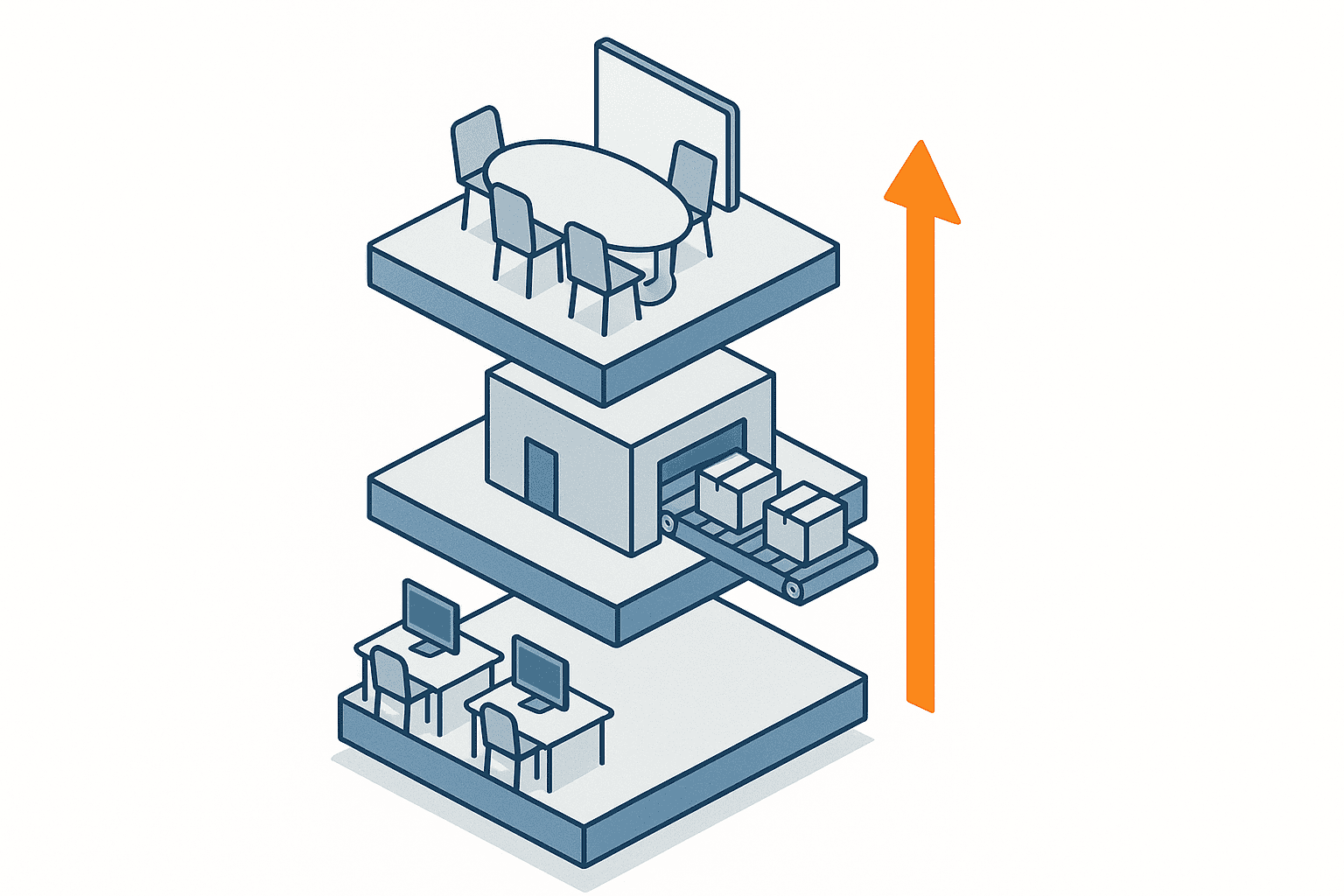
The metrics that work in practice are designed across three layers.
| Layer | What it measures | Example metrics | Measurement cadence |
|---|---|---|---|
| Behaviour | Whether the new way of working has taken hold | Frequency of AI use in the target work, number of self-authored procedures | Monthly |
| Process | Whether the work itself has changed | Time per target task, number of exceptions handled, transcription-related error count | Quarterly |
| Business result | Whether the site’s numbers moved | Throughput per indirect headcount, overtime hours, changes in the staffing plan | Half-yearly to annually |
Watch only the behaviour layer and you miss the state where people use the tool but nothing about the work has changed. Chase only the business result layer and you cannot separate reskilling from other factors, which leaves you unable to explain its contribution. Holding all three together is what supports the decision to keep investing.
Allow for the lag before results appear
For reskilling that involves job redesign, the practical rule of thumb is one to three months for behaviour-layer change, three to six months at the process layer, and six months or more before it shows up in business results. Unless that lag is agreed at the management meeting up front, the month-three report gets read as “no effect” and the programme is cut short.
The danger of cutting it short is not only wasted spend. Reskilling that has been interrupted once meets far less cooperation from the floor when you try to restart it. Agree before you begin on what will be reviewed and when.
Do not defer the compensation design
Return to the WEF survey from the opening. Close to 45% expecting margin improvement against only 12% expecting wage growth is a tension you cannot avoid when measuring the return on reskilling.
Not every productivity gain has to be paid back as payroll. But if the person who moved into a new role is compensated exactly as before, everyone around them learns that taking on harder work is not rewarded. The second and third candidates stop coming forward, and reskilling halts after the first cycle. Grade structures and allowances take time to change, so the realistic approach is to start on them in parallel with the reskilling plan.
FAQ
What is AI reskilling?
It refers to reorganising employees’ skills and jobs so they can handle work whose content is changing as AI spreads. It is not a word for training courses on how to use tools. Treating it as a workforce strategy that includes task decomposition, rewriting job descriptions, redeploying people and revising compensation is the practical reading. Where the term is used to describe only the effort demanded of the learner, management’s own design responsibility quietly disappears from view.
How does AI reskilling differ from AI training?
AI training is one instrument. AI reskilling is the whole undertaking that contains it. Training aims at getting people to acquire new skills. Reskilling aims further, at placing people in jobs where those skills are actually exercised. Run the training without changing the job and the learning goes unused during working hours, so the investment never comes back.
Which department should start the internal generative AI rollout?
The safest place to start is a department with a high share of routine work where an error does not immediately hit quality or delivery. At most sites that points to document preparation in indirect functions, or to departments where translation occurs. Taking it straight into judgement-heavy work in quality assurance or production control tends to impose a heavy verification burden and leaves the floor feeling only the extra load.
How long does reskilling take?
It depends on scope, but a reasonable benchmark is around three months to run one department from task inventory through to a revised job description, and a further three to six months before the person operates independently in the new role. Plan for one to two years if company-wide rollout is the goal. Rather than pressing for quick results, building the method in the first department and passing it to the next spreads faster in the end.
Can training material for Thai staff stay in Japanese or English?
For anything aimed at frontline staff, assume it needs to be in their first language. Skip the Thai version to save translation cost and the intent behind the change does not land, so it gets received as a story about jobs being taken away, which becomes a source of resistance. As covered in the section on barriers specific to Thailand and ASEAN, varying language and length by audience is the realistic design.
Summary
As long as AI reskilling is handled as an HR department initiative, results will stay hard to come by. Here are the points covered in this article.
- A gap exists between what leadership expects and what employees are offered. Design the compensation side first
- The unit of discussion is the task, not the job title. Sort tasks into four quadrants using repeatability of judgement and impact of error
- Inspection, translation, data entry and administration do not disappear. The outline of each job gets rewritten
- Rewrite the job description before the training. Reversing the order forces a redo
- Narrow the target population. Mid-career staff with a high share of routine work and deep domain knowledge make the best starting point
- In Thailand and ASEAN, hiring will not close the skills gap. Move multilingual staff into leading the internal AI rollout
- Measure across three layers, behaviour, process and business result, and agree the lag in advance
The first step is not deciding which tool to buy. It is picking one department and writing out its tasks. Once they are written down, most teams find fewer tasks can be replaced than they imagined, and far more need rewriting than they expected.
TOMAS TECH has supported the digitalisation of Japanese-owned plants across Thailand and ASEAN through PEGASUS and other production and energy management systems. Along the way we have seen many cases where a system went in but the results did not follow, because the jobs on the floor never changed. Even if you are still at the stage of working out where AI reskilling should begin, we are happy to start by mapping out with you which parts of your own operation could realistically be replaced. Feel free to get in touch through our contact page.
References
- Four Futures for Jobs in the New Economy: AI and Talent in 2030 — World Economic Forum, January 2026. Executive survey and the four scenarios for 2030
- The Impact of Generative AI Use in the Workplace on Employees (Research Material Series No. 299) — Japan Institute for Labour Policy and Training (JILPT), 18 March 2026. Case studies at Company J in information and communications and Company K in manufacturing
- Introducing Coursera’s Job Skills Report 2026 — Coursera, 21 January 2026. Enrolment trends among enterprise learners
- Anthropic cofounder Daniela Amodei on humanities majors, soft skills and hiring — Fortune, 7 February 2026
- From Skills Gaps to Growth: Upskilling Southeast Asia’s Workforce for 2026 — ASW Consulting, 6 February 2026. Skills gaps across Southeast Asia
- How AI-Driven, Human-Centred Manufacturing Will Shape Southeast Asia in 2026 — Rockwell Automation. Job redesign and hybrid architectures in APAC manufacturing
- Survey on the Use of Generative AI Platforms at Corporations in Japan — SDE Partners Inc., via PR TIMES, 8 June 2026. Based on 1,014 generative AI users at companies in Japan


