


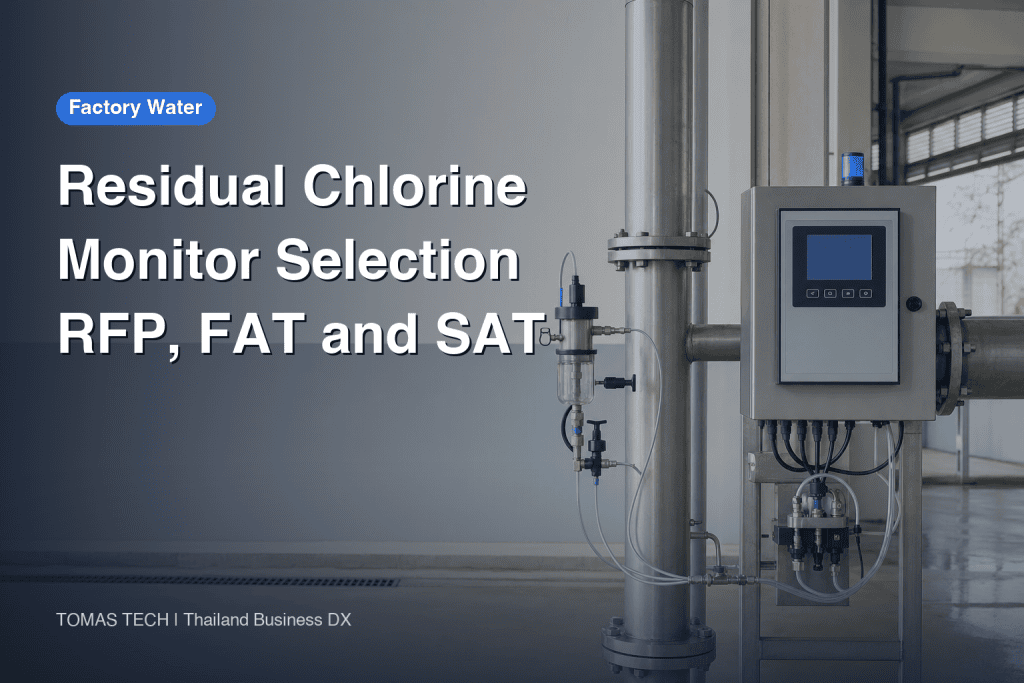
When selecting a residual chlorine monitor for factory water, start with the measurand and the decision the reading must support. Free chlorine and total chlorine are different quantities. Water at a receiving tank, a process supply header, a reuse line and a discharge point also serves different purposes. This guide shows how a Thai factory can specify the method, sample system, maintenance, alarms and records together, then verify the complete installation through FAT and SAT.
Define the duty of each water stream first
Mark the sampling point on the P&ID and write one operational sentence: “If free chlorine at the process supply header leaves the plant’s agreed control band, utilities staff take a confirmatory grab sample and investigate.” If the team cannot write that sentence, comparing instrument resolution is premature. A number has value only when its location, meaning and required response are clear.
Receiving water, tank outlet water and point-of-use water should not automatically share one limit or one tag. Residence time, temperature, pipework and material entering the line can change the residual. A satisfactory value at the inlet does not prove that a distant outlet is satisfactory; a low value at one branch does not necessarily justify raising the dose for every branch. Map the flow path, identify the points that matter, and install separate tags where a single point cannot represent the system.
This is a different measurement task from conductivity monitoring in CIP cleaning or cooling tower water quality monitoring. CIP conductivity can support chemical and rinse changeover, while cooling tower conductivity mainly informs concentration control. Residual chlorine measures remaining oxidising disinfectant. Conductivity or ORP may help explain a trend, but neither can be converted directly into a chlorine result for every water matrix.
State “free” or “total” chlorine in the RFP
An inquiry that only says “residual chlorine” invites offers for different measurands. State whether the process decision concerns free chlorine or total chlorine. Total chlorine is generally used for a quantity that includes free and combined chlorine; exactly what a particular analysis recovers depends on its chemistry and water matrix. Specify the disinfectant used, including any chloramination or chemical additions after the plant receives the water, and use a reference test for the same measurand.
Put “measurand”, “reporting unit, such as mg/L as Cl₂”, “normal range”, “expected peaks”, “decision at the lower end” and “action on an exception” in the first comparison table. A free-chlorine amperometric sensor cannot be assumed to satisfy a total-chlorine requirement. Ask a supplier to complete an empty measurand cell before comparing prices.
Compare DPD and amperometric methods against the actual water
DPD colourimetric instruments add reagents and read the colour optically. Product configurations exist for free or total chlorine. Their cost and work include reagents, tubing and cell cleaning, measuring cycles and waste handling. Hach’s CL17sc is one example of an online DPD analyser for free or total chlorine; its manufacturer describes periodic reagent replacement and colourimetric-cell cleaning. This is an example of the method, not a product endorsement.
An amperometric instrument estimates the target from an electrode current. Endress+Hauser’s CCS51E is an example of a membrane-based free-chlorine sensor. Membranes, electrolyte, flow, temperature and pH compensation must be checked against the specific model and application. “No reagent bottles” does not mean “no maintenance”: the plant still needs a plan for membrane and electrolyte replacement, fouling, bubbles, flow faults, drift and checks against a reference measurement.
Choose on performance in the water and on sustainable operation, rather than on a favourite principle. Colour, turbidity, other oxidants, metals and chloramines may interfere differently. US EPA Method 334.0 addresses drinking-water online chlorine analysis and describes both DPD and amperometric examples, with verification using a grab sample from the same point and time. Its scope and acceptance numbers are not Thai factory-water legal limits. Use the paired-measurement concept as a method design example, then set site-specific acceptance criteria.
| Question | DPD colourimetry | Amperometric sensor |
|---|---|---|
| Principle | Reagent colour read optically | Electrode current |
| Free or total | Verify reagent and configuration | Verify target-specific sensor |
| Consumables | Reagents, tubing, cell parts | Membrane, electrolyte, electrode parts |
| Typical field checks | Reagent age, cell fouling, waste | Flow, membrane, bubbles, pH and temperature |
| Quote comparison | Annual reagent, labour and waste | Annual parts, calibration and labour |
Do not turn this general table into a promise about a model’s accuracy or service interval. Request the current manual, analyse the intended water and, where uncertainty matters, test actual samples. For a plant with rotating operators, either method must be simple enough to describe in an SOP: who checks it, how often and what record is retained.

Treat pH, temperature, flow and pressure as measurement conditions
Free chlorine chemistry changes with pH. Some instruments measure pH alongside chlorine and compensate; an uncompensated sensor and a buffered DPD reference may disagree. Endress+Hauser’s operating instructions list missing pH compensation as a possible cause of disagreement with a DPD check. Require the normal and transient pH range, compensation method, pH-probe calibration owner and alarm behaviour when the pH input fails.
Temperature affects response. Flow changes sample replacement in a cell and conditions at an electrode. Compare the manufacturer’s permitted flow range with the plant’s minimum and maximum, including low-demand shifts, shutdown and restart. Pressure variations, bubbles and bypass-valve movement can interrupt measurement. If the analyser holds its last value on low flow, an apparently normal but stale number can remain on SCADA. Send sample shortage, low flow and instrument faults as quality states separate from the concentration value.
A filter may protect the system in dirty water, but the team must determine whether it alters the sample that reaches the sensor. Long lines, deposits, light, heat and stagnation can also lower the measured residual. EPA guidance on online residual-chlorine measurement in wastewater explains how sample-line length and velocity affect the measurement time, calls for a check-sample point at the analyser entrance, and addresses line cleaning. It is a technical sampling reference, not a Thai factory regulation.
Fix the sample point and flow cell on the drawing
Draw the complete bypass: the tap on the main, isolation valves, pressure reduction if required, filter, flow indication and flow switch, cell, drain, maintenance isolation and a grab-sample tap near the analyser inlet. A precise sensor on an unrepresentative or stagnant sample line cannot support a sound process decision. The grab tap and analyser should see substantially the same water at the same time.
If the tap follows chlorine injection, specify mixing and contact time. Monitoring the injector’s immediate output differs from monitoring water after a defined contact period. With variable plant flow, the same pipe length represents a different transit time. Mark the dosing point, mixer, tank, tap and user points on the P&ID; review normal flow, low flow and restart. Provide access to open the enclosure, replace reagents or a membrane, take samples and dispose of waste. For hot, humid or outdoor Thai installations, compare enclosure temperature, condensation, sunlight and reagent storage conditions with the manual. An enclosure that excludes water but traps heat may harm the instrument and reagents.

Set range and alarms from site data
An extremely wide range is not automatically safer. It may fail to give useful performance around the normal low value. A range that is too narrow may saturate after a dosing change. Collect results for steady operation, startup, dosing changes, post-cleaning and seasonal conditions; distinguish normal band, exceptional band and protective upper bound.
Do not invent an alarm threshold from a product brochure. Product-contact water, general utilities, membrane feed and discharge have different decisions. The site’s owner must check internal specifications, customer requirements, permits and laws actually applicable to that stream. WHO’s 2026 drinking-water guideline is background for drinking-water risk management; it does not impose the same limit on arbitrary Thai factory water.
Separate a low or high process result from invalid data. Low residual calls for a confirmatory sample and process investigation; an invalid reading calls for checks on flow, reagents, membrane and communication. Define alarm delays with the measurement cycle and pump pulses in mind, but avoid averaging so long that it hides a meaningful change. Record acknowledgement, reset and response ownership.
Ten fields to include in the residual-chlorine-monitor RFP
Request the complete measuring system, not a stand-alone analyser price. Have every bidder answer the same form and state exceptions openly.
- Purpose and measurand: water stream, sample point, free or total chlorine, unit and required decision.
- Water matrix: normal and extreme concentrations, pH, temperature, pressure, flow, turbidity, oxidants and chemicals.
- Performance: range, low-end repeatability, response time, compensation, interferences and warmup.
- Sample system: tap, valves, filter, cell, drain, grab tap, materials and required flow.
- Maintenance: reagent or sensor parts, replacement assumptions, cleaning, calibration, waste and annual labour.
- Signals: value, quality flag, low-flow fault, device fault, communication loss, clock and power recovery.
- Operation: alarms, interlock responsibility, reference checks and response SOP.
- Documents: P&ID, wiring, parts, calibration record, manuals and instructions in a language operators use.
- Tests: FAT and SAT procedure, reference method, sample count, acceptance, correction and retest.
- Cost and support: installation, consumables, spares, multi-year service and local response time.
Separate the manufacturer’s instrument guarantee under specified conditions from the SAT criterion for the site water, sample line and reference operator. The latter cannot be calculated automatically from the former. Agree a criterion based on sampling representativeness, reference uncertainty and the error the operational decision can tolerate.
Compare ownership cost as well as purchase price
Build a like-for-like, multi-year cost table. Reagents, membranes, electrolyte, calibration, line cleaning, labour, waste handling and missed data can outweigh a lower purchase price. Do not copy a nominal replacement interval without asking how the plant’s water and operating hours affect it. Check Thai availability and lead times for critical spares.
Count the full maintenance job: travel to the panel, isolation, cleaning, replacement, restart, reference check and record. A sensor maintenance plan can omit sample-line blockage. Align flow indication, valve labels, drain location and the drawing so operators can diagnose a fault. Add the sample water consumed and any chemical waste to the operating estimate. For every promise in the comparison sheet, record whether the evidence is a current manual, a sample trial or only a quotation assumption.
Plan an actual-sample trial before committing
Where the water matrix is complex, ask shortlisted suppliers to measure the same real samples against the same reference method. Select samples that represent risk, not just the cleanest water: steady operation, tank changeover, seasonal variation and high process load. Chlorine can change after collection, so record elapsed time, storage and temperature and avoid bias from testing one supplier’s sample later. A short parallel site trial is stronger if both analysers receive branches from the same sample source and their individual flow conditions are logged.
Do more than compare averages. Check whether a low-end difference would change an alarm decision, whether a high-end event saturates the unit, how quickly each instrument follows a change, and whether bias tracks pH or temperature. Repeat reference tests to understand their own variation. If the difference between candidates is smaller than test variation, decide with maintainability, spare-parts availability, local support and data integration. Agree the decision rule before seeing the graph.
Include invalid states in the acceptance matrix
The pass table must cover the conditions that make a concentration value usable. At what delay below minimum sample flow does the quality flag become invalid? How do value and state update after power recovery? Where is the grab sample taken, and who acknowledges the alarm? A held value during calibration or maintenance must never look like a fresh valid measurement in history.
Run normal operation, low flow, sample stop, dosing change, communications loss, power loss, maintenance mode and recovery in sequence. For every case, record tester, time, water, online and reference results, quality flag, SCADA indication, pass decision and correction. Link the matrix to the operating SOP so SAT becomes a repeatable basis for routine checks.
Record changes and responsibility at contract stage
If the sample point or water changes during implementation, revisit the water stream, chemical, pH, flow, line length and measurand; update affected drawings, quotation and test plan. When the vendor provides the analyser but the plant builds the sample line, assign responsibility for material, diameter, length, insulation and drain on a boundary drawing. An unassigned segment often becomes the segment nobody fixes when readings disagree.
Separate sensor defect warranty, consumable life, performance in site water and sample-line workmanship. Agree before purchase who pays for retesting, a different principle or extra conditioning if the real matrix interferes. Link RFP exceptions to a correction deadline after a failed SAT. Name the sign-off owners in instruments, utilities and quality, and log open items, expiry of any temporary operation, and the manual measurement used meanwhile. If monitoring moves from a tank outlet to a production-line inlet, even with the same source, review branch residence time, response time, cabling, drain, maintenance access and grab-sample location; record why the data still represent the intended water.
FAT: verify configuration and fault behaviour before shipping
FAT checks that the ordered free or total configuration, range, units, communications, alarms, flow switch, fault contacts, logged timestamps, power recovery, consumables, drawings and spare-parts list are present. Fix PLC scaling and the code for “unavailable” so that SAT cannot confuse a genuine 0 mg/L with a failed reading.
Standard solutions or simulated inputs demonstrate instrument function under limited conditions; they cannot prove performance in the factory’s pH, flow, turbidity and sample-line residence time. Record the test water or standard, temperature, setup, reference, repetitions, acceptance and corrective actions. Simulate stopped sampling, low flow, communication failure, power interruption and reagent or sensor faults. Verify both local and SCADA indications. If a value is held during maintenance, define its time limit and quality flag.
SAT: compare the same water at the same time
Pair the online result with a grab-sample reference taken close to the analyser entrance. A sample taken elsewhere or much later mixes instrument error with actual water change. EPA Method 334.0 makes paired point-and-time checks central for its drinking-water application. For the site test, standardise container, mixing, light exposure and time to analysis; chlorine can change after sampling.
Test normal operation, low flow, dosing or startup change, and recovery after maintenance. Record analyser update cycle, sample-line delay and reference-test time to align the water being compared. Use multiple pairs across the relevant range to check bias and repeatability. Agree site-specific acceptance by concentration band before the test. Do not import an EPA drinking-water compliance threshold as a generic Thai factory SAT limit.
If values disagree, investigate the reference reagent and method, tap and timing, flow and bubbles, pH compensation, temperature, oxidant interference and membrane or cell fouling before changing calibration. A one-point adjustment can disguise a sampling problem and create a larger error elsewhere. Record cause, correction and retest; assign authority before connecting the signal to automatic dosing.

Send concentration and quality status to SCADA together
Log concentration, sample flow, pH or temperature, instrument fault, calibration mode and communication state with timestamps. Define units, range, update interval and quality for each tag. Test that a stale value after network recovery is not displayed as fresh data. If the reading will control dosing, first run it in observation mode and compare it with grab samples to understand the sampling delay and process response. Agree what the controller does when the value is invalid, flow is low, maintenance is active or communications fail.
For traceability, connect water-use time to production lots only if the sampling point actually represents that branch and the data-quality flag is good. One sensor cannot automatically stand for every line after tanks and distribution branches. Add line-specific points where the risk assessment needs them. A recorded number without a valid measurement state is weak evidence.
Write the SOP for the shifts that will operate the system
The SOP should cover daily checks, reference comparison, first response to faults, consumables, line cleaning, calibration, waste and record location. Use Thai or English instructions that the actual operators can follow, rather than only a head-office document. Match alarm names to the screen and valve and part numbers to the physical equipment.
Set check frequency from water variability, process criticality, manufacturer guidance, observed drift and reference-method stability. Check more often after startup, then adjust using evidence. Keep replaced parts, before-and-after calibration, grab results and line cleaning in one maintenance history. Follow reagent storage and expiry instructions and agree chemical-waste handling. For a membrane system, follow the model’s procedure for electrolyte, cap and electrode work. The quality of the person performing the reference check matters for either method.
Hand over a usable operating package
Give the site an approved P&ID, as-built wiring, configuration backup, tag and alarm lists, FAT/SAT and calibration records, consumable part numbers, purchase sources, spare-stock recommendation, maintenance calendar and fault contact. Have the actual operator demonstrate reagent or membrane replacement, the follow-up reference check and the record entry. If the screen language and procedure language differ, supply a short terminology crosswalk.
Assign the response boundaries: who calibrates, who changes dosing, who assesses a production-lot impact, and who takes a confirming sample on the night shift. If manual testing replaces a failed online unit, specify its frequency, record location and the comparison required when the unit returns. After several weeks, compare online and reference trends, low-flow alarms and invalid-data frequency. Investigate seasonal or shift patterns before only shortening service intervals; the sample point or line may need redesign. Retain the reason and effect of each change.
For quality records, synchronise the time a measurement was taken, when SCADA received it and when a lot used the water. Document line transit delay and analyser cycle. Protect threshold changes with approval and history. The data are valuable only when later users can reconstruct what was measured and which settings were active.
Review missing periods as well as peaks. If sample flow falls during production demand, bypass differential pressure may be changing; replacing the sensor will not solve it. Put analyser service, pump operation, valve changes and filter pressure on one timeline, then compare grab samples under similar conditions before and after a sample-line modification. For every low or high alarm, retain the quality flag, reference method, time to confirmation and the operator’s reason for accepting or rejecting it. A quarterly review by utilities, quality and maintenance can then distinguish an unsuitable threshold from interference or a real water change, reduce nuisance alarms and preserve important ones.
Common selection mistakes
Catalogue accuracy alone omits the sample system. A quotation for free chlorine cannot be compared as if it were for total chlorine. pH, flow and air bubbles must be measured before every discrepancy is labelled a calibration fault. Without a grab tap there is no practical verification point. Recording “0” for unavailable data confuses a process event with a failed instrument. Spares without an assigned owner and maintenance schedule do not keep a system reliable.
Regulatory scope is another common error. US EPA drinking-water methods and WHO drinking-water guidance may inform technical design, but they are not automatically binding limits for every Thai factory water stream. Check the actual permit, destination, product or customer requirement. Support the final selection with evidence that the complete system enables the agreed decision in the actual water.
FAQ: Should the plant select free or total chlorine?
Choose from the disinfectant and management purpose. Use free chlorine if its behaviour is the target; use total chlorine if the decision includes combined forms. Match the reference method. If both are needed, provide distinct tags, alarm meanings and SOPs.
FAQ: Is DPD or amperometric measurement cheaper?
Purchase price is insufficient. DPD may need reagent, cell and waste work; amperometric systems need membrane, electrolyte and sensor work. Both need sampling-system maintenance and reference checks. Compare multi-year site costs, water suitability and local parts supply. An actual-sample trial can put cost and measurement quality on the same decision sheet.
FAQ: What constitutes a pass in FAT and SAT?
FAT proves the ordered configuration, signals, faults and documents. SAT proves the agreed performance with the site’s water and sample system. Agree conditions, reference method, number of paired samples, tolerance and retest before procurement. EPA Method 334.0’s drinking-water figures are not generic acceptance figures for Thai factory water.
Conclusion
Select a residual chlorine monitor as a complete measuring system. Specify free or total chlorine, water matrix, sample representativeness, pH, temperature and flow, paired reference checks and data-quality signals. Use the RFP to compare equivalent offers, FAT to verify the built system, and SAT to prove the operational decision with the site’s water.
If your Thai factory has a water-system drawing or existing measurements, TOMAS TECH can help review sample location, compare principles and shape the RFP before a purchase decision.
Sources
- US EPA Method 334.0 — drinking-water method and paired checks.
- US EPA recommended practices for wastewater online measurement — sample-line design.
- Endress+Hauser CCS51E — free-chlorine sensor example.
- Endress+Hauser Memosens operating instructions — pH compensation and DPD comparison.
- Hach CL17sc — DPD analyser example.
- WHO 2026 drinking-water guidelines — drinking-water context.


