



Supplier-issued PCN (Product/Process Change Notification) and 4M change notifications require much more than simply reading emails and transcribing them into an Excel sheet. It is essential to connect changed parts or materials to your internal part master, BOM, customer-specific approval conditions, inventory and ordering, and manufacturing processes—and to clearly define who, when, and what decides the next steps. This article provides a detailed implementation design for Thai factory leaders considering “AI-powered supplier change notification matching.” It focuses on using AI for document extraction and candidate matching, while all change approvals and customer notifications are conducted by authorized staff. Scope, RFP, FAT/SAT procedures, and limitations are all thoroughly explained.
What Business Processes Does AI Supplier Change Notification Matching Cover?
The first step is to clarify boundaries: this system covers external notifications from suppliers only. These notifications include supplier PCNs, material manufacturer change proposals, reports of process site changes from subcontractors, attached PDFs, and revised specification sheets. This is separate from internally initiated 4M change management systems, which handle internal staff or equipment changes. The key challenge with supplier-originated notifications is “not knowing which internal part numbers and customers are affected by the incoming notice.” Conversely, internal 4M workflows focus on how internal changes are applied to lots and tracked for compliance. The two processes interface later, once a supplier change is approved and must be implemented.
This is also a distinct purpose from AI verification of supplier material certificates against order specs, which examines if already designated lots and materials meet requirements. PCN matching, instead, determines whether future changes in materials, supply sources, processes, equipment, plants, or inspection methods will be permissible. Although new-vs-old customer spec comparisons are related, this article centers on supplier-initiated change notifications, not customer-driven spec changes. The defined scope is the extraction of notification contents and tracing their impact on internal structures and approval conditions as a single workflow item.
For example, if a supplier writes, “Resin grade will remain equivalent, only the manufacturing plant will change,” you must not mechanically conclude “no impact” from that phrasing. Instead, you must check the correlation between supplier part numbers and your internal part numbers, approved production sites, customer-specific material approval ranges, active BOM versions, inventory of old materials, purchasing before and after the change, and initial part inspections. “Equivalent” is a supplier’s claim—not a substitute for your own acceptance criteria or your customer’s consent. AI should not declare “approval”; it should highlight what must be checked, where inconsistencies or missing documents exist, and point to the origins of any supporting evidence.
What Information Is Included—and What Is Missing—in Supplier PCN and 4M Notifications?
For electronic components, IPC J-STD-046 addresses customer notification for product/process changes. The IPC standards list marks it “No Longer Maintained.” Treat it as a sector reference and check the edition and customer contract before applying it as a current requirement. Altera’s published procedures separate PCNs, advisory notices (ADV), and product discontinuance notices (PDN). However, Altera’s lead times and non-response policies are company-specific—they are not universal rules for all Thai suppliers, contracts, or customers. Final decisions must always refer to your actual contracts, purchasing agreements, customer special requirements, product approval docs, and the original text of the notification.
Supplier notifications are rarely standardized. Information is scattered across a few lines of email text, tables in attached PDFs, revised drawings, and sometimes separate email attachments listing affected part numbers. Even if “change content,” “reason,” or “planned implementation date” is provided, fields like the affected lot boundary, applicable shipments, or arrival of sample and test reports may be left blank. Summarizing this in a single AI-generated sentence will erase these blanks and uncertainties. Implementation must separate the raw values, extracted values, interpretations, and missing information into distinct fields.
You must also separate receipt timestamp from the notification’s sent time. When calculating customer notification lead times, mixing up the supplier issuance date, internal receipt date, launch shipment date, or first plant input can change your entire response. Never estimate deadlines from the PDF creation date alone. Authorized approvers must see the contract’s reference point and the actual terms. If the notification gives a date with no timezone, never assume or auto-convert it (e.g., to ICT); instead, store “as in original—timezone unknown.”
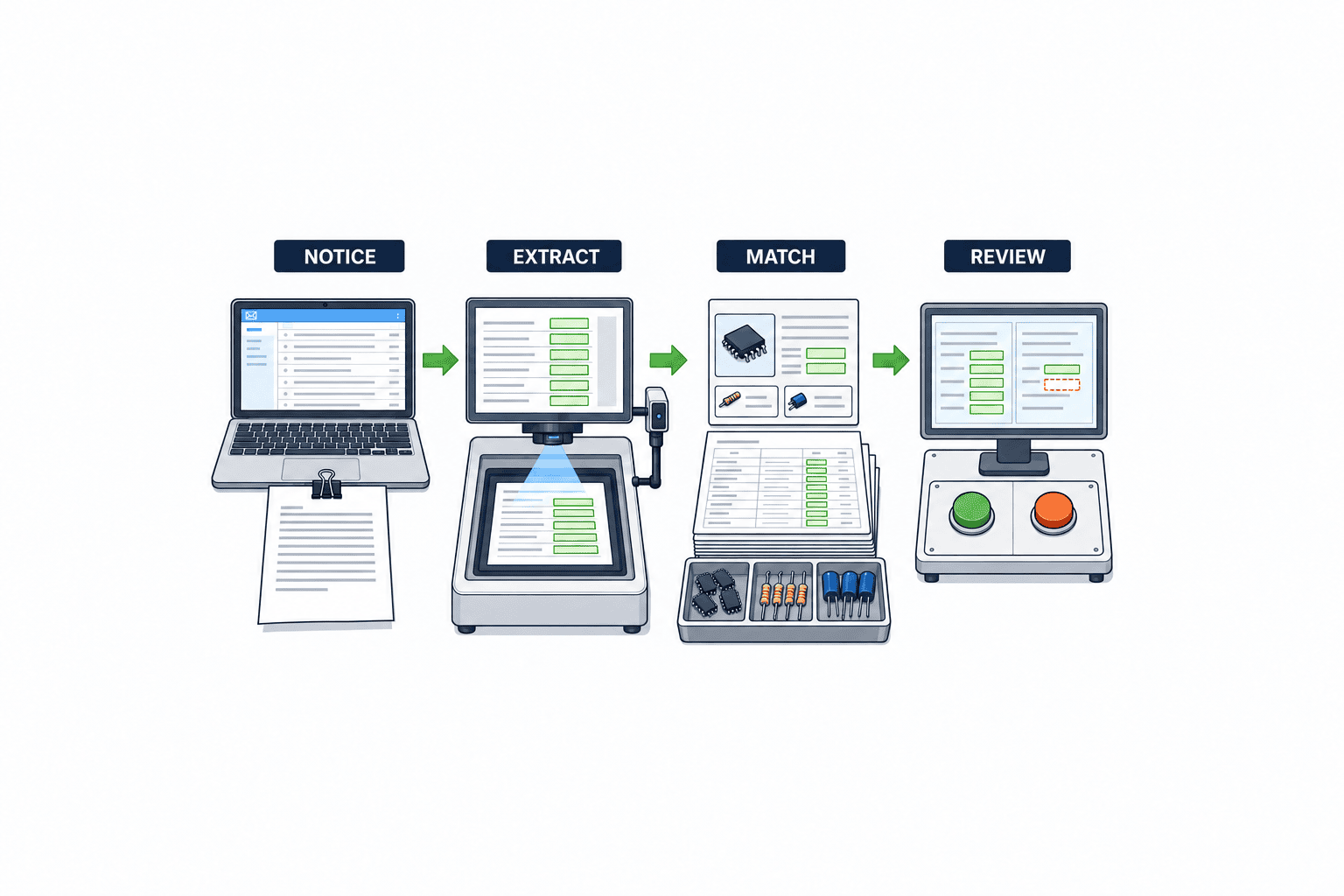
First Output: “Notification Cases” and Extracted Fields with Evidence
Sending incoming emails directly into an AI model and displaying free-text answers is not enough—you must have auditability and reproducibility. Assign a unique case ID to every incoming notification. Record the email Message-ID, attachment file hashes, time received, sender, and version of both email body and PDF. For repeated or revised PCNs with the same number, never discard duplicates—instead, link these as new versions within the same case. When attachments are replaced, retain old versions so that you can trace exactly which version was the basis for each approval.
Your extraction schema should, at minimum, include: notification number, supplier name and code, notification type, supplier part number, details before and after the change, reason for change, affected part numbers, manufacturing site, planned implementation date, first lot affected, supporting docs submitted, reply deadline, and any original text relating to customer approval requirements. For each field, store not only the value but the source file, page number, table row, quotation range, extraction confidence, and review status. If an item is not mentioned, do not infer or auto-fill—display as null, and distinguish between “not mentioned” and “unreadable.” If some values cannot be OCR’d, treat unreadable and unmentioned distinctly.
If your AI model can provide structured outputs, use a strict JSON schema for responses. But remember: OpenAI’s Structured Outputs documentation warns that conforming to schema doesn’t guarantee correct content—independent validity checks are essential. Always double-check numbers, part IDs, and dates with deterministic logic. For example, confusions between “O” and “0” from PDF, “I” and “1” in drawings, decimal points, and day/month inversions in dates must be flagged for human review. If part of the source document is unreadable, keep the case in “pending review”—never route it through automated approval.
String Matching Alone Isn’t Enough for Part Master and BOM Cross-Referencing
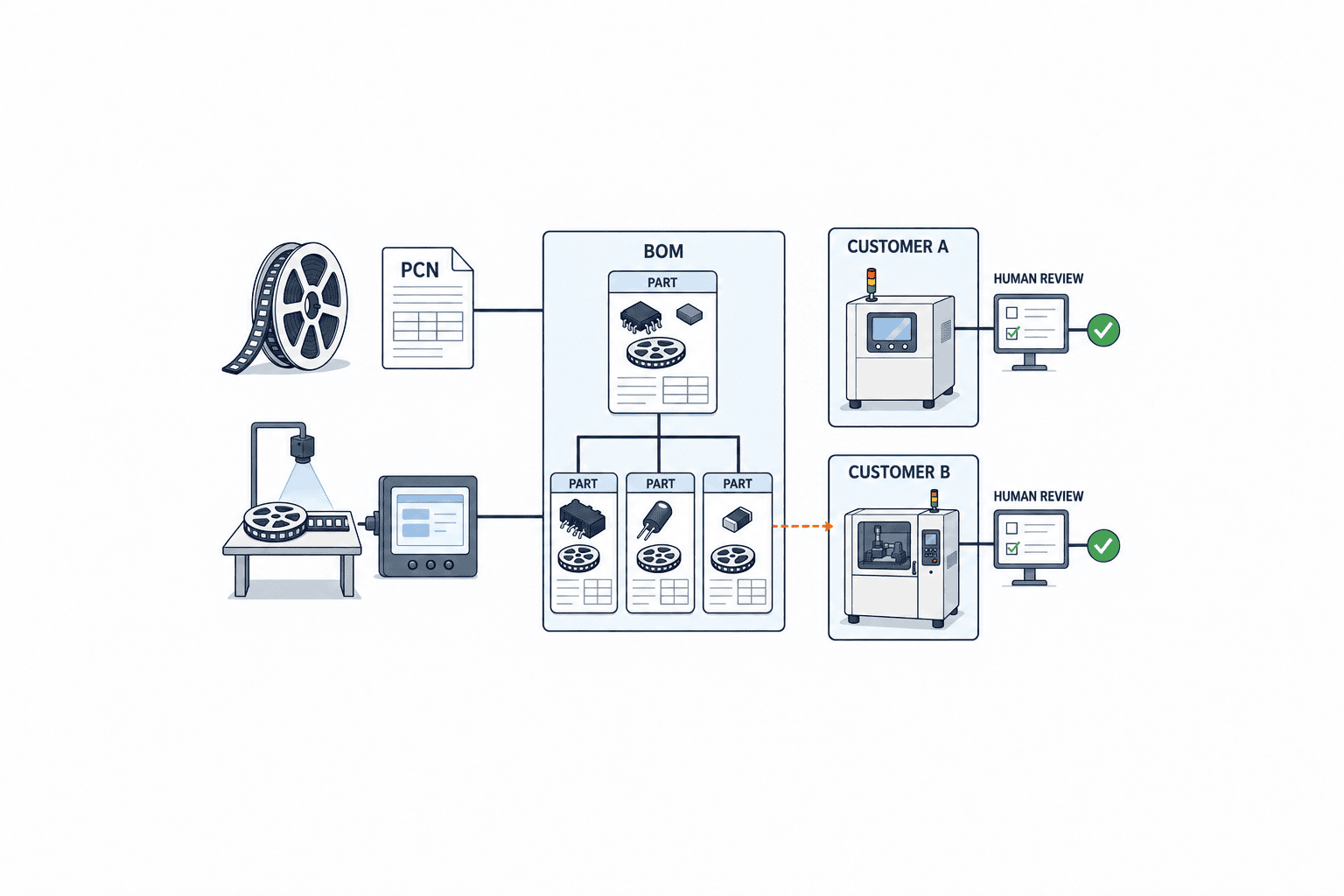
The relationship between supplier part numbers and your internal part IDs isn’t always one-to-one. A single supplier P/N may be used in multiple customer end products. Your part master may have revisions or alternate numbers. The recommended matching process is as follows: (1) exact match of supplier code and supplier part number; (2) then, cross-reference approved equivalency tables with validity periods and revisions; (3) finally, suggest candidates by fuzzy matching on descriptions, dimensions, or material symbols. Fuzzy matches should only be treated as suggestions and never establish definitive links. Nicknames or legacy part numbers used by the factory should be separately registered as synonym dictionaries, with change histories and approver records.
For BOM, you must reference not just the “current displayed version” but also the active version at the notification’s planned effective timestamp, as well as customer-specific derivatives and distinctions between prototype/production structures. If BOM from your production management system differs from drawing BOM from engineering, both must be reviewed. Recursively trace from child parts to finished products, expanding the impact list. Because conditions such as alternative part usage, process-specific use, or phantom items may change results, you need to show “why a product became an affected candidate” with a path such as: “Supplier P/N S-42 → Internal Material M-17 → Part P-300 → Customer Product A-8,” showing master version and validity at each step.
If the master is incomplete, capture the data gap as part of your output, rather than letting AI “fill in” with assumptions. Never declare “no impact” where the supplier code is missing, BOM has no validity period, or updated approval lists are unavailable. In the initial weeks, focus less on boosting AI extraction accuracy and more on eliminating root causes of pending or unresolvable cases. Encompass in your workflows which departments are responsible for resolving each type of “unresolved” case.
How Should Approval Conditions, Customer Notification, and PPAP Be Differentiated?
Don’t try to use a single general-purpose table for all approvals. Approval logic varies by product group, customer, customer site, part classification, change category, production vs. prototype, and customer-specific requirements. Separate decision fields for internal purchasing approval, quality approval, technical evaluation, customer notification, customer approval, and requirement for PPAP resubmission. Note that “customer notification” is not the same as “customer approval”—these distinctions must remain clear. Always link to the requirement-defining documents, applicable reasons, and responsible reviewers.
AIAG’s PPAP overview describes the serial stages of documenting conformity to design records and specs under production conditions. Therefore, “all supplier PCNs must trigger PPAP,” or “PCN means no PPAP required,” are both oversimplifications. Instead, human reviewers must determine from customer requirements and exact change content which supportive materials and submission levels are needed. Customer-specific requirements for automotive parts evolve and are updated; IATF’s official site regularly posts changes to such rules and notification expectations. Your RFP must name which rule versions, effective dates, and person responsible for updates apply at any time.
When the system issues a recommended action, “Requires Notification”, “Requires Approval”, “Internal Evaluation Only”, or “Hold—Insufficient Data” are adequate categories—but they must show the documentary basis behind each recommendation. If AI bases its suggestion on outdated customer specs, a translation, or freeform supplier text only, it must flag for incomplete verification. The final action must be taken by humans with the authority (e.g., in Quality, Engineering, or Sales), and customer notices must go through double-checked, approved content and recipient lists. NIST AI RMF Core emphasizes clear division of responsibility between human and AI in oversight routines. For this system, “AI extracts and suggests, humans approve and communicate externally” makes the split of roles concrete.
Tracing Impact: Inventory, Procurement, and Process
Finding a part in the BOM is not enough to define what the shop floor should do. The same part number may linger in old stock in the warehouse, have new version on order, and active lines may be running substitute materials. Once affected SKUs are identified, trace the status of inventory lots, storage locations, inbound inspection states, orders on hand, expected incoming shipments, production orders, work in progress, finished goods inventory, and shipment schedules. If ERP/MES systems are managed separately, always flag the sync date/time of linked data to avoid misinterpreting old snapshots as current.
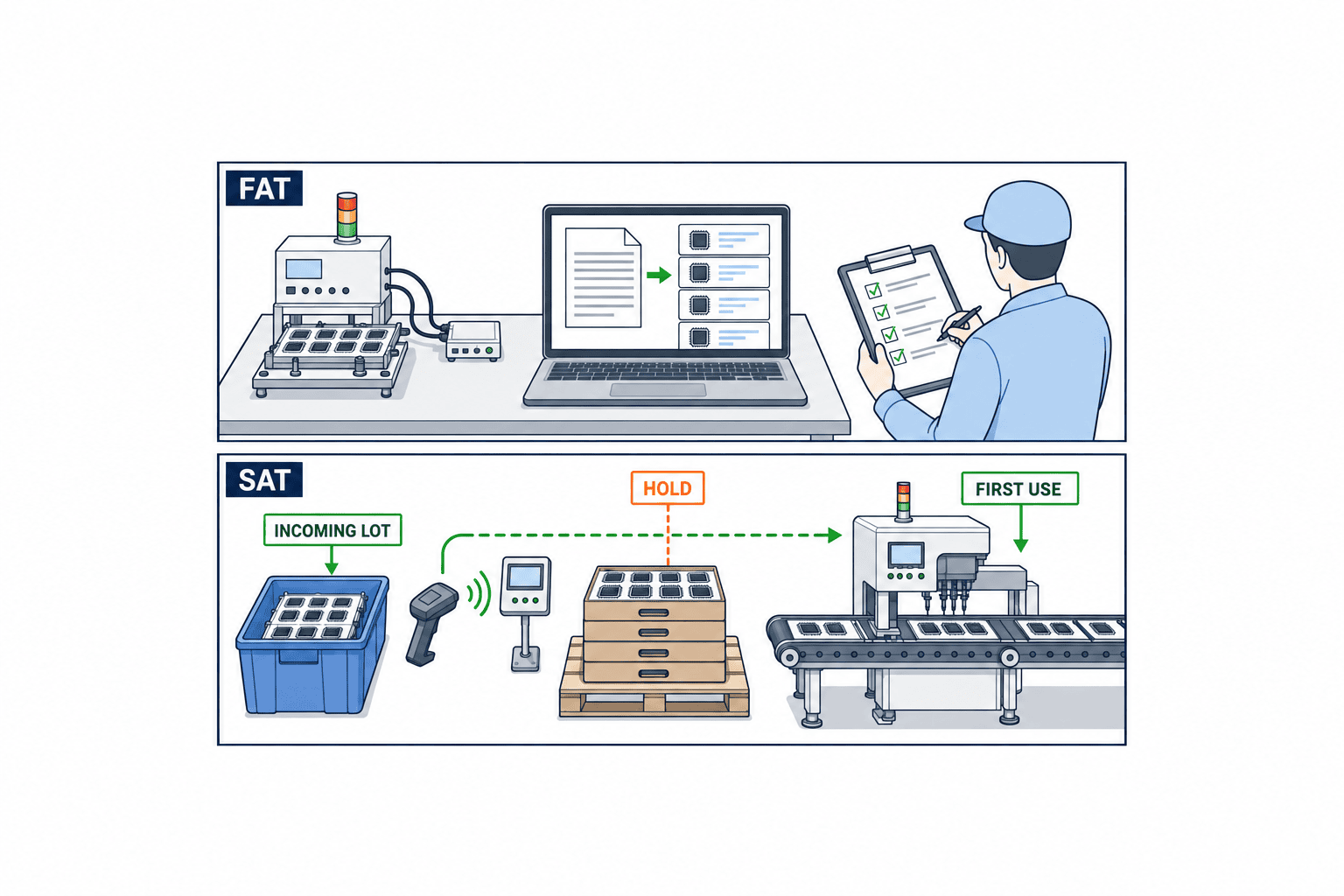
Changeover control must use two boundaries: one based on the notification’s implementation date, and another on actual first use in your facility. Suppliers may promise delayed implementation but ship new-version parts earlier. Conversely, old-version stock may remain after the effective date. Match part labels, inbound lot IDs, supplier shipment details, and receiving inspection logs to register both initial received lot and first use in manufacturing. If these cannot be detected, offer the option to place lots on hold or require further confirmation. If you need to track through to post-change product lots, refer to its design in Automotive Parts Traceability.
Evaluating process impact is not possible from part or material alone. For example, a change in material viscosity may affect application parameters, a switch in resin grade may modify drying/molding conditions, and changes in electronic components packaging could require adjustment of mounting or test fixtures. You must separate “potential impact” from “confirmed evaluation,” and raise process-specific candidate items for technical engineers to review. The system is not intended to auto-modify process parameters by AI. If your quality records and equipment conditions are not fully linked, limit the system’s initial scope to acceptance judgment and impact list to make acceptance testing manageable.
RFP Must Emphasize Exceptions and Responsibility—Not Just Inputs/Outputs
If your RFP only says “PCN must be AI-readable,” each vendor will quote from different assumptions. For a meaningful comparison, specify the target mailbox, notification types, annual/monthly case volume, PDF/file languages and OCR quality, master data format, BOM version management rules, ERP/MES integration, and where customer conditions are stored. Always use actual case numbers from your operation; if not available, present sample period figures and mark as “requires actual measurement.” Never write arbitrary reduction rates as requirements.
At minimum, insist vendors respond in this format:
| RFP Item | Conditions to Specify | Acceptance Test Criteria |
|---|---|---|
| Receiving/Version | Keep all emails, attachments, resends, revisions, per case ID | Revised PCNs do not overwrite old versions |
| Extraction/Evidence | Separate raw value, document position, missing fields, OCR failures | Link from UI to source doc section |
| Part Matching | Match by supplier code, part ID, version, date | Similar parts not falsely declared as definite matches |
| Impact Tracing | Explore parent BOM, inventory, orders, work instructions | Show impact path and data effectivity timestamps |
| Approvals | Apply customer rules and human approval rights | Humans can defer/amend AI suggestions |
| Logging | Retain version, rules, responsible staff, reason | Reproduce status for audits |
| Security | Define access, storage, storage duration for confidential files | No unauthorized cross-customer searches |
Generative AI is effective at reading and extracting info from unstructured documents, but never delegate complete part code matching, BOM unfolding, deadline calculations, or authorization to pure language inference. Use business rules and version-controlled masters for these areas; AI should be used for unstructured document reading and candidate suggestion. When rule and model outputs diverge, always display the comparison for human judgment. Vector search for document lookup is for navigation, not as a substitute for official approval conditions.
What to Test in FAT/SAT to Determine Acceptability
FAT (Factory Acceptance Testing) is done on the vendor’s environment, using a predetermined dataset and expected results to check extraction, matching, and exception handling. SAT (Site Acceptance Testing) repeats the same sequence using real Thai factory emails, masters, BOMs, authorizations, network, and ERP/MES links. Even if FAT shows good numbers, practical gaps in your code mappings or missing legacy part numbers may cause SAT to halt. Define acceptance criteria and test cases before contracting, with QA, Purchasing, and Engineering staff jointly reviewing the “correct answers.”
A robust acceptance test must cover more than ideal cases, including at least the following:
- Both initial and revised PCNs with the same number, confirming differences.
- Implementation date differs between email body and PDF; both are preserved as alternatives, not forcibly merged.
- Supplier part number is a legacy code, matching candidates suggested from synonym dictionary.
- OCR ambiguity between “0” and “O” on part IDs leads to “awaiting human review” instead of mis-matching.
- Multi-tier BOMs where one change spreads to multiple customer products.
- Multiple, differing customer requirements with correct effective versions identified.
- Inventory lots, orders, and WIP with non-synchronized timestamps, exposing “data staleness.”
- Cases with missing attachments, unknown deadlines, or absent approvers remain open until resolved.
- Divergent requirements—e.g., Customer A must be notified, Customer B must approve—persist throughout.
- Supplier retracts change after approval; closure history is logged.
Performance metrics should not be a single “AI extraction accuracy” number. Instead, separately measure accuracy for each mandatory field, total missed impact part counts, count of unnecessary “impact detected,” rate of root-evidence mapping, rate of proper “pending” handling, and manual review time. Rather than claim “zero missed cases”, increase coverage of error-prone scenarios. Document sample size, population, and handling of exceptions in your definition of “pass.”
Rollout Sequence & Operational Responsibility at Thai Factories
Start with moderately sized part families where high notification volume meets relatively clean master data and BOMs.
- Phase 1: Collect a set of anonymized past PCNs and prepare verified answer keys.
- Phase 2: Prepare mapping tables for supplier and internal part numbers, customer-specific approval matrices, and effective BOM versions.
- Phase 3: Pilot receipt–extraction–impact suggestions, recording any deltas between AI output and human decisions.
- Phase 4: Integrate inventory/order/process links, moving from FAT to live SAT.
Run parallel with legacy procedures, and review errors or mismatches on a weekly basis.
For bilingual (Thai/Japanese/English) notifications, always record both original and translated content; never allow evaluation based only on machine translation. For customer communications, the local (Thai) staff may draft the message, but the Japanese quality manager may make the approval. Even if the UI is multilingual, always log which original/translated version, revision, and reviewer were checked at signoff. For operations including suppliers or facilities in Vietnam, apply the same practice to Vietnamese. Language models can make sensible translations, but errors in material, process, or spec codes do occur; keep original part codes and numbers distinct from text translation.
Separate permissions: “notification recipient,” “part master maintainer,” “technical evaluator,” “quality approver,” and “customer representative.” When Purchasing receives a notification, the Quality team must immediately see the case, and if technical review is needed, assign it with deadlines. Define rules for substitute approvals, handover during leave, and customer correspondence logging. In AI-powered processing, always treat all attached supplier docs as potentially containing customer proprietary or price data, and define explicit rules for access, storage, model provider disclosure, and retention. List precisely which data fields may be sent outside to service providers—not just general privacy statements.
Example Data Model: Separate Cases, Change Items, Impacted Targets, and Decisions
To create a robust searchable log, avoid forcing all outputs onto a single PCN sheet.
- The case record links supplier, receipt timestamp, PCN number, and original version.
- Each change item records a row for each material, process, equipment, or plant change, before and after.
- Each impacted target lists internal part numbers, BOM relationships, customer products, and inventory/order links.
- Each decision logs responsible person, timestamp, rule version in use, customer action taken, and rationale.
This modularity enables representing a single notification that covers multiple change items, each affecting several products.
Each record should also log how the value was obtained: was it “extracted from original doc,” “definite master match,” “BOM unfolding,” or “manual override”? This is crucial for targeted re-evaluation when errors are found. Store the AI model version and extraction prompt for traceability. Never retroactively rewrite past approval logs just because you update models; if past cases are re-analyzed, save results as a separate review, with the original condition frozen for audits. When suppliers issue correction notifications, log as a new case version and ensure correct action for pre- or post-adoption.
Effective date/timestamp management deserves special attention. BOM effective date, customer requirement effective date, supplier’s planned change date, receiving date, and first use in process may all differ. “Not found in current master, so no impact” ignores old stock or preorders. Your matching functions should explicitly allow the “evaluation date,” and if unclear, show all plausible dates or keep the case pending. For test data, include month-end cutovers, year crossings, delayed implementation, and parallel use of old/new. In multi-country approval chains, show both ICT and customer time zone; forbid auto-assumptions where the source lacks explicit data.
If, during routine audits or customer questions such as “Why was no notification sent?” arise, AI summaries alone are insufficient. You must be able to export a full trace—original doc lines, which part mappings, which customer requirements, and which approvers were chained together per item. Conversely, where post-fact review uncovers cases where notification “should have occurred,” you must know which master and rule versions were in effect, to accurately attribute the miss to setup, extract failure, or human action. This serves not only for accountability, but for continuous improvement and prevention of future oversights.
Prioritize Real-Case Reproduction over Demo Impressions in Vendor Evaluations
Before requesting quotes, select a set of actual past notifications spanning a variety of difficulties—scrubbing all personal and confidential information—as your evaluation set. Include not only simple PDFs but forwarded emails, image-embedded tables, bilingual notices, correction notices, and differing part number suffixes. Evaluators must establish the “correct answers” upfront: actual supplier P/N, affected internal part, impacted customer product, required checks, and cases that should have remained in hold status.
Vendors must be tested using the same validation set, master data snapshot, and time limits. Favor solutions that safely defer ambiguous cases rather than those which score high on “number of fields extracted.”
In scoring:
- Don’t just count extracted items—weight according to risk/criticality: falsely flagging impact on a product you don’t have is a minor nuisance, but missing a real impact can delay critical notifications or acceptance checks.
- Recognize proper “marked as insufficient basis” as a valid, safe outcome, not a failure.
- Early operation should value correct “pending” routing over maximizing extraction accuracy.
Contracts should require additional acceptance with new notifications to prevent vendors tuning to just the test set; include retest procedures when models or OCR engines are upgraded, as well as procedures for reverting to email/ledger in case of failure, and clarify export formats. By having Purchasing, Quality, and IT use the same scoring sheet, you can compare proposals lacking audit trails (even if low-cost) or unable to manage rule versions, as well as those excelling in accuracy. Implementation decisions must balance manufacturing responsibility and customer agreement compliance.
Once operational, monthly reports should classify extraction errors, matching misses, pending cases, overdue deadlines, and customer rejections. If errors arise from notification format, escalate to suppliers; if from master data, review data maintenance; if from business logic, update approval tables as per customer requirements. Don’t let this process become just a monthly “AI performance” meeting—make sure you are measuring progress in the entire purchasing-to-customer-desk workflow.
Re-evaluation triggers after go-live
Approval does not freeze a case forever. Register a corrected PCN, added affected part number, BOM revision, updated customer requirement, changed open purchase order, or confirmed first receiving lot as a trigger. When one occurs, compare the new notice version with the prior one and recompute the affected parts, inventory, orders and production orders from the changed fields. Do not silently overwrite the prior approval. Show the reviewer newly affected customers, an earlier effective date and missing test evidence as explicit differences. If the change has not yet been adopted, put implementation on hold. If it has already entered production, first identify the affected lots and shipments and alert Quality.
An authorized person decides whether renewed approval is required under the actual customer rule and technical change. If a customer notification must be withdrawn, corrected or supplemented, retain the previously sent message and link a new version. A replacement reviewer should see the original document, prior decision and unfinished checks on one screen. Define closure criteria as well: final supplier notice received, required internal approvals and customer actions complete, and old/new stock and first-use lots distinguishable. Open supplier questions or customer approval still pending mean the case remains on hold. Include this re-evaluation path in SAT so the buyer can distinguish a one-time document-reading demo from a workflow that survives later changes.
Assessing ROI: Separate “Time Saved” from “Decision Quality”
For cost benefit analysis, break down initial data preparation/integration, AI usage fees, maintenance, updates to customer requirements, and maintenance of verified answers. In low-volume facilities, fixed costs for elaborate automation may never be recouped. However, factories with high part/customer counts and complex impact tracing will gain more from integrating BOM/inventory with AI reading than from PDF extraction alone. Calculate effectiveness based on your actual past workload, not vendor generalizations or hypothetical industry benchmarks.
Target metrics include time from notification receipt to initial triage, time verifying affected part numbers, time for customer notification determination, count of overdue cases, and count of re-investigations. Track post-implementation results *with the same definitions* and break down by notification complexity or page count. Merely “halving per-case time” is not success if misses or misnotifications increase. Quality KPIs should cover, for example, missing documents flagged before approval, detection rate for version mismatches in customer requirements, and ability to trace initial receipt lots for changed products. These are internal KPI examples—not industry-wide benchmarks.
Frequently Asked Questions
Can AI matching alone fully automate supplier change notification review and approval?
No, and it is not recommended. AI can extract content, suggest candidate part numbers, propose affected BOM/product candidates, and link to relevant spec documents. However, application of customer-specific requirements, technical assessment of alternative materials, evaluation of quality risk, and definition of customer notification scope must remain under authorized human judgment. Always log the original doc, applicable rule version, and decision rationale with each approval in your operational system.
Should PCN and 4M supplier notifications be processed as a single case type?
While you can receive external notifications via a common intake, PCNs, advisory information, discontinuation notices, and supplier 4M change notices each have different required documents and customer criteria. Always retain notification type and use shared logic for part/BOM matching and impact tracing, but apply distinct approval routes. Internally raised 4M changes are a separate operational starting point and should be integrated at the appropriate stage.
What data should be prepared before deploying AI?
Begin with mapping tables for supplier codes and part numbers, BOMs with valid versions, customer-product relationships, and customer-specific approval conditions. Full coverage of every item is not required upfront. Select your target part families and systematically resolve causes of “unresolved” status detected in past notification reviews. Never design the system to let AI “fill in” for missing master data.
What are the minimum items required in RFP and FAT/SAT?
The RFP must describe document types, languages, master data formats, BOM versioning, ERP/MES connections, evidence linking, human approval rights, and audit trail capabilities. For FAT, include edge cases such as version mismatches, ambiguous part codes, missing attachments, and differences in customer requirements; in SAT, recreate these real-world scenarios using actual data and in-plant roles. Acceptance is based not on mere “system runs” but on whether expected pending/notify/approve actions, with evidence, are produced.
Summary
AI-based supplier change notification management for Thai manufacturing delivers more than just fast reading of email and PDFs. It traces from supplier part code to internal part/BOM and customer product, shows evidence-based impact across inventory, purchasing, and processes, exposes unresolved points, and prepares the reviewer for correct, well-founded decisions. When implementing, always interlink source documents and revision control, certainty of part mappings, customer rule effective dates, and preserve human authority over the final judgment. Document exceptions and audit trails in your RFP, and test with ambiguous and edge-case notifications in FAT/SAT, to ensure you get a system that truly supports frontline operations.
If you wish to clarify which parts and customers in your Thai facility are affected by PCN/4M supplier notifications, do contact TOMAS TECH. Together, we can organize your current notifications, part masters, and define initial target part families and all review fields needed for effective RFPs and acceptance trials.


