


Implementing a manufacturing process skip prevention system means more than showing an operator the next instruction. The system must determine the approved route for each product or lot, verify evidence that prerequisite operations are complete, and only then authorize the next start. This guide covers route design, MES and equipment integration, exceptions, vendor evaluation, and FAT/SAT for factories in Thailand.
The objective is not to freeze every deviation. Rework, parallel subassemblies and outsourced steps need approved routes of their own. A business rule that blocks a manufacturing step must also be distinguished from a machinery safety function.
What counts as a skipped operation?
Separate three situations before configuring a rule. A required operation may truly not have happened. It may have happened in the wrong order. Or it may have happened without a valid completion record. Treating all three as the same defect invites retrospective bulk entry and makes legitimate recovery difficult. Record an unknown execution state as “evidence missing” until someone confirms what physically happened. If work must be repeated, move the unit to a controlled rework route. If the work was done but its record is missing, require supporting evidence and an authorized correction that preserves the original entry.
For each product family, classify which operations are mandatory, conditional or optional, which order constraints are strict, what evidence completes an operation, and what happens when evidence is absent. A cleaning step before inspection may be mandatory for one product and irrelevant to another. “Skipped” therefore cannot be defined by a single line-wide checklist.
MES route control and the boundary with machinery safety
The ISA-95 model places manufacturing operations management, including MES, at level 3 and enterprise planning at level 4. A process skip prevention system uses production orders and product revisions to choose a route, then links execution, quality results and exceptions to that route. Sensors, PLCs and machines can supply evidence or receive a business start authorization, but a cycle-complete bit alone rarely proves that the right part passed its quality criteria.
Be precise about the word “interlock.” An MES rule denying a start because a prior step is incomplete is a production or quality interlock. A safety-related machine control function protects people from hazards and needs its own design and validation. IEC 62061 concerns the design, integration and validation of safety-related control systems for machinery. A screen message or a network permission flag must not be assumed to replace a safety circuit. The machinery supplier and safety owner should evaluate the safety function independently of the MES connection.
Define the route master before designing screens
At minimum, distinguish product and revision, lot or serial identity, route version, operation code, mandatory/conditional status, prerequisites, completion criteria, eligible machine and location, operator qualification, rework branch and effective date. Fix the applicable route version when a lot begins, or explicitly approve a migration rule for work in progress. Otherwise a later master update can silently change what past lots appear to have required.
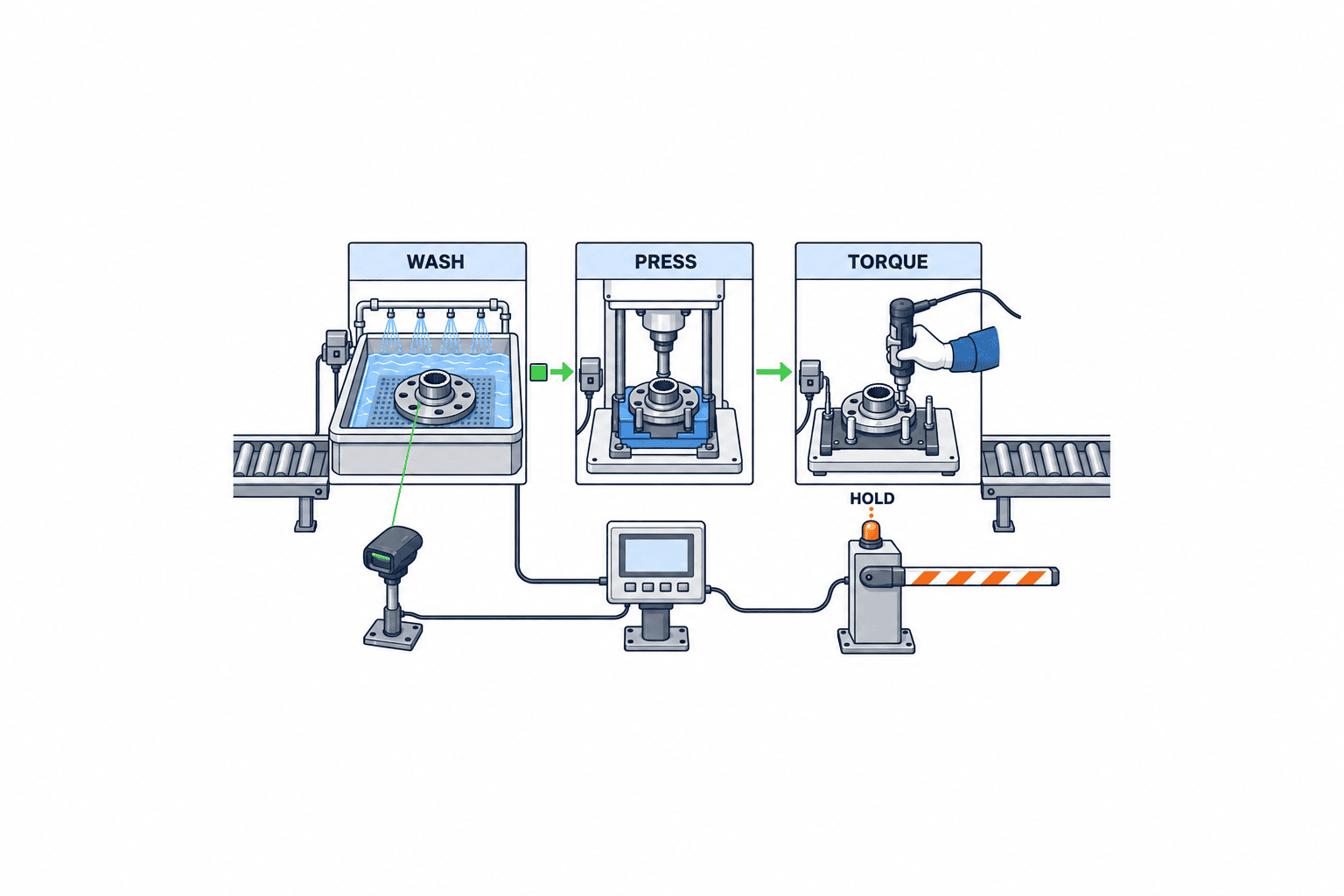
Consider a route of receiving, cleaning, press fitting, torque verification, final inspection and packing. Another product may omit cleaning; a customer option may add an inspection. Resolve the route from product, specification and revision, then store the conditions used in that decision. Keep an operation’s meaning separate from its station: the same operation can be performed on multiple machines, and one machine can host multiple operations.
What should the start gate check?
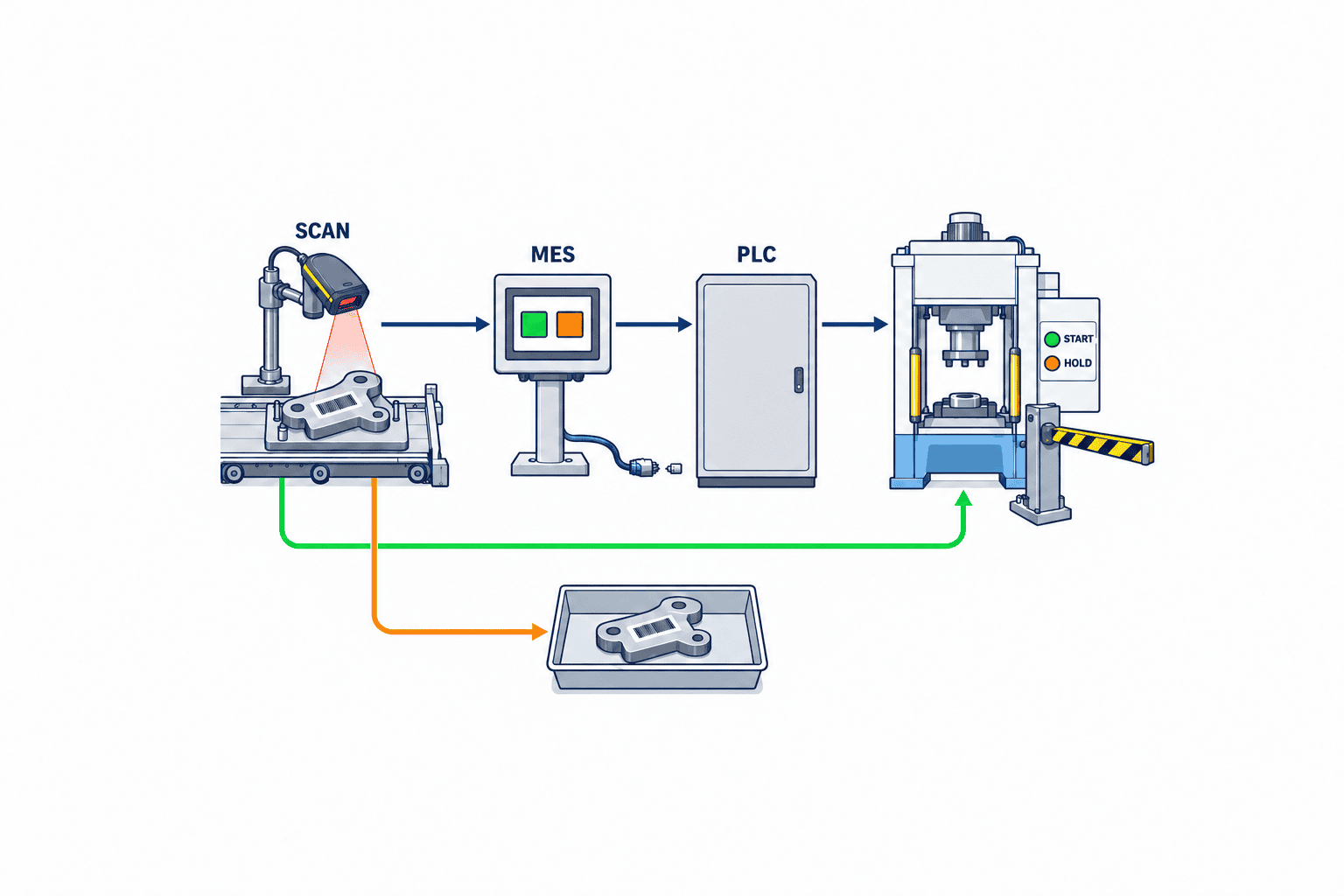
After scanning a lot or serial code, the system should check identity, applicable route version, whether the requested operation is currently eligible, completion evidence for prerequisites, open quality holds, and eligible equipment, tools and operators. Only then should it emit a start authorization with the unit, operation, machine, operator, time and rule version attached. A permission should be scoped to a specific workpiece and machine, expire after a defined time, and be invalidated on changeover or rescan. Restart after a stop, a shift change or a network recovery needs an explicit recheck policy.
Operators need a reason and a next action, not just a red “blocked” state. “Torque verification incomplete,” “route revision mismatch” and “awaiting quality release” lead to different remedies. Localize messages into the languages used at the station. A system that cannot explain its holds encourages bypasses.
Completion evidence must mean something
A button press is useful but may not be sufficient. For machining, link the workpiece to a cycle ID, settings, machine and timestamps. For fastening, capture the tool, fastening point, measured torque and disposition. For inspection, capture the test item, measurement, specification revision, result and measuring-device identity where required. Set evidence depth according to quality risk and customer requirements rather than collecting data that nobody can interpret.
NIST’s digital thread programme describes connecting product definition with manufacturing and quality information and feeding results back. Applied here, the record should explain which instruction revision, asset and result justified the next start. NIST’s recommendations on manufacturing-data traceability and trustworthiness also support preserving provenance. Corrections should keep the old value, new value, reason, approver and time; duplicate scans, clock differences and delayed offline uploads need explicit handling.
Make rework, parallel and outsourced steps proper routes
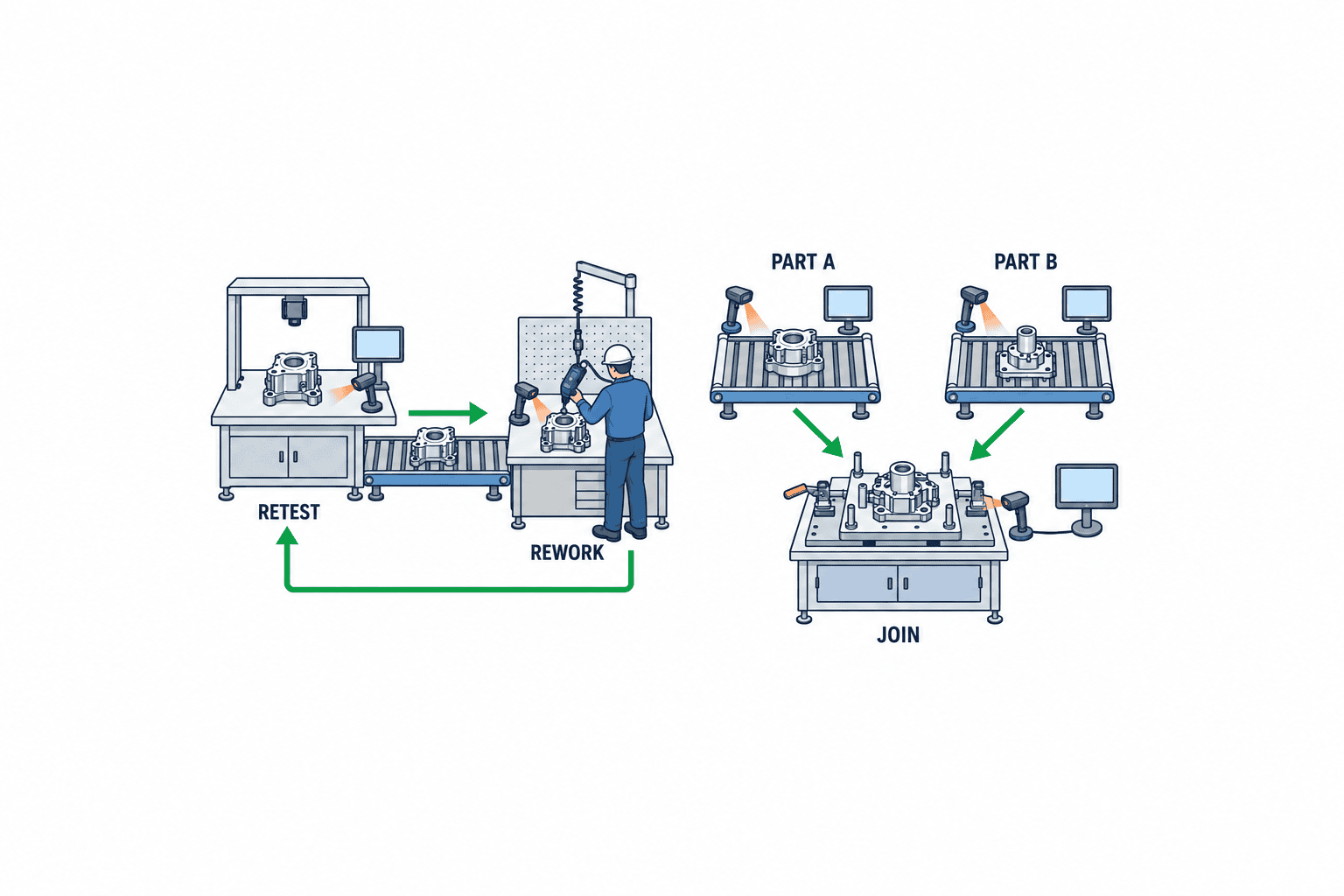
A linear “happy path” prototype often fails when released to a mixed-product line. Reinspection, recleaning, parallel subassemblies and outsourced heat treatment must be modelled from the start. Rework is an approved branch linked to the originating nonconformance, not an untracked repeat of a normal step. For parallel work, define whether either branch or both branches must finish before a join. At a parent assembly, check child identities and completion states.
For outsourced operations, decide whether shipment, supplier certificate, return receipt or incoming inspection establishes completion. Preserve the document and approval when no electronic supplier record is available. Conditional routes must also store the measured value and specification revision behind a branch decision. Changing a threshold later should not rewrite the logic applied to an older lot.
Plan for misreads, network loss and urgent releases
Dirty labels, double scans, terminal outages and late PLC events are normal operating conditions. Combine a code with a fixture or container identity where the part cannot carry a reliable label. Avoid a generic supervisor password that opens every blocked station. A quality-based outage policy may hold new starts at critical operations, while permitting limited offline execution at lower-risk steps. If offline operation is allowed, define the cached route version, expiry, maximum unit count, upload evidence and quarantine action for sync conflicts. Machinery safety must not depend on network availability.
An urgent bypass should identify the workpiece, operation, reason, expiry and approver, notify quality, and specify any additional inspection. Some customer- or regulation-required operations must remain non-bypassable. Review override patterns by reason, line and shift; recurring overrides usually indicate a faulty master, delayed signal or unsuitable workflow.
Connect ERP, quality records, terminals and machines
ERP supplies orders, product and planning information; MES records what happened to the lot or serial unit. An issued production order does not prove an operation was performed. Equipment may supply start, end, result and alarm events; quality systems may supply holds and inspection dispositions. Use ISA-95 as common terminology for these boundaries. Specify event owner, unit identifier, timestamp, retry and deduplication behaviour, and late-arriving events. A resent PLC completion must not complete the step twice, and a later NG decision must stop unjustified downstream starts.
Operator qualification and expiry control can be checked at the same start gate, but operator eligibility is not proof that the operation is complete. Likewise, manufacturing kitting control verifies material readiness and identity; it does not certify the route sequence. Keep these controls separate so a wrong component and a skipped process are both detectable.
Choose an initial scope and measurable acceptance criteria
Start with one high-risk, reasonably well-understood route rather than converting every line at once. Review historical escapes, rework, missing records, branch complexity, machine interfaces and customer audit needs. Walk real workpieces across day and night shifts; compare the documented route with actual movement during equipment failures, outsourcing and rework. Define success as a blocked unauthorized start, an unobstructed approved rework route, understandable hold reasons, traceable overrides and acceptable station time. If a detection-rate claim is made, specify the test cases and denominator.
Test skip scenarios in FAT and SAT
Define operation states more precisely than simply open and complete. Useful states may include not started, start authorized, running, result pending, complete, quality hold, rework and cancelled. A machine cycle may end while its inspection result is still pending; specify whether downstream work can start. Attach every state transition to an event and actor, and define how duplicate events or a later NG result affect work already in progress. For lot-based work, decide whether a lot-level completion covers every unit, what happens when only some units are held, and how split or merged lots retain their lineage. Reconcile input, good, scrap and rework quantities according to the actual process. Pair an electronic hold with a physical quarantine location and a rescan rule so held parts cannot re-enter the flow unnoticed.
In FAT, use simulated equipment to test normal order, attempted early start, wrong product route, quality hold, duplicate scan, repeated completion event, simultaneous terminal use, date rollover and route revision change. Check not only that a start was denied, but that its reason and audit record are correct. In SAT, use real scanners, labels, fixtures, PLCs and networks. Test wrong-workpiece presentation, tool replacement, network restoration, shift handover, rework return, outsourced receipt and a later quality correction. Evaluate machine business permission and independent safety functions with the appropriate owners. Record expected result, observed result, logs, outstanding defect and retest owner.
Cost, payback and vendor questions
Compare more than the MES licence and tablet count. Budget route-master cleanup, data migration, labels, scanners, machine I/O, ERP and quality integration, exception workflows, validation, training and support. Some lines can begin with scanning and inspection records while only critical machines receive an electrical start-permission interface. Baseline scrap, rework, sorting, customer response and record-checking effort. Track skip-related nonconformance, attempted early starts, approved exceptions, unexplained holds, manual corrections and terminal downtime. Initial attempts may rise because a previously invisible behaviour has become measurable; interpret this alongside quality outcomes.
Thailand’s BOI industry-upgrade measure covers eligible efficiency and smart-industry investment under stated conditions. Eligibility of a particular MES proposal must be confirmed against current BOI rules; do not assume an incentive in the payback calculation.
Ask vendors to demonstrate one real route from denied start through approved rework. Confirm route versioning, conditional branches, serial and lot granularity, concurrent stations, hold propagation, outage behaviour, correction audit trail and data export. Separate standard features from custom development. In multilingual plants, review exception messages and training, not merely navigation labels. Confirm local machine-interface testing and regression testing after changes.
Run the control after go-live
Route changes need a request, affected products and plants, effective date, work-in-progress policy, test evidence and approval. A lot already in production may stay on the old revision or migrate under a documented rule; never silently overwrite it. Review early-start attempts, hold reasons, overrides, corrections, read failures and route mismatches by line and shift. Concentrated holds may signal poor label placement, delayed equipment signals or a master that differs from actual work, rather than operator negligence.
For audits, a lot lookup should show the applicable route, each start and finish, evidence, holds and releases, rework, and final shipment approval in one timeline. Define record retention from customer and company requirements and test recovery from backup. Explain to operators how to read a hold, request a correction and escalate an outage. Feedback from real exceptions should improve the route master.
When deploying across plants, compare the purpose of each operation with the equipment at each site before forcing a single common route. The same operation code may use a different inspection method or provide different machine signals. Standardize the quality meaning of “complete,” while allowing site-specific terminal placement and evidence capture. Identical names with different evidence meanings make cross-plant reports look consistent even when the skip decisions are not.
Assign owners to the master data. Engineering or manufacturing engineering owns product identity and revision; manufacturing engineering owns the operation route; quality owns acceptance criteria; and maintenance or the machine supplier owns signal definitions. An MES administrator should not infer these facts alone. Separate the person requesting a master change from the person approving it, compare the lots affected before and after, and retain the decision basis as people and equipment change.
Agree operating rules and acceptance criteria before rollout
A state-and-action matrix is more useful at cutover than a feature list. Put not started, running, result pending, quality hold, rework and complete across one axis; put start, restart, complete, cancel, correct and ship across the other. Define allow, deny or conditional allow at each intersection, including authority and required evidence. A result-pending part may be barred from shipment yet allowed into a non-destructive next operation for a specific product. Tie such differences to product and customer specifications rather than tacit supervisor judgement.
For every gated operation, use a concise requirement sheet to answer four questions: how is the physical unit identified, what proves completion, who checks when the machine signal is unavailable, and where does the physical unit go on an NG result or network outage? Include rework, outsourcing, lot splits and joins, and lots in progress during a specification change. Manufacturing, quality, maintenance and the supplier should review the same sheet. Let operators test whether the displayed hold reason makes sense at the station.
Acceptance criteria should cover recovery from a false hold, not only correct rejection. If a machine event is merely delayed, can it be fetched again and the lot reevaluated without creating duplicate completion records? If a label is damaged, who authorizes alternate identification and preserves its link to the original ID? If a quality result is corrected later, can downstream work in progress be found and held? Reliable operation means recovering from errors without breaking the audit trail.
Review hold reasons daily during initial rollout, but do not set a target that simply minimizes denials. That could loosen necessary controls. Evaluate holds alongside quality escapes, unprocessed units mixed into good stock and manual corrections. Keep valid holds, version any improved route master, record the effective time and affected lots, and retest it. Budget the owners’ time and the change process after go-live.
FAQ: manufacturing process skip prevention
Can MES alone physically stop a machine?
An MES screen can deny a business start, but physical start inhibition requires a designed equipment interface. Safety-related control remains a separate validated function. The extent of integration depends on quality risk, machine modification options and workflow.
Is barcode scanning enough to prevent process skipping?
Scanning identifies a unit. Prevention requires the route version, prerequisite completion, quality state and eligibility checks behind that scan. A fixture or container ID may supplement codes where parts are hard to mark.
What if operations frequently change order?
Model approved alternate and rework routes with their prerequisites and retest requirements. Treating every change as a generic manager override preserves speed but loses explainable history.
What drives implementation cost?
Branch complexity, machine interfaces, traceability granularity, existing-system integration and exception volume often matter more than line count. Give all bidders the same representative route and acceptance scenarios.
Conclusion
A process skip prevention system succeeds when it defines both the evidence that permits progress and the conditions that require a hold. Versioned routes, meaningful completion records, quality states, controlled exceptions and realistic FAT/SAT cases form the core. Machinery safety controls require their own validation.
If your Thailand plant is deciding which operation should have a start gate or how existing ERP and machine signals can support one, contact TOMAS TECH with a sample route and typical exceptions. The discussion can begin while the scope is still being defined.


