



An operator qualification expiry control system should do more than digitize a list of certificates. At the point of execution it should answer a specific question: may this person start this work order, on this machine, for this task and shift, now? HR may know a renewal date, yet a late shift or a last-minute replacement can still begin work without an effective check. This guide describes how a Thai manufacturing site can define the data, stop and escalation rules, audited supervisor exceptions, RFP requirements, and FAT/SAT evidence needed to connect competence records with production execution.
“Qualification” here includes plant-defined training, practical assessment, machine authorization, and customer-required certification as well as any statutory license that actually applies. Legal obligations depend on the task and jurisdiction. Local legal and EHS teams should check current Thai law and contracts for the particular operation. Every time, cost, threshold and benefit calculation in this article is an illustrative design example, not a measured result or a requirement imposed by a standard.
Why a qualification register alone cannot control work starts
A spreadsheet or LMS can show expiry dates, but if its data does not reach the station, supervisors still make a manual judgment for every assignment. The same worker may be approved for assembly yet lack approval for final torque inspection or maintenance. Required qualifications can depend on the order, machine, material, product revision, process and shift. If the plant cannot reconstruct the qualification version and the exact start time, it may also be hard to explain a historical authorization to a customer or auditor.
Four common gaps are: storing a qualification name without its machine or task scope; treating attendance as valid before practical assessment and sign-off; serving an old cache to a night-shift terminal; and allowing a shared administrator account to release a line without recording the accountable approver. These are questions of rules and operating procedure as much as software features. ISO 9001 auditing guidance discusses determining competence and retaining appropriate evidence. ILO-OSH 2001 discusses defining safety competence, initial and refresher training, assessment and records. Neither source prescribes this specific software architecture. The system is a way to execute the plant’s chosen rules at the moment of work.
How this differs from a skill matrix, application access, and shift handover
The AI skill-matrix approach to workforce development asks who should be trained and where people may be allocated over weeks or months. This article checks one concrete start event after allocation. A highly experienced worker can still have an expired authorization for the particular machine. Conversely, a renewed worker should not remain blocked because a planning matrix has not yet refreshed.
Production-system access control governs who may view, edit or approve software screens and APIs. A person with a valid login may still be unqualified to execute a specific production step. The factory shift-handover workflow transfers open work and abnormalities to the next team. When a new person accepts that work, the system should recheck the new person, shift and time.
| Control | Main question | Time horizon | Input to this design |
|---|---|---|---|
| Skill matrix | Who should be trained and allocated? | Weeks to months | Candidate skills and training plan |
| Application access | Who can use a screen or API? | Login and action | Identity and approval rights |
| Shift handover | What must the next team receive? | Shift change | Open work and reassignment |
| Start qualification | Can this person start this order and task here and now? | Start and restart | Allow, hold and audit event |
Evaluate the five-part context: person, order, machine, task and shift
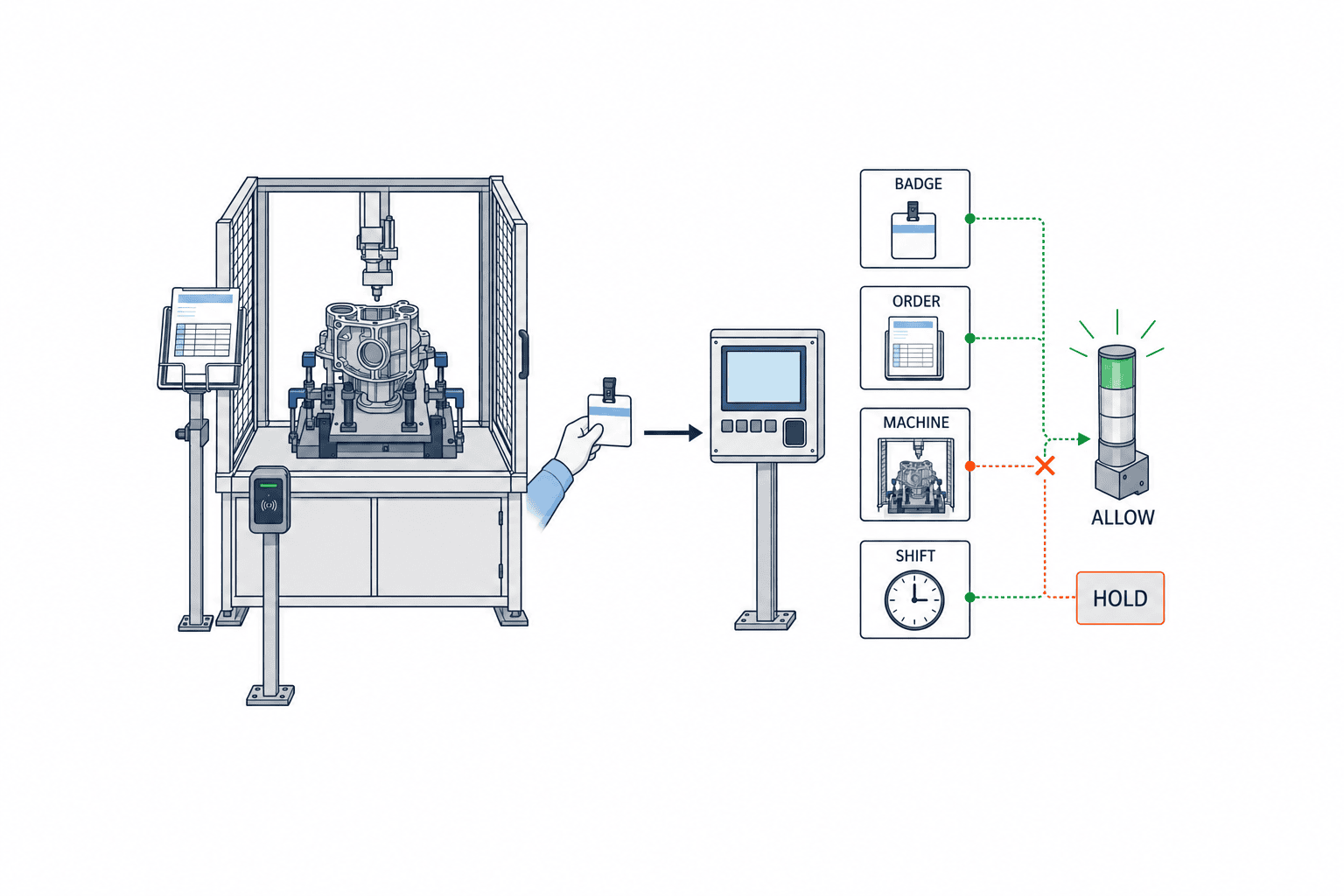
Do not reduce qualification to a single yes/no field. A decision request should at least include operator ID, work-order ID, machine ID, operation or task ID, intended start time and shift ID. Product family, drawing revision, hazardous-work class, maintenance mode or contractor may be additional conditions. ISA-95 is a reference framework for information exchange between enterprise planning and manufacturing operations. It can help define the boundaries among ERP orders, MES execution and station events; it does not itself mandate a qualification gate.
For example, general assembly could require training A; final tightening with a controlled torque tool could require training A plus practical approval B; electrical-cabinet maintenance would have a separate procedure and authorization. Each task needs a set of required conditions. If one qualification applies to a machine family, name the class and any excluded machines. Do not silently extend approval from an old machine to a replacement, or from one product revision to another. The rule owner should determine when an existing assessment remains valid.
A qualification record needs effective start and end, issuer, underlying training or practical test, machine and process scope, evidence-document ID, approver, revocation reason and version. Agree on the meaning of “valid through 31 October”: is the last valid instant 23:59:59 in Thailand, or is 00:00 on 1 November an exclusive end? One consistent approach is to store instants in UTC and display them in the plant’s time zone. When a certificate only states a date, document how that date becomes an instant before coding the rule.
Minimum data model and source ownership
| Data | Example fields | System of record | Update event |
|---|---|---|---|
| Worker | Employee ID, employer, active status | HR/contractor administration | Join, leave, transfer |
| Qualification | Code, scope, dates, evidence, approver | Training, quality, EHS | Assessment, renewal, revocation |
| Requirements | Task, machine class, revision, required approvals | Process engineering, quality, EHS | Process or customer change |
| Work order | ID, step, product, schedule, status | ERP/MES | Issue, change, cancel |
| Machine and shift | Machine ID, status, shift, line | MES/asset register | Changeover, shift change |
| Decision event | Time, input versions, result, reason, terminal | Qualification service | Start, restart, reassignment |
If every application can edit the same end date, no one knows which date controls. One workable split is HR for employment, LMS for attendance, quality for practical sign-off and MES for execution. Attendance and effective qualification should be separate events when assessment is required. If a contractor supplies only a PDF certificate, record the issuer, checker, original-check date and expiry as structured fields rather than burying all information in an attachment.
Version rules that a supervisor can read
An illustrative expression is allow = active_worker AND verified_identity AND active_order AND compatible_machine AND assigned_shift AND all_required_qualifications_valid AND no_block. This is a design example, not a universal standards formula. Return ALLOW, HOLD or REVIEW with an actionable reason code. A generic “error” cannot tell the supervisor whether to find a substitute, fix a mapping or call the training team.
For example, route QUAL_EXPIRED to training, SCOPE_MISMATCH to the process and qualification owner, ORDER_CHANGED to planning and IDENTITY_UNVERIFIED to the identity procedure. Save the rule version in each event. Otherwise a later master-data edit may rewrite the apparent reason for an earlier decision. Bulk CSV changes should have a difference preview and approval so a mistaken extension cannot be applied to an entire workforce unnoticed.
What should happen when an expiry is detected?
An email alert alone should not imply permission to continue. At the same time, a qualification service must not replace an emergency-stop device or safety PLC. Keep machine safety functions under their existing validated design. Use the qualification decision at defined operations such as starting or restarting an order and recording completion. If a qualification expires during a running step, the safe point at which to pause differs by process. EHS and equipment specialists should define that procedure; the software should implement its calls and records.
A reasonable baseline is to hold unstarted work, then bring work in progress to a defined safe boundary, reassign to a qualified person or obtain an authorized review before restart. Machine setup, hazardous-energy maintenance and quality disposition merit rules distinct from ordinary assembly. The US OSHA lockout/tagout rule describes training, retraining and authorized personnel for certain servicing and maintenance. It is a US legal example, not an assertion about Thai legal duties. For Thai operations, check the current Department of Labour Protection and Welfare materials and obtain local EHS/legal review.
Network failure also needs an explicit decision table. Set a cache lifetime and eligible task classes before rollout. For high-risk work, unknown status should generally not become permission: fail closed. If ordinary work may continue offline, specify a previously verified signed snapshot, maximum duration, recovery reconciliation and deviation report. NIST’s OT guidance says security measures must account for OT safety, reliability and availability. Neither “stop everything” nor “allow everything” is an acceptable universal network-failure rule without plant testing.
Escalation is different from a supervisor override
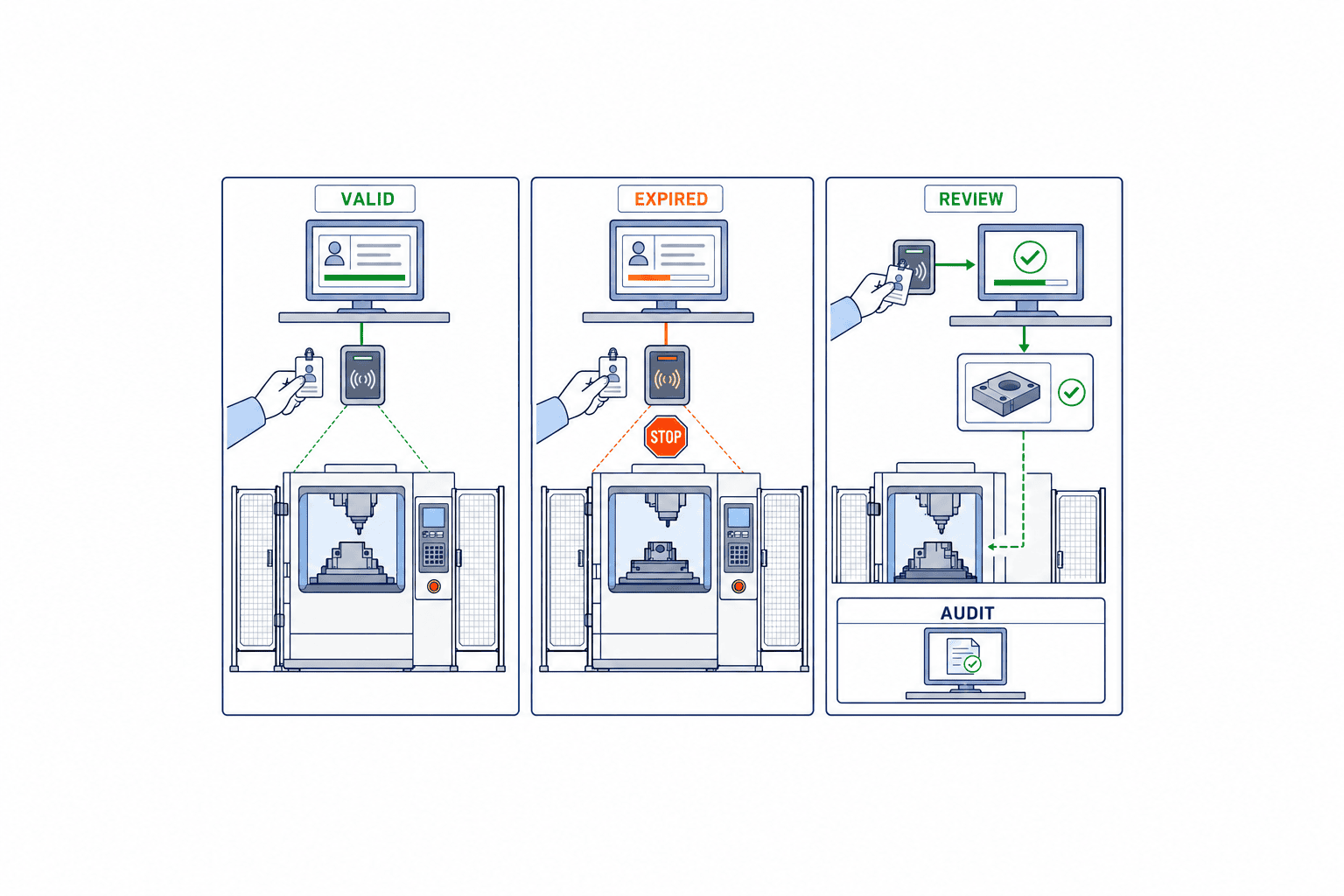
Two HOLD cases should lead to different actions. If a certificate is valid but the evidence was entered incorrectly, the responsible team should correct the record and rerun the normal decision. If the qualification truly expired, first seek a qualified replacement or refresher training. A supervisor override is reserved for a class of exceptions explicitly permitted in advance, after urgency and compensating measures have been reviewed. A software button cannot waive a prohibition in law, a customer contract, insurance terms or the plant’s mandatory safety rule.
An exception event should contain the person, order, machine, task, shift and time, the failed condition, the named approver, evidence reviewed, compensating control, scope, end time and actual start. Make “this one order on this shift” machine-readable. Avoid shared administrator IDs, permanent overrides and freely editable audit histories. Two-level approval by production and quality/EHS may be appropriate for selected risk classes. The operating policy must assign final accountability; software records how the decision was reached.
| State | Shop-floor action | System control | Evidence |
|---|---|---|---|
| Valid and in scope | Start work | Permit the order action | Decision ID, qualification version, time |
| Expired | Hold and find alternate | Block new start | Expiry, reason, notice, retry |
| Evidence unresolved | Verify original and approval | HOLD or predefined REVIEW | Inquiry and reviewer |
| Network down | Follow offline procedure | Restrict by risk class | Cache version, outage, reconciliation |
| Exception approved | Start within narrow scope | Time- and order-bound release | Approver, reason, compensating action |
When and to whom should renewal reminders go?
One “send an email 30 days before” rule ignores class capacity and assessor availability. Derive the alert from expiry minus renewal lead time, with separate values for booking, practical test, approval and replacement allocation. For an illustrative example, allow 14 days to book a course, 7 days for practical assessment, 3 days for approval and 7 days of buffer: 14 + 7 + 3 + 7 = 31 days. That is an internal planning assumption, not a statutory 31-day notice requirement.
Route staged reminders to the worker, training coordinator, supervisor and planner. As the date nears, show which scheduled orders and machines will be affected and who else is qualified. “Email read” is not the same as “renewal complete”; track booking, assessment, approval and fresh start decision. Any extension needs evidence and an accountable approver. Where a task requires multiple qualifications, the shortest remaining validity normally determines the available assignment window.
Separate measurable labor savings from safety outcomes
Avoid unsupported promises that defects or incidents will fall by a stated percentage. Define observable measures: qualification-related HOLD count, renewals completed before expiry, false-allow and false-hold rates, override rate, audit extraction time and time per start check. Use the count of checked start events as the denominator, and segment by night shift, contractor status and machine changes.
An illustrative calculation: suppose a plant performs 400 starts a day, manual verification averages 45 seconds and terminal verification 15 seconds. The difference is 30 seconds, so 400 × 30 = 12,000 seconds, about 3.3 hours per day, or about 67 hours over 20 working days. This is a gross task-time difference, not a payroll reduction or ROI claim. Subtract the time for exceptions, master-data upkeep and incident response. Measure the baseline on the shop floor and repeat the same measurement after deployment.
Where should the integrations and control boundaries sit?
A common pattern imports worker status and qualification evidence from HR, LMS and quality; receives work orders, operations and machines from ERP/MES; and lets a station terminal read a badge and order before asking a decision service. The terminal should show a clear reason in the operator’s language and notify the correct supervisor. The work is not complete when a central database looks tidy: create a decision event on changeover, restart, shift change and operator change as well as first start.
Specify ID mappings, update frequency, time format, duplicate-event handling, outage behavior and revocation propagation in each interface. A design that takes until the next morning to propagate a revoked qualification may be unacceptable for a high-risk task. Set the required propagation time through risk assessment and network constraints, then measure it in FAT/SAT. Give retries the same event ID for idempotent handling, so one approved exception cannot accidentally expand to two orders.
Identity design must address badge sharing. Whether a card, PIN or supervisor check is appropriate depends on risk and privacy assessment; biometrics should not be assumed. End abandoned sessions and reauthenticate before sensitive actions so the next worker cannot inherit the previous person’s qualification. If a signal reaches a machine controller, validate the interface carefully and keep existing safety circuits independent from a general IT authentication API.
What to put in the RFP
An RFP should cover data, rules, station screens, exception control, audit, outages and acceptance testing, not merely “track qualifications.” Supply sample qualification classes, operations, work orders, terminal counts, shifts, ERP/MES/LMS connection methods, approver roles, languages and data-location requirements. Ask bidders to distinguish standard function from customization, explain migration and rule maintenance, and itemize running costs and support.
- Can the standard product model multiple required qualifications that change by machine and product revision?
- Can it enforce expiry boundaries in plant time while storing and displaying historical UTC-based events consistently?
- Can LMS attendance and quality’s practical approval arrive as separate events?
- What is the maximum revocation propagation time in normal and offline conditions?
- Can it prohibit overrides for selected tasks, and confine permitted ones to one order, machine and shift?
- Can the audit export include reason, approver, qualification version, rule version and terminal ID?
- Can HOLD reasons and next steps appear in the languages actually used on the floor?
- How do bulk imports, duplicate IDs, clock drift and recovery avoid false authorization?
Separate license, connector work, badge readers, terminal modifications, master-data cleanup, training and maintenance in the price comparison. A cheap package may impose costly manual scope maintenance. Equally, the first rollout need not automate every line. Start with one operation, use known failure patterns to define tests, and extend only after the gate behaves as intended.
Use FAT and SAT to prove allow, block and record
FAT tests rules and interfaces at the supplier or test environment. SAT tests actual terminals, networks, machines and shift procedures at the plant. “The screen opened” is not a sufficient pass. Include a qualified operator, expired operator, instants just before and after expiry, wrong machine and task, revised order, practical approval pending, departed worker, outage and recovery, and a task that forbids override. For every case retain input, expected and observed result, log ID, evidence image and corrective action.
| Test case | Expected result | Essential record |
|---|---|---|
| Valid qualification and matching machine | Allow start | Person, order, machine, versions, time |
| Past effective end | HOLD start | Expiry, code, notified owner |
| Correct order, wrong machine | HOLD for machine review | Required and actual asset |
| Training done, practical sign-off pending | Qualification remains ineffective | Separate attendance and approval |
| Override requested on high-risk task | Deny | Rule and requester |
| Narrow override approved | Allow only named scope and time | Approver, reason, measure |
| Outage and recovery | Follow defined offline rule | Cache version and reconciliation |
| Shift or operator changes | Recheck | Old and new assignment events |
Walk one work order through acceptance testing
The following is a fictional test scenario. Assembly order W-101 has two tasks on machine M-7: tighten a component, then record a measurement. The first task requires authorization for M-7 and practical approval for the torque tool. The second also requires instrument approval. Operator A has valid machine and tool approvals but an expired instrument approval. The service may allow the first task, but must re-evaluate and HOLD the transition to measurement. An implementation that authorizes the whole order only once cannot detect that difference.
Now a supervisor transfers measurement to qualified operator B. When B scans a badge, the system must not copy A’s permission: it compares B’s own records with the current order, machine, time and shift. If W-101 moves to M-8, the M-7 approval ceases to apply, and the reason for the machine change and new decision become separate events. FAT repeats this sequence with simulated records; SAT uses actual terminals, asset IDs and a night-shift reassignment. Test whether the supervisor can read the reason code and reach the right replacement-worker path, not only whether the API returns a color.
For the boundary test, assume purely for testing that an approval ends at 23:59:59 Thailand time. Check ALLOW just before and HOLD just after. This is an invented test instant, not a universal expiry rule. Deliberately offset a terminal clock and verify that the agreed decision time, rather than an unreliable display clock, controls the result. Deliver a revocation event before an older “valid” update and verify the stale update cannot undo the revocation. Any cached operation during missing messages must stay within its pre-approved task scope and maximum duration.
Finally test exception control. An override button must be unavailable for a prohibited high-risk task. For an eligible task, the supervisor enters a reason and compensating measure under a named account, with a second approval where required. The release must apply only to W-101, M-7 and the named shift, never to W-102 or M-8. Reuse after cancellation must fail. For both allowed and denied decisions, acceptance evidence should retrieve the decision ID, rule version, input-data versions, approver, terminal and time. That verifies the rationale and the limits of permission, rather than merely a green screen.
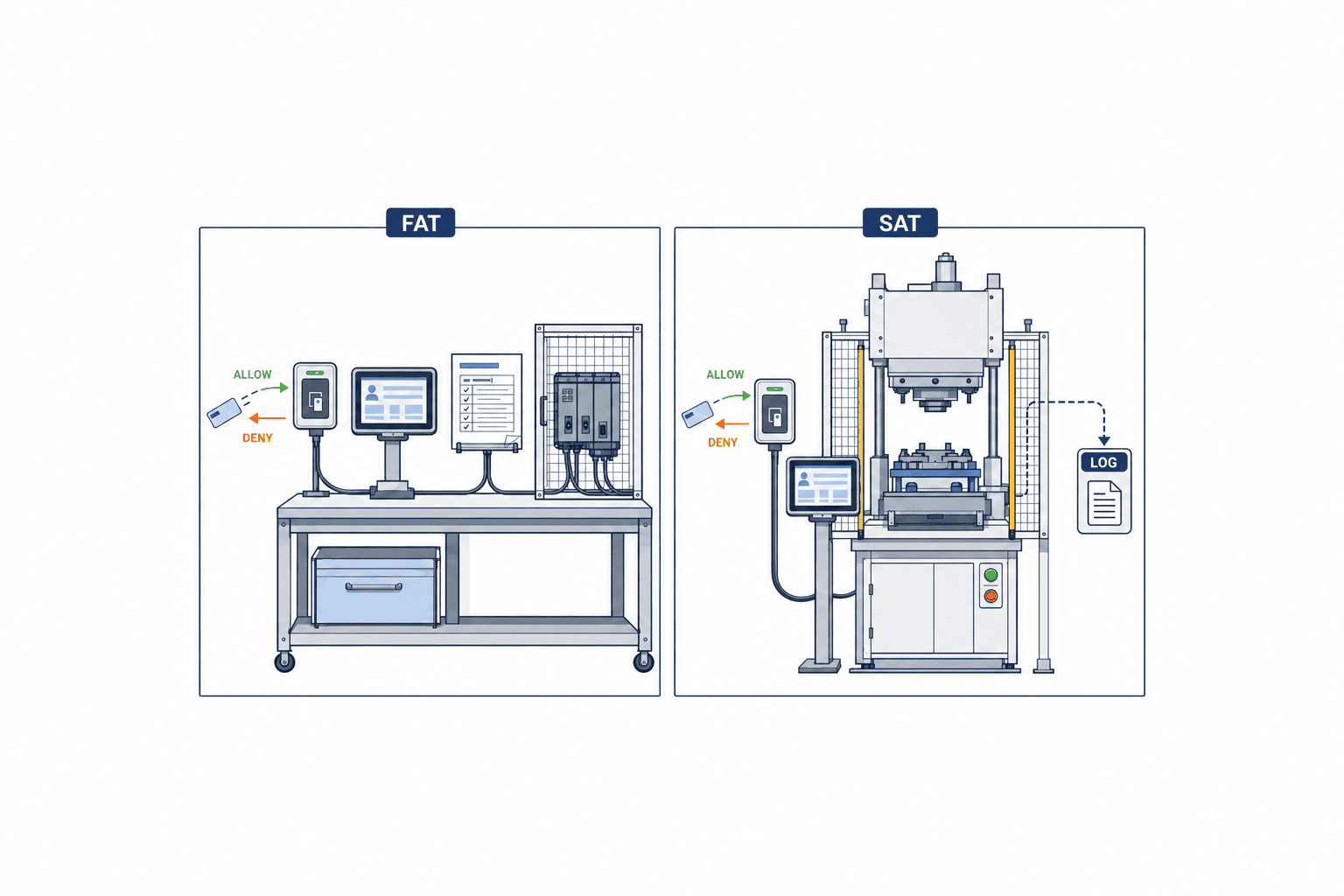
In FAT, simulate the clock at expiry, duplicate messages and arrival of an old master record. In SAT, use real machine IDs, badges, local time and night shifts. If the qualification service sends a signal to equipment, verify signal-loss behavior, separation from safety circuits and manual recovery with the machine supplier. Testing the IT service alone does not prove overall line safety. Define acceptance by severity before testing: for example all critical cases must pass, while a minor display defect may have a dated correction plan.
An illustrative 90-day rollout and operating routine
Select an initial line where the qualifications are clear, a start is captured at a terminal and supervisors can participate. This hypothetical 90-day schedule must be adapted to existing systems and plant size.
| Example period | Work | Completion evidence |
|---|---|---|
| Days 1–15 | Inventory tasks and qualifications; review law and customer terms; appoint record owners | Owners sign condition matrix |
| Days 16–30 | Design ID mapping, rule version, screens and exception path | Approve boundary, revocation and outage tables |
| Days 31–55 | Clean data, connect systems, install terminals | Reproduce correct decisions on sample orders |
| Days 56–70 | FAT, corrections and training | All critical cases pass |
| Days 71–85 | SAT and parallel running including nights | Investigate all divergent decisions |
| Days 86–90 | Cutover and handover | Daily monitoring and change process assigned |
“Zero false allows” may be a test acceptance target; it is not a promise of zero incidents in operation. During parallel running, classify differences between the old and new process as data, rule, identity, time or floor-procedure issues. Write master-data approval, night-shift contacts, weekly expiry forecasts and monthly override review into operating procedures. Staff transfers, departures, machine moves and product revisions require change control if day-one accuracy is to last.
FAQ: operator qualification expiry systems
Is an LMS or Excel renewal alert enough?
An alert encourages renewal but does not itself compare person, order, machine and task at the start point. A simpler process may be reasonable for low-risk work. Select the control point based on task risk, customer requirements, reassignment frequency and audit burden.
Should the machine stop immediately when a qualification expires?
Do not impose a universal physical stop. Define HOLD for work not started, a safe boundary for work in progress and established safety procedures for maintenance. Qualification gating does not replace emergency stops or safety PLCs.
Can a supervisor override an expired qualification?
Only if current law, contracts and the plant’s approved risk rules permit that exception. A mandatory prohibition cannot be bypassed. An allowed exception should be limited by order, machine, shift and expiry, with named approval, reason and compensating control in the audit trail.
What determines implementation cost?
The number of rule variants, existing data quality, ERP/MES/LMS interfaces, terminals and readers, offline requirements, languages and depth of machine integration. Compare setup and ongoing cost including migration and FAT/SAT. The illustrative time calculation above is not an ROI guarantee.
Do ISO and OSHA rules apply unchanged to a Thai plant?
ISO frameworks inform competence and OSH management. OSHA 1910.147 is a US regulation. Local specialists should verify Thai legal requirements, customer terms and personal-data treatment for the actual activity, then derive software requirements from those findings.
Conclusion: turn an expiry date into a work-start decision
Qualification expiry control is more than keeping a tidy register. Link person, order, machine, task and shift in a decision event; return a defined HOLD and responsible contact when a required approval is invalid; and record only permitted exceptions with narrow scope. Decide record ownership, time boundaries, outage behavior and approval policy first. Those decisions make an RFP and FAT/SAT executable. Prove “allow, block and explain” on one operation, then extend based on measured results.
TOMAS TECH can help a Thai plant translate existing ERP/MES and training records into start-check requirements and acceptance tests. You can contact us even while your qualification matrix and target operation are still being defined.
References
- ISO/TC 176 Auditing Practices Group: Auditing competence under ISO 9001:2015 — competence evidence and personnel in controlled production.
- ILO: Guidelines on occupational safety and health management systems, ILO-OSH 2001 — section 3.4 on competence and training.
- ISO: ISO 45001 explained — OSH management, training and competence.
- OSHA: 29 CFR 1910.147 Control of Hazardous Energy — US law example only, not a statement of Thai obligations.
- ISA: ISA-95 Enterprise-Control System Integration — enterprise and operations integration framework.
- NIST: SP 800-82 Rev. 3 Guide to OT Security — safety, reliability and availability in OT design.
- Thailand Department of Labour Protection and Welfare: English OSH laws — starting point for checking current local rules.


