



Introduction: Three Decisions to Make Before Adopting HS Code Classification AI
More Japanese-owned factories in Thailand are considering HS code classification AI. Every time a new component is purchased, or a design change alters a material or configuration, someone has to look up the HS code. The actual work is often left to a customs broker, and the rationale for choosing a particular code never stays inside the company. When the predecessor is reassigned back to Japan, no one can explain why an item was classified the way it was. We believe this situation is not unusual at many plants.
2026 is also a year in which classification carries more weight. According to an explanation by the law firm Tilleke & Gibbins, Customs Department Notification No. 219/2568 abolished the 1,500-baht exemption for low-value imports on January 1, 2026, so that all imported goods are now subject to VAT and customs duty. According to the same explanation, on March 30, 2026, the Customs Department announced a policy to raise duties on a wide range of consumer goods, such as plastic products and electronic accessories, to their statutory ceilings (in many cases 30% or 40%). Many of these goods are said to currently enjoy preferential rates of around 5%, and the article advises being rigorous about HS code classification. In addition, on January 1, 2028, the worldwide nomenclature will be amended to HS 2028.
So should we simply let generative AI determine HS codes? In this article, we take the view that what you decide first when introducing AI is not the name of a tool, but the following three things.
- Scope delegated to AI: AI goes only as far as proposing candidates. A person approves the final code.
- Verification of candidates: Even if the 6 digits match, the 8 digits declared in Thailand are a separate matter. Check digit by digit, and use an advance ruling for items you are unsure about.
- Records of rationale and approval: Keep a record of which General Rule, which heading text and which notes the decision was based on, and who approved it, linked to the declaration documents, for at least five years.
There are four reasons. Even if an AI candidate is wrong, responsibility for the declaration remains with the company. Thailand’s Customs Act provides for record retention and post-clearance audits. Some major products (such as Thomson Reuters and SAP) also describe their design as showing candidates, presenting the rationale, and having a person select and confirm. And research shows that general-purpose large language models (LLMs) become less accurate the deeper the digit level. Below, we check the facts in this order and finally translate them into items for an RFP (request for proposal) and acceptance testing.
Note that this article does not cover origin determination systems as a whole, AI OCR for export documents, or item master management in general. We point to related articles at each of those boundaries.
What HS Code Classification Is: Thailand Declares in 8-Digit AHTN 2022
An HS code is a number based on the international commodity classification (HS) set by the World Customs Organization (WCO). The first 6 digits are common worldwide and become progressively more detailed through the chapter (2 digits), heading (4 digits) and subheading (6 digits). Each country then adds its own subdivisions below that.
According to sources such as the country guide of the U.S. International Trade Administration (ITA), Thailand has adopted the ASEAN Harmonised Tariff Nomenclature based on HS 2022 (AHTN 2022) as its import tariff nomenclature, and Thai tariff codes have 8 digits. The first 6 digits are the worldwide HS, and the last 2 digits are ASEAN and Thai subdivisions. The same guide describes the range of ad valorem duty rates as 0-80%.
The point to keep in mind here is that even within the same 6-digit subheading, a different 8-digit code can change the duty rate or whether a permit or license is required. When people talk about AI performance, figures such as “X% correct at 6 digits” often come up, but what you declare in Thailand is 8 digits. This difference will come up again and again in later sections.
The General Rules for the Interpretation (GIR 1-6) as the Backbone of Classification
HS classification is determined in line with the General Rules for the Interpretation (GIR). According to the English text reproduced by the Swiss Federal Office for Customs and Border Security, the key points are as follows.
- GIR 1: The titles of sections and chapters are for reference only. Legally, classification is determined by the terms of the headings and by the section and chapter notes.
- GIR 2(a): Even incomplete or unassembled articles fall under the heading for the complete article if they have its essential character. 2(b) deals with mixtures of materials and the like.
- GIR 3: When goods appear classifiable under more than one heading, the decision follows this order: (a) the heading with the most specific description, (b) the material or component that gives the essential character, (c) the heading that occurs last in numerical order.
- GIR 4: Goods that cannot be classified under any heading are classified under the heading for the goods to which they are most akin.
- GIR 5: Treatment of cases and packing.
- GIR 6: Classification at subheading level is determined by the terms of the subheadings and the subheading notes, comparing only subheadings at the same level.
In this article, we consider it natural to provide a field that records “which General Rule, and which heading text and notes, the decision was based on” whenever an AI candidate is adopted. This becomes the backbone of the record design discussed later.
What Happens If You Misclassify: Checking the Thai Customs Act
If you declare an AI candidate as is and it turns out to be wrong, responsibility for the declaration is considered to remain with the company that made it. According to an unofficial English translation of Thailand’s Customs Act (B.E. 2560 / 2017), the relevant sections are as follows. The authoritative text is the original Thai, and what follows paraphrases the key points of each section. Please confirm decisions on individual cases with your customs broker or a specialist. This article is not legal advice.
| Section | Key point (paraphrased from the unofficial English translation) |
|---|---|
| Section 202 | Submitting (or causing submission of) a false or incomplete goods declaration, document or information that may mislead customs officers: fine of up to 500,000 baht |
| Section 252 | Violations of Section 202 and others incur liability regardless of intent |
| Section 243 | Importing or exporting with intent to evade duty (intent to defraud the government): imprisonment of up to 10 years, or a fine of not less than 0.5 times and not more than 4 times the additional duty, or both |
| Section 253 | If a juristic person’s violation results from the instruction or act (or omission) of a director, manager or similar person, that person is also subject to the penalty |
| Section 19 | Assessment of underpayment within 3 years of the declaration date (extendable by up to 2 years when unavoidable). A further 5 years if there is evidence of intent to evade duty |
| Section 21 | The right to collect unpaid or short-paid duty runs 10 years from the declaration date (2 years where due to an error in calculating the duty) |
| Section 22 | A surcharge of 1% per month on short-paid duty (capped at the principal duty amount). A 20% penalty if not paid within 30 days of the assessment notice |
| Section 25 | Refund claims for overpaid duty within 3 years of the date of import or export |
| Section 63 | Books, documents, evidence and information relating to cleared goods must be kept for at least 5 years from the date of import or export. A further 2 years upon cessation of business |
| Section 159 | Customs officers may enter business premises and examine books, documents and the like for goods within 5 years of the date of import or export |
What you need to be careful about when reading this is not to confuse Section 202 with Section 243. Section 202 is a fine for false or incomplete declarations, capped at 500,000 baht. Under Section 252, liability arises even without intent. In other words, “the AI got it wrong” or “the person in charge did not know” can be read as unlikely to serve as a valid excuse, at least in situations falling under Section 202. On the other hand, the fine of “not less than 0.5 times and not more than 4 times the additional duty” under Section 243 is a provision for cases where there is intent to evade duty. Not every misclassification falls under Section 243.
According to a 2017 explanation by Tilleke & Gibbins, the new Act took effect on November 13, 2017, and the old Section 27 approach to fines, “4 times the value of the goods plus duty,” was replaced by Section 243’s “0.5 to 4 times the duty evaded.” Care is needed not to use the “4 times” wording found in older materials as is for internal training.
The sections directly relevant to designing an AI rollout are Sections 63 and 159. Records must be kept for at least 5 years from the date of import or export, and customs can examine goods within 5 years at your premises. When a post-clearance audit asks “why did you choose this code?”, a screenshot of the AI screen alone is not an answer. In this article, we consider a design that keeps records of rationale and approval for 5 years to be consistent with these provisions.
The opposite situation also exists. Under Section 25, refund claims for overpaid duty must be made within 3 years of the date of import or export. Reviewing classifications may reveal that a code with a lower duty rate was in fact correct. Reviewing classifications is not only defensive but also a way to identify amounts you can recover.
Origin Determination Also Depends on the HS Code: FTA Preferences and the CTC Criterion
An error in the HS code affects not only the duty rate but also the determination of whether an FTA preferential rate can be used.
According to Japan Customs’ explanation of RCEP, the RCEP rules of origin include a “change in tariff classification (CTC)” criterion, under which goods are treated as originating if the tariff classification of the non-originating materials differs sufficiently from that of the product. For example, CTSH, which requires a change at the 6-digit level, requires that the HS 6-digit codes of all non-originating materials differ from that of the product. Using the product-specific rule “CTSH or RVC40” for 2905.32 as an example, the same explanation states that if a material is in Chapter 28 no further check is needed, if it is in Chapter 29 but outside heading 29.05 a 4-digit check is sufficient, and if it is within heading 29.05 a 6-digit check is required. Unless the codes of both the product and its materials are correct, this determination cannot be made.
According to JETRO’s Trade and Investment Q&A, for exports from Japan to Thailand, the Japan-Thailand EPA (JTEPA), the ASEAN-Japan Comprehensive Economic Partnership (AJCEP) and RCEP coexist without any order of priority, and you can choose the more favorable agreement. The required level of change is checked in the product-specific rules, and for items without a product-specific rule, the general rule is said to be a 4-digit change (CTH) or regional value content of 40% or more. Because the conditions differ by agreement, the prerequisite is that each material in the BOM (bill of materials) has an HS code.
In other words, even if AI correctly identifies the product’s HS code, origin determination will not move forward unless the codes on the materials side are in order. The overall mechanism of origin determination, RVC (regional value content) calculation and BOM management are covered in detail in FTA Origin Determination System for Thai Plants. This article focuses on how to decide the HS codes that serve as its input.
When you are asked to prove origin or actual production, records that can show changes in HS codes become effective alongside manufacturing records. For proving actual production in general, see Transshipment Risk and How Thai Plants Prove Origin.
How Accurately Can AI Identify HS Codes: Research and Customs Reports
AI accuracy varies greatly depending on which items were measured, at how many digits, and under what conditions. We review the main published results along with their conditions.
ATLAS: A Comparison on U.S. 10-Digit HTS
ATLAS is a paper published on arXiv by researchers at Flexify.AI (2509.18400 v1, September 22, 2025). The training, validation and test data were built from 18,731 rulings (2,992 distinct 10-digit HTS codes) in CROSS, the rulings database of U.S. Customs and Border Protection (CBP), and the test set has 200 items. A 10-digit match is counted as fully correct and a 6-digit match as partially correct. Under the conditions of U.S. 10-digit HTS and a 200-item test built from CBP rulings, the results were as follows.
| Model | 10-digit match (items, %) | 6-digit match (items, %) |
|---|---|---|
| Atlas (fine-tuned LLaMA-3.3-70B) | 80 items, 40.0% | 115 items, 57.5% |
| GPT-5-Thinking | 50 items, 25.0% | 111 items, 55.5% |
| Gemini-2.5-Pro-Thinking | 27 items, 13.5% | 62 items, 31.0% |
| DeepSeek-R1 (05/28) | 5 items, 2.5% | 53 items, 26.5% |
| GPT-OSS-120B | 3 items, 1.5% | 16 items, 8.0% |
What this table shows is that for every model, accuracy drops sharply at 10 digits compared with 6 digits. GPT-5-Thinking scored 55.5% (111 items) at 6 digits but 25.0% (50 items) at 10 digits. The average number of correct digits out of 10 was reported as 5.61 for GPT-5-Thinking and 6.30 for Atlas.
There are three caveats. First, these are results for U.S. 10-digit HTS, not accuracy on Thailand’s 8-digit AHTN. Second, the test is small, at 200 items. Third, the training data consisted of published rulings, which differ in nature from a company’s own items.
HSCodeComp: 632 E-Commerce Products at 10 Digits
HSCodeComp is a benchmark published on arXiv (2510.19631 v1, October 22, 2025). For 632 e-commerce products across 32 categories, models must identify the 10-digit HS code from noisy information including titles, attributes and images, and the correct answers were assigned by tariff specialists. According to the abstract of arXiv v1, the best agent achieved 46.8% accuracy at 10 digits, compared with 95.0% for human experts. These are values for 632 e-commerce products, at 10 digits, from arXiv v1, and they do not apply directly to factory components, but they do show that there is still a large gap between AI and experts.
Work on the Customs Side: BACUDA and Azerbaijan
AI research is also progressing on the customs side. Experts in BACUDA, the WCO’s data analytics project (launched in September 2019), developed a model that uses Doc2Vec, a neural network natural language processing technique, to recommend multiple HS code candidates from the goods descriptions declared by traders. It uses import data provided by the Nigeria Customs Service, but the WCO article does not give any accuracy figures.
According to a November 2023 WCO article, Azerbaijan Customs developed a tool based on BACUDA’s open-source model and trained on more than 1.6 million records from 2022 onward. As values reported by customs on its own national data (measurement conditions not disclosed), accuracy is said to be about 85% at 6 digits, 82% at 10 digits, and over 95% in 11 chapters with abundant data. The article also describes multilingual search, supplementary suggestions via the ChatGPT API, duty calculation, and integration with a risk management engine that catches misclassifications. These are values from a system built by customs with large volumes of its own national data, and they are not a benchmark for what a company can expect when using AI on its own items.
“6 Digits Match” Does Not Mean “Correct”
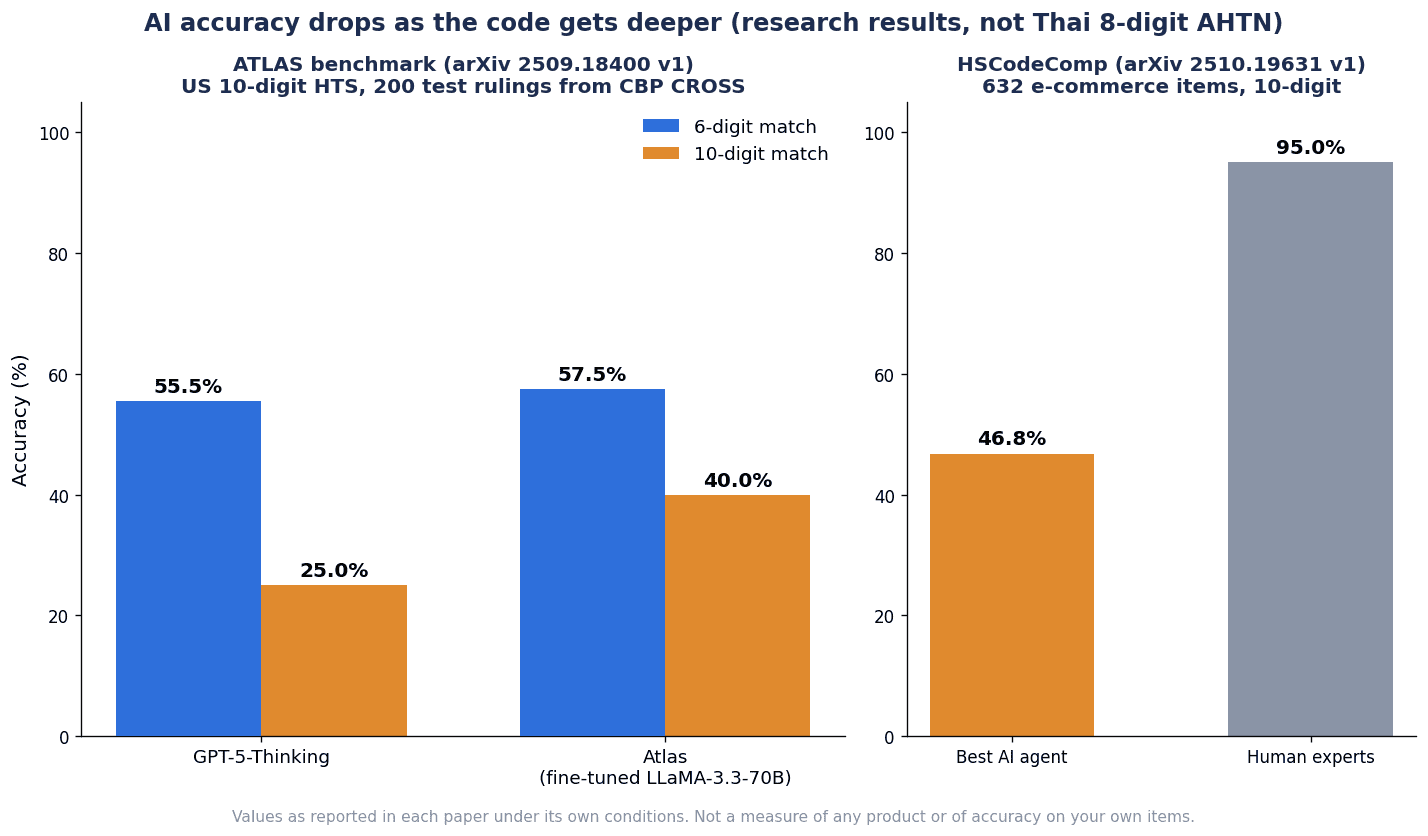
The conclusion this article draws from these results is simple. Even if general-purpose AI is reasonably accurate up to the 6-digit subheading, its accuracy tends to fall once it enters country-specific subdivisions. The 8 digits declared in Thailand need to be checked separately even if the 6 digits match. Accuracy figures can only be compared once the type of items, the number of digits, and the number and conditions of test items are aligned. We believe that “X% accuracy” figures presented by vendors should also be checked for their conditions from the same perspective.
A paper by Andrew Grainger published in the World Customs Journal (March 2024) also states that the performance of assistive tools depends on their understanding of product characteristics, data quality, and training methods. In the author’s testing, machine learning tools overlooked new headings and misread ambiguous goods descriptions. The paper also notes that they may learn and reproduce errors in past declarations. Note that the paper discloses that its funding was provided by Avalara.
How Major Products Describe Their HS Code Classification AI
For commercial classification AI, the following table organizes, in alphabetical order, the features that each company’s public materials describe. It is not a comparison of strengths or a recommendation, but a table for seeing how each is designed to share work with people. We could not confirm published pricing for any of them.
| Product (source) | Main features described in the company’s materials | Treatment of human approval and rationale (as described in the materials) |
|---|---|---|
| Avalara Automated Tariff Code Classification (announcement article, October 2024) | Classifies large product catalogs into HS codes using AI, machine learning and natural language processing. Scans the WCO and national customs sites to reflect amendments. Learns by adding verified items and codes to its database | The announcement article contains no accuracy figures and no description of a human approval flow |
| Descartes CustomsInfo (official page) | Described as “AI-assisted HTS classification software”. Data on tariffs, regulations, rulings, explanatory notes and agreements for more than 175 countries | Records the history of classifications through comments, notes and workflow assignment, supporting proof of “reasonable care”. No explicit human approval flow |
| SAP International Trade Classification Agent (news report, November 2025) | A Joule agent that recommends tariff numbers based on product characteristics and trade regulations. Users can review and drill down into the tariff documents referenced | The agent proposes, and a person ultimately approves or rejects. AI does not classify or declare automatically |
| Thomson Reuters ONESOURCE Global Classification AI (help page) | Displays up to 3 candidates in order of likelihood, with a “Similarity score”, similar examples and product characteristics for each. Option to reference the company’s own previously classified items | Confirmed only when the user selects and saves a candidate, which then populates the “HS Number” and “HS Rationale” fields |
| Zonos Classify (official documentation) | Returns a 6-digit code by default from the item name, description and images, and an 8-digit-or-longer country-specific code when the destination country is specified. Confidence score and up to 5 alternative candidates. Validation of existing codes and bulk catalog classification | Human audit of 1% of classifications (low-score items plus random sampling). AI rationale and duty rates for each code are “coming soon” |
Some notes on the table. The SAP agent is based on a report by Mynavi News (November 6, 2025) and is one of 14 Joule agents announced at SAP Connect 2025. At the time of the report, a beta version was planned for December 2025 and general availability for 2026. According to its help page, Thomson Reuters’ classification AI is currently available only in the United States. The company’s October 2025 press release describes standardizing product data from item description patterns, generating audit-ready classification rationale, and updating HS code and tariff data. Zonos’ documentation states that the results of human audits are fed back into model improvement.
The materials listed here do not confirm how far each product supports Thailand’s 8-digit AHTN or how it handles Thai-language item names. When considering adoption, these become items to check individually in the RFP.
What the table reveals is a division of work in which “AI proposes candidates,” “it shows rationale and similar examples,” and “a person selects and saves.” Thomson Reuters and SAP explicitly describe a form in which a person selects or approves, and at least in their public materials, none of the companies puts forward a model in which “AI confirms on its own.” The three decisions at the core of this article can be described as turning this division of work into your own business process.
Decision 1: Delegate to AI Only “Up to Proposing Candidates”
The first thing to decide is how much to delegate to AI. This article’s proposal is to draw the line as follows: AI goes as far as proposing candidates and drafting the rationale. The final code is approved by the person in charge within the company (or by a customs broker or specialist).
The reasons are as seen so far. Under Section 252, liability arises even without intent; research shows general-purpose AI becomes less accurate at deeper digit levels; and some major products also describe their design on the premise of human approval. Grainger’s paper likewise states that tools are “assistive,” that users should be clearly told that candidates may be wrong, and that companies should regularly audit and correct the results.
However, if every item receives the same level of checking, the benefit of introducing AI fades. We therefore recommend dividing items by risk.
- High risk (specialist review required): Items with large duty rate differences, items using FTA preferences (including on the materials side), items that may require permits or licenses, high-value items, and items whose classification has been questioned in the past.
- Medium risk (approval by the person in charge within the company): Design-change versions of existing items, and items with similar items among the company’s past classifications.
- Low risk (simplified check): Items with the same specifications as previously confirmed items, where only the supplier and item name change, and the like.
A note on permits and licenses. According to a report by LINE TODAY (original article from moneyandbanking.co.th, May 29, 2026), Thailand has about 21,000 tariff lines, of which 9,400 require permits or licenses from 23 agencies and are linked through the National Single Window (NSW). Misclassification can therefore lead to missing a required permit or license, not just duty. From this perspective as well, we believe items that may involve permits or licenses should be placed in a category that is not left to AI.
Decision 2: Candidate Verification Steps and Advance Rulings
Once you receive an AI candidate, define in advance a procedure that checks it in the following order.
- Check up to 6 digits: Read the text of the candidate heading and subheading, the section and chapter notes, and the subheading notes, and compare them with the item’s specifications, material and use. This is the check under GIR 1 and GIR 6.
- Apply the General Rules: If the item appears classifiable under more than one heading, state explicitly which of GIR 3 (a), (b) or (c) decided it. For unassembled items or sets, check GIR 2 and GIR 3(b).
- Check the 8 digits: Confirm the 8-digit AHTN subdivision in Thailand’s tariff schedule. Even if the 6 digits match, the code may turn out differently here.
- Consistency with the company’s past classifications: Check that the code does not conflict with previously confirmed items of the same material and use. If they conflict, one of them is wrong.
- Consistency with advance rulings and rulings: Check that it does not contradict advance rulings the company has received or published rulings that can be referenced.
To make past classification rationales and advance rulings searchable within the company, a RAG system that combines internal document search with an LLM is useful. We summarize how to design and evaluate one in Enterprise RAG Implementation Guide. Past cases surfaced by RAG are still only material for verification and are no substitute for confirmation.
Use a Thai Advance Ruling for Items You Are Unsure About
For items on which internal judgment is divided, obtaining the Customs Department’s decision through an advance ruling is effective. According to the unofficial English translation of the Customs Act, under Section 18 anyone may apply to the Director-General for an advance ruling on customs valuation, origin, or the interpretation of the tariff schedule (classification), and the ruling binds only the Customs Department and the applicant for a period set by the Director-General. The fee schedule annexed to the same Act states that a ruling on classification interpretation is 2,000 baht per case. Please confirm the amount actually collected at present, and how the new electronic application handles it, with the Customs Department or your customs broker before applying.
On the operational side, according to a March 2025 explanation by Tilleke & Gibbins, this became possible under Customs Department Notification No. 17/2561 of 2018, and applications are filed online via the Customs Department website or at the classification desk. Documents showing the goods planned for import, such as purchase orders, sales contracts and price lists, are attached, and with sufficient information a ruling is said to be issued in 30-60 business days (depending on the complexity of the item). Filing at least 30 business days before import is recommended, and rulings are described as valid for 3 years from the date of issue (unless laws or circumstances change).
According to the LINE TODAY report mentioned above, the Customs Department was preparing a new version of “Tariff e-Service,” its electronic application system for advance rulings, which was expected to launch in August 2026. The report lists online notification of results, applications by individuals and new businesses before import/export registration, status checks at any time, integration with the import declaration system, and search of the WCO database, appeal decisions and existing advance rulings. Please check the actual operational status in the Customs Department’s announcements before using it.
For Exports to Japan: Japan Customs’ Advance Rulings
When exporting products from Thailand to Japan, classification on the Japanese side also matters. According to Japan Customs’ English page, written inquiries (Form C-1000) are recommended for advance classification rulings, and written answers are valid for 3 years. They are not respected if the goods differ from the inquiry, the validity period has expired, laws are amended, or laws were misapplied. Oral answers (and, in principle, email answers) are not respected in import examination, and if you disagree with an answer you can file an objection within 2 months of its issue. Agreeing on a division of roles with the Japanese importer and linking a copy of the answer to the item’s record speeds up later checks.
Decision 3: Keep Records of Rationale and Approval for 5 Years
The third decision concerns records. Section 63 requires retention for at least 5 years from the date of import or export, and Section 159 provides for post-clearance audits within 5 years. In this article, we consider a design that keeps the AI’s proposal log, the reason for adoption, and the approver, linked to the declaration documents for at least 5 years, to be consistent with these provisions.
Grainger’s paper also states that it is desirable for tools to explain their rationale in a form that can be filed in the same way as the reasons for a human decision. The table below shows example items to record.
| Record item | Example content | Purpose |
|---|---|---|
| Item code | Internal item number, drawing number, revision | Linking to the item master and declaration documents |
| Item name | Original language (Thai, Japanese) and English | Matching against the item name in declaration documents |
| Specifications, material and use | Main material, configuration, function, how it is used | Basis for decisions such as GIR 3(b) |
| AI candidates | Candidate codes, ranking, similarity or score | Reproducing what the AI proposed |
| Adopted code | 6-digit and 8-digit AHTN | Confirmed value of the code used in the declaration |
| General Rules, headings and notes applied | GIR number, heading and subheading text, section and chapter notes | Rationale for “why this code” |
| Advance rulings and rulings referenced | Number of the company’s advance ruling, rulings referenced | Support for the decision |
| Approver and date/time | Approver’s name, role, approval date and time | Evidence of who confirmed it |
| Applicable HS version | HS 2022 (AHTN 2022) and the like | Old-new mapping at amendments |
| Review deadline | Next review date, expiry of the advance ruling | Preventing records from going stale |
This record flow can be illustrated as follows.
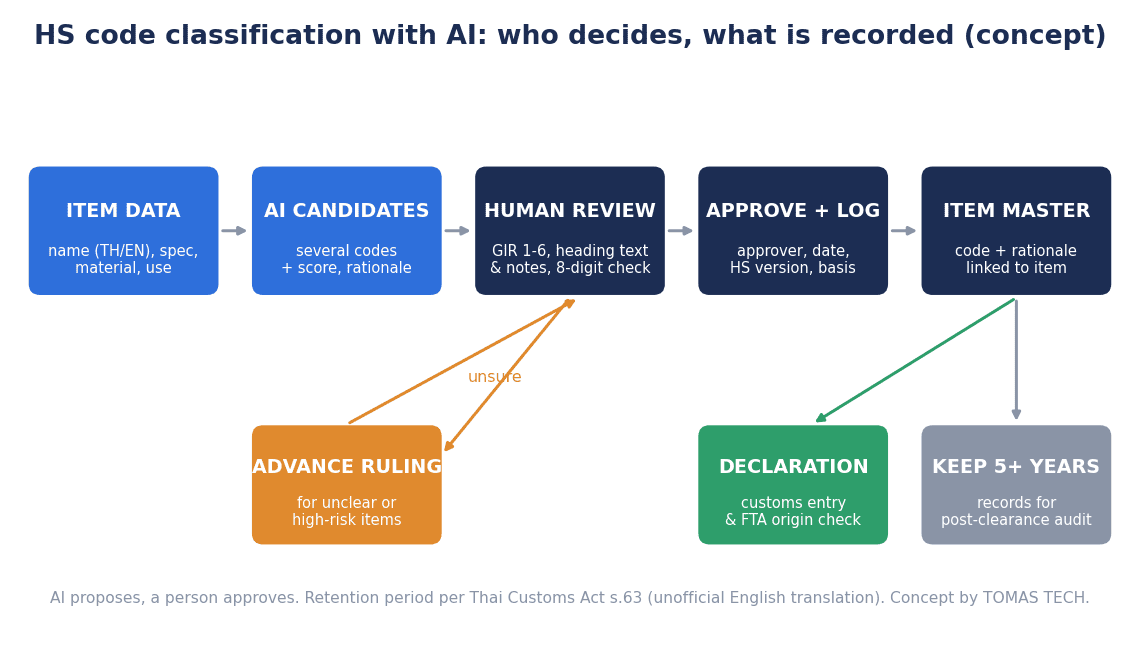
AI candidates become records of rationale after human approval, are stored in the item master, and from there are used for declarations and origin determination. Being able to trace backward, from declaration documents to the item master, to the record of rationale, to the AI candidates, is what prepares you for a post-clearance audit.
When you are asked to submit documents in a post-clearance audit, having records and being able to produce them quickly are separate issues. Record digitization and the idea of time-to-submission are covered in Record Digitization for Audit Response. We believe that keeping classification records in a form that can be pulled up immediately from an item number or declaration number also reduces the burden of responding to audits.
Integration with the Item Master, BOM and ERP
Classification records should basically be held linked to the item master rather than kept in a separate file. According to Thomson Reuters’ help page, the company’s classification AI references the company’s own previously classified items to propose candidates and saves the adopted HS number and rationale to the item record. The SAP agent, according to reports, is a mechanism that recommends tariff numbers from product characteristics and trade regulations. Zonos’ documentation describes a function for validating existing codes. All of these show that classification is treated as part of item data.
In factory practice, we believe integration becomes easier if the following three points are decided in advance.
- Hold HS code fields in the item master: Give each item its 8-digit code, the applicable HS version, a link to the record of rationale, the approval date and the review deadline.
- Hold codes for BOM materials as well: Determining the CTC for origin requires codes on the materials side. Classifying only the product is not enough.
- Reclassify when there is a design change: Build into the ERP and design change procedures a flow that raises a classification review whenever the material or configuration changes.
How to organize item, BOM and routing masters is explained in Manufacturing Master Data Management. If you include HS codes in order data exchanged with business partners, Manufacturing EDI in Thailand is also a useful reference.
Note that cross-checking item names, quantities and amounts between documents such as invoices and packing lists is a separate process from classification. This is covered in Export Document AI OCR. We think it is easiest to organize by connecting classification records and document checks using the item code as a common key.
Preparing for the HS 2028 Amendments: Version Control and Rules of Origin
On January 1, 2028, the HS itself will be amended. According to the WCO’s official page, HS 2028 is the result of the Seventh Review Cycle and contains 299 sets of amendments. After the amendments there will be 1,229 headings and 5,852 subheadings; compared with HS 2022, 6 headings and 428 subheadings are new and 5 headings and 172 subheadings are deleted. Because of the COVID-19 pandemic, the Seventh Review Cycle was extended to 6 years (July 2019 to June 2025). The WCO states that the amendments have been accepted and positions the remaining period as a preparation period. The WCO’s HS 2028 edition page publishes correlation tables between the 2022 and 2028 editions.
On the ASEAN side, according to an ASEAN announcement, the Technical Sub-Working Group on Classification (TSWGC) began a review of AHTN 2022 in October 2024. ASEAN-specific subdivisions are being reviewed based on member states’ proposals, and the subdivisions that are retained are to form the basis of AHTN 2028, aligned with HS 2028. The work is supported by the Japan-ASEAN Integration Fund (JAIF), and a kickoff meeting was held in Jakarta on November 28, 2024. However, as of the time of writing, we have not been able to confirm from when AHTN 2028 will apply in Thailand.
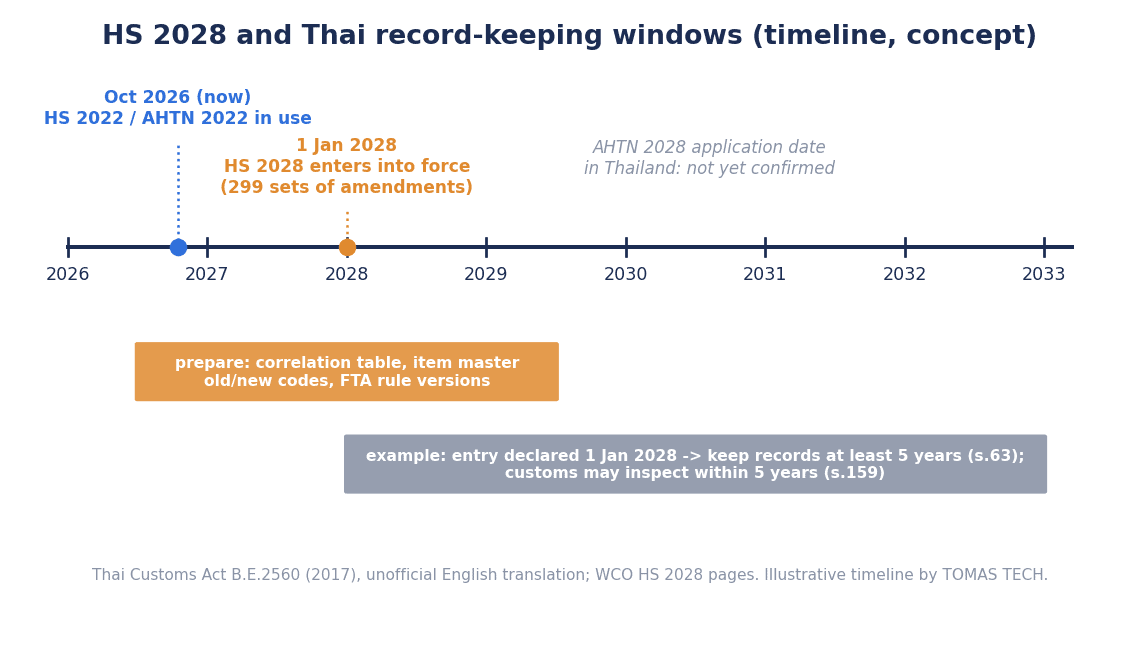
We believe there are three things factories can prepare ahead of the amendments.
- Give item master codes a version: Make it possible to hold, for the same item, its HS 2022 (AHTN 2022) code alongside its HS 2028 code. The code used for declarations changes at the switchover date.
- Use the correlation tables to identify affected items: Use the WCO correlation tables to identify, in advance, which of your items fall under subheadings affected by the amendments. AI can be used for the groundwork of this identification, but a person also confirms the old-new mapping.
- Check which HS version the rules of origin are written in: FTA product-specific rules are written using codes from a particular HS version. In line with the intent of the Australian Border Force’s Customs Notice 2021-51, when the HS is amended you need to check which version the product-specific rules are written in.
The 5-year record period matters here too. From 2028 onward, it is quite possible to undergo a post-clearance audit of declarations made in 2027 or earlier. At that point, you must be able to produce the code and rationale for the version that was valid at the time. A design is needed that keeps each version rather than overwriting and erasing codes from older versions.
Where Data Goes and Confidentiality: Drawings, BOMs, Prices and Thai Item Names
Improving classification accuracy requires passing a lot of information about items. Yet drawings, BOMs, purchase prices and customer names are also information you would rather not disclose externally. When using a cloud AI service, decide the following points first.
- What to send: Are the item name, material, use and main specifications enough? Or will you send drawings and photos as well?
- What not to send: Will your operation exclude prices, customer names and information on unreleased products?
- How sent data is handled: Storage location, retention period, whether it is used for training, and how it is deleted.
How to send information to generative AI, and how to verify this in the RFP and acceptance testing, is organized in detail in Generative AI Data Leak Prevention.
Another issue specific to factories in Thailand is the Thai language. Item names and specifications from local suppliers are often in Thai and mix in abbreviations and in-house nicknames. The quality of candidates may change depending on whether you translate into English before passing data to AI or whether the AI can handle Thai as is. As noted above, the handling of Thai could not be confirmed from the major products’ materials. For how to evaluate AI on Thai-language business documents, see Thai-Language Generative AI Evaluation.
Items to Include in the RFP
We now translate the three decisions so far into RFP items for vendors. Points that could not be confirmed in each company’s materials should be checked through proposals and hands-on testing.
| Item | What to request in the RFP |
|---|---|
| Scope | Import, export or both; target item groups; expected volume; treatment of new versus existing items |
| Number of candidates and display of rationale | Number of candidates per item, meaning of the score, how the rationale (General Rules, headings, notes, similar examples) is displayed |
| Human approval flow | Setting approvers, approval routes by risk category, sending back, records when AI candidates are not used |
| Logs and 5-year retention | How many years the history of candidates, adoption and approval can be retained, change history, tamper prevention |
| Version control | Coexistence of HS 2022 and HS 2028, import of correlation tables, management of the switchover date, retention of old-version codes |
| Reference to the company’s past classifications | Whether previously confirmed items and advance rulings can be used to generate candidates, display of referenced cases |
| Support for 8-digit AHTN | Whether it can return Thailand’s 8 digits or only up to 6, frequency and method of updates |
| Language | Input of item names in Thai and Japanese, whether translation into English is required |
| Data storage location and use for training | Country of storage, retention period, whether data is used for training and how to stop it, deletion |
| Audit output | Whether records of rationale and approval can be output from an item number or declaration number, output format |
| ERP and item master integration | Import of item data, writing back confirmed codes, raising reclassification on design changes |
| Cost breakdown | Initial cost, licensing structure, whether there is per-item billing, cost of additional languages or countries |
Since published pricing could not be confirmed, costs will have to be compared through quotations. If the pricing is per item, we think it is easier to compare by asking vendors to quote separately for the initial bulk catalog classification and for the subsequent volume of new items and design-change items.
Designing the PoC and Acceptance Testing
After receiving explanations through the RFP, verify against your own items in a PoC (proof of concept). As we have seen, research figures vary greatly depending on conditions. Measuring on your own items, under your own conditions, is the only way to be sure.
How to Build the Ground-Truth Data
- Extract confirmed items from past declarations: Choose items whose correct answer you are confident in, such as items that received an advance ruling, items confirmed in a post-clearance audit, and items that have been declared without problems for a long time. Grainger’s paper states that expert-verified data is more suitable for training than raw declaration history. Choose test answers on the same principle.
- Always include difficult items: Deliberately include items that appear classifiable under more than one heading, sets, unassembled items, multifunctional items and items of mixed materials. If you measure only easy items, the figures come out higher than the true capability.
- Record the number of items and the conditions: Keep a record of how many items, which item groups, and what information (item name only, or specifications and photos as well) were used for measurement.
What to Measure
- Measure match rates separately at 6 and 8 digits: Do not judge by the 6-digit match rate alone. Look separately at the match rate at the 8 digits declared in Thailand.
- Whether the correct answer is among the top candidates: If a person is going to select, look not only at first-place accuracy but also at whether the correct answer is among the candidates shown.
- Quality of rationale: A specialist checks whether the displayed rationale actually follows the General Rules and the text of the headings and notes.
- Types of errors: Count chapter mix-ups, heading mix-ups and subdivision mix-ups separately.
Please decide the numerical pass criteria within your company, based on the risk categories of your items and the time available for human approval. This article does not set a specific pass line. However, it is important to set the criteria before starting the PoC and not to move them conveniently after it ends. How to set criteria for ending a PoC and moving to production is explained in AI PoC Exit Criteria, and how to structure acceptance testing before production in AI Agent Acceptance Testing.
In acceptance testing, check not only performance but also whether the approval flow, log retention, audit output and version switchover work as required. In particular, we recommend actually operating the system to confirm that “from a given declaration number, you can trace the candidates at that time, the reason for adoption, the approver, and the HS version that was valid.”
Frequently Asked Questions
Can AI determine HS codes?
It can propose candidates, but we do not recommend leaving confirmation to it. Under the conditions of U.S. 10-digit HTS and a 200-item test built from CBP rulings, GPT-5-Thinking’s accuracy was 55.5% at 6 digits and 25.0% at 10 digits. Accuracy on Thailand’s 8-digit AHTN needs to be measured on your own items. Some major products, such as Thomson Reuters and SAP, also describe in their public materials a form in which a person selects and confirms.
How do manufacturers look up HS codes?
In manufacturing practice, you organize the item’s specifications, material and use, determine the heading and subheading in line with the General Rules for the Interpretation, and confirm the 8 digits in Thailand’s tariff schedule. You also check consistency with the company’s past classifications and advance rulings. AI is used as a tool to speed up this groundwork, and the rationale and approval are kept on record.
What is an advance ruling in Thailand?
It is a system for asking the Customs Department in advance for a decision on classification and other matters. According to the unofficial English translation of the Customs Act, it is based on Section 18, and the annexed fee schedule states that a classification ruling is 2,000 baht per case. According to Tilleke & Gibbins’ explanation, with sufficient information a ruling is issued in 30-60 business days and is valid for 3 years from the date of issue. Please confirm the actual fees and procedures with the Customs Department or your customs broker before applying.
What should we do for the HS 2028 amendments?
Ahead of entry into force on January 1, 2028, give item master codes a version, use the WCO correlation tables to identify affected items, and check which HS version the FTA product-specific rules are written in. Since the application date of AHTN 2028 in Thailand has not been confirmed as of the time of writing, you will need to follow announcements from the Customs Department.
Who is responsible for AI classification errors?
Responsibility for the declaration is considered to remain with the company that made it. According to the unofficial English translation of the Customs Act, a false or incomplete declaration under Section 202 carries a fine of up to 500,000 baht, and under Section 252 this applies regardless of intent. That is exactly why a system is needed in which a person approves AI candidates and the rationale is kept. Please confirm individual decisions with your customs broker or a specialist.
Does the Thai Customs Department use AI for classification?
According to a July 2026 article in The Nation, the Director-General of the Customs Department explained that the department is preparing to use AI and a risk management system to narrow down high-risk passengers, baggage, parcels and cargo. The main purpose is drug enforcement, and the article does not mention applying AI to HS classification.
Summary
- What you decide first when adopting HS code classification AI is not the name of a tool but three things: (1) the scope delegated to AI (up to proposing candidates, with a person approving the final code), (2) verification of candidates (check 6 and 8 digits separately, and use an advance ruling for items you are unsure about), and (3) records of rationale and approval (General Rules, headings, notes and approver, linked to the declaration documents, for at least 5 years).
- According to the unofficial English translation of the Thai Customs Act, liability for false or incomplete declarations arises even without intent, records must be kept for at least 5 years, and customs can examine goods within 5 years at your premises. AI errors, too, are considered to come back to the company as its responsibility.
- Research shows that general-purpose AI becomes less accurate the deeper the digit level. Read figures with the items, number of digits, number of test items and conditions aligned.
- Major products’ public materials (Thomson Reuters, SAP and others) also describe a division of work into candidates, rationale and human selection. Thailand’s 8 digits, Thai language and retention periods should be checked individually in the RFP and acceptance testing.
- Ahead of the HS 2028 amendments on January 1, 2028, we recommend designing version control for item master codes and a review of rules of origin together with the AI rollout.
Even at the stage of starting an inventory of your classification work, such as deciding which items to review first or where to draw the line on what to delegate to AI, you are welcome to consult TOMAS TECH. Please contact us here.
References
- Customs Act B.E. 2560 (2017), unofficial English translation (Unofficial Translation, PDF) https://multimedia.3m.com/mws/media/1577570O/th-customs-rule-eng-pdf.pdf
- Tilleke & Gibbins, “Requesting Advance Rulings on Customs Classification under Thai Law,” March 14, 2025 https://www.tilleke.com/insights/requesting-advance-rulings-on-customs-classification-under-thai-law/
- Tilleke & Gibbins, “A Step Forward: Thailand Takes Dramatic Steps to Modernize Customs Laws,” 2017 (PDF) https://www.tilleke.com/wp-content/uploads/2017/11/A-Step-Forward-Thailand-Takes-Dramatic-Steps-to-Modernize-Customs-Laws.pdf
- Tilleke & Gibbins, “Thailand Announces Customs Duty Hikes for Key Consumer Goods,” April 1, 2026 https://www.tilleke.com/insights/thailand-announces-customs-duty-hikes-for-key-consumer-goods
- LINE TODAY (original article from moneyandbanking.co.th), May 29, 2026 https://today.line.me/th/v3/article/PGeg6r7
- The Nation, “Customs turns to AI, X-rays to stop Thailand becoming drug-transit hub,” July 6, 2026 https://www.nationthailand.com/news/general/40068314
- U.S. International Trade Administration, “Thailand – Customs Regulations” https://www.trade.gov/knowledge-product/thailand-customs-regulations
- WCO, “Amendments effective from 1 January 2028” https://www.wcoomd.org/en/topics/nomenclature/instrument-and-tools/hs-nomenclature-2028-edition/amendments-effective-from-1-january-2028.aspx
- WCO, “HS Nomenclature 2028 Edition” https://www.wcoomd.org/en/topics/nomenclature/instrument-and-tools/hs-nomenclature-2028-edition.aspx
- ASEAN, “ASEAN commences AHTN 2022 Review to Strengthen Regional Trade Integration” https://asean.org/asean-commences-ahtn-2022-review-to-strengthen-regional-trade-integration
- WCO BACUDA, “WCO BACUDA experts develop a neural network model to assist classification of goods in HS,” March 3, 2022 https://bacuda.wcoomd.org/2022/03/03/wco-bacuda-experts-develop-a-neural-network-model-to-assist-classification-of-goods-in-hs/
- WCO, “Advanced AI-HS tool developed by the Azerbaijan Customs,” November 16, 2023 https://www.wcoomd.org/en/media/newsroom/2023/november/advanced-ai-hs-tool-developed-by-the-azerbaijan-customs.aspx
- Andrew Grainger, “Customs Tariff Classification and the Use of Assistive Technologies,” World Customs Journal Vol.18 No.1, March 31, 2024 https://www.worldcustomsjournal.org/article/116525-customs-tariff-classification-and-the-use-of-assistive-technologies
- Japan Customs, “Advance Classification Ruling” https://www.customs.go.jp/english/advance/classification.htm
- U.S. CBP, “Rulings” https://www.cbp.gov/trade/rulings
- Thomson Reuters, “ONESOURCE Global Classification AI” (help page) https://www.thomsonreuters.com/en-us/help/onesource-global-trade/global-classification-modernized/onesource-global-classification-ai.html
- Thomson Reuters press release, October 20, 2025 https://www.thomsonreuters.com/en/press-releases/2025/october/thomson-reuters-launches-enhanced-ai-solutions-for-corporate-tax-and-trade-driving-intelligent-compliance-and-strategic-growth
- Mynavi News TECH+, November 6, 2025 https://news.mynavi.jp/techplus/article/20251106-3632318/
- Zonos, “Classify features” https://zonos.com/docs/catalog/classify/features
- CPA Practice Advisor, “Avalara Announces New AI-Based Tariff Code Classification Solution,” October 3, 2024 https://www.cpapracticeadvisor.com/2024/10/03/avalara-announces-new-ai-based-tariff-code-classification-solution/151780/
- Descartes, “Product Classification and Duty Determination” https://descartes.com/solutions/global-trade-intelligence/product-classification-and-duty-determination
- Yuvraj, Devarakonda, “ATLAS,” arXiv 2509.18400 v1, September 22, 2025 https://arxiv.org/html/2509.18400v1
- “HSCodeComp,” arXiv 2510.19631 v1, October 22, 2025 https://arxiv.org/abs/2510.19631
- Japan Customs, “RCEP” explanation https://www.customs.go.jp/english/epa/rcep/rcep2.html
- JETRO, “Trade and Investment Q&A” https://www.jetro.go.jp/world/qa/04E-080302.html
- Australian Border Force, “Customs Notice 2021-51” (PDF) https://www.abf.gov.au/help-and-support-subsite/CustomsNotices/2021-51.pdf
- General Rules for the Interpretation of the Harmonized System (English text reproduced by the Swiss Federal Office for Customs and Border Security, PDF) https://www.bazg.admin.ch/dam/en/sd-web/T8KbdrI4bLxt/general-rules-interpretation-harmonized-system-en.pdf


