


A surplus material return control system does more than move a box from a production line back to a warehouse. For unused components already issued to a work order, the factory must define who requests the return, who checks the physical item, lot, quantity and condition, when a quality hold applies, where the material is put away, and how ERP, MES and WMS records are reconciled. Otherwise the material may be physically present but absent from the books, or available in the books before anyone has confirmed that it can be used. This guide focuses on unused materials returning from a production order in a Thai factory, from process design and RFP through FAT and SAT.
Define the boundary of a line-to-warehouse material return
The subject is a raw material or purchased component issued from stores for a production order but left unused after production, a changeover or cancellation. An unopened carton, a partly used reel and an offcut may all look like “leftovers,” but their reuse rules differ. Every request should identify the production order, operation, original issue, item, source lot and inventory status. A verbal statement that something was left over cannot establish how much is fit for the next order.
This is separate from a customer return of finished goods, a return to a supplier, general excess inventory reduction, preproduction kitting or the outward issue of material to a line. Customer returns involve shipment and warranty records; supplier returns involve procurement and contract terms. This process starts after the material has been issued and moves unused physical stock back under warehouse control. State that boundary in the RFP. Otherwise a vendor may demonstrate a “returns module” built for customer returns.
Microsoft describes a released production order as available for shop-floor execution and warehouse activity, with picking work for physically reserved material. Its guidance on releasing BOM and formula lines explains how material is picked from a production input location or moved there from the warehouse. Those documents explain the outward flow; they do not by themselves prove that condition checks and return putaway are covered. Model the return as its own state transition. For broader system selection, see the factory inventory system comparison. Work-in-process inventory management covers partly completed products between operations. Do not treat unused components as completed WIP moves.
A return error has several dimensions
A common failure is a physical return while the ERP still records the material as consumed by the work order. The reverse also happens: a return transaction is posted while the carton is still beside the line. If that quantity becomes available for allocation, the next order may be promised stock that cannot be picked. Item and quantity are therefore insufficient. Lot identity, usable condition, location and transaction time matter too.
A partly used electronic-component reel may need an opening time and moisture history. A metal offcut may need length, surface condition and an identified container. Resin or process materials may need expiry, resealing and contamination checks. The precise rules depend on the item, customer and quality specification. Do not apply a universal “return and reuse” rule. Keep a quality hold between receiving the material and releasing it to available stock when inspection is required.
The return can affect work-order cost, raw-material balance and lot balance. Actual accounting entries depend on ERP configuration and company policy. Do not invent a negative issue in a local application without confirming how the target ERP handles the transaction. Oracle Fusion Cloud Manufacturing documentation distinguishes an Issue from a Return against a work-order operation. Confirm the selected product version and configuration with a real transaction and accounting review.
Design seven explicit states
First, a return candidate is identified when the order ends or changes. Second, the operator creates a return request linked to the order, original issue, item, lot, container, declared quantity and opening condition. A unique return ID travels with the container. Third, the container is awaiting receipt and must not yet be added to available warehouse stock. Fourth, warehouse staff verify the physical material by scanning identifiers and measuring count, mass or remaining length as appropriate. Fifth, quality either holds or releases it using item-specific criteria. Sixth, the warehouse puts away approved material in a valid status and bin. Seventh, the factory reconciles posting by matching the ERP Return transaction and WMS location event to the return ID.
This business sequence is not necessarily the technical write order. Some ERP configurations increase available stock immediately when a Return posts; others can block allocation by quality status or location. The RFP must specify what every system displays when the item has not arrived, remains under quality hold, or has not been put away. The implementation can then choose a safe posting order without making uninspected material pickable.
| State | Physical owner | Minimum evidence | System treatment |
|---|---|---|---|
| Candidate | Line supervisor | Order and leftover identified | No returned available stock |
| Requested | Operator | Return ID, item, lot, declared quantity | MES request record |
| Awaiting receipt | Line or carrier | Container ID and handover time | Not available for allocation |
| Checked | Warehouse | Measured quantity, condition, variance | Difference awaits decision |
| Quality hold | Quality | Decision, reason, expiry, approval | Allocation blocked |
| Put away | Warehouse | Bin and movement scan | WMS location updated |
| Reconciled | ERP/finance owner | ERP transaction ID and match | Balance finalized once |
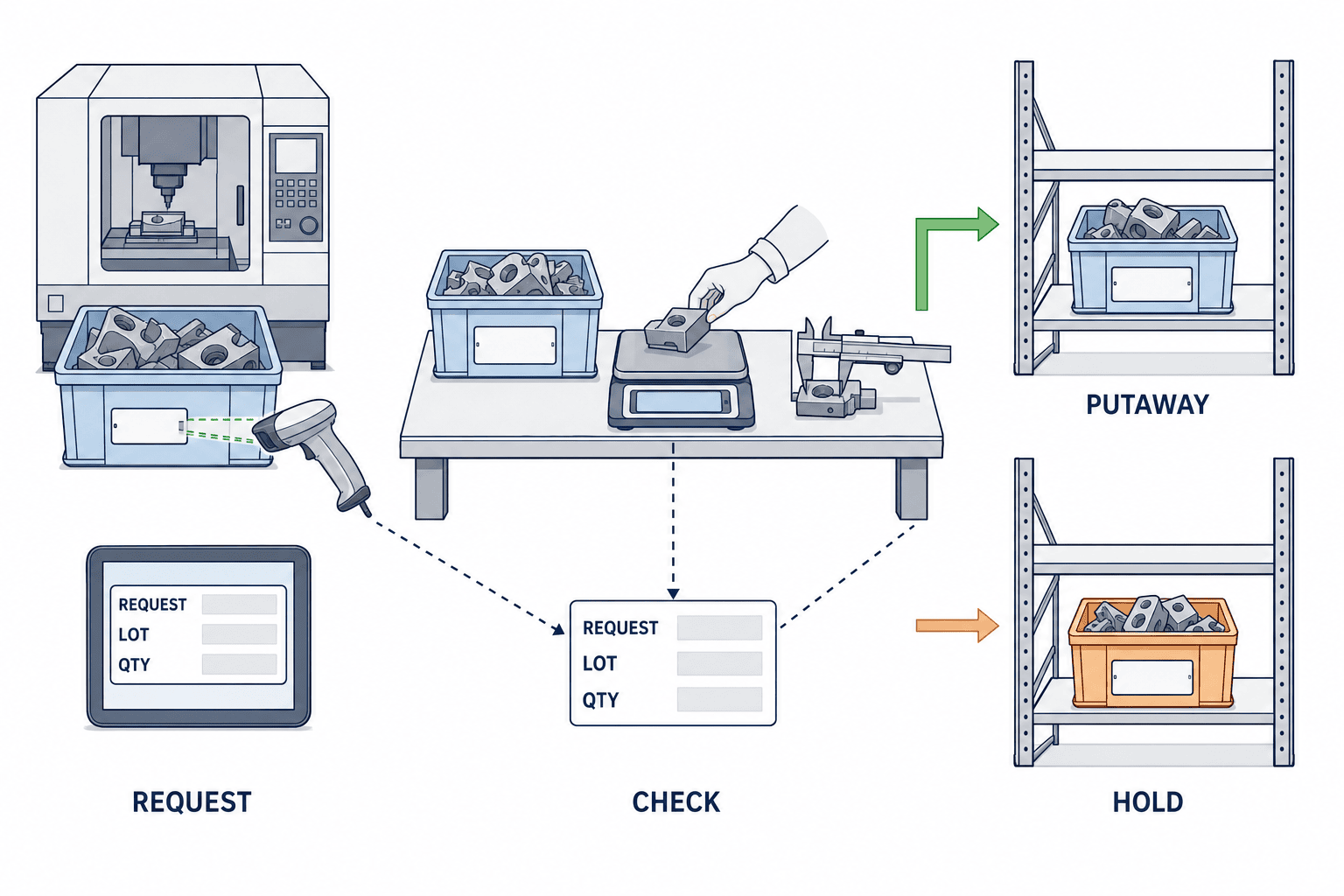
Separate permissions for each decision. If the requester can approve their own declaration, a variance may pass unseen. If every low-risk unopened pack needs a manager, work will queue. Define automatic release and human approval by item, opened state, variance, lot controls and customer requirement. Include a night-shift delegate.
Verify the actual lot, quantity and condition
A return ID is a key joining the physical container to digital events. If a container may hold more than one lot, require separate detail lines and physical segregation. For items where mixing is prohibited, use separate containers. An automatically suggested “last used lot” is helpful for entry but does not replace scanning the physical label. The original issue itself could have been wrong.
Define units precisely. “One box” says nothing about how many pieces remain. Maintain versioned conversions among purchase units, issue units, inventory base units and measured mass or length. For partial returns, specify measurement method, tolerance, rounding and minimum return unit. A fixed item-master factor may be inadequate when conversion varies by lot. Oracle manufacturing documentation supports dual units of measure for relevant transactions, but applicability must be checked in the actual configuration.
Three quantity checks are essential: the accepted amount must not exceed what was physically measured; it must not exceed the net amount eligible to return against the order; and it must not include quantity already returned from the same lot and container. Extra issues, transfers between operations, substitute material, scrap and inventory adjustments mean the simple formula “issued minus consumed” may be wrong. State which transactions count and who can authorize a correction.
Build condition checks by item family: unopened or opened, original packaging, readable lot label, damage, rust, contamination, expiry, environmental exposure, measurement method and any required photo. A photograph alone does not prove usability. Decide which materials require images and who owns the decision. If the item or lot cannot be identified, use an explicit exception and segregated container. Never guess the lot to make a transaction pass. Relabel only after documented inventory and quality approval; otherwise use a separate approved path for inspection, disposal or alternate use.
Keep quality hold apart from available inventory
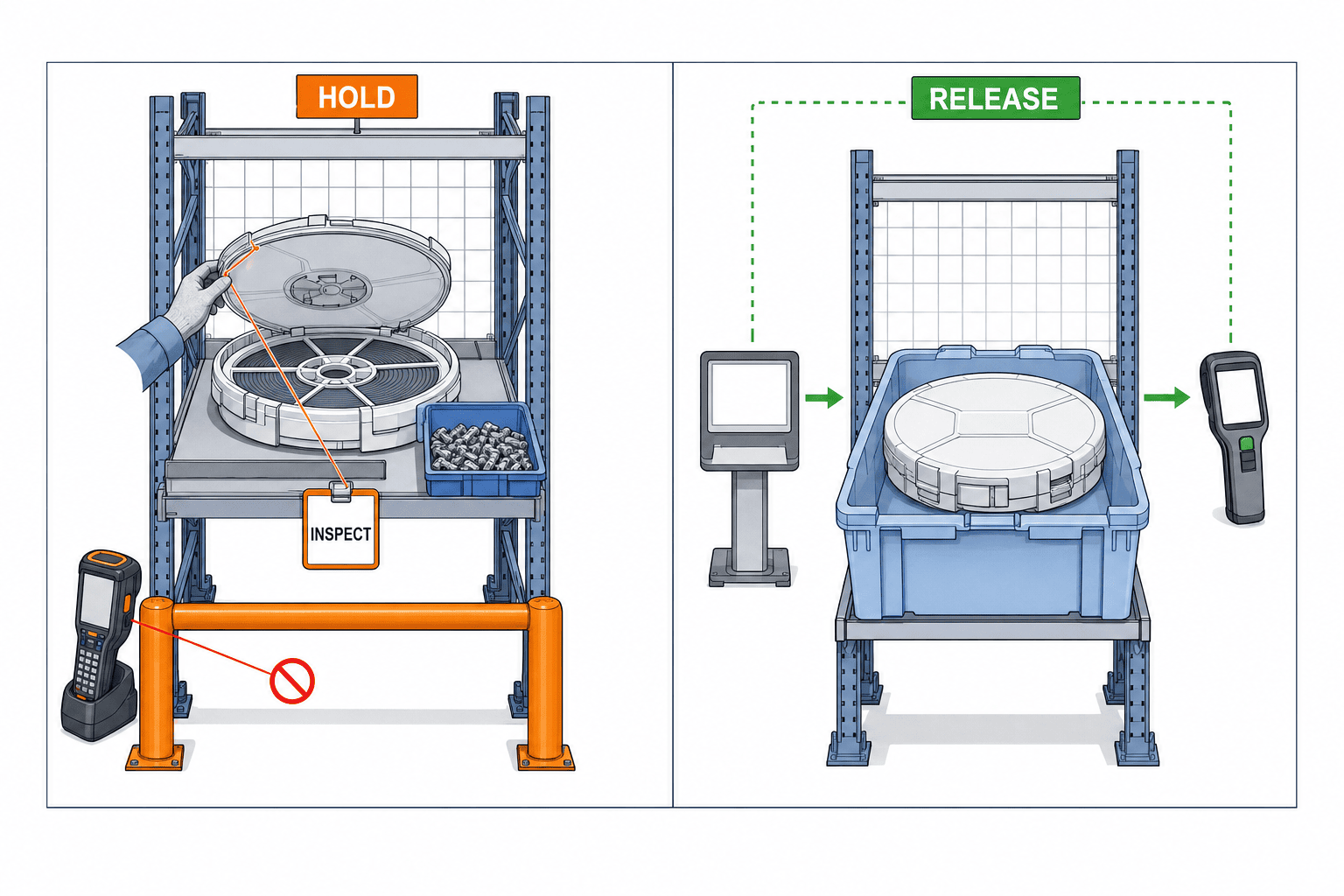
A warehouse receipt is not the same as permission to use the item. Represent physical custody, book ownership and allocation eligibility separately. A container may sit on a hold shelf but must be excluded from reservation and picking. Conversely, a quality-approved item with no registered bin should not be offered for picking. If ERP and WMS both carry status fields, name the system whose status controls allocation.
Opening a package may shorten its usable life; the return date is not automatically a new expiry date. Quality must apply product specification, storage conditions and customer requirements. If a lot is split or a new container ID is assigned, retain the source lot and work-order link. The GS1 Global Traceability Standard and EPCIS provide a useful language for identifiers, events, locations, times and business context. Using either standard does not determine a factory’s pass/fail rule.
Every hold needs a due date, owner and next action. A growing hold shelf is hidden inventory even when the return screen looks complete. Report overdue items by cause: awaiting inspection, unclear lot, costing approval and so on. If the final disposition is disposal, keep the original receipt and a separate approved disposal event rather than silently overwriting history.
Reconcile ERP, MES and WMS with one return ID
MES often knows orders, operations and consumption; WMS knows containers, bins and warehouse moves; ERP knows inventory balances and costing. The actual owner depends on installed products and settings. Agree on three questions before integration: where is the authoritative net returnable quantity, which system can increase allocatable stock, and which owns the physical bin? Assign ownership by data field and transaction, not by an umbrella product name.
The integration event should carry return ID, order and operation, original issue ID, item, lot and serial if applicable, container, declared and measured quantities, unit, condition, hold reason, receipt time, quality decision, bin and ERP transaction ID. If an old record lacks an original issue ID, show candidate issues for a person to confirm and preserve that exception. An EPCIS-inspired design can preserve what happened, where, when and why without forcing every application to share one format.
Specify partial success. If the MES request is accepted but WMS work creation fails, retry with the same return ID. If putaway succeeds but the ERP call times out, query ERP for the transaction before sending again with the same idempotency key. A lost response can follow a successful server-side write. Show a clear operational error to staff, preserve the technical log, and avoid an unconditional second Return.
At minimum, compare declared, received, quality-approved, ERP-returned and WMS-put-away quantities. A difference may be legitimate while inspection is pending or part of a lot is rejected, but it must have a reason and owner. Daily reconciliation should list overdue open IDs, ERP-only IDs and physical-only IDs separately. A month-end balance adjustment hides the mechanism that created the gap.
Stop duplicate returns
The same container scanned twice must not double its quantity. Use return detail ID plus container ID as an identity rule. After final posting, changes should be a controlled reversal and repost or explicit variance adjustment, not an overwrite. If partial receipts are allowed, sum them against the request. Two different line containers from the same order and lot can be legitimate separate returns.
Define offline operation. May a container move during a network outage? How are temporary IDs made collision-safe? Which event wins when the connection returns? Unlimited offline posting can create available stock twice, especially if another order has already used the material. Hold higher-risk lots physically and digitally until reconciliation completes.
Write the RFP as executable scenarios
“Returns supported” and “barcode ready” are weak requirements. Describe the plant, lines, item families, order volume, lot controls, ERP/MES/WMS versions, devices, warehouse layout and approval roles. Then require vendors to walk through a representative finished order: what the operator sees, where the container moves, what each ledger records and who resolves a mismatch. Distinguish standard configuration, customization and manual workaround in each answer.
Include at least these cases: unopened full-lot return; partial quantity from an opened container; two lots at the line; declared versus measured difference; unreadable label; near-expiry material; quality rejection; duplicate message; ERP connection loss; and a subsequent order attempting to allocate the just-returned stock. Add offcuts, reels or serialized material as relevant. For each case, request the screen, physical destination, balance effect, approver and recovery method.
| RFP requirement | Vendor evidence | Decision question |
|---|---|---|
| Original issue link | Screen, fields and matching rule | Are extra issues and substitutes distinct? |
| Lot and quantity inspection | Scan and measurement demonstration | Can it accept part of an opened pack? |
| Quality hold | Bin and allocation configuration | Can an unapproved item be reserved? |
| ERP/MES/WMS interface | API, retry and reconciliation design | Can partial success double a transaction? |
| Exceptions | Unknown-lot, variance and disposal screen | Do open cases remain visible? |
| Audit history | Permission and change export | Who changed the item to usable? |
| Operation | FAT/SAT and support plan | Are nights and outages tested? |
Compare total implementation cost: software, labels, handhelds, scales, network, ERP interface, master-data cleanup, hold shelf, training and maintenance. Do not justify the project only with faster entry. Measure missed returns, duplicate balances, disposal, emergency reorder and stocktake variance in a pilot. Set monetary benefits only after internal data and test conditions are known. Every number below is an illustrative assumption, not a reported factory result.
An illustrative quantity and investment example
Hypothetical example: 100 units of one lot are issued to an order; net good-product usage is 72, process scrap is 3, and 25 unused units are physically present. The physical explanation is 100 = 72 + 3 + 25. If ERP backflush records 75 units of consumption, do not assume that entering a negative issue of 25 is appropriate. Examine actual transaction setup, extra issues and scrap. If the warehouse measures only 24 units, hold the one-unit difference rather than posting the declared 25.
Hypothetical example: 20 of the 25 units pass unopened-pack inspection; five opened units are held. Available returned stock is 20 and hold stock is five. Later three of the held units pass and two are disposed. The final usable return is 23, and disposal is two, with the sequence preserved. Rewriting the original request from 25 to 23 would hide the quality decision. Financial posting order must follow the target ERP and company policy while keeping physical, held and usable balances explainable.
Hypothetical investment calculation: 300 requests a month at 12 minutes each become eight minutes each after implementation: a saving of 1,200 minutes, or 20 hours monthly. Confirm that saved time can actually be reassigned before valuing it as labor benefit. If discrepancies fall from 20 to eight, a different product mix or volume may explain some change. Compare the same line, item families, period and measurement method. Do not count a disposal reduction and the associated stockout avoidance twice.
FAT and SAT must test exceptions
In FAT, use representative data and boundary cases in a vendor environment. A single correct lot and quantity is insufficient. Test missing original issue, excessive quantity, wrong lot, unreadable label, duplicate return ID, quality rejection, API timeout and a lost response after a successful write. Check not just screens but ERP transaction IDs, WMS bins, MES order balance and audit log. Put expected states in test cases before deciding pass or fail.
SAT uses the real plant network, scanners, scales, printers, shelves, shift permissions, gloves, oil and lighting. Test whether labels remain scannable, offcuts can be measured safely, containers fit the target bin, and hold and approved stock remain separated. Check throughput at the busy receiving period. An API that passed FAT may fail under actual timeouts or sleeping handheld devices. Include the worker’s physical path in acceptance.
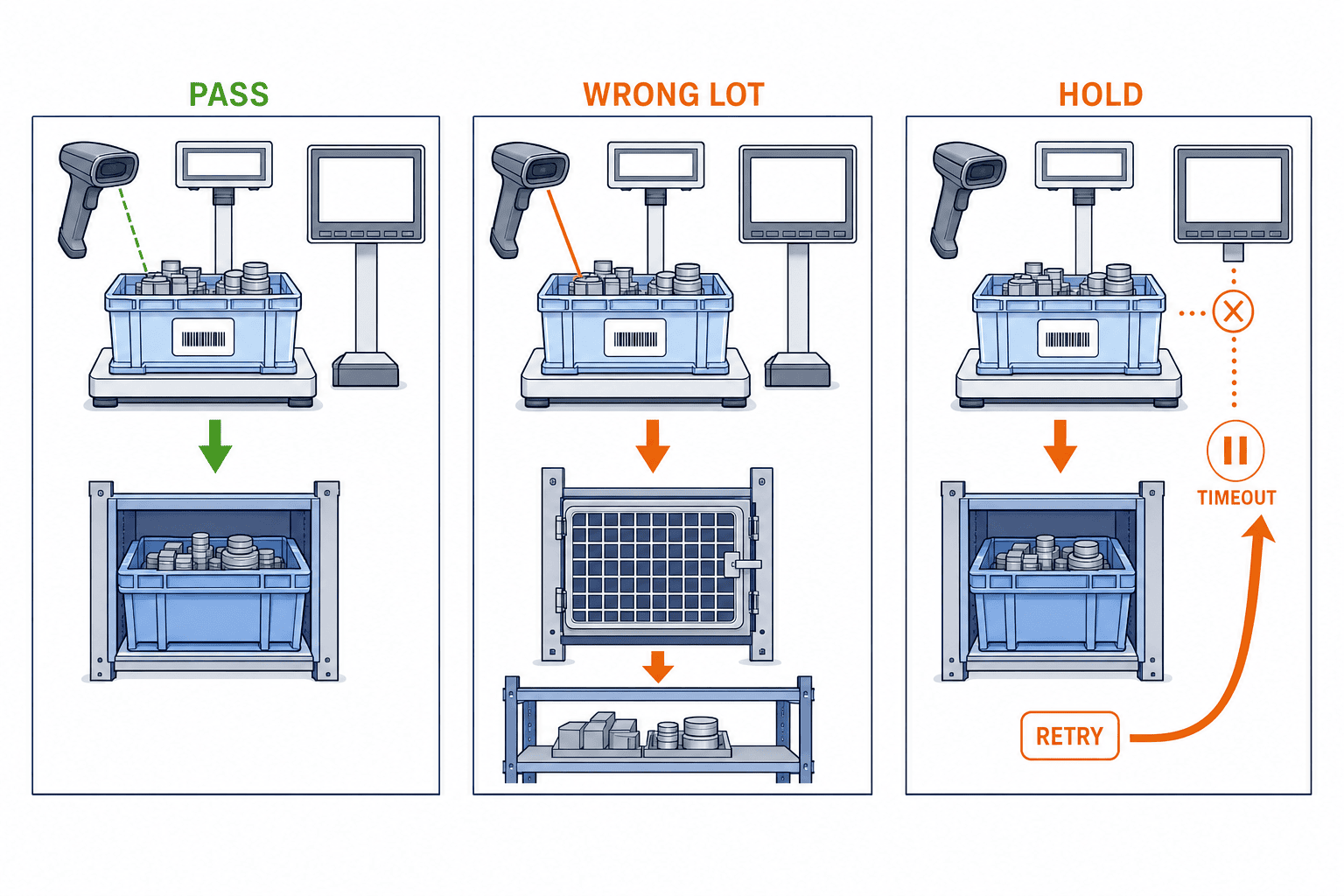
Write acceptance criteria as observable states, for example: “Attempting to pick an unapproved hold container stops the task, displays the hold reason, does not increase available ERP quantity and logs the attempt.” This is a design example; the system enforcing allocation varies. Agree on failure recovery, retest scope and migration responsibility before signing. After launch, monitor completion time, declared-versus-measured variance, hold age, unknown-source rate, retries, duplicates and physical bin differences. Fewer returns do not automatically mean improvement; production volume or reporting behavior may have changed. Use orders or issues as a denominator and read reason codes.
Start with a small, measurable scope
Choose one line and one warehouse with frequent returns and manageable lot rules. Collect recent return slips, stocktake differences, disposals and hold cases, then walk the actual material path. Design the container and original-issue link, name the owner of each data item, and agree on the state diagram and exception codes before building screens. Adding scanners without these decisions increases scans without necessarily improving inventory accuracy.
During a pilot, reconcile the new system against the present procedure for a defined period. Count omissions, wrong lots, uncleared holds and posting delay. Initially keep the path to automatic available stock narrow. Expand item families, lines and warehouses only when evidence is stable. When expanding, update master data, quality rules, bins, device settings and acceptance tests together. An earlier FAT pass is not proof for every new material.
Report to management using time from request to usable stock, unexplained physical differences, hold age, emergency reorders and stock adjustments, defined consistently before and after. Discrepancies may initially increase because they become visible. Judge resolution time and recurrence as well as the initial count. Do not set a universal target of zero returns: frequent returns may signal over-kitting, while fewer returns may mean accurate supply or hidden reporting. Compare return metrics with issue accuracy and line stoppages.
Is the standard ERP Return function sufficient?
It may be, if the existing ERP and WMS can cover physical receipt, opening condition, quality hold, bin, offline device use and duplicate prevention by configuration. It may not be. Run representative scenarios in the actual version and price both configuration and customization before choosing.
Can a returned item be allocated to the next order immediately?
At minimum, confirm its lot, quantity and location. Items affected by opening or storage conditions remain held until quality release. Record why and when they became available. Do not let a book entry substitute for physical putaway.
What if the original issue lot is unknown?
Use a segregated unknown-lot container. Compare labels, order, movement and inventory history. Quality and inventory owners decide whether re-identification is justified. If it is not, use an approved disposal or other disposition with its own record, not a guessed normal return.
What is the minimum RFP and FAT/SAT scope?
Require order, original issue, lot, partial quantity, condition, hold, bin and ERP transaction ID. Test normal return plus variance, unknown label, rejection, outage, retry and duplicate scan. Accept based on the physical state and final ERP/MES/WMS balances and histories.
What changes when an order is cancelled or its process changes?
A completed order has confirmed good, scrap and consumption quantities. A mid-process cancellation may leave material inside a machine, a partly mounted reel or stock moved to another operation without a recorded transaction. A screen may calculate a candidate from planned issue minus planned use, but that is not the confirmed return. The line supervisor must inspect equipment and in-transit containers, recording their location by operation. If an engineering change makes the old material unusable, hold it for a quality and design decision even when its physical count is certain.
Blocking work-order closure until every return is complete can be simple, but it may delay closing when inspection occurs the next day. Some plants should separate production-completion criteria from quality and warehouse return completion, while keeping every open return ID reachable from the order. For items whose return difference materially affects costing, finance may instead require a close hold. Decide by item family with costing and quality owners and test month-end close in the RFP.
Keep migration stock separate from new returns
At go-live, leftover material beside a line may or may not have a traceable historical issue. Link traceable items to the old order, verify the physical stock and create a new return ID. Do not bulk-load untraceable items as ordinary successful returns; that would make unknown-origin lots appear normal on day one. Count item, lot, status and location before cutover. Isolate unknowns as migration exceptions and process them with approved opening balance or adjustment transactions. Report new-return performance separately from resolution of migration exceptions.
Show the next action on the shop-floor screen
“Error 409” does not tell an operator where to put a rejected container. Distinguish “lot not in original issue,” “quantity exceeds returnable balance,” “quality decision pending,” and “ERP response unknown,” then show whether to rescan, place on a variance shelf, call quality or wait for a safe retry. Printing a container ID and assigned exception shelf keeps digital open work linked to physical stock. In SAT, check that Thai operator screens and Japanese manager screens show the same item, lot and unit and give equivalent permissions. After retry, verify the open task closes and both warehouse receipt and work-order history can find the same return ID.
Conclusion
A surplus material return is a controlled path from request through physical verification, quality decision, putaway and ledger reconciliation. The goal is to explain exactly when unused material became safe, located and available for the next order. Make physical custody and system ownership explicit in the RFP, then test real exceptions in FAT and SAT. That turns an invisible line leftover into inventory whose origin, quantity, condition and location can be traced.
If your Thai factory is defining how line leftovers return to stores, how ERP/MES/WMS should reconcile, or when quality holds apply, contact TOMAS TECH. We can help scope one line and item family before a full RFP or pilot.


