


When commissioning a factory Wi-Fi site survey, begin with the work that connectivity must support. Where does a handheld scan fail? Where does an AGV turn, stop, and restart? Which machine data is lost only while the production line runs? An access point (AP) count and a polished signal heatmap cannot answer those questions. This guide shows how a Thailand factory can commission predictive and on-site surveys, test actual clients along critical routes, and accept the finished network using evidence that operations, IT, and suppliers can all inspect.
A factory survey must go beyond an AP placement map
Metal machines, loaded racks, liquid containers, shutters, and moving vehicles alter radio propagation. The same aisle may behave differently when a rack is full. A detectable signal is also different from a completed transaction in the production application. Cisco’s factory design for Ultra Reliable Wireless Backhaul (CURWB) calls for a floor plan, metal and other obstructions, vehicle type and speed, power and backhaul locations, spectrum scanning, and an active survey. CURWB is distinct from a standard Wi-Fi WLAN; its physical-site and mobile-route inputs are useful here by analogy, not as WLAN performance specifications. Cisco CURWB factory design. HPE Aruba says complex manufacturing floors may need a physical survey to measure both Wi-Fi and non-Wi-Fi interference. HPE Aruba RF design.
This article concentrates on buying, running, and accepting the survey. For broader architecture and procurement decisions, see our factory wireless LAN design guide. For the cost and network layers surrounding Wi-Fi, see the factory wireless LAN and industrial network guide. If the suspected fault may be on the wired industrial network, the PROFINET diagnostics guide helps frame that investigation.
Map the places where an interruption matters
Do not define the survey solely by square metres. Walk the plant with operations staff. Mark every handheld scanning point, tablet approval point, AGV or AMR turn and stop, and fixed gateway. Treat transitions between warehouse and production, shutter crossings, rack ends, intersections, charging stations, loading bays, and indoor-to-outdoor boundaries as distinct segments. A site-wide average can hide a failure at any one of them.
Describe clients, routes, and consequences together
A device inventory alone is insufficient. Record the device model and software version, supported radio bands, authentication, antenna position, application retries and offline behaviour, movement pattern, and what happens when communication fails. For an AGV, include travel direction and speed, stopping and restarting, the installed radio, handoff behaviour, and the system’s safe response to disconnection. Ask client and application suppliers to validate these inputs. Set acceptance values from the actual device specifications and the business process’s tolerance; do not copy a single RSSI or latency number from an unrelated deployment.
Record changing physical conditions
Add rack height and loading, metal machines, liquid tanks, shutters, moving shelves, future installations, feasible AP mounts, wired drops, and PoE locations to the drawing. Document existing AP location, band, channel, power, antenna orientation, and switch connection where available. Correct the drawing when it disagrees with the plant. For each measurement, record whether lines were running, racks were loaded, and doors were open. Those details make a future incident comparable to the acceptance baseline.
Combine predictive, passive, and active surveys
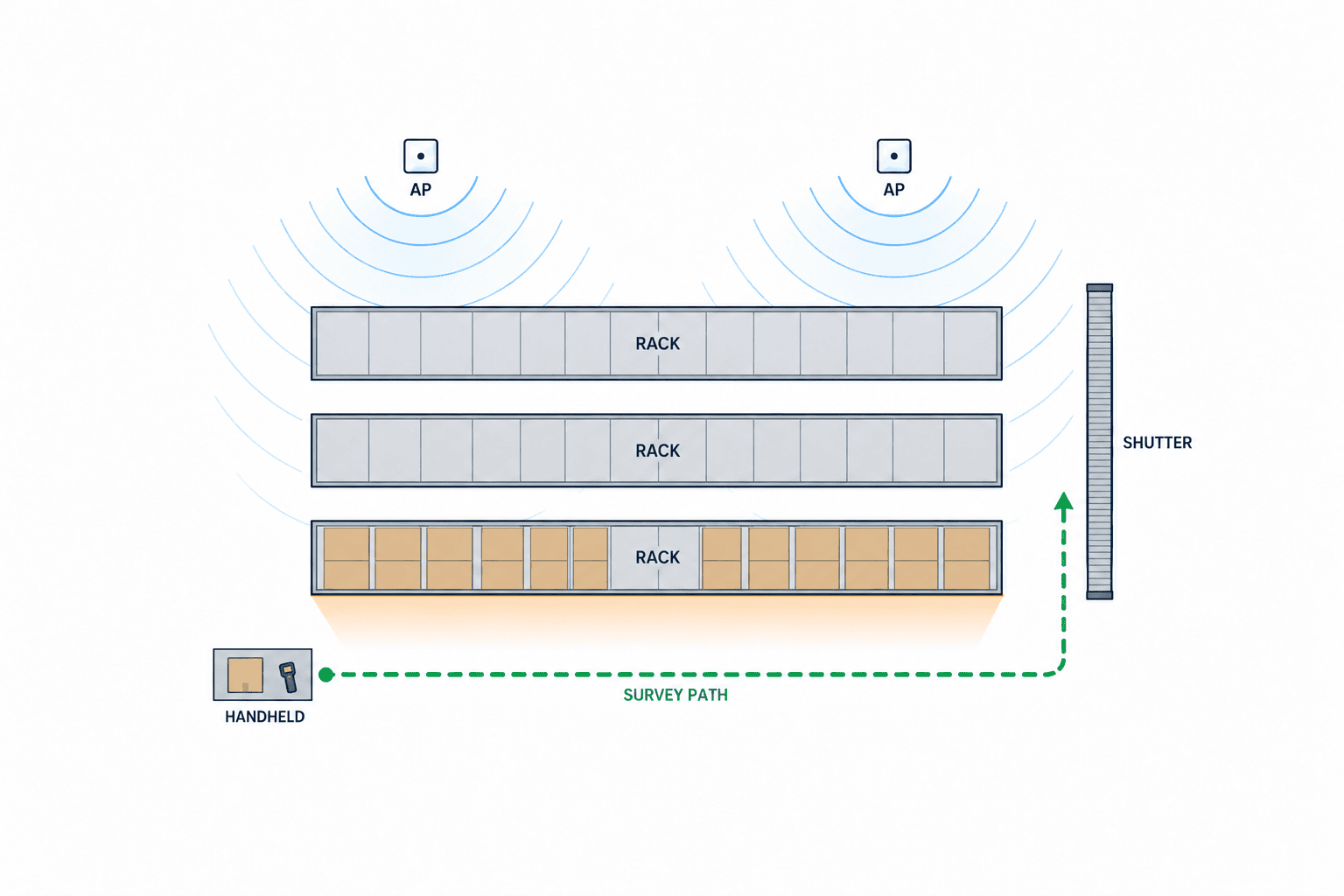
Cisco distinguishes predictive, passive, and active surveys. Predictive modelling estimates coverage from an assumed layout and materials. A passive client listens without associating to the AP; it can show RF distribution but cannot by itself prove client uplink or packet retransmissions. An active survey associates to the AP and can observe bidirectional traffic, rate changes, retries, and roaming. Cisco site survey guidelines.
Use predictive design as a hypothesis
A predictive model is useful before a new building is ready: it helps propose AP locations, antenna types, cable routes, and a budget. Its accuracy depends on the building and equipment data supplied. HPE Aruba lists predictive heatmaps and AP placement maps among typical deliverables and separately recommends physical investigation for complex manufacturing areas. HPE Aruba wireless survey. Keep the model as an assumption to test, rather than treating it as proof of installed performance.
Use passive survey for distribution and interference
Walk the planned routes and record existing APs, channel overlap, weak spots, unexpected transmitters, and candidate mounting areas. Add spectrum analysis where non-Wi-Fi interference is plausible. A passive receive-only map does not demonstrate that the handheld can send a transaction or that the AGV maintains its application session. State clearly which bands and operating conditions were measured.
Use active survey with the target client
Once the installation is configured for production, connect the actual device to its real SSID and perform the intended operation along the route. Observe uplink and downlink behaviour, retries, delay, AP transitions, authentication, and application continuity. A survey laptop may not represent a scanner’s antenna, driver, or power-saving behaviour. HPE Aruba recommends surveying, testing, and validating with target end-user devices before widespread deployment. HPE Aruba planning and deployment. If several models exist, explain which were tested and why; list untested models explicitly.
Build a factory Wi-Fi survey execution plan
Before contracting, specify who measures what, where, when, and with which clients and tools. Arrange access, safety induction, escorts, and photography approval. Schedule the work around production rather than assuming the surveyor can enter every area at any time. Include operations, OT, IT, client, and application owners in a short walk-through so that the survey captures actual peak conditions and obstructions that are missing from drawings.
Separate the measurement stages
First, survey the current environment before installation to establish a baseline and correct the predictive model. Second, check proposed AP positions and mounting feasibility with temporary or planned hardware. Third, conduct post-installation acceptance with the production SSID, security settings, channel and power plan, and target clients. Preserve a dated configuration snapshot for each stage. Mixing results from different configurations makes before-and-after comparisons misleading.
Test segments under relevant operating states
Divide a route into straight travel, turns, shutter crossings, intersections, stopping, and restarting. Where practical, distinguish a stopped line from a running line and an empty rack from a full one. Prioritize combinations by known failures and business impact; an exhaustive matrix is rarely feasible. Record the untested conditions. A failed event should carry the time, place, client, configuration, application action, and steps needed to reproduce it. Also record the conditions for successful tests, including shift, nearby machinery, load state, and concurrent devices.
Keep raw data aligned with application logs
Request measurement points and paths, AP association history, signal and noise, channel use, retries, roaming events, and relevant client and application logs in a format the owner can inspect. Synchronize timestamps before testing; otherwise, the application pause at a corner cannot be matched to the RF event. Decide in advance how production and personal data will be protected. Some tools cannot collect every metric, so name acceptable alternative evidence in the RFP.
Heatmaps are useful for discussion but can hide sparse sampling through interpolation. Show the measured points and untested areas on the map, along with band and rendering assumptions. A green-looking aisle centre does not prove performance behind a machine or inside a rack. In the acceptance meeting, inspect critical transactions and exceptions before judging the proportion of green pixels.
Preserve precise locations and separate the fault history
Some areas can be entered only once during a planned shutdown. Tie each measurement point to a location on the plan and, if permitted, a site photograph, so another surveyor can walk the same path later. If photographs could disclose confidential equipment or workers, decide permission and storage in advance. Column numbers, machine IDs, or rack row names can identify a point when photographs are prohibited. Record successful periods with the day, shift, adjacent lines running, rack loading, door position, and types of simultaneous clients. A lunchtime test cannot silently stand for a night shift or logistics peak; put that limitation in the acceptance record and decide whether another shift needs testing from the incident history and operational impact.
Give the contractor more than email subject lines describing old incidents. Include the business operation that failed, its time and place. A report of “weak Wi-Fi” may actually describe authentication failure, unstable switch power, or an application timeout. Start from the operator’s observation, collect corresponding logs, and separate the stage where communication stopped. If the cause is outside radio, retain that diagnosis in the survey report so an unnecessary AP addition is avoided. Evidence should precede configuration changes, especially where production cannot be stopped.
Set test stop and recovery rules before measuring
Agree who may stop a test if production is affected and who restores the prior configuration. A temporary AP might interfere with the existing network; test authentication settings might affect production clients. Save the original configuration, check those interactions, and schedule changes when the people needed for recovery are on site. Keep the test and production environments controlled so the survey itself does not cause an outage.
AGV Wi-Fi roaming needs motion testing
Static signal readings do not reproduce a vehicle’s metal body, cargo, antenna position, speed, turning, or restart. Cisco’s CURWB factory guidance includes vehicle type and speed, roaming requirements, obstructions, interference, and an active survey among its design inputs. That is guidance for CURWB, not a Wi-Fi WLAN acceptance threshold; we use its mobile-route survey factors as an analogy. Cisco CURWB factory design.
Drive the real vehicle on the real route
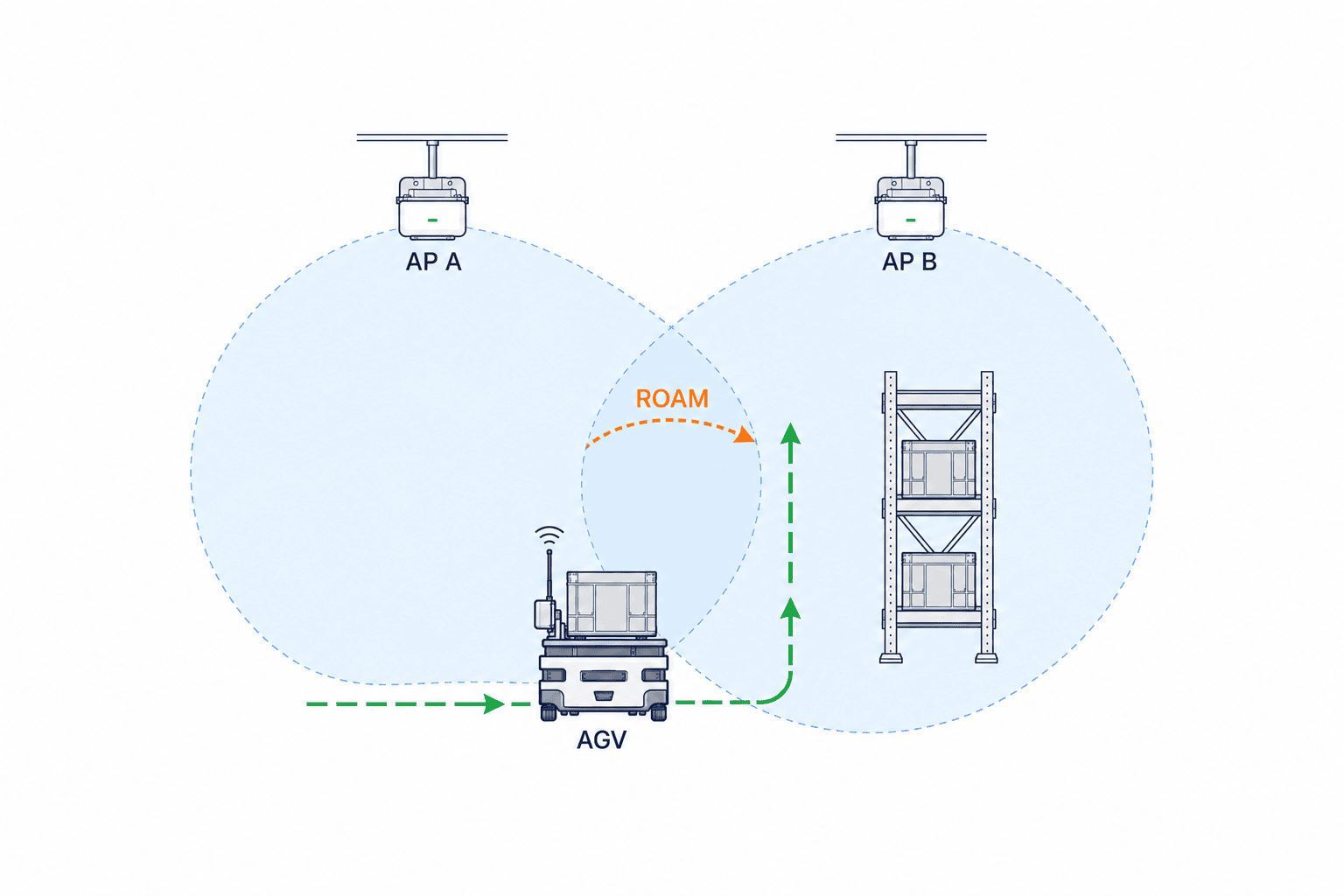
Use the production radio and antenna. Repeat normal travel, turns, stops, and restarts at the areas where APs change. Correlate AP transitions with the AGV’s control and task logs. For handhelds, test scan submission, repeated scans, screen transitions, and waking from idle. If a supplier excludes actual-client trials, the contract must say who will perform them and who will provide the evidence.
Check recovery in the application
A client may remain associated while an application times out or creates duplicate transactions. Operations, controls, and IT should define acceptable interruption, retries, buffering, duplicate protection, alarms, and safe stopping for each use case. Link the RF acceptance sheet to the application and vehicle acceptance tests. Safety-related functions require their own risk assessment; ordinary Wi-Fi signal metrics do not certify safety.
Roaming also depends on client implementation and configuration. Adding an AP does not guarantee that a client will change AP at the desired point. When a transition fails, inspect the candidates the client saw, authentication events, overlap, channel and power plan, and application reconnect logic before selecting a remedy. Repeat the same route after each change and check adjacent routes for regression.
For demanding control or vehicle traffic, assess whether Wi-Fi is the appropriate communications method at all. Evaluate candidate methods against required availability, routes, and fail-safe behaviour during design. The field survey remains useful before comparing methods because it exposes obstructions, interference, and installation constraints. Its purpose is to choose an approach that works under actual operating conditions, not to justify a preselected device.
Define factory wireless LAN acceptance criteria
“Coverage everywhere” is too vague to accept. For each area, specify the device, operating condition, business operation, measurement method, acceptance owner, and response to failure. Put provisional criteria into procurement documents and define how they may be revised after the initial site visit. Numeric limits should derive from the target device, application tolerance, and site evidence.
Assess three layers
The RF layer covers distribution, interference, AP placement, and channel and power settings. The client layer covers association, uplink and downlink, retransmission, roaming, reauthentication, loss, and recovery. The business layer covers completed scans, vehicle commands, or data delivery. Passing one layer does not replace the others. Tie each failed segment to a diagnosis, modification, and repeat test.
What one row of the acceptance register should contain
Take the case of a worker who continuously scans from a finished-goods rack to the shipping door. Identify the start and end points, rack rows crossed, shutter state, handheld model, and application version. Describe the barcode type, destination system, confirmation displayed after submission, and retry behaviour if connectivity drops. Record the walked path, AP transitions, how radio and application logs will be obtained, and the time or screenshot captured when a transaction fails. Finally, state which result the operations owner will accept as a pass. If the team cannot write this row, the surveyor will not know what to test and the buyer will have to invent a pass criterion after receiving the report.
For an AGV, replace the handheld with the onboard radio and control application. Divide the route into normal travel, slowing at an intersection, turning with a load, and restarting from a stop. The vehicle supplier and plant owner must agree before testing on the vehicle’s response to a brief disconnect, retrieval of a missed command, prevention of duplicate execution, and transition to a safe state. Assess the actual transport command record as well as the radio connection screen. If there are several vehicle models, state why one represents the group and when the others will be checked.
The register does not replace the specification; it links each requirement to one observable action in the plant. Write it for important operations in terms that both the installer and production team understand. A good RF reading does not pass the business layer if the barcode was not submitted. One successful submission does not pass every route or shift. Keep the tested conditions explicit. Have the operations owner attend critical route tests or name a proxy and required evidence in advance. When a decision is deferred, record what evidence is missing, who will review it, and when.
Tie the test instrument and client clocks, drawing revision, and AP configuration revision to the register. If an AP moves during construction, distinguish the older heatmap as historical and remeasure affected segments after the change. Maintain one as-built baseline for maintenance and for fault allocation when multiple contractors are involved. Later rack additions, shutter replacement, AGV model changes, client operating-system updates, or AP firmware changes can trigger focused rechecks. Test the affected route and clients against the baseline first, widening the survey only if the impact remains uncertain. This keeps the survey useful as the factory changes.
Make “not tested” an explicit outcome
An unavailable AGV, uninstalled rack, or inaccessible route is not a pass. Record it as untested, with an owner and follow-up date. If a proxy test is accepted, document why it is representative and when the actual condition will be tested. An acceptance register should include route, state, client, method, result, exception, action, retest date, and approver.
Preserve the as-built baseline
Store the final maps, AP and antenna positions, channel and power settings, firmware, client versions, representative route logs, and unresolved exceptions together. When a line or rack moves, compare the new state with this baseline before blaming the wireless system. The ability to reproduce and compare a test matters more to maintenance than the AP count alone.
Put the survey into the RFP, FAT, and SAT
Replace “wireless site survey, complete” in the RFP with named areas, routes, target clients, operating states, survey types, deliverables, retest rules, and attendees for acceptance. The buyer need not know every final threshold at tender time, but should state what evidence will inform it and who may approve a change.
Name the deliverables
Ask for an updated floor plan, field constraints, predictive assumptions, passive and active measurement paths and raw data, interference observations, AP mounting and wired connectivity, final channel and power configuration, client-specific roaming results, exception list, corrective actions, retests, and handover documents. Specify exportable formats as well as any vendor-specific project file so the owner can compare future changes.
Keep FAT and SAT distinct
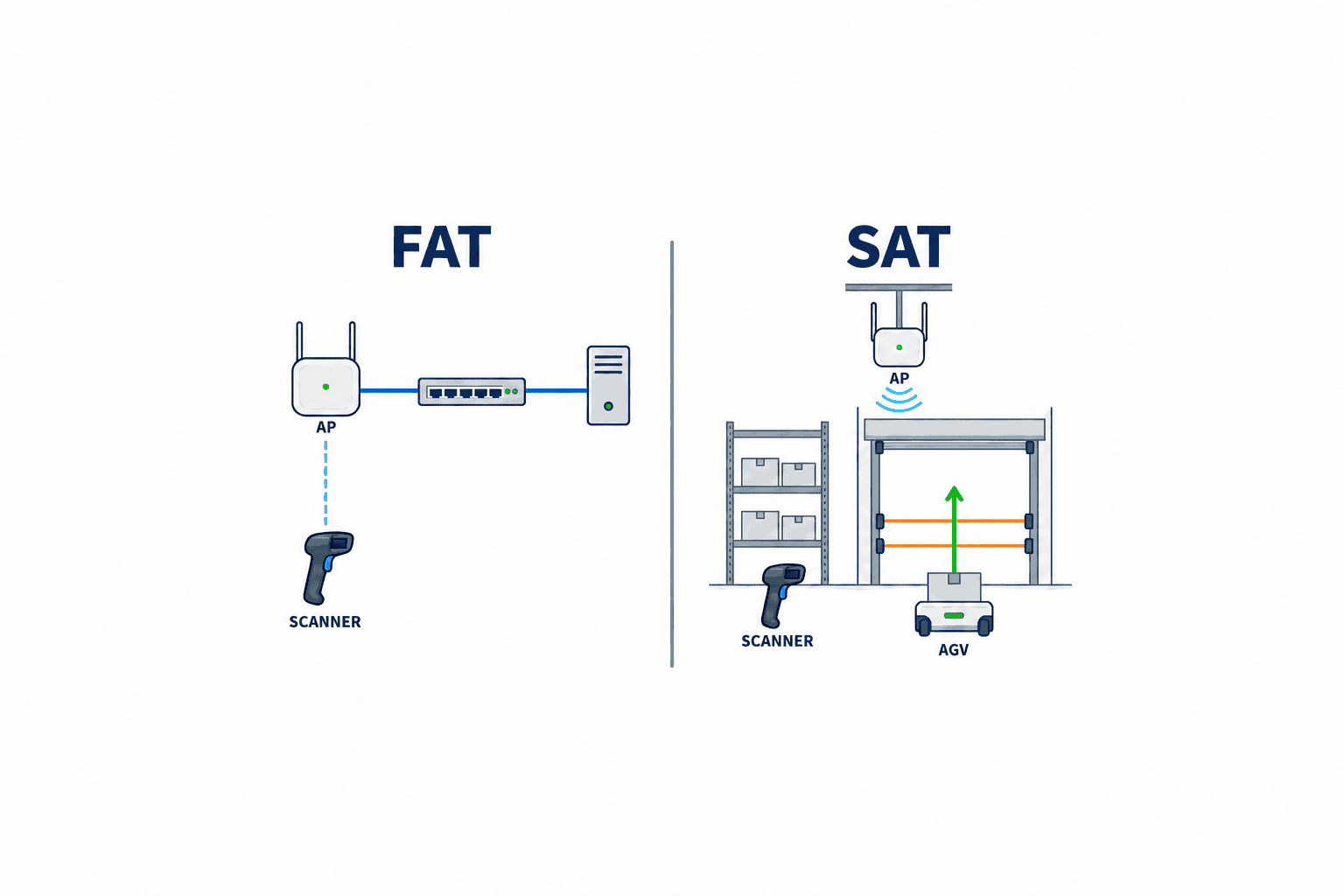
FAT can validate templates, SSIDs, authentication, network segmentation, monitoring, and basic client connection before installation. It cannot reproduce the factory’s metal structures or working shutters. SAT tests the installed system in the actual plant with RF measurements, target devices, routes, and application transactions. After a correction, retest the failed point and nearby segments. Define the content of FAT and SAT in the contract rather than relying on the labels alone.
Compare bids on the same survey scope
One quote may include only a predictive map; another may include post-install passive measurement; a third may include actual-client active testing and repeat visits. Normalize the routes, client types, operating states, safety access, after-hours work, report languages, and retest allowance before comparing price. Identify what the owner must supply: test accounts, devices, an AGV driver or supervisor, production access, and safety coordination. Ask bidders how they would capture and resolve a failure at a shutter or turn. The answer is more informative than the name of a survey instrument.
Agree who investigates each fault
Wireless, switching and PoE, authentication, client, application, and vehicle-control owners should agree which logs each can provide and who leads first diagnosis. Use a shared incident record containing time, location, client, SSID, AP, and attempted business action. At acceptance, distinguish passed, conditional, and untested areas on the drawing; assign corrective owners and dates. Preserve the final as-built record with the teams who will maintain it.
Practical coordination in a Thailand plant
Fit the visit around production plans, logistics peaks, planned shutdowns, access permits, and safety rules. Surveyors may need escorts or protective equipment, and AP-mount checks may require separate safe access. Decide which report sections the Thai maintenance team needs in Thai and what summary a regional or Japanese approver needs. In the acceptance meeting, review untested routes, failed segments, business results, and action owners before discussing the look of the heatmap. Procurement should verify applicable Thai radio-device and band requirements for the actual equipment at the time of purchase; this guide does not grant blanket permission to use a particular band.
Frequently asked questions
Is a predictive factory Wi-Fi survey enough?
It is useful for early AP planning, but it cannot verify actual obstructions, non-Wi-Fi interference, client uplink, or roaming after installation. Plan field checks and post-install passive and active testing in proportion to the impact of a communication failure.
Can a walking test replace an AGV Wi-Fi roaming test?
Walking can locate weak areas. It may not represent vehicle speed, cargo, antenna placement, or the control application’s recovery. Use the real vehicle and route for final acceptance, or mark that scenario untested.
Which numeric factory wireless LAN acceptance limits should we choose?
Use the target client specifications, application timing needs, operational consequences, and pilot measurements. Record the device, route, production state, method, and treatment of failures alongside any number. A borrowed RSSI threshold alone is not a complete acceptance criterion.
What should the owner give a survey contractor?
Provide current and proposed plans, critical routes, client inventory, existing AP and switch information, incident history, and site-access restrictions. Request raw data, survey paths, final settings, business test results, exceptions, and retest evidence in return.
Does a passed FAT remove the need for SAT radio testing?
No. FAT checks configuration and basic interoperability; SAT verifies the actual installation, obstructions, interference, roaming, and business transactions in the factory.
Conclusion
A factory Wi-Fi site survey converts operational needs into measurable acceptance conditions. Map critical routes and clients, use predictive modelling to form a design hypothesis, measure the installed RF environment, and test real devices in motion. Specify raw evidence and retests in the RFP, use FAT for pre-install configuration, and use SAT for plant performance. Keep the as-built baseline so future layout changes can be assessed against it.
If your Thailand plant is still deciding the survey scope, critical routes, or client-specific acceptance checks, you can discuss those questions before selecting AP models or finalizing a budget. Share the current situation through the TOMAS TECH contact page.


