


Installing a temperature monitoring system in a frozen-food warehouse takes more than putting a thermometer in the room and sending an alert when it crosses a threshold. You must define which products you protect, what temperature you measure, where and when you measure it, and who decides what an excursion means. A graph alone cannot establish the condition of a particular lot. Air in the room can change rapidly during door openings or defrost, whereas the temperature at the centre of a packed product responds differently. This guide covers sensor placement, records, alarms, failure recovery, purchasing and acceptance testing for food plants and cold-chain operators in Thailand.
The principal reference is Codex CXC 8-1976, which applies to quick-frozen foods. Its temperature guidance must not be applied automatically to chilled food or every other frozen product. QA must confirm the requirements for each product, destination market, customer contract and applicable law.
Start with the outcome: buy evidence and a response process
The specification has five parts: product-specific conditions; measurement locations representative of the store; time-stamped records from receiving to dispatch; alarm, acknowledgement and product-disposition procedures; and recovery from power or communication failure. A polished dashboard is of limited use if it cannot show whether a lot was in an affected zone. A modest system with clear measurement and response responsibilities can expand from one cold room to multiple sites.
Codex CXC 8-1976 defines quick-frozen food in relation to a cold chain maintained at −18°C or colder, subject to permitted tolerances. The quick-freezing process is not complete until the product’s thermal centre reaches −18°C or colder after temperature stabilisation. The code discusses both continuous monitoring of operating air temperature and direct or indirect checks of product temperature. One warm air reading is not the centre temperature of every carton. Nor does a brief air excursion, by itself, either condemn or release a lot; tolerances depend on the context and competent authority.
Define scope and temperature conditions first
Separate product groups before choosing a warehouse setpoint. CXC 8-1976 addresses quick-frozen foods but excludes edible ices, ice cream and milk from its scope. Quick-frozen fish, prepared meals, chilled goods and ice cream can have different specifications. List SKU groups, package types, expected storage time, receipt conditions and the boundary at which custody passes between parties. A loading dock, inspection area, storage rack, picking lane and dispatch stage are different environments. State who measures temperature and who may hold or release a lot at each point.
The −18°C figure here explains the Codex guidance for quick-frozen food; it is not a universal statutory limit for all food. Derive actual equipment setpoints, alert levels, permitted exposure and disposition rules from the product hazard analysis and applicable requirements. Any operating margin should reflect refrigeration capacity, measurement uncertainty, load pattern and door use, rather than copying a number from an article.
Air temperature versus product temperature: what each record proves
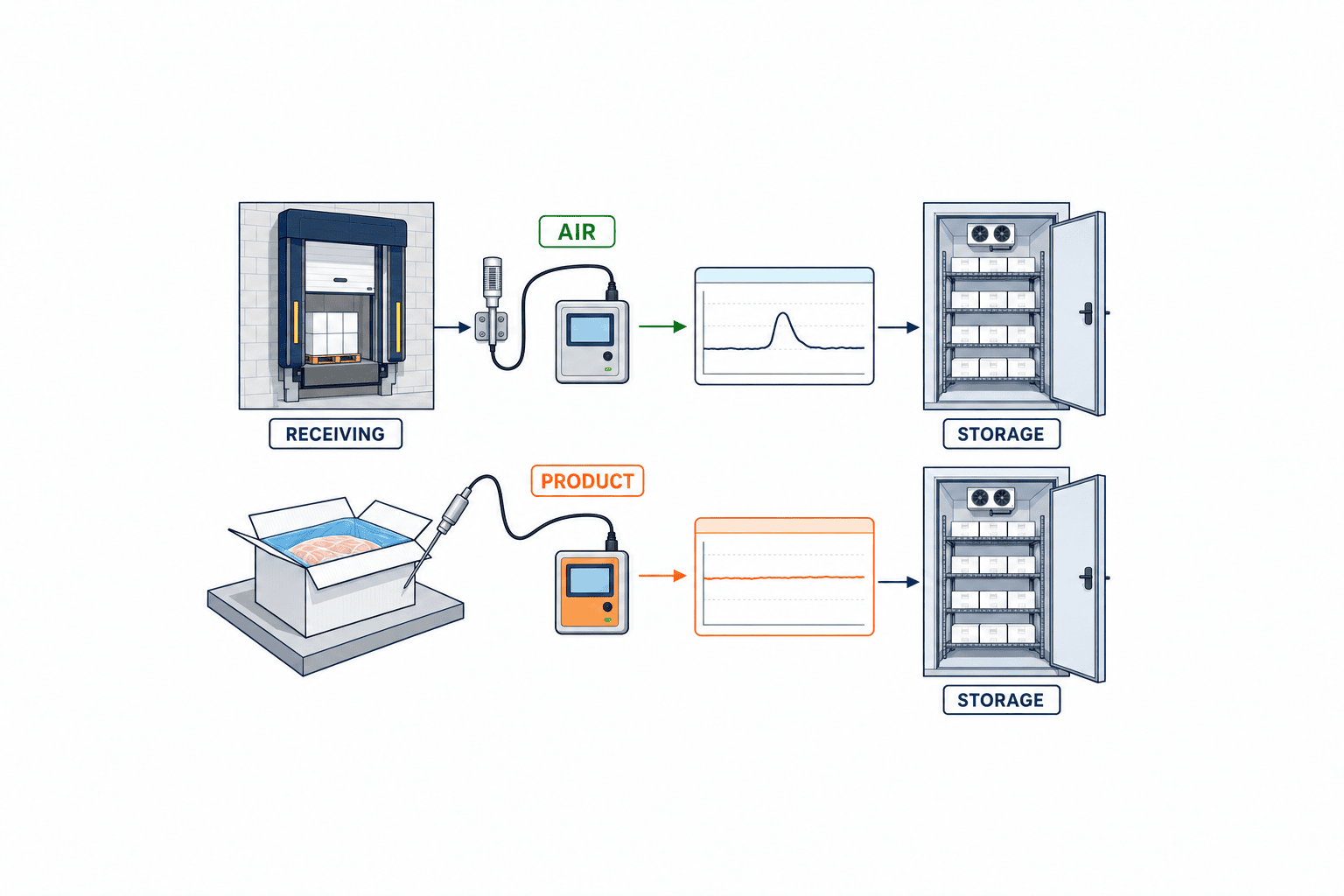
Continuous air readings can reveal refrigeration failure, a door left open or slow recovery after defrost. Air reacts quickly to fans and open doors; the centre of packaged food reacts according to thickness, packaging, stacking and exposure duration. Treat a high air reading as a trigger for investigation, not as an automatic product rejection or approval.
Plan representative product checks at receipt, during process verification and for suspect lots. Measuring every carton core destructively is usually impractical. Define sample locations, instruments, method, lot ID and authorised decision maker. A non-contact surface reading is not a core reading. QA should decide which evidence determines product disposition, while air trends identify when, where and for how long exposure may have occurred. Codex CXC 8-1976 covers air and product temperature measurement separately; Testo also distinguishes ambient and food-core measurement. More air channels do not replace a product-verification plan.
Use temperature mapping to place cold-room sensors
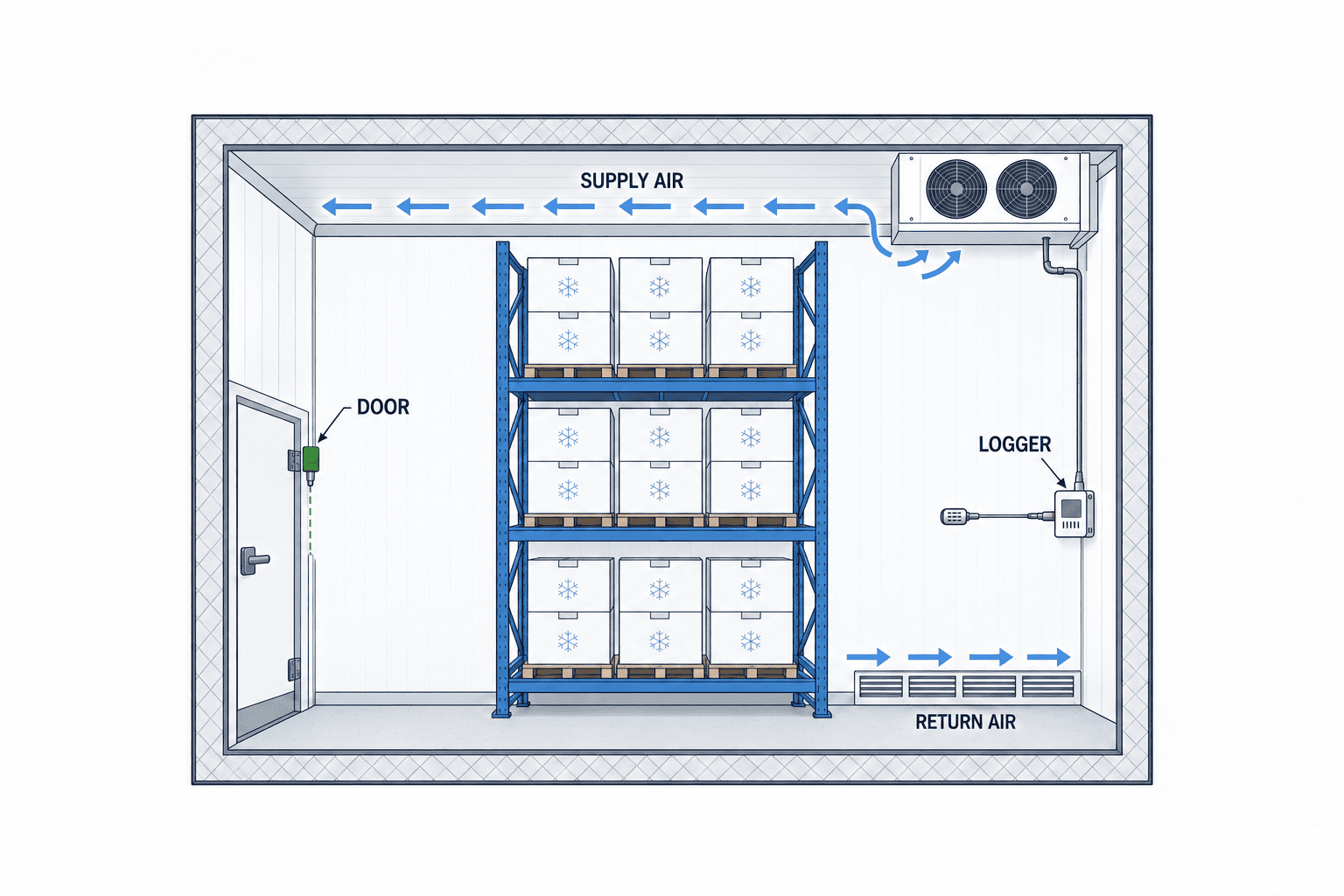
Uniformly spacing probes on convenient walls may miss vulnerable stock. Door-side racks, upper levels, poorly ventilated rear areas, dock openings and positions near evaporators may behave differently. A probe directly in cold supply air may give an overly optimistic impression of product storage conditions. Installation convenience and measurement representativeness are separate decisions.
Map temperature with temporary loggers at multiple horizontal and vertical locations. Include typical loading, busy receiving and dispatch periods, door events and defrost; consider seasonal changes where practical. Rack changes or a new pallet arrangement can alter airflow and should trigger reassessment. Vaisala’s mapping guidance examines three-dimensional temperature distribution and extremes, then links mapping results to routine monitoring locations. Its pharmaceutical examples are useful for design thinking, not food-law requirements.
Choose permanent positions that detect relevant changes yet remain protected from forklifts and cleaning and accessible for maintenance. A door-event probe and a probe representing the storage zone should not be averaged into an ambiguous single “room temperature.” Record each probe’s name, position, height, zone, equipment ID and photograph. Preserve location history if it moves. Check through-wall insulation and moisture sealing, probe operating range, battery replacement and wireless performance under loaded conditions.
Distinguish normal door and defrost events from abnormal ones
If every air fluctuation triggers the same message, everyday work can hide serious faults. Display door-open intervals, defrost start and end, refrigeration state and shift activity alongside the temperature trend. Yet suppressing all alarms during defrost could mask an extended cycle or a simultaneously open door.
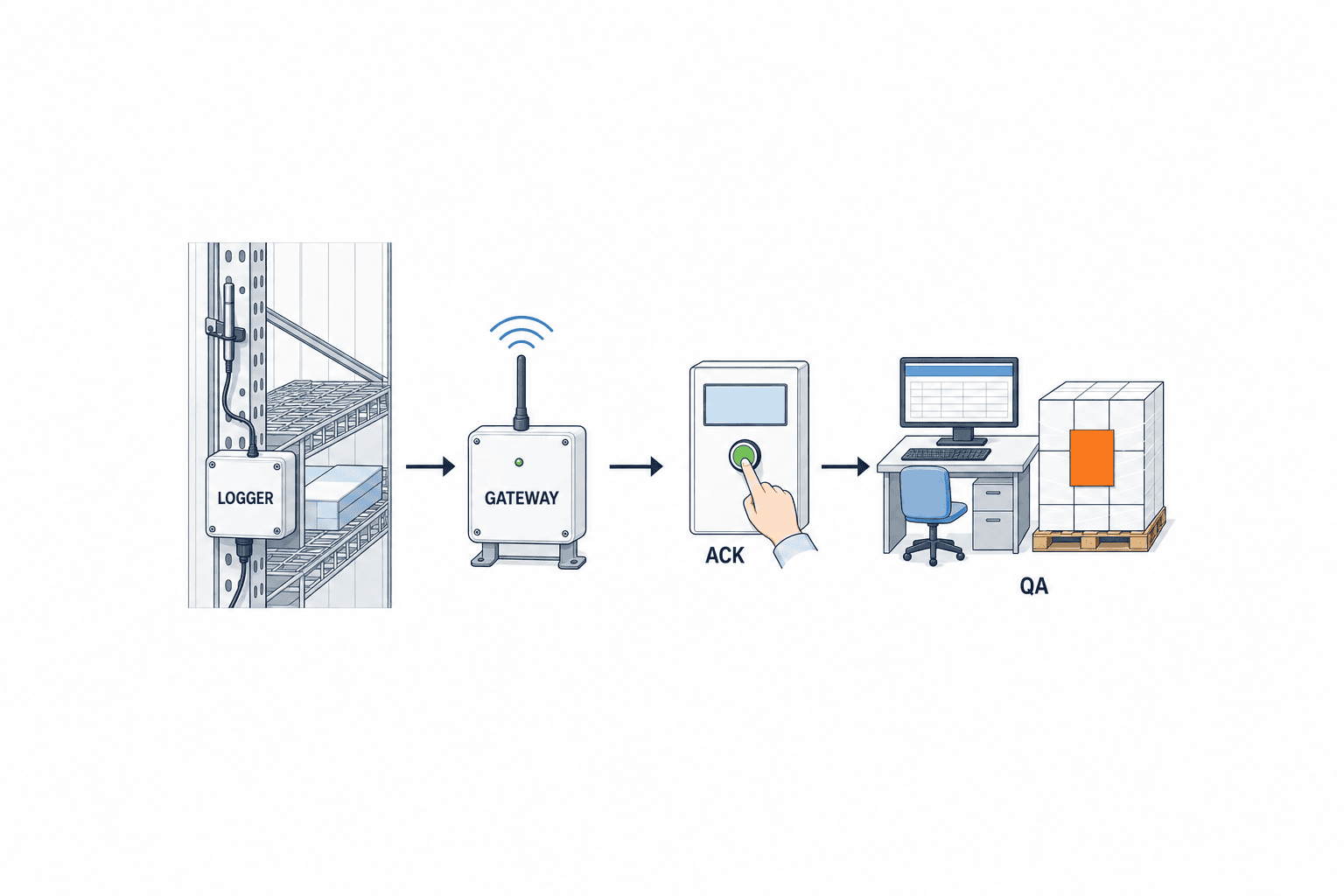
Use staged alerts: early information for maintenance and escalation to warehouse management and QA when defined conditions persist. Each rule needs a measuring point, threshold, duration, recovery rule, maintenance mode, primary and backup recipient. Save “door open,” “air temperature high,” “data missing” and “instrument fault” as distinct events. Air returning to normal does not automatically establish that product is unaffected. Warehouse staff verify the immediate situation, maintenance checks equipment and QA decides whether the lot is held or released. Clicking “acknowledge” proves someone saw the alarm; it is not a product-release decision. Keep acknowledgement, cause, corrective action and QA disposition in separate fields.
Connect temperature records to lots
A temperature timeline cannot identify affected goods unless you know which lot was in each zone at that time. Bring lot ID, pallet ID, SKU, quantity, zone and receipt, movement and dispatch times from the WMS or an auditable log. Preserve movement history rather than overwriting the current location. Use consistent clocks and time zones across the monitoring platform, WMS and vehicle records.
For an investigation, the system should reproduce a list of lots occupying the affected zone during an alarm interval. Keep raw readings, amendments, user identity, timestamps and reasons. Daily averages cannot reconstruct a short excursion. Specify raw-data interval and retention according to contracts, quality system and applicable rules; there is no universal retention period to copy. Codex CXC 1-1969 and ISO 22000 provide broader food-hygiene and food-safety management context. ISO 22000 certification by itself does not specify probe counts, thresholds or lot disposition; your hazard analysis and procedures do.
Test communication loss, power failure and battery depletion early
A cloud-only display may lose the very evidence needed during an incident. Check that loggers save timestamped readings locally while offline and forward them without gaps, reversal or duplicates after reconnection. Test storage-capacity warnings, clock drift and how receipt time differs from measurement time. Health checks should identify whether the logger, gateway, power, network or server is failing.
Define which monitoring components have emergency power, how long batteries last, what backup connection exists and how staff take manual readings. Metal racks, pallets and doors affect radio coverage, so test with realistic loads. A calibration certificate does not prove reliable communication or storage. Vaisala’s freezer-monitoring products illustrate loggers, door contacts, alarms and reporting as possible components; their suitability for a particular food warehouse still needs an RFP and site test.
System architecture: choose the right automation boundary
The minimum chain is probe, logger, gateway, time-series store, display, alert recipients and backup. Door contacts and refrigeration operating signals help explain excursions. WMS integration helps identify affected lots, but cannot repair inaccurate warehouse movements. Decide the required time, location and accountable person in the physical workflow before automating data exchange.
Separate monitoring data paths from refrigeration control commands where OT and office networks meet. Assign distinct permissions for reading, alarm acknowledgement, threshold changes, QA disposition and administration. Approve and log configuration changes. For cloud systems, confirm data location, export format, access at contract termination and offline operation. Test restoration of both raw values and graphs. Incident reconstruction also needs probe definitions, calibration history, alarm-settings history and user actions.
Compare total cost and operating effort
Compare quotes on the same scope: mapping, installation, insulated penetrations, gateways, connectivity, subscriptions, calibration, batteries, maintenance, training, FAT/SAT and migration. A cheap logger can become costly if repeaters or frequent battery changes are required. Mark excluded tasks explicitly.
For internal evaluation, annual cost can be modelled as allocated capital cost plus annual subscription, calibration, maintenance, consumables and staff effort. A sensitivity example is assumed annual incidents × assumed investigation hours per incident × internal hourly cost. These are assumptions, not a guaranteed ROI. Do not invent incident rates or disposal savings. Thailand BOI’s 2025 guide lists investment-promotion categories for cold storage and for combined cold storage and transport, with conditions. Buying a monitoring device alone does not establish eligibility. Verify the current project and refrigerant criteria with BOI before including any incentive in an investment case.
What to put in the RFP
Replace “24/7 monitoring” with answerable requirements. Which products and zones are covered? How will air readings and product verification be distinguished? What probe range, accuracy, calibration and positioning evidence is supplied? What sampling interval, clock rule, offline buffer and export are provided? Who receives which alarm, how is acknowledgement recorded and when is it escalated? Can the system reconstruct lot presence during an event? How are data ownership, retention, configuration history and FAT/SAT failures handled?
| RFP item | Vendor response required | Acceptance evidence |
|---|---|---|
| Measurement | Probe type, range, accuracy, calibration | Certificates and location register |
| Placement | Mapping method and permanent-point rationale | Map, door and defrost tests |
| Records | Raw values, timestamps, storage and export | Time-series export and audit trail |
| Alarms | Conditions, delay, recipients and acknowledgement | Test event and delivery history |
| Failures | Power/network loss, buffer limit, recovery | Gap, retransmission and restore tests |
| Integration | WMS lot and zone history | Affected-lot demonstration |
Separate mandatory functions from future extensions. A normal-day graph is a weak demonstration: ask vendors to show an open door, failed probe, network outage and clock problem. Do not pay for unused integration while omitting local records and export needed for an incident.
FAT: verify functions and records before shipment
At factory acceptance testing, apply controlled input to a sensor and confirm that the same event appears consistently in display, raw log, alert message, acknowledgement and report. FAT cannot reproduce the real cold-room heat map, but it can reveal faulty logic. Simulate a misconfigured threshold and an offline gateway; neither should silently look like a healthy normal reading.
The test script should state input conditions, expected display, recipient, allowed response, event ID, user permission and retest rule. Use calibrated equipment and record both instrument and system clocks. Check units, negative signs and display rounding. A temperature returning to range should not erase an unacknowledged event.
SAT: verify actual doors, defrost, load and radio coverage
At site acceptance testing, match installed probe IDs to the drawing, test connectivity with real pallets and compare door and defrost timestamps with the temperature trend. Include normal storage arrangements and working shifts, not just an empty room. Do not deliberately expose saleable food to unsafe conditions; use safe simulated inputs and planned normal operation under an approved QA test plan.
Simulate power and network interruptions, reboot a gateway, then confirm that reconstructed raw data have no unexplained gaps, duplicate samples or reversed timestamps. Test after-hours escalation. Warehouse workers, maintenance and QA should each execute their steps. Hand over procedures, location drawings, calibration register, test evidence and unresolved issues.
Design the excursion decision flow before go-live
If a door remains open and air temperature rises, first verify the physical door, refrigeration unit and probe. Next identify the affected zone and interval and temporarily hold lots present there. QA then evaluates product conditions, exposure, any needed product measurements and customer requirements before disposition. Maintenance records the repair and preventive action. A normal reading after the door closes is not automatic permission to dispatch; neither does a brief air excursion automatically justify discarding the whole store. If the probe failed, product condition during the gap remains uncertain and needs alternative evidence.
How this differs from general temperature and humidity monitoring
General factory monitoring primarily describes room conditions. A frozen-food warehouse must also connect quick-frozen product requirements, custody at receipt and dispatch, and lot-level hold and release. Our factory temperature and humidity monitoring guide explains basic devices and communications, but its general room readings cannot determine frozen-food disposition. Metal racks, low temperature, doors and condensation also increase data-loss risk. Our sensor data-loss monitoring guide covers gap detection, buffering and recovery. Apply those ideas together with product-temperature verification and lot history.
Rollout: begin with one cold room
Document product groups, operating workflow, existing logs, alarm history, held stock and equipment faults. Map temperature, choose monitoring points and define product-check methods. Give vendors the same RFP and compare equipment, records, fault handling and training. Verify logic at FAT and real-site behaviour at SAT. After go-live, review ignored alarms, missing samples and whether a real or simulated event yields the right affected-lot list. Room expansion, new racks, changed doors, different products and night operations should prompt review or remapping. A useful pilot success criterion is not merely “the sensor works,” but “a simulated excursion was detected, the affected lots were found and QA recorded a decision from the evidence.”
Cover receiving, internal moves and dispatch
Monitoring only inside the freezer leaves gaps at the dock, inspection station and loading stage. Receive vehicle temperature records and link unloading, inspection and put-away times to the lot. Normal vehicle air data alone do not prove product core temperature. Define a hold location for disputed deliveries. For internal moves, distinguish exit scan, time in transit and entry scan; do not overwrite the old zone. This also reveals whether traffic or picking practices keep doors open. Use these data for quality improvement with appropriate access controls, not personal surveillance.
At dispatch, separately record room conditions, picking start, loading finish, vehicle precooling and handover. A graph pasted on a delivery note may be ambiguous unless its sensor and lot relationship is clear. Agree with customers on a report identifying warehouse, measuring point, time range, lot and reviewer. Preserve instrument-replacement history. Update receiving and dispatch procedures when the system goes live.
Calibration, uncertainty and clock control
A display with many decimal places is not proof of accuracy. Require accuracy in the actual operating range, calibration traceability, replacement procedure and a temporary monitoring method during calibration. QA and metrology staff should decide whether checking only near room temperature is adequate for freezer service. If a probe is exchanged under the same point ID, keep its serial number and effective period.
Consider measurement uncertainty when defining alert levels. A threshold equal to the product boundary may leave too little time for action; an overly strict alert can flood operators during normal door use. State the risk each alarm is meant to catch, then use mapping and operating evidence to tune it. If correction factors are used, restrict changes and retain both raw and adjusted values consistently in displays and exports.
Synchronise logger, gateway, cloud, WMS and vehicle clocks. A Thai operator may prefer local-time displays, while stored timestamps must carry explicit time-zone information. Watch for instruments that reset after outage or order offline data by receipt time rather than measurement time. At FAT and SAT, interrupt the network and inspect both the event time and subsequent receive time.
Train operators and include maintenance in the project
An alert does little if a night-shift worker does not know what to inspect, whom to call or which lots to hold. Training should cover the door, refrigeration equipment, alternative measurement, QA escalation and event recording, not just software buttons. Set backup contacts and shift-handover rules for open alarms. Test delivery periodically and update recipient lists when staff change.
The service scope should define response hours, spare probes, batteries, software updates, backups, calibration reminders and field retesting. Plan how to replace equipment without stopping storage and how to record temperature meanwhile. A cloud update that changes alarms, time displays or reports needs review and, for material changes, testing before deployment. During early operation, investigate both false alarms and missed detection. Do not raise thresholds simply to silence messages; use evidence to decide whether placement, door practices, staged alerts or repairs need improvement.
Use concrete scenarios to evaluate vendors
Give all bidders the same scenario: a dock door stays open, air warms near a rack, two lots move zones, the network then fails and the night operator inspects the area. Ask what each component records, who is notified, how the timeline is rebuilt after reconnection and what QA receives. Compare raw exports and configuration history, not only the screen.
Add a compound event: a door opens during defrost while one logger reports low battery. Show which alerts remain active and what happens to unacknowledged events. Finally, simulate moving a probe after a rack redesign. The system must retain position history and effective dates so an analyst does not mistake readings from two different locations for one continuous point. A proposal that supports changing warehouse layouts is more valuable than a long feature list on day one.
Frequently asked questions
Q1. Does one air reading above −18°C automatically fail the product?
No. Air and product respond differently, and CXC 8-1976 recognises permitted tolerances for quick-frozen food. This does not mean any short exposure is harmless. QA must evaluate the product specification, exposure, uncertainty and applicable requirements. An alarm resetting is not product approval.
Q2. How many sensors do I need?
Area alone cannot determine the count. Doors, evaporators, racks, load, height and traffic change the thermal pattern and connectivity. Use mapping and the failures you need to detect to justify positions and numbers, then reassess after layout changes.
Q3. Must every product core be measured continuously?
Continuous air monitoring and representative product checks have different roles. QA should define checks at receipt, for suspect lots and during process verification. Probing every carton is unnecessary, but an air record alone does not prove every lot’s core temperature.
Q4. Defrost causes frequent alarms. Can we disable them?
Record defrost events and distinguish expected warming and recovery from prolonged or combined faults. Disabling all alerts can hide a long defrost or an open door. Retest the changed logic at FAT or SAT.
Q5. Do we need WMS integration to start?
No, if an auditable process preserves lot-zone movement times so they can be compared with alarms. Do not overwrite history. Integration becomes more useful as sites and transaction volumes grow.
Q6. Can Thailand BOI incentives pay for the monitoring equipment?
The 2025 BOI guide lists cold-storage investment categories; it does not establish eligibility from buying a monitor alone. Verify current project, refrigerant and application criteria with BOI. Make the monitoring decision on quality and operational needs without assuming an incentive.
Summary: join sensor position, product checks and lot decisions
A frozen-food warehouse temperature monitoring system should distinguish air visibility from evidence of product temperature. Set requirements for the actual product and contract, select points through mapping, and design records and responses for doors, defrost and network loss. FAT tests logic; SAT tests the real warehouse. Leave QA with evidence that supports lot-level decisions, limiting both unsafe release and unnecessary disposal.
TOMAS TECH supports Thai factories and cold-chain sites with site assessment, mapping requirements, sensor and communications design, WMS integration, and FAT/SAT checklists. Share your room drawing, product groups and current recording or alarm problems through our contact page.
References
- Codex Alimentarius, CXC 8-1976: Code of Practice for the Processing and Handling of Quick Frozen Foods
- Codex Alimentarius, CXC 1-1969: General Principles of Food Hygiene
- ISO, ISO 22000:2018 Food safety management systems
- Thailand BOI, A Guide to the Board of Investment 2025
- Vaisala, Temperature and Humidity Validation Mapping
- Vaisala, Refrigerator & Freezer Temperature Monitoring
- Testo, testo 175 T2 temperature data logger


