


A manufacturing lot split and merge system must do more than divide or add quantities on a screen. Physical work in progress (WIP), quality decisions, operation records, warehouse locations and ERP inventory must refer to the same parent–child history. This guide helps teams in Thai factories define the rules, data, MES–ERP–WMS boundaries, request for proposal (RFP) and factory/site acceptance tests (FAT/SAT) before implementation.
Why a physical WIP lot split matters
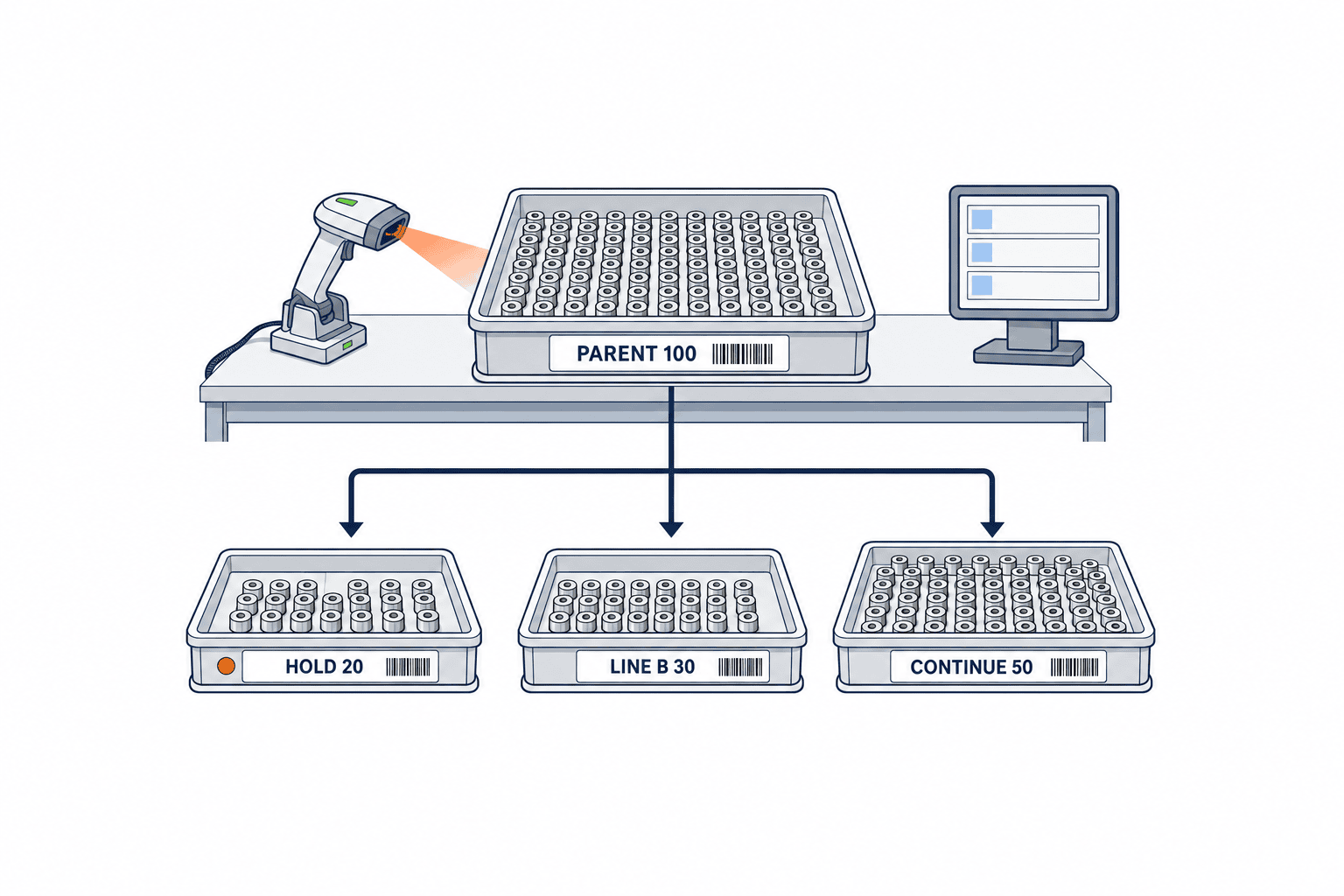
Imagine a work order with 100 WIP units. Twenty need extra inspection, 30 must continue on another line, and 50 stay on the original line. A single lot with a note saying “partly on hold” will not identify which physical tray the next operator may use. The physical move, new child lot identifiers and labels must be one controlled workflow.
A merge can mean different things. Material from two lots may be mixed into one new manufacturing lot, or two separately identifiable boxes may merely share a pallet. GS1’s EPCIS/CBV implementation guideline distinguishes transformation, where inputs contribute to new outputs, from reversible aggregation, where members keep their identities. Define which operation the plant means by “merge” before designing the screen. Otherwise a quality investigation will not know whether to trace contributors to a new lot or list the contents of a container.
Our earlier guide to general WIP management covers queues, location and progress. This article addresses the deeper question of when to create and connect lot IDs and quantities. The guide to engineering change PLM–ERP integration concerns BOM revision changeover. Even with the same revision, a quality hold or a change of line can require a WIP lot split.
Define the operation before comparing products
“Lot” can refer to a production order, a raw-material batch, a WIP identity or a finished-product batch. An RFP saying only “supports lot split” invites different interpretations. Define the target as physically separating a portion of WIP of the same item and operation state, then managing the portions with distinct identifiers, locations and quality states. State exclusions too. Breaking a shipping pack can be a packaging transaction; dividing a planned order can be an order split; changing the item through processing can be a transformation.
Likewise, distinguish physical blending, combining inputs for a common downstream operation, and logistics aggregation. Quality rules, customer commitments and product specifications must decide whether material may be blended. A software button cannot grant that permission. For an irreversible blend, create a new output lot and retain every input relation. For a pallet from which separately identified boxes can be removed, retain the box or lot IDs and record container membership instead.
| Operation | Physical action | Record to keep | Correction principle |
|---|---|---|---|
| Split | Separate one WIP population | Parent, children, quantities, reason and locations | Record an authorized reversing transaction; retain history |
| Blend or transform | Inputs become a new manufacturing unit | All inputs, new output, quantities and operation | Correct with an auditable disposition |
| Logistics aggregation | Identified boxes share a container | Container ID and member lot IDs | Change membership on removal |
| Quality hold | Usage is blocked, with or without physical separation | Affected scope and approver | Release by recorded quality decision |
This classification determines how many labels and scans operators need. The GS1 Global Traceability Standard offers a way to identify critical tracking events and their key data elements. Map the plant’s events and decide what to retain for who, what, where, when, why and how much. Screen requirements then become testable.
A split event is more than “parent 100, children 20 + 30 + 50”
The following quantities are illustrative. Parent lot W100 holds 100 units. Split 20 for extra inspection, 30 for another line and 50 to continue, creating W100-A, W100-B and W100-C. At the split, 20 + 30 + 50 = 100; scrap is zero. If two units of W100-A are later rejected, do not edit the split to 18. Add a scrap event of two against W100-A, leaving 18 in W100-A. Physical stock across all children is now 98, while usable quantity is 80 until the remaining 18 on hold are released. The record can then explain where all 100 original units went over time.
At minimum, a split event should hold parent and child IDs, item and revision, order and operation, before/after quantities and unit of measure, event time and time zone, location and equipment, operator, reason code, quality state and original transaction ID. If kilograms and pieces coexist, fix conversion and rounding rules. Use a unique event ID so a repeated scan or retry cannot post a second split. Correct total quantity is not enough if a child is attached to the wrong item or order.
Decide when the event becomes final. Creating digital children before moving the physical trays leaves the screen showing multiple locations while the stock remains in one place. Moving first and losing the network can leave an unlabeled container. One possible workflow is to scan the parent, count, print and attach child labels, rescan children, move them to approved locations and confirm. Mark offline transactions visibly and block unconfirmed children from issue or downstream use. The actual sequence must be validated against equipment and process safety.
Quality status should not be copied blindly. If the parent is on hold, children can inherit the hold until quality staff approve a partial release. If the purpose of the split is to isolate a suspect portion, the plant needs evidence that the unaffected portion has been identified. Configure states such as pending, accepted, hold, rejected and scrap, along with roles and transition conditions. Link each state to permission to move, issue, merge and consume.
For a merge, preserve inputs and check mixing permission first
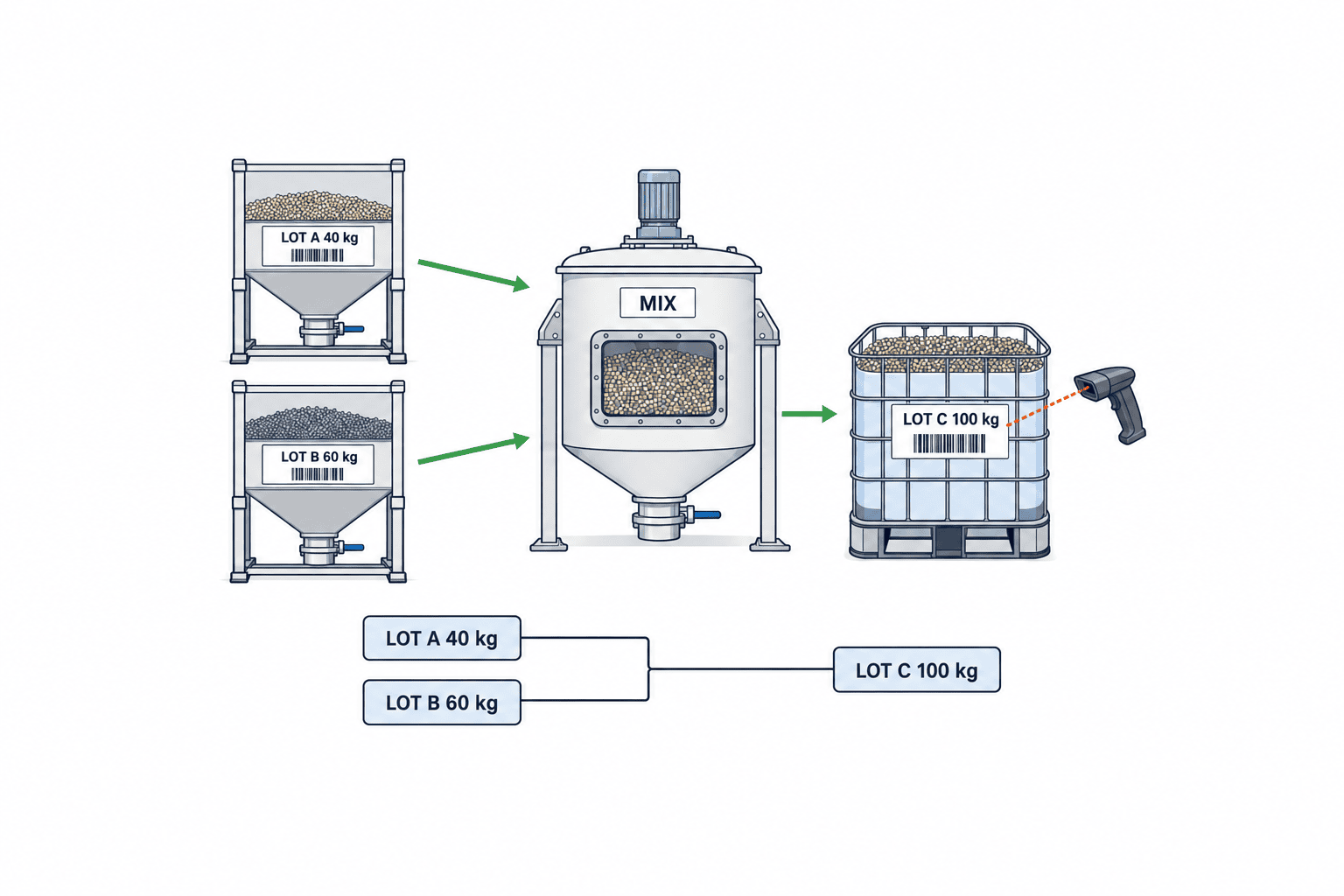
Consider an illustrative process with 40 kg in WIP lot A and 60 kg in lot B, producing 100 kg in new lot C. This example assumes no process loss. If measured output is 98 kg, do not pretend that A + B = C without explanation: record the 2 kg loss or measurement variance according to quality and accounting rules. Before blending, check source dates, materials, inspections, hold states, shelf life and customer restrictions. A user role alone should not allow lots of incompatible specification to be combined.
The TransformationEvent in the GS1 EPCIS 2.0.1 standard can express input and output relationships and quantities. EPCIS does not by itself decide a plant’s loss accounting or quality approval. An internal transaction still needs quantity for every input, output quantity, units, remaining quantity, operation, equipment, time and authorization. With partial consumption, show what remains in A; do not make it appear that all of A disappeared.
A one-level list of A and B is insufficient if C is subsequently split and only part reaches a finished-product lot. Keep genealogy as a directed history spanning split and transformation events. Prevent cycles that would make a lot its own ancestor. Do not erase the original relation to correct a mistake; add a reasoned and approved reversal or adjustment. Product features vary, so make suppliers demonstrate a multistage case with realistic data.
Reconcile quantity, scrap, hold and rework
“Children sum to parent” is just one rule. Define how issue, completion, scrap, sampling, rework, hold, unit conversion and count adjustment affect each balance. Distinguish conservation at the split from the remaining balance over time. In the W100 example, the split transfers 100 units into children; later scrap of two leaves 98 physically present. The remaining 18 in W100-A are still on hold, so usable quantity is 80 until they are released. A hold does not remove physical stock.
| Balance | Meaning | Typical transaction | Reconcile against |
|---|---|---|---|
| Physical remaining | Units present in the plant | Split, move, consume, scrap | Counted stock |
| Usable quantity | Units permitted for the next operation | Hold, release, expiry | Quality decision |
| Order progress | Actual against plan | Operation completion, good output | MES and ERP order |
| Valued inventory | Accounting or inventory balance | Issue, receipt, adjustment | ERP inventory and cost |
These balances need not always be equal; differences must be explainable. A hold can reduce usable quantity without reducing physical quantity. Depending on the integration, WIP can be issued from one ERP location but not yet received into the next. Do not silently erase such differences with automatic corrections. Show the originating event ID, quantity, time, owning system, retry method and need for a business hold.
Microsoft’s documentation for tracking batch and serial numbers of components and finished products shows a product-specific way to link consumed components with produced identifiers. It does not mean every ERP offers the same WIP split and merge behavior. Ask vendors which exact identification level links WIP splits, component consumption and finished output, then inspect both transactions and trace reports.
Set MES, ERP and WMS transaction ownership
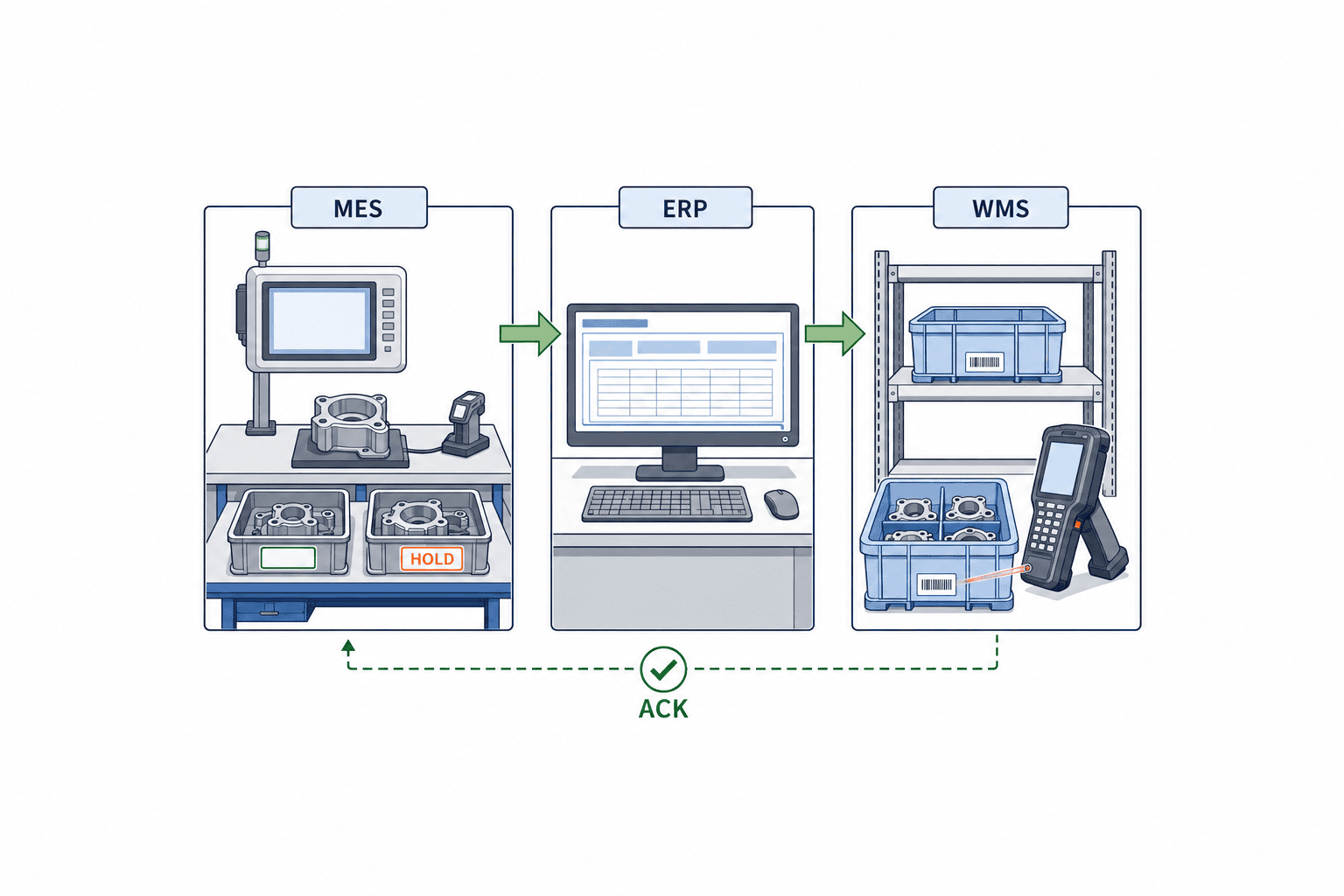
The ISA-95 overview distinguishes manufacturing operations management and enterprise planning/logistics exchanges. Do not assign ownership merely by product name. For each event, identify who first commits it, who acknowledges it and who may correct it. A possible arrangement makes MES the owner of in-process physical events and quality status, ERP the owner of orders and valued inventory, and WMS the owner of warehouse location and handling units. The actual boundary depends on the deployed systems and plant procedure.
| Event | Where the physical action is verified | Candidate first owner | Minimum information exchanged |
|---|---|---|---|
| In-process lot split | Line or WIP location | MES | Parent/child IDs, item, quantities, order, time, status |
| Quality hold/release | Inspection point | MES or QMS | Affected scope, status, approval ID |
| Warehouse transfer | Handover point | WMS or agreed ERP boundary | Container, lot, quantity, location, receipt |
| Finished-good report | Operation exit | MES with ERP acknowledgement | Finished lot, inputs, good and rejected output |
| Inventory valuation | Accounting process | ERP | Order, item, valued quantity, source transaction |
“MES sends the split to ERP” leaves failure behavior undefined. Give the event an immutable ID and version; store the ERP acknowledgement separately. Permit safe retry and prevent double posting on duplicate receipt. Decide whether WMS may move a child before ERP receipt, and whether MES may let production use it. “Sent” and “accepted and reconciled” are different states. ISA-95 Part 5 addresses business-to-manufacturing transactions and offers a useful frame for writing interface contracts.
Keep handling-unit and manufacturing-lot IDs separate. Two boxes may belong to one lot but sit in different places; one pallet can carry boxes from two lots. Clarify whether the scan key is container, lot or individual unit in both screen and label design. A WMS receipt should not silently clear a MES quality hold. Movement permission and production-use permission are separate controls.
Conditions to verify in a Thai factory
Before transferring a head-office rule to Thai shop-floor terminals, verify working language, label reading conditions, network outages, local units and time handling. These are practical site checks, not universal regulatory claims. Let actual operators test Thai and English action labels and reason codes. A term translated correctly in a manual can still be misunderstood at a fast-moving station.
Keep event time with its time zone separate from server receipt time. A night-shift split crossing midnight or an offline terminal uploading later can otherwise appear out of sequence. Put item, lot ID, quantity, unit, status and the needed barcode on labels without translating the underlying identifier. Test print durability, reprint authorization and how to reidentify a container whose label has come off.
Choose an initial operation where holds and splits really occur and physical quantity can be counted. Test the handover to the next operation and warehouse. A standard product demo will not reveal the actual scan order or quarantine shelf. Record common rules and genuine site exceptions separately in requirements rather than hiding them during rollout planning.
Give vendors data and expected results in the RFP
Attach sample data and expected outcomes, not just a feature checkbox. Ask for a demonstration of splitting W100’s 100 units into 20, 30 and 50; holding the 20, scrapping two and releasing the remaining 18. Ask to see forward and backward genealogy, remaining quantities, authorization, labels and transactions received by ERP/WMS in this same case. For blending, use illustrative lots A 40 kg and B 60 kg to make C 100 kg and then partially issue C. These numbers assume no process loss and must be replaced with representative plant data for acceptance.
- Can split, blending and logistics aggregation be recorded as distinct events? If not, how is the distinction retained?
- Who issues parent and child IDs, and how are duplicates, reprints and damaged labels handled?
- How are incompatible item, revision, operation, order and quality states prevented from merging?
- How are quantities, partial consumption, scrap, samples and unit-conversion rounding recorded?
- Can multistage genealogy be searched both from finished product to input and from suspect input to outputs?
- Who owns each MES–ERP–WMS event, and how are retry, duplicate and reversed message order handled?
- What remains possible during an outage, and how are unsynchronized physical items isolated?
- Which approvals govern moving, issuing, consuming or blending a held lot?
- Can corrections retain the original event and show actor, time, reason and approval?
- Are Thai and English screens, reports, actual scanners and label printers included in the demonstration?
Require each answer to distinguish standard capability, configuration, custom development and operating workaround. A demo that works without production permissions and interfaces is not equivalent to a live workflow. Align quotations for master-data preparation, labels, devices, integration, training, testing and support as well as licenses. A generic price would be misleading because operation count, sites and existing-system boundaries materially change scope.
FAT and SAT: test evidence and acceptance criteria
Use FAT to test functions and interfaces in a supplier environment and SAT to test the real Thai equipment, devices, network, operators and locations. Agree test data, initial state, action sequence, expected genealogy and quantities, evidence and sign-off owner in advance. A paper procedure passing while labels fail at the actual station is not a successful site acceptance.
The normal test should split 100 into 20, 30 and 50, reconcile labels and locations, verify that the held 20 cannot be consumed, scrap two, then release the remaining 18 with approval. A blending test should turn 40 kg and 60 kg into 100 kg and trace both directions. Compare the physical labels, MES events, ERP acknowledgement and WMS location by common IDs, not just screenshots. Substitute representative item data before these illustrative values become contractual criteria.
Failure cases should include double scan, lost acknowledgement after sending, ERP downtime, out-of-order interface messages, offline terminal, damaged label, wrong-item scan, attempted use of a held lot, over-split quantity, conversion rounding and night-shift date changes. State whether physical work stops, which system shows the unresolved state and who may recover it. Retrying after recovery must not inflate quantities; original events must remain auditable after a reversal. During SAT, add Thai warning comprehension, gloved scanning, lighting, print quality and actual movement time.
Oracle’s lot split and merge feature description is evidence that an inventory product offers such transactions. It is not proof that a plant’s physical WIP blending, approvals and MES interfaces are automatically covered. Define acceptance by the process and cross-system results.
Operate the system by business exceptions
After go-live, monitor more than API success. List cases where a labeled child exists physically but not in MES, MES has a child whose quantity ERP has not received, WMS location conflicts with the latest MES operation, or a hold was released in only one system. Show event ID, lot ID, quantity, time, place, owner and next action. A technical retry is different from a discrepancy needing a physical count or quality decision.
Periodically recalculate balances from genealogy and compare them with counts, operation results and ERP inventory. Do not overwrite original history automatically; approve and record an adjustment. Practice both finished-lot-to-input and suspect-input-to-affected-output tracing. Microsoft’s item and raw-material tracing guide illustrates these practical trace directions in one product.
Prioritize three controls for the first deployment: physical child labels agree with digital IDs, a held child cannot enter the next operation, and an MES transaction cannot be posted twice in ERP or WMS. Expand to blending, rework and further sites after these hold up in operation. Quality ownership, label reprinting and outage recovery belong in the operating procedure as much as in the software specification.
Design data migration and go-live acceptance
Do not reconstruct old splits and merges by guesswork when migrating a paper or legacy ledger. A parent may be known while the quantity sent to each child is not. Importing that relationship as “verified” makes a precise-looking report unreliable. Separate current physical WIP IDs, items, quantities, locations and quality states from historical parent–child links supported by evidence. Leave unproven links marked unknown, count physical stock against opening balances, and record complete events for every new split and merge after the cutover time.
Before migration, check whether lot IDs have been reused across sites or items, whether units and decimal precision match, and where held stock physically sits. If an old number is duplicated, keep it as a display reference while assigning a distinct internal key. Flag lots with partial pre-migration history in trace results. Distinguish the actual event time from later entry time for late paperwork, and retain who checked the source evidence.
Separate operator permission to split a counted lot from quality approval to release a hold or allow blending. A supervisor may review a difference without permission to delete history. Define substitute approvers for shift changes and record why they acted. Reprinting a damaged label should retain the original lot ID and leave a reprint trail; control the discarded old label as well.
Judge go-live by whether actual operators can complete a sequence of normal and failure cases in the chosen operation, not by whether a screen opens. Reconcile the pre-cutover count, open WIP, first split, quality hold, warehouse transfer and ERP acknowledgement with shared transaction IDs. Any unsynchronized events need an owner and due time. For an initial period, reconcile genealogy balances against physical count and ERP daily, recording causes and corrective actions. The frequency and tolerated variance must follow product and plant rules; the illustrative numbers here are not acceptance thresholds.
Ask quality, production, planning, warehouse, IT and accounting to trace the same sample lot. Each function should explain its own status or balance from the common ID. If they cannot, fix keys and transaction boundaries before adding reports. Management indicators can include unresolved child lots, prevented attempts to use held stock and unreconciled quantity differences, rather than transaction volume alone.
FAQ: manufacturing lot split and merge implementation
Is a WIP lot split the same as splitting a production order?
No. Two orders do not guarantee that one physical tray has been separated and labeled. One order can also have several WIP children for inspection or different lines. Keep order ID and physical lot ID as different keys, and relate each child to the appropriate order quantity.
Can two lots be merged without losing traceability?
Retain every input ID and quantity, new output ID, operation, time and quality decision, and enforce mixing permission. Putting two identified boxes on one pallet is aggregation, not physical blending. Keep each box or lot ID. Traceability alone does not override a product specification or customer restriction against mixing.
What if split quantities disagree with ERP?
Reconcile physical stock, MES event, ERP acknowledgement and WMS move by transaction ID to locate the divergence. A missing retry requires a different remedy from scrap, count variance or conversion error. Post an authorized adjustment in the owning system rather than editing the original record, and apply a usage hold while an unexplained discrepancy remains.
Which of MES, ERP and WMS should be implemented first?
Start with where the physical split or merge happens and can be scanned. MES ownership of the shop-floor event with ERP and WMS acknowledgements is one possible model. Existing systems may already support the necessary transactions. Define event ownership and test with representative data before choosing sequence.
How should implementation quotations be compared?
Use the same scope for operations, sites, genealogy, devices, labels, interfaces, quality approvals, training, FAT/SAT and support. Confirm by demonstration whether multistage trace and outage recovery are standard. Comparing a license line alone can hide custom work and manual tasks.
Summary
A manufacturing lot split and merge system must distinguish physical separation, blending and container aggregation; retain parent–child IDs, quantities, quality state, location, approval and acknowledgements; and make discrepancies explainable. Define MES–ERP–WMS ownership by event, give suppliers concrete RFP cases, and verify real labels, equipment, screens and messages in FAT/SAT. The result is a WIP process that can explain remaining quantities and affected outputs even when only part of a lot is held or diverted.
If your Thai factory is still defining WIP lot rules or MES–ERP–WMS responsibilities, contact TOMAS TECH. We can use one of your actual lot and operation examples to shape an RFP and acceptance-test outline.


