


“How much can this machine produce tomorrow?” A catalog speed does not answer the question. The answer changes with the product, tool or mold, setup, shift, qualified staff, maintenance, and existing reservations. If a static maximum rate is copied into ERP, promise dates can drift away from the plant’s actual capability. If yesterday’s poor output is automatically written back as the standard, a temporary material shortage or breakdown becomes a permanent loss of capacity on paper. An equipment capacity master system should separate what a resource can do from when it can be used.
This guide is for production control, engineering, maintenance and IT teams in Thai factories connecting ERP, MES and APS. The existing finite-capacity planning guide deals with sequencing work against constraints. This article defines the data and change process that supply that plan. The broader manufacturing master-data guide covers items, routes and equipment across the enterprise; our scope here is the measured and time-dependent capacity of equipment.
Separate capability, available time and reserved time
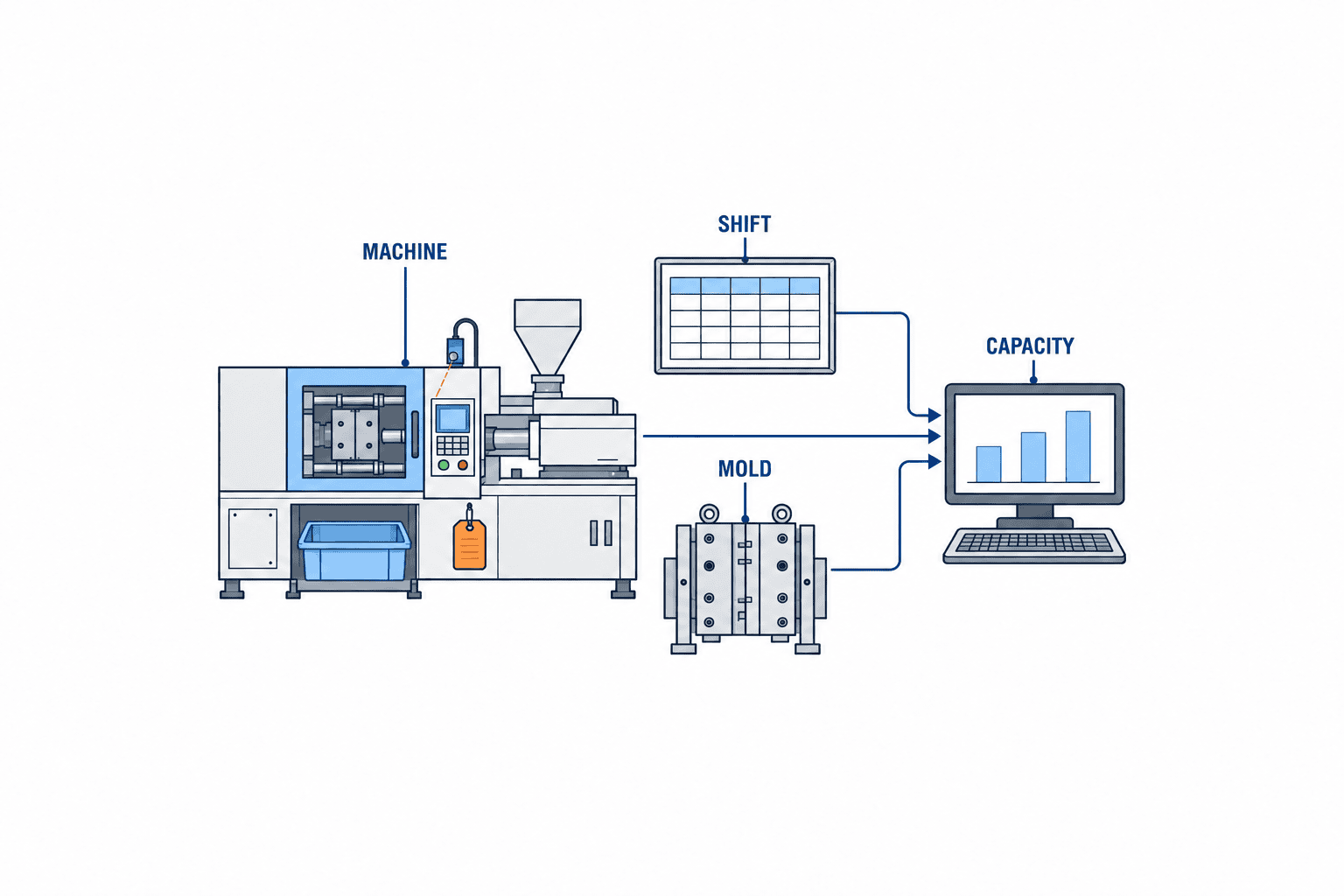
A single “units per day” field hides too many reasons for change. At minimum, distinguish the resource’s eligibility for an operation, its standard setup and run time for a product/tool combination, its shift calendar, planned and unexpected downtime, and capacity already reserved for orders. Time is often a useful common unit; convert to pieces with product-specific cycle time and cavities or parallel units. A batch oven, however, may need batch volume and compatibility rules. State the unit explicitly.
Microsoft’s operations-resource documentation describes capabilities, calendars, finite capacity and reservations as different elements. Oracle’s work-center calendar documentation distinguishes plant shifts from resource-specific exceptions. These are implementation examples, not a universal design for every Thai plant. They support a basic rule: an equipment rate and its availability on a date are different facts.
Begin with bottleneck resources that materially affect customer promise dates. Agree who measures, proposes, approves and publishes a capacity change. Record the version used by each plan, or a changed schedule cannot be explained later.
Minimum fields in the capacity master
A useful record identifies plant, work center, physical machine, planning resource, operation, product or family, effective dates, required mold/tool, required skill and unit. Store standard setup time, standard run time, parallel count or cavities, cleaning condition, qualification restrictions, measurement method, approver and version. If machines form a resource group, retain the membership dates and exceptions of each machine. Do not hide an individual breakdown inside a permanent group rate.
Keep the calendar as another layer: shift start and end, breaks, holidays, overtime and resource-specific closures. Do not multiply an hourly rate by a day with no night shift. Define the Thailand local-time boundary and how timestamps move among systems. The machine may technically be available yet unusable for a particular order because a mold is mounted elsewhere, an approved operator is absent or quality has not approved the machine. Eligibility matters as much as speed.
A press with adequate nominal tonnage may still be unsuitable because a die will not fit, strip width is wrong or customer approval is missing. An injection machine may meet clamp-force requirements but lack the needed mold envelope, screw or take-out equipment. Give qualifications effective dates and evidence. Do not let a faster but unqualified machine reappear as an alternative.
Keep standard cycle separate from actual output
The standard cycle is a planning baseline; MES actuals are evidence for reviewing it. A simple ratio of good units to the whole shift includes setup, shortages, stops and rejects. Writing that ratio back as the standard can turn a temporary loss into a permanent planning assumption. A manufacturer’s rated speed can be equally misleading if feeding, tool change or inspection cannot keep up. Measure representative stable production, record the conditions and let engineering and production approve the standard.
A high-mix plant may start with families based on geometry, material, tool and process conditions, then create item-specific exceptions. Keep the family assignment rationale and retesting trigger. Before promising a rush order, check its real mold and setup even if a family average exists. For injection molding, define whether “one cycle” means one shot and how many good cavities are active. For stamping, distinguish single-hit, progressive and multi-lane dies. For a batch process, define batch size, time and whether items can mix. Cross-process “pieces per hour” comparisons are meaningless without these definitions.
When the plan and actuals diverge, classify the reason: setup overrun, material shortage, absence, short stops, quality hold, lower machine speed or bad assignment. Repeated gap from one cause may call for process improvement rather than a master-data change. A persistent gap under verified conditions may justify remeasurement. Record the old and new standard, applicable product/resource, effective date, measurement and approver. Never rewrite past actual production to make the new standard appear to have applied historically.
Shifts, shared tools and maintenance change daily capacity
A machine cannot run a part when its required mold is on another machine. Shared fixtures, setup staff, certified operators and inspection devices can also constrain production. Treat them as required resources when they affect feasibility. Microsoft’s resource model includes machines, tools and people, but systems vary in how deeply they reserve secondary resources. Test the chosen product with the factory’s real shared-resource scenario.
Put approved preventive maintenance on the resource calendar. On breakdown, close the expected unavailable window temporarily; replace the estimate with actual recovery after confirmation. Do not automatically slow the standard cycle because of a breakdown. A continuing speed loss should be investigated and approved as a standard change. A staff shortage is not a machine failure: skill requirements and staffing calendars can explain it without rewriting the machine’s physical capability.
If two lines share one piece of equipment, do not count its full capacity in each line simultaneously. Use one common reservation pool or explicit exclusive time windows. Apply the same reasoning to a shared mold, inspection station or setup technician. Distinguish “sum of rated capacities” from “capacity usable at the same time.”
Define the ERP, MES and APS boundary by data item
ERP commonly holds orders, item/route baselines and released production orders. MES commonly records starts, completions, good/rejected quantities and downtime. APS commonly evaluates constraints and revises a schedule. Products differ and functions overlap, so do not assign ownership by system acronym alone. Write a matrix for each item: machine ID, work center, route, eligibility, standard time, shift calendar, downtime event and reservation. For each, name its owner, authoritative source, receivers, update trigger and reconciliation rule.
An ERP route and MES equipment tag may use different names. Maintain a mapping with effective dates. An APS provisional reservation must not become a duplicate ERP reservation on confirmation. The OPC Foundation’s ISA-95 common object model offers a way to represent equipment hierarchy and resources, but it does not automatically make two vendors’ fields match. Test mapping and failure handling.
If both ERP and MES allow direct edits to the same standard time, there are two competing masters. Let production propose a correction and engineering approve the planning baseline. Publish the approved version, report failed deliveries and show the age/version of the data used when a system is temporarily offline.
Recalculate after downtime without corrupting the standard
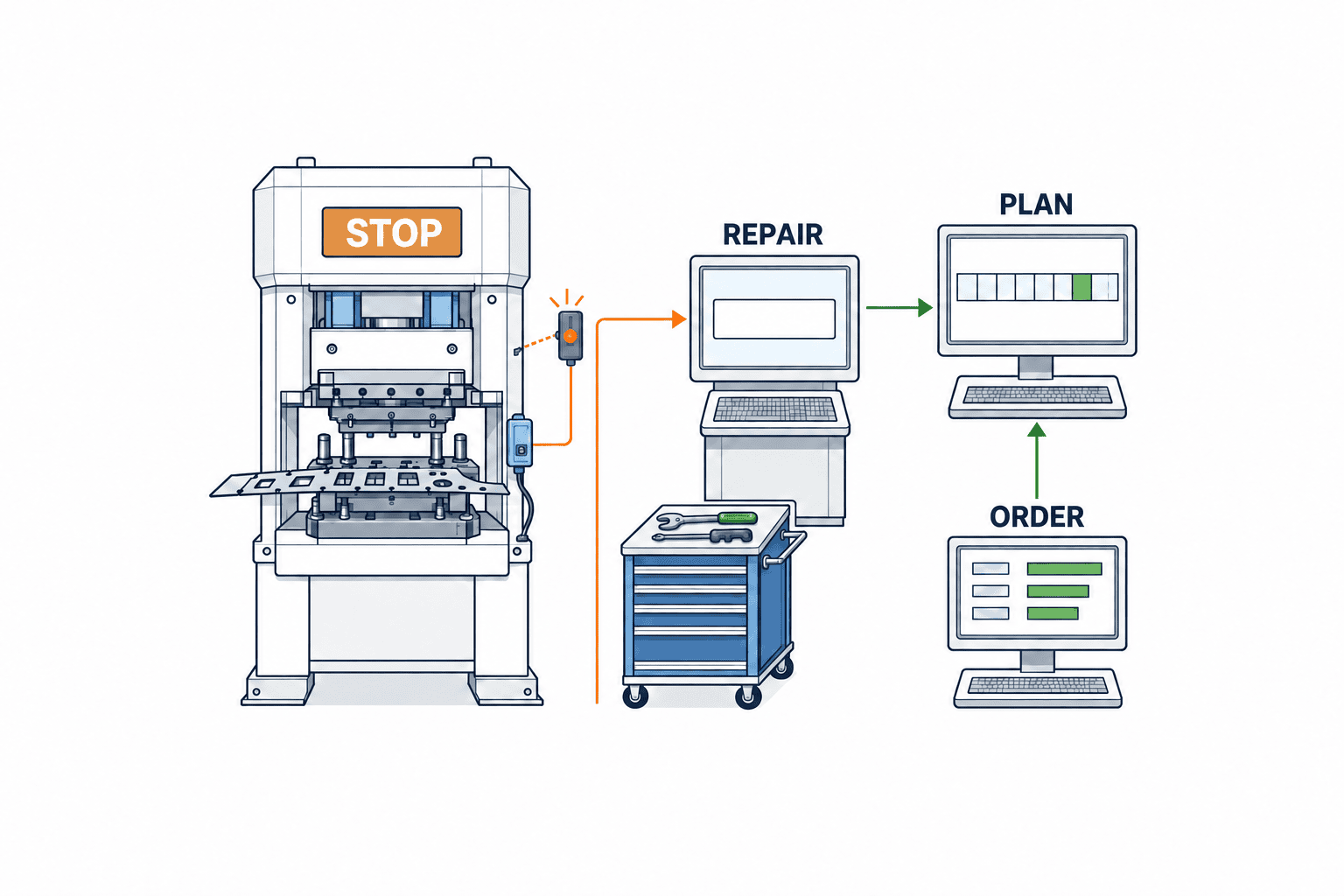
Record at least four times: breakdown occurrence, shop-floor report, estimated repair completion and replan execution. A PLC stop bit does not tell the planner when a machine will recover. Maintenance should supply an estimate or confirm an advisory estimate; store who accepted it. Before reallocation, account for good pieces already made, work in process, remaining operations, re-setup, material, tools and approved alternative resources.
A revised plan may offer overtime, another eligible machine, outsourced capacity or a later promise date. Quality and customer qualification still govern alternatives. Microsoft’s finite-capacity documentation describes reservations and schedule movement when capacity is unavailable. Its capacity-error guide also shows that an apparent capacity shortage can result from missing eligibility or a closed calendar. Distinguish actual downtime from configuration errors.
After a mechanical repair, the machine may run but not yet produce releasable goods. Consider separate states for mechanically available, production ready and quality released. Do not restore capacity to the promise-date calculation before the agreed release point. This is a plant process decision; confirm how each software product can model it.
Capacity calculation needs declared assumptions
For a date, begin with shift working time, remove breaks and approved closures, then deduct reserved work and required setups. Convert remaining time to output using the standard cycle and active cavities or parallel units. This is a conceptual order, not a universal software formula. Batch overlap, shared tools, alternative routes and duplicate reservations require their own rules. Keep minutes, seconds, shots and pieces from being silently mixed.
“Rated speed × OEE” is not automatically a sound planning formula. If maintenance, setup or quality losses are already represented in the calendar and standard, applying an OEE factor can double-count them. Decide once where each kind of loss belongs. A faster upstream machine also may not improve the order promise if downstream inspection is the bottleneck. Link capacity records to routes and the resources that constrain the end-to-end flow.
Effective dates, confidence and change history
A machine may change after retrofit, a new mold, a revised inspection method or a customer qualification. Give each capacity record a valid period. Preserve the version used for an earlier promise or plan. A machine performance improvement should become available only to product/operation combinations that have actually been tested and approved. A physical asset ID and a planning-resource ID may differ when the machine has been replaced under the same shop-floor number; maintain the mapping over time.
Mark values as measured and approved, provisional, under review or expired. A borrowed standard from a similar item should not silently become a firm promise. When an unmeasured part is ordered, request engineering review or label a date as provisional. Explain a shortage by its cause: no open machine hours, mold in use, missing setup person, missing quality qualification or absent material. A red capacity bar alone cannot tell planning whether overtime will help.
Replanning too frequently can create costly setup churn. Protect frozen near-term work where appropriate and calculate the affected range after a change. This is a scheduling design choice, but it depends on a capacity master that emits correct versions and event timestamps. A master that silently changes a rate undermines every scheduling algorithm.
Design for interface failure
When a MES downtime event fails to reach APS, the plan remains based on stale capacity. Give each event a stable ID, source and receipt times, processing status and retry count. Detect failed delivery and define manual correction and reconciliation. Receiving the same event twice must not subtract downtime twice. Show how old the capacity snapshot is. Not every brief stop should force a full replan; define triggers based on duration, bottleneck status, due-date impact and alternatives.
Test recovery when a maintenance closure is added while the interface is down. Identify plans built with the old calendar and mark them for recalculation. Prevent the restored feed from overwriting a valid manual correction without review. The useful requirement is visibility of the data’s age and an accountable fallback, rather than a vague promise of “real time.”

RFP, FAT and SAT questions
The RFP should name target machines and operations, units, shift and exception calendars, mold/people/tool constraints, ERP/MES/APS ownership, downtime transmission, replan trigger, approvals and audit history. Ask vendors to demonstrate one machine with different cycle times for two operations, a shared mold that blocks a nominally free machine, a holiday with overtime and an unqualified alternative resource. Price measurement, tag acquisition, ID mapping, migration, training and ongoing changes separately.
In FAT, test eligibility, calendar exceptions, standard-time revisions, duplicate reservations and interface failure. Verify which plan version receives each change. In SAT, reconcile real stops, maintenance work, shift extensions and quality release with a daily plan. Include a closed calendar, missing route, unapproved mold and unknown recovery time. A useful error message distinguishes bad master data from a true resource shortage. Define the expected result for each scenario before testing.
Questions before signing include: Which resources drive promise dates? Who owns standards and measured evidence? Where are shifts and maintenance closures maintained? How are molds, tooling and skills reserved? Which system owns each event and reservation? What is the approval route for a standard change? Who enters a recovery estimate? How are quality restrictions enforced on alternatives? What happens during failed integration? Which real scenarios decide FAT/SAT acceptance?
Measure the quality of the capacity master
A count of populated records can reward the creation of unusable values. Track the share of critical resources measured and approved, the share of recent process changes reflected, late calendar exceptions, explained plan-versus-actual gaps and time to resolve interface errors. The test is whether a planner can identify why a date lacks capacity and choose a practical correction, not whether every optional field is filled.
Updates have different rhythms. A machine move or mold retrofit needs prior approval, a shift change updates the calendar, an unplanned stop closes an immediate availability window, and a standard-cycle revision needs measurement and review. One editing workflow for all four either delays urgent stops or lets permanent standards change without scrutiny. When a planner reports a wrong number, trace master value, shift, downtime, reservation, product family and unit before editing. Correct only the affected layer and review unreleased orders and any customer date already promised.
Next step for a Thai factory
Start with a bottleneck work center, representative products and a measured standard. Connect actual stops and calendar changes, then compare promise dates and replans before expanding to every machine. Preserve the rationale for changes so planners can trust the number. TOMAS TECH can help structure capacity master and calendar data, connect ERP and MES events, and prepare a practical RFP and acceptance test. Bring a machine list, sample routes, shift calendar, recent downtime and the present promise-date process to a TOMAS TECH consultation.


