


When you request quotes for a PLC upgrade or a line modification, system integrators are increasingly proposing remote I/O, which puts remote I/O selection on your desk. Yet lining up catalogs will not tell you which approach to choose, which network to specify or what to test at acceptance. This article is a practical guide to remote I/O selection for production engineering, maintenance and electrical design staff at Japanese-affiliated plants in Thailand who have been asked to prepare the facts for an internal decision.
Thick cable bundles run from the central control panel out to the machines, and every time a single broken sensor wire stops the line, it takes time to find which terminal is at fault. Remote I/O is a component that may be able to shorten this “time spent searching.” Choose it the wrong way, however, and you end up with a half-finished result.
This article makes one argument. Remote I/O should not be chosen by comparing catalog point counts, module widths and ingress protection ratings. Instead, (1) fix the upstream PLC and the plant-standard network first; (2) decide the form factor from the installation environment (in the cabinet or on the machine); (3) make the mechanisms that shorten downtime (diagnostic granularity, hot swapping, automatic restoration of settings, spare parts) into requirements; (4) build safety I/O and cybersecurity into the same design from the start; and (5) confirm diagnostics and recovery in acceptance testing by “deliberately breaking things.” And if you are doing this together with a PLC upgrade, the best answer changes depending on how much of the existing wiring can be reused.
Below, we work through these five steps in order. All product specifications are figures published by the manufacturers, not values verified by third parties. The amounts, hours and counts in the model calculation are placeholder figures set for this article.
Why remote I/O selection is a live question in Thai plants now
Thai manufacturing in 2026 shows a mix of weak and strong numbers.
According to figures from Thailand’s Office of Industrial Economics (OIE) reported by The Nation, the Manufacturing Production Index (MPI) for June 2026 was 94.99, down 3.10% year on year. Capacity utilization was 57.61% in June and averaged 57.47% for the second quarter. Automotive output fell 12.59%, with household debt and tighter lending standards cited as reasons. On the other hand, according to Trading Economics, industrial production in August 2026 rose 4.44% year on year, the second consecutive monthly increase. Communication equipment was up 24.41%, driven by AI investment and data center demand. The Ministry of Industry raised its 2026 outlook for factory output from 0.0%–0.5% previously to 2.75%–3.55% (this outlook reflects a revised MPI calculation method and is a forecast).
Intentions to invest in equipment are also visible. In a first-half 2026 survey of 504 Japanese companies in Thailand reported by TCIJ (432 companies gave detailed answers on investment plans), 59% (256 companies) said they plan to invest in replacing existing machinery, 31% (132 companies) in improving production efficiency and 22% (96 companies) in digital transformation. According to the same article, from 2023 through the first half of 2026, Japanese-capital companies filed more than 400 applications under the BOI’s “Smart and Sustainable Industry” measure, with investment exceeding 55 billion baht. Note that the article does not identify who conducted the survey.
On the policy side, according to an explainer by the law firm Tilleke & Gibbins, BOI Announcement No. 4/2569, published in the Royal Gazette on March 31, 2026, provides import duty exemptions on machinery and a three-year 50% corporate income tax exemption on investments in automation and robotics for existing and new projects in general automobile manufacturing (category 3.6) and PHEV/HEV manufacturing (category 3.8) (this is the explainer’s summary wording; strict conditions such as the cap on the exemption amount need to be checked in the original announcement). According to The Nation, the BOI has explained that it offers demand-side manufacturers incentives equivalent to 50% of actual investment, and on the supply side supports system integrators with advanced engineering design skills.
Many companies planning to replace existing machinery also means more PLC upgrades, panel replacements and line modifications. Within those projects, we expect more situations where the question of where to place the I/O comes up at the same time. However, we could not find any statistics that directly link remote I/O adoption with equipment replacement. Please read this as an inference.
What remote I/O is: how it differs from centralized I/O and distributed I/O
Let us align the terminology first.
Centralized I/O places the I/O units in the same rack or the same control panel as the PLC CPU, and runs wiring point by point out to the sensors and valves on the machine. The number of wires is proportional to the I/O point count, and the further the machine is from the panel, the thicker and longer the cable bundles become.
Remote I/O places the I/O units close to the machine (inside a small panel for each machine, or on the machine itself) and connects them to the PLC over an industrial Ethernet or fieldbus communication cable. Sensor wiring only has to reach the nearby I/O unit, and what runs between the panel and the machine is mainly communication and power cables.
Distributed I/O is used with almost the same meaning as remote I/O. Siemens calls its ET 200 series “distributed I/O,” and Rockwell Automation divides its product categories into “In-Cabinet Distributed I/O” and “On-Machine Distributed I/O.” In this article, too, remote I/O and distributed I/O are treated as the same thing.
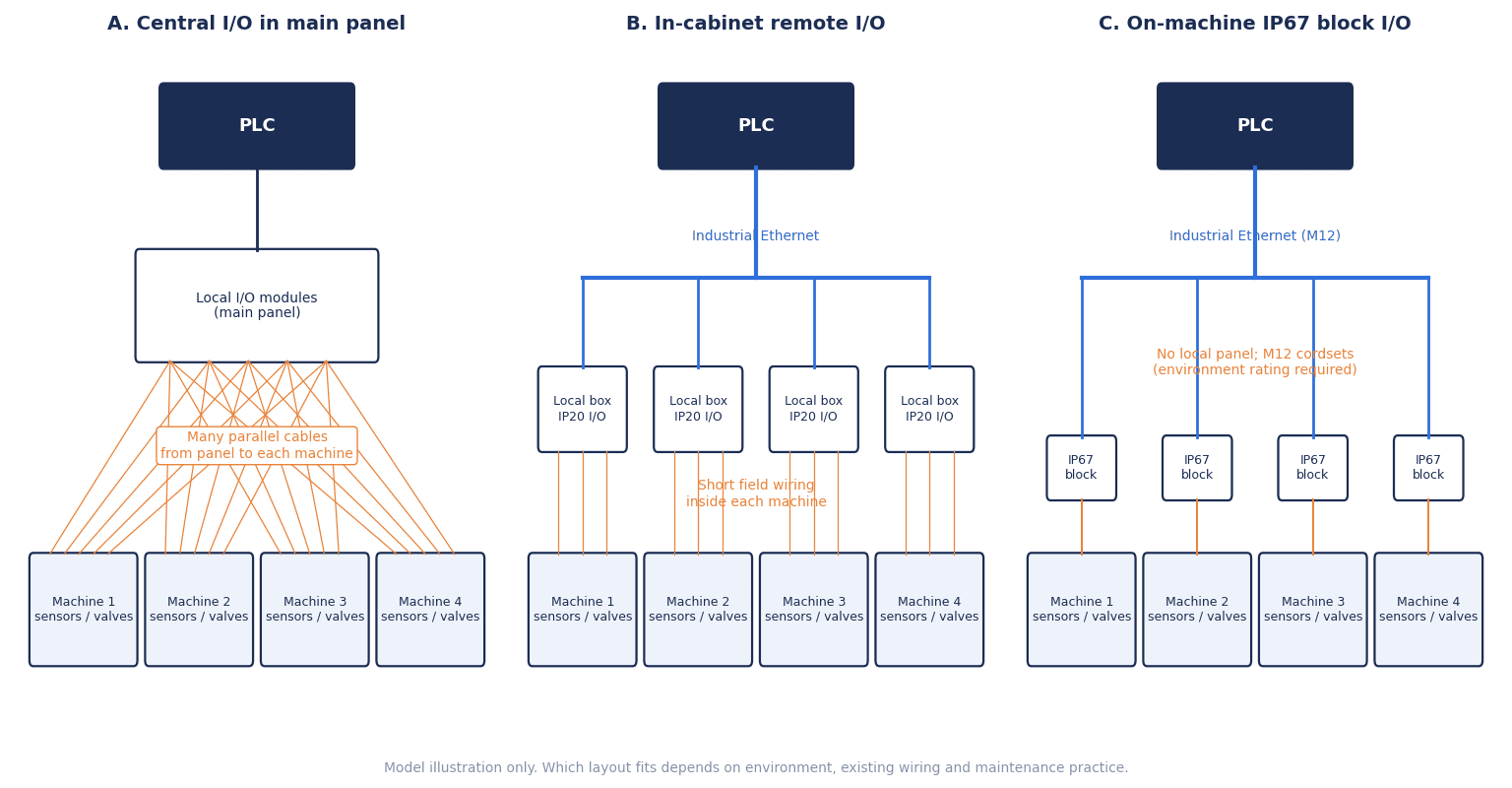
Moving to remote I/O may reduce the amount of wiring work and panel space. What matters even more is that, depending on the product, the I/O unit itself reports over the network which channel on which station has a fault. In this article, we make “the time needed to identify the cause of a stoppage” the central evaluation axis for selection.
“Cabinet-free control,” which eliminates the panel itself, is a design philosophy that lies beyond remote I/O. Whether to go cabinet-free, and how to judge it for new builds and retrofits, is covered in “Cabinet-Free Control in Thailand: New Machines or Retrofits?” This article focuses on the step before that, namely the selection, procurement, migration and acceptance of remote I/O as a component.
Distributed I/O comparison: four form factors of remote I/O
Remote I/O products are easier to sort out if you divide them broadly into the following four form factors. The manufacturers themselves split their lines this way: Siemens into two families, “compact modules for use in the cabinet” and “rugged designs for use outside the cabinet,” and Rockwell Automation into two categories, in-cabinet and on-machine.
| Form factor | Installation location | Typical protection rating (published values for example products) | Strengths | Weaknesses | Suited to |
|---|---|---|---|---|---|
| In-cabinet slice type | DIN rail in a small per-machine panel or a junction panel | Depends on the panel’s protection rating | Modules can be combined in fine increments. Wide range of types such as analog, high-speed counter, motor starter and safety I/O. Hot swapping supported on some products | A panel is required. Panel cooling and dust protection still need to be designed | Equipment where a panel can be placed per machine, stations with many I/O types, reuse of existing junction panels |
| On-machine IP67 block type | Mounted directly on the machine frame | IP65/IP67, and IP69K on some products (published values for ET 200eco PN, ArmorBlock 5000 and others) | No panel needed. With M12/M8 connector wiring, replacing sensors and re-plugging wiring is fast | Limited points per block. Analog and special functions generally have fewer options than in-cabinet types. Heat and shock at the mounting position and cable routing must be designed | Equipment that is mainly digital with points spread across the whole machine, such as conveyors, material handling and fixture areas |
| Combined IO-Link master | On-machine (IP67 type) or in-cabinet | On-machine types include examples rated IP65/IP67/IP69K (published values for NQ-EP4L) | Sensor settings and diagnostic information can be handled digitally. Automatic restoration of settings on replacement can be built in | Little benefit for sensors that are not IO-Link devices. Power capacity per port must be checked | Equipment with many sensors whose settings change often or with product changeovers, or many sensors you want to condition-monitor |
| Safety remote I/O | Both in-cabinet and on-machine types | On-machine types include IP67 examples (published value for Banner RSio) | Safety signals such as emergency stops, door switches and light curtains can be handled on the same network. Some products can identify which safety device caused a stop | Assumes a combination of a safety protocol and a safety PLC. Validation takes effort | Equipment with many safety devices and long safety circuit wiring |
All protection ratings in the table are manufacturers’ published values given as “examples.” They are neither exhaustive nor recommendations.
Decide the form factor from the environment
The right order for choosing a form factor is to start from the installation environment, not from a catalog comparison of point counts.
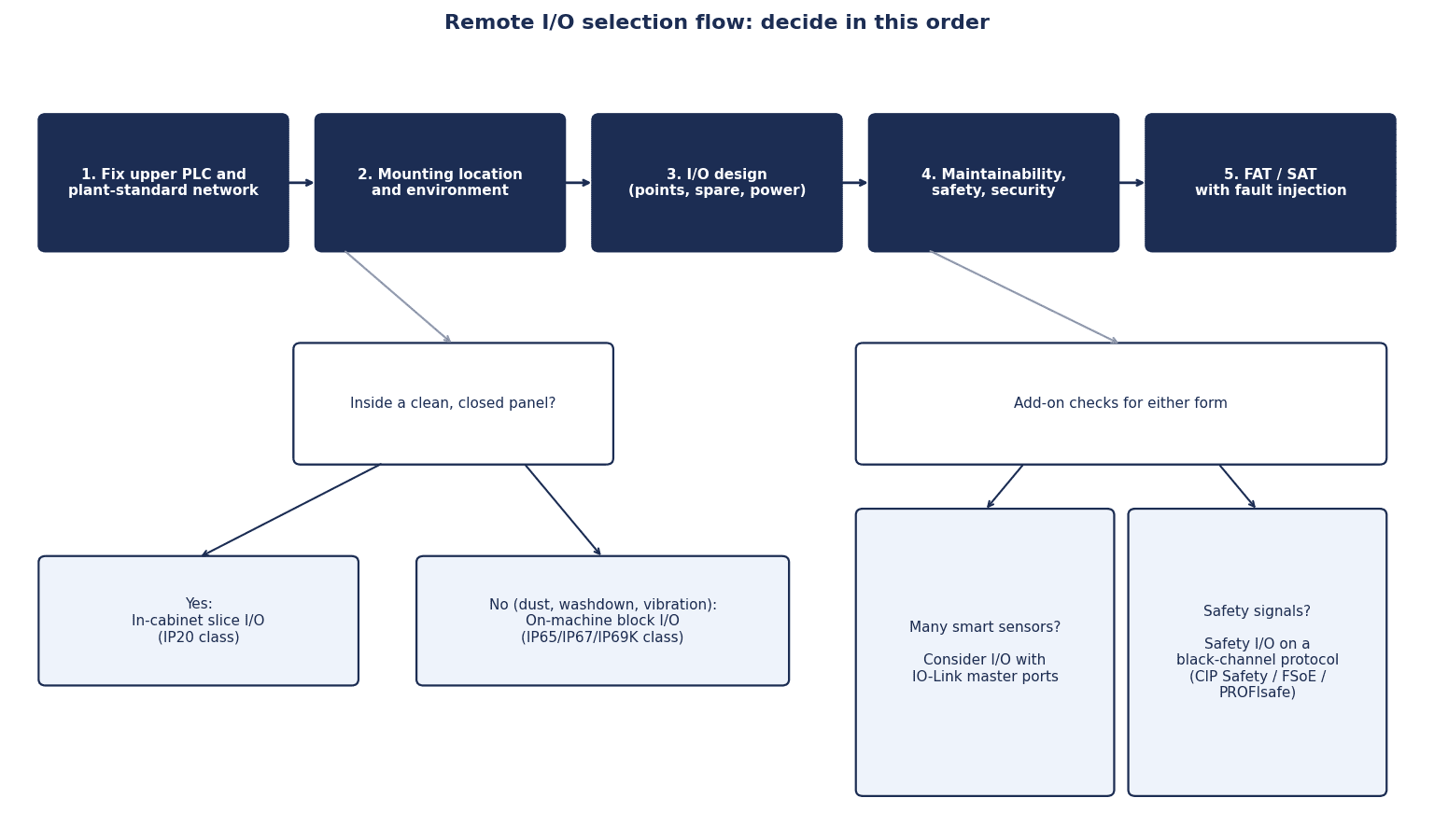
- Can you place a panel? If there is space and cooling for a small panel near the machine, the in-cabinet slice type is a candidate. If there is nowhere to put a panel, or you want to reduce panels altogether, consider the on-machine type.
- Is the environment harsh? Where dust, cutting oil or washdown water reach the equipment, on-machine types rated IP67 or higher are candidates, and on food lines with high washdown pressure or temperature, products claiming IP69K become candidates. A protection rating is a code that shows “protection against what, and to what degree.” Write down your own washdown conditions (chemicals, water pressure, frequency) and confirm with the manufacturer whether the product is suitable for them.
- Will safety signals ride on it? If there are many emergency stops and door switches, check whether safety I/O can be included within the same form factor.
- Do you want to handle sensor settings or condition? If you need to change sensor settings for product changeovers, or want to see contamination or deterioration of sensors, consider the combined IO-Link master form factor.
As for IO-Link, the IO-Link Community positions it as “point-to-point communication” and “not a fieldbus,” and it does not depend on the type of upstream network. Integrating IO-Link sensor data and how to approach acceptance are covered in detail in “IO-Link Implementation: Sensor Data Integration and Acceptance.”
Choosing a protocol: fix the plant standard first
In remote I/O selection, the first thing to fix is not the product but the network. Remote I/O is meaningless if it cannot communicate with the upstream PLC, and once the network is decided, the candidate products narrow down considerably.
Market estimates and associations’ self-reported counts
HMS Networks’ “Industrial network market shares report 2026,” released on June 16, 2026, estimates the share of newly installed nodes at 79% industrial Ethernet (76% in the 2025 edition), 14% fieldbus (17% in the 2025 edition) and 7% wireless. Within industrial Ethernet, the breakdown is PROFINET 30%, EtherNet/IP 25%, EtherCAT 20%, Modbus TCP 5% and CC-Link IE 3%. For Asia, it states that “CC-Link IE maintains a strong presence in the region.” These are estimates based on HMS’s own market knowledge, internal data and information from industry contacts, not measured statistics.
Each association also publishes its own counts. PI (PROFIBUS & PROFINET International) announced that new PROFINET nodes in 2025 reached 10.4 million, for a cumulative 89.2 million. The EtherCAT Technology Group (ETG) puts the cumulative node count at the end of 2025 at 105.2 million, with 16.9 million new in 2025. ETG explains that it counts using a “deliberately conservative method.” All of these are self-reported counts by the associations, and because the methods differ, the figures cannot be compared directly with each other.
Technical characteristics of each protocol (associations’ published information)
- PROFINET: Promoted by PI. IEB Media reports that specification V2.5 includes resolving outstanding issues in the security specification, including certificate distribution; new secure transmission channels for parameter setting, tool access and firmware updates; and integrated support for Single Pair Ethernet.
- EtherNet/IP: Promoted by ODVA. It uses CIP (Common Industrial Protocol) in the upper layers and supports real-time cyclic communication over UDP in addition to TCP/IP. Topologies are star, line and DLR (Device Level Ring). Services include CIP Safety and CIP Security.
- EtherCAT: Promoted by ETG. According to ETG’s published values, cycle times are 100 µs or less, synchronization jitter is 1 µs or less, up to 65,535 devices can be connected in one segment, and topologies include line, tree, star and daisy chain. The protocol is published in IEC 61158.
- CC-Link IE TSN: Promoted by CLPA. According to Mitsubishi Electric’s description, Class B complies with IEEE 802.1AS and IEEE 802.1Qbv with time synchronization accuracy within ±1 μs, while Class A does not require time synchronization technology and achieves high-speed I/O control while keeping device costs down.
- Modbus TCP: 5% of new nodes in HMS’s estimate. Among the example products in this article, some claim support for it as one of several protocols.
The decision to adopt CC-Link IE TSN is covered in “CC-Link IE TSN Implementation: Migration Decisions, RFP and FAT/SAT for Thai Factories.” Note that, at the time we viewed it, the 2026 entries in CLPA’s new products list did not include any newly listed remote I/O.
In Japanese-affiliated plants, the upstream PLC effectively decides
Share estimates reflect global trends and are of limited help for an individual plant’s selection. In Japanese-affiliated plants, we expect the network is often effectively decided by the existing PLC manufacturer and the configuration tools the maintenance staff are used to. In general, common pairings are CC-Link IE family networks where Mitsubishi Electric PLCs are the standard, EtherNet/IP where Rockwell’s ControlLogix is the standard, PROFINET where Siemens PLCs are the standard and EtherCAT where Beckhoff control is the standard. However, some PLC models from the same manufacturer support multiple networks, so decide after checking the existing configuration and what maintenance staff are familiar with.
Remote I/O that supports multiple protocols is also becoming more common. According to the manufacturers’ announcements, Siemens’ ET 200SP and ET 200eco PN claim MultiFieldbus support for PROFINET, EtherNet/IP and Modbus TCP, and Murrelektronik says its pure.IO handles PROFINET, EtherNet/IP and EtherCAT on a single platform. In plants with a mix of upstream PLC manufacturers, these products widen the options.
Even so, there are reasons for a plant to standardize on a single network: it lets you keep one set of configuration tools, one set of spare parts and one troubleshooting procedure. It is best to evaluate multiprotocol products as “insurance against future change” and decide the plant standard separately. Options for when you must connect different networks are covered in “Industrial Protocol Gateway Selection: RFP, FAT and SAT for Thai Factories,” and how to choose the network equipment that hosts the remote I/O is covered in “Selecting an Industrial Ethernet Switch for a Thai Factory: RFP to SAT.”
Example products and how to read published specifications
Here we list, as examples, products whose specifications we could confirm from primary sources. The list is not exhaustive and does not recommend any particular product. All specifications are manufacturers’ published values (vendor claims). Omron, Phoenix Contact, Weidmüller, Balluff and others also offer remote I/O, but we could not confirm their specifications from primary sources this time, so they are not included in the table.
| Example product | Form factor | Main published specifications (manufacturer’s published values) |
|---|---|---|
| Siemens SIMATIC ET 200SP | In-cabinet slice type | DIN rail mounting. Digital, analog, fail-safe I/O, motor starters, technology and communication modules. Multi-hot swapping. MultiFieldbus (PROFINET, EtherNet/IP, Modbus TCP) |
| Rockwell Automation FLEX 5000 I/O (5094) | In-cabinet slice type | 1 Gb EtherNet/IP. DLR, star, line, PRP. Up to 16 modules per adapter. RIUP (removal and insertion under power). Safety I/O up to SIL 3, PLe, Cat. 4 (TÜV certified), safety reaction time up to 10 ms. Operating temperature -40 to +70 °C |
| Beckhoff EtherCAT Terminals | In-cabinet slice type | Digital terminals with 2/4/8/16/32 channels. HD versions fit 16 or 32 channels into a 12 mm width. TwinSAFE terminals. The ED series announced in April 2026 offers push-in wiring and app-assisted diagnostics using Data Matrix codes |
| WAGO I/O System 750/753 | In-cabinet slice type | More than 500 types of modules, controllers and couplers combined. Fieldbus independent. Up to 16 channels in a 12 mm width. The 753 uses pluggable connectors and is compatible with the 750. A 4-port IO-Link master is also listed |
| Siemens SIMATIC ET 200eco PN | On-machine block type | IP65/IP67/IP69K. Operating temperature -40 to +60 °C. MultiFieldbus. Safety modules up to SIL3/PL e. S2 redundancy. IO-Link modules available |
| Rockwell Automation ArmorBlock 5000 I/O (5032) | On-machine block type | Up to IP69K. IO-Link master block with 4 Class A ports plus 4 Class B ports. Outputs up to 2 A. Automatic IODD download |
| Beckhoff EtherCAT Box | On-machine block type | IP65/IP66/IP67, fully potted. Stainless steel versions rated IP69K. EtherCAT P (communication and power on one cable). Operating temperature -25 to +60 °C |
| Mitsubishi Electric CC-Link IE TSN-compatible IP67 remote I/O units | On-machine block type | A 2022 technical report describes the development of 6 models. IP67, maximum load current 4 A per point, also supports the CC-Link IE Field Network communication mode. Current model numbers and specifications need to be confirmed |
| Keyence NQ-EP4L | Combined IO-Link master | EtherNet/IP, Modbus/TCP. 4 IO-Link ports (Class A). IP65/IP67/IP69K. -40 to +70 °C. Power supply V2 is 4 A total across the 4 ports |
| Murrelektronik pure.IO | Multiprotocol (form factor to be confirmed) | Announced as handling PROFINET, EtherNet/IP and EtherCAT on a single platform with integrated diagnostics (exhibited at Automate 2026) |
| Banner Engineering RSio Remote Safe I/O | Safety remote I/O | IP67. 6 independently configurable hybrid ports. Up to 32 safety devices daisy-chained on each input via ISD. Up to Category 4 PLe, SIL3. For CIP Safety systems |
Points to watch when reading published specifications
- Check what a number means. Banner RSio’s “up to 192 per block” refers to the number of ISD-capable safety devices (emergency stops and the like) that can be connected, not the I/O point count.
- Check how old the announcement is. Turck’s TBEN-S is a product that claims IP65/IP67/IP69K, automatic multiprotocol detection and plain-text diagnostic display on a built-in web server, but the source is a product news item from March 2015. The specifications of the current product need to be checked again. The Mitsubishi Electric technical report is also from 2022.
- Check the scope of “support” for safety and security. For safety SIL and PL values, confirm which configuration and which modules the value applies to. For security, as discussed in the next chapter, evaluation of a protocol and certification of a product are different things.
- Do not generalize wiring-reduction figures. As an example of eliminating control cabinets, ifm describes one plant builder serving the food and beverage and energy industries where installation time was cut by about 25%, leading to cost savings of more than 10,000 euros and eliminating the need for a control cabinet. This is a single company’s case and the vendor’s own announcement. The only way to know whether it applies to your conditions is to check against your own wiring diagrams.
Key points of I/O design: point counts, spares, station division and power
Once the form factor and network are decided, design the content of the I/O. Cut corners here and problems surface later: not enough points, not enough power, or maintenance procedures complicated by where the station boundaries fall.
Inventory of points and spares
First, take an inventory of the existing I/O list by machine and by unit. Divide it into digital, analog, high-speed counter, IO-Link and safety I/O, and identify points in use, unused points and points where drawings and the actual installation do not match. On older equipment, finding additional wiring that is not on the drawings is normal.
Decide the spare point ratio first as a plant standard, and give each station a fixed amount of free capacity. What percentage to use depends on plant policy and panel space; there is no single right answer.
Units for dividing stations
What you use to divide stations (one remote I/O station each) is directly tied to maintainability.
- By machine: one station per machine. When you stop a machine for maintenance, you only need to think about that station, and the scope of responsibility is clear.
- By unit: a large machine is split into units such as handling, processing and inspection, with a station for each. This keeps the scope of impact small when part of the machine is replaced or modified.
- By location: physically close I/O is grouped together with the aim of minimizing cable length. Wiring gets shorter, but if I/O from several machines is mixed in one station, a failure of that one station stops several machines.
If in doubt, using the machine as the basic unit and splitting only large machines by unit is a way to keep maintenance procedures easy to understand.
Output current and sensor power
For on-machine blocks, check the current per output point, the sensor power capacity per port and the power capacity of the block as a whole. As examples of published values, ArmorBlock 5000 offers outputs up to 2 A and sensor power up to 0.5 A per port; NQ-EP4L’s power supply V2 is 4 A total across the 4 ports; and Mitsubishi Electric’s IP67 remote I/O (2022 technical report) claims up to 4 A per point, allowing direct drive without going through relays. Design the power supply allowing for the inrush current of solenoid valves and lamps and the number of points that operate simultaneously.
Some products allow control power (for the unit itself) and load power (for outputs and sensors) to be separated, and designs that cut only the load power on an emergency stop are sometimes used. Decide which power to cut and where together with the safety circuit design. Panel power, heat and circuit design are covered in “Control Panel Design for Thailand: Circuit, Thermal and FAT.”
Maintainability that shortens downtime: diagnostics, hot swapping, restoring settings, redundancy and spare parts
In our view, the value of remote I/O is often decided less by the difference in equipment cost than by how quickly you can recover when it stops. In the model calculation later, too, we place the source of the benefit in “shorter recovery time per I/O-related stoppage.”
Diagnostic granularity
What to check in diagnostics is whether faults are shown only “per station,” or down to “per module” and “per channel,” and whether wire break, short circuit, overload and loss of power can be distinguished. According to the manufacturers’ announcements, Turck TBEN-S (announced in 2015) continuously monitors each output channel, records events in an event log and displays them in plain text on its built-in web server. Banner RSio says it carries diagnostic data over the same wiring as the OSSD signals and can identify which device in a chain of safety devices caused the stop. Beckhoff says its ED series supports diagnostics with an app that reads the Data Matrix code on the product.
For diagnostics, being able to get error codes in the PLC is not enough. The scope of the design extends to showing on the HMI, in words maintenance staff can read, “which fault, on which channel, on which station, on which machine.”
Hot swapping
Whether modules can be removed and inserted during operation affects recovery time. Siemens claims multi-hot swapping for ET 200SP, and Rockwell claims RIUP (removal and insertion under power) for FLEX 5000. For EtherCAT, the detection time of Hot Connect, which connects and disconnects network sections during operation, is stated as less than 15 μs. Even when hot swapping is supported, the scope of what stops during replacement (just that module, or the whole station) varies by product and configuration, so try it for real at FAT.
Automatic restoration of settings
Who loads the settings into a newly replaced module or sensor, and how, also matters. PI explains that with IO-Link, each device has an IODD (IO-Link Device Description), making automatic parameter setting on replacement possible. Rockwell says ArmorBlock 5000 supports automatic IODD download. Whether night-shift maintenance staff can replace a sensor without a laptop and configuration tool is a point that should be written into the RFP as a requirement.
Redundancy
Network redundancy is a way to avoid stopping the whole line because one cable breaks. As examples of published values, FLEX 5000 supports DLR and PRP, ET 200eco PN supports S2 redundancy, and EtherCAT states cable redundancy recovery of less than 15 μs. Redundancy adds equipment and cable costs, so consider applying it first to the stations where a stoppage would cause the largest losses.
Decide spare parts in the contract
In this research, we could not confirm from public information what each manufacturer’s remote I/O spare parts stock, lead times and repair support look like within Thailand. For Mitsubishi Electric, we confirmed the existence of a service contact at its Thai sales company, Mitsubishi Electric Factory Automation (Thailand) Co., Ltd., but the page gives no details of spare parts stock or repair locations.
That is exactly why spare parts should be decided in the contract rather than assumed to “probably be available.” Write into the RFP and the maintenance contract the types and quantities of spares kept at the plant, lead times when relying on manufacturer or distributor stock, handling of repaired items and advance notice of end of production. Standardizing models across the plant reduces the number of spare part types.
Safety I/O and functional safety: should safety circuits ride on remote I/O too?
Safety signals such as emergency stops, safety doors and light curtains have traditionally often been wired individually to dedicated safety relays or a safety PLC. Today, configurations that carry a safety communication protocol on top of ordinary industrial Ethernet using the “black channel” approach are widely used. In general, the idea is that the communication path itself is given no safety role, and safety is ensured by the sending and receiving devices that process the safety protocol detecting communication errors.
According to each association’s published information:
- CIP Safety (ODVA): Supports applications up to SIL 3 based on IEC 61508, and also refers to PLd-Cat3 (about SIL2) under ISO 13849. It is a black channel protocol certified by TÜV Rheinland and runs on EtherNet/IP and DeviceNet.
- FSoE (Safety over EtherCAT) (ETG): Standardized in IEC 61784-3 and described as suitable for safety applications up to SIL 3.
- PROFIsafe (PI): PI’s announcement of 2025 results gives 2.8 million new nodes and 31.5 million cumulative.
- IO-Link Safety: The IO-Link Community announced on August 11, 2025 that TÜV SÜD had certified specification V1.1.4. It says the development phase is complete and the first certified products will reach the market “soon” (planned). The IO-Link Community describes IO-Link Safety as compatible with PROFIsafe, CIP Safety and FSoE.
As examples of products’ published values, FLEX 5000 safety I/O is rated SIL 3, PLe, Cat. 4 with a safety reaction time of up to 10 ms; ET 200eco PN safety modules go up to SIL3/PL e; and Banner RSio goes up to Category 4 PLe, SIL3.
The point to note here is that even if a product or protocol claims SIL 3 support, whether a machine’s safety function meets that level is determined by risk assessment, safety function design, and verification and validation. Putting safety signals on remote I/O reduces wiring, but response time including communication delay, safe-side behavior when communication is lost and mechanisms to prevent incorrect address settings all need to be confirmed through design and testing. How to proceed with verification in combination with a safety PLC is covered in “Safety PLC Implementation: RFP, Validation and FAT/SAT Evidence.” The descriptions here do not present an interpretation of standards or laws and are not legal advice. For conformity judgments on individual machines, please consult specialists or certification bodies.
Cybersecurity: put IEC 62443 and the CRA into the requirements from the start
Remote I/O is also communication equipment. As long as it is connected to the plant network, protection against settings being rewritten, firmware being tampered with and unauthorized devices being connected should be part of the initial requirements, not an afterthought.
The framework of standards and certification
ISA/IEC 62443 is a series of international standards for the security of industrial control systems. For equipment procurement, the most relevant parts are 62443-3-3, which defines system security requirements and security levels; 62443-4-1, which defines a secure product development lifecycle; and 62443-4-2, which defines technical requirements for control system components. ISASecure’s CSA certification is a scheme based on 62443-4-2 and 4-1 that certifies embedded devices, network devices and similar products at four levels, Level 1 to Level 4.
Efforts by protocol (associations’ published information)
- CIP Security (ODVA): Protects TCP communication with TLS and UDP with DTLS. There are four profiles, the EtherNet/IP Confidentiality Profile, CIP User Authentication Profile, Resource-Constrained CIP Security Profile and Pull Model Profile, and user authentication uses OpenID Connect. ODVA states that it aims to support compliance with IEC 62443 and the EU Cyber Resilience Act (CRA).
- PROFINET Security (PI): According to IEB Media, as of January 2026, Security Class 1 is in practical use, while Class 2 and Class 3 are at the testing stage. In an August 2025 announcement, PI said that specification V2.4 MU6 includes comprehensive definitions of Security Classes 2 and 3.
- EtherCAT (ETG): ETG announced that UL Solutions evaluated EtherCAT’s cyber resilience, mapped it against more than 100 system requirements of IEC 62443-3-3 and confirmed that, in three typical system configurations and threat scenarios, it meets Security Level 2 requirements without modification. This is an evaluation of the protocol and typical configurations, not certification of any individual remote I/O product.
So in the RFP, rather than “the supported protocol supports security,” ask suppliers to state “which level of which part of which standard the proposed product itself has been certified or evaluated against, and by which body.” Where there is no certification, ask them to answer concretely what the product can do, such as password protection of settings, disabling unused ports, and firmware signing and update procedures.
If you have machines or products destined for the EU
The EU Cyber Resilience Act (CRA) entered into force on December 10, 2024, and according to Ireland’s National Cyber Security Centre, the obligation to report actively exploited vulnerabilities and severe incidents began on September 11, 2026. An early warning is due within 24 hours, and a detailed notification within 48 hours of the early warning (72 hours in total from awareness). Full application of the design and lifecycle requirements is scheduled for December 2027.
The CRA is not Thai domestic law. However, if you export machines or products made in Thailand to the EU, it may affect the procurement conditions for the remote I/O built into them. Please consult legal specialists on whether your products are in scope and who bears which obligations. The descriptions in this article are not legal advice.
PLC migration and remote I/O: doing it alongside a PLC replacement
Remote I/O often comes up for consideration at the same time as a PLC upgrade. What changes the best answer most in that case is how much of the existing field wiring can be reused, and how many hours of planned downtime you can take for the cutover.
Examples of ways to reuse existing wiring
Rockwell Automation’s “1771-to-1756 I/O Swing-arm Conversion System” converts the field wiring terminals (swing arms) of older 1771 I/O modules into terminals that fit the newer 1756 I/O modules. It consists of conversion modules and dedicated cables and is a system for replacing I/O while reusing the existing field wiring. The manufacturer’s installation manual requires obtaining the 1771 wiring diagrams before the work, securing inventory and spare parts, and switching off and locking out all power.
This is one manufacturer’s example, but the idea is general. If the existing wiring is in good condition, the drawings match the actual installation and the cutover downtime is short and limited, it can be more reasonable to keep the central panel and reuse the wiring. Conversely, if the wiring has deteriorated, the drawings do not match the installation, or the wiring will have to be re-run anyway because of machine modifications, it is a good opportunity to move to remote I/O.
Lining up three options
I/O placement at PLC upgrade time is easier to compare if you line up the following three options.
- Option A: Keep the I/O in the central panel and re-run the wiring
- Option A’: Keep the I/O in the central panel and reuse the existing wiring through terminal conversion
- Option B: Place in-cabinet remote I/O for each machine
Cutover procedures, downtime and how to roll back to the old system are covered in detail in “PLC Replacement and Retrofit: Zero-Surprise Migration for Thai Factories in 2026.” In the next chapter, we compare these three options using placeholder figures.
Model cost calculation (placeholder figures)
All figures used here are placeholders. They are not industry averages, survey values or manufacturer prices. The purpose of this calculation is to show that the conclusion changes depending on “whether existing wiring can be reused” and “how often I/O-related stoppages occur.” Please replace the figures with real ones from a site survey and quotes.
Model assumptions
We upgrade the PLC on one existing assembly line (4 machines, 480 I/O points in total). We compare only three options for “where to place the I/O.” The currency is Thai baht (THB), and the loss per hour of stoppage is set at 25,000 THB, common to all options.
| Item | Option A: central panel I/O, re-run wiring | Option A’: central panel I/O, reuse existing wiring via terminal conversion | Option B: in-cabinet remote I/O per machine (4 stations) |
|---|---|---|---|
| I/O equipment cost | 600,000 THB | 600,000 THB | 780,000 THB |
| Wiring materials and installation | 900,000 THB | 400,000 THB | 500,000 THB |
| Planned downtime for cutover | 32 hours → 800,000 THB | 20 hours → 500,000 THB | 16 hours → 400,000 THB |
| Initial total (one-time cost) | 2,300,000 THB | 1,500,000 THB | 1,680,000 THB |
The planned downtime amounts are calculated as downtime hours × 25,000 THB (32×25,000=800,000, 20×25,000=500,000, 16×25,000=400,000).
The initial totals are calculated as follows.
- Option A: 600,000 + 900,000 + 800,000 = 2,300,000 THB
- Option A’: 600,000 + 400,000 + 500,000 = 1,500,000 THB
- Option B: 780,000 + 500,000 + 400,000 = 1,680,000 THB
Annual difference (Option B only)
For Options A and A’, operational stoppages are assumed to remain the same as today. Only for Option B do we assume the following difference.
| Item | Value | Calculation |
|---|---|---|
| Number of I/O-related stoppages | 12 per year | Placeholder |
| Recovery time per stoppage | Average 3 hours → 1.5 hours | Placeholder. Reduction from being able to identify the station and channel through diagnostics |
| Reduction in stoppage losses | 450,000 THB/year | 12×1.5×25,000 |
| Added cost of holding spare modules | 30,000 THB/year | Placeholder |
| Annual net benefit | 420,000 THB/year | 450,000−30,000 |
The unit rate of 25,000 THB per hour of stoppage is used both for the planned downtime in the initial cost and for the unplanned stoppages in the annual benefit, but this is not double counting: the former is planned downtime for the cutover work, the latter is unplanned I/O-related stoppages during operation, so they apply to different stoppage hours.
How to read the calculation
- Option A vs Option B: Option B is 2,300,000−1,680,000 = 620,000 THB cheaper in initial cost, and also delivers 420,000 THB per year in benefit. Under these assumptions, Option B comes out ahead.
- Option A’ vs Option B: Option B is 1,680,000−1,500,000 = 180,000 THB more expensive in initial cost. Dividing by the annual benefit of 420,000 THB, the difference is recovered in 180,000÷420,000 ≈ 0.43 years (about 5 months).
- Sensitivity (Option A’ vs Option B, with 4 I/O-related stoppages per year): The reduction in stoppage losses is 4×1.5×25,000 = 150,000 THB/year, and the annual net benefit is 150,000−30,000 = 120,000 THB/year. Recovering the difference takes 180,000÷120,000 = 1.5 years.
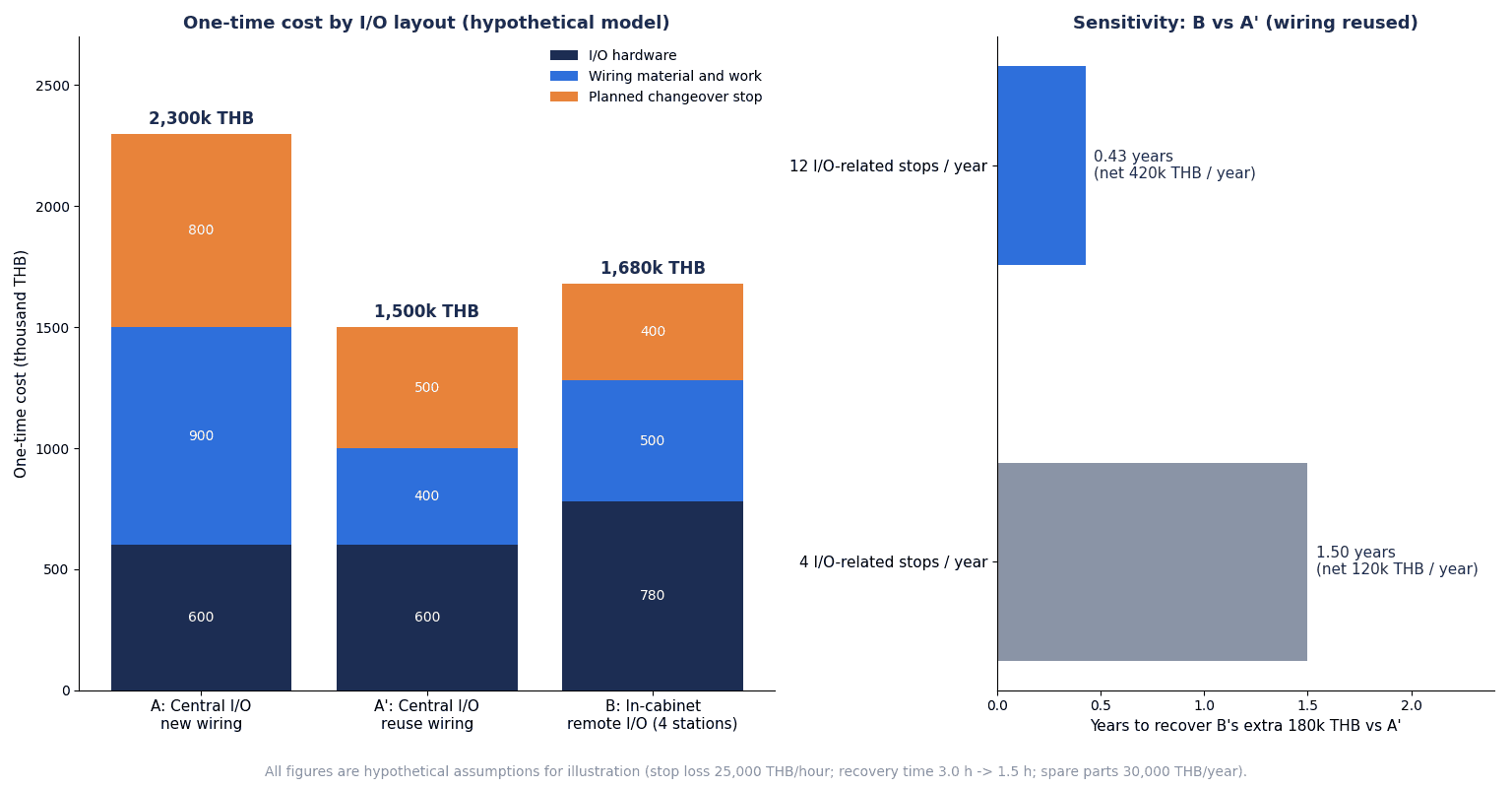
If Option A’, which reuses the existing wiring, is feasible, it is the cheapest when you look at initial cost alone. Whether you still choose Option B depends on how often I/O-related stoppages are actually occurring, and how much faster diagnostics make recovery. In plants without stoppage records, the starting point for the calculation is to pull “the number of I/O-related stoppages and the time it took to identify the cause” out of the maintenance records.
What this calculation leaves out
To avoid overestimation and double counting, the following items are not included in the calculation.
- Smaller panel size from space savings
- Fewer wiring errors
- Ease of future expansion
- Opportunity losses other than planned downtime (such as stoppages from problems after start-up)
- Tax incentives such as those from the BOI
If you want to include these as benefits, prepare your own data as the basis for each and add them as separate lines.
What to write in the RFP for remote I/O selection
Here we turn the points so far into 12 RFP (request for proposal) items. Have each supplier answer in the same format so that the proposals can be compared.
| No. | Item | Examples of what to write |
|---|---|---|
| 1 | Scope | Target lines, machines, I/O point list (by type, in use, unused and spare). Also state which machines are out of scope |
| 2 | Upstream PLC and network | The plant-standard PLC and communication protocol, the configuration tool to be used and its version. If a multiprotocol product is proposed, specify the one protocol to be used |
| 3 | Form factor and environmental conditions | In-cabinet or on-machine for each station, ambient temperature, humidity, dust, cutting oil, washdown conditions (chemicals, water pressure, frequency), vibration. The required protection rating and how the underlying test conditions will be confirmed |
| 4 | I/O configuration and spares | Unit for dividing stations (machine or unit), point count and spare ratio per station, number of analog, high-speed counter, IO-Link and safety I/O points |
| 5 | Power | Separation of control and load power, current per output point, sensor power capacity, approach to inrush current, which power is cut on an emergency stop |
| 6 | Diagnostics | At what granularity (station, module or channel) and which faults (wire break, short circuit, overload, loss of power, communication loss) are distinguished and shown in the PLC and HMI. Display language |
| 7 | Replacement and restoring settings | Whether hot swapping is possible and what stops, how settings are automatically restored after replacement, whether replacement is possible without a laptop |
| 8 | Redundancy and network configuration | Ring and redundancy method, network topology, switch specifications, separation from other systems |
| 9 | Safety I/O | Safety protocol, target safety functions, required SIL and PL and the scope of product certification supporting them, response time, behavior on communication loss, division of responsibility for validation |
| 10 | Security | Whether the product has IEC 62443 certification or evaluation and its scope, password protection, disabling unused ports, firmware update procedure, policy on CRA compliance for products destined for the EU |
| 11 | Migration and cutover | Scope of reuse of existing wiring, cutover procedure and planned downtime hours, rollback method, scope of the advance wiring survey |
| 12 | Spare parts, maintenance and training | Types and quantities of spares kept at the plant, stock and lead time assumptions, repairs and advance notice of end of production, training materials and screens in Thai, English and Japanese, maintenance response times |
When comparing proposals from several suppliers, look not only at total equipment cost but give heavy weight to how specific the answers to items 6 and 7 (diagnostics and replacement) are. Answers that simply say “supported” should go onto the list of items to verify at FAT.
What to check at FAT/SAT: deliberately breaking things
The most important part of remote I/O acceptance testing is not confirming that it works normally, but confirming that “when something breaks, diagnostics appear correctly and you can recover within the agreed time.” To do that, you deliberately create faults during testing.
List of deliberate-failure tests
| Stage | Test | Method | Pass criteria approach |
|---|---|---|---|
| FAT | Check all inputs and outputs | Switch every point on the I/O list ON/OFF by operating the actual device or with simulated signals, and match against the PLC and HMI displays | Every point behaves as per the I/O list and the names match |
| FAT | Unplug a sensor cable | Unplug input cables one at a time | The station, channel and fault type appear on the HMI |
| FAT | Output short circuit and overload | Short-circuit and overload outputs using a test load | A fault appears for the affected channel and other channels are unaffected |
| FAT | Module removal and replacement | Remove a module during operation and replace it with a spare | The scope of what stops matches the specification, settings are restored after replacement and recovery time is within the contracted range |
| FAT | Unplug a communication cable | Unplug a communication cable between stations. In a redundant configuration, unplug one side | If redundant, operation continues and an alarm appears. If not redundant, the system goes to the defined safe state and the station is identified |
| FAT | Power loss and momentary interruption | Drop control power and load power separately. Simulate a momentary voltage dip | Each power supply produces the defined behavior, and the restart procedure after power returns matches the specification |
| FAT | Safety I/O response | Trigger emergency stops, safety doors and light curtains and measure the time to stop. Also check behavior when communication is cut | The system stops to the safe side within the defined response time, and the device that caused the stop can be identified |
| FAT | Configuration errors | Deliberately misconfigure a station’s address or name | The wrong station does not go into operation, or an alarm appears |
| SAT | Operation in a noisy environment | Run continuously with the site’s inverters, welders and motors operating | Communication errors and malfunctions are within the range defined in the contract |
| SAT | Adding a station | Add one spare station and have it recognized | It can be added with the defined procedure and time, and existing stations do not stop |
| SAT | Readability of diagnostic displays | Thai maintenance staff locate a deliberately created fault using only the procedure manual and HMI | They identify the correct station and channel within the defined time |
| SAT | Recovery records | Check that the times of faults and recoveries in the series of tests are recorded | Time, station, channel and fault type are all recorded without gaps |
Dividing roles between FAT and SAT
FAT (factory acceptance test) is where the function and diagnostic logic are confirmed at the system integrator’s or panel builder’s factory. SAT (site acceptance test) is where they are confirmed with the actual machines, the actual wiring, the actual noise environment and the actual maintenance staff. Even for the same test, passing at FAT does not necessarily mean it can be skipped at SAT. In particular, noise, long cables, behavior after washdown and fault location by maintenance staff can only be confirmed on site.
The key to the SAT test in which “maintenance staff locate the fault” is to have it done by maintenance staff who do not know the test procedure. If the system integrator’s engineers operate it, they will compensate with experience even if the display is hard to understand, and the test loses its meaning. “Control Panel Manufacturing Thailand: A Practical Guide to Specification, FAT and Handover” is also a useful reference on how to run a panel FAT.
Issues specific to Thailand and ASEAN
Heat, humidity and dust
In Thai plants, panels and on-machine equipment are sometimes used in buildings without air conditioning. Compare the products’ published operating temperatures (for example, ET 200eco PN at -40 to +60 °C, EtherCAT Box at -25 to +60 °C, and FLEX 5000 and NQ-EP4L at -40 to +70 °C) with the actual temperature at the machine mounting position. Locations near motors or heaters, in direct sunlight or near the roof tend to be hotter than the building’s air temperature. Measuring before deciding is the reliable approach. In humid environments or where corrosive gases are present, the availability of conformal coating (for example, the XT versions of FLEX 5000) is also a selection factor.
Washdown
In food and beverage plants, equipment is sometimes placed where washdown water and chemicals reach it. Products claiming IP69K and products with stainless steel housings (for example, the EQ series of Beckhoff EtherCAT Box) are candidates, but do not judge by the protection rating code alone; give the manufacturer your actual washdown conditions and confirm suitability. Forgetting to fit protective caps on unused connector ports can also cause failures on sites with frequent washdowns.
Power outages and momentary interruptions
How each station behaves during a power outage or momentary voltage dip, and how it restarts after power returns, must always be confirmed in the power loss and momentary interruption tests at FAT. If the restart order is not aligned across stations, a situation can arise right after power returns in which only some stations cannot communicate.
Multilingual maintenance staff
In plants where maintenance staff are mainly Thai, prepare HMI diagnostic displays, fault procedures and labels in Thai as well. With only Japanese or English, night-shift maintenance staff cannot identify the station or channel, and the value of diagnostics is cut in half.
Spare parts and procurement lead times
With imported modules, if you order after a failure, the line may stay stopped until the part arrives. As described in an earlier chapter, keep spares for critical stations at the plant and write the stock and lead time assumptions into the maintenance contract.
Confirming eligibility for BOI incentives
Under the BOI Announcement No. 4/2569 mentioned earlier, according to Tilleke & Gibbins’ explainer, if 30% or more of the total machinery value supports Thailand’s domestic automation equipment manufacturing industry, the corporate income tax exemption is expanded to 100%; the minimum investment is 1 million baht (excluding land and working capital, and including machinery, equipment, software, IT systems and so on); and the application deadline is the end of 2027. Because the measure targets the general automobile manufacturing and PHEV/HEV manufacturing categories, automotive parts, electronic components, food and plastic molding plants need to check individually whether they are eligible. Please confirm conditions such as the cap on the exemption amount in the original announcement. The descriptions here are not tax or legal advice.
Frequently asked questions
What is the difference between remote I/O and distributed I/O?
In practice, they are used with the same meaning. Both refer to a configuration in which I/O units are placed close to the machine and connected to the PLC over a network. When selecting, rather than the name, check whether it is in-cabinet or on-machine and which network connects it to the PLC.
Is IP67 on-machine I/O more expensive than in-cabinet I/O?
Unit equipment prices are generally not published and are set by distributor quotes, so there is no simple answer. What you should compare is not just equipment cost but the total, including whether a panel is needed, wiring materials and installation, cutover downtime and recovery time during operation. The model calculation in this article (placeholder figures) also showed a case in which the option with higher equipment cost became cheaper in initial cost once wiring costs and downtime were included.
Should we switch to remote I/O when upgrading the PLC?
It depends on how much of the existing wiring can be reused and how often I/O-related stoppages occur. If wiring can be reused through terminal conversion or similar means, upgrading while keeping the central panel can have a lower initial cost. If the wiring has deteriorated or does not match the drawings, and I/O-related stoppages are frequent, it is a good opportunity to move to remote I/O. Start by investigating the maintenance records and the current state of the wiring.
What is the difference between an IO-Link master and remote I/O?
Remote I/O is equipment that conveys the ON/OFF states and analog values of sensors and valves to the PLC over a network. An IO-Link master is equipment that communicates one-to-one with IO-Link-capable sensors and actuators and also exchanges settings and diagnostic information. IO-Link is not a fieldbus and does not depend on the upstream network. There is also remote I/O with a built-in IO-Link master function (for example, the IO-Link master block of ArmorBlock 5000, the IO-Link modules of ET 200eco PN, and NQ-EP4L), making it possible to cover both roles with one device.
How does remote I/O change control panel design?
The I/O units and terminal blocks in the central panel and the multi-core cables to the machines decrease, and in their place you add the design of small per-machine panels or on-machine blocks, communication cables and power distribution. Because the number and size of panels, thermal design, power circuits and the range of power cut on an emergency stop all change, the placement of remote I/O stations needs to be decided from the control panel design stage.
Is it acceptable to put safety circuits on remote I/O as well?
By combining a safety protocol such as CIP Safety, FSoE or PROFIsafe with remote I/O that supports safety I/O and a safety PLC, you can build a configuration that carries safety signals on the same network. However, even if a product claims SIL or PL values, whether the machine’s safety function meets that level is determined by risk assessment, design, and verification and validation including response time. For individual judgments, please consult specialists or certification bodies.
Conclusion
If remote I/O selection starts with comparing catalog point counts, module widths and protection ratings, it tends to end, after the purchase, with “the diagnostics are unreadable,” “replacing a module wipes its settings” or “only the safety circuits are left on separate wiring.” First, fix the upstream PLC and the plant-standard network. Next, decide the form factor (in-cabinet slice type, on-machine IP67 block type, combined IO-Link master or safety remote I/O) from the environment: whether a panel can be placed, and what the dust, washdown and temperature conditions are. Then design point counts and spares, station division and power, and make diagnostic granularity, hot swapping, automatic restoration of settings, redundancy and spare parts into requirements. Build safety and cybersecurity into the same design from the start. Deciding in this order makes it clear what to buy and what you need to decide yourselves.
When doing this together with a PLC upgrade, the best answer changes depending on whether existing wiring can be reused and how often I/O-related stoppages occur. In the model calculation (placeholder figures), the remote I/O option came out ahead even on initial cost compared with the option that re-runs the wiring, while compared with the option that reuses the existing wiring, the difference was recovered in about 5 months at 12 stoppages per year and in 1.5 years at 4 per year. That is exactly why, in acceptance testing, you should unplug cables, pull modules, drop power and check, under conditions close to mass production, whether Thai maintenance staff can locate faults on their own.
At TOMAS TECH, we help Thai plants consider remote I/O as part of PLC upgrades and line modifications, matched to their equipment and maintenance setup. You are welcome to consult us even before a product or approach has been decided, for example while you are taking an inventory of the I/O points on an existing line or comparing in-cabinet and on-machine approaches. Please reach us through this contact form.
References
- Tilleke & Gibbins: New BOI measures for automotive and HEV/PHEV manufacturing (April 21, 2026)
- TCIJ: Equipment replacement and digital investment plans of Japanese companies in Thailand (August 18, 2026)
- The Nation: BOI support for supply chain upgrading (August 27, 2026)
- The Nation: Manufacturing Production Index for June 2026 (July 27, 2026)
- Trading Economics: Thailand’s industrial production in August 2026 (September 30, 2026)
- Siemens: SIMATIC ET 200SP product page
- Siemens: SIMATIC ET 200eco PN product page
- Siemens: SIMATIC ET 200 product page
- Rockwell Automation: 5094 FLEX 5000 I/O
- Rockwell Automation: 5032 ArmorBlock 5000 I/O
- Beckhoff: EtherCAT Terminals
- Beckhoff: ED series EtherCAT Terminals (April 20, 2026)
- Beckhoff: EtherCAT Box
- WAGO: I/O System 750/753
- Turck: Announcement of multiprotocol I/O modules (March 26, 2015)
- Mitsubishi Electric Technical Report Vol.96 No.1, FA Systems (2022, in Japanese)
- KEYENCE: NQ-EP4L
- Embedded Computing Design: Murrelektronik at Automate 2026 (July 21, 2026)
- Design World: Banner Engineering RSio Remote Safe I/O (March 5, 2026)
- HMS Networks: Industrial network market shares report 2026 (June 16, 2026)
- PI: PROFINET, IO-Link and PROFIsafe results for 2025 (April 17, 2026)
- ETG: Cumulative EtherCAT node count (April 20, 2026)
- ETG: EtherCAT – Technology
- ETG: UL Solutions evaluation of EtherCAT cyber resilience (April 20, 2026)
- ODVA: EtherNet/IP
- ODVA: CIP Safety
- ODVA: CIP Security
- IEB Media: PROFINET V2.5 and security (January 5, 2026)
- PI: PROFINET security standards (August 5, 2025)
- Mitsubishi Electric: CC-Link IE TSN classes
- CLPA: Latest Products
- IO-Link Community: IO-Link Technology
- IO-Link Community: TÜV SÜD certification of the IO-Link Safety specification (August 11, 2025)
- PI: Release of the IO-Link Safety specification (April 21, 2017)
- ISA: ISA/IEC 62443 Series of Standards
- ISASecure: IEC 62443 CSA Certification
- National Cyber Security Centre (Ireland): EU Cyber Resilience Act
- ifm electronic: Wiring without control cabinets (case study, January 2023)
- Rockwell Automation: 1771-to-1756 I/O Swing-arm Conversion System installation manual
- Mitsubishi Electric (Thailand): FA service contact


