


Introducing AI voice entry for factory work reports starts with a question about transactions, not a choice of speech engine. How will “which machine, which work order, which lot, how much work was completed” become confirmed, structured data? Transcription alone does not establish a production result. A usable design must account for noisy lines, Thai–Japanese–Vietnamese language switching, similar sounding identifiers, human confirmation, interrupted connectivity, and a traceable handoff to MES or ERP. This guide turns those questions into an implementation path, RFP requirements, and FAT/SAT acceptance tests for a factory in Thailand.
The scope differs from AI automation of daily reports, which reads and aggregates reports, from general transcription and report writing, and from AI analysis of near miss reports. Here, one spoken statement must be bound to an actual machine, work order, and lot, confirmed by a person, then posted as a work event. Well written prose is not proof that a transaction happened.
Define a single voice captured work event
Start with a concrete event: “On line A, for work order WO-1042, 19.8 kg from material lot L-27 was charged, against a 20 kg plan, with no exception.” Its record needs an event ID, plant and process, equipment ID, work order ID, item and lot IDs, event type, quantity and unit, occurrence time, operator ID, capture method, confirming user, status, and a reference to the original audio where retained. A factory may require more fields, but leaving machine, order, lot, and quantity buried in free text makes reliable MES posting difficult.
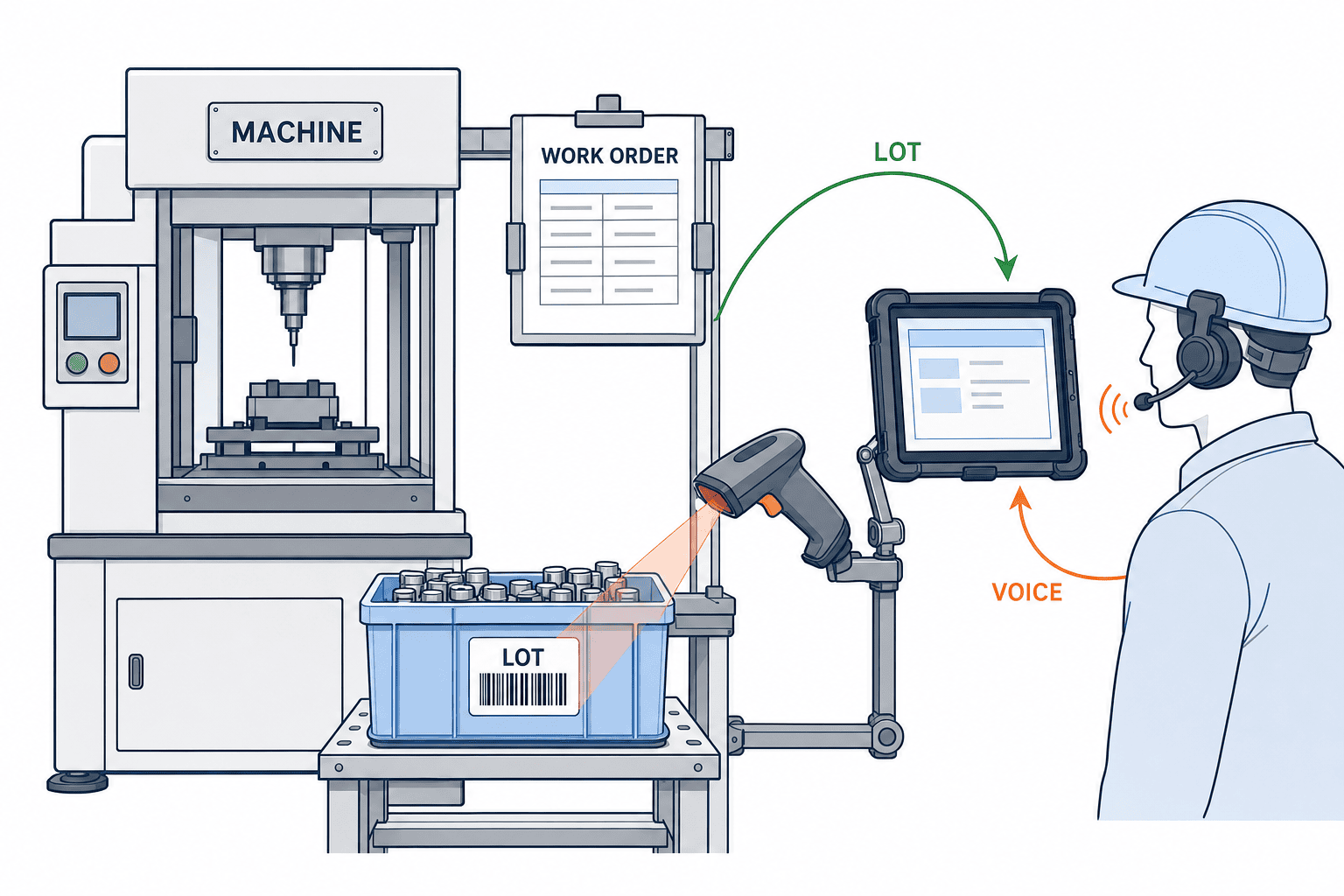
Voice should complement physical identification. The operator may scan the machine plate and material label, select the active work order on a tablet, then speak the action and reason. Speaking every long identifier is possible to test, but often creates avoidable ambiguity among letters and numbers. Decide on the mix of scanning, selection, instrument data, and speech through trials with gloves, protective equipment, and the actual operator posture. For a high consequence material charge, a scanned lot and scale reading can be independent checks against the spoken statement.
Give the event distinct states: captured, recognition candidate, requires confirmation, confirmed, waiting for integration, posted, and returned for correction. A successful speech API response is not a posted production event. Show the operator the machine, order, lot, quantity, and unit before confirmation. After validation and an MES/ERP acknowledgment, display the downstream confirmation number. Preserve a correction trail instead of silently deleting the first attempt.
Select pilot tasks by error consequence as well as frequency
Cleaning completion, changeover start, production quantity, machine downtime reason, material charge, and quality hold are not equivalent. They differ in identifiers, numerical precision, approval rights, and downstream systems. Score candidate tasks by how often they occur, whether the operator’s hands are occupied, the complexity of IDs, consequences of incorrect posting, and duplication with current MES screens. Pilot one simpler event and one demanding event involving a lot or quantity. Success on quiet, short completion phrases does not establish suitability for material consumption.
A downtime reason may use machine and timestamp already present on the terminal, while voice selects only a reason code. A material charge may need item, lot, weight, scale value, permitted tolerance, and the manufacturing lot. Decide whether a spoken weight is authoritative or merely confirms a value read from the scale. Where a wrong lot matters greatly, keep label, scale, and work order checks. The factory’s quality rules should determine whether voice can initiate the transaction and who can confirm it.
Measure more than seconds per entry. Track the number of events stuck in a queue, correction rates, time to MES posting, repeated entries, and supervisor workload. A fast operator interaction that moves work to the next shift’s supervisor is not a successful improvement.
Design speech capture for the running line
Factory sound changes with air bursts, alarms, conveyors, impacts, and nearby operators. A sample recorded in a quiet office cannot establish real line performance. Collect audio from normal operation, changeovers, cleaning, and the noisy conditions relevant to the task. Record microphone position, orientation, protective equipment, and machine state for each sample. Verify that speaking does not mask a safety instruction or interfere with hearing protection.
Compare a headset, lapel microphone, rugged tablet microphone, and push to talk unit under actual working conditions. Directionality and noise reduction can help, but aggressive filtering may erase short digits or word endings. Keep utterances short and structured, such as “action, object, amount, unit, exception.” Ask for a missing field rather than forcing a long sentence. The confirmation card should enlarge numbers and IDs that can be confused, such as 19.8 versus 90.8 or a letter in a lot code. High risk fields merit scan confirmation or a read back.
The operator’s voice may be personal data. Specify retention, access, deletion, vendor processing, and whether samples may be used to improve a model. Keep audio only for a justified operational and audit period. Confirm the policy with the factory’s legal and employment teams; the article does not assert one universal retention rule.
Test language mixing, not just three separate languages
Microsoft’s Azure Speech language table lists speech recognition locales including Japanese, Thai, and Vietnamese, while support differs by feature. That table does not establish that every selected model can recognize all three within one utterance. Verify model, region, language identification, and feature availability at procurement and at implementation.
Create a corpus that includes Thai speech with Japanese machine names, Vietnamese sentences containing English item codes, local accents, abbreviations, and spoken alphanumerics. Compare an explicit language choice, an operator profile default, and automatic language identification where offered. Test how many extra actions each choice requires and whether it changes incorrect field values. Translate the interface and error messages, but keep stable equipment and reason codes across languages.
Google Cloud describes phrase and class based adaptation, while Amazon Transcribe documents custom vocabularies. These are mechanisms for specialist words, not promises that any code switch or locale will work. Test each candidate service with real equipment names and lot formats. Maintain official names, shop floor nicknames, pronunciations, confusing pairs, and a change owner in the vocabulary list.
Separate transcription, extraction, validation, and posting
Google Cloud’s Speech-to-Text overview describes conversion of audio to text. It does not by itself validate a production transaction. The text “charge 19.8 kg” still requires a check that the item is permitted on the open work order, the lot is available, the quantity is within the process rule, and the unit is correct. Implement recognition, structured field extraction, master data checks, operator confirmation, approval where required, and posting as distinct stages.
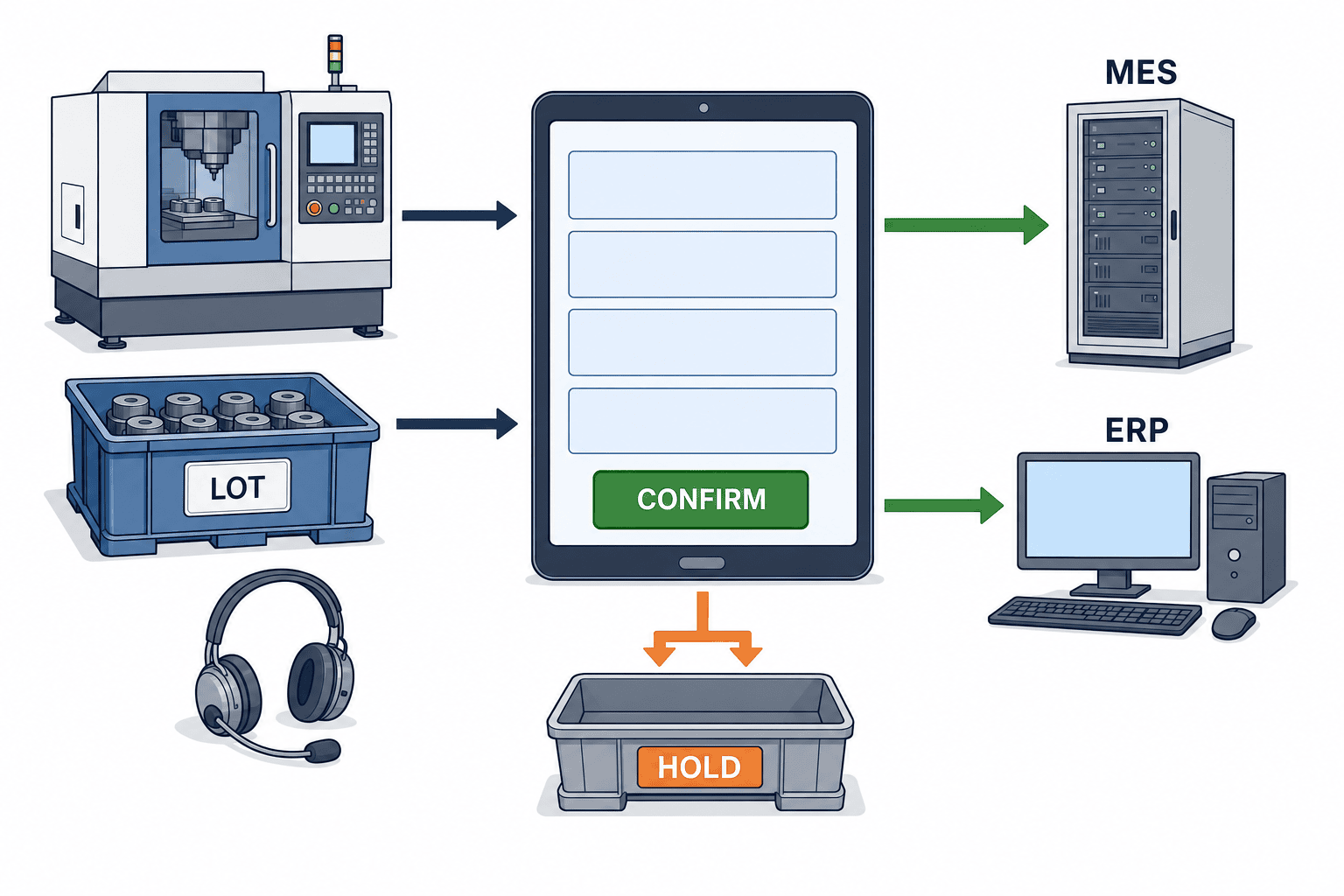
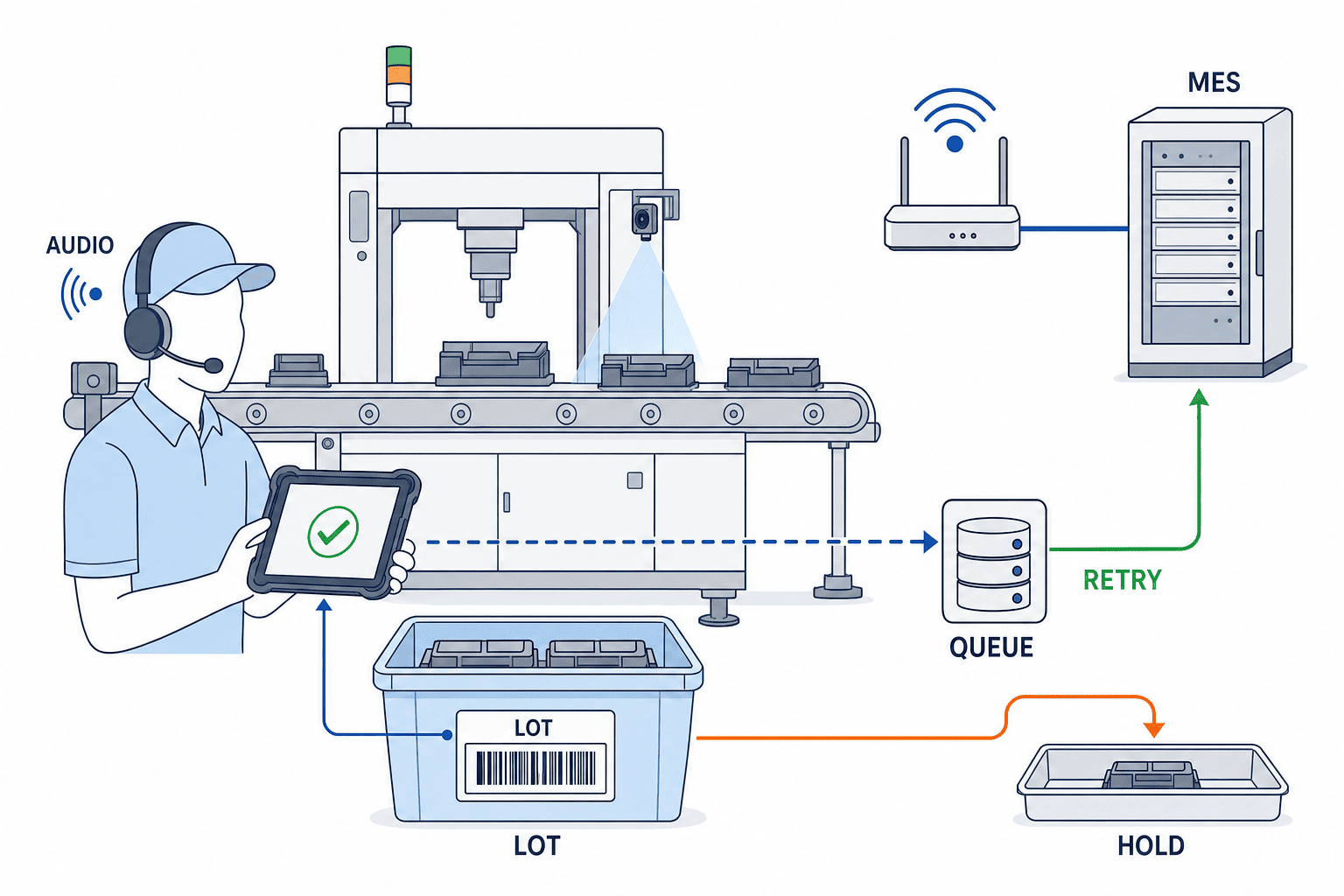
A practical path is: establish equipment, work order and operator context; assign one immutable event ID; record speech; produce candidate fields; check them against master data and the work order; present the candidates to the operator; route a required approval; post the same event ID to MES/ERP; then capture its receipt number. This is a design recommendation, not a claim about a vendor’s default behavior. Keep capture, server receipt, and final posting timestamps separately.
If generative AI extracts fields from free speech, restrict IDs to records available in the current work order. Do not let the model invent a plausible lot. Missing equipment, lot, unit, or quantity should enter a confirmation or exception path. Validate output against a schema and preserve both candidate and confirmed values. The NIST AI RMF Measure playbook supports evaluating a system in its use context and documenting measurement. Here, the meaningful outcome includes the rate of wrong work events that reach posting, not just transcript word accuracy. Microsoft’s transparency note is also a useful reference on limitations and human oversight, although it does not establish product behavior for this specific solution.
Build human confirmation and an exception queue
A useful confirmation view presents four groups together: current machine/order/item/lot context; AI candidate quantity, unit and reason; master data mismatches; and the consequence of pressing confirm. “This will post a 19.8 kg material charge to MES” is clearer than an unexplained “OK.” A confidence score is a model signal, not a guarantee that the lot and quantity are correct.
Differentiate unrecognized speech, unknown ID, out of range quantity, missing unit, blocked lot, approval wait, integration failure, and possible duplicate. Give each category an owner, resolution route, and expected response time. Operators can correct a misheard amount at the station; production planning can fix a missing master record; quality must decide a blocked lot; IT handles integration failure. A single generic error bin obscures responsibility and encourages paper workarounds.
Set approvals by risk. A changed material lot, unusually high quantity, or release of a quality hold can require a supervisor. Show the approver the original candidate, changes, scan evidence, and audio reference where authorized. Ordinary downtime reasons may not require the same approval. Define the matrix in the RFP and test that unauthorized users cannot post restricted events.
When a line loses connectivity, “saved on device” must remain distinct from “posted in MES.” Retry with the same event ID so duplicate taps or network retries do not produce multiple production entries. Revalidate against master data after reconnection, since a lot may have been blocked while the terminal was offline. Check each shortlisted device and application for actual offline capability, encryption, and loss handling.
Put testable details into the RFP
Do not stop at “multilingual AI voice entry.” Specify the process and event types, ID capture method, utterance pattern, code switching, microphone environment, confirmation view, exception queue, MES/ERP interface, audit fields, offline behavior, vocabulary changes, and support ownership. Ask each bidder whether a requirement is standard, configurable, custom built, or provided by another product. Distinguish a roadmap item from a delivered capability.
Document ownership at the boundary between speech service, integrator, MES vendor, and plant master data team. Who adds a new machine name? Who approves its pronunciation? Where does an MES rejected lot return? Who monitors failed retries? Who runs regression tests after a model update? Speech model tuning cannot repair an invalid ERP master record.
Compare full operational cost, including microphones, terminals, networking, integration, vocabulary upkeep, training, exception resolution, and audit storage. The usage component may be estimated as monthly events × average audio duration × the quoted rate, but that is only one cost line. The article does not claim a universal vendor price or market benchmark.
FAT and SAT: accept complete events rather than attractive transcripts
For a project, define FAT as testing designed behavior in a controlled environment and SAT as testing it on the operating line. Agree the contractual meaning with the vendors. Each test case needs sample audio, noise and microphone condition, starting machine/order/lot context, expected field values, expected confirmation display, exception route, and final MES/ERP result. A perfect transcript bound to the wrong order fails. A minor spelling variation with correctly confirmed structured values is a different issue.
Cover at least: ordinary utterances in each target language; language switches; noise and protective equipment; similar equipment and lot IDs; decimal and unit confusion; missing fields; blocked lots; communication loss and retry; duplicate taps; unauthorized approval; and regression after model or vocabulary updates. Report results by risk group instead of letting a high average on easy speech conceal one wrong lot posting.
Acceptance measures should include all required fields correct, incorrect IDs that pass confirmation, operator correction rate, mean exception resolution time, time to MES/ERP acknowledgment, duplicate postings, and repeated operator entry. Agree thresholds from the plant’s quality and business risk. Do not reuse a vendor demo score as a plant acceptance limit. Separate training/tuning audio from final test audio, and include different shifts, operators, and equipment conditions.
An illustrative calculation, not an ROI claim
The following numbers are a hypothetical arithmetic example, not measured performance or a guaranteed return. Assume 120 reports per day. If the old entry takes 50 seconds and voice plus confirmation takes 35 seconds, the difference is 15 seconds per report. That is 120 × 15 = 1,800 seconds, or 30 minutes per day. Over 20 operating days, it is 600 minutes, or 10 hours before exception work, device handling, training, and support.
Now suppose 8% of reports create an exception and each exception needs another two minutes. Expected daily exception work is 120 × 0.08 × 2 = 19.2 minutes. The net time difference in this simplified example is 30 − 19.2 = 10.8 minutes per day, or 216 minutes = 3.6 hours in 20 days. The 9.6 expected exception cases are an average, not a literal fraction of a case on one day. Replace these assumptions with site measurements and count supervisor and IT time too.
Acceptance decisions need a separate stop condition for severe incorrect postings, not only an average score. A minor quantity correction and a confirmed charge to the wrong lot cannot be treated as equivalent errors. Record severity, reproduction conditions, temporary containment, permanent fix, and retest evidence. The system should be able to suspend automatic posting for the affected event type until the severe error is resolved.
Implement one full transaction before scaling
First, map the existing work report, MES screen, ERP field, work order, machine and lot master, and exception process. Mark which event changes production results and which only adds a note. Agree the source of truth and the exact meaning of “posted.” Next, collect consented line audio across noise, language, ID, and shift conditions. Label both transcript and expected event fields, and separate tuning from final acceptance samples.
Then prototype the full route: ID capture, speech, candidate card, confirmation, exception path, MES/ERP API, acknowledgment, and offline retry. Watch real operators use the view and check for stale context after moving to another machine. FAT/SAT should test the complete route. During launch, reconcile with the previous method for a defined period while preserving one authoritative record. Keep a rollback trigger for repeated wrong postings and retest when machines, items, vocabularies, or model versions change.
Define what happens to exceptions on nights and holidays. If an unrecognized lot appears during the night shift but only a day-shift planner can amend master data, show that the event remains on hold until the next morning. Quality and production procedures must say where the physical material is kept, whether work may continue, and whether a temporary paper record is permitted. An electronic queue without a rule for the actual material is not an auditable work result.
If performance declines after launch, investigate changes in operating conditions as well as the model. New equipment, a changed lot naming pattern, different protective equipment, relocation of the station, or seasonal staffing can change the input. Store machine, language, shift, microphone, and vocabulary version with each event so failures can be segmented. Review process and condition breakdowns rather than only a monthly average.
When a formally posted event must be corrected, create a separate correction transaction instead of overwriting it with a new voice entry. Link the original event ID, reason, before and after lot and quantity, approver, and any MES/ERP reversal or reposting number. This distinguishes recognition error from operator misstatement and a later quality change. Determine downstream accounting, inventory, and quality effects from the actual system design and close procedures.
Frequently asked questions
Can operators simply dictate the old paper work report?
Dictation may capture prose, but MES/ERP posting requires structured machine, order, lot, quantity, unit, operator, and time fields. A free text report still needs identification and confirmation before it becomes a transaction.
Does support for Thai, Japanese and Vietnamese guarantee mixed language recognition?
No. Language support for separate locales and code switching inside a single utterance are different requirements. Check the selected model and region, then test actual machine names and alphanumeric lots. Compare manual language selection and ID scanning when automatic detection performs poorly.
Can human confirmation be removed?
A lower risk reason code may be eligible under site rules. A material lot, quantity, or quality status usually warrants explicit operator confirmation or supervisor approval according to its consequence. Model confidence alone should not authorize a high consequence post.
What should an RFP, FAT and SAT measure?
Include noise, language switching, confusing IDs, digits and units, missing data, master data rejection, offline retry, duplicate suppression, and authorization. Measure whether the correct machine, order, lot and quantity reached MES/ERP exactly once, with traceable confirmation and exception handling.
Summary
The goal of AI voice entry for factory work reports is a confirmed shop floor event, not a fast transcript. Bind the machine, order and lot before speech where possible; show candidate fields for human checking; route exceptions; and post once to MES/ERP with a receipt. A defined event, responsibility matrix, and FAT/SAT test sheet allow vendors to be compared against the same operational outcome.
If your Thai factory is considering voice captured work reports, contact TOMAS TECH. We can start by mapping one existing work report through capture, confirmation, exception handling, and MES/ERP posting, even while requirements are still being drafted.


