


A RAIN RFID sensor project does not mean that attaching a tag will stream vibration or temperature continuously. In September 2026, the RAIN Alliance announced a working group for the RAIN RFID sensor ecosystem. Its official event page lists RAIN in Action 2026 in Madrid for September 29–October 1, with end-user cases, demos and workshops. This is an industry discussion, not certification or a performance guarantee for a sensor on a particular machine. For a Thai factory, the useful next step is to define what condition must be observed, under what read conditions, and which maintenance decision will use the result.
This guide covers pumps, fans, gearboxes and other rotating assets where wiring is difficult. It distinguishes passive UHF interrogation from sensor power architectures, discusses metal and RF constraints, and gives a practical PoC, RFP and acceptance framework. The focus is equipment condition monitoring, not item identification, stocktaking or generic RFID cost.
Separate RFID communication from sensor measurement
RAIN RFID commonly uses passive UHF backscatter: a reader transmits RF energy and commands, and the tag responds by modulating the reflected signal. A passive tag generally does not broadcast whenever it wants. Sensor architectures vary: pure passive measurement may be triggered by reader energy; a battery-assisted passive (BAP) design can use a battery for sensor circuitry while communicating by backscatter; an independent logger can measure and store data while RAIN is used only for identification or retrieval. “Battery-free” does not by itself promise continuous measurement, a fixed sampling interval or long-term history.
| Architecture | Verify in the PoC |
|---|---|
| Purely passive sensor tag | Wake-up conditions, response latency, distance/orientation effects |
| Battery-assisted passive | Battery life, replacement, behavior during RF loss |
| Independent logger plus RAIN | Time synchronization, storage and retrieval |
| Wired or industrial wireless sensor | Installation, power, network and protection requirements |
Require suppliers to specify sensor power, sampling trigger, local storage and behavior when the tag cannot be read. Total cost includes readers, antennas, brackets, RF surveys, software, integration, commissioning and maintenance workflow, not just tag price.
Choose the use case from a failure mode
Start with the measurement gap: where is wiring difficult, and what decision will the measurement change? Prefer stable mounting surfaces such as a bearing housing, motor casing or pump body. Mounting on a shaft raises balance, centrifugal force, temperature, lubrication, retention and service-access concerns. A first PoC should usually evaluate a fixed surface.
Potential candidates include remote auxiliary pumps, outdoor assets with difficult cable routes, equipment under removable covers, or periodic checks of temperature or moisture. High-bandwidth vibration waveforms, millisecond protection trips and guaranteed 24/7 alarms may require wired accelerometers, protection relays or independent-power sensors. Returning a value is not the same as capturing a diagnostic waveform.
Use maintenance history to define the failure mode, observable precursor, current detection method, impact, useful warning time and available response. “We want vibration data” is an idea. “Flag a worsening condition on this pump before the next route inspection so a technician can verify it” is an operational requirement.
Test the actual RF environment
Read range is not a single product number. GS1 guidance describes passive UHF/RAIN as typically reading over several metres, with up to 15 m only in special cases; antenna pattern and gain, polarization and tag orientation affect results. These are general statements, not a guarantee for a target machine.
Metal, curved surfaces, nearby pipes and cables, rotation and changing loads can alter tuning, shielding and multipath. A metal-mount rating does not guarantee on-machine performance. Test the actual tag, mounting spacer, orientation, antenna polarization, reader settings and machine states. A tag may read while stopped but fail during operation, so align logs with speed, load, temperature and operating state.
RAIN Alliance design guidance covers regional frequency settings, antenna switching, sessions and RF fading. For a Thai installation, confirm current NBTC requirements, approved equipment, frequency/power configuration and local supplier evidence. Put the Thailand compliance owner and evidence into the RFP; this article does not state regulatory limits.
Turn measurements into maintenance events
Record asset and tag IDs, sensor model, quantity and unit, measurement time, read time, reader and antenna, channel, read success/failure, quality flag, machine state and threshold version. Measurement time may differ from read time. Preserve raw reader events separately from deduplicated or transformed values; repeated reads of the same stored value may not be new measurements.
A path can be sensor tag → reader and antenna → edge collector → time-series store/API → asset master → maintenance system and work order. For bearing temperature, a rule might consider absolute limits, deviation from baseline, rate of rise, valid readings in succession, operating state and ambient temperature. This is an example, not a universal threshold. Use equipment specifications, lubrication conditions, baseline data and maintenance history, with an accountable approver.
Never treat a missing response as normal. Distinguish valid new measurement, old value re-read, overdue update, failed read, machine stopped, maintenance state and threshold exceedance. Alerts should lead to re-read, inspection or a work order. Do not use a RAIN sensor value for safety protection or automatic shutdown without a separate reliability and functional-safety assessment.
PoC and acceptance design
A PoC should test decisions, not just display one value on a demo screen. Select representative assets, a reference instrument, tag and antenna positions, operating modes and safe test windows. Any example quantity or duration is a planning assumption, not an industry standard.
Where safe, test stopped, startup, steady operation, different loads, nearby machinery, closed guards, worker movement and temporary obstruction. Align reader logs, reference readings, sensor values, machine state and maintenance records by time. Measure read success, value error, update latency, missed events, false alerts, stale-data detection and maintenance response.
Agree acceptance targets before testing. Metrics may include valid-data availability in a defined operating window, agreement with a reference within a project-defined tolerance, time to detect a stale value and completion of maintenance follow-up. Derive actual thresholds from the asset and intended decision. Keep RF metrics distinct from maintenance outcomes.
RFP checklist
| Area | Specify |
|---|---|
| Asset and environment | Model, location, surface, metal/liquid proximity, temperature, vibration and washdown |
| Measurement | Quantity, units, range, accuracy basis, update interval, event and warning time |
| Tag/sensor | Power architecture, sampling trigger, storage, mounting, life and replacement |
| Reader/antenna | Thailand-appropriate model, frequency/power, polarization, pattern, layout and interference |
| Performance | Stopped/running reads, stale-data logic, cross-reads, missing-data behavior |
| Data/IT | Asset mapping, time sync, units, API/OPC UA, network boundary and retention |
| Maintenance | Alert recipient, response deadline, CMMS link, threshold approval and feedback |
| Security | Accounts, encryption, segmentation, logs, updates and remote-service approval |
| Acceptance | FAT/SAT cases, reference instrument, raw evidence, training, spares and warranty |
Ask for mounting photos, antenna layout, logs by operating state, configuration backup, Thai compliance evidence, data-field list and fault procedures. A maximum-range figure alone cannot establish site performance.
FAT can check data fields, units, timestamps, interfaces, access roles, notifications and logs. SAT should include the real machine, metalwork, radio environment and maintenance workflow. Test power/network loss, tag damage or detachment, antenna cable fault, wrong asset mapping, stale values, duplicate reads and unanswered alerts. Record what the system stores, displays, notifies and does after recovery. Never fill missing intervals with a normal value.
Cost and FAQ
There is no universal price or ROI. Separate tags, readers, antennas, mounts, survey, installation, gateway, software, integration, trials, training, spares and annual support. If downtime or hourly loss figures are placeholders, label them as assumptions and replace them with plant records. Do not assume that a sensor prevents a fixed share of failures.
Does battery-free mean 24/7 monitoring?
No. Purely passive designs require reader energy and product-specific measurement behavior. BAP and independent-power designs differ. Verify cadence, storage and read-loss behavior.
Can a tag be mounted directly on a shaft?
Not without mechanical review of balance, centrifugal force, temperature, retention, guarding and service access. Evaluate a fixed housing first.
Can it diagnose bearing vibration?
It depends on bandwidth, sampling rate, power and data transfer. A returned value is not necessarily a diagnostic waveform. Compare wired or independent-power sensors when waveform analysis is required.
Is the longest read range enough?
No. Antenna pattern, gain, polarization, tag orientation, metal, liquid, rotation, interference and local rules matter. Require a site test.
Conclusion: start with the maintenance decision
RAIN RFID sensors can add an option where wiring or battery replacement is difficult, but passive interrogation, sensor power and measurement are separate design questions. Metal and rotation affect RF performance; readings are useful only when timestamp, quality, machine state and missing data are visible to maintenance.
Use the PoC to compare with a reference and test actual machine states. Put Thai compliance ownership, missing-read behavior, data interfaces, alerts, FAT/SAT evidence, maintenance and replacement into the RFP. Keep wired sensors and independent loggers in the comparison. For help structuring a Thai-factory PoC or RFP, contact TOMAS TECH.
Related articles
- RFID implementation cost: four factory budget layers
- Predictive maintenance case studies
- IO-Link sensor data integration in Thailand
Sources
Checked 30 September 2026. Vendor descriptions are manufacturer claims, not machine-specific guarantees. General procurement guidance only; not a substitute for engineering, safety or legal review.
- RAIN Alliance, sensor working-group announcement: https://therainalliance.org/rain-alliance-launches-working-group-to-support-the-growing-rain-rfid-sensor-ecosystem/
- RAIN Alliance, Industry Events: https://therainalliance.org/industry-events/
- RAIN in Action 2026 official event page: https://www.raininaction.org/event/2026/home
- RAIN Alliance, System Design Guidelines v1.1: https://rainrfid.org/wp-content/uploads/2020/11/RAIN-RFID_System-Design-Guidelines-V1.1.pdf
- RAIN Alliance, Augmenting RAIN RFID with Passive Sensors: https://rainrfid.org/wp-content/uploads/2021/09/Augmented_RAIN_RFID_with_passive_sensors-V1.0.pdf
- GS1, Gen2 v3.0.1: https://ref.gs1.org/standards/gen2/
- GS1 Support, typical RFID read range: https://support.gs1.org/support/solutions/articles/43000734166-what-is-the-read-range-for-a-typical-rfid-tag-
- HID Global, Sense Passive Tag: https://www.hidglobal.com/products/sense-passive-tag
- Impinj, How RAIN RFID systems work: https://www.impinj.com/products/technology/how-do-rain-rfid-systems-work
- NBTC, RFID technical standard: https://www.nbtc.go.th/getattachment/spectrum_management/%E0%B8%81%E0%B8%8E%E0%B8%A3%E0%B8%B0%E0%B9%80%E0%B8%9A%E0%B8%B5%E0%B8%A2%E0%B8%9A%E0%B8%81%E0%B8%B2%E0%B8%A3%E0%B9%83%E0%B8%8A%E0%B9%89%E0%B8%84%E0%B8%A5%E0%B8%B7%E0%B9%88%E0%B8%99%E0%B8%84%E0%B8%A7%E0%B8%B2%E0%B8%A1%E0%B8%96%E0%B8%B5%E0%B9%88/Unlicensed-%28Wi-Fi-SRD-RFID-IoT-WirelessMic%29/28672/standard-RFID.pdf.aspx?lang=th-TH&page=hsn
- Zhang et al., Sensors and Actuators A: Physical 405 (2026), DOI: https://doi.org/10.1016/j.sna.2026.117809
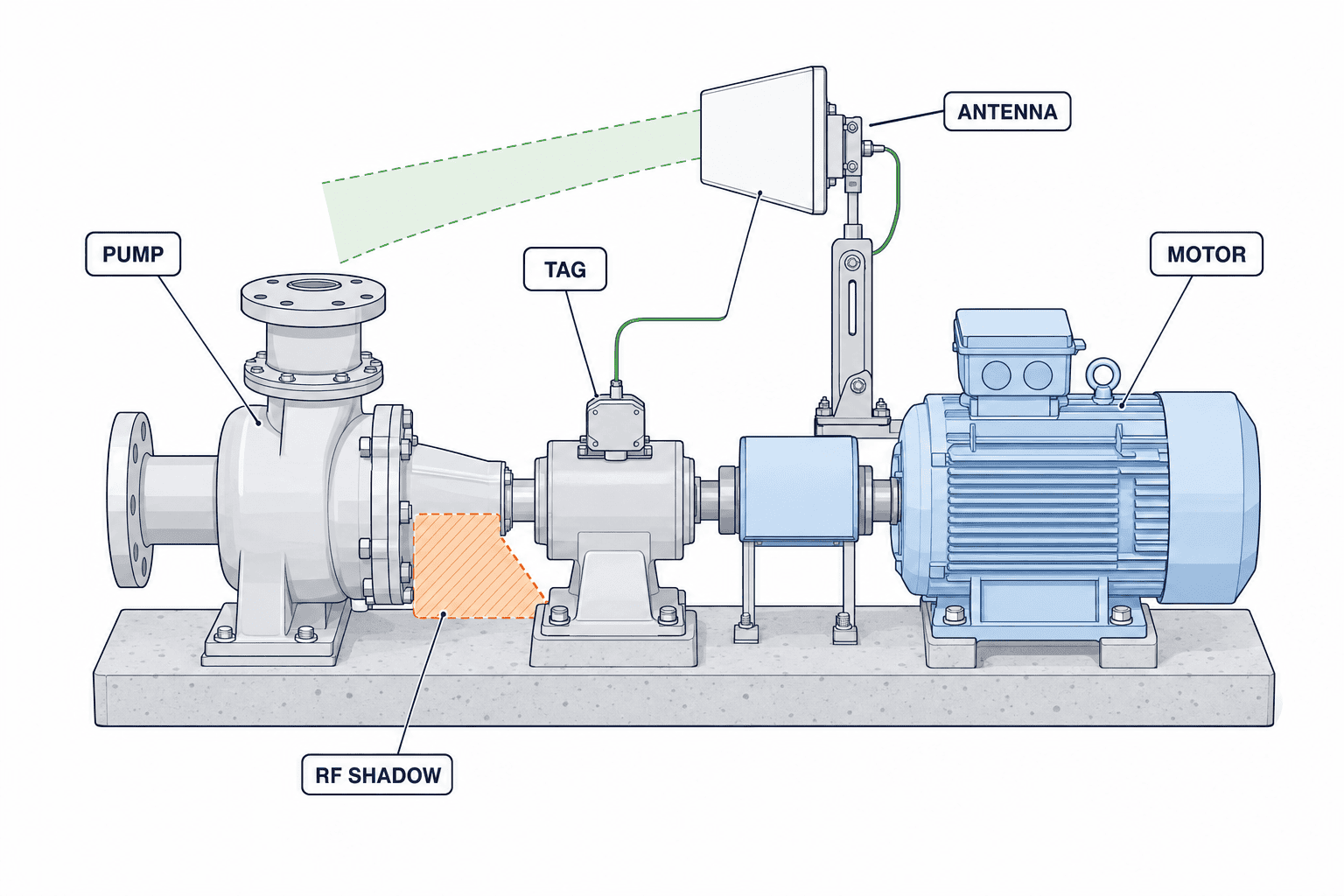
Figure 1: Fixed mounting and RF field
Show a pump, motor, fixed bearing housing, sensor tag on the stationary housing, directional reader antenna and an orange metal-shadow area. Keep the rotating shaft untagged.
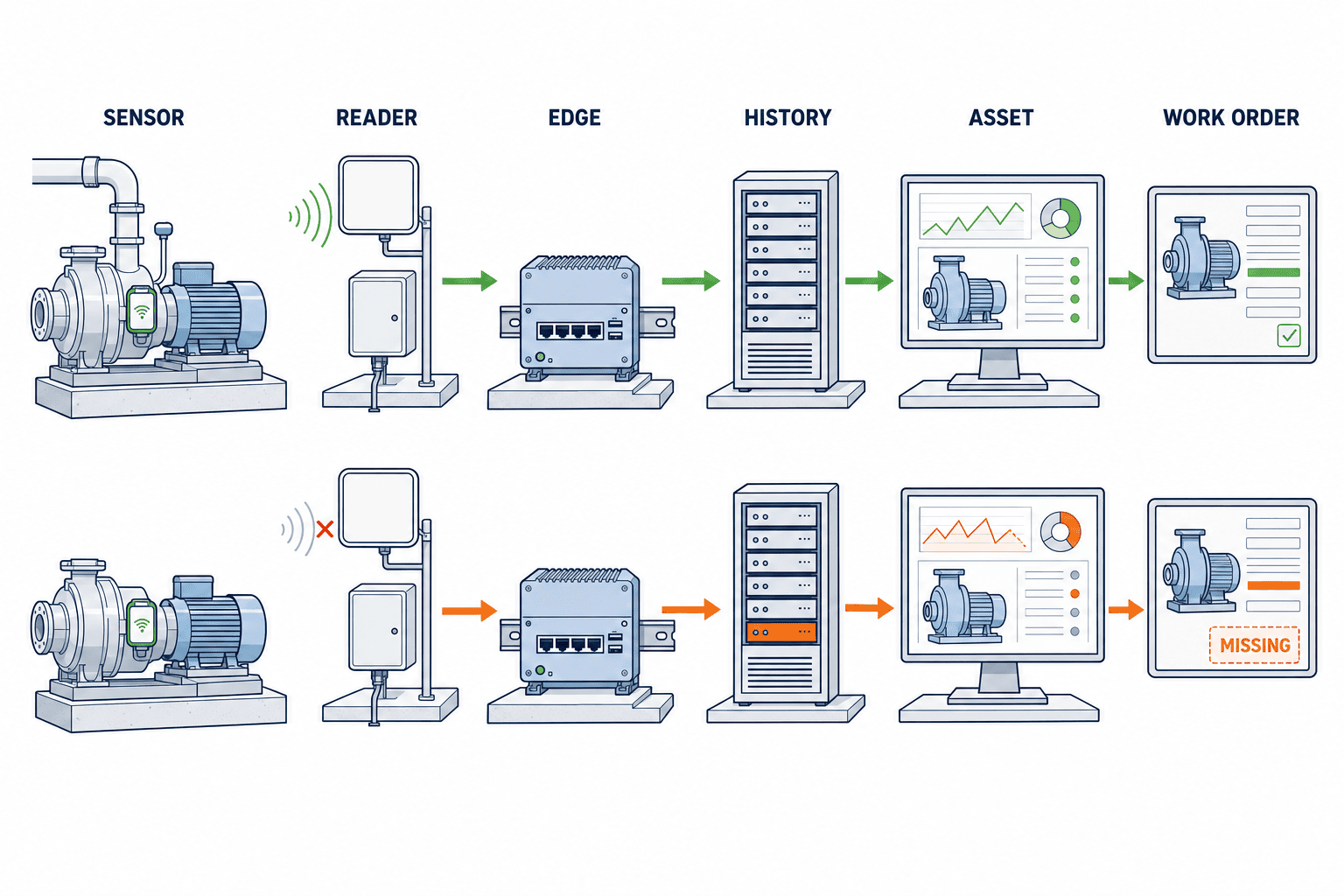
Figure 2: Measurement to maintenance
Show sensor/tag, reader, edge gateway, time-series store, asset master and work-order screen; distinguish valid green data from an orange missing-read path.
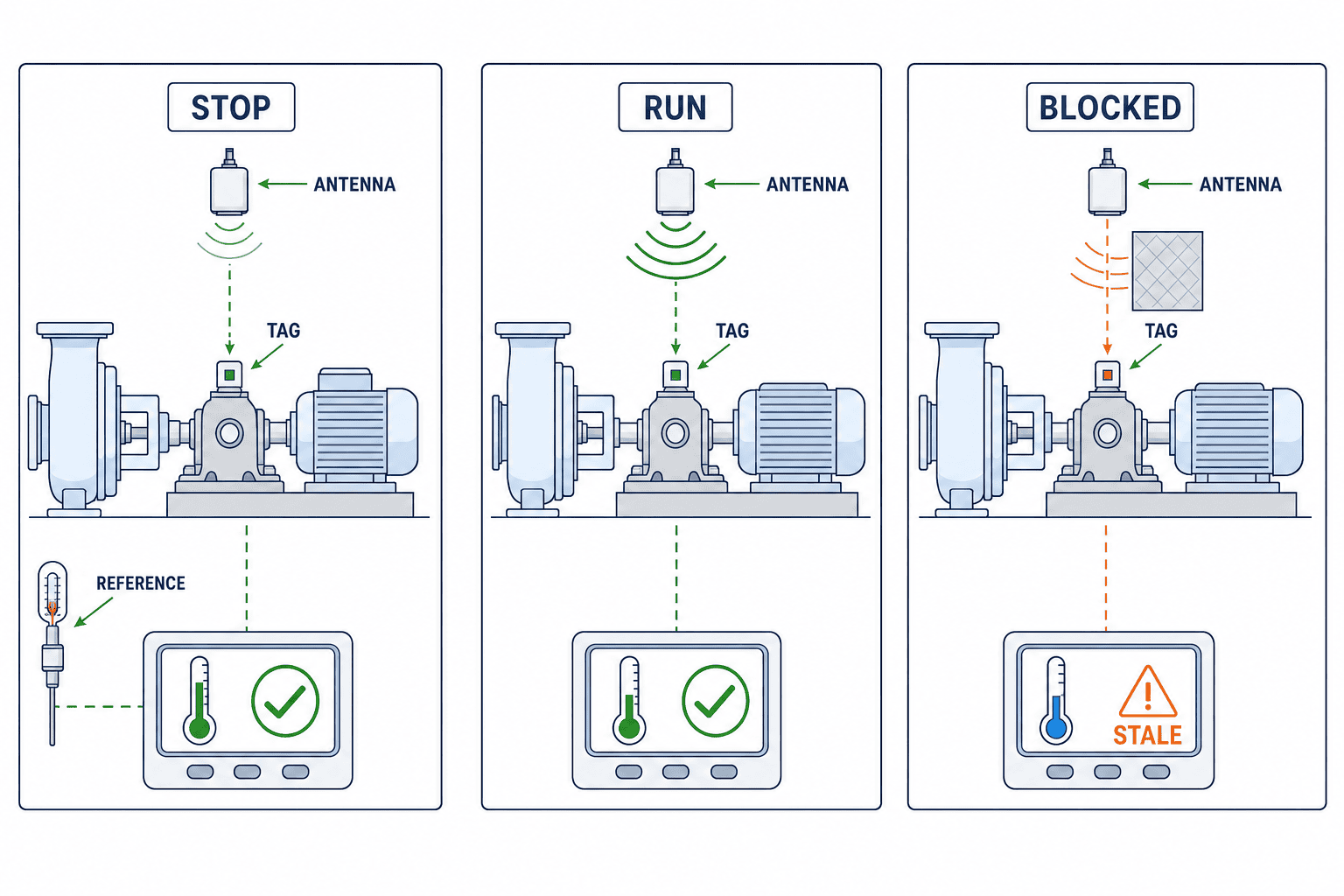
Figure 3: PoC acceptance states
Use three panels: stopped, running and temporarily blocked read, with a reference thermometer and stale-data alert.


