


An ISO 50100 implementation in a Thai factory should not begin with a promise to “get certified.” It begins with a reproducible data chain for absolute energy-related Scope 1 and Scope 2 emissions, using the same boundary, units and emission-factor rules across a contiguous 12-month base year. This guide translates ISO 50100:2026, published on 30 March 2026, into an RFP, a 90-day proof of concept, FAT/SAT criteria and auditable evidence.
Three facts to understand before an ISO 50100 implementation
ISO’s official page identifies ISO 50100:2026 as a 40-page, first-edition standard applicable to organizations of any type or size. Its core scope is energy-related Scope 1 and Scope 2 emissions, and it requires demonstration of absolute ERGE reduction aligned with the organization’s targets. ERGE means energy-related greenhouse gas emissions and is expressed in absolute tCO2e per year. An improving production intensity does not, by itself, demonstrate an absolute reduction if total emissions continue to rise.
Second, ISO 50100 does not replace ISO 50001. ISO 50001 supplies a management-system framework for policy, responsibilities, energy review, performance indicators and continual improvement. ISO 50100 focuses on the decarbonization boundary, quantification, a base year, plans and claims that can be validated or verified. The public ISO preview explains that ISO 50100 is not itself a management-system standard and that Annex A maps its relationship with ISO 50001:2018. An existing EnMS is a valuable foundation, but an ISO 50001 certificate does not automatically prove ISO 50100 conformity or an absolute GHG reduction.
Third, do not overload the first project. The mandatory core concerns energy-related Scope 1 and Scope 2. An organization may also include Scope 3 emissions associated with its energy consumption, but Scope 3 is not a blanket mandatory scope under this standard. A practical first implementation closes the evidence chain for fuels, purchased electricity, purchased heat, cooling or steam that the factory can govern.
Important: this article is an implementation guide based on public information, not a substitute for the normative standard. Purchase or obtain authorized access to the complete ISO 50100:2026 text and confirm the interpretation with competent certification, validation/verification, legal, tax and BOI advisers. Neither certification nor an incentive outcome is guaranteed.
Separate ISO 50001 operations from the ISO 50100 deliverables
The factory ISO 50001 implementation guide covers the EnMS operating model. An ISO 50100 RFP should make the following additions explicit.
| Topic | Reusable ISO 50001 asset | ISO 50100 addition or reinforcement |
|---|---|---|
| Governance | Energy policy, team, significant energy uses | Decarbonization boundary, Scope owners, claim approver |
| Indicators | kWh/unit, GJ/tonne, EnPIs, energy baseline | Absolute tCO2e/year, Scope targets and reductions |
| Data | Meters, invoices, production and relevant variables | Factor version, formula, evidence and recalculation history |
| Action | Efficiency, controls and maintenance | Separate efficiency, fuel switching and electricity-factor effects |
| Assurance | EnMS process and performance improvement | Evidence for validating a future plan and verifying historical results |
Adding a “CO2” tile to an energy dashboard does not complete the work. The system must answer: Which meter supplied this month’s reading? Who approved the missing-data estimate? Which emission-factor version was used? Was the base year recalculated after a boundary change? The answer must lead back to source evidence.
For the broader organizational inventory and reporting context, also see our GHG emissions management guide for manufacturing. The present guide deliberately stays with energy-related Scope 1 and 2 implementation.
Freeze three connected boundaries
1. Decarbonization boundary
Define whether the claim covers a legal entity, one site, a building, a process or multiple sites. Record the treatment of leased warehouses, shared utilities, on-site logistics, canteens, accommodation, on-site generation and third-party-operated equipment. State the control approach consistently and identify every inclusion and exclusion.
2. Metering boundary
Map utility revenue meters, transformers, main and branch feeders, fuel receiving and storage, boilers, furnaces, generators, purchased steam and compressed air. Where invoice totals and submeters do not reconcile, distinguish technical loss, billing cut-off, scaling, missing intervals and calibration issues. Do not hide the difference in an undefined “adjustment.”
3. Improvement-project boundary
Define the affected points for variable-speed drives, compressed-air leak reduction, boiler fuel conversion, rooftop solar or a purchased-electricity contract change. A project’s avoided emissions are not automatically equal to the change in the entire factory’s absolute emissions. Output, product mix, shutdowns, weather, outsourcing and equipment transfers also matter. Confirm the local project effect, then reconcile it with the absolute factory-boundary result.
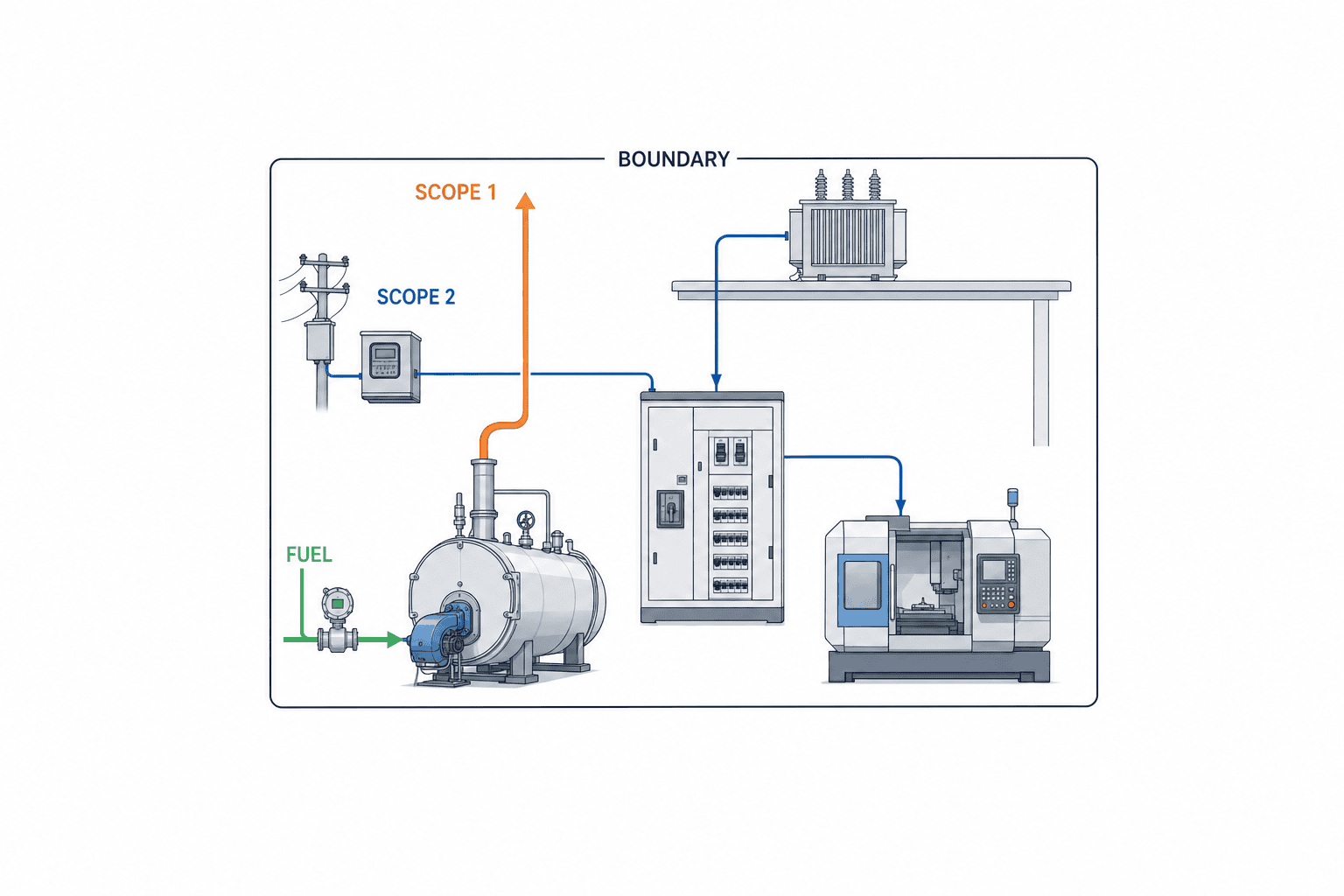
The boundary register should contain a boundary ID, asset, energy carrier, Scope, ownership/control rule, meter ID, evidence, effective dates, exclusion reason and approval. Link the structured register to drawings. When an asset moves or leased space changes, open a change request, assess the consequence and, where required, recalculate the base year under the same boundary.
Make the contiguous 12-month base year auditable
In ISO’s public preview, a base year is a historical contiguous 12-month period selected for comparison; it need not be January to December. A reporting year is also a 12-month period. A Thai factory may align it with its fiscal or operating cycle, but it should explain representativeness, rainy/dry seasons, major shutdowns and product launches. Selecting only the cleanest months without a documented rationale weakens the claim.
Freeze a base-year package in this order:
- Approve the boundary version and all inclusions and exclusions.
- Collect twelve months of electricity invoices, fuel deliveries, tank issues, steam bills and relevant logs.
- Normalize units, scaling, cut-off rules and time zone.
- Flag missing, estimated, corrected, duplicated and anomalous records; apply an approved treatment.
- Freeze factor sources, versions, applicability periods and GWP references.
- Calculate by Scope and carrier in tCO2e/year and retain a package that another person can reproduce.
The RFP should also define recalculation triggers: acquisition or divestment, a material boundary change, significant metering error, a method change, or outsourcing that creates an apparent reduction. Never overwrite history. Create a new version, retain the previous result and link the reason and approval.
OT/IoT architecture from meters to the tCO2e ledger
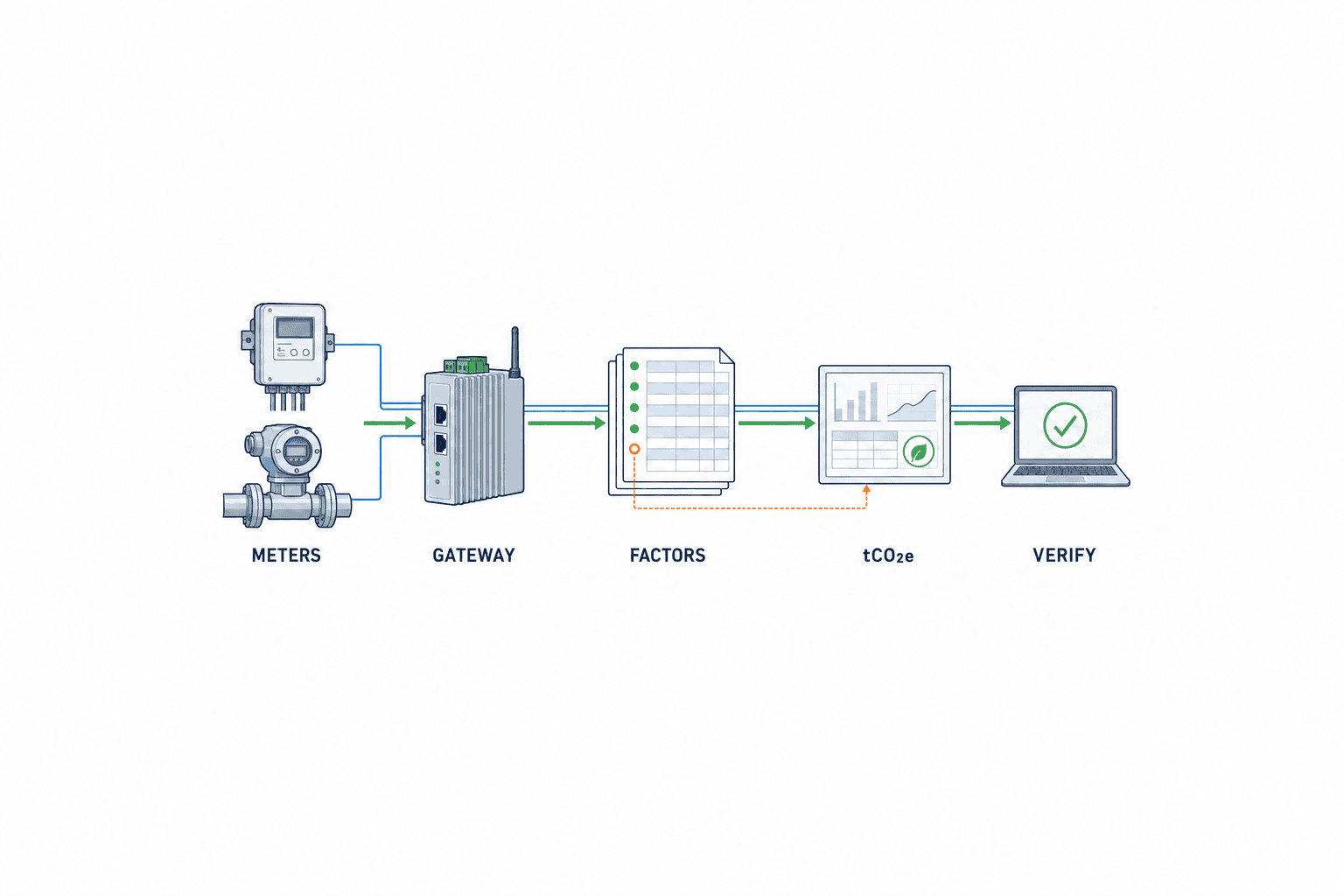
The priority is not the number of sensors; it is an unbroken evidence chain.
| Layer | Main records | Required controls |
|---|---|---|
| Source evidence | Electricity, fuel and steam invoices; delivery notes; contracts; meter photographs | File hash, received date, covered period, approval |
| OT acquisition | Power meter, flowmeter, PLC, BMS, boiler and generator tags | Tag dictionary, unit, scale, calibration, time sync, quality flag |
| Preparation | Interval/day/month aggregation, billing cut-off and gap filling | Transformation version, processing ID, reason and approval |
| Factors | Factors by energy carrier, GWP and contractual attributes | Source, version, geography, period, unit and evidence |
| Calculation | Activity × factor, Scope totals and absolute tCO2e/year | Formula version, input snapshot and unrounded values |
| Claim | Base year, reporting year, target, achievement and notes | Boundary version, workflow, evidence links and publication scope |
Map each physical meter to one governed tag. Retain the effective dates of old and replacement serial numbers. A communication failure must never become a zero: store zero consumption, no production, missing data and a communication fault as different states.
Invoices and interval data have different roles. An invoice is strong external evidence of a monthly total; 15-minute records explain operational causes and interventions. The monthly close should calculate the difference between the billed quantity and the OT total. If it exceeds an agreed threshold, the system should open an investigation rather than lock the claim.
Govern emission factors as a versioned master
An emission factor is not a timeless constant. It varies by carrier, geography, year, accounting method, contractual attribute and GWP basis. GHG Protocol is updating its Corporate Standard, Scope 2 Guidance and related documents, but states that existing standards and guidance remain in effect until it communicates otherwise. The correct control is therefore to store the version actually used, not to anticipate a draft rule.
At minimum, the factor master needs factor_id, carrier, Scope, method such as location-based or market-based, value, unit, gas coverage, GWP version, issuer, publication, issue date, effective dates, retrieval date, approval and evidence link. If more than one factor can apply, codify the selection rule.
Do not set purchased electricity to zero simply because a certificate or contract exists. Test the period, quantity, geography, accepted market rules, double-counting controls, residual-mix treatment and retirement evidence required by the chosen reporting method. Separate physical efficiency savings from changes caused by a factor or contractual instrument.
Fictional calculation for architecture screening
The following values illustrate the data structure only. They are not Thai official factors.
| Item | Activity | Illustrative factor | Illustrative result |
|---|---|---|---|
| Purchased electricity | 12,000 MWh/year | 0.45 tCO2e/MWh | 5,400 tCO2e/year |
| Stationary fuel | 18,000 GJ/year | 0.056 tCO2e/GJ | 1,008 tCO2e/year |
| Total | — | — | 6,408 tCO2e/year |
If electricity falls by 1,200 MWh and fuel by 1,800 GJ under the same illustrative factors, the example reduction is 1,200×0.45 + 1,800×0.056 = 640.8 tCO2e/year, or 10.0% of the example base total. A real claim still requires the current authoritative factor appropriate to its purpose, comparable methods and review of boundary and factor changes. This calculation guarantees neither certification nor verification.
Design a verifiable claim before designing the dashboard
ISO’s public preview distinguishes validation of a plan for future outcomes from verification of achieved historical results. “We have established a pathway” and “we reduced 640.8 tCO2e in the reporting year” need different evidence.
A claim template should identify the claiming entity and site, boundary, Scope, energy carriers, contiguous base and reporting years, absolute results, target, method and factor versions, boundary changes, recalculations, exclusions, uncertainty, evidence-pack ID, approval date, and whether the statement concerns a future plan or a past result.
Terms such as “carbon neutral,” “net zero” and “100% renewable” have requirements outside this standard’s core scope. Do not extend an ISO 50100 implementation into those claims without the applicable framework and evidence. Likewise, distinguish a vendor estimate, a measured PoC result and a full reporting-year outcome.
Mandatory content for a Thai factory RFP
A request for an “ISO 50100-ready system” cannot be compared objectively. Require concrete deliverables.
Business and governance
- Responsibility for purchasing the standard and completing a clause-level gap assessment
- RACI for plant management, EHS, energy, engineering, finance, procurement, IT, OT and assurance
- Boundary register, inclusion/exclusion review and change control
- Base-year rationale, recalculation policy and data-quality rules
- Targets, project portfolio, investment gates and claim approval
OT and instrumentation
- Meter list and electrical/process drawings for grid, branches, fuels and steam
- Accuracy, calibration status, scaling, CT/PT and pulse-loss detection
- PLC/gateway/protocol, local buffering, retry and time synchronization
- Segmentation, read-only OT access, accounts, logging and backup
Data and calculation
- Tag and unit dictionaries, quality flags and approved gap filling
- Invoice reconciliation, difference threshold and close/reopen workflow
- Factor version control, method views, recalculation and API/CSV exchange
- Lineage and tamper-evident audit records from source to claim
Non-functional and acceptance
- Retention, availability, recovery, performance and authorization
- Reproducible exports and calculations, not only multilingual screens
- FAT/SAT scenarios, tolerances, defect severity and correction deadlines
- Handover of configuration, registers, training and operating procedures
Compare five-year total cost, including instruments, panels, outages, networking, calibration, factor maintenance, assurance support and annual recalculation. A low subscription price can conceal recurring vendor work every time a factor changes.
A 90-day PoC with evidence gates
The purpose is not to complete an entire factory. It is to prove the evidence chain in a representative boundary: typically one electricity feed, one fuel stream and one key process.
Days 0–15 — freeze scope, evidence and ownership
Confirm the draft claim, site, Scope, candidate base year, invoices, meters and factors. Walk down the meters and record drawing-to-field discrepancies. Gate 1 approves the boundary register, RACI, data dictionary and PoC acceptance table.
Days 16–35 — acquire OT data and expose quality
Implement gateway reads, units, scaling, time synchronization, buffering and retry. Deliberately break communications. Missing data must not become zero, and recovery must not create duplicates. Gate 2 reviews completeness, time skew, duplicates, gaps and invoice reconciliation.
Days 36–55 — calculate the versioned ledger
Register the factor master and calculate Scope totals. Clone a factor into a new version and rerun the ledger without overwriting the original result. Export the input, formula and output under one calculation ID. Gate 3 requires an independent person to reproduce the result from the package.
Days 56–75 — action and claim workflow
Register project measurement points, assumptions, forecasts and results. Simulate a boundary change and a missing-data correction. Gate 4 confirms that unapproved data cannot enter a published claim and that revocation remains in the audit trail.
Days 76–90 — FAT/SAT and scale decision
FAT confirms configuration, calculation and exceptions. SAT confirms wiring, meter identities, communications, invoice close and user actions at the site. The go/no-go decision should be based on completeness, reproducibility, lineage, operating effort, cybersecurity and rollout cost—not visual polish.
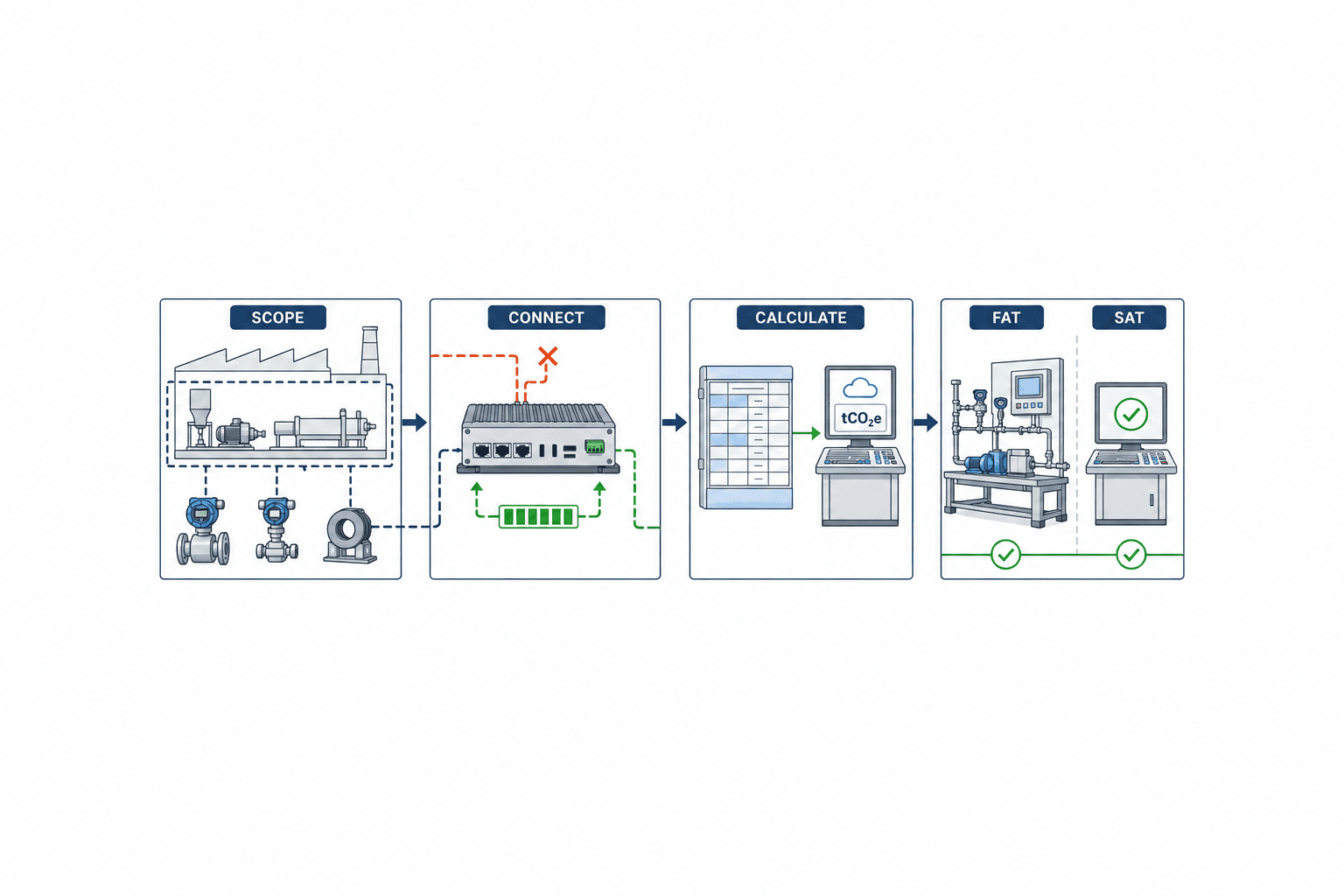
FAT/SAT acceptance matrix
| ID | Test | FAT evidence | SAT evidence | Example pass condition |
|---|---|---|---|---|
| BND-01 | Boundary-to-asset mapping | Register and simulated tags | Nameplate, drawing and tag walkdown | Unique ID for all items; exclusions approved |
| DAT-01 | Communications failure | Disconnect/retry log | Site gateway disconnect | No zero fill, no duplicate, quality flag present |
| DAT-02 | Time | UTC/ICT test | PLC and server time check | Aggregation boundary follows specification |
| REC-01 | Invoice reconciliation | Sample bill | Actual bill and monthly total | Within tolerance or investigation created |
| FAC-01 | Factor version | Old/new version rerun | Approved factor registration | Old result retained; overlapping periods detected |
| CAL-01 | tCO2e calculation | Known input and expected result | Independent site-month rerun | Unrounded result and formula version match |
| CHG-01 | Boundary change | Simulated asset transfer | Site change procedure | Recalculation decision recorded and approved |
| CLM-01 | Claim package | Evidence export | Approver workflow | Traceable to source; unapproved values excluded |
| SEC-01 | Access control | Role test | Production accounts | Read-only OT; factor and claim approvals separated |
| DR-01 | Recovery | Backup restoration | Site exercise | Restored within target and calculation hash matches |
Set quantitative tolerances in the RFP for invoice differences, time skew, completeness, processing and recovery. Do not copy a generic tolerance across every meter: align it with instrument accuracy, billing cut-off, process behavior and applicable requirements.
Treat BOI and DEDE as a parallel, conditional workstream
The current Thailand BOI Smart and Sustainable Industry page states a minimum efficiency-enhancement investment of THB 1 million, excluding land and working capital. It describes machinery import-duty exemption and, for existing projects, a three-year corporate-income-tax exemption capped at 50% of eligible upgrading investment. A 100% cap is described only under the stated domestic-automation condition. These are conditional program descriptions, not a promise that an ISO 50100 project qualifies. Confirm eligible activity, costs, application timing, implementation deadline and evidence directly with BOI and qualified advisers before investment approval.
The same current BOI page warns that applications for solar projects under the referenced alternative-energy efficiency measure ceased from 1 July 2025. Do not copy an expired solar window from an old presentation into a 2026 RFP.
DEDE’s e-service portal is an official entry point for relevant energy-efficiency services; it is not an automatic ISO 50100 certification portal. Confirm which reporting or support service applies. Reuse governed activity data where possible, but keep source, factor, calculation and output templates separate so regulatory form changes do not break the core ledger.
Operating controls after go-live
Monthly, reconcile bills and OT totals, review gaps and estimates, confirm factor periods, review Scope totals and action effects, then lock an approved evidence pack. Quarterly, review boundary changes, outsourcing and output effects; update forecasts; test access and recovery; and review proposed public claims. Annually, freeze the 12-month reporting year, perform an independent recalculation, assess base-year triggers, decide factor/method updates and coordinate assurance.
This cannot remain an EHS spreadsheet exercise. Finance owns invoices, engineering owns meters, IT owns the platform, OT owns safe connectivity, procurement owns contractual attributes and management approves claims. Separate the person maintaining factors from the final claim approver.
ISO 50100 implementation FAQ
What is ISO 50100?
It is a 2026 international standard specifying requirements and guidance for reducing energy-related GHG emissions. Its official core scope is energy-related Scope 1 and 2, with absolute results in tCO2e/year.
Is ISO 50001 certification required first?
The public ISO information presents ISO 50001 as a compatible foundation and Annex A explains the relationship; it does not state in the public scope that an ISO 50001 certificate is a prerequisite. Confirm any contractual or conformity-assessment condition with the chosen body.
Is Scope 3 mandatory?
No. The core is energy-related Scope 1 and Scope 2. An organization may include Scope 3 associated with energy consumption as an optional extension and should disclose its boundary and method.
Must the base year be a calendar year?
No. The public preview defines a contiguous 12-month period. Document why it is representative and how recalculation works.
Is better production intensity enough?
No. Intensity is useful operationally, but the official summary requires demonstration of absolute ERGE reduction aligned with targets. Track both.
Can we overwrite emission factors every year?
No. Version them with source, method, unit and effective dates. Assess the effect on comparability and retain historical results.
Can a 90-day PoC guarantee certification?
No. It tests a representative evidence chain and acceptance process. Certification timing depends on the full implementation, the normative text, the chosen body and closure of findings.
Does ISO 50100 automatically qualify for BOI incentives?
No. BOI conditions concern eligible activities, costs, timing and other criteria. The current page’s THB 1 million, three-year and 50% figures must be confirmed for the actual project.
What is the most important RFP acceptance criterion?
A competent independent person must be able to trace the claim to source evidence and reproduce the result, including handling of communication failure, missing data, factor changes and boundary changes.
Conclusion
An ISO 50100 implementation is not a carbon dashboard purchase. It is a controlled chain that connects energy-related Scope 1 and Scope 2 activity data, a contiguous 12-month base year, an explicit boundary, versioned factors, absolute tCO2e/year and approved evidence. Reuse ISO 50001 operating assets, but add claim-level traceability. Specify deliverables and acceptance in the RFP, and prove failure handling and recalculation during a 90-day PoC before scaling.
TOMAS TECH can help a Thai factory inventory meters, connect OT data safely, design the factor ledger, prepare the RFP, and run PoC and FAT/SAT activities. If you are still defining the boundary or requirements, you can contact us for an implementation discussion while normative, assurance and incentive decisions remain with the appropriate professional bodies.


