


GHG emissions management has moved from a corporate sustainability slogan to a factory-floor topic for Japanese manufacturers operating in Thailand. Two things changed the conversation. In December 2025 the Thai cabinet gave approval in principle to the Climate Change Act, and the EU Carbon Border Adjustment Mechanism (CBAM) entered its definitive phase in 2026. The Thai bill is not law yet, but waiting for it is no longer a safe default. This article walks through Scope 1, 2 and 3, the current status of the Thai bill, what CBAM already demands, and how to build the data collection layer that everything else depends on.
What GHG emissions management actually means
Energy saving and emissions management are not the same thing
Most Japanese factories have been running energy-saving programmes for years. Cut kilowatt-hours, cut the electricity bill, and the benefit lands straight on the P&L. GHG emissions management has a different character. Before you reduce anything, you are asked to state how much you emit in a form that someone outside your company can examine.
Energy saving can live entirely inside the plant as an improvement activity. Emissions management assumes third-party verification, government reporting, and disclosure requests from customers. You may be handling the same kilowatt-hour data in both cases, but the requirements diverge sharply. A monthly total is enough to steer internal improvement. Producing evidence that can be traced back by equipment and by period is a different specification, and it changes what you must measure and how long you must keep it.
Why the pressure is arriving now for Japanese plants in Thailand
For a Japanese-owned plant in Thailand, the pressure comes from three directions at once. The first is the parent company in Japan, where sustainability disclosure in annual securities filings has expanded and consolidated overseas sites are now asked to submit emissions figures. The second is Thai domestic regulation, with the Climate Change Act at its centre. The third is customers, particularly those shipping finished goods into the EU.
The three ask for different formats on different deadlines. The parent company works to the consolidated reporting calendar. The regulator will want a prescribed form. The customer wants figures tied to a product or a process. Handling each request separately means the plant re-aggregates its electricity data every time. Store the underlying consumption data in one place, however, and you are only changing the presentation layer. That is the practical reason to treat emissions management as a system rather than as a recurring reporting chore.
Defining Scope 1, Scope 2 and Scope 3
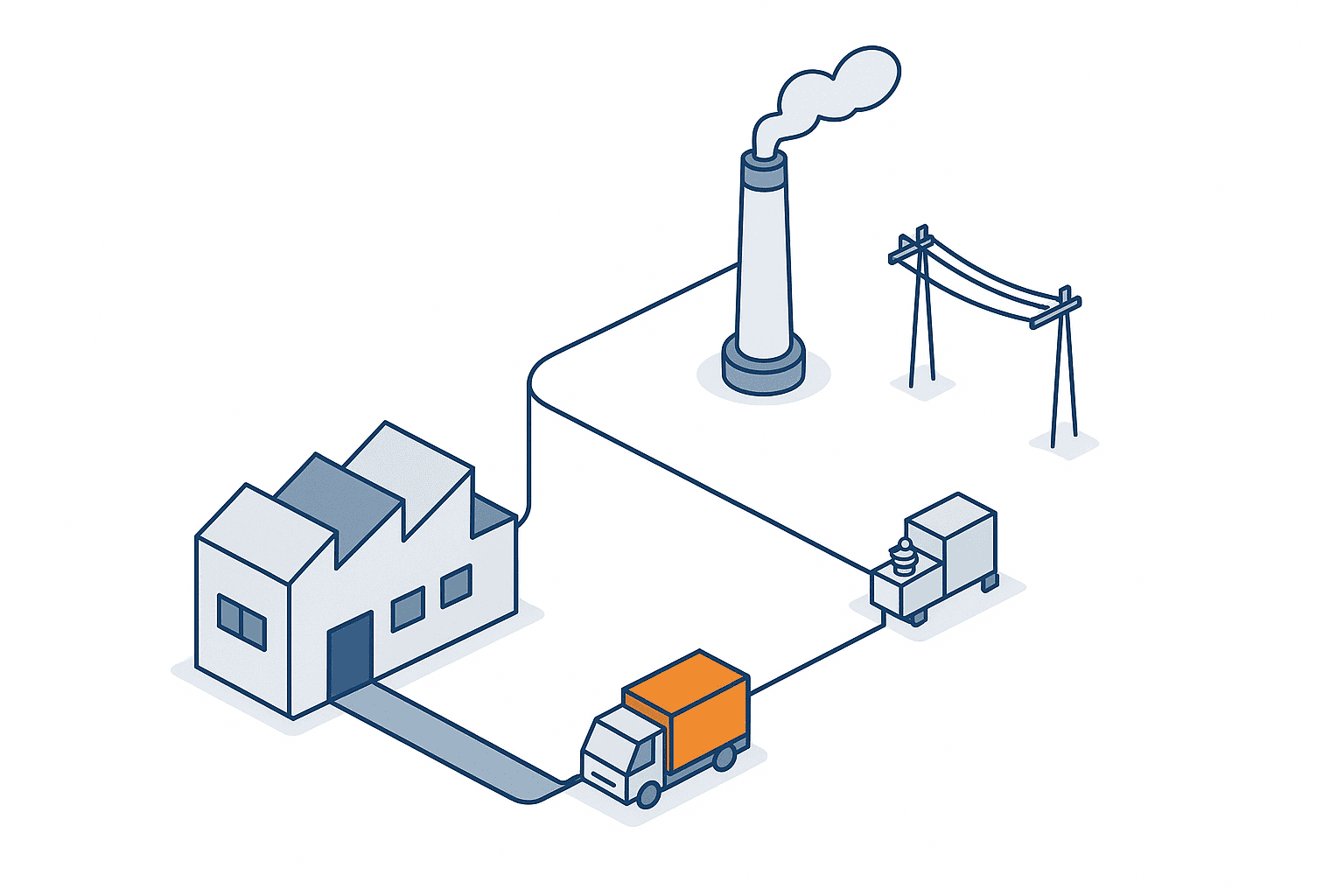
Emissions are calculated across three scopes, following the internationally accepted framework that also underpins the Japanese Ministry of the Environment guidance on supply chain accounting.
- Scope 1 covers direct emissions from sources the company owns or controls, such as fuel burned in boilers and industrial furnaces, and fuel used by company vehicles.
- Scope 2 covers indirect emissions from purchased electricity, heat and steam. For most plants this means grid electricity.
- Scope 3 covers everything else in the value chain that the company does not directly control, from raw material procurement and transport through to product use and disposal, organised into 15 categories.
Translated into factory practice, the three scopes look like this.
| Scope | What it covers | Typical factory examples | Where the data comes from |
|---|---|---|---|
| Scope 1 | Direct emissions from owned or controlled sources | Boiler fuel combustion, gas fired furnaces, company vehicle fuel | Fuel purchase records, refuelling logs, gas flow meters |
| Scope 2 | Indirect emissions from purchased electricity, heat and steam | Grid electricity, purchased steam | Utility invoices, on-site electricity meters |
| Scope 3 | Value chain emissions outside direct control, across 15 categories | Raw material procurement, inbound and outbound transport, commuting, product use and disposal | Primary data from suppliers, or spend multiplied by emission intensity factors |
Where manufacturers usually get stuck
Once the calculation starts, Scope 1 and Scope 2 tend to come together within weeks, and then the work stalls on Scope 3. The reason is straightforward. Scope 3 data does not live inside your company. You need actual figures from material suppliers and logistics providers, and if they have not calculated their own emissions, there is nothing to receive.
The workable sequence is therefore to lock down Scope 1 and Scope 2 first, start Scope 3 with a spend-based estimate using sector emission intensity factors, and then replace the estimates with primary data supplier by supplier, beginning with the most material ones. We cover the collection mechanics in more detail in our article on supply chain emissions data collection.
Where Thailand’s Climate Change Act stands today
Approved in principle by the cabinet on December 2, 2025
The Thai Climate Change Act was approved in principle by the cabinet on December 2, 2025. The wording matters. Approval in principle is not enactment, and the bill is not yet law.
The draft is currently under review by the Council of State, and parliamentary deliberation follows after that. Another cabinet approval is required before the bill is submitted to parliament. Several procedural gates therefore remain, and no commencement date has been fixed. At this stage there is no confirmed timetable to plan against.
What the draft requires in terms of calculation, verification and reporting
The substance of the draft, on the other hand, is already fairly specific. According to reporting and law firm commentary, operators whose annual GHG emissions exceed 3,000 tonnes of CO2e, or who fall within designated industries, would be required to calculate emissions using internationally recognised standards, obtain third-party verification, report to the Department of Climate Change and Environment (DCCE), and submit to audit.
A threshold of 3,000 tonnes of CO2e is not a large-enterprise-only line. Working backwards from the grid emission factor discussed below, a plant can reach that level on purchased electricity alone, at a size that is unremarkable in a Thai industrial estate. Whether you fall in scope is something you can estimate today from your existing electricity and fuel consumption, without waiting for the bill to pass.
How penalties were framed at the draft stage
Earlier drafts also addressed sanctions. International law firm commentary indicates that fines ranging from 10,000 baht to 5,000,000 baht depending on the severity of the breach were under consideration, alongside additional sanctions of up to three times any profit gained from the violation, and joint liability for directors and executives.
These figures reflect what was being considered at the draft stage, not confirmed final provisions, and the bill may change during parliamentary deliberation. The point to take away is not the exact numbers but the direction of travel. Emissions reporting is being designed as an obligation backed by sanctions, not as a voluntary target.
The relationship with T-VER
Thailand already operates T-VER, a voluntary carbon credit programme launched in 2012 by the Thailand Greenhouse Gas Management Organization (TGO). Projects undergo third-party validation and verification, register with TGO and receive credits. Participation has been voluntary throughout.
The Climate Change Act is understood to provide a statutory foundation for existing arrangements including T-VER. In other words, a framework that has operated as a voluntary initiative is moving toward one with legal backing. For companies already participating in T-VER, the practical experience of calculation and verification is directly transferable to future compliance.

CBAM already requires action from 2026
The transitional period ended at the close of 2025
Concluding that no action is needed because the Thai bill is still a draft is a risky read, because EU regulation is already asking for the work regardless of what happens in Bangkok.
The EU CBAM ran a transitional period from October 2023 to the end of December 2025. During that phase only emissions reporting was required, with no financial charge. The definitive regime began on January 1, 2026. Thai companies exporting covered goods, which include iron and steel, cement, aluminium, fertilisers, hydrogen and electricity, face annual emissions reporting from 2026 onward. From 2034 onward, certificates are expected to be required for 100 percent of the embedded emissions in covered goods.
The essential point is that CBAM is EU legislation and does not wait for the Thai Climate Change Act. If your business touches covered goods heading to Europe, practical obligations already exist. Setting the two regimes side by side makes the difference clear.
| Item | Thailand Climate Change Act | EU CBAM |
|---|---|---|
| Current status | Approved in principle by the cabinet on December 2, 2025, now under Council of State review | Transitional period ran from October 2023 to the end of December 2025, now in the definitive phase |
| What happens next | A further cabinet approval before submission, then parliamentary deliberation | Definitive regime from January 1, 2026, with certificates expected for 100 percent of embedded emissions from 2034 |
| Who is covered | Operators exceeding 3,000 tonnes of CO2e per year, or in designated industries, per the draft | Exporters of covered goods such as iron and steel, cement, aluminium, fertilisers, hydrogen and electricity |
| What is required | Calculation to international standards, third-party verification, reporting to DCCE and audit, per the draft | Annual emissions reporting, and certificate purchase in future phases |
| Timing | Commencement date not yet fixed | In force since January 1, 2026 |
Indirect exporters are not insulated
Not exporting to the EU yourself does not put you out of reach. Companies handling covered goods must quantify the emissions embedded in their products, so they turn to the suppliers who provide their materials and processing and ask for emissions data. That is the mechanism by which a Japanese-owned supplier in Thailand receives a request from an EU-bound customer to report emissions for its portion of the process.
Those requests usually arrive with short deadlines. If you only start designing your electricity aggregation method after the request lands, historical data cannot be reconstructed and you are left offering a weakly supported estimate. In this area the gap between companies that already collect data and those that do not translates directly into a difference in how customers rate them.
The request is also rarely satisfied by a plant-wide annual total. What the customer needs is the emissions attributable to the specific product they buy, which means allocating the plant figure by output volume or machine hours to a product or process level. Making that allocation credible requires electricity data that can be lined up against production records on the same time axis. Emissions accounting looks like an environmental function, but in practice it succeeds or fails on whether it connects to production management data.
How to actually collect the emissions data
Measurement points for Scope 1
Scope 1 can be calculated once you know how much fuel you burn. The representative measurement points in a factory are the LPG, natural gas or fuel oil supplied to boilers and furnaces, the fuel used by forklifts and trucks, and refrigerant top-ups.
In most plants these already exist as purchase records and refuelling logs held by the accounting or procurement team, which is why Scope 1 can begin with a document gathering exercise. The limitation appears when several pieces of equipment share a fuel supply. Invoices are sufficient for a plant-level total, but identifying which asset to tackle first requires flow metering at equipment level.
Measurement points for Scope 2 and the grid emission factor
Scope 2 is usually the largest share of emissions for a manufacturer. The calculation itself is simple arithmetic, purchased electricity multiplied by an emission factor. For Thailand, practitioner guidance cites an EGAT grid CO2 emission factor of approximately 0.4999 tonnes of CO2e per 1MWh, referencing 2023 TGO and EGAT figures. That source is practical reference material rather than legal advice, so treat the number as an indicative figure, but it is more than adequate for checking whether you sit near the 3,000 tonnes of CO2e threshold.
Applied to a plant purchasing 6,000MWh of electricity per year, the factor puts Scope 2 alone at roughly 3,000 tonnes of CO2e. Add Scope 1 fuel on top and it becomes clear that a mid-sized plant can approach the threshold. A useful first step is simply to lay out twelve months of utility invoices and see where your site actually sits.
The limits of invoice-based data
A utility invoice gives you a plant-wide monthly total. That is fine for gross figures, but it falls short in three situations.
- Identifying which equipment or which line is driving the emissions
- Producing a per-unit product carbon footprint
- Confirming whether a reduction measure worked, without waiting for the next monthly cycle
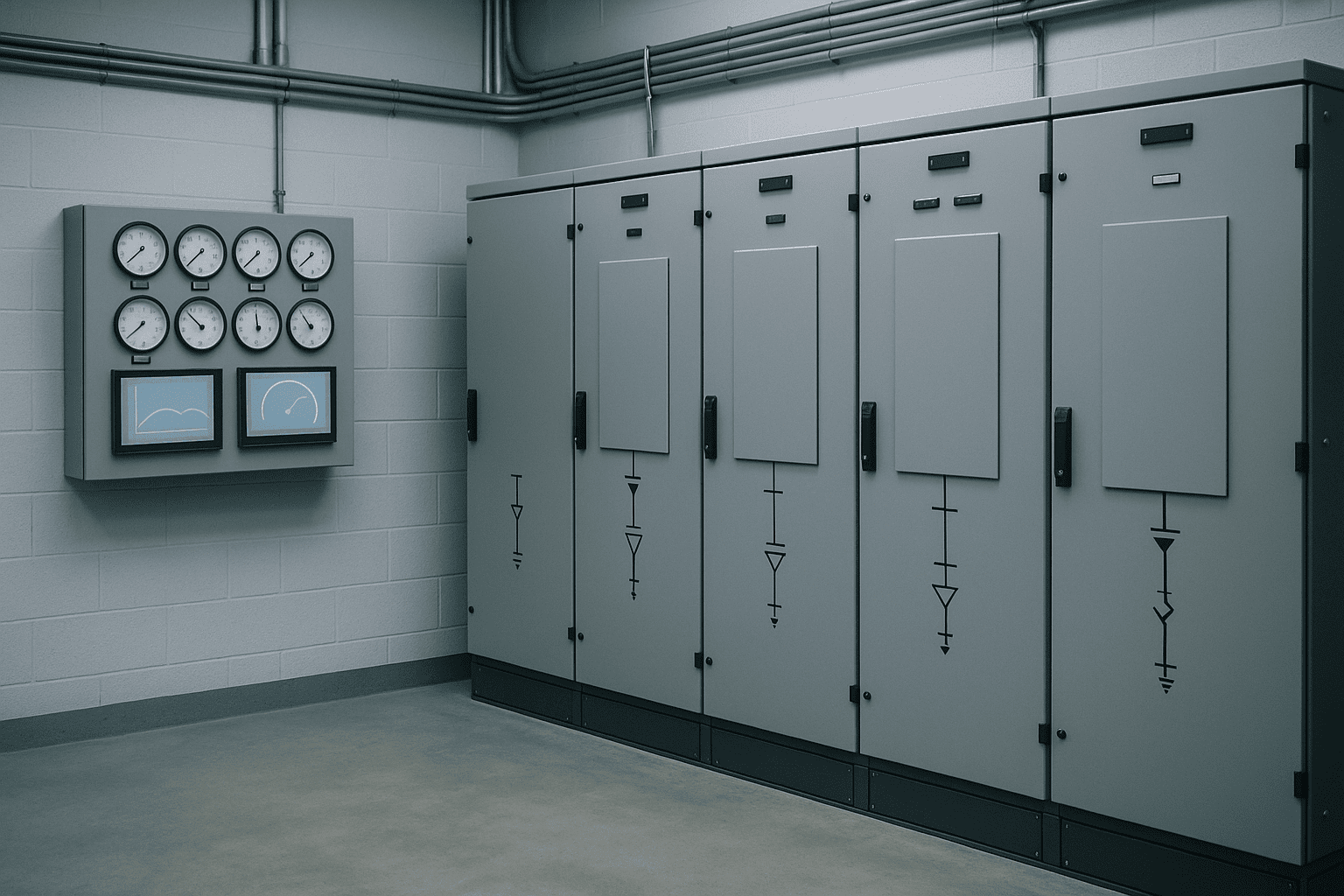
Answering these requires continuous measurement not only at the incoming supply point but at major distribution boards and individual assets, stored as time series data. Existing meters with pulse or Modbus outputs can often be read directly, and where no such output exists, retrofitting clamp-type CT sensors is frequently viable. Whether installation can proceed without stopping production depends on how each plant’s panels are configured, so a site survey beforehand is essential.
The energy monitoring solutions TOMAS TECH provides sit exactly in this layer. They collect data from meters and equipment across the plant, accumulate it as time series, and consolidate it into dashboards, so that the primary data needed for emissions accounting keeps building up as a matter of routine. Our article on energy monitoring systems for factories covers the deployment picture in more detail.
Deciding how granular to go
More measurement points mean more analytical freedom, and also more capital cost and installation work. In practice it is realistic to expand in stages rather than instrumenting everything at once.
- Meter the incoming supply point and reconcile it against the utility invoice
- Split by main distribution board to obtain a breakdown by building or by process area
- Meter high-consumption assets individually, such as compressors, HVAC and large machining centres
- Break down to line or machine level only where product-level allocation is genuinely required
Each stage produces the information needed to justify the next investment. If the incoming supply point and the invoice do not reconcile at step one, the measurement chain itself has a problem, and that has to be resolved before finer metering is worth doing.
Making the data defensible
Once third-party verification is in view, it is no longer enough for the data to exist. You need to be able to explain why the number is right. Verifiers typically probe the following.
- Whether drawings show where each meter is installed and which loads it captures
- Whether instrument accuracy class and calibration records are retained
- How gaps caused by communication loss or power outages were filled, and whether that can be explained
- Whether the source and vintage of each emission factor is recorded, with reasons documented for any change
Retrofitting all of this after a system is live is laborious. Simply preparing a measurement point layout drawing and a register of emission factors at the outset substantially reduces the verification burden later. Gap handling in particular needs a rule agreed in advance, otherwise each staff member fills gaps differently and the figures become impossible to reconstruct.
A roadmap toward carbon neutrality
Measure, visualise, reduce, report, in that order
Carbon neutrality programmes at factory level very often begin with reduction, because measures such as rooftop solar or high-efficiency equipment replacement are tangible and easy to put to an investment committee. The problem is that reduction without a measurement layer leaves you unable to quantify the effect, which means no evidence base for the next investment.
A sounder sequence is measure, visualise, reduce, report. Setting out what each stage involves gives the following picture.
| Stage | Main activities | Deliverable | Common pitfall |
|---|---|---|---|
| Measure | Collate fuel records, install metering points, automate data collection | Consumption data by asset and by period | Meter readings do not reconcile with invoices, data gaps appear |
| Visualise | Apply emission factors, convert to CO2e, consolidate into dashboards | Monthly and daily trends for Scope 1 and Scope 2 | Factor source and vintage are not being managed |
| Reduce | Improve operation of major loads, replace equipment, procure renewable energy | Measured effect of each individual measure | No baseline defined for measuring the effect |
| Report | Support third-party verification, disclose to regulators and customers | A complete, verifiable calculation evidence set | The basis for historical data cannot be reproduced afterwards |
Do not skip the visualisation step
The visualisation stage between measurement and reduction is frequently skipped, but it is what makes internal alignment possible. When targets arrive without the numbers being visible on the floor, teams do not know what to act on and the activity fades. Conversely, when emissions become visible by line and by shift on a daily basis, the floor starts spotting improvement opportunities itself. We deal with the design of this stage concretely in our article on factory CO2 emissions visualisation.
Why a small start is the right call
Attempting a complete company-wide system in one pass tends to consume months in requirements definition, and programmes often stall once executive attention has moved on. Starting with one building, one line, or the handful of assets with the highest consumption puts a first dashboard in front of people within a few months.
The real value of starting small is not the lower cost. It is finding out early which data your plant can actually produce and which it cannot. With that understanding in hand, you can extend only the parts you need when the regulatory picture firms up. While the details are still unsettled is precisely the right moment to put in place a data foundation that is easy to extend.
When will GHG emissions management become mandatory
As of August 2026 no commencement date has been fixed for the Thai obligation. The Climate Change Act was approved in principle by the cabinet on December 2, 2025, but Council of State review, a further cabinet approval and parliamentary deliberation remain ahead of it.
The EU CBAM, by contrast, has been in its definitive phase since January 1, 2026, and companies connected to covered goods already have practical obligations. Rather than waiting to learn when the mandate arrives, the pragmatic posture is to be in a position to answer a customer disclosure request whenever it lands.
Does this apply to small and medium-sized companies
The threshold in the draft is annual GHG emissions exceeding 3,000 tonnes of CO2e, or membership of a designated industry. The line is drawn by emissions and sector, not by capital or headcount.
A company that counts as small or medium-sized by employee numbers can therefore fall in scope if it operates electricity or fuel intensive processes. Using the indicative factor of 0.4999 tonnes of CO2e per 1MWh, you can approximate where your site sits relative to the threshold today. That modest exercise is worth doing before assuming you are out of scope.
How does CO2 visualisation differ from GHG emissions management
CO2 visualisation is about sharing collected data internally, typically through dashboards, so that it drives improvement. GHG emissions management includes that, and adds the requirement to retain a calculation basis that can be explained externally and can withstand third-party verification and regulatory reporting.
The practical difference shows up in retention periods and traceability. Visualisation needs recent trends. Reporting needs the source and vintage of every emission factor used, the installation position and calibration record of every instrument, and the method used to fill any gap, all retained in a form that can be explained afterwards. Both activities stand on the same data foundation, but the level of rigour required is a step apart.
Where should Scope 3 accounting start
Trying to populate all 15 Scope 3 categories from the outset reliably leads to deadlock. The practical approach is to produce a first-pass estimate across all categories using spend multiplied by sector emission intensity factors, then identify the two or three categories that dominate by both spend and emissions.
For most manufacturers, purchased goods and services (category 1) and transportation (category 4) come out on top. The next step is to build a mechanism for receiving primary data from key suppliers in those categories. Going deep on the material categories stands up better to customer disclosure requests and third-party verification than spreading thin effort across all fifteen.
Summary
Thailand’s Climate Change Act was approved in principle by the cabinet on December 2, 2025, and the draft points toward mandatory calculation, third-party verification and reporting for operators exceeding 3,000 tonnes of CO2e per year. Council of State review and parliamentary deliberation still lie ahead, and no commencement date has been set.
The EU CBAM, meanwhile, entered its definitive phase on January 1, 2026, and companies connected to covered goods already face practical obligations. Certificates are expected to be required for 100 percent of embedded emissions from 2034, and requests for emissions disclosure will increasingly reach suppliers who never ship to Europe themselves.
Put side by side, the two regimes leave very little room for a wait-and-see position. Using the indicative factor of 0.4999 tonnes of CO2e per 1MWh, you can estimate where your plant sits against the threshold today. Start by getting continuous measurement in place at the incoming supply point, then work through measure, visualise, reduce and report in sequence. The most commonly overlooked trap in this field is simple. Once the rules are settled, you cannot go back and recreate data you never collected.
Working out how far your plant’s data can realistically go, and which measurement point to start from, is often something that can be sketched out quickly from single-line diagrams and a year of utility invoices. TOMAS TECH works with factories in Thailand on IoT-based electricity data collection and dashboards, and we are happy to discuss the data foundation behind emissions accounting. Early-stage enquiries are welcome, so please get in touch through our contact form.
References
- Current Status and Issues in the Preparation of Thailand’s Climate Change Bill – Institute of Developing Economies (IDE-JETRO), Policy Brief No. 278
- Thailand’s future regulations on climate change – Legal500
- The impact of Thailand’s Climate Change Bill – Norton Rose Fulbright
- Basic Guidelines on Accounting for Greenhouse Gas Emissions Throughout the Supply Chain – Ministry of the Environment, Japan
- Carbon tax and the Climate Change Act – what factories in Thailand need to prepare – Capital Solar


