


Accounting AI Efficiency: A 90-Day Guide for Thailand
For a manufacturer or regional subsidiary in Thailand, accounting AI efficiency does not come from comparing OCR accuracy alone. If evidence remains scattered across email, paper, e-Tax data, shared folders and supplier portals—and validation, approval and posting still depend on personal memory—automating data capture merely moves the bottleneck. This guide explains how to design a closed loop from evidence capture to month-end close: AI proposes, deterministic rules validate, authorized people approve, and every action remains auditable. It includes practical RFP requirements, TOMAS TECH’s proposed 90-day PoC, audit trails and an assumptions-based business case for CFOs and finance leaders.
Conclusion: accounting AI efficiency needs a human-approved closed loop
The recommended target is not unattended AI bookkeeping. It is a controlled flow that (1) captures every document, (2) compares extracted values with the original and reference data, (3) presents evidence to an authorized approver, (4) sends an approved journal proposal to the ERP, (5) routes exceptions back to accountable owners, and (6) shows open items and changes at month-end.
AI can extract fields from Thai, English and Japanese documents, suggest account or tax-code candidates, and retrieve similar approved cases. A rules engine tests explainable conditions such as tax ID, currency, PO, goods receipt, amount, accounting period, duplicates and approval limits. A person makes the final decision. The system records who reviewed which evidence and whether they accepted, amended or rejected the suggestion. This division of responsibility preserves useful automation without erasing accountability.
TOMAS TECH can support an initial current-state assessment, RFP definition or 90-day PoC scoping before any product decision. If you want to define which steps a Thai operation can automate and where human approval must remain, please use our contact page.
Why invoice processing automation stalls when it stops at AI-OCR
Reading an invoice and safely completing its accounting treatment are different tasks. Even when AI-OCR extracts an invoice number, date, supplier, net amount and tax, it cannot establish from the image alone whether the document is authentic, duplicated, consistent with a purchase order and goods receipt, subject to the correct VAT or withholding treatment, or recorded in the correct period. Those decisions require master data, transaction data, policy and accountable judgment.
Thai operations may receive paper, PDFs, structured e-Tax material, portal downloads, email attachments and scans. The Thai Revenue Department provides an official e-Tax Invoice & e-Receipt portal and publishes ICT standards for electronic tax transactions, including information security, electronic data retention, data format, data exchange and electronic signatures. Therefore, “the value was read from an image” is not a sufficient system boundary. The original, any structured payload, validation result and approval outcome should remain connected.
One common failure is a convincing OCR demonstration followed by rising exceptions in production. The evaluation set may contain mostly clean invoices while production includes stamps, handwriting, mixed languages, currencies, credit notes, prepayments and damaged scans. Another failure occurs when the review screen is slow or unclear, so accountants export data and retype it into spreadsheets. Both are end-to-end design issues, not merely model issues.
For the matching step, see our guide to goods receipt and invoice matching in Thailand. For product evaluation criteria, use the AI-OCR comparison and RFP guide for Thailand. This article covers the wider loop before and after matching.
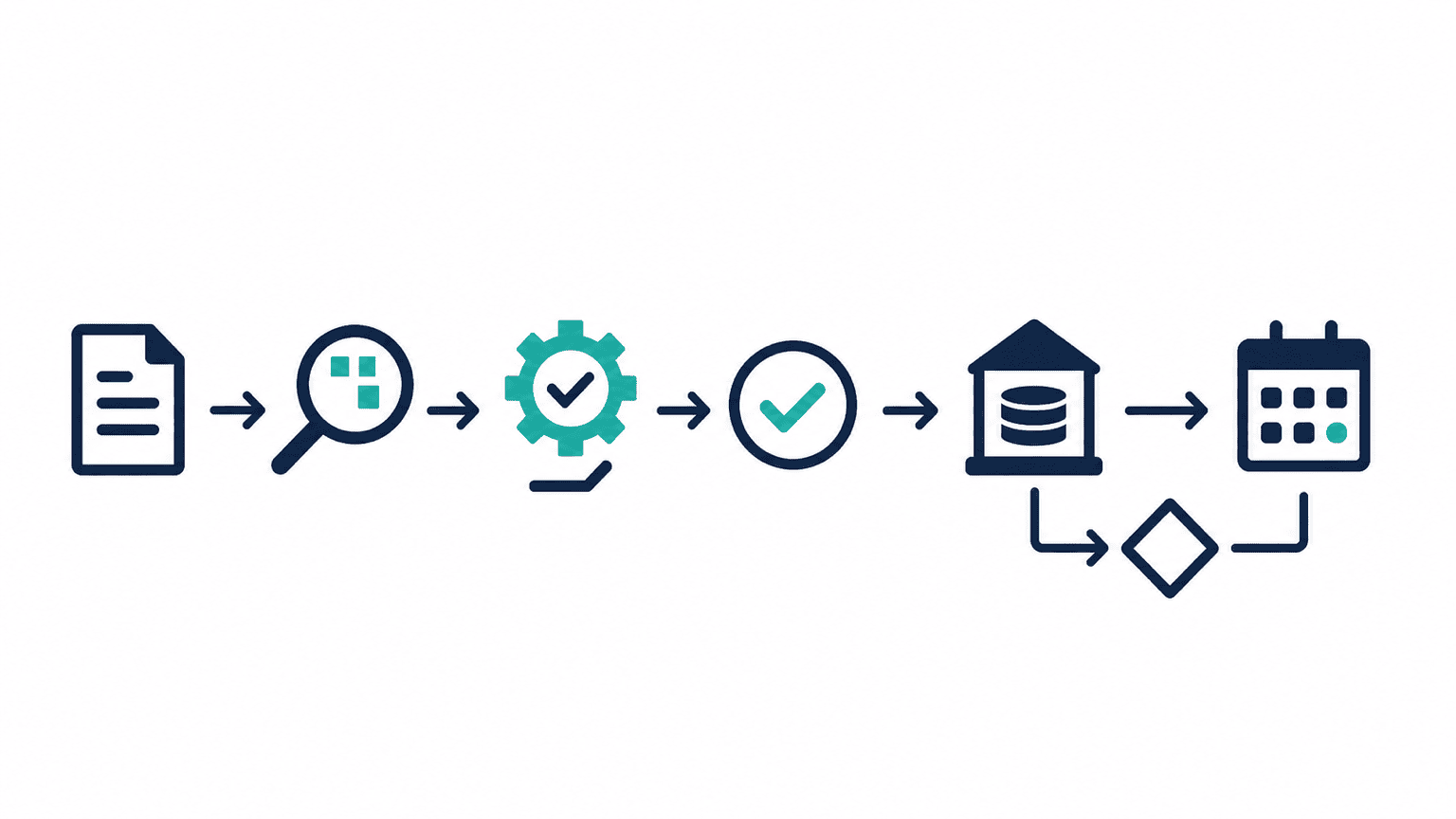
Building a human-approved closed loop for a Thai operation
1. Evidence capture: put email, paper, e-Tax and portals into one intake ledger
Standardize the intake ledger before trying to standardize every file. Give each item an intake ID, received timestamp, source, legal entity, site, document type, immutable original location and processing status. Link attachments to their message IDs, scans to the operator and device, and electronic submissions to their received files and verification information. Never overwrite the original.
At intake, check malware, corruption, password protection, missing pages, identical hashes and known invoice numbers. Do not discard unreadable material; route it to a “request replacement” queue. If the intake layer silently loses evidence, the month-end team will spend its saved time searching for unrecorded liabilities.
2. Data entry automation: AI returns both a value and its evidence location
An AI-OCR service should return more than a normalized value. It should retain the source page, coordinates, source text, confidence indicator and model version. A reviewer should be able to compare the extracted invoice number with the highlighted source without opening a separate repository. When Thai and English legal names differ, show both the source wording and the proposed supplier master match.
Data entry automation can include lines, VAT information, withholding-related fields, PO or contract number, cost-center candidate and payment terms—not just header data. Yet each output remains a candidate. Deterministic tests confirm required fields, length, date range, line-to-total arithmetic, currency and master-data existence.
3. Validation: use rules and reference data for explainable decisions
Do not use an AI confidence score as the only pass/fail test. Prefer rules that can be reproduced: the tax ID matches the supplier master; the invoice number does not duplicate an earlier document; the invoice date falls within an allowed period; a PO and receipt exist; and calculated lines reconcile to the total. Store the rule version, execution time, input, result and exception reason.
For e-Withholding Tax, the Thai Revenue Department explains that tax and payment information can be searched within 6 business days from payment through a participating bank, provided that the bank has submitted accurate and complete information. A missing result immediately after payment is therefore not automatically an error. The workflow needs a waiting state and scheduled recheck that respect this official timing condition.
4. Approval: route by amount and exception, with evidence visible
The approval workspace should show the original, extracted values, changes, rule failures, PO/receipt/contract references, proposed journal and similar prior treatments. Configure authority by entity, department, amount, expense class, supplier and related-party status. Record the period and reason for delegated approval, and prevent self-approval or segregation-of-duties violations.
Reviewers need a way to amend suggestions and record why. Structured reasons—wrong tax code, wrong supplier match, accounting-period change or exceptional contract term—help distinguish model improvement from policy improvement. Feeding every exception into training can teach the model that an exceptional judgment is normal.
5. AI-assisted ERP posting: send only approved journal proposals to the ERP
Avoid letting AI write directly to the production ledger. Send approved proposals through an interface ledger that records an integration ID, ERP document number, send time, response, retry count and relation to cancellations or reversals. If the ERP rejects a transaction, use an idempotency key so that a retry cannot create a duplicate.
AI may suggest a general-ledger account, tax code or cost center using the supplier, item, contract, department and previously approved entries. The acceptance rule and human approval must remain visible, and AI should not create new master records on its own. The main value of AI-assisted ERP posting is not merely removing keystrokes; it is preserving meaning from an approved decision through to a traceable ERP document.
6. Exception processing: design the queue before the happy path
In practice, exception speed determines close speed. “Low OCR confidence” is only one category. Separate missing evidence, unregistered supplier, missing PO, receipt variance, pending tax judgment, suspected duplicate, out-of-period item, unavailable approver and ERP error. Assign an owner, due date and escalation route to each.
Show the impact on close, not only a generic priority. A low-value item may still require special handling as a prepayment, fixed asset or related-party transaction. Repetitive transactions that fully meet approved rules can receive simplified review, but the exact simplification conditions must be logged and available for sample review.
7. Month-end close: one control view for open items, changes and failed integrations
The close view should show received-but-unprocessed items, approvals pending, exceptions, unsent ERP items, integration failures, cancellations and carry-forwards by entity, site and owner. A user must be able to trace from evidence ID to original, decision, journal and ERP document. Changes after close require before/after values, actor, approver and reason.
With this loop, a finance leader manages more than “how many documents the AI read.” They can see which evidence passed which controls, who approved it, which accounting document resulted, and what remains open. That is auditable accounting AI efficiency.
RFP requirements for an AI-OCR implementation
Write an RFP as testable questions and evidence requirements, not as a marketing feature list. “AI enabled” and “ERP integration available” do not define the supplier’s responsibility or the acceptance condition. A common response format based on the table below makes vendors easier to compare.
| Area | Requirement to test in the RFP | Acceptance evidence |
|---|---|---|
| Evidence capture | Intake from email, scan, shared folder and e-Tax-related data; immutable original and duplicate detection | Intake ID, hash, receipt log, replacement queue |
| AI-OCR | Thai, English and Japanese; headers and lines; coordinates, source text, confidence and model version | Source-versus-output screen and results by evaluation segment |
| Validation | Where master, PO, receipt, contract, tax and accounting rules execute | Rule version, inputs, decision and exception-reason logs |
| Approval | Authority by amount, entity and department; delegation, segregation, return and correction reason | Approval, return and authority-change histories |
| Journal proposal | Basis for account, tax-code and cost-center suggestion; accountable finalizer | Candidate, accepted value, amendment and approver |
| ERP integration | API/file method, idempotency, retry, response, cancellation and reversal | Integration ID, ERP document number and error log |
| Exception management | Category, owner, due date, escalation and close impact | Queue history, elapsed time and reassignment history |
| Audit and security | Access, encryption, retention, deletion, log export and subcontractor control | Configuration, access log and sample export |
| AI governance | Purpose, data boundary, human oversight, evaluation, change control and stop procedure | Model-card equivalent, tests and approval record |
| Operations | Incident notice, recovery, support, version changes and continuity | Runbook, exercise record and sample incident report |
Require vendors to label each answer as standard, configuration, custom development, third-party product or customer operation. Confirm data location and retention, training use, subprocessors, notice of model changes and log-export mechanisms. During the PoC, verify that contract statements match deployed settings.
Governance should become operating controls, not a slide. The NIST AI RMF is voluntary and organizes its core around Govern, Map, Measure and Manage. In finance terms: define accountability and policy; map the use context and impact; measure extraction, exceptions and controls; then correct, restrict or stop the service. When generative AI supports journal explanations or operator questions, the NIST Generative AI Profile and ETDA guidance help identify additional risks.
ETDA’s AI 2026 announcement described 12 available AI-governance guidelines/toolkits and 2 more under development in 2026. Those counts do not certify a vendor or prove legal compliance. Ask the vendor which guidance it used, which components are in scope, which controls were implemented and which residual risks remain.

TOMAS TECH’s 90-day PoC for invoice processing automation
The following 90 days are a TOMAS TECH proposal model, not a statutory period or public standard. The objective is to operate the complete loop for a limited entity, site and document population, then decide whether the process, controls, integration and support are acceptable.
| Period | Main work | Deliverable and gate |
|---|---|---|
| Day 1–15 | Examine workflow, intake routes, exceptions, authority, ERP integration and baselines | As-Is/To-Be, data register, risk register and acceptance criteria |
| Day 16–30 | Configure intake, immutable storage, extraction schema, rules and master connections | Sample flow, field dictionary, rule list and authority design |
| Day 31–60 | Parallel-run real data; test approval UI, exception queues and ERP integration | Daily issue log, extraction/correction logs, exception classes and integration evidence |
| Day 61–75 | Rehearse close, access review, failure, retry and cancellation | Close checklist, authority review and recovery results |
| Day 76–90 | Evaluate KPIs, controls and cost; decide production scope and improvements | Go/conditional-go/no-go decision and rollout roadmap |
Day 1–15: measure the baseline and narrow scope
Do not select only clean, normal documents. Include major suppliers, languages, currencies, paper/PDF/electronic sources, PO and non-PO cases, credit notes and difficult scans. Set privacy and confidentiality rules and use only data approved for the PoC environment.
Define and measure your own intake-to-approval elapsed time, manual touch time, returns, duplicates, open items and ERP failures. Do not adopt an external “average” as the target: sites differ in intake channels and approval depth, so only a local baseline supports an investment decision.
Day 16–30: establish the data contract and rules first
Define field names, types, mandatory conditions, source-text retention and missing-value handling as a data contract. Decide how supplier, account, tax-code and cost-center masters are joined. Put a normalization layer between AI output and ERP specifications so a model change does not break the interface.
Day 31–60: measure human corrections and improve exception classes
Keep the current process running while comparing it with AI candidates. Classify mismatches as original-document issue, missing master data, missing rule, interface problem, AI extraction or accounting judgment. Treating every mismatch as an “AI error” sends improvement work to the wrong owner.
Day 61–75: rehearse close and failures
Test an absent approver, network outage, ERP downtime, repeated delivery of the same file, master changes and post-close correction. Confirm that recovery creates no duplicate journal, loses no open item and preserves the action history.
Day 76–90: make the Go decision using performance and control
Do not decide on extraction accuracy alone. Evaluate manual touch time, where exceptions remain, whether approvers can see evidence, whether ERP transactions are traceable, whether the audit trail can be reproduced and whether operations can handle incidents. If a control fails, a conditional Go with narrower scope may be more responsible than a full rollout.
Assumption-based business case for data entry automation
The following is an illustrative assumption, not a customer result, industry benchmark or promise. Replace every input with your own observations. No market-price or currency-conversion claim is used.
| Assumed item | Current | Assumed after PoC | Difference |
|---|---|---|---|
| Documents per month | 5,000 | 5,000 | 0 |
| Manual touch time per item | 8 minutes | 3 minutes | 5 minutes less |
| Monthly manual touch time | 40,000 minutes | 15,000 minutes | 25,000 minutes less |
| Hour equivalent | about 667 hours | 250 hours | about 417 hours less |
| Assumed internal labor rate | 400 THB/hour | 400 THB/hour | unchanged |
| Monthly internal effort value | about 266,800 THB | 100,000 THB | about 166,800 THB less |
The arithmetic is 5,000 × 8 = 40,000 minutes and 5,000 × 3 = 15,000 minutes. Minutes are divided by 60 and hours multiplied by the assumed 400 THB; rounded values are marked “about.” The difference is not automatically cash savings. Assess whether time can be redeployed and separately include license, implementation, support, exception handling, internal governance and audit costs.
Measure open items at close, suspected duplicates, returns, ERP errors and approval backlog as well. Set targets from the PoC baseline, not from an unsupported industry success rate.
Turning audit trails and AI governance into implementation requirements
The minimum audit trail
An audit trail is not merely a large log file. For each item, it must reconstruct:
- Which original arrived, when and through which channel.
- Which model version extracted which value from which source location.
- Which rule version used which reference data and returned which result.
- Who amended the candidate and why.
- Who approved, returned or rejected under which authority.
- Which integration ID sent it and which ERP document number returned.
- How cancellation, retry, reversal and post-close correction are linked.
Logs should include time, user, role, action, object, before/after values, reason and system response, and ordinary users should not be able to alter them. Search, export and controlled disclosure to auditors are required. Map the Revenue Department’s ICT topics—security, electronic retention, format, exchange and electronic signatures—to the transactions in scope, and obtain qualified legal or tax advice for specific interpretations.
AI change control and stop procedures
Version models, prompts, extraction schemas, rules and master interfaces separately. Re-run the approved evaluation set before deployment and require change approval. Where a provider updates a model, the contract and architecture should preserve the customer’s ability to accept the change.
If abnormal behavior appears, operations should be able to stop AI suggestions while retaining manual intake, approval and ERP processing. A design where stopping AI stops accounting damages continuity. Use Govern, Map, Measure and Manage to place ownership, context, monitoring and response on the regular control agenda.
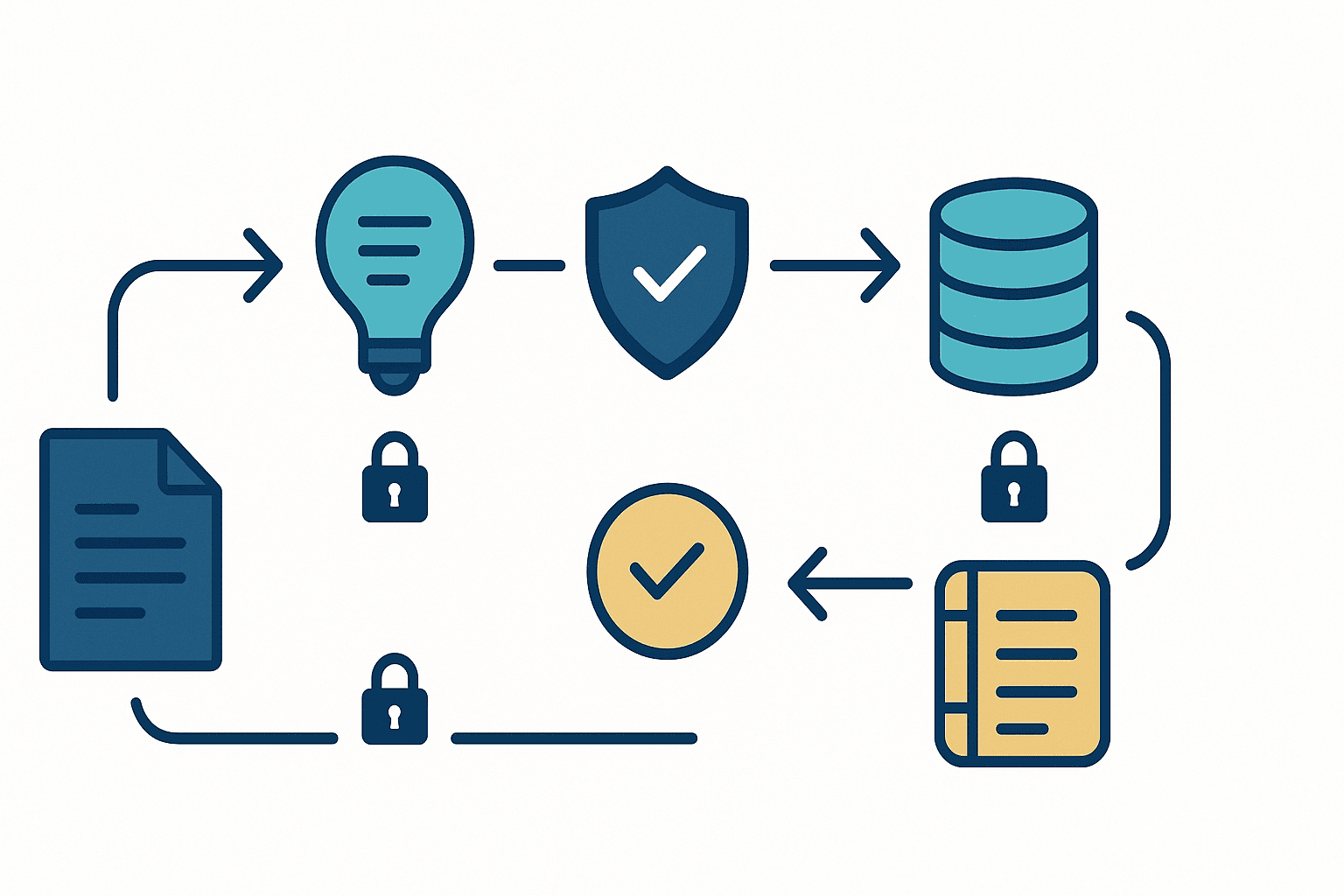
Architecture and data boundaries
Separate intake, immutable original storage, extraction, normalization/validation, workflow, integration ledger, ERP and audit log. For generative AI, state which fields leave the environment, what is masked, where data is stored, whether it is used for training, how cross-border transfer is treated and how deletion works. Do not place unnecessary personal data or entire contracts into a prompt.
The cited Bank of Thailand Payment page describes payment statistics and statistics API information. It is not a specification for retrieving a company’s individual bank statements. In the RFP, distinguish public statistics from transaction data for the company’s own account and from an API contracted with a bank or payment provider.
For a dedicated electronic-tax integration design, also read Thailand e-Tax Invoice and ERP integration.
Pre-implementation checklist
- Have legal entities, sites, document types, languages, currencies and volumes been scoped?
- Can every evidence channel enter one intake ledger?
- Is the original immutable and traceable from every extracted value?
- Are AI outputs candidates validated by deterministic rules?
- Can authority, delegation, segregation and returns be configured?
- Are before/after values and correction reasons retained?
- Does ERP integration record idempotency, responses, retries and cancellations?
- Does every exception have an owner, due date, close impact and escalation?
- Are model, prompt and rule versions tied to test results?
- Is there a manual fallback and tested recovery procedure?
- Do contract and settings cover storage, deletion, access, suppliers and training use?
- Are KPIs based on the local baseline rather than unsupported expectations?
Frequently asked questions
Does accounting AI efficiency mean fully autonomous journal posting?
No. AI presents extraction and journal candidates, deterministic rules perform explainable validation, and an authorized person approves. Only approved data goes to the ERP, with traceability from the original to the accounting document.
Can invoice processing automation be achieved with AI-OCR alone?
AI-OCR is an important intake function, but it is insufficient. Capture, duplicate checking, master/PO/receipt validation, approval, journal proposal, ERP integration, exceptions, close and audit logs must form one flow.
Which fields should data entry automation address first?
Start with fields that can be verified against the original and master data: invoice number, date, supplier, currency, net, tax, total and PO number. Keep account and tax treatment as evidence-backed suggestions with approval.
Should AI-assisted ERP posting write directly to the ERP?
Unapproved AI output should not write directly to the production ledger. Send approved proposals through an interface ledger with an idempotency key, ERP response, document number, retry and cancellation history.
How should an AI-OCR RFP evaluate accuracy?
Evaluate by language, document type, supplier, field and image quality—not one average. Include correction time, exception routing, approval, ERP integration and audit evidence as acceptance criteria, using difficult production-like documents in a separate evaluation set.
Is 90 days a public or statutory PoC standard?
No. It is TOMAS TECH’s proposal model. Day 1–15, 16–30, 31–60, 61–75 and 76–90 cover discovery, configuration, parallel operation, close/failure rehearsal and the Go decision. Adjust scope to internal governance.
Is missing e-Withholding Tax information immediately after payment an error?
Not necessarily. The Thai Revenue Department says information can be searched within 6 business days after payment through a participating bank when the bank has submitted accurate and complete information. Track a waiting state and recheck date, and consult the bank or a qualified adviser when needed.
Summary
Accounting AI efficiency for a Thai operation is not an OCR-accuracy contest. It is a management design that links evidence capture, validation, approval, journal proposals, exceptions and month-end close. Use AI for proposals, place explainable rules and human approval at the center, turn accountability into RFP evidence, and operate difficult cases and failure scenarios during a 90-day PoC. Decide against your own baseline and control requirements.
If your evidence channels are fragmented or you want to define PoC scope and RFP requirements first, TOMAS TECH can review the workflow, ERP and internal controls with your Thai team. Please contact us to discuss a practical closed-loop design.
References and sources
- Thai Revenue Department: e-Tax Invoice & e-Receipt
- Thai Revenue Department: ICT Standards for Electronic Tax Transactions
- Thai Revenue Department: e-Withholding Tax portal
- ETDA: AI 2026 / Driving Trust AI Governance
- ETDA: Generative AI Governance Guideline
- NIST: AI Risk Management Framework
- NIST AI 600-1: Generative AI Profile
- Bank of Thailand: Payment statistics and API information


