


IATF 16949 traceability should not end with a screen that can find a serial or lot number. In an automotive-parts plant, the useful outcome is an authorized, time-consistent evidence chain from incoming material lots through process conditions, equipment, tools, operators and inspection to shipment. That chain must also preserve 4M changes, nonconformity, sorting and rework. This guide shows how a plant in Thailand can convert that objective into a data model, an RFP, FAT/SAT acceptance tests and customer-audit evidence.
What this guide helps you decide
- what to identify, at what granularity, and how to connect the records;
- how to link material lots to actual consumption rather than warehouse issue alone;
- how to connect equipment, operators, measurements and release decisions;
- how to return 4M changes, nonconforming output and rework to the main genealogy;
- how to test customer-audit traceability for evidence quality, not just query speed; and
- what to specify before selecting or rebuilding a traceability platform.
Applicability of IATF 16949 and customer-specific requirements (CSRs) depends on the organization, customer, product, supply tier and contract. This article is an implementation guide based on public primary sources, not a substitute for the standards or applicable customer documents. Retention, lookup time, identifier granularity, authorization and test populations must be derived from customer, legal, product-risk and operational needs.
IATF 16949 traceability is explainability, not merely search
An auditor or customer does not only want a lot number to appear. They need confidence that the result corresponds to actual production, has not silently changed, and explains exceptional paths. A sound evidence chain answers, in one journey:
- Which supplier and internal material lots were actually consumed by this shipment?
- Which route, machine, tool, program and recipe revision produced it?
- Who operated, checked and authorized it, under which role or qualification?
- Which measuring device and inspection revision generated each result, and where is the source data?
- Which package, delivery document, customer and destination received it?
- Which 4M change, deviation, equipment alarm or inspection issue overlapped production?
- After hold, sorting or rework, who decided the disposition and how did the unit return to the approved flow?
This is accountability across ERP, MES, WMS, QMS, PLCs, inspection equipment, maintenance and shipping. It does not require moving every record into one database. It does require a declared system of record, stable joining identifiers, consistent time, retained revisions, and a defined response when data is missing.
A “traceability system” is a feature. Audit-ready traceability is an operating capability that includes process ownership, data integrity, access, retention, backup and restoration.
The IATF public landscape to monitor in 2026
Revision 2 is a published direction of travel, not a finished requirement
IATF’s July 2026 Stakeholder Communiqué SC-2026-005 identifies five priorities for IATF 16949 Revision 2: simplification, software quality assurance, Tier N supplier development, production launch management, and consolidation of customer-specific requirements. It gives mid-2027 as the planned publication timing.
That statement does not make unpublished language effective. A sensible preparation step is to keep requirements and system behavior loosely coupled: store customer rules, required evidence, approval paths and retention settings as controlled configuration; retain their revisions and effective dates; and map suppliers, processes, parts and sites using stable relationships. This improves readiness for Tier N and launch-related evidence without inventing the final edition. The five priorities and mid-2027 timing remain a July 2026 development status and may change.
Keep SIs and Rules 6th distinct
The official IATF SIs page lists IATF 16949:2016 SIs 27–30 as effective in November 2025. Because SIs are live applicability information, the current consolidated official material should be checked at project launch, design review, change and audit preparation.
Separately, the official Rules 6th publication notice states that Rules 6th became effective on 1 January 2025. The Rules govern operation of the certification scheme; they are not identical to the product and process requirements of IATF 16949. An RFP that bundles both into a single phrase such as “IATF ready” obscures who is verifying which obligation.
Manage OEM CSRs by customer and effective date
The IATF OEM customer-specific requirements hub shows that OEM documents change on different schedules. Current examples in 2026 include Ford dated 15 June, Renault dated April and a Stellantis summary dated July. Those dates do not turn each document into a universal rule for every customer.
Maintain an applicability matrix for customer, delivery part, destination, supply tier, document revision, effective date, owner and implementation status. In the RFP, replace “supports CSRs” with the ability to configure evidence fields and reports, control effective dates, and reconstruct an old lot under the version applicable at the time.
Use ISO 9001 documented-information examples as an evidence skeleton
ISO’s official guidance on documented information for ISO 9001:2015 gives examples including evidence of unique identification where traceability is required under 8.5.2, results of the review of changes under 8.5.6, evidence of authorized release under 8.6, and records concerning nonconforming outputs under 8.7.
Those examples form a practical skeleton:
- Identification: distinguish the controlled unit or batch.
- Change: explain before/after state, reason, impact, approval and effective point.
- Release: show who authorized progression or shipment against which result.
- Nonconformity: show what was affected, how it was controlled and who determined disposition.
Do not turn this list directly into four screen fields. Connect every record to a common unit, batch or manufacturing-event identifier, and distinguish source readings from derived decisions. A manually entered pass result without the measurement or device file cannot later prove how the decision was made.
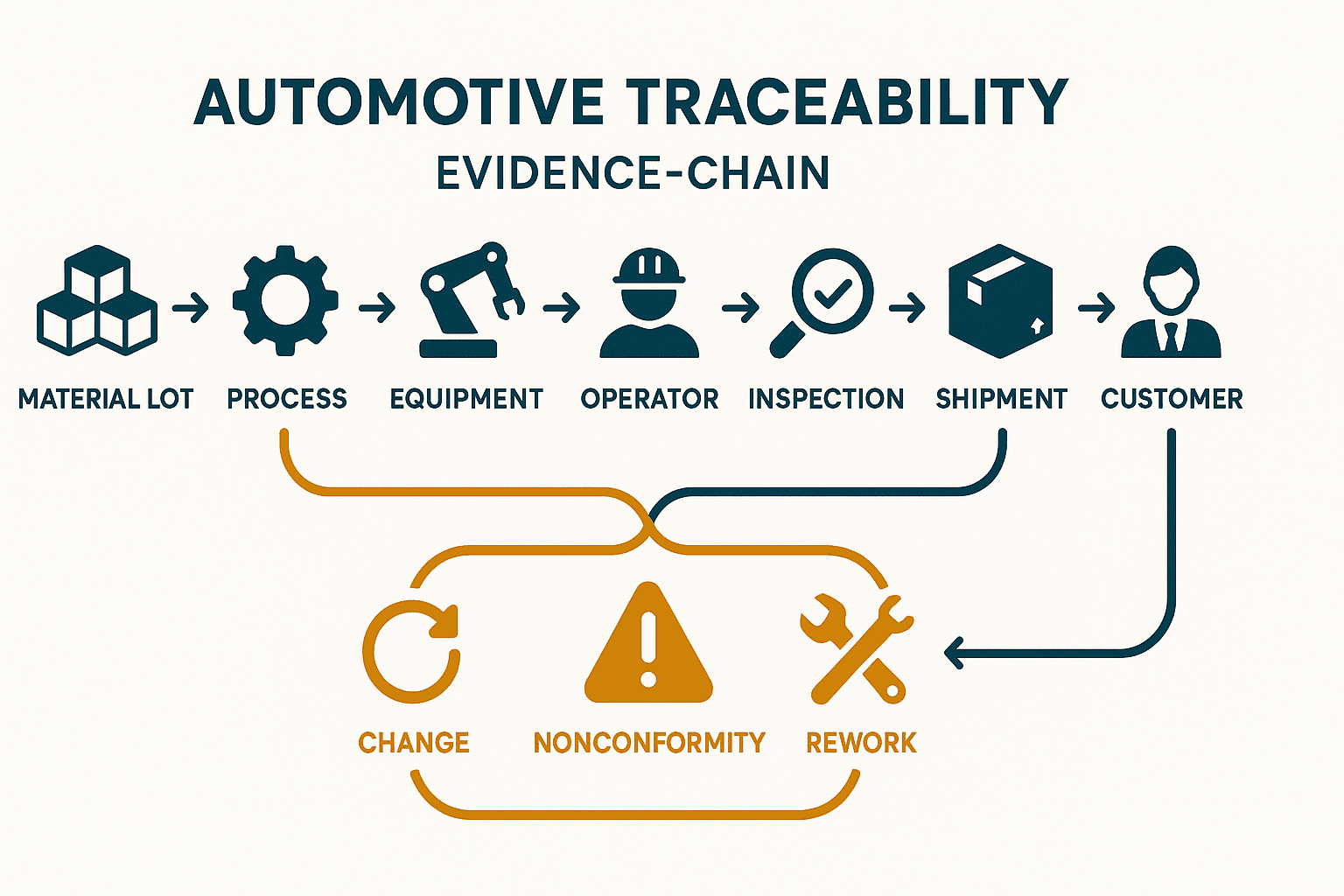
The automotive-parts traceability evidence chain
1. Incoming material: retain both supplier and internal identity
Relate the supplier lot, delivery unit, receipt, inspection, certificate, internal lot, location and status. If the supplier label is the only primary key, duplicate numbers, format changes, repacking and split issues become difficult. Generate an internal identity while retaining the supplier identity and source document.
Material lot linkage must represent actual consumption, not merely warehouse issue. Real flows include returns after issue, distribution to multiple machines, remnants, container transfer, and departures from FIFO. If these events cannot be represented, an impact calculation will be too broad or dangerously narrow.
2. Process: separate the expected route from actual events
The standard route states what should happen; events state what did happen. Record skips, re-entry, loops, subcontracting and alternative equipment with reason and authorization. Time-stamped start, complete, hold and release events make the state transition reviewable.
A work-order number can be too coarse. Continuous material, batch processing, piece production, mixing and assembly create different genealogy shapes. Choose unit, container, batch or time-window granularity according to product risk and process behavior.
3. Equipment, tools and settings: retain the executed revision
Connect machine, mold, fixture, cutter, gauge, program, recipe, parameter snapshot, calibration and maintenance state as of production. Referencing only the current master can make a later change appear to rewrite history.
Storing a PLC or inspection file without a searchable revision is also weak. A production event should reference the executed revision and lead to the controlled file, hash and approved change. Clock drift among equipment, servers and inspection devices can break event order, so time synchronization and exceptions need monitoring.
4. Operators and approvers: preserve identity and authority
A shared login or shift name does not establish who performed or approved an action. Connect the person, role, qualification, shift and authentication at an appropriate level while applying privacy and access controls.
An operator ID alone does not prove that the required qualification was valid then. Qualification records should have effective periods and process scopes, with warning or execution control when authorization has expired.
5. Inspection: separate result, source data and decision revision
Retain the reading, unit, specification limits, gauge, inspection-program revision, sample relationship and location of images or waveforms—not just pass/fail. After a limit changes, the plant must still explain why an old unit was released under the then-current specification.
If manual entry is allowed during a device outage, distinguish it from normal acquisition and retain reason, entrant, verifier and source document. Filling missing values with zero, duplicating after reconnection, or ignoring time zones produces a complete-looking but false record.
6. Shipment: close production genealogy at the customer
Relate the finished identity or package to pallet, delivery document, customer order, destination and time. Preserve parent-child relationships through repacking, relabeling, mixed loads, partial shipment, return and warehouse movement.
Forward trace asks which inventory, shipments and customers are affected by a material or process event. Backward trace asks which materials and conditions created a customer-returned unit. If the two directions do not return a consistent population, an unrecorded split, merge or exceptional move may exist.
Material lot linkage: the difficult cases are split, merge and return
A one-to-one model cannot represent many plant realities:
- one supplier lot is divided into several internal containers;
- multiple lots are blended into one batch;
- partly used material returns to storage and is consumed later;
- continuous stock is separated by time or weight;
- coils, resin or coating have transition zones at changeover; and
- subcontracting replaces the original identity with a partner identity.
Model parent and child lots, quantity, unit, input start/end, machine and production target as events. When actual consumption and calculated stock differ, record the discrepancy and authorized adjustment instead of deleting it.
Barcode and RFID capture can reduce input work but can also read the wrong label perfectly. Validate part, operation, status, machine and shelf-life context, and control the quarantine and release after an incorrect input. Our guide to traceability system cost and scope in Thailand explains why media, readers, terminals, networks, integration and operations belong in the same cost boundary.
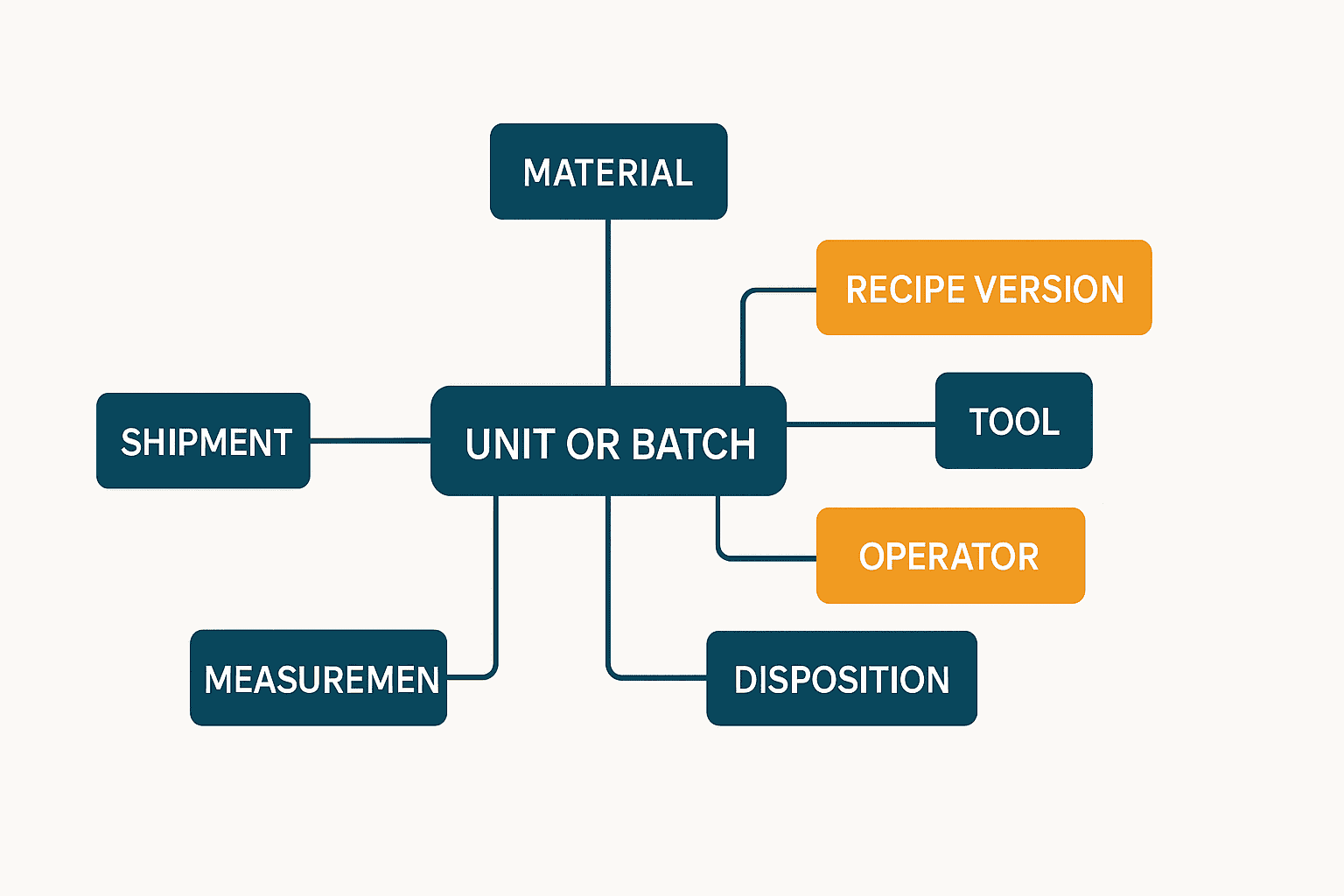
Connect 4M change management to manufacturing events
When 4M change management ends at an approval workflow, the plant cannot prove when an approved change reached each machine, part and lot. Issue a Change ID and connect:
- the affected Man, Machine, Material and/or Method elements;
- before/after supplier, specification, machine, tool, setting, instruction and inspection revisions;
- reason, product-safety or special-characteristic impact and risk review;
- internal approval and any required customer approval;
- trial, measurement, capability or first-piece verification;
- effective parts, lines, sites and the first actual production event; and
- disposition of old material, WIP, labels, programs, documents and inventory.
A manufacturing record should find its Change ID, and a Change ID should find all affected lots and shipments. Retain the actual first-use event, not only the planned effective time. Changes can be asynchronous: a machine program may update today while a material transition occurs tomorrow.
See 4M change management systems for Thailand factories for the approval-to-execution bridge.
Keep nonconformity, sorting and rework inside the genealogy
A clean normal route is not enough when incident records are dispersed across spreadsheets, paper and chats. A nonconformity event should identify the affected object, detection point, symptom, population, quantity, containment location, state, decision maker and disposition.
Rework must not erase the original genealogy and create a newly “good” item. Append the initial state, nonconformity, authorized instruction, rework machine/settings/operator, reinspection and final disposition. For sorting, retain the candidate population, criterion, personnel, results, unprocessed quantity and controls against remixing.
Control permissions for concession, scrap, return, repair and reclassification. A release from shipping hold may need customer authorization and expiry conditions in addition to internal approval. If the application overwrites only the latest state, it cannot explain who held it, why, or what allowed release.
Customer-audit traceability needs scenario testing
Do not accept an audit function from a prepared demonstration alone. Select an object with minimal notice and run backward, forward and exception scenarios.
Backward trace
Start with a shipment label or customer information. Traverse package, finished unit, each operation, inspection, machine/tool, operator and material. At each connection, reconcile identity, time, quantity, status and revision.
Forward trace
Start with a material lot, equipment-alarm interval, inspection-program revision or 4M change. Identify affected WIP, finished goods, inventory, shipments and customers. A zero result must distinguish “no impact” from “missing evidence.”
Exception trace
Choose a lot with re-entry, rework, sorting, label reissue, manual entry, communication outage, clock drift or alternative equipment. Exception paths expose design weaknesses earlier than the happy path.
Evaluation is not only elapsed time. Check completeness, accuracy, consistency, tamper evidence, approval, revision, restoration and least-privilege access. If the organization defines a response-time target, state its scope and rationale; this article does not recommend one universal number.
What to write in a traceability RFP
“Track with barcodes” or “IATF compliant” is not testable. Specify scenarios and evidence.
Scope and boundaries
- sites, processes, parts, customers and supply tiers;
- unit, container, batch or time-window granularity;
- boundaries among ERP, MES, WMS, QMS, PLC, inspection, maintenance and shipping;
- system of record, joining IDs, clock source and master-data source; and
- safe continuation and synchronization during network or device outage.
Data integrity
- mandatory, conditional and source-data elements;
- creation, correction, cancellation and approval history with reason;
- role permissions, no shared administrative users, and audit logs;
- retention, archive, backup, restoration and disposal; and
- detection of duplicates, gaps, reversed order and time-zone errors.
Operations and exceptions
- damaged labels, reprint, misread, duplicate scan and part mismatch;
- split, blend, return, substitute material/machine and subcontracting;
- hold, release, sorting, concession, rework and scrap;
- 4M and program revision effective control; and
- temporary paper operation plus post-recovery reconciliation.
Reporting and integration
- backward/forward trace and affected-shipment report;
- exportable evidence package with query criteria and generation identity;
- API retry, idempotency, error queue, monitoring and alerting;
- local-language terminals, printers and readers; and
- data ownership, open export and contract-exit handover.
Require suppliers to classify each item as standard, configurable, custom, third-party or excluded, and state assumptions. Compare terminals, labeling, network, integration, validation, migration, training, maintenance and later changes—not licenses alone. Production equipment traceability provides a complementary view of connecting machine events to production.
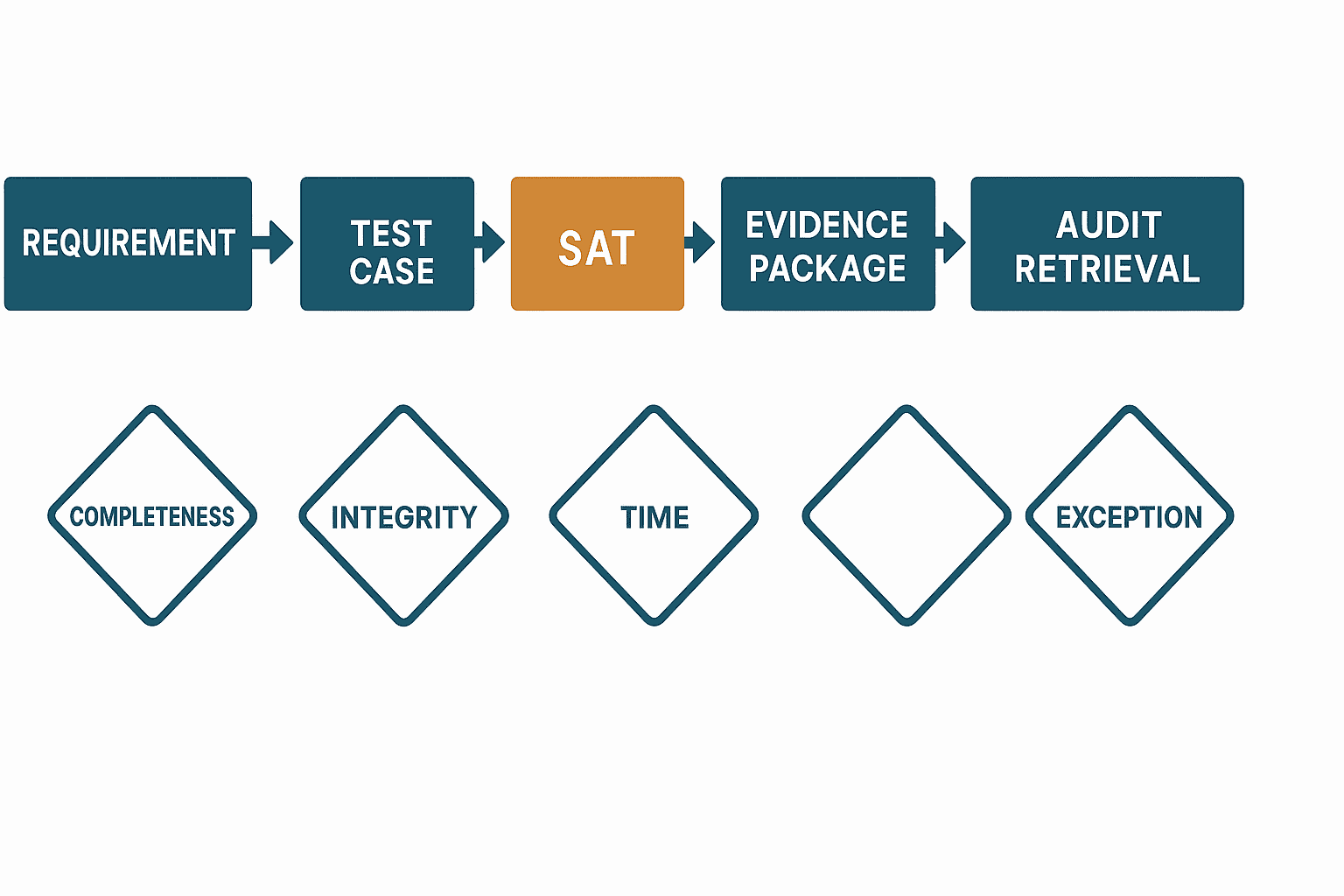
Make FAT/SAT an acceptance test for evidence
FAT can test function and exceptions in a controlled supplier environment. SAT must prove the chain with the actual plant’s equipment, network, people, material, labels, host systems and shift practices.
| Test area | FAT focus | SAT focus | Evidence |
|---|---|---|---|
| Normal flow | Identity chain from material to shipment | Actual equipment, parts and roles | Query and source events |
| Split/merge | Parent-child and quantity logic | Real containers, inputs and returns | Genealogy and stock reconciliation |
| Inspection | Value, limit revision, result, source | Actual gauge and calibration state | Reading, revision, authorization |
| Change | Before/after, effective point, old-version block | Deployment and first use | Change ID and affected lots |
| Nonconformity | Hold, release and rework states | Physical containment and permissions | State history and reinspection |
| Failure | Disconnect, duplicate, retry and clock drift | Actual recovery | Error logs and reconciliation |
| Audit | Backward, forward and exception query | Unprepared role-based retrieval | Evidence package |
| Restore | Restore from backup | Approved alternative environment | Restore log and reconciliation |
Each case needs prerequisites, input, action, expected result, decision method, evidence location, executor and approver. “The screen displayed” is not acceptance evidence. Reconcile the displayed result with source events and explain corrections or gaps.
Migration is also in scope. Counts may match while encoding, time zones, canceled records, attachments or parent-child links are missing. Use automated checks for totals, mandatory-field gaps, duplicates, broken references and out-of-range values, plus risk-based source reconciliation. The project should set populations and thresholds from risk and data volume rather than copying an arbitrary number.
Do not turn Thailand automotive statistics directly into system requirements
The Federation of Thai Industries news listing reported 117,383 vehicles produced in July 2026, up 6.12% year on year, and 59,196 domestic sales, up 20.07%. These official monthly market figures do not guarantee an individual supplier’s orders, capacity need or return on investment.
In a variable environment, do not size traceability on a simple average. Load-test peak scans, retries, label generation, inspection files, shift transitions and recovery synchronization using your own measurements. Use market statistics as context; use customer schedules, part mix, process events and retention volumes for capacity and economics.
An implementation roadmap built around responsibility
Phase 1: applicability and current genealogy
Map customer requirements, CSRs, laws, quality-plan controls and the current material-to-shipment chain. Record events, IDs, owners, systems of record and gaps—not just application names. Choose representative audit questions the current process cannot reproduce.
Phase 2: common identity and data contracts
Define identities for product, material, machine, tool, person, measurement, change, nonconformity and shipment. For every interface, agree fields, data type, unit, clock, mandatory status, retries, cancellation and error handling. Issuance, uniqueness, retirement and ownership matter more than ID length.
Phase 3: closed-loop proof on a representative process
Include splits, returns, outages, label reissue, change and rework—not only normal production. Verify that operators can record exceptions, supervisors can see unsynchronized evidence, and quality can reproduce the affected population.
Phase 4: FAT/SAT and operational handover
Link every RFP requirement to a test case and retained evidence. Hand over accounts, master changes, incident response, backup, restore, audit requests and CSR-update ownership. Acceptance means the plant can monitor and correct evidence gaps without permanent vendor presence.
Phase 5: scale across processes and suppliers
Reuse templates but reassess process form, product risk and customer differences. For Tier N exchange, agree identifiers, required evidence, correction and outage responsibility rather than forcing every partner to buy the same system.
Common failure modes and controls
Collecting everything without defining meaning
Large logs are not evidence when they cannot be joined to product, process, revision and time. Work backward from audit questions, define required events, and distinguish raw data from derived decisions.
Automating normal flow while returning exceptions to paper
Exceptions are essential to impact analysis. Do not simply ban paper; define controlled temporary operation and reconciliation after recovery.
Reconstructing history with current master data
Current recipes, limits and qualifications erase the basis for an old lot. Retain effective periods and executed revisions.
Separating 4M approval from produced lots
An approved request does not prove the first application. Pass Change IDs into deployment and manufacturing events, then reconcile plan versus actual.
Buying an “IATF-compliant system” as a label
Software alone does not replace organizational conformity. Decompose requirements into scenario, data, permission, evidence, test and responsibility.
Backing up without restoring
A file’s existence is not recovery. Test restoration of application, database, settings, certificates, label templates, equipment programs and time configuration, then retain the result.
FAQ: IATF 16949 and automotive-parts traceability
What is IATF 16949 traceability?
It is the operating ability to identify a controlled product unit and reconstruct required evidence across material, process, equipment, people, inspection, change, nonconformity and shipment. The necessary granularity varies by customer, product risk, process and CSR.
Is warehouse issue enough for material lot linkage?
Usually the plant also needs actual consumption. Returns, splits, blends, remnants and movement among machines must show which input reached which production unit.
How should 4M change management connect to traceability?
Use a Change ID relating before/after revisions, approval, verification, effective scope and first actual lot. Search must work both from manufacturing to change and from change to lots and customers.
What should a customer-audit traceability test include?
Run backward trace from shipment, forward trace from material/change/alarm, and exception trace through rework or outage. Evaluate completeness, revisions, approval, tamper evidence, access and restoration in addition to speed.
When is IATF 16949 Revision 2 planned for publication?
The July 2026 IATF communiqué states mid-2027 as planned timing. It is a development update, not confirmation of final requirements or an effective date.
When did Rules 6th become effective?
The official notice says 1 January 2025. Rules 6th concerns certification-scheme operation and should not be confused with the requirements text.
Is there one universal retention or audit-response time?
This guide specifies none. Derive the value from customer requirements, contract, law, product safety, warranty, process risk, data volume and recovery needs, and document its scope.
Can legacy equipment support traceability?
Often yes, after validating available signals, clock, part state and manual controls. Readers, I/O, edge terminals and operator confirmation can be combined, provided gaps and exceptions remain visible.
What is the difference between FAT and SAT?
FAT tests the controlled supplier configuration; SAT proves the evidence chain with the plant’s real equipment, network, materials, operators and upstream/downstream systems. Open items from both must feed production acceptance.
Conclusion
The purpose of IATF 16949 traceability is not to add a search screen. It is to link incoming material, process conditions, equipment and tools, people, inspection and shipment under consistent identities and time, while preserving every 4M change, hold, sort and rework decision.
Start from applicable customer and product questions, then define the evidence chain, system of record, ownership and exceptions. Write the RFP in scenarios and acceptance evidence. Use FAT/SAT to prove backward, forward and exception trace, failure recovery and data migration. Manage Revision 2, SIs, Rules and OEM CSRs according to their different status and effective dates rather than hard-coding speculation.
Whether you are still defining material-lot linkage, acquiring signals from legacy equipment, integrating 4M change, or writing audit evidence and FAT/SAT criteria, TOMAS TECH can support on-site discovery in Thailand and the integration of identification, inspection, MES and OT data. You can contact us while the project is still at the concept or RFP stage.


