


Material-handling equipment should not be selected by lining up conveyor, AGV/AMR, forklift and automated-storage catalogues. That approach lets each supplier’s feature list define the comparison. The factory’s real objective is to deliver a defined load, at the required rate, safely and within an acceptable interruption window. This guide shows Thailand factories how to quantify load form, unit load, flow, peak factor, travel distance, buffer, interaction with people and tolerable stoppage before choosing a technology through RFP, FAT/SAT, TCO and decision gates.
Why material-handling equipment selection matters in Thailand in 2026
Thailand’s Board of Investment reported that its Smart and Sustainable Industry initiative received 132 applications worth approximately THB 17.2 billion in the first half of 2026. The applications covered machinery upgrades, digital technology, automation and robotics. The same official release separately reported 82 applications worth about THB 13.1 billion in machinery, automation and robotics. The categories are not identical, so they should not be added together. Applications are also not approvals and do not prove the benefit or eligibility of an individual project.
BOI’s current Smart and Sustainable Industry page describes headline conditions including a minimum efficiency-improvement investment of THB 1 million, excluding land and working capital, import-duty exemption for machinery, and a corporate-income-tax exemption structure for existing projects. It also describes a 30% linkage condition involving Thailand’s domestic automation industry. Buying material-handling equipment does not automatically qualify a project. Activity, cost eligibility, calculation method, evidence, application timing and completion deadline require project-specific confirmation with BOI or an appropriate adviser.
The practical lesson is to build the operational, safety and financial case first, then assess available promotion measures. In an active investment market, buyers need a common data set and acceptance criteria so supplier proposals remain comparable.
What is material handling? Define the logistics service before the machine
Material handling covers the movement, storage, loading, unloading, positioning and supply of raw materials, components, work in process, finished goods, containers and waste. Equipment may include conveyors, lifts, AGVs, AMRs, forklifts, tugger trains, automated storage and retrieval systems, palletisers, robots, sensors and controls.
Before choosing a method, define the service:
- what moves: dimensions, mass, centre of gravity, base, rigidity, leakage, temperature and cleanliness;
- the unit load: item, carton, tote, pallet, rack, trolley or roll;
- origin and destination: normal flow, return load, empty container, reject and urgent move;
- timing and quantity: average, hourly profile, changeover, month-end and peak;
- delivery quality: time window, sequence, orientation, shock, traceability and error prevention;
- tolerable stoppage: line-side stock, manual fallback, recovery time and production impact;
- shared space: pedestrians, forklifts, carts, visitors and maintenance work.
A single figure such as “60 pallets per hour” is insufficient. Build an origin-destination matrix with time distribution, simultaneous calls and priorities. Two flows with the same average can require very different systems when one is steady and the other is concentrated into short waves.
Standardise the unit load before comparing offers
If one proposal carries one pallet and another carries two trolleys, vehicle count is not comparable. For every unit load, state minimum, maximum and representative dimensions and mass. For pallets, record entry direction, underside condition, deflection, overhang, load stability and identifier. For cartons, consider bottom friction, closure, protrusions, softness and barcode location.
Measure real variation, not only drawing-perfect loads. Broken pallets, swollen cartons, loose stretch wrap and leaning stacks cause jams. Decide whether equipment must tolerate them, an incoming check must reject them, or the packaging standard must be improved.
Eight measurements for improving factory intralogistics
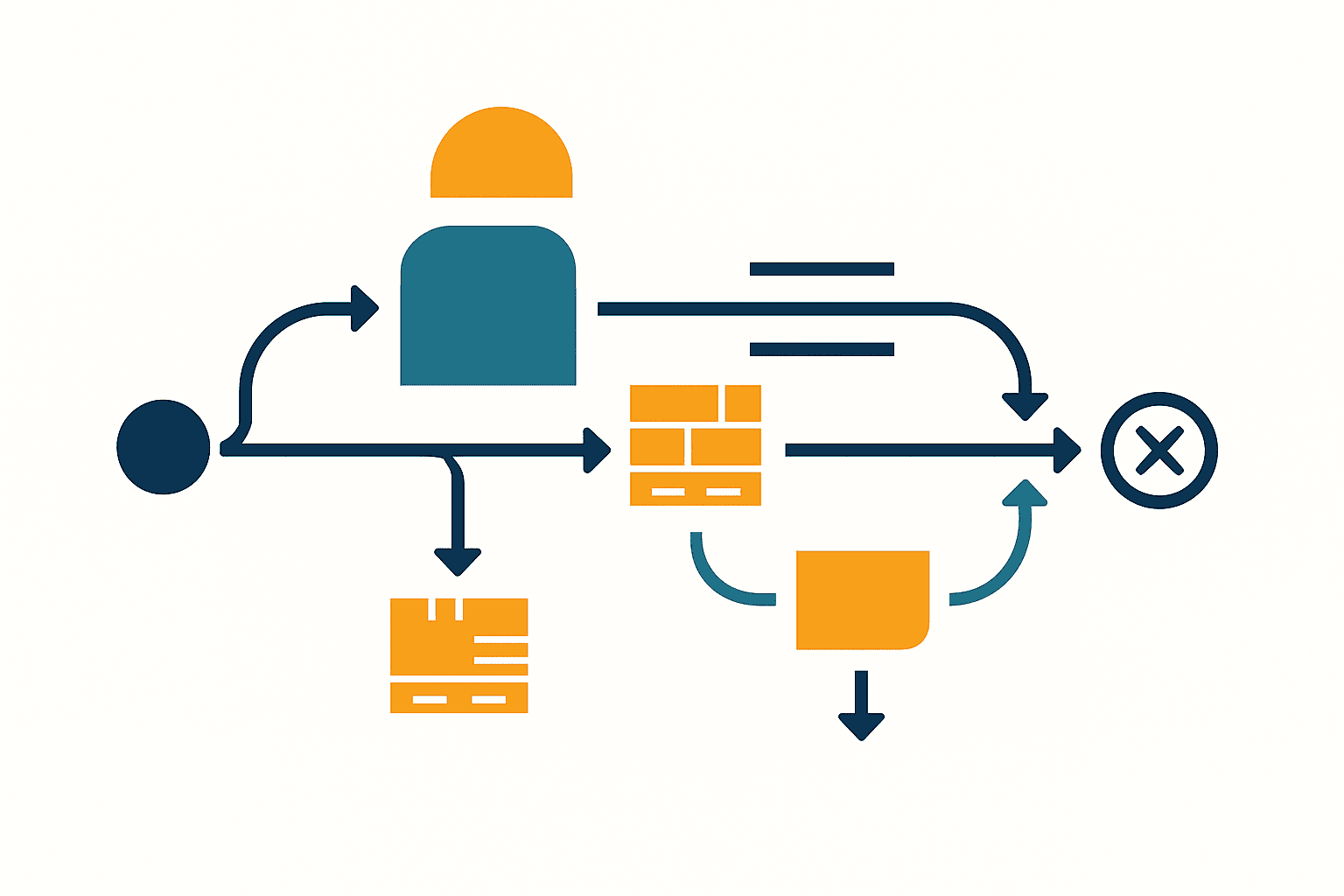
1. Load form and unit load
Separate representative, maximum and difficult loads. Mass alone is insufficient; centre-of-gravity height, eccentricity, stability, surface and orientation matter. Hazardous materials, food, pharmaceuticals, clean rooms, cold stores, heat and explosive atmospheres require application-specific treatment.
2. Average flow at useful time resolution
Use receiving/issuing records, PLC or MES history, vehicle movements and observation to create shift and hourly flows. Retain the distribution, gaps and exclusions. Even manual sampling can be auditable when period, sample size and exclusions are documented.
3. Peak factor
Peak factor is design peak divided by average demand. There is no universal “industry-standard” factor. Select a time window from evidence and distinguish normal peaks from catch-up after abnormal downtime. Decide whether equipment, buffers or production levelling will absorb each peak.
4. Travel distance and route constraints
Measure actual travel, including corners, crossings, doors, lifts, slopes, floor joints, headroom, columns, escape routes, charging and parking. Mobile robots lose time through deceleration, yielding, blockage and replanning. Conveyors create requirements for supports, aisle crossings, cleaning and emergency access.
5. Buffer
A buffer is designed decoupling capacity, not leftover floor. Define FIFO, mixed products, full/empty detection, tracking, manual access and fire/egress constraints. More buffer can improve resilience but also increases WIP, space, dwell time and misidentification risk.
6. Interaction with people and vehicles
Map crossings and observe pedestrian and forklift movements, visibility, doors and loading. A sensor alone does not establish safety. Stopping distance, protruding loads, floor friction, speed, occlusion and reasonably foreseeable behaviour belong in the risk assessment.
7. Tolerable stoppage
Define how long each process can run without transport. This is different from mean repair time. Specify whether manual transport is possible, the people and vehicles required, aisle availability and how WIP identity remains controlled.
8. Catch-up capacity after recovery
If normal capacity merely equals demand, backlog never clears after a stop. Define how much backlog must be recovered and by when. Test peak service and catch-up service as separate scenarios.
An illustrative material-handling capacity calculation
The following figures are illustrative assumptions, not Thai market benchmarks, recommended speeds or universal throughput. All four language versions use the same scenario.
Assume one pallet per move, average demand of 48 pallets/hour and an evidence-based peak factor of 1.25:
Design demand = 48 × 1.25 = 60 pallets/hour.
The route is 120 m outbound and 120 m return. For an AGV/AMR screening calculation, assume 1.2 m/s loaded, 1.5 m/s empty, 45 seconds for transfer and handshake, a 25% allowance for traffic and charging, and 75% effective utilisation.
Cycle time = (120/1.2 + 120/1.5 + 45) × 1.25 = 281.25 seconds.
Effective capacity per vehicle = (3,600/281.25) × 0.75 = 9.6 moves/hour.
Initial fleet estimate = ceiling(60/9.6) = 7 vehicles.
Seven is a simulation input, not a purchase quantity. Intersections, concurrent transfers, charging, failure, empty travel and priority work can change the result. A discrete-event model and pilot should test it.
For a conveyor screening calculation, assume a 45-second pallet release pitch. Theoretical capacity is 80 pallets/hour. Applying an illustrative 85% availability factor gives 68 pallets/hour:
Planning capacity = (3,600/45) × 0.85 = 68 pallets/hour.
Exceeding 60 does not prove acceptance. Merge priority, accumulation, jam recovery, rejected-load handling and downstream-full behaviour still require testing. The eight-pallet margin may also be inadequate for future products or catch-up.
A 20-minute buffer at the 60-pallet peak requires 20 pallet positions under this illustration. Maintaining unchanged production through a separate 30-minute transport interruption implies 30 positions. Choose using space, WIP, fallback and downstream recovery, not a universal rule.
Choosing conveyors, AGV/AMR, forklifts and automated storage
When a conveyor system tends to fit
Conveyors often fit repetitive movement between stable endpoints with consistent loads and volume. They can integrate accumulation, inspection, sorting and handshakes. Their constraints include layout change, aisle crossings, cleaning, load deviation and common failure points.
The RFP should state minimum release pitch, merge throughput, full-line control, jam detection, rejected-load discharge, guarding, interlocks, emergency-stop zones, maintenance access and replacement time—not merely belt or roller speed.
When AGV/AMR tends to fit
Driverless vehicles can suit multiple origins and destinations, product changes, phased deployment and changing routes. Fleet performance, however, depends on dispatch, intersections, charging, communication, transfer and disabled-vehicle recovery—not top speed.
Our AGV and AMR cost guide for Thailand factories explains why travel time alone is not enough. Include utilisation, charging, spare strategy, maps, software licences, equipment interfaces and support in TCO. Do not infer guidance or safety capability merely from the labels AGV or AMR; verify the actual function, intended use and applicable standards.
When forklifts or tugger trains tend to fit
Human-operated vehicles may remain rational for low frequency, diverse loads, exceptions, outdoor use and temporary routes. More automation is not automatically better. Compare staffing, absence, training, mixed-traffic risk, tracking quality and future demand over the same period.
When AS/RS tends to fit
Automated storage can create value through density, inventory accuracy and controlled sequencing. It does not fix an undersized transport interface. Include concentrated input/output, crane or shuttle failure, fire strategy, building, maintenance access and inventory recovery. Design from SKU count, velocity, lot/expiry rules and peak transactions.
Design hybrid boundaries explicitly
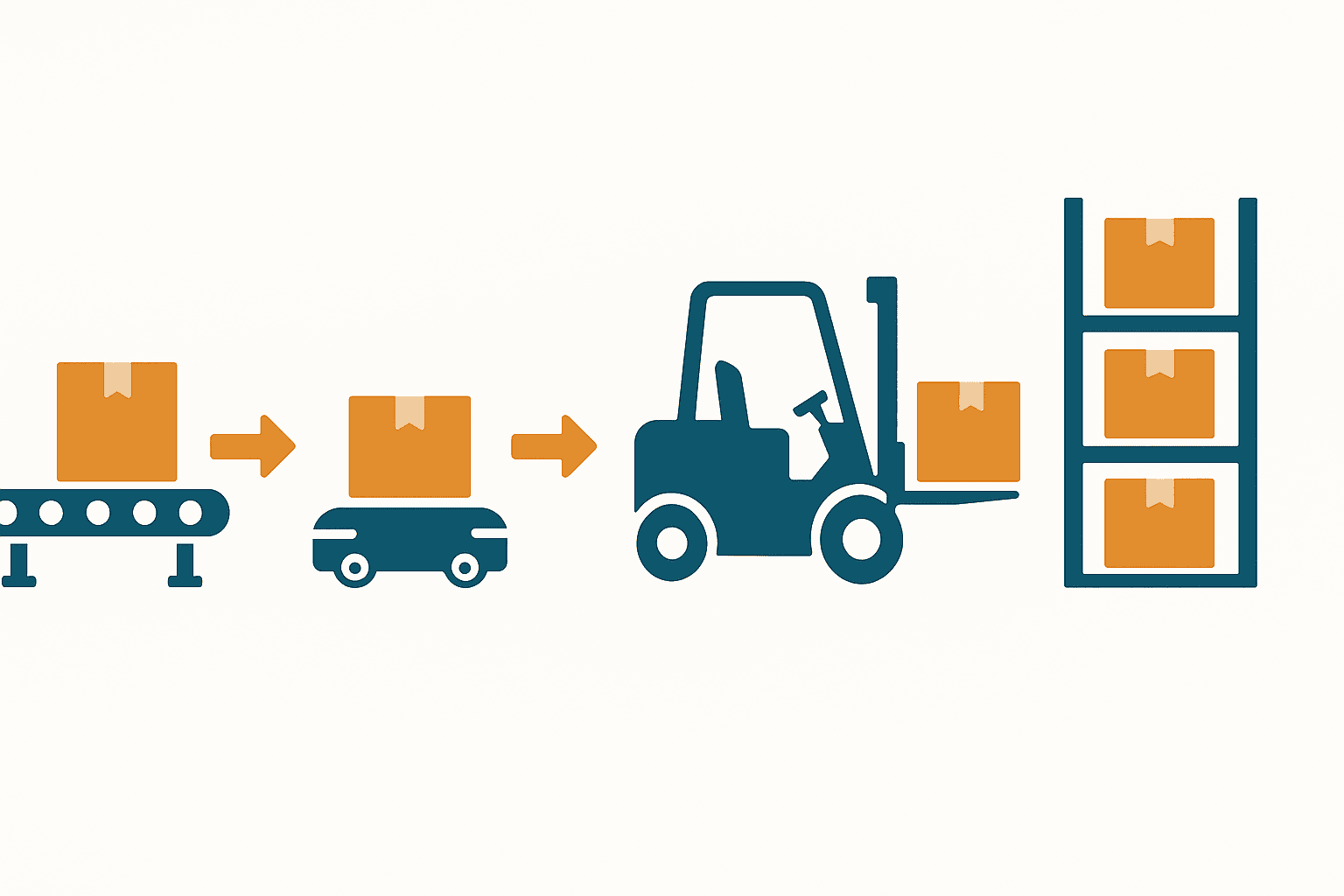
Many factories combine fixed-route conveyor, AMR distribution, forklift exceptions and automated storage. At every boundary, define load geometry, identity, custody, completion signal, timeout, retry and duplicate-move prevention.
Using ISO 3691-4, ISO 12100 and ISO 13849-1 correctly
ISO 12100:2010 provides principles for hazard identification, risk estimation/evaluation, risk reduction, documentation and verification through the machinery life cycle. ISO says the edition remains current after confirmation in 2022, while showing a draft replacement. Check the contract-date edition. Naming the standard does not complete a site-specific risk assessment.
ISO 3691-4:2023 addresses safety requirements and verification for driverless industrial trucks and their systems and includes AGV and AMR among examples. It highlights the influence of the operating zone. ISO currently lists the 2023 edition as published and a DIS replacement in development. Request evidence covering the vehicle, controls, guidance, transfer and operating zone. The standard does not cover every conveyor or human-driven truck.
ISO 13849-1:2023 provides a method for designing and integrating safety-related parts of control systems. Its abstract says it does not specify the safety functions or required performance level for a particular application. Derive those from risk assessment, then verify architecture, diagnostics, reliability, software and validation. It also does not prescribe specific cybersecurity measures; wireless, fleet manager, remote access, accounts and updates require separate treatment.
Reduce interaction through operating-zone design
Where practicable, eliminate crossings through separated pedestrian and vehicle routes, fewer intersections, fence-side transfer and clear visibility. Then combine speed/stopping controls, detection, warning, guarding, interlocks, procedures and training. Include wet floors, protruding loads, blind corners, doors, cleaning and maintenance mode as foreseeable conditions.
Building a comparable material-handling RFP
As discussed in our automation-equipment vendor selection guide for Thailand, compare suppliers with the same questions, data and evidence.
| Requirement | Buyer provides | Supplier returns |
|---|---|---|
| Loads | envelope, mass, centre of gravity, variation, bad-load examples | supported range, detection, rejection, test loads |
| Flow | O-D table, time profile, peak, future scenarios | formula, simulation assumptions, bottlenecks |
| Route | measured layout, crossings, floor, doors | layout, speed zones, waiting, maintenance access |
| Buffer | minutes, FIFO, traceability, WIP limit | positions, full/empty logic, recovery scenario |
| Availability | tolerable stop, fallback, critical segment | failure modes, recovery, spares, degraded mode |
| Safety | intended use, people, hazards, site rules | risk-reduction design, safety functions, validation, residual risk |
| Controls/IT | PLC, MES/WMS, identity, time, network | interfaces, logs, backup, updates, privileges |
| Lifecycle | horizon, expansion, relocation, exit | maintenance, licences, configuration handover, disposal |
Classify answers as standard, option, custom or excluded, with price, lead time, assumptions and responsibility. Every performance number needs operating conditions. An unconditional maximum is not a factory guarantee.
FAT, SAT and operational proving
FAT verifies design and implementation before site deployment in a controlled environment. SAT verifies performance with the real floor, equipment, people, network and operating conditions. Use approved procedures, inputs, expected results, measurements, deviations, evidence and approvers.
FAT should cover representative and bad loads; normal, peak, merge and buffer-full control; sensor, communication and power failures; emergency stops and restart; duplicate orders and unreadable IDs; safety-function validation; backup/restore; logs and time synchronisation.
SAT should cover actual friction, joints, slopes, light, dust and climate; pedestrians, forklifts, doors and crossings; PLC/MES/WMS and transfer equipment; wireless dead zones; manual fallback; disabled-vehicle or jam recovery; catch-up after restart; and real operator, maintenance, EHS and IT/OT work.
Add an operational proving period across shifts, product changes, cleaning, maintenance and absences. Track delay distribution, incomplete missions, manual intervention, damage, misdelivery, downtime and recovery—not average rate alone.
Comparing five-year TCO on the same boundary
Evaluation-period TCO = acquisition + civil/building/electrical + integration + safety + training/start-up + energy/maintenance + expected downtime exposure + planned change + exit − residual value.
For arithmetic only, use dimensionless cost units: acquisition 100, civil/electrical 35, integration 30, safety 20, training 10, energy/maintenance 45, downtime exposure 25, planned change 15, exit 5 and residual value 10.
100 + 35 + 30 + 20 + 10 + 45 + 25 + 15 + 5 − 10 = 270 cost units.
This is not a Thai price or technology benchmark. Replace every input with your own quotations and operational data. Use the same tax, currency, horizon, discounting and residual-value rules. Apply low/base/high scenarios to uncertain inputs, then use pilots or contract terms to reduce the assumptions that dominate the result.
Do not deduct BOI incentives from the base case using headline conditions. First build the no-incentive case. Then confirm current eligibility, costs, evidence, application timing and completion obligations, and model promotion as a separate scenario.
Decision gates from requirements to acceptance
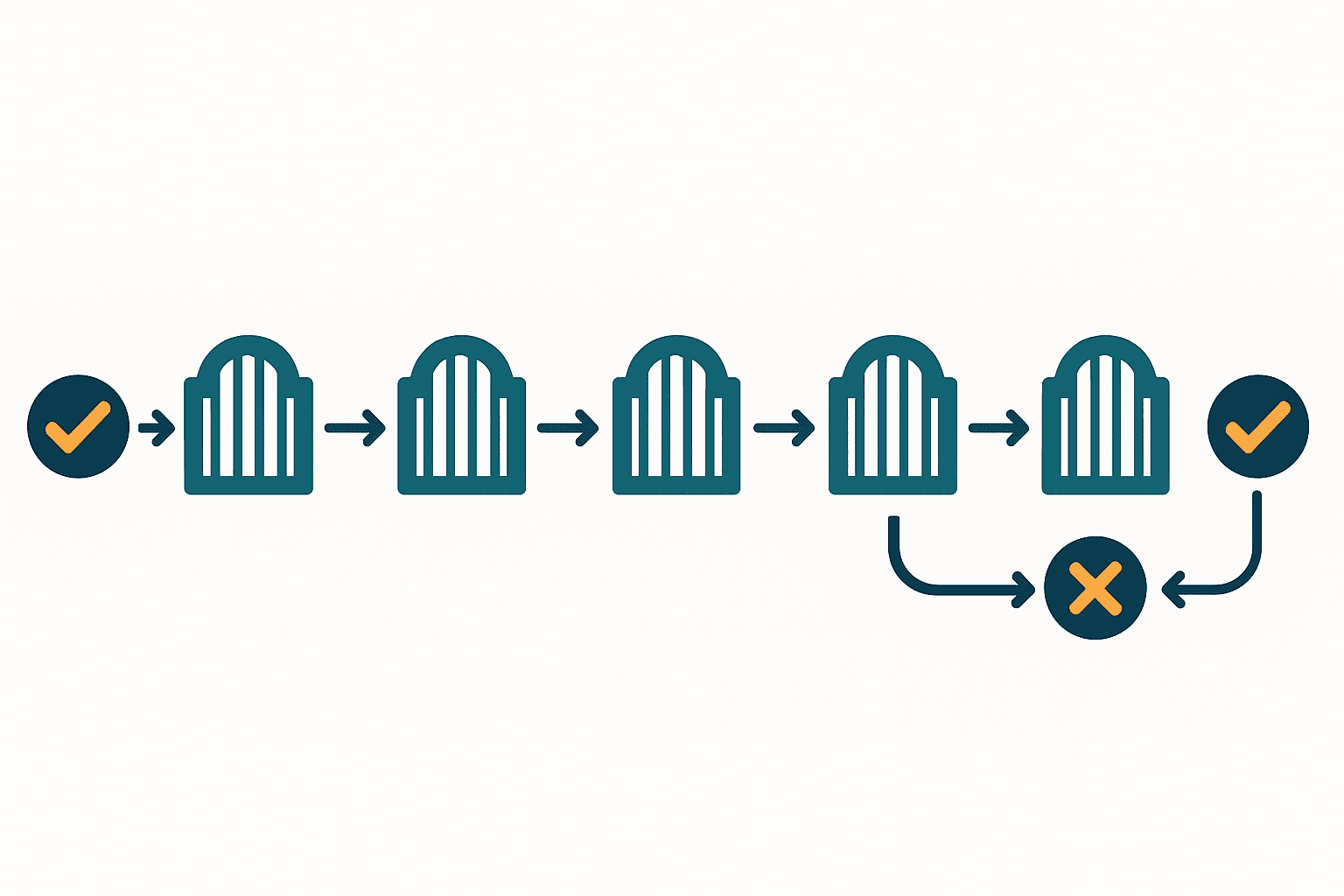
- Problem gate: flow, KPI, exclusions and owner approved.
- Data gate: evidence for loads, O-D flow, peak, route, crossings and stoppage.
- Concept gate: current-state improvement and multiple technologies compared equally.
- Safety gate: intended use, hazards, risk-reduction concept, standards and responsibilities agreed.
- RFP/contract gate: performance conditions, evidence, change, acceptance, payment and exit linked.
- FAT gate: must-pass normal and failure tests complete; critical deviations closed.
- SAT gate: site interaction, fallback and rollback demonstrated.
- Operations gate: training, inspection, spares, monitoring, backup and change management work.
- Benefits gate: capacity, safety, quality, labour hours, WIP and downtime compared with baseline.
A gate must be able to stop the project. Record residual risk, interim control, deadline and owner for any exception. Linking payment milestones to evidence reduces pressure to accept incomplete work.
Common material-handling implementation failures
Sizing from average demand
Peak, concurrency, empty travel, charging, congestion and recovery are missed. Use time-based O-D data and update a transparent model with measurements.
Treating top speed as throughput
Acceleration, curves, crossings, transfers, waiting, failures and charging determine cycle and fleet output.
Automating waste
Long routes, excessive repacking and avoidable intermediate storage become expensive waste. Review layout, packaging, replenishment and levelling first.
Outsourcing all safety responsibility
The supplier does not know every cleaning, maintenance and future-change scenario. The factory must define intended use and operating zones with production, maintenance, EHS, IT/OT and suppliers.
Turning FAT into a demo
Success-only scripts push communication loss, jams, bad loads, restart and fallback into site commissioning. Put failure scenarios into acceptance before award.
Forgetting software and exit
Include fleet manager, connectors, remote support, simulator and engineering-tool licences, configuration handover, relocation, data export and removal.
Frequently asked questions about material-handling equipment
What is material handling?
It is the movement, storage, loading, unloading, supply and positioning of materials and products. Good design includes packaging, layout, information, work, buffer and maintenance—not machines alone.
How should factory intralogistics improvement start?
Observe actual origin-destination flow, load form, hourly demand, peaks, distance, waiting, crossings and downtime. Consider eliminating moves, shortening routes, levelling and standardising loads before automation.
Is a conveyor system better than AGV?
Conveyors often suit stable fixed routes, while AGV/AMR can suit multiple or changing routes. Neither tendency is a decision. Test loads, peaks, transfers, interaction, availability, change and TCO using the same scenarios. A hybrid may be best.
What matters most when choosing an AGV?
There is no single metric. Use unit load, time-based O-D demand, actual route, transfer time, congestion, charging, tolerable stoppage and recovery together. Top speed and catalogue vehicle count are insufficient.
How many buffer positions are required?
Calculate from peak variation, required production continuity during transport loss and catch-up after recovery. The 20 and 30 positions in this article are illustrative, not standards. Also check FIFO, WIP, space, traceability, fire and egress.
Does ISO 3691-4:2023 make an AGV safe automatically?
No. A conformity claim does not replace risk assessment and validation of vehicle, control, guidance, transfer, operating zone, loads, interaction and maintenance. Check the applicable edition at contract time.
Does BOI Smart and Sustainable Industry always cover material-handling equipment?
No automatic eligibility can be claimed. BOI publishes headline conditions, but the activity, equipment, cost, domestic linkage, application and implementation requirements require project review before ordering.
What is the difference between FAT and SAT?
FAT verifies design and implementation in a controlled environment before site use. SAT verifies them with the real floor, equipment, network, people and operations. Both should include normal and failure cases with recorded evidence.
Conclusion: select material-handling equipment with numbers and evidence
Start with load form and unit load, then quantify time-based O-D demand, peak factor, actual distance, buffers, interaction, stoppage tolerance and catch-up. Compare current-state improvement, conveyor, AGV/AMR, forklifts, automated storage and hybrids using the same data.
Use ISO 12100, ISO 3691-4 and ISO 13849-1 within their actual scope and current edition, then perform the factory-specific risk assessment and validation. Put conditioned performance, failure behaviour, evidence, responsibility, lifecycle and exit into the RFP. Verify through FAT, SAT and operational proving. Build TCO from company inputs rather than invented market rates, and assess BOI only after the operational case is sound.
TOMAS TECH can support a Thailand factory from current-state analysis and RFP preparation before a technology has been selected. To structure loads and flow, compare conveyor with AGV/AMR, or plan FAT/SAT and phased deployment, contact TOMAS TECH.


