


When teams search for inventory count time reduction, scanner speed is often the first comparison. Yet faster reading can create more recounts when receipts, issues and transfers continue without control or when the unit being counted is ambiguous. The real opportunity is to narrow the count population, align movement timing and send only genuine exceptions to an independent reviewer. This guide integrates cycle counting, cut-off, blind count and variance approval into one operating model for factories and warehouses in Thailand.
Inventory count time reduction starts with operating design
Total count time includes preparation, operational interruption, travel, location checks, unit conversion, recounting, variance investigation, approval, adjustment posting and evidence packaging. A device can read one line quickly while the close still runs late because an expected quantity biased the counter, a pallet was counted twice, or an unposted transfer had to be reconstructed.
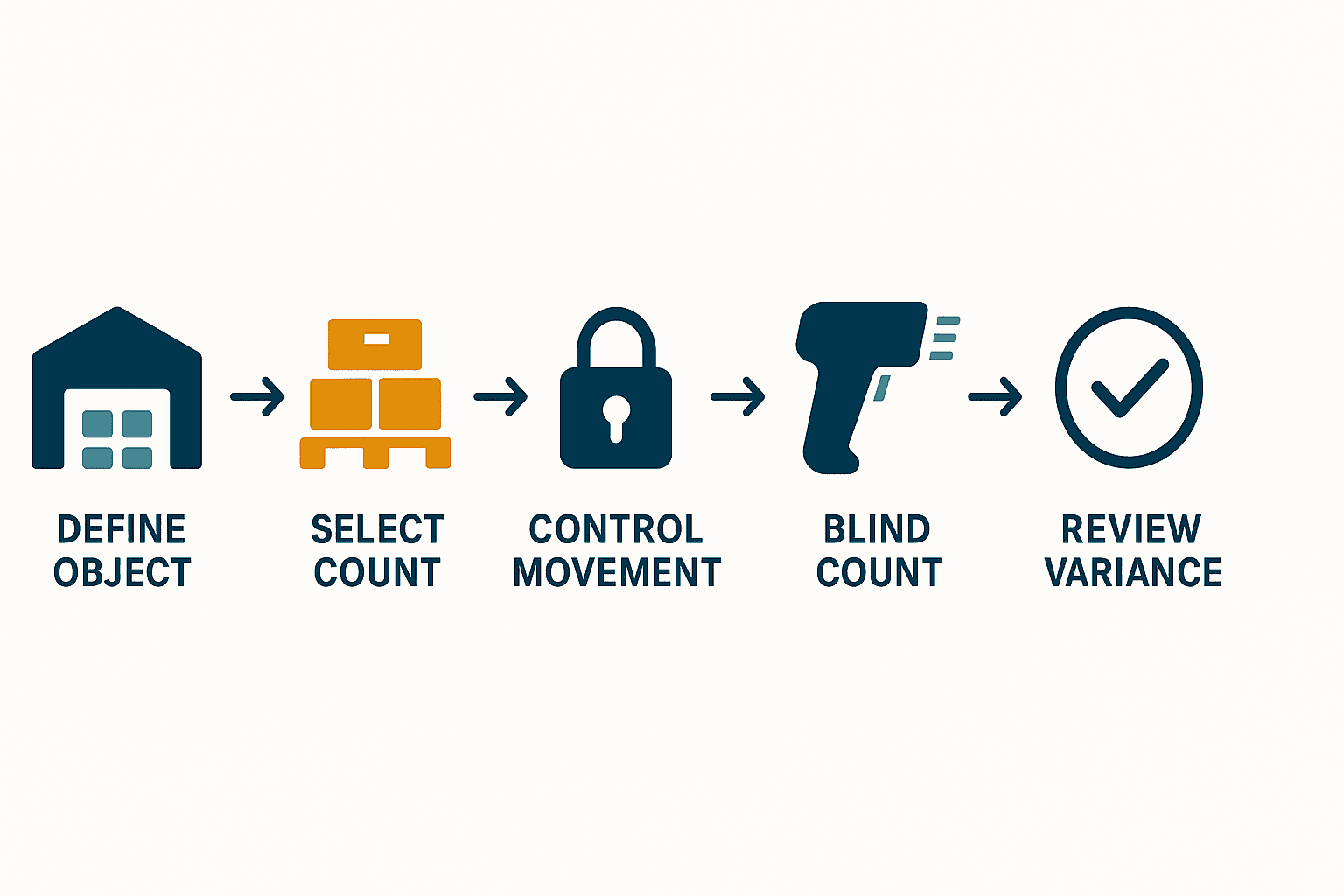
The practical sequence is therefore: define the count object; select count methods by risk; design cut-off or controlled concurrent movement; separate blind first count from recount; resolve variances through a reason queue; and only then choose barcode, RFID or mobile technology. Our inventory management system implementation guide covers the wider system. This article deliberately focuses on count downtime and exception work.
Establish a decomposed baseline
Split current labour into preparation, first count, recount, investigation, approval and posting. Measure operational downtime separately from labour-hours. Otherwise the same hour can be counted as ordinary labour, overtime and lost production. A defensible basic equation is saved time = baseline labour-hours minus future labour-hours. When converting it to value, remove overlaps among shutdown, overtime and the same workers’ hours.
Pair speed with control metrics
Lines scanned per hour alone can reward counters for passing ambiguous stock or choosing a convenient reason. Track count labour-hours; lines or locations per hour; first-pass completion; recount share; variance-review lead time; aged unresolved differences; and repeat variance after adjustment. Speed and control must appear on the same dashboard.
Define the count object before pursuing inventory efficiency
“Count the item” is not a complete requirement. Define the combination that forms one count line: site, warehouse, zone, location, license plate or pallet, item, lot or serial, unit of measure and inventory status. The same item in available, inspection, hold, damaged and return status may require separate observations.
Decide whether place or handling unit is authoritative
A fixed shelf is naturally counted by location. If pallets are the movement unit, a license-plate identifier may better prevent double counting. Oracle Warehouse Management Cloud 26B documentation describes product-specific support for reserve-location counts involving LPNs or pallets and summary-based cycle count. It is an implementation example, not proof that one model suits every warehouse. Decide whether the record of truth is “what belongs in this place” or “what is inside this identified handling unit,” and define reconciliation between them.
Preserve lot, serial and status identity
A matching total can still be wrong if two lots have been swapped. That can affect traceability, shelf life, quality hold or stock rotation. Confirm serial existence for serialized goods, quantity by lot for lot-controlled goods, and condition for status-controlled goods. IAS 2 explains accounting principles for inventory cost and net realisable value, but a software count alone does not establish compliance with every accounting or audit requirement. Quantity, identity, condition and cost treatment must remain reconcilable with finance and audit procedures.
Govern box, piece and pallet conversions
Do not leave it to mental arithmetic to decide whether a box quantity agrees with a piece quantity. Microsoft documentation on units and stocking policies illustrates product functionality for configured units and conversions in cycle counting. Define receipt, storage and issue units, open-case treatment and effective-dated conversion changes. Catch-weight or packaging variants need explicit exception rules rather than being forced into a simple fixed conversion.
Choose full, cycle, threshold and spot counts by purpose
A full physical count is not the only control. Combine full counts, planned cycle counts, threshold-triggered counts and spot counts according to purpose. Microsoft documentation for Dynamics 365 warehousing describes creating count work, performing counts, resolving differences, and planned, threshold and spot cycle-count patterns. These are useful operating patterns; frequency and approval rules remain site-specific risk decisions.
| Method | Main purpose | How scope is selected | Movement control | Evidence focus |
|---|---|---|---|---|
| Full physical count | Broad closing or control assertion | Complete warehouse or site | Shutdown or strict cut-off | Completeness, zero uncounted work, approval |
| Planned cycle count | Maintain accuracy throughout the year | Value, movement, risk and prior variance | Zone-level controls may be used | Plan, completion and recurrence |
| Threshold-triggered count | React to transaction or balance signals | Activity, remaining quantity or anomaly | Protect the target location | Trigger, deadline and outcome |
| Spot count | Investigate an observation | Unexpected empty, damage or misplacement | Temporarily hold local movement | Originator, reason and result |
Do not turn ABC into one universal frequency table
Value matters, but high-movement low-value parts, traceability-critical lots, hazardous stock, line-stopping components and historically unstable locations can also deserve frequent counting. A high-value sealed item with little movement may be controlled through restricted access plus periodic verification. Do not present “A monthly, B quarterly” as a universal benchmark. Derive frequency from value, movement, risk, prior variance and closing requirements.
Use partial-location counts with explicit limits
Microsoft’s partial-location cycle-count documentation describes guiding work for selected items or variants rather than every on-hand item at a location. Check what happens to non-target items sharing the location, residual quantities and completeness across the full-count programme. Partial counting is not an automatic substitute for a full count; it is useful where narrower scope can still be explained and evidenced.
Align the time axis with inventory movement cut-off
The most expensive difference is one that cannot be classified as a physical error or a timing error. Define whether receipts, issues, transfers, production consumption, finished-goods receipt, returns, damage and scrap are included in the book snapshot.
Full stop, zone freeze or controlled concurrent movement
There are three common design options. A full stop is simple to explain but may cause high operational impact. A zone freeze blocks movement only in locations under count. Controlled concurrent movement permits operations after a snapshot, but only if every handling unit can be identified as not yet counted, in count, already counted or moved after snapshot.
| Movement | Boundary that must be defined | Evidence for an exception |
|---|---|---|
| Receipt | Arrival, inspection or put-away point of recognition | Receipt number, time and staging location |
| Issue | Allocation, pick, loading or shipment confirmation | Order, handling unit and gate time |
| Transfer | Atomicity of decrement and increment | Transfer ID, scans and incomplete state |
| Production | Material issue, backflush and finished receipt timing | Order, reporting time and WIP status |
| Return or scrap | Available, hold, damaged or disposed status | Reason, photograph, approval and status change |
Do not rely on a paper “counted” label
A label can remain on the rack while the pallet moves. Tie count work ID, location state, handling-unit ID and transaction timestamp together. Detect duplicate scans and open transfers. Offline acceptance tests must cover dataset age, reconnect conflicts, duplicate submission and resuming partially completed work.
Pre-authorise and record necessary emergency movement
Quality or production may require an emergency issue from a frozen zone. A rule that simply says “prohibited” encourages an undocumented workaround. Record requester, reason, handling unit, quantity, source and destination, time, approver and the method used to reflect it in the count. An unresolved emergency movement cannot be excluded from count-completion criteria.
Translate cut-off into transaction-state transitions
“Stop the warehouse on count day” is too vague. For receipts, map truck arrival, unloading, inspection, staging, put-away and recognition, then decide how stock crossing the reference time is held. For issues, separate allocated, being picked, packed, loaded and shipment-confirmed states. In production, expose the gap between physical consumption and system backflush. Returns must not mix release-to-available, inspection hold and disposal candidates.
Each state needs a physical area, inclusion rule, authorised role, required evidence and exit condition. Goods unloaded before the reference time but not inspected can create a difference if placed in normal storage while excluded from the ledger. Use a distinct staging area and handling-unit identity. Mark post-snapshot transactions as a separate sequence so they cannot be backdated into the count population.
Define a gate for releasing a frozen zone
“Release when counting is finished” is insufficient. First count may be complete while duplicate work, unsent offline records, open transfers, tolerance breaches or unapproved adjustments remain. Release criteria should cover completed count work, zero unsynchronised devices, zero open movements, assigned ownership for material differences, and reconciliation of emergency movements. An authorised role records release time, zone, open issues and temporary controls. Across shifts, pass a system list rather than relying on verbal handover.
Separate blind count, recount and approval
In a blind count, the first counter does not see the expected book quantity. Microsoft cycle-count documentation describes product behaviour in which expected quantity is hidden from the worker and recount attempts can be configured. It is a useful control pattern, not a universal legal mandate. Apply it according to the site’s risk and segregation-of-duties policy.
Why hide expected quantity?
An expected value can anchor the observer. A counter may accept a box count without checking open cartons, miss the wrong location, or enter the displayed number after a superficial check. Blind count is not about distrusting workers; it creates an observation independent of the ledger. Display item identity, unit and lot instructions needed to perform the task, while hiding the expected quantity.
Do not repeat the same method with the same person
When a difference occurs, first run structured checks for UOM, lot, handling unit, open movement and unposted transactions. A subsequent physical recount should be performed by another counter or reviewer and, where appropriate, use a different viewing direction or open cartons. Showing the expected quantity to the same person and asking them to “make it match” is not independent verification. Configure the number of attempts, escalation path and stop condition.
Combine quantity, value and risk tolerance
A small quantity error may be material for a high-value or serialized item. Bulk low-value goods may have measurement characteristics that require a different review. Do not auto-approve from one percentage alone. Include monetary exposure, lot or serial status, quality status, prior variance and reason type. Exact tolerances depend on company policy and audit requirements; this article does not invent an industry threshold.
Turn inventory variance root causes into a closed queue
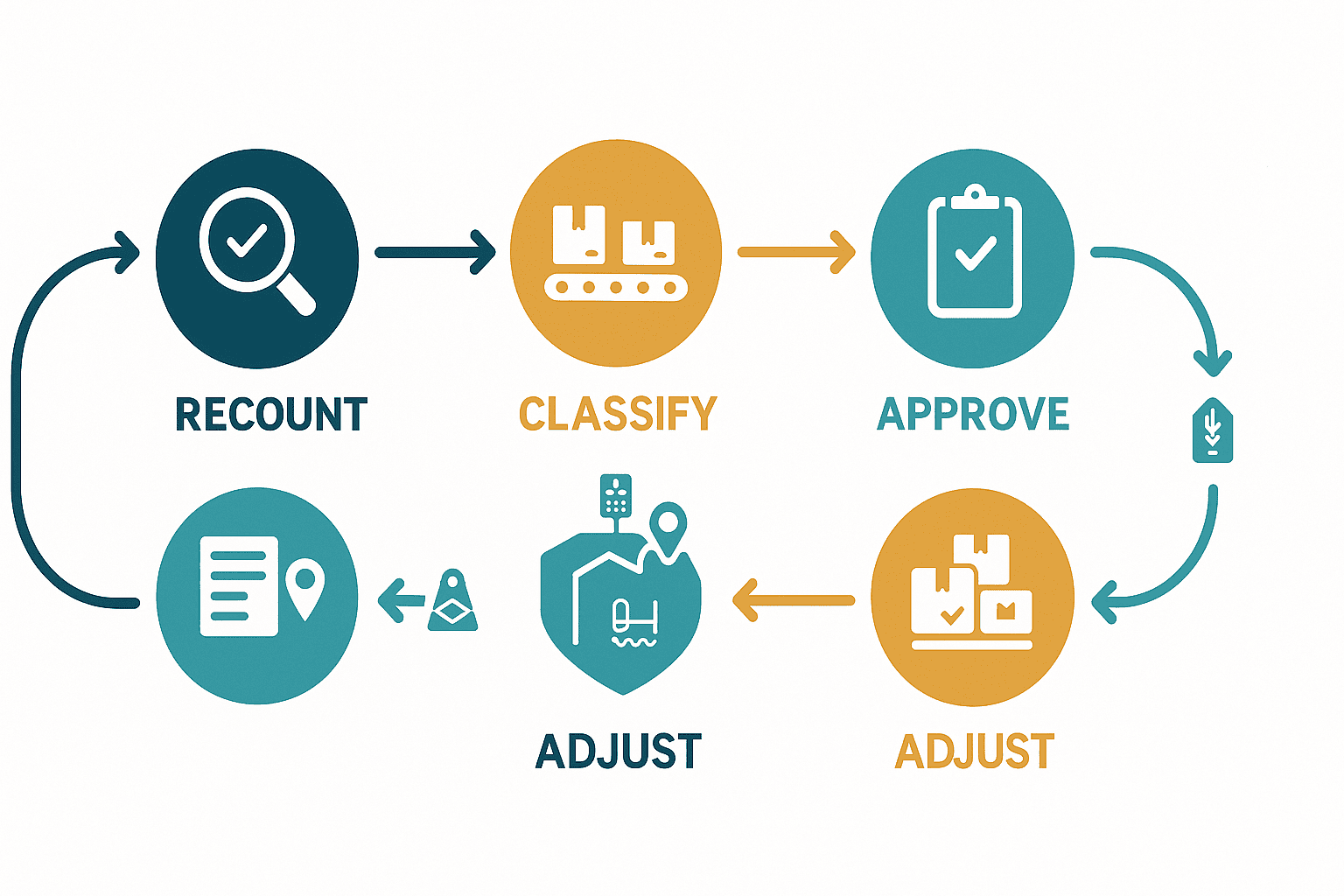
A variance is not merely a failed count. It is input for correcting transactions, master data and floor practice. If the team only clicks an adjustment approval, the same investigation returns next time. Keep reason, evidence, owner, due date, approval, posting and corrective action in one managed queue.
Use actionable reason categories
At minimum distinguish UOM conversion, wrong location, unposted movement, receipt or issue timing, BOM or backflush timing, lot or status mismatch, damage or scrap, master-data error, duplicate count, missed count, label failure and cause not yet determined. “Operator error” is too broad to improve a process. If “undetermined” is allowed, require an owner and due date for follow-up.
Separate adjustment posting from root-cause closure
Closing deadlines may require posting an adjustment before investigation is complete. The design must not auto-close the cause when that posting occurs. Retain observed quantity, book quantity, difference, UOM, cost exposure, reason, photographs or transaction logs, first reviewer, approver, adjustment document and timestamps. The counter should not independently select the reason, approve it and post their own adjustment end to end.
Measure recurrence after the adjustment
Analyse the same item, location and reason over time. Repeated backflush-timing differences are not solved by counting more often; review reporting timing, machine integration, BOM alternatives and scrap treatment. Frequent wrong-location findings point to labels, location naming, put-away rules, mixed storage or scan sequence. The variance queue becomes the improvement loop.
Assign prevention ownership by cause
For UOM differences, the master-data owner reviews purchasing, production and sales units, effective-dated conversions and open-case rules. For wrong locations, logistics reviews label visibility, similar location names, mixed-storage permissions, put-away proposals and the final confirmation scan. For unposted movements, IT verifies that source decrement and destination increment complete under one movement identity, including interrupted transactions.
Production and planning own BOM, substitute, yield, scrap and backflush-timing causes. Quality owns disposition timing, hold labels, status permissions and quarantine areas. Damage and disposal need a measured path from discovery through isolation, evidence, approval and inventory reduction. Corrective action should record the change, owner, due date, verification method, affected scope and rollback condition—not merely “completed.”
Select barcode, RFID and handheld tools after the workflow
Technology selection still matters, but it comes after the operating design. Barcode supports deliberate one-at-a-time confirmation and often has a lower implementation barrier. RFID can read multiple tags or without line of sight in suitable designs, but requires control of over-reading, occlusion, metal and liquid effects, tag attachment and read-zone boundaries. Manual entry may remain for approved exceptions, with reasons and role controls.
See our handheld-terminal implementation guide for Thailand for device rollout and our RFID implementation cost guide for cost components. The decision here is not “which device is fastest?” but “which device reliably executes the defined count object and exception workflow under site conditions?”
Acceptance tests beyond a successful scan
Test duplicate scans, wrong labels, multiple UOMs, lot mismatch, offline operation, battery loss, reconnection, resume and concurrent workers. For RFID, test adjacent-rack over-read, missing and duplicate tags, metal proximity, and full versus empty handling units. Measure performance using the site’s racks, stock, packaging and network; do not generalise a pilot result into a universal benefit claim.
Put testable inventory count requirements in the RFP
An RFP should specify acceptance evidence, not just feature names.
| Requirement | What to request | Acceptance evidence |
|---|---|---|
| Work generation | Work by location, item, value, movement and risk | Generated work for defined scenarios |
| Blind count | Hidden expected quantity, recount and view permissions | Role-based screens and audit log |
| Identity | UOM, lot, serial, status and handling unit | Representative count and variance cases |
| Offline | Save, resume, deduplicate and conflict resolution | Disconnect-and-recover demonstration with logs |
| Movement | Cut-off, zone freeze or controlled concurrency | Receipt, issue, transfer and production boundary tests |
| Exception | Tolerance, queue, reason, evidence and segregation | Trace from difference to approval and adjustment |
| Integration | ERP/WMS adjustment, API and export | Reconciliation and prevention of double posting |
| Management | KPIs, ageing, recurrence and retention | Dashboard and exportable evidence |
| Operations | Thai/English, roles, backup/restore and local support | Access and restore tests; support window |
Convert the vendor demo into a site scenario
Provide representative items, open cartons, mixed storage, lots, quality-hold stock and handling units in transit. Acceptance is not “the screen exists.” It is evidence of who performs each action, what the audit trail retains, and whether an approved adjustment posts exactly once to the ERP.
Reuse acceptance evidence after go-live
Acceptance records must not become one-time implementation files. Link each test to system updates, device replacement, layout changes, UOM-master changes and interface modifications that require regression. A test record should retain process scope, prerequisite master data, configuration version, input, expected and actual result, logs, reviewer and related change types. If offline recovery changes, rerun save, duplicate prevention, conflict resolution and exactly-once ERP posting—not only a normal online scan.
Training should include “do not count” states, escalation states and when manual entry is allowed. Regularly compare the access matrix with actual permissions and remove obsolete access after transfers or departures. Periodic control reviews should sample aged variance, repeat causes, unauthorised actions and unsynchronised devices. Backup evidence should include a restore test proving count work, approvals and attachments can be read in an isolated environment.
Include Thailand operating conditions
Check Thai and English displays, item abbreviations, date format, UOM, shifts, local holidays and local support hours. Test recovery from power or network instability, device replacement, backup and temporary delegation when an administrator is absent. Whether cloud or on-premises, define the responsibility boundary and data-export method.
An illustrative 30-day PoC
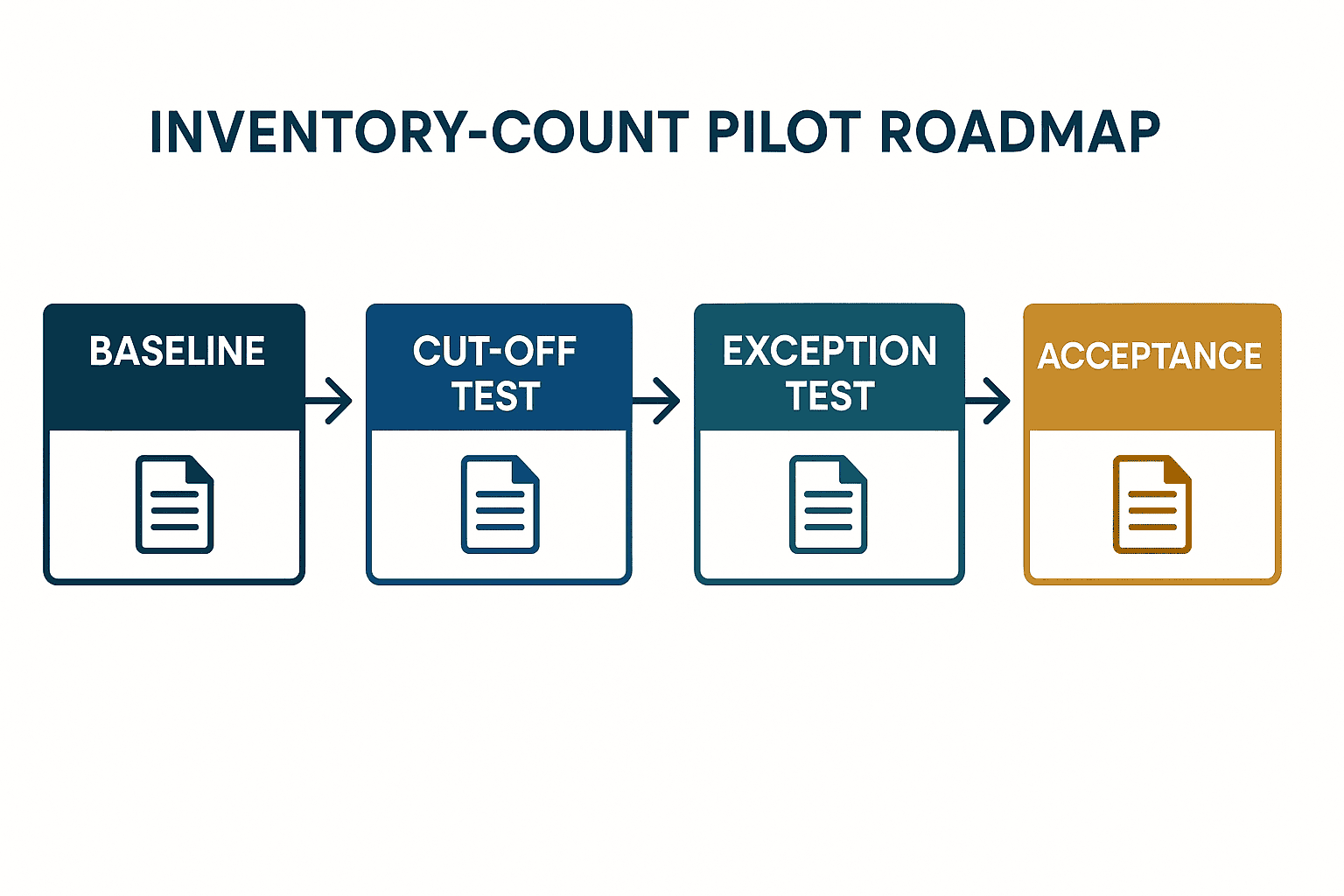
The following is an illustrative planning assumption, not an industry benchmark or guaranteed benefit: 30 days, one zone and representative item classes with different value, movement and risk. Actual scope and duration depend on risk, closing calendar, shifts and integration work.
Week 1: fix the baseline and count object
Measure current effort by activity. Clean up location, handling unit, item, lot, UOM and status definitions. Observe movement types and timestamps, and form hypotheses about physical, timing and master-data causes. Document what is outside the pilot boundary.
Week 2: simulate cut-off and blind count
Choose a full stop, zone freeze or controlled-concurrency candidate. Run receipt, issue, transfer, production and return scenarios. Test a blind first count, independent recount and tolerance-breach review, including permissions and evidence.
Week 3: inject approved differences and disruptions
Create controlled wrong-location, wrong-UOM, incomplete-transfer, lot-mismatch, offline and duplicate-scan cases. Confirm detection, notification, ownership, ageing and prevention of double posting after recovery.
Week 4: evaluate control and business case
Compare baseline and future effort with the same boundary. Review labour-hours, operational interruption, first-pass completion, recount share, review time and unresolved differences. If annualising, state seasonality and count frequency, and remove overlap among downtime, overtime and ordinary labour. Include unresolved requirements, operating change, training and data cleansing in the implementation estimate.
Use separate PoC acceptance gates, not one speed target
Judge speed, control and operational independence separately. A four-gate decision is practical: readiness confirms count objects, UOM, lot, status and movement boundaries; control execution confirms cut-off, blind count, recount, approval and emergency evidence; exception closure confirms injected differences receive reason, owner, evidence, adjustment and preventive action; operational independence confirms local staff can generate work, recover, administer access and export evidence from documented procedures.
If a gate fails, classify the issue as requirement, configuration, data, training or product constraint. Set a retest and due date for remediable items. For a product constraint, document compensating control, residual risk, approver and restricted rollout scope. Do not leave conditional acceptance open indefinitely or call a speed improvement a successful rollout while control and recovery remain unfinished.
Frequently asked questions
What should we do first to reduce inventory count time?
Decompose total work into preparation, first count, recount, investigation and approval. Then define the count object and movement boundary. If recount and investigation dominate, cut-off, UOM, location and unposted movement usually matter more than scanner speed.
Can cycle counting eliminate the annual count?
There is no universal answer. It depends on law, accounting policy, audit, customer requirements and inventory risk. Demonstrate completeness, independence, variance handling and evidence, then confirm the conclusion with finance and auditors. Partial counting does not automatically replace whole-inventory assurance.
What is blind counting?
It hides expected book quantity from the first counter so the observation is independent. Information needed to identify item, unit and lot remains visible. A difference should flow to an independent recount and approval, not a request to make the number match.
How should inventory variance causes be classified?
Use specific categories such as UOM conversion, wrong location, unposted movement, receipt/issue timing, BOM or backflush, lot/status mismatch, damage, master data, duplicate and missed count. Keep evidence and corrective action rather than closing everything as “operator error.”
Does RFID always make stocktaking faster?
No benefit can be guaranteed. It may accelerate suitable read zones, but over-read, missing tags, metal, liquids, packaging and duplicate processing must be designed and tested. Measure total labour and exception time in the site’s PoC.
What should a handheld acceptance test include?
Beyond normal scans, test duplicates, wrong labels, multiple units, lot handling, offline work, resume after interruption, battery replacement, concurrent users and exactly-once ERP posting. Also test Thai/English presentation, role permissions and backup/restore. Retain the test data, configuration version, expected result, actual logs and reviewer so the same evidence can be reused after upgrades or device replacement.
What if an emergency issue is needed during cut-off?
Use a pre-defined exception. Record requester, reason, handling unit, quantity, before/after locations, time and approver, then ensure it is reflected in the snapshot or count result. Do not rely on a verbal approval and a later unexplained adjustment.
How should ROI be calculated?
Subtract future labour-hours from the same baseline scope, and include devices, software, integration, training, data preparation and support. Avoid double counting when shutdown, overtime and ordinary labour describe the same hours. Use site measurements rather than generic percentages.
Conclusion: reduce the population and the true exceptions
Inventory count time reduction is not about scanning the same broken process faster. Define the count object through location, handling unit, item, lot, UOM and status. Use full, cycle, threshold and spot counts according to risk. Align timing through cut-off or controlled concurrent movement, then separate blind count, independent recount and variance approval.
A reason-coded variance queue reduces the exceptions that must be investigated again: UOM, misplacement, unposted movement, production timing, lot/status, damage and master data. Barcode, RFID and mobile tools should be selected to execute this model reliably.
TOMAS TECH helps factories in Thailand assess current count work, design cycle counts and cut-off, integrate WMS/ERP, pilot handheld or RFID solutions, and define RFP and acceptance evidence. You can contact us while technology selection is still open; the practical starting point is to turn site effort and variance reasons into testable requirements.
Primary and official references
- Microsoft Learn — Cycle counting
- Microsoft Learn — Partial location cycle counting
- Microsoft Learn — Units of measure and stocking policies
- Oracle Warehouse Management Cloud 26B Online Help
- IFRS — IAS 2 Inventories
- Microsoft Learn — Define inventory counting processes
- Microsoft Learn — Count, adjust and reclassify inventory


