


Lift one carton at a time off a pallet and set it on a conveyor. The task is simple enough to explain to a factory visitor in under thirty seconds. And yet, once a plant actually starts evaluating depalletizing automation, the quotations come back built on incompatible assumptions, the specification never freezes, and six months later nothing has reached the approval stage. This article takes that mismatch apart — a job that looks trivial but refuses to be decided — from three angles: how the methods differ, how the cost is structured, and how the payback case should actually be built.
Why Depalletizing Projects Stall — The Asymmetry With Palletizing
Palletizing is a decision, depalletizing is an interpretation
Palletizing and depalletizing look like mirror images of each other, the same equipment running in reverse. From an automation standpoint, they are entirely different processes.
On the palletizing side, you decide everything. Which case size goes on the pallet, how many layers, in what pattern. The stacking pattern is a design value, and the robot simply places each case at a coordinate you specified. Teaching only has to cover as many patterns as you choose to run. Equipment selection and the pricing logic for the stacking side are covered in palletizing robot pricing and implementation.
Depalletizing is the opposite. The pallet that arrives in front of the robot has a load condition you did not get to choose. Layers have shifted from vibration in transit. Cases are deformed where the stretch film pulled them in. A supplier changed a process and the case dimension moved by five millimetres. Palletizing is the act of deciding a load pattern; depalletizing is the act of reading whatever load pattern turned up. That asymmetry is what pushes the evaluation difficulty up, long before any equipment is selected.
The real reason the quotations do not line up
You invited several system integrators, and the numbers that came back differ by a factor of three. This is one of the most common complaints in depalletizing projects, and the cause is usually not technical.
Vendor A priced a simple vacuum gripper with fixed teaching, assuming clean single-SKU cardboard cases only. Vendor B priced 3D vision and mixed-load handling, because they assumed the SKU count would grow. When the assumed range of load conditions differs that much, a three-fold price gap is arithmetic, not a difference in engineering capability. It is the result of going out to quote before defining the load conditions.
In other words, these projects usually drag on not because the technology is hard, but because the question of what exactly is being automated has never been answered on paper.
Three challenges created by load-condition uncertainty
System integrator literature on the depalletizing process consistently names three technical challenges: handling mixed workpieces, handling positional deviation, and preventing load collapse. All three point in the same direction, toward a vision system. They are laid out in detail in challenges of the depalletizing process and why vision is required.
Handling mixed workpieces means dealing with a single pallet carrying cases of different sizes or different SKUs. Handling positional deviation means recognising where a case actually sits after it has shifted in transit, and correcting the pick point accordingly. Preventing load collapse means controlling the pick sequence so that removing a case from an upper layer does not bring the layer below, or the cases next to it, down with it.
None of the three can be solved by fixed teaching alone. Each requires measuring the surface of the pallet, estimating the outline and orientation of each case, and deciding the pick order dynamically. That is the point at which 3D vision stops being optional and becomes a structural component of the system. The cost and payback logic of vision itself is treated in depth in robot vision cost and return on investment.
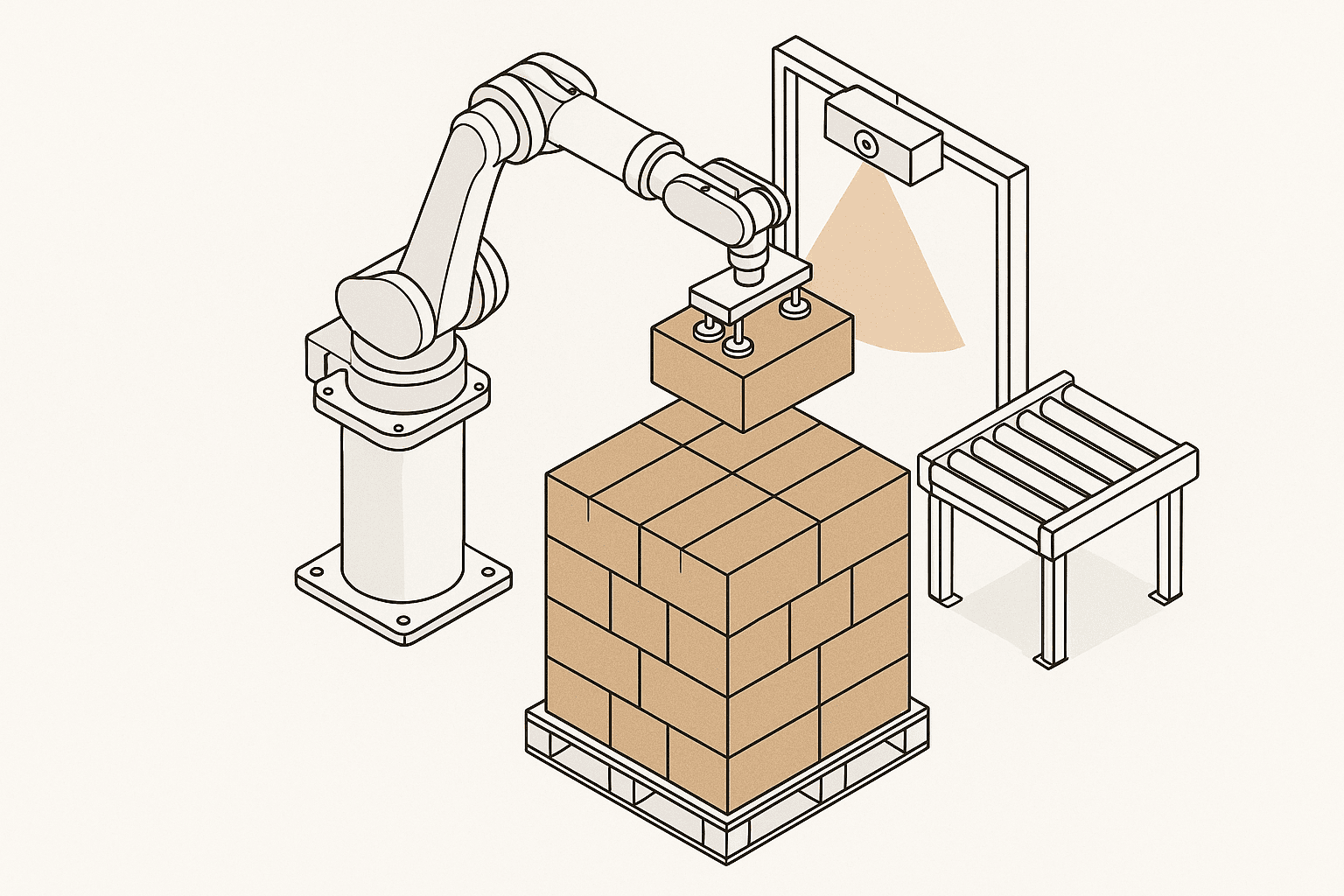
Vision is not a nice-to-have, it is what keeps the line running
Published Japanese deployments tell the same story. In a case study from the Shiseido West Japan distribution centre, published by Hitachi Automation under its Kyoto Robotics brand, five depalletizing robots handle foldable returnable containers. Each is equipped with a high-precision 3D vision sensor so the system can absorb not only variation in the load condition, but also mixed loads, partial layers, and irregular arrangements. It is worth noting that this case study does not publish headcount reduction or any other quantified labour saving, so the size of the effect has to be estimated against your own conditions rather than borrowed from the case.
What matters here is the workpiece. Foldable containers are standardised products, dimensionally far more stable than corrugated cardboard. The fact that 3D vision was still specified tells you that variation in the load condition is the normal state of affairs, not the exception.
The most common misjudgement on the shop floor is the assumption that a single-SKU operation does not need vision. Even with one SKU, you still have pallet positioning tolerance, layer shift, and warping of the pallet itself. Leaving vision out lowers the initial cost, but it buys an operation that assumes stoppages and human intervention. If one person ends up permanently assigned to handle those stoppages, the purpose of the automation has already been lost.
Depalletizer Methods — Four Options and Where Each Fits
Mechanical (fixed) depalletizers
These push off an entire layer at once, or invert the whole pallet. A mechanical depalletizer that slides a complete layer of corrugated cases across onto a conveyor can deliver a low cost per unit of throughput, provided the SKU is single and the load condition is genuinely stable.
The weakness is flexibility. If the case dimension or the number of layers changes, the machine has to be adjusted, and in some cases mechanical components have to be swapped. For a process locked to one or two SKUs where you can honestly say that will still be true five years from now, this is a strong option. For a site where the SKU count is trending upward, it is difficult to justify.
Robotic depalletizers with fixed teaching
An articulated or parallel-link robot is fitted with a vacuum or clamp gripper and removes cases exactly as the taught stacking pattern describes. Because patterns are held as programs rather than as hardware settings, changeover is far easier than on a mechanical unit.
The catch is that this approach assumes the pallet looks the way it was taught. When that assumption breaks — a shifted layer, a tilted case — you get missed picks and crushed product. In practice, this method has to be designed as a package: pallet positioning guides, layer-shift detection sensors, and a documented human intervention procedure.
3D vision-guided robotic depalletizers
A 3D camera measures the top surface of the pallet, recognises the outline and height of each case, and determines the pick points and the pick sequence on the spot. This handles mixed pallets, shifted layers, and dimensional variation. Industry commentary points to the same trend, noting the progress being made in mixed-SKU handling through 3D vision and AI, and this method is being selected more and more often.
As a throughput reference, one manufacturer’s published specification for a robotic depalletizer states a maximum of 1,000 cases per hour for single-SKU loads and a maximum of 600 cases per hour for mixed loads, with a maximum workpiece weight of 25 kg and a recognition envelope of 1250 mm by 1250 mm by 2000 mm (source, Mujin depalletizer). These numbers matter for both throughput design and layout design, so they are unpacked in detail later in this article.
Where the boundary with piece-picking robots sits
The equipment most often confused with a depalletizer is the piece-picking robot. Both are robots that pick up goods, but they work at a different unit of handling and demand a different granularity of recognition.
A depalletizer handles case units — corrugated boxes, returnable containers, essentially rigid bodies close to a rectangular solid. A piece-picking robot handles piece units, which is what comes out once the case is opened: bagged items, blister packs, and irregularly shaped products. At the piece level, a harder set of problems appears, including deciding which surface can be gripped, deformation of the item, and recognition of transparent packaging.
For process design, the important conclusion is not to try to make one machine do both. Taking cases off a pallet, and opening cases to rebuild them into shipping units, are cheaper, faster and more reliably commissioned when they are designed as separate processes. Which robot type suits which job is summarised in industrial robot types and how to select them.
Comparing the four methods
Here are the four methods lined up against the axes that actually drive the decision.
| Method | Tolerance to load variation | Changeover | Relative initial cost | Best suited to |
|---|---|---|---|---|
| Mechanical, full-layer sweep | Low | Mechanical adjustment required | Low | Single SKU, fully stable load, high throughput |
| Robotic with fixed teaching | Medium | Program switch | Medium | Several SKUs but tidy, consistent loads |
| 3D vision-guided robot | High | Little or no teaching | Medium to high | Mixed loads, layer shift and dimensional variation are routine |
| Piece-picking robot | High, but a different process | Workpiece registration required | High | Picking at piece level rather than case level |
The majority of sites today have no choice but to prioritise the first column, tolerance to load variation. The reason lies in the workpieces themselves, which is the subject of the next section.
Cases Versus Sacks — The Workpiece Changes the Design Philosophy
Case depalletizing with corrugated cardboard
This is the most widely deployed and the most technically mature application. A corrugated case has a flat, rigid top surface, so a vacuum gripper works on it cleanly. Add side clamping to the top-surface suction and you get a combination gripper that also handles heavy cases and cases with a weak top face.
The point to watch is that cardboard quality directly determines whether the pick succeeds. Sag or a dent in the top face causes vacuum leakage, and suction performance also changes with tape ridges and with the surface finish of the print. If the design stage is validated using only good boxes, suction failures will multiply as soon as production volume starts. Sample sets for trials must include boxes that absorbed humidity during the rainy season, boxes with a high recycled-fibre content, and boxes with corners crushed in transit.
Sacks, for powders, resin pellets and raw materials
A sack is not a rigid body. The moment it is lifted, the contents shift and the centre of gravity moves with them. The suction surface is unstable, and when sacks are pressed tightly together, two can come up at once.
A published case of automated sack unloading reports that unloading of corrugated cases weighing 8 to 20 kg and sacks weighing 10 to 25 kg was automated using a single robot combined with a pallet conveyor, and that a process previously staffed by one operator could then be covered by 0.5 of a person, in other words a labour reduction of roughly 50 percent (source, JRC depalletizing automation case).
The detail worth noticing in this case is that the labour effect is 50 percent, not 100 percent. Feeding pallets in, collecting empty pallets, and handling exceptions all still need people. When evaluating depalletizing automation, setting the initial target at halving the labour rather than eliminating it makes both the investment case and the shop-floor acceptance far more realistic.
Returnable and foldable containers
Returnable containers have standardised dimensions, which makes them the easiest category to handle in terms of load condition. On the other hand, the surface is plastic and carries ribs and hand holes, so the suction position needs care in design. If a suction pad lands over a hand hole, vacuum cannot be held.
The 3D vision sensor in the Shiseido case described earlier exists precisely to deal with the reality that even standardised products produce variable load conditions. Foldable containers have a folding mechanism, which introduces slight tilt when they are stacked. The reasoning that a standardised product only needs fixed teaching does not hold up.
Design priorities by workpiece
Change the workpiece and you change the gripping method you should be selecting.
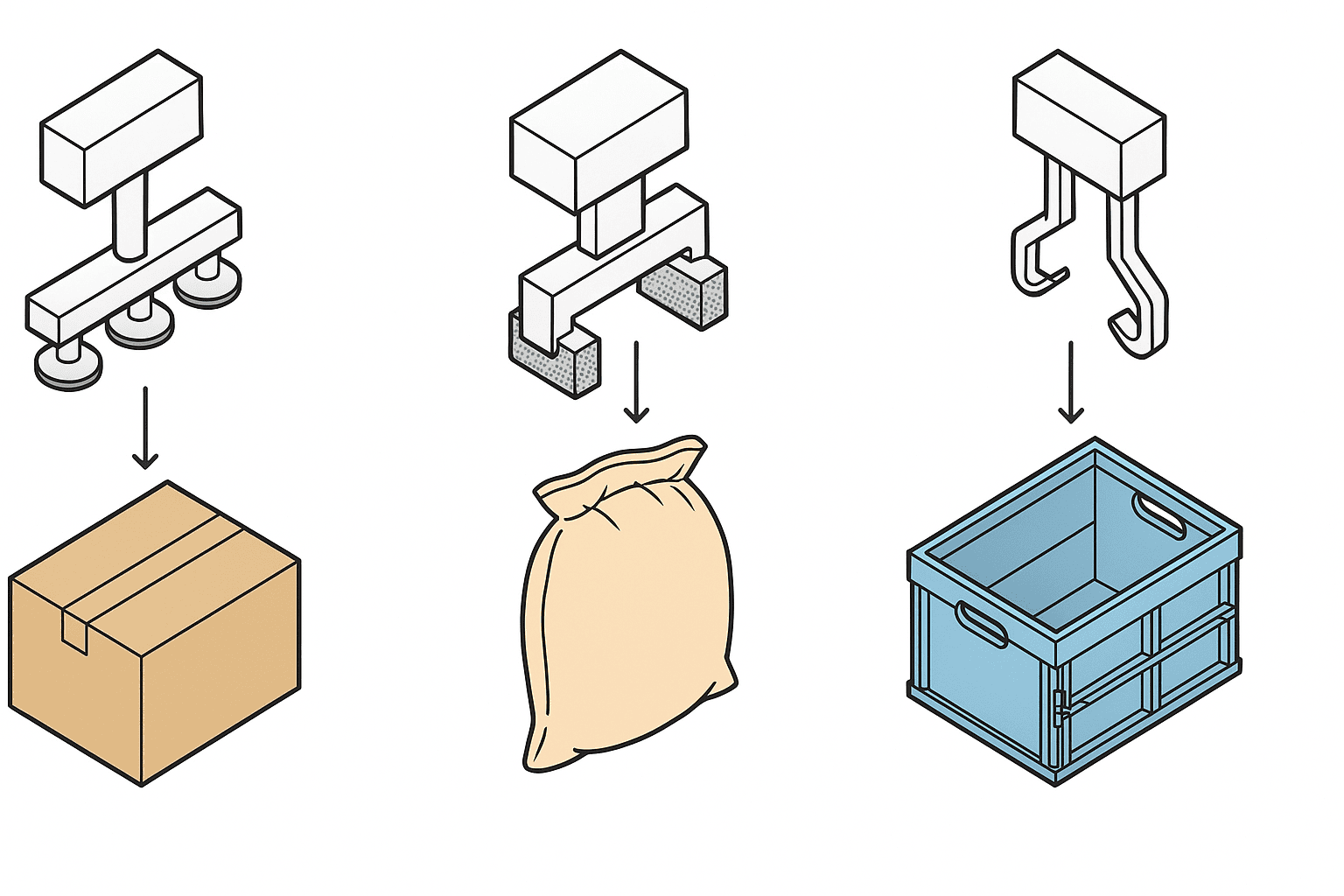
The table below organises the points to nail down for each workpiece type.
| Workpiece | Main gripping method | Specific difficulty | Samples to prepare for trials |
|---|---|---|---|
| Corrugated case | Top-surface vacuum, side clamp in combination | Sag from moisture absorption, crushed corners, print surface finish | Rainy-season stock, high recycled-content boxes, boxes with crushed corners |
| Sack, powder or pellets | Large-area suction, forked gripper with tines, dedicated gripper | Shifting centre of gravity, double picks, protruding seal seam | Units at the maximum and minimum fill levels, two sacks pressed together |
| Returnable or foldable container | Top-surface suction, inner flange gripping | Hand holes, ribs, tilt from the folding mechanism | Units several years old, units whose lid does not close firmly |
| Mixed pallet | Vacuum gripper under 3D vision guidance | Dimensional differences between layers, gaps, overhang | Mixed patterns extracted from actual shipping records |
If sample selection is settled with clean, new units, the acceptance test will pass and the line will still stop in production. The right-hand column of that table is the item most often dismissed in practice, and the one that does the most work.
Single-SKU Versus Mixed Loads — Designing for Real Throughput
Translating the published specification into time
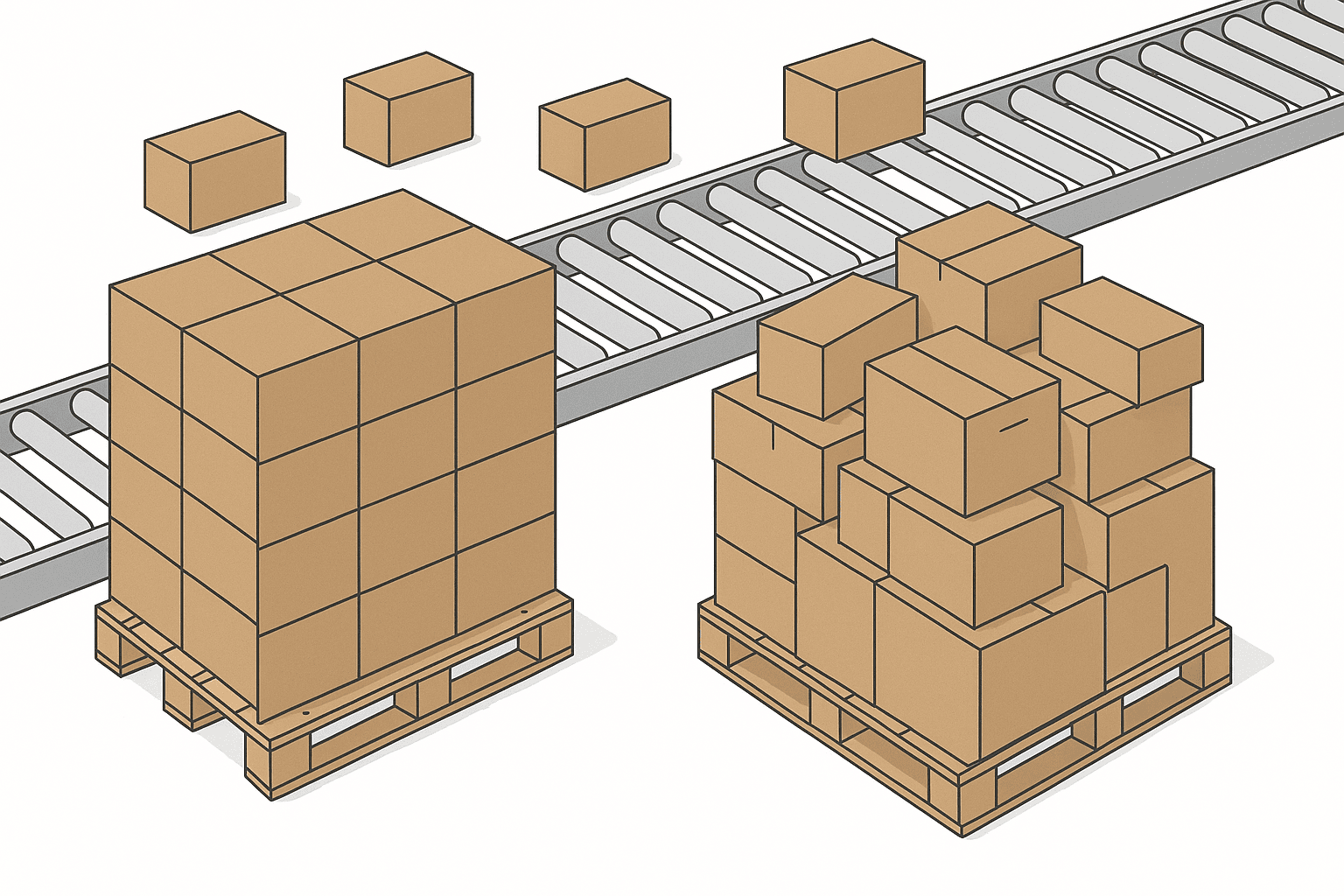
Take the published specification quoted earlier, a maximum of 1,000 cases per hour for single-SKU loads and a maximum of 600 cases per hour for mixed loads, and convert it into time per case. Single-SKU gives 3,600 seconds divided by 1,000 cases, or 3.6 seconds per case. Mixed gives 3,600 seconds divided by 600 cases, or 6.0 seconds per case. On identical equipment, the time required per case differs by a factor of roughly 1.7.
That gap is not a difference in how fast the robot moves. In mixed operation, every case picked forces the system to recognise the next target again and recalculate the pick point and the pick sequence. In single-SKU operation, one recognition result can be reused across the whole layer; in mixed operation it cannot. The recognition and decision cycle is what shows up as a throughput difference.
Converting to pallets
To bring the numbers closer to how a plant actually thinks, assume 60 cases are stacked on each pallet.
| Condition | Per case | Per pallet, 60 cases | Pallets per hour |
|---|---|---|---|
| Single-SKU, maximum 1,000 cases per hour | 3.6 seconds | 3.6 minutes | 16.7 |
| Mixed, maximum 600 cases per hour | 6.0 seconds | 6.0 minutes | 10.0 |
Both rows are theoretical values derived from catalogue maximums. In reality, pallet exchange time, empty pallet discharge, and stoppages for exception handling are added on top, so effective throughput will sit below these figures.
The factor most often overlooked in this conversion is pallet exchange time. If the machine clears a pallet in 3.6 minutes but it takes two minutes to present the next one, the effective cycle becomes 5.6 minutes and throughput drops by more than 30 percent. The conveyor or forklift route feeding pallets in becomes the constraint long before the depalletizer itself does. This is the first thing to close out in layout design.
Recognition envelope and stack height
The same published specification gives a recognition envelope of 1250 mm by 1250 mm by 2000 mm and a maximum workpiece weight of 25 kg. Those numbers can be used directly as specification check items.
In plan, 1250 mm by 1250 mm accommodates a T11 pallet at 1100 mm by 1100 mm. If your stacking pattern lets cases hang over the edge of the pallet, however, that overhang has to be checked against actual measurements. The 2000 mm in the vertical direction needs the same treatment: measure what your standard stack height actually is, in millimetres, including the thickness of the pallet. Settling for a rough estimate of about 1.8 metres is exactly how a plant discovers after the specification is frozen that its loads fall outside the envelope.
The 25 kg weight limit matters just as much. Plants handling sacks above 25 kg are not unusual. If any workpiece exceeds the limit, you have to state at the time of the quotation request whether that SKU will stay manual or whether a different method will be evaluated for it.
The Cost Structure of Depalletizing Automation — Four Layers
Why no market rate can be quoted
The cost of depalletizing automation changes by an order of magnitude depending on the workpiece, the required throughput, whether mixed loads are involved, and the interface conditions with existing equipment. Quoting a single market rate is therefore meaningless. What is meaningful is understanding which layer the cost accumulates in, so that quotations can be compared on the same axes.
The cost breaks down into four layers.
- Equipment layer. The robot itself, the pedestal, safety fencing, control cabinets — the main machinery, and the part for which catalogue prices exist
- Gripper and vision layer. Design and fabrication of a gripper matched to the workpiece, the 3D camera, and the licence and tuning of the recognition software
- Conveying and peripheral layer. Pallet infeed conveyors, empty pallet discharge, alignment conveyors, buffers, and ancillary equipment such as metal detection or label reading
- Construction and commissioning layer. Foundation work, power and compressed air distribution, installation, teaching, trial running, training and acceptance testing
When quotations diverge between vendors, most of the difference appears not in the equipment layer but in the gripper and vision layer and the conveying and peripheral layer. The price of the robot itself does not vary much wherever you buy it, but the engineering hours behind a custom gripper, and how much of the surrounding material handling a vendor chooses to include, vary enormously with the philosophy of the proposal.
The assumptions that must be fixed before comparing quotations
To put every vendor on the same footing, the following assumptions have to be fixed in writing at the point the request goes out.
- The complete list of target workpieces, with dimensions, weight, material and top-surface condition recorded for every SKU
- Whether loads are single-SKU or mixed, and if mixed, an attachment showing mixed patterns extracted from actual shipping records
- Required throughput, expressed in pallets per hour rather than cases per hour, with peak and normal conditions both stated
- The pallet supply method, whether forklift drop-off, conveyor feed or AGV
- The exception procedure, defining who intervenes and how when a pick fails or recognition fails
- The acceptance criteria, stated numerically as a duration of continuous running and a maximum acceptable failure rate
Of these six, the project that omits the acceptance criteria will run into a dispute at commissioning without exception. Making it possible to settle a subjective complaint that the machine stops more than expected against a number written into the contract protects both parties.
Building the Payback Case — Labour Savings Alone Will Not Carry It
Turning the labour effect into numbers
The published case discussed above reports that a one-operator arrangement became coverable by 0.5 of a person, a labour reduction of roughly 50 percent. That 50 percent is the starting point for a payback calculation.
Every monetary figure from here on is a placeholder used to show the structure of the calculation. None of it represents an actual wage level or an actual equipment price, so replace all of it with your own figures before drawing conclusions.
Assume the fully loaded annual cost of one operator, wages plus statutory benefits plus overhead, is 240,000 THB. On a line running two shifts with one dedicated operator on each, two people in total, a 50 percent labour reduction removes one person, or 240,000 THB per year. On three shifts with one operator each, three people in total, it removes 1.5 people, or 360,000 THB per year. If there are two such two-shift lines, four people in total, it removes two people, or 480,000 THB per year.
How sensitive the payback period is
The table below sets those annual savings against a range of investment levels.
| Investment, assumed | Saving 240,000 THB per year, assumed | Saving 360,000 THB per year, assumed | Saving 480,000 THB per year, assumed |
|---|---|---|---|
| 3 million THB | 12.5 years | 8.3 years | 6.3 years |
| 5 million THB | 20.8 years | 13.9 years | 10.4 years |
| 8 million THB | 33.3 years | 22.2 years | 16.7 years |
It would be premature to look at this table and conclude that depalletizing automation does not pay. What the table does show, as long as the calculation stays at these assumed levels, is a clear tendency: justifying a depalletizing investment on labour cost reduction alone is difficult. The first thing to check is whether substituting your own actual figures reproduces the same tendency.
If a proposal transplants a Japanese domestic case into Thailand and tells you the payback is two years, always ask which labour cost level that calculation assumes. When the absolute labour cost differs, the payback period for identical equipment can differ several times over.
So what actually drives the return
This is where the industry commentary earns its place. In a 2026 analysis of the robotics sector, Luc Vanden-Abeele of NuMove Robotics & Vision states that “Labor availability remains a major concern, and depalletizing is one of the most labor-intensive tasks in material handling.” (source, The State of Robotic Depalletizing)
What is being described there is not labour cost but labour availability. Depalletizing is among the most labour-intensive tasks in material handling, and because it involves repetitive handling of heavy loads, it is hard to recruit for and hard to retain people in. Cheap labour is worth nothing if nobody answers the job posting, because the line does not run.
The effects that belong in the payback case therefore go well beyond labour cost.
- Elimination of stoppage risk caused by unfilled positions. The loss from a line standing idle on a day when nobody shows up is an order of magnitude larger than the wage
- Reduction in product write-offs from load collapse and case damage. In plants that track a damage rate, this can be the single largest effect
- Reduction in workplace injuries from back strain and crushing. Repetitive heavy handling is a recognised risk factor for back injury, and it carries the cost of compensated absence plus replacement staff
- Extended operating hours. Because the machine does not depend on breaks or shift handovers, the same equipment covers more of the day
- Shorter shipping lead time. Less material waits between receiving and the next process, which reduces the inventory you have to carry
The critical discipline here is not to discount all of these with a single blanket factor. If the labour saving looks too optimistic and you shave the damage reduction and the injury reduction by the same percentage, an investment that works in reality fails on paper only. The correct treatment is to state the basis and the confidence level for each effect separately, and to apply conservatism only to the ones with genuinely low confidence.
At the same time, check that every one of the four cost layers has an effect attached to it. If a large sum sits in the conveying and peripheral layer but the payback calculation says nothing about what that layer produces, it will be the first thing cut in the approval meeting. Once it is cut, pallet feeding stays manual, and the labour effect the whole case rested on disappears with it.
The Market and the Policy Environment — Doing This in Thailand
The market is growing at 12 percent a year
The robotic depalletizer market is forecast to expand from USD 1.81 billion in 2025 to USD 5.02 billion in 2034, a compound annual growth rate of 12.00 percent between 2026 and 2034. The single largest growth driver identified is AI-powered vision guidance for mixed-SKU handling (source, Robotic Depalletizer Market).
What that forecast says is not simply that the market gets bigger. The substance is that mixed-load capability is what pulls the growth. As the product specification above showed, mixed operation is the regime where throughput drops, and demand is concentrating there anyway. That is a reasonable basis for expecting future engineering investment to head in the same direction.
The barriers are described just as plainly
The same industry analysis names the obstacles to adoption as SKU proliferation, declining packaging quality, and the height of the investment hurdle for small and mid-sized sites.
Of these, declining packaging quality is the one most immediately recognisable in Thai plants. When cost pressure on packaging materials reduces the thickness or the strength of corrugated board, the top face sags more and suction stability drops. The difficulty of your automation can rise through nothing you did, purely because a supplier changed a packaging specification. If you are going to automate depalletizing, it is worth agreeing packaging specifications with suppliers covering thickness, material and flatness of the top face.
Robot adoption and incentives in Thailand
Thailand is among the more advanced ASEAN countries for robot adoption. An analysis based on the IFR World Robotics 2023 report places Thailand at around 3,300 industrial robot installations in 2022, ranking 14th worldwide and second in Southeast Asia behind Singapore (source, industrial robot adoption trends in Thailand).
Policy support exists as well. In the Eastern Economic Corridor, USD 45 billion has been allocated to upgrading high-tech industry, with robotics designated a priority field. The BOI supports robotics projects worth THB 15 billion and targets 10,000 new system installations per year (source, Southeast Asia industrial and service robot market).
If you intend to use an incentive scheme, timing is what to watch. Confirming eligibility after the equipment specification has been frozen and the order placed means any specification change needed to satisfy the requirements becomes rework. The standard approach is to identify the applicable measures and their requirements at the earliest stage of the evaluation, and to build them into the specification design.
Pre-Quotation Checklist for Depalletizing Automation
Fill in the following items internally before issuing a request for quotation. Going out to several vendors with items still blank guarantees a set of quotations that cannot be compared.
- The complete list of target SKUs has been prepared, with dimensions, weight, material and top-surface condition recorded for each
- Whether the heaviest workpiece exceeds 25 kg has been confirmed by measurement, and the treatment of any SKU above the limit has been decided
- The standard stack height has been measured including pallet thickness, and any pallets exceeding 2000 mm have been identified
- Pallet plan dimensions and the presence of overhang have been confirmed by measurement
- The ratio of single-SKU to mixed loads has been calculated from the last three months of shipping records
- Where mixed loads exist, representative mixed patterns have been extracted from actual records and documented
- Required throughput has been defined in pallets per hour, stated separately for peak and normal conditions
- The pallet supply method has been decided, whether forklift drop-off, conveyor or AGV
- The empty pallet return route and storage location have been decided
- Measured data on the current manual depalletizing operation has been collected, including headcount assigned, pallets actually processed, and a breakdown of downtime
- The occurrence rate of load collapse and case damage is known from actual records
- The intervention procedure for exceptions and the role of each person have been defined
- Acceptance criteria have been defined numerically, stating continuous running time and the acceptable failure rate
- Planned changes to packaging specifications have been confirmed with suppliers
- The possibility of applying BOI or other incentives has been checked before the specification is frozen
For the items involving measured data, collect at least one week of it. A single day of observation will not reveal day-of-week bias in load conditions, or the shift in mixed-load ratio caused by end-of-month shipping peaks.
Common Failure Patterns in Depalletizing Automation
Validating with clean samples only
The workpieces provided for trials are all pulled from the back of the warehouse in excellent condition. The acceptance test passes without trouble, and suction failures start multiplying the moment production volume begins. Always mix a defined proportion of poor-condition workpieces into the trials.
Leaving pallet supply until later
Comparing only the throughput of the depalletizer itself and deferring the design of how pallets get to it. Even if the machine is capable of 16.7 pallets per hour, if supply can only deliver six pallets in an hour, the line runs at six pallets per hour. The value of a capital investment is set by its slowest element.
Not counting the people who handle exceptions
If nobody has decided who responds when recognition fails or a pick is missed, one person ends up permanently stationed at the line. That invalidates the labour saving calculation from the outset, which is why the assumed frequency of exceptions and the response procedure must be settled at the quotation stage.
Trying to automate down to the piece level in one step
Attempting to automate the opening of cases and extraction of their contents at the same time as depalletizing raises the difficulty sharply and inflates both the commissioning period and the cost. Case-level and piece-level handling are more reliably treated as separate processes with separate equipment.
Frequently Asked Questions About Depalletizing Automation
What does depalletizing automation typically cost?
No single market rate can be given, because the figure moves by an order of magnitude with the workpiece, the required throughput, whether mixed loads are involved, and the interface conditions with existing equipment. For budgeting, work from the cost structure rather than from a price. It accumulates across four layers — equipment, gripper and vision, conveying and peripheral, and construction and commissioning — and quotations diverge mainly in the gripper and vision layer and the conveying and peripheral layer. Building a budget from the catalogue price of the robot alone will land far from the real total. In the early stage, put an allowance against each of the four layers and then issue an RFP with the conditions equalised.
Can one machine do both palletizing and depalletizing?
Mechanically the same robot can run in both directions, but in practice combining them is generally avoided. Palletizing is placing to a designed pattern; depalletizing is reading the load condition that arrived. The grippers and the sensor configuration required are different. On top of that, making one machine cover both processes halves the throughput available to each, which increases the number of machines needed. Treat it as a configuration to consider only where receiving and shipping are completely separated by time of day and there is spare capacity.
Is 3D vision mandatory for case depalletizing?
If the operation is single-SKU, the load condition is genuinely stable, and pallet positioning can be guaranteed mechanically, fixed teaching will work. In reality, variation remains: layer shift from transport, sag from packaging absorbing moisture, dimensional changes from suppliers. Leaving vision out does lower the initial cost, but it produces an operation that assumes human intervention at every stoppage, and if that intervention ties up one person, the purpose of the automation is gone. The fact that 3D vision was specified even in the returnable container case referenced earlier is a useful reference point for this decision.
Can mixed pallets be automated?
Yes, with a 3D vision-guided system. Throughput does fall, however. One manufacturer’s published specification gives a maximum of 1,000 cases per hour for single-SKU loads against a maximum of 600 cases per hour for mixed loads, which is a difference of 3.6 seconds versus 6.0 seconds per case. On lines with a high proportion of mixed loads, design the number of machines and the buffer capacity around that difference. Extracting mixed patterns from actual shipping records and attaching them to the quotation request is also the fastest way to improve the accuracy of the proposals you get back.
Can sacks be depalletized automatically?
They can. A published case automated the unloading of corrugated cases weighing 8 to 20 kg and sacks weighing 10 to 25 kg using a single robot and a pallet conveyor, allowing a one-operator arrangement to be covered by 0.5 of a person. Because the contents of a sack shift and move the centre of gravity the instant it is lifted, however, the design of the dedicated gripper determines success or failure. Trials must include units at both the maximum and minimum fill levels, and two sacks pressed tightly together. Where sacks exceed 25 kg, the treatment of those SKUs has to be decided in advance.
How do I decide between a piece-picking robot and a depalletizer?
Decide by unit of handling. Taking cases off a pallet is the depalletizer; taking the contents out of a case at piece level and rebuilding them into shipping units is the piece-picking robot. At piece level, harder problems appear, including deformable bagged items and recognition of transparent packaging, so both the technology required and the cost change. Even on sites that need both, commissioning is far more reliable if the processes are kept separate and introduced in sequence rather than combined into one machine.
How long does implementation take?
The duration varies with the complexity of the configuration, so no single figure applies, but the sequence of steps is common to every project. Collect current-state data and build the workpiece list, issue an RFP with equalised conditions and compare quotations, run gripping trials with real workpieces, complete detailed design, manufacture, install and carry out construction work, teach and trial run, then perform acceptance testing. The step that cannot be compressed is the gripping trial with real workpieces, and skipping it guarantees problems in production. Conversely, current-state data collection can be progressed internally before any order is placed, so completing that stage first shortens the overall schedule.
Can BOI incentives be used?
In Thailand, USD 45 billion has been allocated to upgrading high-tech industry in the Eastern Economic Corridor, with robotics designated a priority field. The BOI also supports robotics projects worth THB 15 billion and targets 10,000 new system installations per year. Eligibility and requirements change with the content and timing of the investment, so always verify against the latest official information. What matters in practice is the timing of that check, because once the specification is frozen and the order placed, any change needed to meet the requirements becomes rework. Check early in the evaluation and build the result into the specification design.
Summary
Depalletizing automation looks simple but refuses to be decided, and the reason is not that the technology is unusually hard. Palletizing decides the load pattern while depalletizing has to read the load pattern that arrived, and that asymmetry surfaces as difficulty in defining the specification. Quotations diverge for the same reason, not because of differences in engineering capability but because each vendor assumed a different range of load conditions.
The choice of method follows from tolerance to load variation. If the operation is single-SKU with a stable load, a mechanical unit or a robot with fixed teaching is sufficient; if mixed loads, layer shift and dimensional variation are part of daily life, a 3D vision-guided system is the baseline. In throughput design, build in the published gap between a maximum of 1,000 cases per hour for single-SKU loads and a maximum of 600 cases per hour for mixed loads, which is 3.6 seconds against 6.0 seconds per case, and then check first whether pallet supply becomes the constraint. Note that these figures come from one manufacturer’s published specification and are not an industry-wide standard.
Treat cost as four layers — equipment, gripper and vision, conveying and peripheral, and construction and commissioning — and fix six items in writing as the basis for comparing quotations: the workpiece list, mixed patterns, required throughput, the supply method, exception handling, and acceptance criteria. In the payback calculation, face the result honestly: at the assumed labour cost levels used above, labour saving alone struggles to justify the investment. Build the case up from stoppage risk caused by recruitment difficulty, reduced load collapse and damage, fewer workplace injuries, and extended operating hours, weighting each by its own confidence level. Industry analysis puts the same thing at the centre of the adoption motive, and it is labour availability rather than labour cost.
Then fill in the measured items on the pre-quotation checklist, even if only a single week of data, before contacting vendors. Following that order alone will visibly shorten the evaluation period.
TOMAS TECH supports Japanese manufacturers operating in Thailand and across ASEAN in automating their unloading processes, working from both sides of the problem — FA and robot system integration, and production management systems. We are equally happy to be involved at the evaluation stage, whether the question is how to collect current-state data, how to establish an axis for comparing several quotations, or simply whether your workpieces are suited to automation at all. Starting with a conversation about the situation on your floor is perfectly fine, so please get in touch through our contact page.
References
- Shiseido West Japan distribution centre case study — A deployment case published by Hitachi Automation under its Kyoto Robotics brand. Five depalletizing robots for foldable returnable containers were installed, using high-precision 3D vision sensors to handle variation in load condition, mixed loads, partial layers and irregular arrangements. No quantified figures such as headcount reduction are given.
- Depalletizing automation case study — A case in which unloading of corrugated cases weighing 8 to 20 kg and sacks weighing 10 to 25 kg was automated with a single robot combined with a pallet conveyor. A one-operator arrangement became coverable by 0.5 of a person, reported as a labour reduction of roughly 50 percent.
- Challenges of the depalletizing process and vision systems — Explains the three technical challenges of handling mixed workpieces, handling positional deviation and preventing load collapse, and why a vision system becomes necessary.
- Mujin depalletizer — Published specification for a robotic depalletizer, stating a maximum of 1,000 cases per hour for single-SKU loads, a maximum of 600 cases per hour for mixed loads, a maximum workpiece weight of 25 kg and a recognition envelope of 1250 mm by 1250 mm by 2000 mm.
- The State of Robotic Depalletizing — Industry commentary on robotic depalletizing as of 2026, covering labour availability as the leading adoption driver, progress in 3D vision and AI for mixed-SKU handling, and the barriers of SKU proliferation, declining packaging quality and the investment hurdle for small and mid-sized sites.
- Robotic Depalletizer Market — Market size forecast for robotic depalletizers, projecting growth from USD 1.81 billion in 2025 to USD 5.02 billion in 2034, a compound annual growth rate of 12.00 percent from 2026 to 2034.
- Industrial robot adoption trends in Thailand — An analysis based on the IFR World Robotics 2023 report, describing Thailand as having installed around 3,300 industrial robots in 2022, ranking 14th worldwide and second in Southeast Asia behind Singapore.
- Southeast Asia industrial and service robot market — States that the Eastern Economic Corridor has allocated USD 45 billion to upgrading high-tech industry with robotics as a priority field, and that the BOI supports robotics projects worth THB 15 billion while targeting 10,000 new system installations per year.


