


Manufacturers with plants in Thailand are increasingly asking whether a planned overhaul of their order management or ERP platform should also address Thailand’s e-Tax Invoice framework. The trigger is a series of reports that in June 2026 the Thai Cabinet approved an extension of measures promoting the adoption of electronic tax systems through the end of 2027. This article sorts out what is actually settled about the scheme at this point and what is not, and then explains how to design the integration between e-Tax Invoice handling and your order management, purchasing and production control systems, from both the finance and the IT perspective.
What Thailand’s e-Tax Invoice and e-Receipt scheme is — where it stands in 2026
A framework that has existed since 2012, and participation remains voluntary
The first thing to establish is that e-Tax Invoice and e-Receipt is not a brand-new scheme. The Thai Revenue Department introduced this framework back in 2012, building a mechanism under which a Tax Invoice and a Receipt issued electronically carry the same legal standing as their paper equivalents.
And as of 2026, participation in the scheme remains voluntary. There is no situation in which VAT-registered businesses operating in Thailand are uniformly required to issue Tax Invoices in electronic form. Continuing to issue paper Tax Invoices is not unlawful at this point, and it is not subject to penalties.
This is where finance staff at foreign-owned manufacturers most often go wrong. Europe and Latin America have been rolling out phased mandates for electronic invoicing, and viewing Thailand through that lens invites the assumption that a mandate must be coming soon here too. However, based on the information publicly available as of August 2026, there is no confirmed instance of the Thai Revenue Department publishing a deadline-bound rollout plan covering all businesses. Some sources report that discussions toward a future mandate exist, but that is not the same as the Revenue Department having set a date. As a scheme it continues to be voluntary, and the government is reported to be driving adoption through tax incentives rather than penalties.
How it differs from a paper Tax Invoice
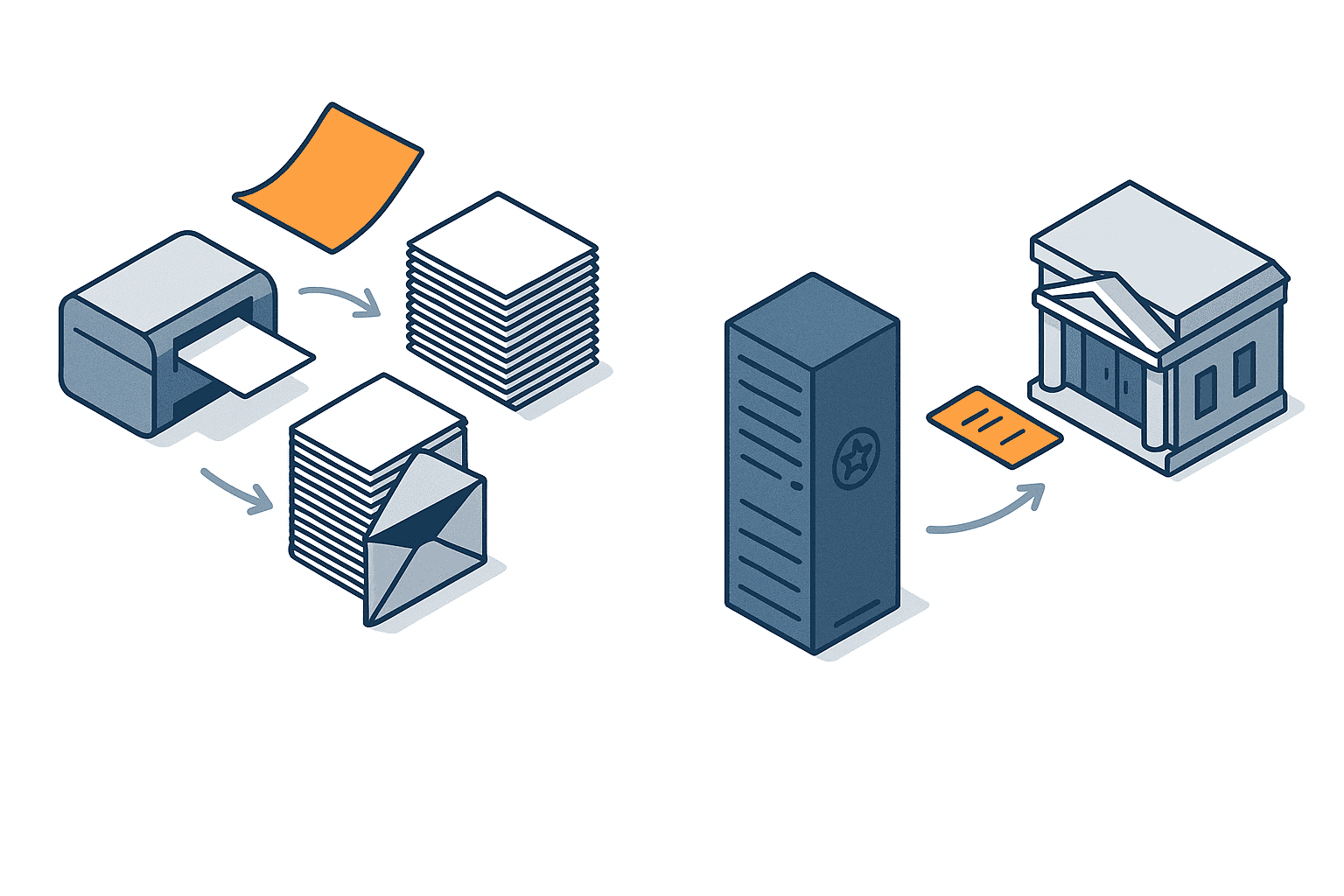
Under Thailand’s VAT system, the Tax Invoice is an extremely important piece of evidence because it is the basis for input VAT credit. Run on paper, the issuer must prepare a document containing the prescribed particulars, and the recipient must retain it and keep it available for presentation during a tax audit. That retention obligation runs for five years, and in manufacturing operations with heavy import, export and related-party transaction volumes it is not unusual for the document count to reach tens of thousands of sheets per year.
The e-Tax Invoice is a mechanism that completes this entire flow in electronic data. The issuer creates an electronic file bearing an electronic signature, sends it to the counterparty, and submits the data to the Revenue Department in the prescribed format. The recipient can retain the electronic file as-is, with no paper filing or scanning work required.
The critical point here is that simply emailing a PDF is not an e-Tax Invoice. To satisfy the requirements of the scheme, you need an electronic signature based on a digital certificate that proves the issuer’s identity, or data submission via a route the Revenue Department has defined. Attaching a PDF produced in-house and sending it by email is not recognised as an e-Tax Invoice under the scheme. If local staff describe the situation as “we have already gone electronic” while leaving that distinction blurred, the actual practice needs to be verified.
What it means in practice for manufacturers
At manufacturers in Thailand, particularly Tier 1 and Tier 2 suppliers of automotive and electronic components, monthly invoice issuance runs from several hundred to several thousand documents. Transaction patterns are varied as well — exports to the parent company, deliveries to vehicle assemblers inside Thailand, and purchasing from local suppliers.
At that scale, issuing and retaining Tax Invoices stops being clerical work and becomes a clear cost driver. Printing and paper, postage, the labour and storage space for filing, and the reissue work that follows whenever a document is lost or a particular is found to be wrong. On top of that, month-end close brings reconciliation work of the “we still have not received the Tax Invoice for this transaction” variety, which squeezes the finance team’s closing schedule.
Migrating to e-Tax Invoice is a way to attack that structural cost. And right now, tax incentives are reported to have been layered on top of it — that is the situation heading into the second half of 2026.
What the tax incentives reportedly approved by the Cabinet in June 2026 contain
Outline of the reported measures
According to reports from several accounting firms and tax news outlets, in June 2026 the Thai Cabinet approved an extension through the end of 2027 of the tax incentives designed to promote adoption of electronic tax systems, namely e-Tax Invoice and e-Receipt as well as e-Withholding Tax.
The incentives being reported fall broadly into two categories.
| Type of incentive | What is reported | Examples of qualifying spend or payment |
|---|---|---|
| Additional corporate income tax deduction | A 200% deduction is reported to be allowed for system investment and related expenses | Investment in an e-Tax Invoice and e-Receipt system, investment in an e-Withholding Tax system, service provider fees, and fees paid to ETDA (Electronic Transactions Development Agency) for information system assessment services |
| Reduced withholding tax rate | For payments made through e-Withholding Tax, rates that were previously 5%, 3% and 2% are reported to be unified at 1% | Service fees, rental payments, advertising and promotion expenses, and other payments subject to withholding |
On the application period, the Cabinet is reported to have approved an extension covering 1 January 2026 through 31 December 2027. That point matters a great deal in practice. The previous incentives expired on 31 December 2025, so if the reporting is accurate, we are currently in a gap in which the old measures have lapsed while the new royal decree has not yet been promulgated. In other words, companies executing investment during 2026 are proceeding on the assumption that legislation promulgated later will apply retroactively.
That said, while multiple secondary sources agree on the figures in this table and on the application period, as of the time of writing we have not been able to verify the underlying text of a royal decree or ministerial regulation published in the Royal Gazette. Most reports state that what the Cabinet approved was a draft bill or draft text, and that formal promulgation of the legal instruments is still pending. So when you actually go to claim the benefit, always confirm the conditions and the application period against the promulgated text of the law, through a Thai accounting firm or tax adviser.
The cash flow impact of a 200% deduction
Assuming the reported 200% deduction applies as described, the effect on the investment decision is not small. Suppose you spend 3,000,000 THB on system investment and related expenses for electronic invoicing readiness. Normally the deductible amount would be 3,000,000 THB. If it qualifies for the 200% deduction, the deductible amount becomes 6,000,000 THB.
Calculated at Thailand’s standard corporate income tax rate of 20%, ordinary deduction at 100% produces a tax reduction of 600,000 THB, leaving an effective cost of 2,400,000 THB. If the spend qualifies for the 200% deduction, the reduction becomes 1,200,000 THB and the effective cost falls to 1,800,000 THB. The difference between the two is 600,000 THB.
Of course this varies with your loss carry-forward position and with whether the measure can be combined with other incentives, and it is in any case an estimate based on a deduction rate sourced from reporting. Even so, an effective cost that would normally have been 2,400,000 THB coming down to 1,800,000 THB — 25% lighter — significantly changes how persuasive an internal approval request is. The harder it is to get system investment signed off at your company, the more this point is worth having in hand.
Where a single withholding tax rate starts to pay off
The other reported incentive, unification of the withholding tax rate at 1%, also affects the workload in payment processing. Thai withholding tax rates are finely split by type of payment, and finance staff have to judge the nature of each transaction and apply the correct rate. Get the judgement wrong and you create exposure to a back-tax assessment.
The reported unification at 1% for payments made through e-Withholding Tax therefore does more than reduce the tax burden — it cuts down the judgement work itself. Seen from the purchasing and procurement system that handles payment processing, it means simpler tax rate master maintenance and fewer exception paths.
Here too, however, this is information at the stage of reported Cabinet approval. Before building it into operations, the range of payment types covered needs to be confirmed against the text of the law.
The two e-Tax Invoice issuance methods — which one to choose
Full XML versus the simplified email method
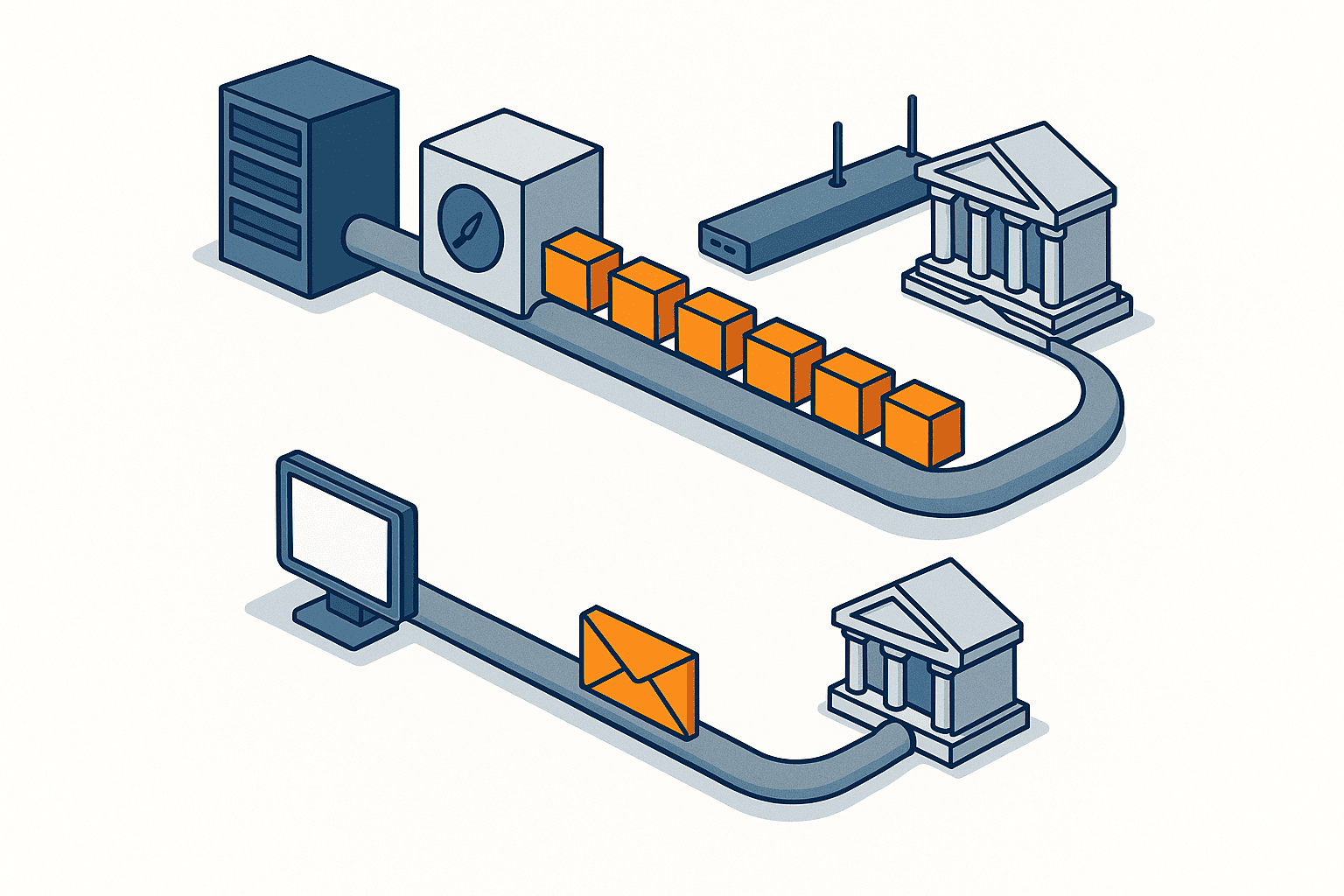
Thailand’s e-Tax Invoice offers two broad issuance methods. They assume different types of business and place different requirements on the systems side.
| Comparison point | Full XML method (electronic signature) | Simplified email method |
|---|---|---|
| Who can use it | Available regardless of company size | Businesses with annual revenue of 30,000,000 THB or below |
| Infrastructure required | A digital certificate and electronic signature mechanism. XML, PDF and PDF/A-3 are accepted formats, and submission is via web upload, host-to-host connection or a service provider | Creation in the designated format (PDF/A-3) and automatic forwarding to the Revenue Department via time stamping by ETDA (Electronic Transactions Development Agency) |
| Assumed issuance volume | Handles high volume, from several hundred to several thousand documents per month | Low volume, on the order of a few dozen documents per month |
| Integration with ERP and order management | Can be designed on the premise of integration | Integration is limited and manual work tends to remain |
| Implementation effort | High. System modification and operational design are required | Low. Can start in a form close to the existing business flow |
| Medium to long term scalability | High. Operations hold up as transaction volume grows | Low. A change of method is required once revenue exceeds the threshold |
Most foreign-owned companies with manufacturing sites in Thailand have annual revenue well above 30,000,000 THB, so in practice the full XML method is the realistic option. The simplified email method is chosen mainly by small service entities, or by newly established sales companies with limited transaction volume, as an interim measure.
The decision criteria most often overlooked when choosing a method
If you choose an issuance method on revenue scale alone, you will hit a wall later. In reality you need to look at three axes together.
First, where the issuance trigger sits. Are Tax Invoices generated automatically from shipping records, or does a finance staff member create them by hand while looking at order data? In the former case there is room to build in XML output, but if you digitise while leaving the latter in place, the manual work simply moves location and the effort does not go down.
Second, the readiness of your counterparties to receive. Where you have a mix of counterparties that can receive electronic data and counterparties that will only accept paper, you get a period of dual operation. Handling that differs between deliveries to vehicle assemblers and dealings with local suppliers is an everyday sight in Thailand.
Third, the frequency of amendments and cancellations. In industries where Tax Invoices are frequently reissued because of quantity changes or unit price corrections, the design of the post-digitisation correction flow decides whether operations succeed or fail. What used to be handled on paper with a red-slip reversal has to be given an electronic equivalent. Deploy without settling this and the shop floor starts running electronic and paper side by side, and control breaks down.
Designing the integration with order management systems and ERP
Why tax compliance should not be treated as a standalone project
Plenty of companies stand up their Thailand e-Tax Invoice response as a self-contained modification project on the accounting system. In manufacturing, though, that tends to be a poor way to proceed.
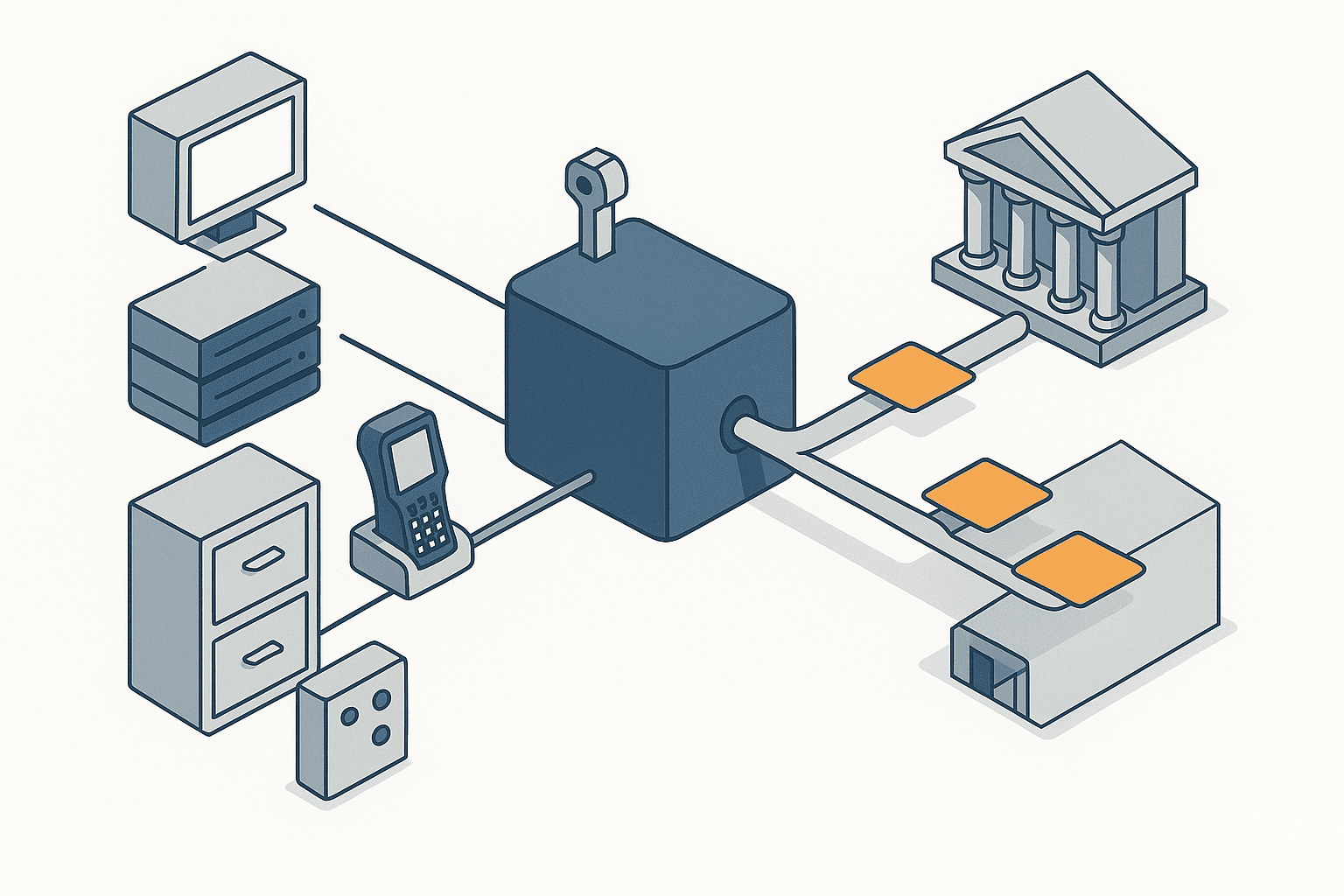
The reason is simple. Most of the information printed on a Tax Invoice does not live in the accounting system — it lives upstream, in the order management, shipping and purchasing systems. Item code, quantity, unit price, delivery destination, shipping date and purchase order number. These arise in the order management and production control domains and reach accounting only as a result.
So the moment you try to put correct data on an e-Tax Invoice, integration design with the upstream systems becomes unavoidable. Put the other way round, the point at which you replace your order management system or ERP is the cheapest opportunity you will get to build that integration in. Bolting on tax compliance alone without touching the existing systems adds interface layers and permanently raises maintenance costs. For the overall picture when you reconsider the order management side of things, see How to choose an order management system in 2026.
Five data points to nail down in the integration design
In an actual integration design, these five points get worked through.
- Consistency of the counterparty master. Do the Tax ID and the branch code match between the order management system and ERP? Thailand manages the head office as 00000 and branches from 00001 onward, so if those five digits are wrong the Tax Invoice fails to meet the content requirements
- Item master and VAT category. Is each item correctly set to standard rate, zero rate or exempt? Where the same item is handled in both export and local transactions, is the design such that the rate is controlled from the transaction category side?
- Numbering rules for issuance. Are Tax Invoice numbers managed as a running sequence with a mechanism that prevents gaps and duplicates? How will you split the numbering scheme when issuing from multiple sites or multiple systems?
- Data flow for amendments and cancellations. Is the flow for issuing a Credit Note or Debit Note on correction tied to the returns and discount handling on the order management side?
- Retention and access rights. Who guarantees the five-year retention of the electronic data? Will it sit inside ERP, or be entrusted to an external service provider? Can the data needed during a tax audit be extracted quickly?
These five points can be used as-is as a checklist when you communicate requirements to a system vendor. Conversely, if you select a product that advertises itself as e-Tax Invoice ready without checking them, you will spend months on master data cleanup after go-live.
Include e-Tax Invoice receipt on the purchasing side in the design scope
The discussion tends to skew toward the issuing side, but for a manufacturer the receiving side matters just as much. Once you start receiving Tax Invoices from suppliers in electronic form, the question of how to run three-way matching (purchase order, goods receipt, invoice) in the purchasing management system comes to the surface.
Under a paper process, a person looked at the arriving invoice and matched it against the purchase order data. Receiving electronic data creates room for automated matching, but that requires a master that maps the supplier’s item codes to your own. Neglect that groundwork and you end up in a state where everything is electronic and a person still matches by eye. On building out the purchasing side, see also How to choose a purchasing management system.
There is also the question of how to guarantee authenticity when you retain a received electronic Tax Invoice as the basis for input VAT credit. Simply dropping files received by email into a local folder makes it hard to explain that your controls are adequate when presentation is demanded during a tax audit. The storage location and access controls for received data should be designed to the same standard as the issuing side.
How to run the implementation project
Think in six phases
A system renewal project that includes e-Tax Invoice readiness is realistically run in the following sequence.
| Phase | Main work | Indicative duration | Primary owner |
|---|---|---|---|
| 1. Current state assessment | Inventory of monthly issuance volume, issuance routes, correction frequency and retention methods | 2 to 4 weeks | Finance |
| 2. Regulatory confirmation | Confirm current legislation and the conditions for the incentives with a tax adviser | 2 to 3 weeks | Finance and tax adviser |
| 3. Method selection | Full XML or simplified email method, and selection of a service provider | 3 to 4 weeks | IT and finance |
| 4. Integration design | Finalise data integration specifications with order management, purchasing and production control systems | 4 to 8 weeks | IT and vendor |
| 5. Build and test | Master data cleanup, XML output implementation, parallel running with a limited set of counterparties | 8 to 12 weeks | IT and vendor |
| 6. Cutover | Phased expansion of covered counterparties, reduction of paper operations | 4 to 8 weeks | Finance and operations |
Stacking those indicative durations gives roughly five and a half to nine months from kick-off to completed cutover. Given that the reported incentives are said to run to the end of 2027, starting within 2026 leaves ample room to complete the investment inside the window. Once again, though, the incentives are at the stage where Cabinet approval has been reported, and formal promulgation of a royal decree or ministerial regulation, along with the application conditions, remains subject to confirmation by a tax adviser.
Do not skip phase 2
In practice, the phase most often skipped is phase 2, the regulatory confirmation. On projects led by the parent company’s IT department, the discussion of system requirements runs ahead and confirmation of the Thai tax conditions gets pushed back.
Yet the return on this investment depends heavily on whether the tax incentives apply. The scope of qualifying spend, the documentation needed to claim, the timing of application. Without establishing these first, you can end up with an investment that turns out to fall outside the incentives entirely. Regulatory confirmation is the tax adviser’s job, not the system vendor’s. Separating that out at the very start is what decides whether the project as a whole succeeds.
How to estimate the cost structure
Break it into four layers
Costs for Thailand e-Tax Invoice readiness estimate more accurately when you split them into the following four layers.
The first layer is service provider costs. This covers the initial fee and monthly subscription when you procure the service that handles connection to the Revenue Department and electronic signing from an external party. Pricing is often metered by document volume, so an estimate of monthly issuance volume is a prerequisite.
The second layer is the cost of obtaining the digital certificate. This is the cost of acquiring a corporate digital certificate and renewing it each validity period. The amounts are not large, but a missed renewal translates directly into an issuance stoppage, so the person accountable for managing it needs to be named.
The third layer is modification of your own systems. This covers implementing the function that outputs XML from ERP or the order management system, master data cleanup and building the correction flow. This layer is the largest share of total cost, and it also varies most widely depending on the state of the existing systems. For the cost structure of building ERP integration into existing business systems, see Business system development costs and ERP integration.
The fourth layer is internal operating cost. Double checking during the parallel running period, notification and coordination with counterparties, and training for shop floor staff. It is hard to book as a monetary line item, yet it is not negligible as project load.
Questions to ask when reviewing a quotation
When you receive a proposal from a vendor, putting the following questions to them will reduce later cost additions.
- How many document types are covered by XML output? Tax Invoice only, or Credit Note and Debit Note as well?
- Is a bulk audit of Tax ID and branch code in the counterparty master included in the scope of work?
- Will amendment and cancellation processing be linked to returns handling in the existing order management system?
- How many years will electronic data be retained, and what are the means of search and extraction during the retention period?
- Is remediation work included in the maintenance contract if regulatory requirements change?
The last item in particular matters. Thailand’s electronic tax systems can be expected to see further additions and changes to requirements. Under a maintenance contract frozen to the specification at signing, every regulatory change produces an additional quotation.
Common failures and how to avoid them
The misconception that producing PDFs equals going electronic
The most frequent failure is mistaking an in-house process of generating PDFs and emailing them for electronic invoicing compliance. As noted above, recognition as an e-Tax Invoice under the scheme requires an electronic signature, or data submission via a route defined by the Revenue Department. Proceeding under this misconception risks documents you believed were digitised not being treated as e-Tax Invoices under the scheme, and the spend not being regarded as investment eligible for the tax incentives either.
Notifying counterparties too late
Even with the technical preparation complete, operations cannot start if counterparties cannot receive electronic data. Dealings with local suppliers inside Thailand are especially affected, because their accounting operations are frequently built around paper and the switch takes several months of coordination. Start notifying counterparties early, in parallel with the system build.
Leaving master data cleanup until later
Errors in Tax ID and branch code are lurking in existing masters in considerable numbers. What went unnoticed under a paper process erupts as errors the moment you go electronic. A bulk audit of master data should be built into the plan during the early stage of the project.
Communicating the regulatory situation incorrectly internally
Trying to push an approval request through with wording like “electronic invoicing is becoming mandatory in Thailand too” leaves you unable to explain yourself later. As of 2026 participation is voluntary, and the position is that the Cabinet is reported to have approved an extension of the incentives. Stating those facts accurately and then making the investment case on cost reduction and operational efficiency is, in the end, an easier way to win internal support.
FAQ
Is Thailand’s e-Tax Invoice mandatory?
As of 2026, participation is voluntary. The Thai Revenue Department’s e-Tax Invoice and e-Receipt scheme is an existing framework that has been in place since 2012, but no uniform rollout plan requiring electronic issuance by all businesses has been confirmed. The government is reported to be driving adoption through tax incentives rather than penalties.
How long will the tax incentives be available?
Reports indicate that in June 2026 the Thai Cabinet approved an extension of the tax incentives for promoting adoption of electronic tax systems through 31 December 2027. However, this is information at the stage where Cabinet approval has been reported, and as of the time of writing we have not been able to verify primary sources for formal promulgation of a royal decree or ministerial regulation. Always confirm eligibility and conditions against the text of the law through a Thai tax adviser.
How much does compliance cost?
Costs break into four layers — service provider fees, the digital certificate, modification of your own systems, and internal operating cost — and they vary widely with the state of the existing systems. Because modification of your own systems is the centre of gravity, confirming first how far your existing ERP or order management system already supports XML output is what determines the accuracy of the estimate. Note that reports indicate a 200% corporate income tax deduction is allowed for qualifying system investment costs, so the effective cost may be compressed.
Is there any problem with choosing the simplified email method?
For a business with annual revenue of 30,000,000 THB or below, it is available under the scheme. However, most foreign-owned companies with manufacturing sites exceed that scale, so in practice the full XML method is the realistic option. The simplified method also tends to break down operationally as issuance volume grows, and its integration with ERP and order management systems is limited. Decide on the basis of your medium to long term transaction volume outlook.
Should this be done at the same time as an ERP replacement?
From the standpoint of integration design cost, doing them together is advantageous. If you are considering replacing ERP or the order management system at your Thai site, the rational approach is to build e-Tax Invoice readiness into the requirements at the requirements definition stage and include it among the evaluation criteria for vendor selection. If on the other hand no replacement is planned for the time being, start by confirming which formats your current system can output data in, and how far the Tax ID and branch codes in the counterparty master have been cleaned up. Those two facts will tell you roughly how much modification compliance would take.
Summary
Thailand’s e-Tax Invoice and e-Receipt scheme is an existing framework that has been in place since 2012, and as of 2026 participation remains voluntary. This is not a situation in which a deadline for a mandate has been set. At the same time, multiple accounting firms and tax news outlets have reported that in June 2026 the Thai Cabinet approved an extension through the end of 2027 of tax incentives aimed at promoting adoption of electronic tax systems, with a 200% corporate income tax deduction and unification of the withholding tax rate at 1% reported as the two pillars. That said, this is information at the stage where Cabinet approval has been reported, and formal promulgation of a royal decree or ministerial regulation is still pending confirmation. Always confirm the application conditions against the text of the law through a tax adviser.
What matters in practice is not carving this out as a standalone modification of the accounting system. Most of the information that appears on a Tax Invoice arises in the order management, shipping and purchasing systems. For a company considering a replacement of ERP or an order management system, therefore, folding e-Tax Invoice readiness into that project’s requirements definition is the most cost-effective way forward. Precisely because participation is voluntary, this is a topic to be decided not to avoid penalties but from the standpoint of reducing operating cost and maximising investment efficiency.
TOMAS TECH builds order management, purchasing management and production control systems for manufacturers in Thailand, and we also advise on integration design that anticipates electronic tax requirements. You are welcome to come to us at the stage of simply wanting to sort out where the regulations stand, or to check how far your existing systems can already go. If you would like to work through an approach suited to your own situation, please get in touch via Contact TOMAS TECH.
References
- Cabinet approves extension of tax measures to end of 2027 to promote adoption of electronic tax systems — HLB Thailand, on the content of the Cabinet approval and the categories of qualifying spend
- E-Invoicing Remains Voluntary — 2026/2027 Updates and Tax Incentives — VATupdate, on the voluntary nature of participation and the fact that formal legal instruments remain pending
- Thailand Approves Two-Year Extension of Electronic Tax System Incentives — Mahanakorn Partners Group, on the date of the Cabinet approval and the application period
- Understanding e-Tax Invoice in Thailand — PKF Thailand, on issuance methods, accepted formats and submission routes
- The Revenue Department official website — the Thai Revenue Department, the place to verify primary information on the scheme


