


A conveyor-top AMR combines autonomous travel with powered rollers or a belt so loads can transfer automatically between production lines, warehouse stations and inspection cells. Buying a mobile robot and mounting a conveyor on it, however, does not complete inter-process transport automation. The load unit, docking tolerance, safety, station handshake, WMS/MES integration and abnormal recovery must be engineered as one system.
This guide helps manufacturers in Thailand define, compare and validate conveyor-top AMRs. It covers capacity, RFP requirements, PoC, FAT/SAT and the business case, with a clear distinction between catalogue maxima and performance that can be accepted on the actual floor.
What is a conveyor-top AMR?
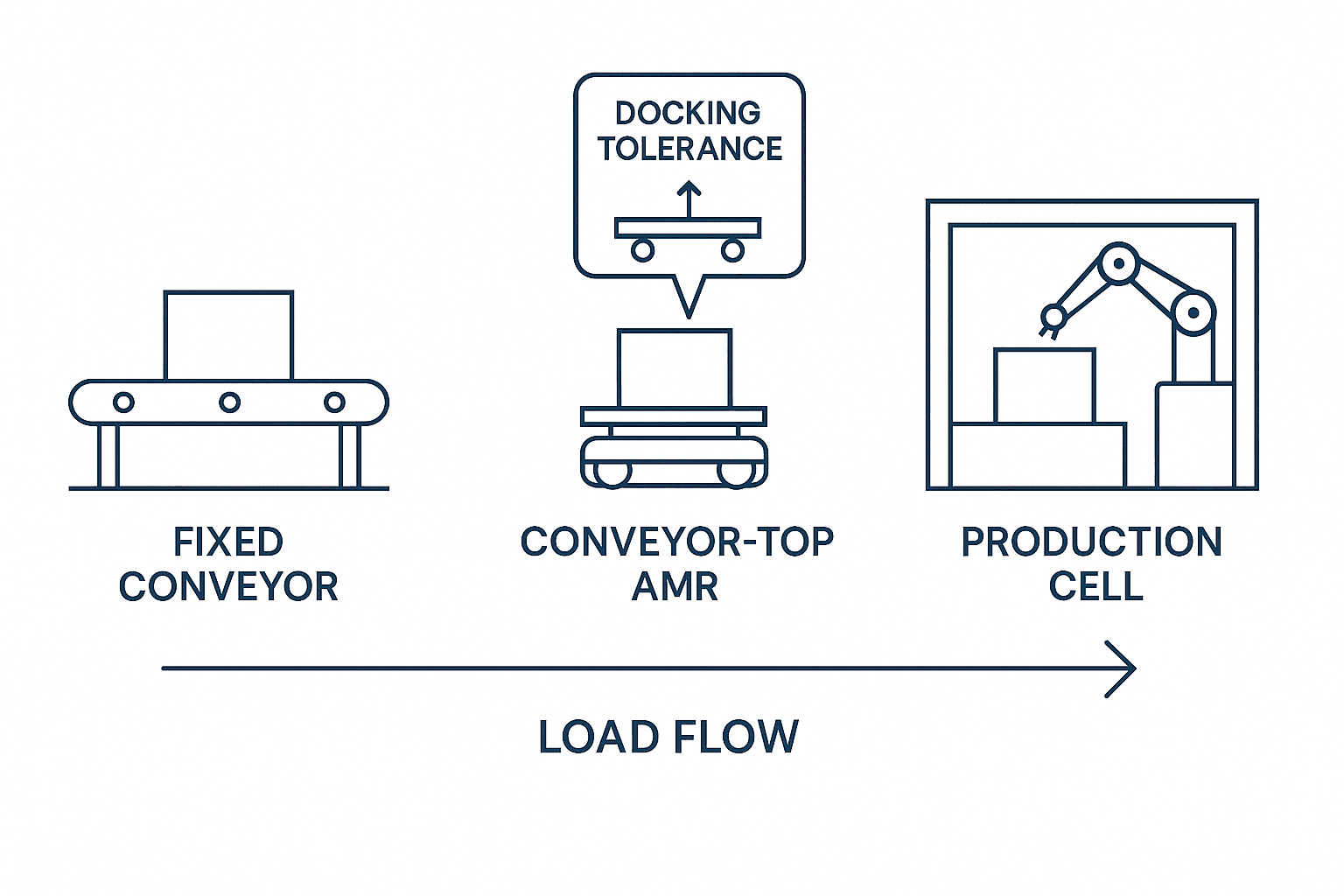
A conveyor-top AMR is a mobile robot fitted with a powered load-transfer module. It docks with a fixed conveyor, assembly cell, inspection machine, packaging machine or warehouse station, confirms that both sides are ready, and then runs its rollers or belt in synchronisation with the station. It can replace manual cart movement while preserving a digital chain of custody from one process to the next.
Conveyor AGV versus AMR
The phrase “conveyor AGV” is used broadly. It may describe a vehicle following tape or reflectors, or an AMR that navigates from a map and responds to obstacles. Do not select by label. Confirm:
- the guidance method and how routes are changed;
- the boundary between local obstacle avoidance and central traffic control;
- docking position and angular tolerance;
- payload and centre-of-gravity limits with the conveyor module installed;
- safety functions for shared areas; and
- interfaces to fleet software, upper-level systems and fixed equipment.
A conventional AGV may be efficient where routes and flow are stable. An AMR becomes attractive when destinations, layouts, bypasses or fleet size change. Free navigation still requires deliberate rules for crossings, passing, queues, charging and emergency routes.
When another mobile format is better
A conveyor top suits stable-bottom totes, cartons or pallets that must transfer without a person. A tugger can be better for several carts, a shelf-carrying robot for goods-to-person work, and an automated forklift for floor pallets or racks at different heights. The right question is not which robot looks most advanced, but which load unit and station boundary the system must serve.
Why Thai factories are automating inter-process transport
Thailand’s Board of Investment describes an efficiency-enhancement measure for investment in automation or robotics used in manufacturing or services. In its release on the first half of 2026, BOI also reported 132 applications worth about THB17.2 billion for machinery upgrades, digital adoption and automation or robotics integration. Eligibility and current conditions must be confirmed for each project, but the figures show continued industrial investment in automation.
“Labour shortage” alone is too vague for a specification. Translate the business issue into measurable outcomes:
- minutes of production stoppage caused by missing material;
- work-in-process and transport lead time;
- forklift–pedestrian interactions;
- wrong deliveries or unrecorded movements;
- the ability to add capacity by stations or vehicles; and
- service continuity during breaks or night shifts.
For line-supply automation, speed is secondary to delivering the correct material, in sequence, before depletion. Evaluate logistics labour, line stoppage, inventory accuracy, safety and traceability together.
Freeze the load and transfer conditions first
Success is often decided before a robot model is chosen. “Cartons up to 50 kg” is not enough. Build a load matrix covering minimum and maximum dimensions, actual weight, centre of gravity, base rigidity, friction, deformation, leakage, projections, orientation and barcode position.
Standardise containers where possible
Rollers work well when the base is sufficiently rigid and supported by the roller pitch. Soft bags, deep-rib totes, small cartons and damaged bases may sag, skew or climb a stop. Belts give continuous support but introduce requirements for friction, tracking, heat, cleaning and replacement.
If containers cannot be standardised, limit the automated scope, use a carrier tray, or divert exceptions to a staffed path. A PoC using only an easy “representative” carton hides the exact cases that jam after go-live. Bring the worst valid container into the first tests.
Transfer height and accumulated tolerance
Matching nominal heights does not remove the effects of floor unevenness, tyre wear, load deformation or installation error. Add the tolerances for floor, docking, roller diameter, frame deflection and load base. Guides, tapers, side rollers, stops and presence sensors should absorb realistic misalignment.
Docking accuracy is not the same as general navigation accuracy. MiR’s official MiR250 specification, for example, states ±3 mm in X and Y and ±0.5° yaw when docking to a VL marker under controlled conditions, while its figures for moving to a position are wider. These are product specifications, not a site guarantee for a custom top, floor and load. The RFP should identify the docking method and acceptance tolerance under actual payload.
Select the top module: roller, belt or chain
Powered roller top
Powered rollers are a common choice for totes and cartons. The module normally combines rollers, stops, load sensors, side guides, a drive and local control. Specify roller pitch, starting torque, direction, minimum load, overrun, pinch protection and cleaning access.
Very light cartons may not trigger sensors reliably; heavy cartons may slip on start-up; flexible bases can sink between rollers. Use more than one signal to establish that a load has left one side and is fully supported by the other. Treat a bridging load as a controlled fault.
Belt top
A belt supports small items, bags and irregular carton bases continuously. It can widen the acceptable load envelope, but belt tension, tracking, cleaning, replacement time, slip and motor load must be evaluated. Food, electronics and clean environments may add material, dust, ESD or wash-down requirements.
Chain or pallet top
Chains may be used for pallets or skids. Calculate the total of the top module, control hardware, optional battery equipment and payload against the AMR’s capacity and centre-of-gravity envelope. Check stability during turns and stops, floor loading, broken pallets and mechanical interference.
Standard module or custom engineering
A standard module usually has defined mechanical and electrical interfaces, documents and spare parts. A custom module can match a process more closely but must stay within the AMR manufacturer’s mounting, safety and warranty conditions. The contract should separate the responsibilities of the vehicle maker, top-module supplier and system integrator.
Design the inter-process workflow before programming
Define the state from task creation to confirmed completion. A robust sequence is:
- MES, WMS, a PLC or an operator application creates a transport request.
- The upper system fixes source, destination, load ID, priority and due time.
- Fleet software assigns a capable AMR and manages route and traffic.
- The AMR arrives at a source queue and requests permission to dock.
- The station confirms safe state, load presence, direction and availability.
- After mutual permission, the top and fixed conveyor run in synchronisation.
- Sensors confirm transfer, and the digital owner of the load changes.
- The AMR travels to the destination and repeats the controlled transfer.
- The upper system stores completion time, trace and any exceptions.
Adding PLC signals after the physical system is built tends to create duplicate requests, empty trips, wrong destinations and missing completion records. Define which system is the source of truth for load location.
Push, pull and emergency supply
A push flow requests transport when the upstream process finishes. It is simple but can create WIP when downstream is blocked. A pull flow requests replenishment from consumption or kanban status. It is useful for line supply but depends on reliable consumption, replenishment lead time, safety stock and empty-container return data.
Many plants need scheduled milk runs, threshold replenishment and emergency tasks together. Unlimited “urgent” priority starves normal work, so set priority classes, deadlines, pre-emption rules and escalation.
Engineer the station handshake
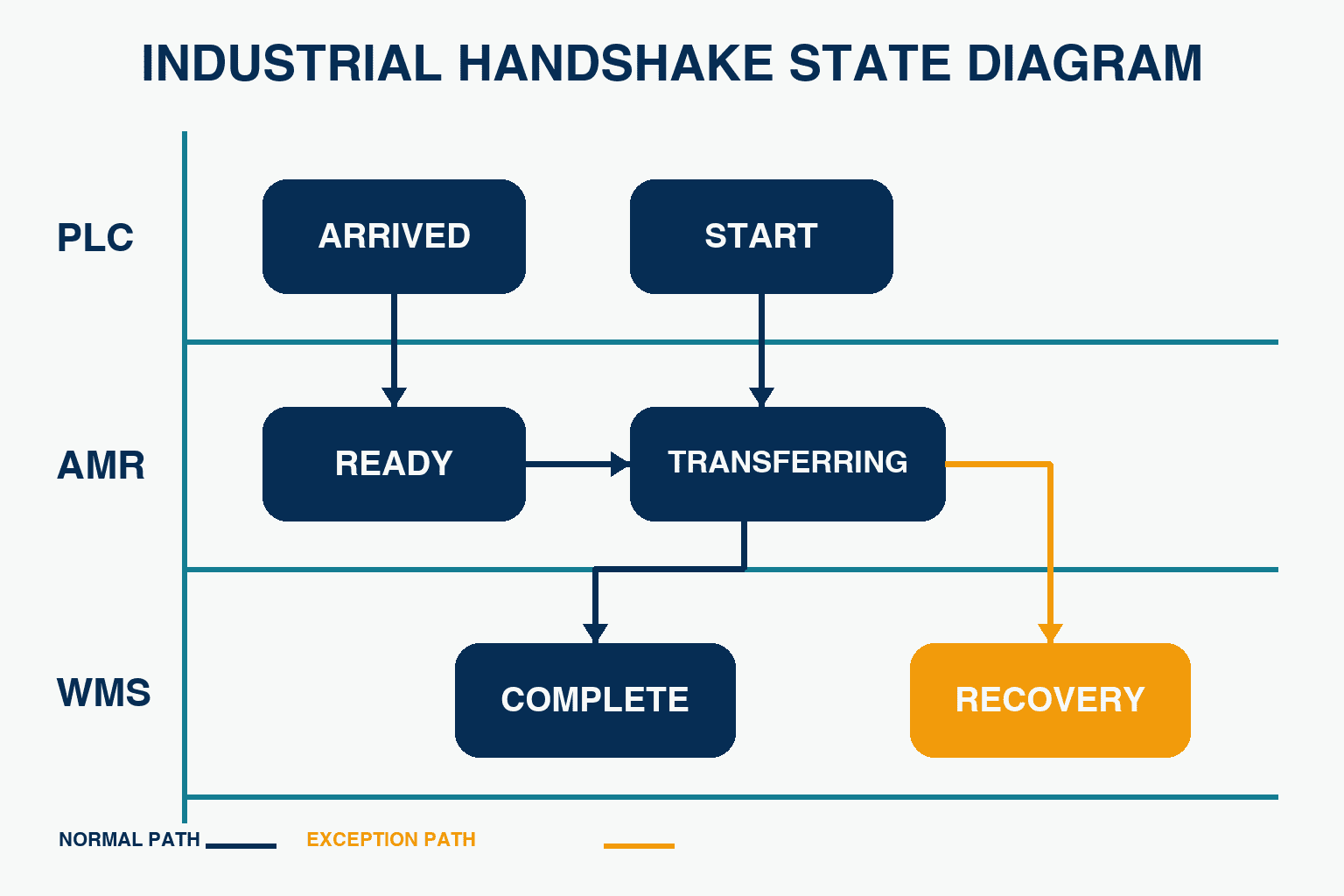
Transfer failures are often more disruptive than navigation failures. At minimum, exchange these states:
- AMR arrived and docked;
- station available;
- transfer direction;
- load present or empty;
- permission to start;
- AMR top and fixed conveyor running;
- transfer complete; and
- fault, timeout and reset request.
Wireless I/O, industrial protocols and APIs can all work. The decisive design is the state transition, timeout, retry and recovery—not the signal name. If communication disappears during a transfer, two independent restarts can pull a load in opposite directions. If only one side records completion, inventory location becomes false.
Transfer digital custody with the physical load
Before transfer, the sender owns the load ID; during movement the state may be “transferring”; after confirmation the receiver owns it. Decide whether the AMR scans the barcode or relies on a station scan. Define what happens for no-read, duplicate and unexpected IDs: stop, quarantine or supervised override.
Make timeout recovery state-specific
Separate inability to dock, station unavailable, drive failure, bridging load and missing completion signal. Each fault needs a rule for automatic retry, alternate station or human intervention. FAT must verify the restart state after every interruption.
AGV WMS integration and the MES/PLC boundary
AGV–WMS integration does not necessarily mean that WMS sends low-level commands directly to vehicles. Divide roles deliberately:
| Layer | Primary responsibility | Typical data |
|---|---|---|
| WMS | Inventory, locations, receiving, shipping, replenishment | Load ID, SKU, quantity, source, destination, business priority |
| MES | Production order, process progress, consumption and WIP | Order, operation, need-by time, lot and quality status |
| WCS/orchestration | Task decomposition, equipment arbitration and queues | Task state, equipment capability, constraints and exceptions |
| Fleet manager | Vehicle assignment, route, traffic and charging | Position, battery, availability and traffic |
| PLC | Real-time sensors, drives and safety interfaces | Presence, interlock, operating state and fault |
A small system may connect MES or WMS directly to a fleet API. With several vehicle types, conveyors, lifts or AS/RS, an orchestration layer may be justified.
VDA 5050 Version 3.0, published in March 2026, defines communication of order and status data between a master control and mobile robots. It adds concepts such as zones and path sharing for freely navigating robots. Support can help a mixed-fleet strategy, but it does not automatically integrate WMS, station PLCs or load handling. Confirm protocol version, implemented scope, vendor extensions and test cases.
Event and API design
A transport request should carry a request ID, load ID, source, destination, priority, deadline, required equipment and cancellation rule. Align statuses such as Requested, Accepted, Assigned, AtSource, Loading, InTransit, AtDestination, Unloading, Completed and Failed. Repeating the same request must not create a second task; idempotency is essential.
Logs should show who requested a task, which robot accepted it, station waiting time, retries, manual interventions and final result. Design for analysis of waiting, empty travel and recovery, not only completed counts.
Calculate fleet size and throughput
Do not size a fleet from maximum speed. Split a cycle into dispatch wait, empty travel, source queue, docking, loading, loaded travel, destination queue, unloading and clearing.
As an illustration, a 12-minute mean cycle with one container gives five theoretical moves per hour. A design assumption of 70% usable utilisation reduces this to 3.5 moves per hour. A demand of 20 moves per hour gives 5.7, hence six vehicles before peak clustering and failure resilience. These are explanatory values, not a universal design factor. Replace them with site measurements and simulate the peak.
Required inputs include:
- demand by time band and 15-minute peak;
- distance by source–destination pair;
- empty-travel ratio;
- docking, loading and unloading time by station;
- crossing, narrow aisle, door, lift and shutter delay;
- charging method and battery policy;
- planned stops, faults, cleaning and manual recovery; and
- future volume, destination and load changes.
Catalogue specifications are only a starting point. OMRON describes LD models with 60, 90 and 250 kg payload classes and publishes model speed and runtime figures. MiR lists 250 kg and up to 2.0 m/s for the MiR250. A top module consumes part of the payload, while safety fields, floor, traffic, load and configuration reduce practical speed. Measure the configured system.
When discrete-event simulation adds value
With several robots, stations, crossings, priorities and charging, averages hide queues. Model request arrival, routes, station occupancy and dispatching. Compare a normal day, peak, one robot unavailable and a blocked route. Simulation is not an automatic answer; it exposes assumptions for agreement.
Safety is a system property
ISO 3691-4:2023 covers safety requirements and verification for driverless industrial trucks and their systems, including AGVs and AMRs. ISO also notes that operating-zone conditions significantly affect safe operation. A compliant base vehicle therefore does not replace site risk assessment for the top module, station, people and operating procedure.
Top modules introduce roller, belt or chain pinch points; a gap to fixed equipment; falling or bridging loads; a higher centre of gravity; unintended movement during transfer; unexpected restart; and fault states involving power or communication. Separate business control from safety-rated control. An API stop command is not automatically a safety function. Select emergency stops, scanners, bumpers, interlocks, guarding, light curtains and warnings from the risk assessment.
Shared operating areas
Aisle width is more than body width. Include protective fields, load overhang, passing, human escape space, doors, columns, temporary storage and forklifts. Survey oil, water, floor joints, grating, slopes, sunlight, dust, temperature, humidity and Wi-Fi. OMRON’s LD specification, for example, lists indoor use, 5–40°C and IP20 for the cited models; compare every selected product with actual conditions.
Layout and station engineering
Provide queue space before docking, a safe escape route after a failed transfer and maintenance access. A waiting AMR must not block the main aisle while another occupies the station. Review chargers, maintenance bays and evacuation routes on the same drawing.
Our conveyor system design guide for Thailand explains accumulation, merge capacity and maintainability on the fixed side. For ownership across vehicle, software and equipment, see the AGV system integration guide.
Standardise transfer height, guide geometry, signals, timeout, HMI, warning and recovery across stations where practical. Survey wireless coverage along routes, docks and chargers, including roaming, latency and packet loss. Define behaviour during network loss and recovery. Include OT segmentation, firewall rules, certificates, accounts, time synchronisation, logs and patch ownership.
Compare total cost and ROI
Budget the whole system:
- AMRs, top modules, chargers and optional batteries;
- fixed conveyors, guides, stops, sensors and safety devices;
- fleet software, WCS, WMS/MES/API and PLC changes;
- Wi-Fi, servers, network and cybersecurity;
- mapping, configuration, simulation, programming and training;
- FAT, shipping, installation, SAT and ramp-up;
- spares, service, software updates and local support; and
- container standardisation, floor repair, layout and signs.
Benefits can include redeployable labour, less line stoppage, overtime, WIP, wrong delivery and risk, plus scalable output. Avoid double counting. If a material handler performs several duties, only the genuinely released time is a labour benefit.
Include local first response in Thailand, parts availability, language, response target, battery, wheels, sensor cleaning, belts, rollers and firmware in OPEX. Interoperability also has lifecycle costs: interface versions and upgrades require regression testing.
What the PoC must prove
A PoC is not a video of a robot moving. It is an experiment that reduces uncertainty before investment. Test the lightest, heaviest, largest, smallest and worst-base loads; docking under realistic floor tolerance; traffic during an actual busy period; loss of communication; sensor faults; bridging loads; station-full recovery; end-to-end load ID trace; charging across a shift; and first-line recovery by local maintenance.
Set acceptance before testing. Possible project-specific criteria include all approved load classes transferred, zero wrong destinations, P95 cycle time within requirement, recovery inside an agreed time and complete trace logs. The actual thresholds must come from the plant’s service requirement.
Build an RFP that vendors can answer consistently
The RFP should provide time-banded demand, source–destination pairs, priorities, load matrix, required cycle time and degraded-mode service. Mechanical requirements should cover top type, height, tolerance, direction, sensing, total load, centre of gravity, floor and slope. Electrical and safety requirements should define power, charging, interlocks and emergency-stop scope.
Software requirements should assign WMS, MES, WCS, fleet and PLC ownership; state API/protocol and any VDA 5050 version; and define state, log, alarm, retry, idempotency, backup and access control. Service requirements should cover Thailand support, response, spares, training language, drawings, I/O, API documentation, configuration backup, FAT/SAT, warranty and change management.
Convert catalogue claims into FAT/SAT evidence
FAT should run the complete path from upper-system request to completion record, not only mechanical transfer. Give equal weight to normal, boundary, fault and recovery cases: network loss, emergency stop, stuck sensor, bridging load, duplicate request, full station, low battery and one robot unavailable.
SAT adds the actual floor, wireless network, people, temperature, lighting and adjacent equipment. Measure P95 or P99 cycle time, queue time, manual intervention, empty travel, charging and transfer failure across representative shifts and a peak—not a short demonstration.
Common failure patterns
Quoting only vehicle count: tops, fixed equipment, software, wireless, safety and ramp-up appear later. Establish one system boundary and cost sheet.
Sizing from rated speed: real cycles consist of curves, stops, crossings, docking, transfer and charging. Use task logs and measured times.
Testing only an easy carton: damaged, soft, light or off-centre containers fail in production. Include worst valid cases and prohibited cases.
Leaving WMS integration to the end: material may move while inventory becomes false. Use production-like request and load states in the PoC.
Depending on the vendor for every recovery: create safe isolation, load removal and task restart procedures that a trained local team can execute.
A 90-day decision plan
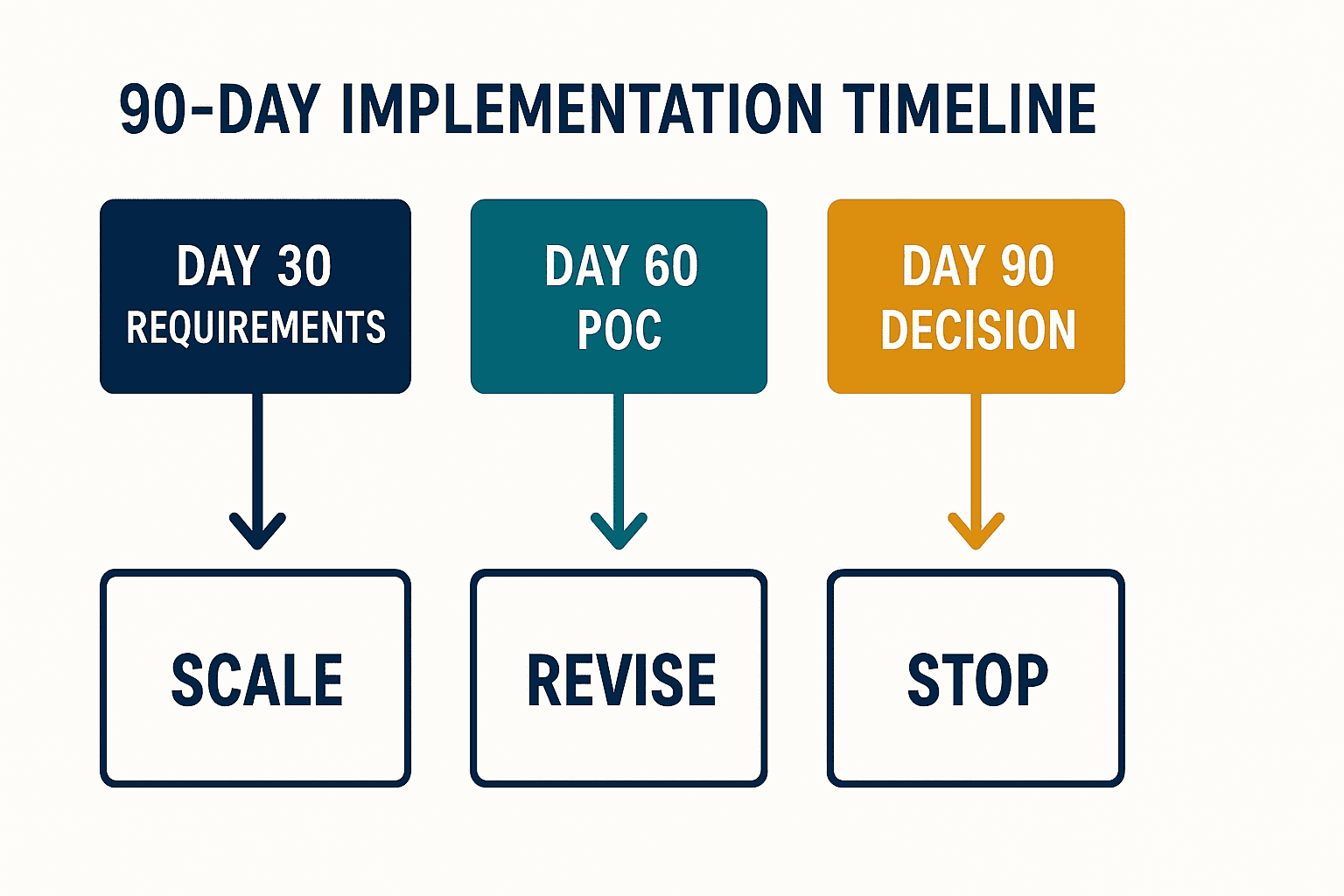
Days 0–30 — measure and specify: collect demand, distance, waiting, loads, traffic and exceptions. Agree scope, KPI, prohibited conditions and system boundary. Compare formats using the actual layout and loads.
Days 31–60 — PoC and interfaces: test transfer, docking, safety and communication with real loads and a representative route. Trigger requests from WMS/MES, trace IDs and deliberately create recovery cases.
Days 61–90 — capacity and investment decision: feed measurements back into fleet sizing and simulation. Update CAPEX, OPEX, benefit and risk. Put FAT/SAT, ownership and Thailand support into the RFP, then decide Scale, Revise or Stop.
Conveyor-top AMR FAQ
Should we choose a conveyor AGV or an AMR?
A conventional AGV can be efficient for fixed routes and stable flow. An AMR is often stronger where destinations, layout, bypass routes or fleet size change. Compare guidance, traffic, safety, docking, integration and support under one requirement set.
How many robots should inter-process transport automation start with?
Calculate from peak requests, measured cycle, charging and the required service when one unit is unavailable. A small one-route PoC is valid, but station and fleet standards should anticipate expansion.
How does line-supply automation prevent shortages?
Manage consumption, reorder point, safety stock, empty-return state and emergency demand in MES/WMS. Measure P95 replenishment lead time and demand clustering, then reserve capacity and priority rules.
What data is required for AGV–WMS integration?
At minimum: request ID, load ID, source, destination, priority, due time, task state, vehicle, fault and completion time. Add idempotent retry, cancellation, network-loss and manual-recovery reconciliation.
Is top-module payload equal to AMR payload?
Not necessarily. Subtract the top, controls and options from the robot’s capacity and validate centre of gravity, height, speed, floor and slope as a complete configuration.
Can a standards-compliant AMR be used immediately?
No. Vehicle compliance is important, but the site must assess the top, stations, people, forklifts and recovery procedure. ISO 3691-4 explicitly recognises the influence of the operating zone.
How should suppliers’ prices be compared?
Compare total ownership cost including vehicles, tops, stations, charging, software, WMS/MES, PLC, wireless, safety, floor, training, FAT/SAT, spares and service. Separate labour, uptime, WIP, quality and safety benefits.
Conclusion: engineer the transfer system, not only the mobile robot
A conveyor-top AMR can connect islands of fixed automation and create traceable inter-process and line-supply flow. Its value depends on engineering the load, mechanical tolerance, handshake, digital custody, WMS/MES interface, capacity, safety and recovery as one transfer system. Prove worst loads and fault cases in a PoC, and freeze measurable FAT/SAT acceptance before contract.
TOMAS TECH supports manufacturers in Thailand from concept and load/layout assessment through fleet sizing, fixed conveyor design, WMS/MES and PLC integration, RFP, PoC and acceptance. You can discuss the process while the robot brand is still open. Contact TOMAS TECH to review your target flow and available operating data.