


Automated Warehouse Cost in Thailand: Price, TCO and ROI
When someone asks, “What is the price of an automated warehouse?”, an estimate based only on rack count is likely to mislead. Two warehouses with the same 4,000 pallet positions can require completely different systems because their peaks, SKU profiles, storage temperatures, permitted downtime, WMS interfaces, buildings and acceptance scope differ. This guide compares manual operations plus WMS, partial automation and AS/RS under one normalized operating baseline for a factory or logistics site in Thailand. Every monetary figure is an editorial assumption used to demonstrate the calculation—not a market price, quotation range or performance guarantee. Replace it with site data and multiple supplier quotations before making an investment decision.
Why automated warehouse cost cannot be priced by rack count
An automated warehouse is not merely a rack-and-crane purchase. It is an operating system that identifies a load, selects a location, issues movement commands, updates inventory and enables people to recover safely from exceptions. Its commercial boundary may include racks, stacker cranes, shuttles, conveyors, AGVs or AMRs, lifts, sensors and PLCs, but also WMS, warehouse control systems (WCS), warehouse execution systems (WES), networks, building and fire-protection work, installation, training, spares and maintenance.
A common comparison error is to put three totals in one table when Supplier A includes floor reinforcement and fire modifications, Supplier B excludes them, and Supplier C sells the WMS under a separate contract. A low initial number may later gain interfaces, electrical work, night shifts, stock relocation and performance testing. Before comparing money, normalize what is supplied, the performance it must deliver and where responsibility ends.
The national context reinforces the importance of a business-level view. NESDC’s *Thailand’s Logistics Report 2024* estimated 2024 logistics costs at THB 2,509.4 billion, or 13.5% of GDP, and projected 13.4–13.8% for 2025. It projected value added by logistics service businesses at THB 556.5 billion in 2024, up 3.8%. These figures do not benchmark automated warehouse prices. They show why inventory, transport and management costs should be evaluated together rather than treating automation as an isolated machine purchase.
Seven requirements that determine automated warehouse implementation cost
1. Peak throughput, not the daily average
The same daily volume can need a modest system when work is spread evenly across eight hours, or much larger buffers and transport capacity when dispatch is concentrated into 90 minutes before cutoff. Define pallets, cases and order lines per hour separately for receipt, put-away, replenishment, picking and dispatch. State the peak factor, duration of the wave, concurrent activities and expected growth. An RFP containing only average daily volume allows each bidder to use a different hidden assumption, making its price incomparable.
2. Physical load and SKU characteristics
Record pallet dimensions, maximum weight, center of gravity, deflection, bottom-board geometry, overhang, packaging, barcode position, temperature, humidity and hazardous-material class. For cases, provide the distribution of length, width, height and weight. For totes, check lids and handles. Forcing exceptional loads through the automatic path increases jams and false sensor detections. A boundary such as “standard loads automated; exceptions handled manually” can be sound engineering rather than a compromise.
3. Service level and tolerated downtime
Define the interval from order cutoff to dispatch, shortage tolerance, FIFO or FEFO rules, lot quarantine, traceability and emergency retrieval. “99% availability” is not enough: does it include planned maintenance, refer to one machine or the whole system, and what duration counts as a stop? Add recovery time objective (RTO), manual bypass, critical spares and remote-support response to the commercial specification. This allows low price to be weighed against continuity of operations.
4. Building and utilities
Survey column spacing, clear height, floor loading and flatness, soil, doors, escape routes, sprinklers, smoke exhaust, electrical capacity, earthing, communications, temperature and dust. A greenfield building and an operating brownfield warehouse present different risks. In a live facility, area segregation, nights and weekends, stock moves, temporary storage and impact on production are also implementation costs. Put building, fire and electrical work excluded from the equipment quotation into a separate owner-cost schedule.
5. Data and AS/RS–WMS integration
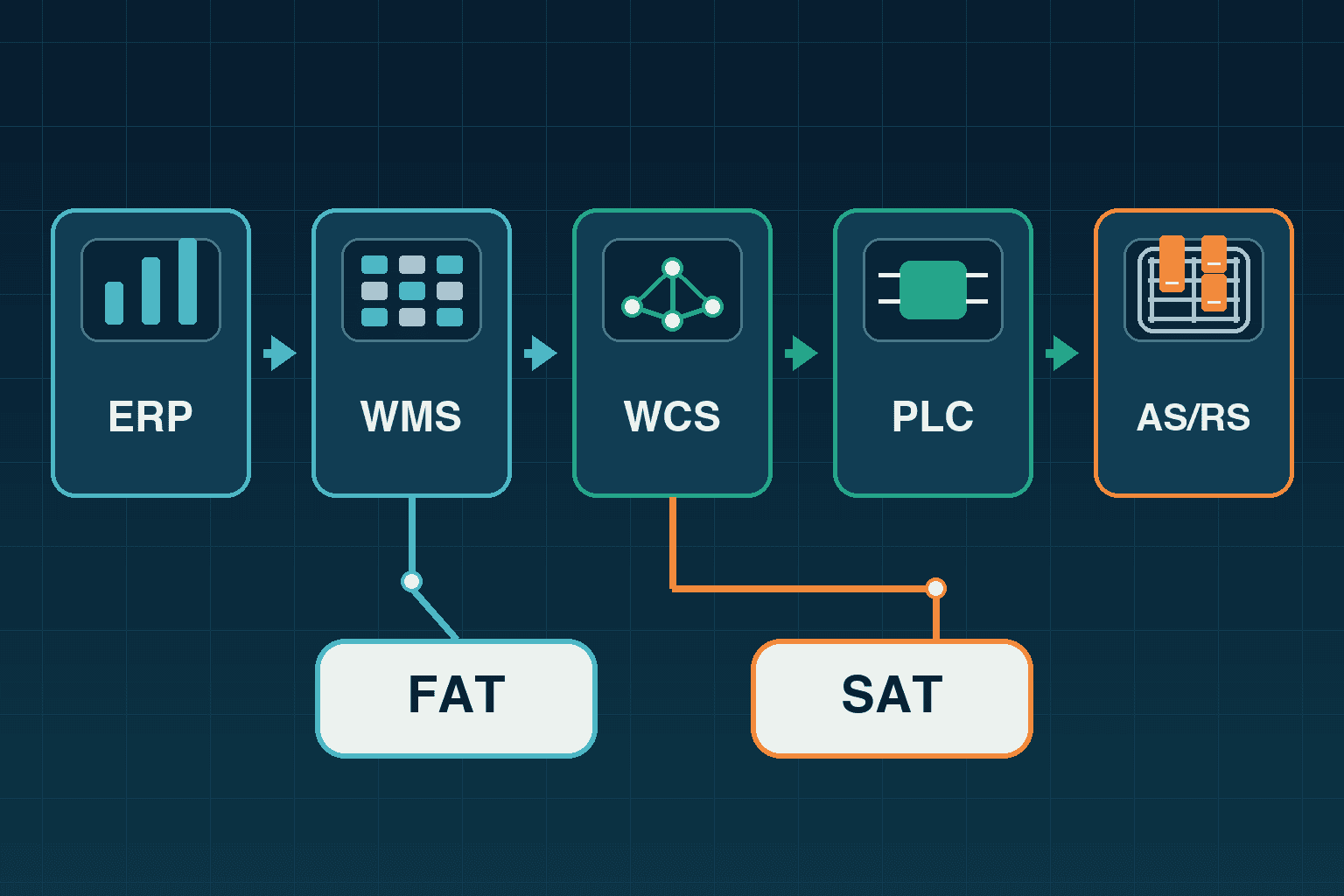
Decide whether ERP, WMS or equipment control is the system of record for inventory. In a typical architecture, ERP handles commercial transactions, WMS locations and work, WCS commands PLCs and material-handling equipment, and WES coordinates priorities across processes. Product boundaries differ, so define responsibility message by message rather than relying on module names.
List item master, logistics-unit ID, receipt authorization, put-away completion, allocation, retrieval request, completion, adjustment, equipment alarm and time synchronization. Test duplicate prevention on retries, resynchronization after communication loss, cancellation, partial completion, unit conversion, lot, expiry and serial handling. The companion guide to WMS cost for Thailand factories helps prevent duplicate budgeting and gaps between equipment and software.
The GS1 Logistic Label Guideline identifies the SSCC as the single mandatory element of a GS1 Logistic Label. It can link a physical logistics unit to data in electronic messages. If GS1 identification is adopted, define who issues the label, how duplicates are prevented, how relabeling and parent–child packs work, and what happens after a no-read. This is an interoperability choice; it is not presented here as a blanket legal obligation for every Thai warehouse.
6. Safety, local rules and insurance conditions
Assess people–equipment traffic, intrusion points, falling loads, crushing, collision, maintenance at height, fire and recovery from power loss—not only normal production but also cleaning, jam clearing and inspection. ISO 3691-4:2023 specifies safety requirements and verification for driverless industrial trucks and their systems, with AGV and AMR among its examples. ISO 13849-1:2023 provides design methodology for safety-related parts of control systems. Merely naming standards in a specification is insufficient; the evidence must trace from risk assessment to safety function, required performance and validation record.
OSHA notes that poorly integrated conveyors, robots and other warehouse automation can create struck-by and caught-between hazards. This is useful hazard-recognition guidance from the United States, not Thai law. Building, fire, occupational safety, electrical and insurer requirements in Thailand must be confirmed for the specific project with qualified local parties and competent authorities.
7. Responsibility boundary and acceptance evidence
Avoid the vague phrase “complete set.” Build a RACI covering supply, design, permit support, delivery, installation, wiring, programming, migration, test, training, documents, spares, warranty and maintenance. When two companies own opposite ends of an interface, name the party that leads integrated testing. The final price determinant is the evidence that proves completion. Throughput, inventory accuracy, availability, recovery, exception handling and safety functions need a measurement method and pass/fail threshold in the contract.
Compare three solutions under the same operating scenario
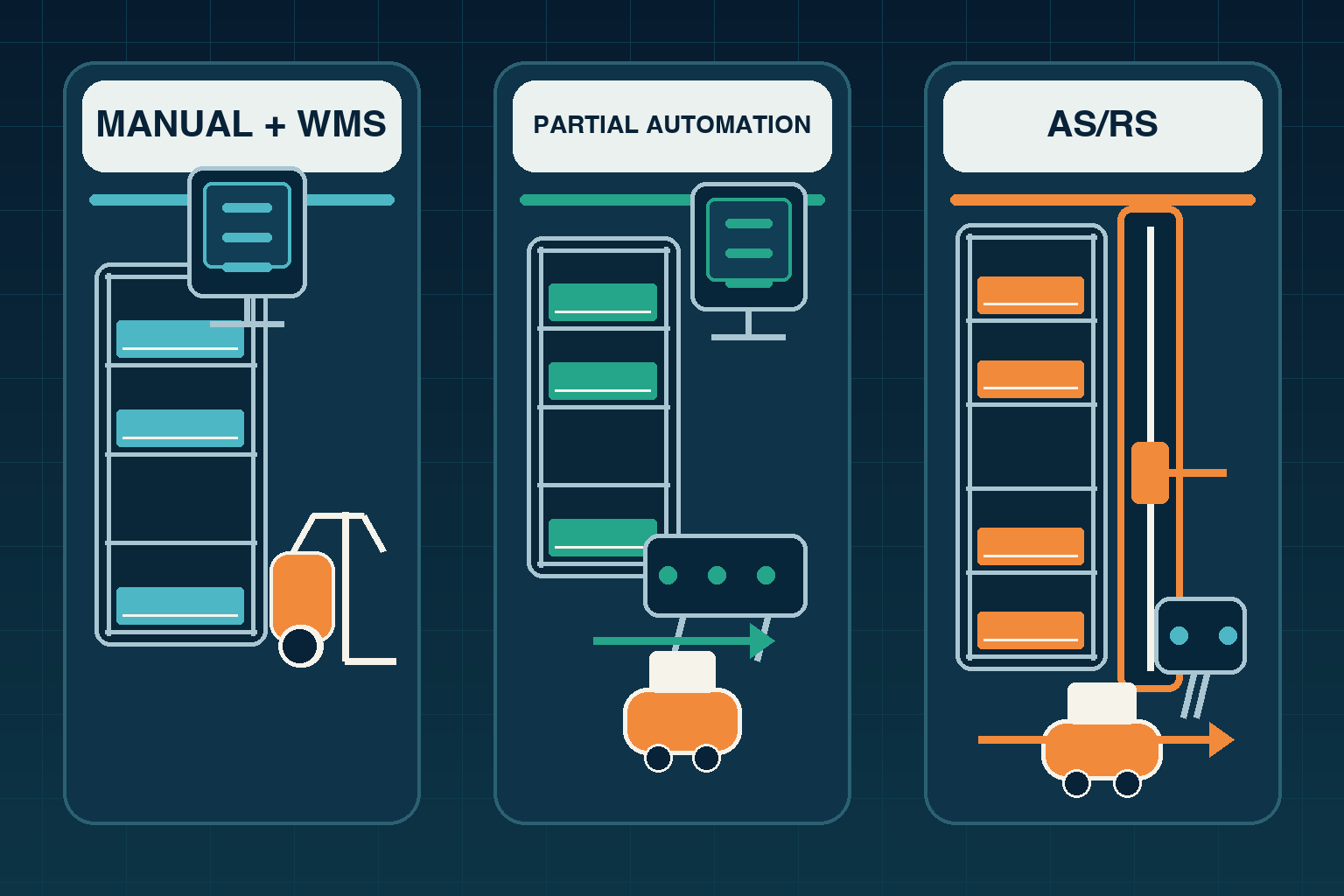
More automation is not automatically better. The right solution fits volume variability, SKU change, building limitations and local maintenance capability.
| Option | Main components | Good fit | Main weaknesses |
|---|---|---|---|
| Manual + WMS | Static racks, forklifts, handhelds, WMS | High product variability, low initial investment, staged rollout | Labour dependency, travel, peak staffing, accuracy variation |
| Partial automation | WMS plus conveyors, AGV/AMR, pick assistance | Clear repetitive moves, brownfield use, modular expansion | Balance between machines, mixed traffic, integration ownership |
| AS/RS | High-density racks, crane/shuttle, transport, WCS/WMS | High throughput, height utilization, standard loads, stable long-term demand | Initial cost, lower change flexibility, stop impact, specialist maintenance |
Manual + WMS is not a “do nothing” option. It establishes location, load-unit and transaction discipline that makes later automation easier. Partial automation can start with receiving transfer, replenishment, long-distance movement or sorting where the bottleneck is demonstrable. The guides to AGV system integration and conveyor system design provide additional detail for these boundaries.
AS/RS can use height efficiently and standardize movement, but nonconforming loads and upstream or downstream stops constrain its actual output. Compare end-to-end capacity from receiving inspection and labeling through storage, picking and shipping—not the theoretical maximum cycle of one machine. Future changes, such as cases becoming long products or multiple pallet standards, belong in the evaluation.
A three-option automated warehouse price model
The figures below are editorial assumptions for explaining a calculation. They are not a Thai market survey, supplier price range or project quotation. They exclude taxes, finance, foreign exchange, BOI benefits, a new building and residual value. Do not reuse them in an investment proposal; replace every value after the site study.
Common assumptions
- 1,200 order lines per day and 300 operating days per year
- Peak factor 1.8 and 4,000 active pallet locations
- Ten-year comparison and 8% discount rate
- Target inventory accuracy 99.5%
- All three options are assumed to meet the same service boundary
| Assumption | Manual + WMS | Partial automation | AS/RS |
|---|---|---|---|
| Initial cost | THB 6.0m | THB 18.0m | THB 48.0m |
| Annual maintenance/licenses | THB 0.9m | THB 1.8m | THB 3.6m |
| Annual operating labour | THB 8.4m | THB 5.4m | THB 3.0m |
| Annual error/damage/downtime allowance | THB 1.2m | THB 0.8m | THB 0.7m |
The ten-year nominal formula is:
Ten-year nominal cost = initial cost + 10 × (annual maintenance + labour + error/damage/downtime allowance)
The result is THB 111.0m for manual + WMS, THB 98.0m for partial automation and THB 121.0m for AS/RS. Manual + WMS has the smallest initial number, while partial automation has the lowest nominal ten-year cost under these assumptions. Using an illustrative 8% discount rate and a ten-year annuity factor of approximately 6.7101 gives discounted TCO of about THB 76.5m, THB 71.7m and THB 97.0m.
The lesson is not that partial automation is always cheapest. It is that disclosed common assumptions can change the decision. If only AS/RS satisfies capacity or avoids a building expansion, ranking by cost alone is meaningless. If demand is uncertain and utilization remains low, the economics of high-density automation deteriorate.
Warehouse automation ROI and simple payback
In the partial-automation comparison, the assumed annual labour difference is THB 3.0m and the error, damage and downtime difference is THB 0.4m, giving a gross operating effect of THB 3.4m. Annual maintenance rises by THB 0.9m, so annual net effect is THB 2.5m. Additional initial cost is THB 12.0m:
Simple payback = THB 12.0m ÷ THB 2.5m = 4.80 years
This calculation deducts incremental maintenance so its boundary matches the annual-cost table. A capital-approval cash flow should additionally include tax, working capital, refresh, decommissioning and timing.
For AS/RS versus manual + WMS, assume the labour and quality difference less incremental maintenance produces an annual net effect of THB 3.2m, against THB 42.0m additional initial cost. Simple payback is about 13.13 years. Because that exceeds the ten-year comparison, test whether AS/RS creates genuine additional value through avoided floor space, otherwise impossible throughput, cold-store energy, recruitment constraints or service resilience.

Downside, baseline and upside
A single forecast hides risk. Holding partial-automation incremental investment at THB 12.0m and incremental maintenance at THB 0.9m per year while varying labour and quality effects gives net effects of THB 1.3m, THB 2.5m and THB 3.7m. Payback is 9.23, 4.80 and 3.24 years respectively. These are not probabilities. They test resilience to workload, utilization, staffing and quality assumptions.
| Scenario | Assumed annual effect | Simple payback | Management question |
|---|---|---|---|
| Downside | THB 1.3m | 9.23 years | Can the business carry contract and maintenance cost if volume misses plan? |
| Baseline | THB 2.5m | 4.80 years | Are standard staffing and utilization achievable? |
| Upside | THB 3.7m | 3.24 years | Does the bottleneck simply move downstream? |
Avoid presenting labour savings based only on a statutory minimum wage. Thailand’s Ministry of Labour announced a THB 400/day minimum effective 1 July 2025 for Bangkok, Chachoengsao, Chonburi, Rayong and other specified areas or business categories. This is identified as the July 2025 rate; this article has not reverified it as a 2026 current wage. A real labour model uses job rates, overtime, shift premium, social contribution, recruitment, training, turnover, supervision and contractor charges.
Prevent missing cost with a structured RFQ
Write operating scenarios before the equipment list. Cover a normal day, peak, month-end, stock count, return, quality hold, equipment stop, network loss and fire alarm. For each, show who acts and which data changes. Then require every bidder to answer the same cost breakdown:
- Mechanical equipment and safeguarding
- Racks, floor, building, fire systems, power and network
- WMS/WCS/WES/PLC, ERP interfaces, terminals and licenses
- Engineering, simulation and project management
- Freight, treatment of duties and taxes, insurance, delivery and installation
- FAT, SAT, performance acceptance and safety validation
- Migration, training and ramp-up assistance
- Maintenance, SLA, remote support, site callout and spares
- Options, exclusions, assumptions, validity and currency terms
- Five- and ten-year refresh, obsolescence, removal and relocation
Ask for quantity logic, not only totals: number of cranes, shuttles, chargers, I/O points, servers, terminals, interfaces, training days and spare units. Convert exclusions into named owner work with budget, owner and due date, then add them back to the total investment.
AS/RS and WMS integration design
Passing a normal API call is not enough; the operation must recover from mismatched states. If WMS sends a retrieval request, WCS accepts it and the connection drops before acknowledgment, retries need an idempotency key to prevent duplicate retrieval. If equipment completes a movement but WMS cannot update, a hold queue and reconciliation process must protect physical–logical inventory integrity.
Include at least these items in interface design and SAT:
- Unique message ID and logistics-unit ID
- Sent, received, started, completed, failed and cancelled transitions
- Timeout, retry count, duplicate rule and out-of-order handling
- Master-data owner, release timing and isolation of unknown products
- Lot, expiry, quality status, inventory owner and unit conversion
- Clock synchronization and audit logs across PLC, WCS, WMS and ERP
- Adjustment and approval after manual recovery
- Backup, restore, cybersecurity and account administration
Simulation should contain order mix, transport conflicts, charging, breaks, replenishment and exception rate, not only machine nameplate capacity. Make assumptions and the model part of the deliverables so differences between model, FAT and SAT can be diagnosed.
Evidence required at FAT, SAT and ramp-up
Factory acceptance testing checks function and safety design before shipment. Site acceptance testing uses the actual building, loads, network, host systems and operators. Performance should use a defined order mix over a sustained period, including stops, restart and exceptions, instead of a momentary maximum.
| Acceptance item | How to write the pass criterion | Evidence |
|---|---|---|
| Throughput | At least Y transactions/hour for X continuous hours with the specified SKU mix | Timestamped logs, order dataset, video |
| Inventory accuracy | Reconciliation after initial stock and all movements | WMS/WCS report and discrepancy record |
| Availability | Define stops, exclusions and measurement period | Alarm history and downtime analysis |
| Recovery | Restore from network loss, power failure and jam within specified time | Scenario test sheets |
| Safety | Safety functions meet requirements with traceable validation | Risk register and validation record |
| Training | Named roles demonstrate operation, checks and recovery | Attendance and competency records |
Rather than a single big-bang switch, migrate by product family or area. Set Go/No-Go criteria, fallback conditions, support staffing and daily review for each stage. A site that cannot stop orders needs particular control over duplicate inventory and the data-freeze time.
Treat BOI support as conditional until verified
BOI reported that Q1 2026 investment applications exceeded THB 1.01 trillion across more than 600 projects. In its application breakdown, Machinery, Automation and Robotics represented 38 projects and THB 8,081m. These are application figures, not approvals, realized investment or automated-warehouse market size. They are only contextual evidence of broader investment interest.
BOI guides and pages describe treatments for automation, robotics, domestic linkages, software and cloud expenditure, but conditions vary by measure, activity, deadline, existing or new project and eligible investment scope. Older pages can retain expired deadlines, including dates in 2025. Do not assume an automated warehouse qualifies or book an incentive percentage into the base case. Confirm the currently valid announcement and project-specific eligibility with BOI or a qualified adviser. Until approval is supportable, place possible benefits in sensitivity analysis rather than the base cash flow.
A 90-day path to an automated warehouse decision
Days 0–30: establish facts
Collect 12 months of receipts, shipments, order lines, stock, SKU dimensions, work records, errors, damage, downtime, staffing and building drawings. Observe travel, waiting, rehandling and search in both normal and peak periods. Give every missing-data assumption an owner and validation date.
Days 31–60: compare concepts and boundaries
Develop manual + WMS, partial automation and AS/RS concepts under the same throughput, service and safety requirements. Put layout, capacity, exceptions, systems, responsibilities, TCO and risks on one comparison sheet. Agree owner evaluation criteria and weights before a supplier-specific concept dominates the discussion.
Days 61–90: quote and test uncertainty
Issue a common RFP and normalize bidder assumptions. Use a proof of concept for the largest uncertainty: load reading, AGV route, WMS messages or picking. A PoC needs success and failure criteria, measurement and deliverables for the production phase—not just a demonstration. The final proposal should include baseline, downside and upside cash flows plus controls for under-capacity, delay and adoption.
FAQ: automated warehouse price, implementation cost and ROI
Can automated warehouse cost be calculated per pallet position?
It can support rough screening but not an investment decision. Peak capacity, loads, building, transport, software, fire protection, downtime and acceptance scope materially affect price. If a per-position metric is used, document its scope and performance and still compare total TCO.
What belongs in automated warehouse implementation cost?
Include mechanical equipment and racks, building, floor, fire, power, WMS/WCS integration, network, freight, installation, tests, migration, training, ramp-up, maintenance, spares, refresh and removal. Add supplier exclusions back into the owner budget.
What matters most in AS/RS–WMS integration?
Define the inventory system of record and message ownership, then preserve physical–logical consistency through communication loss, retries, cancellation, partial completion and manual recovery. Prove abnormal cases at FAT and SAT, not only the happy path.
What payback period makes warehouse automation acceptable?
There is no universal threshold. It depends on capital cost, asset life, demand confidence, competing investments, building limitations and continuity. Use discounted TCO, NPV, downside and capacity requirements alongside simple payback.
Is it reasonable to begin with partial automation instead of AS/RS?
Yes. Establish locations and logistics units in WMS, then automate proven repetitive transport or handling bottlenecks. Preserve future aisle, power, network and interface capacity so staged implementation does not create a dead end.
Conclusion: compare evidence of the same business result
An automated warehouse price comparison starts by fixing peak throughput, service, safety, data, operations, building and responsibility—not with rack count or equipment total. Normalize manual + WMS, partial automation and AS/RS under one scenario, then compare initial cost, ten-year TCO, payback, downside and acceptance evidence. Replace every model assumption with measured data and quotations, and confirm legal, safety and BOI eligibility for the specific project.
If your Thailand factory or logistics site is still at the stage of comparing concepts, writing requirements, defining WMS–equipment interfaces or normalizing quotations, that is already an appropriate time to seek support. To clarify which option and validation sequence fit your existing building and operating data, contact TOMAS TECH.
Sources
- NESDC, Thailand’s Logistics Report 2024: https://www.nesdc.go.th/download/thailands-logistics-reporteng-2024/
- NESDC, full English report PDF: https://www.nesdc.go.th/wordpress/wp-content/uploads/2025/09/logistics-2567-Full-Report-ENG-F.pdf
- Thailand Ministry of Labour, wage rates effective 1 July 2025: https://www.mol.go.th/en/news/starting-july-1-ministry-of-labour-revises-minimum-wage-to-align-with-economy-and-improve-workers-quality-of-life
- Thailand BOI, Q1 2026 investment applications: https://www.boi.go.th/index.php?_module=news&from_page=press_releases%26group_id%3D22&page=press_releases_detail&topic_id=138788
- Thailand BOI, eligible activities/current portal: https://www.boi.go.th/index.php?language=en&newpage=true&page=eligible_activities
- Thailand BOI, Investment Promotion Guide: https://www.boi.go.th/upload/content/BOI_A_Guide_EN.pdf?v=20260607125432
- ISO 3691-4:2023: https://www.iso.org/standard/83545.html
- ISO 13849-1:2023: https://www.iso.org/standard/73481.html
- GS1 Logistic Label Guideline: https://www.gs1.org/standards/gs1-logistic-label-guideline/1-3
- OSHA Warehousing — Hazards and Solutions (US context, not Thai law): https://www.osha.gov/warehousing/hazards-solutions
*All cost, ROI, payback and scenario figures in this article are illustrative assumptions. They are not market prices, quotation ranges, tax or legal advice, performance commitments or investment guarantees. Conduct a site survey, verify current law and programs, perform risk assessment and obtain multiple supplier quotations for a real project.*


