


Welding Robot Implementation 2026 | Production Pattern Decides, Not Price
When a plant starts looking at welding robots, the first information that reaches the desk is almost always pricing. Collaborative cells are cheap, industrial cells are expensive. Once that framing lands first, every subsequent discussion collapses onto a single axis, which is whether the number fits the budget. Yet when you trace back the projects that went live and never delivered the expected result, the cause is rarely that somebody picked the wrong price bracket. It is that the character of the machine never matched the way the plant actually produces.
Welding is an unusual process to automate. A shop running the same part in large volumes and a shop whose product mix turns over every week need completely different capabilities from the same equipment. The first is rewarded by how long the arc can keep running and how much metal goes down per hour. The second is rewarded by how quickly a new part can be taught. No single machine maximizes both. Which is why there is a question that has to be answered before anyone opens a price list.
That question is not how much you can spend. It is how many pieces of how many different parts you run, and how often the mix changes. Move those numbers and the answer to whether a collaborative or an industrial robot wins flips outright. And that is not a figure of speech. There is a region where a collaborative cell that costs 40 to 55% less loses on cost per weld, and there is another region where the speed of an industrial cell earns nothing at all because changeover time absorbs it.
This article lays out the published cost and performance figures, shows where the dividing line actually falls, and then works backwards from there to cover safety design specific to welding, how to secure the people to run the cell in Thailand and ASEAN, how the payback breaks down, and what to settle before you request quotations. It is written for the production engineering and facilities people who have to make this decision inside a plant in Thailand.
Why Welding Robot Projects Stall at the Price List
There is a reason evaluation gets stuck comparing prices. Price arrives as a number from day one and is easy to present internally. Whether the machine fits your production pattern, by contrast, cannot even be articulated without a yardstick to measure against. The result is a capital request that carries a figure and a set of generic benefits, while the question of whether this particular machine suits the way your plant actually runs work is quietly skipped.
The second reason is that welding has been tied to human skill for a very long time. It is entirely normal to find a plant where nobody can say who welds which part in how many minutes, because the process sheets were never kept at that granularity. Without that baseline there is no way to build a from-here-to-there comparison, so the catalogue figures get copied straight into the benefit case. Catalogue figures describe ideal conditions. Setup, fixture changes, spatter removal and all the other real work never appear.
Put those two together and selection becomes a price contest. And selecting on price alone produces two very predictable failures. In the first, a high-speed industrial cell lands in a high-mix, low-volume shop, and the fast machine spends more hours idle for setup and reprogramming than it spends welding. In the second, a collaborative cell lands in a shop running the same part in volume, cannot reach the required output, and a second unit has to be purchased. Neither is a shortfall in the machine. Both are a shortfall in the selection criteria.
So the first step is not collecting quotations. It is turning your own production pattern into numbers. The next section starts matching those numbers against the character of each machine type.
Industrial Versus Collaborative | Arc-On Time, Deposition Rate and Programming Time
Start with the measurable gap between the two types. The figures below are the comparison data published by evsint.com. When you evaluate a welding process, the metrics that matter are not raw motion speed but the proportion of time the arc is actually running and how much metal is deposited per hour.
| Metric | Collaborative welding cell | Industrial welding cell |
|---|---|---|
| Arc-on time | 50 to 65% | 70 to 85% |
| MIG deposition rate | 3 to 7 kg per hour | 8 to 14 kg per hour |
| Motion speed | Baseline | 2 to 3 times the collaborative robot |
| Programming time for a new part | 2 to 8 hours by hand guiding | 2 to 5 days by offline programming |
The top three rows and the bottom row point in opposite directions. Arc-on time, deposition rate and motion speed all favour the industrial cell, and the same source notes that industrial robots also lead on payload, reach and continuous duty. Measured purely on the ability to melt wire and lay down weld metal, industrial equipment wins.
Programming time for a new part reverses that. A collaborative robot can be taught by an operator physically guiding the arm, which puts a new part on the machine in 2 to 8 hours. An industrial cell assumes offline programming and takes 2 to 5 days. Whether the same job takes two hours or two days carries entirely different weight depending on how many new parts you introduce in a month. In a shop that adds a handful of parts a year it is noise. In a shop whose mix turns over weekly it eats the available running hours.
The point to hold onto is that there is no answer to which type is better. The two groups of metrics run in opposite directions, so which one you weight is decided by your production pattern, not by the equipment. The next section establishes the price side of the same comparison.
Welding Robot Price | How Far Apart Do Complete Cells Sit
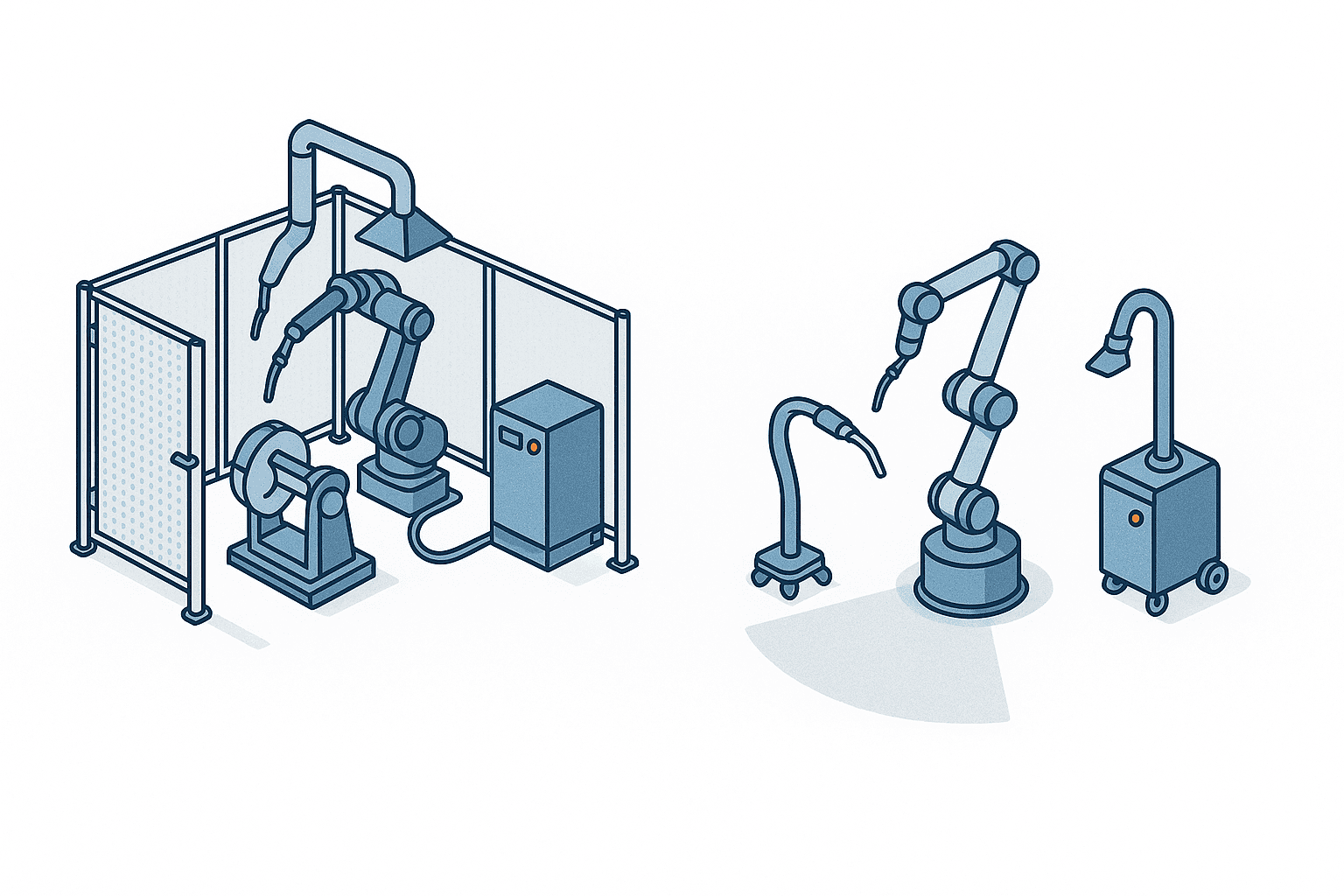
Comparing the price of the arm alone tells you nothing. What you actually pay for is the complete cell, which includes the welding power source, torch, wire feeder, fixtures and positioner, fume control, safety equipment, installation and commissioning. The published data organizes complete system cost as follows.
| Configuration | Indicative complete cell cost |
|---|---|
| Collaborative welding cell | USD 35,000 to 65,000 |
| Industrial welding cell, typical configuration used for comparison | USD 80,000 to 150,000 |
| Industrial welding cell, single station across the wider range | USD 80,000 to 300,000 |
| Entry-level model from a Chinese manufacturer | USD 60,000 to 80,000 |
Collaborative cells are reported to cost 40 to 55% less than conventional industrial cells, and that is not a difference you can wave away. Note that the amounts are kept in the currency of the source. Exchange rates, local content ratio, freight and the conditions of the installation work all move what you actually pay, so treat these as a way to grasp relative scale rather than as a quotation.
The reason the industrial range stretches to USD 300,000 even for a single station is that the number of positioner axes and how far the material handling is engineered can make the overall system considerably larger. It is also worth noting that entry-level machines from Chinese manufacturers, which sit in the industrial category, land in the USD 60,000 to 80,000 band. On price alone, the top of the collaborative range and the bottom of the industrial range overlap. You cannot tell the two machine types apart by price.
That has a direct practical consequence. Overlapping price bands mean a price-led comparison loses resolution. Once several options with different characters sit inside the same budget bracket, the deciding axis has to move over to performance and production pattern.
Breaking Down the Payback Period | What Sits Inside 12 to 24 Months
Take the cost discussion one step further. Payback on a welding robot is generally cited as 12 to 24 months, and the same source separately presents a conservative estimate of 10.5 months and an optimistic estimate of 3.8 months. The general range and those individual estimates rest on different assumptions and are not figures to line up side by side. What matters is that the general range itself spans a factor of two. That spread is the information. It means payback is decided not by the specification of the machine but by how much work you actually give it.
The breakdown of benefits is presented as three components.
| Type of benefit | Indicative annual value |
|---|---|
| Labour cost reduction | USD 180,000 to 270,000 |
| Throughput improvement | USD 30,000 to 80,000 |
| Quality improvement | USD 20,000 to 50,000 |
Labour cost reduction accounts for most of the total. Which means the payback case succeeds or fails almost entirely on how many hours of how many people’s work you genuinely displace. If that assumption does not match your reality, no amount of accumulation in the other two lines will hold the payback period.
The caution here is that labour cost levels differ enormously by region. The source does not state which region’s wage levels these amounts assume. Where wages differ, the absolute value of the labour saving differs, and the payback period moves with it. So a plant in Thailand cannot apply this estimate as published. It has to be rebuilt using your own actual manning and running hours.
The other two lines, throughput and quality, contain elements that are less sensitive to wage levels. Less rework and fewer repeat welds, and less downstream adjustment caused by dimensional variation, show up as flow improvements even in a lower-wage environment. The realistic approach when building a payback case is to substitute your own wage level into the labour line while resisting the temptation to discount the remaining two.
Where the Crossover Happens | Batch Size and Part Count Flip the Answer
Layer the numbers so far and the dividing line comes into view. The industrial advantage of 70 to 85% arc-on time and 8 to 14 kg per hour deposition applies for exactly as long as the machine keeps welding. It contributes nothing during the hours the machine is stopped. While the setup is being changed and the program is being written, industrial speed generates no value at all.
So separate the clock into two parts. One is time actually spent welding. The other is time spent getting ready to run the next part. In a high-volume, low-mix pattern the first is overwhelmingly larger, and the gap in arc-on time and deposition rate translates directly into a gap in output. In that region the industrial cell wins on cost per piece even at the higher purchase price.
In a pattern where the mix turns over frequently, the second accumulates. The difference between 2 to 8 hours and 2 to 5 days to program a new part repeats itself once for every changeover. Repeat that a dozen or more times a month and preparation time consumes whatever the industrial machine earns through speed. In that region the collaborative cell wins on the hours it can actually run, and that advantage matters more than the 40 to 55% difference in the price of the cell.

The structure can be restated simply. An industrial cell buys you productivity during the time you are welding. A collaborative cell buys you a reduction in the time you are not welding. Which one you should buy depends on which of those two blocks of time is larger across your year. Which is why the first step in selection is not issuing a request for quotation but counting last year’s production volumes by part number and the number of changeovers.
At minimum, gather the following. Annual production volume for each part number, lot size per run, number of changeovers per month, weld length and welding position for each part, and the number of new parts introduced per year. With those in hand you can approximate the ratio between the two blocks of time described above. Once you have that ratio, which type to build the evaluation around is decided before a single quotation arrives.
Four Conditions That Favour Collaborative Welding
The published analysis sets out four conditions under which collaborative welding is clearly the stronger choice. They are framed around smaller manufacturers, but the same reasoning applies to the high-mix, low-volume processes inside a large plant.
| Condition | Detail |
|---|---|
| Batch size | Under 50 units per week, with the product mix changing week to week |
| Part count | Twelve or more active part numbers per week |
| Safety approach | Fenceless operation at 1.5 to 3 m is feasible using area safety scanners |
| Facility work | No large-scale facility construction required |
The four look like independent criteria but they are really one situation described from four angles. That situation is a shop running small quantities of many parts, where layout and setup change often, and where the plant therefore wants to avoid committing to fixed installations. Under those conditions the periods during which industrial speed and deposition rate can be exploited are short, while ease of teaching and installation flexibility do the work.
The fourth condition is easy to overlook and carries real money. Where no foundation work or heavy structural steel is needed, the difference in civil and installation cost stacks on top of the difference in cell price. The reverse also holds. In a plant that already has a fenced bay with a suitable foundation standing empty, this condition carries much less weight. The practical judgement is simply to count how many of the four apply to your situation.
For the implementation process for collaborative robots generally, and the cost logic across applications beyond welding, see our article on collaborative robot implementation cost and process. This article deliberately narrows the scope to welding and to the comparison against industrial equipment.
Safety Design Specific to Welding | What to Add to an ISO 10218 Risk Assessment
On safety, general robot implementation practice is not sufficient. ISO 10218 is the safety standard for industrial robots, and according to the explanation published by the Japan Quality Assurance Organization, specific applications such as welding introduce additional hazards including fume, gas, chemical substances and hot materials, and these must be addressed in the risk assessment for the individual application.
That single sentence has very practical consequences. You can calculate stopping distances and design fences and door interlocks exactly to the standard, and all you have covered is mechanical crushing and impact. Welding adds fume that damages health when inhaled, arc radiation that damages eyes, hot workpieces and fixtures that burn on contact, and the possibility of shielding gas accumulating. None of these are solved by the fence design.

Concretely, four items have to be raised as design topics in their own right. First, fume capture. Whether local exhaust can be positioned near the weld point, whether it clears the robot’s working envelope, and whether the hood position obstructs part loading all have to be settled while the cell layout is being drawn. Routing ductwork after the fact tends to mean cutting into the working envelope.
Second, screening arc radiation. A safety fence is equipment for preventing mechanical access and does not necessarily provide optical screening. Whether you use a fence without screening properties or choose to run without a fence at all, the light reaches adjacent operations. The extent of welding curtains or screens has to be set by working backwards from where people stand nearby. Third, handling hot material. Where the workpiece goes immediately after welding, and how long it cools before moving to the next operation. Without that flow defined, automation can end up increasing the number of occasions on which a person handles a hot part. Fourth, shielding gas management. In an enclosed bay the possibility of accumulation has to be considered.
Fenceless operation with a collaborative robot is described as feasible within 1.5 to 3 m using area safety scanners, but that statement concerns mechanical contact only. A bay with no fence also has no barrier against fume dispersion or arc radiation. And since a fence provides optical screening only if it is specified to, exhaust and screening have to be treated as independent design items either way. If you choose to run fenceless, settle the exhaust and screening design before you settle the machine and the layout.
For the design of the safety fence itself, how stopping distance is calculated, and the selection of guards and protective devices under ISO 10218, see our article on robot safety fences and ISO 10218. What this article adds is the layer of welding-specific items that has to sit on top of that.
Supply and Demand in Thailand and ASEAN | A Growing Market Short of Technicians
Shift the view to the market. The welding robot market is forecast to grow from USD 720 million in 2025 to USD 1.18 billion in 2030, at a compound annual growth rate above 10%. Change the scope to industrial and service robots across Southeast Asia as a whole and the market is projected to expand from USD 1.29 billion in 2026 to USD 1.83 billion in 2031, a compound annual growth rate of 7.24% over that period. These are two separate forecasts covering different product scopes, so neither can be read as a subset of the other. Treat each as an independent indication of direction.
Within that Southeast Asian market, Thailand is reported to hold roughly 22% of the regional share, and the Eastern Economic Corridor has attracted USD 3.2 billion in automation-related foreign direct investment against a backdrop of 1.9 million vehicles produced and 4,500 new robot installations. The same source records that body-in-white welding cells and machine-tending collaborative robots have proliferated in Thai manufacturing areas such as Rayong and Chonburi, driven by labour shortages and rising wages. Automating welding is no longer an exceptional decision in this region.
Market growth and ease of implementation are two different things, however. The other figure in the same source is the one that bites in practice. Across Thailand, Malaysia and Vietnam combined, fewer than 4,000 certified robot technicians were trained in 2024, against demand approaching 10,000 by 2027.
That gap is described as pushing up implementation cost and extending implementation timelines by up to three months. This is the most commonly overlooked item in a project plan. Equipment lead time appears on the quotation. How you will secure the people to commission the cell, teach it and adjust it day to day sits outside the quotation entirely. Against an investment with a 12 to 24 month payback, three months of delay is not a rounding error.
There are two practical responses. One is to build the time required to develop in-house capability for teaching and basic adjustment into the implementation plan from the start. The other is to define at the outset how much you will depend on external technicians. Both belong on the schedule at the same point as machine selection.
The Welder Shortage | How to Read Overseas Estimates
Behind the interest in welding automation sits a structural welder shortage. Before quoting any figures, note that the estimates available here cover the United States and do not describe conditions in Thailand.
The two sources referenced carry two different estimates. One article states that the United States is expected to face a shortfall of more than 360,000 welders by 2027. The other states that the United States is expected to face a shortfall of more than 330,000 by 2028. The years and the values differ, and these are independent estimates that should not be merged into a single number. In direction, however, both say the same thing. The supply of people carrying welding skill is not keeping pace with demand.
How that structure relates to a Japanese-owned plant in Thailand needs care. Supply and demand for welders in Thailand operate under different conditions and the figures above cannot be transplanted. On the other hand, as noted earlier, labour shortage and rising wages are cited as drivers of the Southeast Asian robot market, and the same drivers are given as the reason welding cells have spread across Thai manufacturing areas. The common thread is that the assumption underpinning a manually staffed welding process is eroding regardless of geography.
There is one practical implication. Presenting a welding robot as an investment made to reduce the headcount you currently have tends to strain both internal consensus and the payback arithmetic. Designing it instead as an investment that redeploys the skilled people you have into work that is harder to automate is closer to reality and less likely to fall apart. Somebody still has to teach the robot and adjust the programs, so moving people with welding skill onto the operating side of the equipment is the rational answer on both sides of the supply and demand equation.
BOI Incentives and Where Capital Investment Sits
Any automation investment in Thailand will bring the incentive scheme run by the Board of Investment into scope. The BOI treats automation machinery and the robotics industry as priority promoted activities under the Thailand 4.0 policy. Categories such as A1 and A2 carry multi-year corporate income tax exemption together with benefits such as exemption from import duty on machinery.
The caution is that the specific content of the incentives varies by category and by the nature of the business, and conditions including the number of exempt years and any ceilings are set individually. This article describes the general design of the scheme only and deliberately does not state specific durations or caps. When you reach the point of preparing an application, check the official BOI documentation as it stands at that time and confirm which category your business falls into. Scheme administration is revised from time to time, so assuming the terms from a previous project still apply should also be avoided.
For practical investment planning, it is safer not to build incentives into the payback case as an assumption. Incentives accelerate payback when granted, but a plan that collapses without them cannot move forward until the outcome of the application is known. Base the case on a payback scenario that stands without incentives and treat any incentive as upside. Build the case in that order and the project can proceed regardless of how the application lands.
Integrator Selection and Maintenance Decide Uptime
Every payback estimate above assumes the equipment runs as planned. In practice, the uptime of a welding cell is determined far more by the quality of commissioning and the maintenance arrangement than by the specification of the machine. Welding in particular has a long list of items that require routine attention, including torch and nozzle consumables, spatter build-up, wire feed irregularities and fixture wear.
Commissioning quality is governed by the choice of system integrator. For a welding cell, what determines how much rework happens after start-up is whether one party can take an integrated view across robot installation and teaching, development of the welding parameters, fixture design, layout for fume control, and the safety risk assessment. How far you can pin down the interface with the welding power source manufacturer, and the policy for handling dimensional variation in incoming parts, before contract signature is the deciding factor. For how to evaluate an integrator, our article on how to choose a robot system integrator sets out the criteria.
Maintenance sits directly in the path of the technician shortage described earlier. With fewer than 4,000 certified technicians across the three countries, searching for support after a breakdown is not a workable approach. Decide before implementation which work you handle in-house, where you call in an external party, and how long that party takes to arrive. Our article on robot maintenance and support arrangements covers how to structure that.
The single largest lever on uptime is building the in-house capability to replace consumables and make simple teaching corrections. Fewer call-outs mean less time waiting for a technician to become available. That is a separate matter from implementation lead time, but it means the same tight supply of technicians can be made to hurt much less once the cell is running.
Pre-Order Checklist | What to Settle Before You Request Quotations
Here is everything above, reorganized as items to settle before ordering. With these in place, comparing quotations becomes a comparison of conditions rather than a comparison of numbers.
- Annual production volume for each part number, and the lot size per run
- Number of changeovers per month, and the number of new parts introduced per year
- Weld length, welding position, material thickness and material grade for each part
- Measured cycle time of the current welding process, and how much of it is setup
- The welding process specified, and whether an existing power source will be reused
- Measured range of dimensional variation in the workpiece, and the acceptable finish standard
- Floor area of the intended bay, existing foundation and electrical capacity, and whether exhaust ductwork exists
- Whether the design assumes a fence or fenceless operation, and the distance to adjacent operations
- Where hot workpieces are placed and how the cooling flow works
- Who internally will handle teaching, and how much of their time is available
- The boundary between maintenance work done in-house and work sent outside
- Whether a payback scenario exists that stands without any incentive
The first four items on that list are the selection criteria this article has described. If those are filled in with numbers, whether to build the evaluation around a collaborative or an industrial cell can be decided before any quotation arrives. Send enquiries to several suppliers with those four blank and each of them will build a quotation on different assumptions, at which point the comparison itself stops working.
Common Failure Patterns
Here are the failures that occur most often, organized by cause.
First, estimating benefits from catalogue motion speed. Welding output is governed by the proportion of time the arc is running and by the deposition rate, not by how fast the arm travels through air. Arc-on time of 50 to 65% for collaborative and 70 to 85% for industrial equipment means, read the other way, that the arc is off for the remainder. An estimate built on speed alone will overshoot what the cell delivers.
Second, putting an industrial cell into a high-mix, low-volume shop. Place a machine that needs 2 to 5 days to program a new part into a process where the mix turns over weekly and program preparation becomes the constraint on output. The fast machine spends its life waiting.
Third, putting a collaborative cell into a high-volume, low-mix shop. Where required output exceeds what a 3 to 7 kg per hour deposition rate can sustain, the choice narrows to buying a second unit or covering the gap with overtime. The 40 to 55% price advantage disappears with the second purchase.
Fourth, treating safety as a question about fences. Designing stopping distances and guarding to ISO 10218 still leaves the welding-specific hazards, meaning fume, gas, chemical substances and hot materials, unaddressed unless they are assessed individually. Having to add exhaust ductwork after start-up and cutting into the robot’s working envelope to do it is the textbook version of this.
Fifth, leaving people out of the plan. Where the supply of certified technicians is not keeping up with demand, equipment can arrive on time and commissioning still slips. Since the technician shortage is cited as a factor extending implementation by up to three months, who will handle teaching and maintenance is a decision that belongs alongside machine selection, not after it.
Conclusion | Work Backwards From Your Production Pattern
To restate the argument. What really decides a welding robot implementation is not the absolute size of the initial investment but your production pattern, meaning batch size and how often the product mix changes.
An industrial welding cell brings 70 to 85% arc-on time, 8 to 14 kg per hour MIG deposition and 2 to 3 times the motion speed of a collaborative robot, and all of that applies for as long as the machine keeps welding. A collaborative welding cell costs USD 35,000 to 65,000, which is 40 to 55% less than industrial equipment, and can be taught a new part in 2 to 8 hours, but it is capped at 50 to 65% arc-on time and 3 to 7 kg per hour deposition. Where batches run under 50 units per week across twelve or more active part numbers, fenceless operation at 1.5 to 3 m is feasible with area safety scanners, and no large-scale facility work is required, the collaborative cell wins. Outside that region, industrial equipment wins on cost per piece despite the higher price.
On safety, the design of guarding and stopping distances under ISO 10218 has to be supplemented with an individual risk assessment covering the hazards specific to welding, meaning fume, gas, chemical substances and hot materials. The more you lean towards fenceless operation, the more carefully the exhaust and optical screening design has to be done.
And the constraint on the schedule is usually people rather than equipment. Fewer than 4,000 certified robot technicians were trained across Thailand, Malaysia and Vietnam in 2024 against demand approaching 10,000 by 2027, a gap described as raising implementation cost and extending implementation timelines by up to three months. On an investment with a 12 to 24 month payback that delay matters. Planning for the people who will teach and maintain the cell at the same time as selecting the machine is, in practice, how the payback period gets protected.
If You Are Looking at Automating a Welding Process
Whether to build your evaluation around a collaborative or an industrial cell, given your own volumes and part mix, is not always obvious. Nor is it unusual to find that production volumes by part number and setup times are not available as numbers in the first place. Conversations at that stage are welcome. TOMAS TECH is based in Bangkok and works with Japanese-owned manufacturers across Thailand and ASEAN on everything from production management systems through to factory automation. We can start by walking through your current process and helping you work out which numbers to nail down first. Please get in touch through our contact form.
Frequently Asked Questions
How much does a welding robot cost to implement?
Published data puts a complete collaborative welding cell at USD 35,000 to 65,000 and an industrial welding cell at USD 80,000 to 150,000 in the typical configuration used for comparison, widening to USD 80,000 to 300,000 for a single station across the full range. Entry-level models from Chinese manufacturers sit in the USD 60,000 to 80,000 band. All of these describe the complete cell, including the welding power source, fixtures, safety equipment and installation, rather than the arm alone. What you actually pay moves with exchange rates, local content ratio and the conditions of the installation work, so treat these as an indication of scale. When comparing quotations, always confirm whether fixtures and positioner, fume control and teaching effort are inside the scope.
Can a collaborative robot really do welding?
Yes, with a clear ceiling on capability. Arc-on time runs at 50 to 65% against 70 to 85% for industrial equipment, and MIG deposition rate at 3 to 7 kg per hour against 8 to 14 kg per hour. For the same output you therefore need more hours. Collaborative welding is clearly the better choice where batch size is under 50 units per week with the product mix changing week to week, where there are twelve or more active part numbers per week, where fenceless operation at 1.5 to 3 m is feasible with area safety scanners, and where no large-scale facility work is required. In a high-mix, low-volume process meeting those conditions, the agility of teaching a new part in 2 to 8 hours outweighs the price difference.
How far can a welding robot solve the welder shortage?
Even after automating, you still need people to handle teaching, program adjustment, routine consumable replacement and development of welding parameters. So the honest framing is not that people become unnecessary but that the skills required change. On the shortage itself, the available estimates cover the United States, where one source expects a shortfall of more than 360,000 welders by 2027 and another expects more than 330,000 by 2028. Those are independent estimates with different years and different values, and they do not describe conditions in Thailand. That said, labour shortage and rising wages are cited as the reason welding cells have spread across Southeast Asia, so the erosion of the assumption behind a manually staffed process is common ground.
Is a safety fence always required for a welding robot?
For a collaborative robot, fenceless operation within 1.5 to 3 m is described as feasible when combined with area safety scanners. That statement is confined to mechanical contact. ISO 10218 is the safety standard for industrial robots, and specific applications such as welding introduce additional hazards including fume, gas, chemical substances and hot materials, which must be addressed in the risk assessment for the individual application. A bay with no fence also has no barrier against arc radiation or fume. Choosing fenceless operation is precisely the case in which the position of local exhaust and the extent of welding curtains have to be designed by working backwards from where people stand in adjacent operations.
What should we watch for when implementing a welding robot in Thailand?
Three things. First, securing people. Fewer than 4,000 certified robot technicians were trained across Thailand, Malaysia and Vietnam in 2024 against demand approaching 10,000 by 2027, and that shortage is cited as raising implementation cost and extending implementation timelines by up to three months. Second, how you treat incentives. The BOI designates automation machinery and the robotics industry as priority promoted activities under Thailand 4.0, with categories such as A1 and A2 carrying multi-year corporate income tax exemption and exemption from import duty on machinery, but the conditions vary by category and business activity and have to be confirmed individually against official BOI documentation. Build your payback case so that it stands without incentives. Third, the installation environment. Dust, humidity, electrical capacity and whether exhaust infrastructure already exists all feed directly into cell layout and the protection scheme.
References
- EVS International, cost structure of welding robots, payback breakdown, performance differences between industrial and collaborative robots, and market size outlook
- EVS International, conditions under which collaborative welding beats an industrial cell, cost comparison, and comparison of arc-on time, deposition rate and programming time
- Mordor Intelligence, Southeast Asia industrial and service robot market size, Thailand share and Eastern Economic Corridor trends, and the certified robot technician supply gap
- Thailand Board of Investment, investment promotion policy documentation for the automation machinery and robotics industries
- Japan Quality Assurance Organization, overview of ISO 10218 and explanation of the additional hazards arising in specific applications