


Line up the quotations for robot teaching and the comparison almost always collapses into a single axis: how many hours will it take? But the hours are not what shows up in the plant’s P&L. What shows up is the time the line was stopped while that work was being done. This article takes a single robot cell in a Thai factory as its subject and shows, with arithmetic you can redo on a calculator, that the variable separating one teaching method from another is exactly one number: the number of product changeovers per year.
A note before we start. Every figure in this article that is labeled as a worked example is an original calculation derived from the shared assumptions set out below. None of them are industry averages or survey results. Swap in your own numbers and the conclusion itself changes. That is how the article is meant to be used.
What Is Robot Teaching? Four Methods and the One Variable That Decides
Robot teaching is the work of telling a robot arm which position to move to, in which posture, and at which speed, and storing that information in the controller. Under Japanese law, an industrial robot is defined as “a machine equipped with a manipulator and a memory device, which is capable of automatically performing extension/contraction, bending/stretching, vertical movement, lateral movement or rotation of the manipulator, or any combination thereof, based on information in the memory device” (Ministry of Health, Labour and Welfare, Japan). In other words, teaching is the act of creating the information that goes into the memory device, and whether a robot project succeeds is decided at this stage of the design, before the hardware selection.
There are four broad methods. Rather than comparing feature lists, line them up on two axes, whether the real robot has to be stopped and how much you pay up front in preparation, and the selection logic becomes obvious.

| Method | Real-robot downtime | Up-front preparation cost | Best suited to |
|---|---|---|---|
| Online (teach pendant) | Required (the entire work time) | Almost zero | Few changeovers, one-off start-ups |
| Direct teaching | Required (but short) | Small | Collaborative robots, high-mix low-volume, shop-floor led |
| Offline programming (OLP) | Fine-tuning only | Large (3D models, calibration, training) | Many changeovers, roll-out across multiple cells |
| AI-assisted / natural language | Depends on the underlying method | Medium (organizing existing assets) | Existing program assets with frequent revisions |
Online Teaching: Looks Cheapest, Often Ends Up Most Expensive
The operator holds a teach pendant, jogs the real robot at low speed, and stores the target points one at a time. It requires almost no additional investment and can start tomorrow. For a small or mid-sized plant, choosing this as the first step in a robot arm implementation is a perfectly reasonable decision.
The problem is that the time spent teaching is line downtime, one hour for one hour. Trial runs and fine-tuning occupy the real robot in exactly the same way. If changeovers happen a few times a year this is rounding error. If they happen several times a month, this becomes the plant’s single largest hidden cost.
Direct Teaching: The Method With Reported Cases of “60% Shorter Deployment”
A person physically guides the arm by hand and the trajectory is recorded. It is common on collaborative robots, and its biggest advantage is that shop-floor operators with no programming background can use it. Vendors and system integrators have reported cases of a 60% reduction in deployment time. That is a published case figure, not a general rule that reproduces in every plant. Please read it separately from the worked example in the second half of this article.
It suits situations where positional accuracy requirements are not down to the millimeter, where the payload is light enough for a person to guide by hand, and where changeovers are frequent. The cost structure of collaborative robots themselves is covered in “Collaborative Robot Implementation: Costs and How to Proceed“.
Offline Programming (OLP): No Downtime, but a Large Payment Up Front
The robot, fixtures and workpiece are reproduced in a 3D space on a PC, trajectories are built in simulation, and the program is then transferred to the real robot. The essential value is that programs can be written without stopping the line. Vendors and system integrators have reported cases of a 50% reduction in labor hours, and even a case of programming 20 robots simultaneously without stopping the line. There is also a report of up to 80% reduction depending on the method chosen. All of these are published case figures. This article uses none of those reduction rates; it calculates from independently stated assumptions.
The trap in OLP is not the reduction rate, it is the structure of the up-front payment: software licenses, building the 3D models, calibration, and training people. The money spent there is never recovered in a plant with few changeovers. The break-even point is calculated in numbers later in this article.
AI-Assisted and Natural Language Teaching: What Is Actually in Production Use in 2026
The intersection of generative AI and industrial robotics has been organized into four layers as of 2026 (EVS International): (1) an LLM generating code and motion scripts in existing controller languages; (2) VLA (Vision-Language-Action) foundation models operating robots without explicit programming; (3) generative simulation producing large volumes of synthetic training data; and (4) AI-assisted offline programming, including natural language teach pendants.
What matters is this: as of 2026, only layers 1 and 4 have reached production scale, while layers 2 and 3 remain at the pilot stage. So “let us wait, because layer 2 is coming” is not an available option for today’s investment decision. Read the other way round, layers 1 and 4 pay off most in plants that already own controller-language program assets and an OLP environment. The precondition for using AI turns out to sit in an unglamorous place: whether your 3D models and program assets are in order.
Decision rule you can use tomorrow. Do not choose among the four methods with a feature comparison table. Write down only two things: does the real robot stop during that work, and how many times a year do you do it? Once those two are fixed, the method narrows down by itself.
Why Teaching Costs Disappear from View: Count Downtime, Not Labor Hours
In most plants, teaching cost disappears because it gets absorbed into the payroll account. The salary of the teaching staff is booked as labor cost at the same amount every month, and nobody separates out how many of those hours were spent standing in front of a robot. Meanwhile, the output that could not be produced because the line was stopped during that work appears in no account at all. If the production plan was built from the start on the assumption that the line stops that day, the loss dissolves into the plan itself.
Put numbers on this structure and it becomes obvious why labor-hour management misses the target. Under the assumptions in this article, the teaching operator’s wage is THB 75.6 per hour and the loss from stopping this cell for one hour is THB 1,500 per hour (the basis is given in the next chapter). The total cost of one hour of teaching while the real robot is stopped is therefore:
- 1,500 + 75.6 = THB 1,575.6 per hour
Labor accounts for 75.6 / 1,575.6 = 0.0480, that is about 4.8%. The remaining roughly 95% is the loss from downtime. Cut labor hours by 10% and the total moves by less than 0.5%. And yet improvement activities gravitate toward “shortening teaching time”. The first argument of this article is simply that the wrong target is being cut.
This invisibility is amplified through three further channels.
First, the downtime comes in small pieces. A single 3.5-hour stop is not the kind of incident that gets raised at the morning meeting. But 120 of them a year is 120 x 3.5 = 420 hours, which at 8 hours per day is 52.5 days of lost production opportunity. Against 250 operating days a year, the cell is idle for the equivalent of roughly a fifth of those days.
Second, the loss per hour differs by plant. The THB 1,500 per hour figure is the value added per hour of that cell. A cell running high-value-added products is worth more; if you have slack capacity and can catch up on another line, the effective figure can be close to zero. So do not carry this article’s conclusion home unchanged. Calculate the value added per hour of your own cell and substitute it in. That is the first thing to do.
Third, changing the method can actually increase labor hours. In the worked example below (the case with 120 changeovers a year), introducing OLP increases annual work hours from 420 to 480. The total cost still falls. As long as the evaluation is done in labor hours, this decision will never be approved.
Decision rule you can use tomorrow. Do not let teaching improvements be reported as “hours saved”. Have them reported as “hours the real robot was stopped x your own cell’s hourly value”. Adding that one line to the reporting format is enough to reorder the priorities.
Worked Example: Break-Even at 70 per Year. Which Plants Recover OLP and Which Do Not
From here on, this is an original worked example for this article. Everything is derived from a single equation, and you can check it on a calculator as you read.
Shared Assumptions
| Item | Value | Basis / note |
|---|---|---|
| Subject | One robot cell in a Thai factory (handling / assembly) | — |
| Operating days per year | 250 days | Assumption |
| Teaching operator wage | THB 605/day, i.e. THB 75.6/hour | Thailand’s occupational (skill-based) minimum wage for “Industrial Robot Controller Level 1”. 605 / 8 = 75.625, rounded to 75.6 |
| Loss from one hour of cell downtime | THB 1,500/hour | Value added per hour of that cell. This differs by plant, so substitute your own figure |
| Product changeovers per year | N times | Count of new teaching jobs or edits to existing programs |
Wages are stated on a statutory basis throughout. In practice, the fully loaded cost including social security and bonuses runs 1.2 to 1.3 times higher, but if you apply a multiplier, apply the same multiplier to both scenarios. Note that Scenario B has longer work hours (see below), so applying the multiplier does shift the coefficient of the difference slightly. Applying 1.3x moves the coefficient from 3,712.2 to 3,700.86, the five-year break-even from 70.04 to 70.25 changeovers, and the payback period at N = 120 from 2.391 years to 2.400 years. That is the size of the movement, and the conclusions of this article (70 per year, about 2.4 years) do not change.
One more assumption is the most important of all. There is only one counterfactual in this calculation. We compare the world in which OLP was not introduced (Scenario A) against the world in which it was (Scenario B), as whole packages, and count only the difference as the effect. We do not double count by separately adding up “downtime saved” and “labor hours saved”.
Scenario A: Mainly Online Teaching (Stop the Robot and Teach)
Real-robot downtime is 3.5 hours per changeover: 2.5 hours of teaching plus 1.0 hour of trial running and fine-tuning. A person is standing at the robot for that entire time.
- Annual downtime = N x 3.5 hours
- Downtime loss = N x 3.5 x 1,500
- Labor cost = N x 3.5 x 75.6
- A(N) = N x 3.5 x 1,575.6 = N x 5,514.6 THB per year
Scenario B: Introduce Offline Programming (OLP)
The initial investment is set at THB 850,000: software licenses 450,000, 3D model preparation and calibration 250,000, and training and start-up 150,000, totaling 850,000. Annual maintenance is THB 90,000.
Each changeover splits into offline work of 3.0 hours (during which the real robot keeps running) and on-robot touch-up of 1.0 hour (this is when it stops).
This point is easy to misread, so it is stated explicitly. In Scenario B, labor cost is incurred for both the 1.0 hour of on-robot touch-up and the 3.0 hours of offline work — 4.0 hours in total, that is N x 4.0 x 75.6 = N x 302.4 THB. Offline work does not become free; it simply moves to a place where the line does not have to stop. What changes is that downtime loss is incurred only for the 1.0 hour of on-robot touch-up.
- Downtime loss = N x 1.0 x 1,500
- Labor cost = N x 4.0 x 75.6 = N x 302.4
- Maintenance = 90,000
- B(N) = N x 1,802.4 + 90,000 THB per year
Within B’s variable cost (excluding maintenance), downtime loss is 1,500 / 1,802.4 = about 83% and labor is about 17%. Compared with A’s roughly 95% versus 4.8%, the structure has genuinely changed.
The Annual Difference, and the Results at N = 120 and N = 40
A(N) – B(N) = N x (5,514.6 – 1,802.4) – 90,000 = N x 3,712.2 – 90,000
That single line is everything. Every number below comes from it and nowhere else.
When N = 120 (about 10 per month)
- A = 120 x 5,514.6 = THB 661,752 per year
- B = 120 x 1,802.4 + 90,000 = 216,288 + 90,000 = THB 306,288 per year
- Difference = 661,752 – 306,288 = THB 355,464 per year (check: 120 x 3,712.2 = 445,464; 445,464 – 90,000 = 355,464 ✔)
- Simple payback = 850,000 / 355,464 = about 2.4 years
Break it down by cost line and the single most important fact in this calculation appears.
| Cost line | A (N = 120) | B (N = 120) |
|---|---|---|
| Real-robot downtime | 420 hours | 120 hours |
| Downtime loss | 630,000 | 180,000 |
| Work hours | 420 hours | 480 hours |
| Labor cost | 31,752 | 36,288 |
| Annual maintenance | 0 | 90,000 |
| Annual total | 661,752 | 306,288 |
B has a higher labor cost than A. The gap is 36,288 – 31,752 = THB 4,536 (the 60 extra hours x 75.6). Work hours rise from 420 to 480, an increase of more than 14%. And yet B is THB 355,464 a year cheaper, because downtime falls from 420 hours to 120 hours. Judged on labor hours, this investment gets rejected. “Cost is driven by downtime, not labor hours” is not a metaphor; it is this table.
Five-year totals
- A = 661,752 x 5 = THB 3,308,760
- B = 850,000 + 306,288 x 5 = 850,000 + 1,531,440 = THB 2,381,440
- Difference = 3,308,760 – 2,381,440 = THB 927,320 (check: 355,464 x 5 = 1,777,320; 1,777,320 – 850,000 = 927,320 ✔)
When N = 40 (3 to 4 per month)
- A = 40 x 5,514.6 = THB 220,584 per year
- B = 40 x 1,802.4 + 90,000 = 72,096 + 90,000 = THB 162,096 per year
- Difference = THB 58,488 per year (check: 40 x 3,712.2 = 148,488; 148,488 – 90,000 = 58,488 ✔)
- Payback = 850,000 / 58,488 = 14.5 years
Over five years: A = 220,584 x 5 = THB 1,102,920 and B = 850,000 + 162,096 x 5 = 850,000 + 810,480 = THB 1,660,480. B costs THB 557,560 more (check: 850,000 – 58,488 x 5 = 850,000 – 292,440 = 557,560 ✔). You are saving THB 58,488 every year, and yet the equipment replacement cycle arrives before the initial investment is recovered. That is the classic losing pattern.
Break-Even and Sensitivity

If you want to recover the initial investment in five years
- Required annual difference = 850,000 / 5 = THB 170,000 per year
- N x 3,712.2 – 90,000 = 170,000, so N x 3,712.2 = 260,000, giving N = 70.04
- 70 changeovers a year (just under 6 per month) is the five-year break-even point
At exactly 70, the annual difference is 70 x 3,712.2 – 90,000 = THB 169,854, or THB 849,270 over five years — THB 730 short of the THB 850,000 initial investment. That is why the strict figure is 70.04. Read the other way round, near the break-even point one additional changeover moves the five-year total by only THB 18,561 (3,712.2 x 5). For a plant whose actual N sits around 70, the difference is small whichever way it falls. The plants that need to decide quickly are the ones whose N is far away from the break-even point.
If you want payback in three years
- Required annual difference = 850,000 / 3 = THB 283,333 per year
- N x 3,712.2 = 373,333, so N = 100.6, that is 101 changeovers a year (just over 8 per month)
(Check: at 100, three years give 281,220 x 3 = THB 843,660, which falls short; at 101, 284,932.2 x 3 = THB 854,796.6, which clears it.)
Sensitivity: substitute your own downtime loss
If the downtime loss is redefined as X THB per hour, the annual difference becomes N x (2.5X – 37.8) – 90,000. (With X = 1,500, 2.5 x 1,500 – 37.8 = 3,712.2, which matches the equation above.) The five-year break-even is therefore:
N = 260,000 / (2.5X – 37.8)
Put your own cell’s value added per hour into that formula. Halve X and the denominator roughly halves too, so the break-even moves to roughly twice the number of changeovers. Conversely, the higher the value added of the cell, the fewer changeovers are needed to justify OLP. The debate about which teaching method to adopt can be replaced by a debate about which X to put into this formula.
Decision rule you can use tomorrow. Take two numbers into the meeting instead of a method comparison table: (1) your cell’s value added per hour X, and (2) last year’s actual changeover count N. Put them into N = 260,000 / (2.5X – 37.8) and look only at whether your actual N exceeds the break-even. If it does not, however good the features are, OLP waits.
The Real Cost of Key-Person Dependency: In Thailand, “People Who Can Teach” Sit in a Separate Wage Tier
Any discussion of robot teaching in Thailand eventually has to deal with the price of people.
Alongside the general minimum wage, Thailand has an occupational (skill-based) minimum wage established under the National Skill Development Act. Among the 13 occupations announced in the Royal Gazette on 20 June 2025 and effective 90 days later is “Industrial Robot Controller Level 1”, set at THB 605 per day or more. Of the 13 occupations, this is the only one in the automation and robotics field. For reference, the highest rate in the same announcement is THB 800 per day for “Air Conditioning Technician for Clean Rooms Level 2”, followed by THB 770 per day for “Network Administrator Level 2” and THB 700 per day for “Computer Programmer (C language) Level 1”.
The general minimum wage, by contrast, is THB 400 per day in Bangkok (applied from July 2025), and the 2026 range across provinces is THB 337 to 400 per day, with Bangkok, Phuket, Chonburi, Rayong, Chachoengsao and Koh Samui at the upper end.
That gives the following comparison:
- 605 / 400 = 1.5125, that is about 1.51 times
- Daily gap = 605 – 400 = THB 205 per day
- At 250 working days a year, 205 x 250 = THB 51,250 per year (the statutory-floor gap per person)
So in Thailand, “someone who can work on robots” is already placed in a different tier by the regulatory system. The wage gap itself is a matter of a little over THB 50,000 a year, which is not a number that shakes a business. The question is what is lost when that person leaves.
Retraining: the second worked example
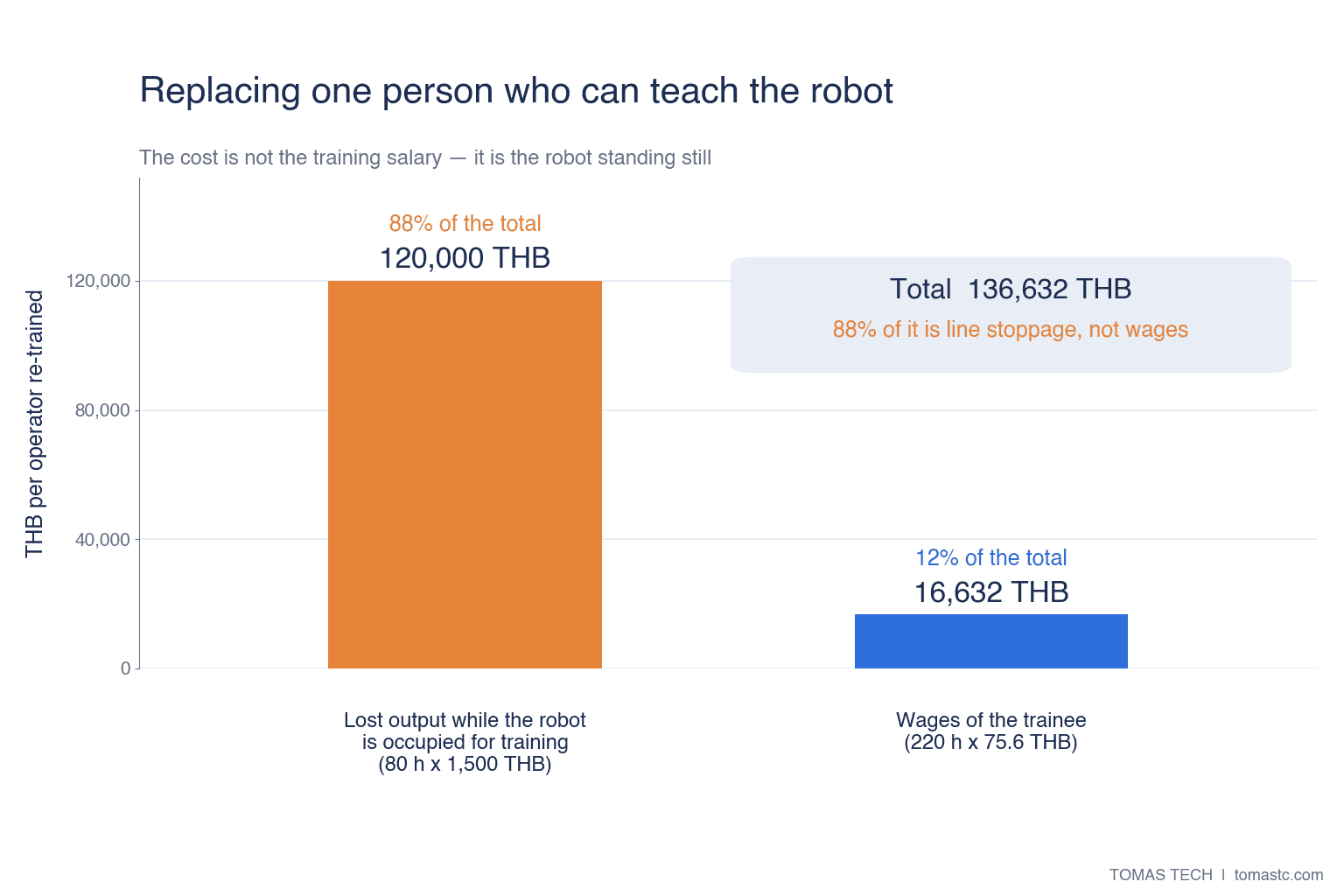
Assume that bringing one person up to being a capable teaching operator from zero requires 20 hours of classroom and hands-on training plus 200 hours of on-the-job training on the real robot, for a total of 220 hours. Of that, assume 80 hours occupy the real robot and stop the line.
- Direct labor cost = 220 x 75.6 = THB 16,632
- Downtime loss = 80 x 1,500 = THB 120,000
- Total = THB 136,632
- Share attributable to line downtime = 120,000 / 136,632 = 0.8783, that is about 88%
About 88% of the retraining cost is not labor, it is the time the real robot is stopped. Those 80 hours are 10 days at 8 hours per day. What looks like a discussion about investing in people is, in substance, a discussion about equipment utilization — the same structure repeating itself.
This has two clear practical implications. First, if the training budget is viewed only through the “training expense” line, you are seeing barely a tenth of the real cost. Second, with an OLP environment or a simulator, most of those 80 hours can be moved off the line. So the OLP investment decision turns not only on the changeover count from the previous chapter, but also on how many people you have to retrain and how often. Note, however, that this training effect is not included in either Scenario A or Scenario B in this article; A and B contain only the cost of N changeovers. To avoid double counting, please read this as a separate reference figure.
Decision rule you can use tomorrow. Do not judge your teaching succession plan by how many people you have. Judge it by how many hours of training you can deliver without occupying the real robot. If the answer is zero, that plant is paying 10 days of lost production every time one person leaves.
Training and Regulation: Japan’s Special Education (Ordinance Article 36, item 31) and How It Is Handled in Thailand
Under Japan’s Ordinance on Industrial Safety and Health, teaching operations for industrial robots fall under Article 36, item 31, and inspection operations fall under item 32, as work requiring special education. The fact that teaching and inspection are split into separate items matters in practice when you build a training curriculum. The underlying notifications are Kihatsu No. 339 (28 June 1983), partially amended by Kihatsu 1224 No. 2 (24 December 2013). Prevention of danger during operation is covered by Article 150-4 of the same Ordinance. These are Japanese domestic regulations, not Thai ones.
The definition of an “industrial robot” is as quoted earlier, but the exclusions need to be understood precisely. Machines whose drive motor has a rated output of 80 W or less are excluded from the definition of an industrial robot. For multi-axis combinations, the machine is excluded if the largest of the individual motors is 80 W or less. Small benchtop machines and some collaborative robots can fall into this category, but this does not mean “80 W or less, therefore safe” in any sense. It only means the machine falls outside the statutory special education requirement; the need for risk assessment is unchanged.
The practical issue in a Thai factory is that this Japanese legislation does not apply directly. Even so, Japanese-affiliated manufacturers commonly bring the Japanese standard with them, for three reasons.
- Head office safety audit standards follow Japanese law. As long as the local subsidiary’s training records are reviewed in head office audits, records aligned with items 31 and 32 are expected.
- The training content is reasonable on its own merits. Entering the working envelope during teaching, the location of emergency stops, the limits of reduced-speed mode — accidents happen the same way regardless of jurisdiction.
- Consistency with the occupational minimum wage. As described above, Thailand has institutionalized “Industrial Robot Controller Level 1” as a skilled occupation. In a country that defines skills through a formal system, internal training also works better when it is documented as “who completed what”.
Safety fencing and guarding design have to be considered together with training. The standards side is covered in “Robot Safety Fence Standards 2026“, which is worth reading before you build the training curriculum.
Decision rule you can use tomorrow. Do not keep training records as just a name and a date. Record separately whether the session covered item 31 (teaching operations) or item 32 (inspection operations), and which item’s content was delivered. This is the most frequent reason records get sent back in head office audits.
Four Forks Where Teaching Breaks Down in a Robot Arm Implementation
Cases that fail to pay back as calculated share a common set of patterns. In every one of them, the outcome is decided not by teaching skill but by the design decisions made upstream.
1. Gripper Selection Was Left Until Later
The gripper (end effector) is the single biggest variable determining how difficult teaching will be. Choose a gripper that cannot settle on a single grasp position on the workpiece and the number of taught points goes up, and so does the fine-tuning. Conversely, a dedicated gripper matched to the workpiece geometry makes teaching simple, but every additional product variant brings a gripper change and its own setup.
Gripper selection should be considered before the robot itself is selected. Reverse the order and you end up absorbing the gripper’s constraints through strained trajectories, and touch-up stops fitting into the assumed 1.0 hour.
2. Variation in Part Supply Was Not Designed In
Parts arranged in a tray, parts arriving from a bowl feeder, and parts in a bin are three completely different teaching problems. If supply is not stable, vision-based position correction becomes necessary, and that is system design territory, not teaching.
The decision is simple: do not try to absorb supply-side variation through teaching. Fixing the supply is almost always cheaper.
3. Part Tolerances Were Never Actually Measured
Drawing tolerances and real lot-to-lot variation are different things. Taught points are created from one reference workpiece, but production runs across every lot. Teach without measuring the tolerances and, once mass production starts, you get the “sometimes it does not grip” phenomenon, and each occurrence means stopping the real robot to fine-tune. That effectively pushes up the assumed changeover count N and undermines the premises of the calculation.
Before teaching, secure at least one physical workpiece at the upper tolerance limit and one at the lower limit. That single step visibly reduces stoppages after mass production begins.
4. Coordinate Systems and Calibration Were Treated Lightly
This is the biggest technical reason offline programming fails to pay back. OLP builds programs on ideal coordinates in a 3D model, while the real robot carries installation error, fixture mounting error, and unit-to-unit variation in the arm. Calibration is what absorbs that gap, and it is why THB 250,000 of the assumed THB 850,000 initial investment is allocated to 3D model preparation and calibration.
Cut this and OLP does not work. With sloppy calibration, touch-up does not finish in 1.0 hour and B’s downtime creeps toward A’s. When that happens the coefficient in N x 3,712.2 – 90,000 shrinks and the break-even of 70 moves to a larger number. The line item you must never cut in an OLP project is calibration, not software.
Decision rule you can use tomorrow. When reviewing an OLP quotation, before negotiating the license discount, ask how many hours are allocated to 3D model preparation and calibration. A quotation that is thin here is not cheap; it will be invoiced later as real-robot downtime.
Robot Implementation for Small and Mid-Sized Manufacturers: Deciding What to Keep In-House
For a smaller manufacturer, the question in a robot project is not “can we do it” but “how much of it do we do ourselves”. And that line, too, is drawn by frequency, not by capability.
Setting the Global and Thai Context
A quick look at where the market sits. According to IFR World Robotics 2025, new installations of industrial robots worldwide reached 542,000 units in 2024 — more than double the level of ten years earlier, and above 500,000 units for the fourth consecutive year. Asia accounts for 74% of new installations, followed by Europe at 16% and the Americas at 9%. Robot density per 10,000 manufacturing employees is 1,012 units in South Korea, 818 in Singapore, 449 in Germany and 446 in Japan. Regional averages are 267 in Western Europe, 204 in North America and 131 in Asia.
Turning to Thailand, the country installed about 3,300 industrial robots in 2022, ranking second in Southeast Asia after Singapore. Incentives in the EEC (Eastern Economic Corridor) are driving demand. Under its robotics industry promotion plan, the government has set a target of attracting THB 200 billion in investment over five years, and the BOI offers a 50% corporate income tax reduction for three years for robotics and automation-related projects. The Southeast Asian market for industrial and service robots is forecast at USD 1.29 billion in 2026.
Read the BOI Incentive Conditions Exactly
For the BOI in 2026, there is also the Smart and Sustainable Industry measure, which is a separate scheme from the three-year 50% tax reduction for robotics and automation mentioned above. The two are easily confused, so their designs have to be understood separately. The latter provides a three-year corporate income tax exemption capped at 50% of qualifying equipment upgrade expenditure. The cap rises to 100% only where specific conditions involving domestically made automation and robotics are met.
Misread that as “any automation investment gets a 100% exemption” and the premises of the whole investment plan go wrong. In terms of the earlier worked example, the way the incentive applies to the THB 850,000 initial investment changes, which moves the payback discussion itself. Always confirm eligibility case by case — the application category, the definition of qualifying equipment, and the determination of domestic manufacture differ from project to project.
Where to Draw the In-House / Outsourced Line
With that background, the principles look like this.
| Scope | Recommendation | Reason |
|---|---|---|
| Day-to-day teaching adjustments | In-house | High frequency; if outsourced, the wait for someone to arrive becomes downtime |
| New cell start-up and system design | Outsource | Low frequency, large loss if it goes wrong; experience with coordinate systems and safety design pays |
| Calibration and 3D model preparation | Outsource the build, bring the procedure in-house | Building it takes specialist skill, but assets go stale if you cannot update them |
| Safety design and risk assessment | Outsource plus internal review | Misreading regulations and standards carries the largest rework cost |
The criterion is consistent: the more frequent the task, the more it belongs in-house; the less frequent it is and the more costly failure would be, the more it belongs outside. It is not “difficult, therefore outsource”. Day-to-day teaching adjustments are not difficult, but outsourcing them is expensive in downtime. Conversely, doing an annual new-cell start-up in-house means paying the learning cost over again every time.
Criteria for selecting a partner are set out in “How to Choose a Robot System Integrator in 2026“. In Thailand in particular, whether shop-floor communication actually works in Japanese, Thai or English translates directly into real downtime.
Decision rule you can use tomorrow. Do not decide “in-house or outsourced” by difficulty. Count how many times that task actually occurred in the past year. Anything above 10 times a year is a candidate for in-house capability; anything at 1 or 2 times a year is a candidate for outsourcing.
Frequently Asked Questions
Q. What is robot teaching?
A. It is the work of teaching a robot arm the positions, postures and speeds of its motions and storing that information in the controller’s memory device. Japanese law defines an industrial robot as “a machine equipped with a manipulator and a memory device, which is capable of automatically performing… motions based on information in the memory device”, and creating the information that goes into that memory device is what teaching is. The methods fall into four broad groups: online, direct, offline programming (OLP), and AI-assisted.
Q. How much does offline programming cost?
A. Under the assumptions used in this article, the initial investment is set at THB 850,000 (software licenses 450,000, 3D model preparation and calibration 250,000, training and start-up 150,000) with annual maintenance of THB 90,000. These are not market survey figures; they are the assumptions needed to make the calculation work. What matters more than the amount is the payback condition: the break-even is 70.04 changeovers a year. If your annual product changeovers fall below roughly 70, it does not pay back within five years.
Q. Is a qualification required for teaching?
A. In Japan, teaching operations on industrial robots fall under the special education requirement of Article 36, item 31 of the Ordinance on Industrial Safety and Health (inspection operations fall under item 32). Machines whose drive motor has a rated output of 80 W or less are excluded from the definition of an industrial robot, and for multi-axis machines the exclusion applies if the largest of the individual motors is 80 W or less. Japan’s Ordinance does not apply directly to a factory in Thailand, but Japanese-affiliated manufacturers commonly deliver equivalent training to match head office safety audit standards.
Q. How many hours does it take to teach an articulated robot?
A. It varies so much with the application that there is no general figure. In this article’s worked example, the online method is assumed to take 3.5 hours per changeover (2.5 hours of teaching plus 1.0 hour of trial running and fine-tuning, with the line stopped throughout), and the OLP method 4.0 hours per changeover (3.0 hours offline plus 1.0 hour of on-robot touch-up, with only 1.0 hour of downtime). What to watch is not the total time but how many of those hours the line is stopped. In total working time, OLP is actually longer.
Q. When should the gripper be selected?
A. Before the robot itself. The gripper’s design determines the number of taught points and the touch-up time, so leaving it until later means absorbing the constraints through strained trajectory design, and downtime then exceeds the assumption.
Q. What is the wage level for people who can do teaching in Thailand?
A. Under the occupational minimum wage established through the National Skill Development Act, “Industrial Robot Controller Level 1” is set at THB 605 per day or more (announced in the Royal Gazette on 20 June 2025, effective 90 days later). Compared with Bangkok’s general minimum wage of THB 400 per day, that is about 1.51 times, a daily gap of THB 205. But as this article’s calculation shows, about 88% of the real cost when someone in that tier leaves is not wages — it is the time the real robot is stopped for retraining.
Q. Will generative AI make teaching unnecessary?
A. Not as of 2026. The intersection of generative AI and industrial robotics is organized into four layers, but only two have reached production scale: (1) generation of code and motion scripts in existing controller languages, and (4) AI-assisted offline programming including natural language teach pendants. Layer (2), operation via VLA foundation models, and layer (3), synthetic training data from generative simulation, remain at the pilot stage. Both (1) and (4) work better the more your existing program assets and 3D models are in order, so the action to take now is not to wait, but to get those assets organized.
Summary
The cost of robot teaching is determined not by the labor hours worked but by the hours the line was stopped while the work was done. Under this article’s assumptions, of the THB 1,575.6 total cost of one hour of teaching with the real robot stopped, labor accounts for only about 4.8%.
That is why the variable separating the methods is neither features nor price, but a single number: the annual product changeover count N. The annual difference is decided by one equation, N x 3,712.2 – 90,000. The five-year break-even is 70 changeovers a year (just under 6 per month), and if you want payback in three years, 101 a year (just over 8 per month). At N = 120, the difference is THB 355,464 a year, payback about 2.4 years, and THB 927,320 over five years. At N = 40, payback takes 14.5 years and over five years OLP actually costs THB 557,560 more. A plant with few changeovers does not recover an OLP investment.
And introducing OLP raises work hours from 420 to 480 and labor cost by THB 4,536 a year. The total still falls, because downtime drops from 420 hours to 120 hours. An approval document that only shows the labor-hours column will not get this investment through.
The structure is the same on the people side. Of the THB 136,632 real cost of retraining one teaching operator, about 88% is the time the real robot is stopped. Thailand has institutionalized “Industrial Robot Controller Level 1” as a wage tier at THB 605 per day, but the substance of what is lost is not the wage gap — it is equipment uptime.
There is one thing to do tomorrow. Work out your cell’s value added per hour X, count last year’s changeovers N, put them into N = 260,000 / (2.5X – 37.8), and check whether you are above the break-even. If you are not, then however good the OLP package is, waiting is the right answer.
How to derive your cell’s hourly rate, and where to pull last year’s changeover count from — those first two steps are where most teams get stuck. At TOMAS TECH, we discuss robot implementation and teaching capability for Japanese-affiliated manufacturers with sites in Thailand from the early consideration stage. “We have not decided whether to invest” or “we would first like to run the numbers for our own plant” is a perfectly good place to start. We can help simply by working through the inputs to the formula above with you, so feel free to get in touch through the contact form.
References
- Nation Thailand: Thailand’s occupational (skill-based) minimum wages
- Nishimura & Asahi: Revision of Thailand’s minimum wage
- PKF Thailand: Bangkok raises minimum wage to 400 baht
- Japan Robot Association (JARA): Special education for industrial robots
- Ministry of Health, Labour and Welfare (Japan): Notifications related to the Ordinance on Industrial Safety and Health
- EVS International: Generative AI and industrial robotics, the four layers (2026)
- IFR: World Robotics 2025 press release
- MIRAI-LAB: Case examples of robot simulation and offline teaching
- Kibo Robo: Complete guide to robot teaching
- Tokyo SME Support Center, Bangkok Office: Thailand’s robotics industry
- Mahanakorn Partners: Thailand’s BOI investment incentives in 2026
- BOI: Investment promotion policy for automation and robotics industries (Japanese)


